[Education] [Emory College] Orr, Gustavus J AM (Professor of Mathematics and Astronomy) A MBiblio.com
650 résultats
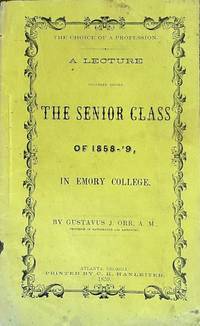
185936176Atlanta: Printed by C. R. Hanleiter 1859. First Edition. Wraps. Good. Stitched wraps. 16 pages. Yellow outer wraps present. A couple of dried spots on the front cover. Moderate toning to the contents. <br /> <br /> Emory College was founded in 1836 in Oxford Georgia. It was named after Methodist bishop John Emory. The main College relocated to Atlanta in the early 1900's and was renamed Emory University. The Oxford Emory College campus is still open today and is part of Emory University. Early Atlanta imprint by C. R. Hanleiter one of the first printers in Atlanta. Printed by C. R. Hanleiter unknown
182026937np 1820. Caption title as issued. 8pp stitched. Light wear untrimmed small hole affects a couple of letters. Good. With the contemporary ownership signature of Wm. B. Stilson.<br /> <br /> Descriptions of the major constellations imprint unknown but certainly the United States. This rare pamphlet leads with Orion followed by the Pleiades Castor & Pollux and moves right along. <br /> Not in Sabin American Imprints Eberstadt Decker. OCLC 28681901 3- AAS NYPL Emory. unknown
1789D16582Boston: B. Edes & Son 1789. First Edition. Hardcover. Good. 12mo. 19thcentury ¾ leather and marbled paper over boards. 16pp. Lacking the folding plate which holds the distinction of being the first chart of the solar system produced in the United States. Nevertheless a book that has become quite scarce on the market. Housed in a custom box with a reproduction of the lacking chart folded and laid in. <br/><br/> B. Edes & Son hardcover
173455790London: Printed for J. Osborn; and S. Birt 1734. 8vo. vi 2 219 1 pp. including publisher’s ads. With 10 folding copper engraved plates. Contemporary dark polished calf red & gilt morocco spine label very faint tidemark at gutter margin of last couple leaves expertly restored at head & foot of spine still a very good fresh copy from the libraries of John Morris and Robert Harland Waterford w/ ownership markings on title and last page of introduction. Second edition revised & expanded of this excellent posthumous work on spherical projection and applications for astronomy by the former assistant to the astronomer John Flamsteed. The first edition was published posthumously in 1714 and then revised and expanded by Hodgson former assistant to Flamsteed for this edition. Witty 1679-1711/12 was employed by Flamsteed from 1705-1706 in order to oversee the computations necessary to prepare Flamsteed’s notorious Historia Coelestis for the press. Flamsteed after the death of Queen Anne in 1714 retrieved 300 of the 400 copies printed and destroyed them with only 60 surviving copies. After leaving Flamsteed when Newton had withheld payment for the massive work Witty became a chaplain for a gentleman in Hampshire was ordained priest in 1708 and became curate at St. Vedast London until his death. Houzeau & Lancaster 9674 1714 ed. Printed for J. Osborn; and S. Birt, unknown
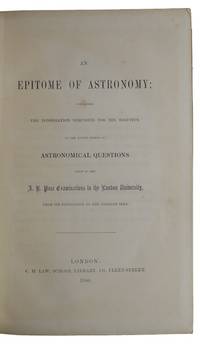
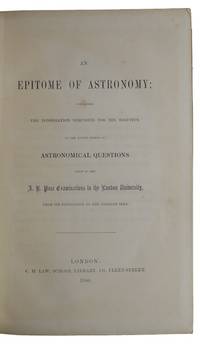
1853TA4<p>8vo. 6 9-58pp complete despite this apparent pagination jump which is found in all copies. With ten lithographed plates lettered A-D and numbered I-VI. Original publisher's blind-stamped blue cloth. Slightly rubbed to extremities offsetting to glassine interleaving else a crisp copy. Inscribed 'To Fred Bone with the donor's best wishes. Percy House Christmas 1864' to FFEP.</p><p>A rare and fabulously illustrated series of answers designed for students of the A.B. Pass examinations in the early years of the London University founded as a secular alternative to Oxford and Cambridge in 1835. The authorship not explicitly stated is inferred from the preface - which is signed Grove School York where the schoolmaster and popular text-book writer John Tabor taught - notes the work is excerpted and extended from 'An Outline of the London University Course of Mathematics containing the Questions Solutions" &c'. Moreover the plates lettered A-D are captioned 'From a Series of Drawings by J. Tabor Grove School York'.</p><p>The thoroughly detailed model answers include significant reference to the planets of our solar system including the then recent discovery of Neptune 'justly considered one of the greatest achievements of mathematical science. Its existence was simultaneously inferred by Adams and Le Verrier from some irregularities which were noticed in the motion of Uranus'.</p><p>COPAC and OCLC together locate copies at just four British institutions BL Cambridge Oxford and NLS and none elsewhere.</p> C.H. Law, School Library. hardcover
1853AQ26197London: C.H. Law School Library 1853. 6 9-58pp complete despite this apparent pagination jump which is found in all copies. With ten lithographed plates lettered A-D and numbered I-VI. Original publisher's blind-stamped blue cloth. Slightly rubbed to extremities offsetting to glassine interleaving else a crisp copy. Inscribed 'To Fred Bone with the donor's best wishes. Percy House Christmas 1864' to FFEP. A rare and fabulously illustrated series of answers designed for students of the A.B. Pass examinations in the early years of the London University founded as a secular alternative to Oxford and Cambridge in 1835. The authorship not explicitly stated is inferred from the preface - which is signed Grove School York where the schoolmaster and popular text-book writer John Tabor taught - notes the work is excerpted and extended from 'An Outline of the London University Course of Mathematics containing the Questions Solutions" &c'. Moreover the plates lettered A-D are captioned 'From a Series of Drawings by J. Tabor Grove School York'. The thoroughly detailed model answers include significant reference to the planets of our solar system including the then recent discovery of Neptune 'justly considered one of the greatest achievements of mathematical science. Its existence was simultaneously inferred by Adams and Le Verrier from some irregularities which were noticed in the motion of Uranus'. COPAC and OCLC together locate copies at just four British institutions BL Cambridge Oxford and NLS and none elsewhere. . First edition. 8vo. C.H. Law, School Library hardcover
181155122London: Printed for J. Johnson and co. St. Paul’s Churchyard 1811. 8vo. viii 384 pp. Copper-engraved frontisp. 19 copper-engraved plates most folding. Black half-calf over marbled boards gilt lettering on spine rebacked minor wear to corners rubbing occasional light foxing still VG copy from the library of Charles Douglas Halford 1793-1865 attended Cambridge and finished MA by 1826 East Bergholt Suffolk squire. Sixth revised & expanded edition of Bonnycastle’s 1751-1821 informative work astronomy and astronomical instruments. His astronomy textbook first issued in 1786 was designed for students without a mathematical background and proved so popular it continued to be used until the 1820s. Printed for J. Johnson and co., St. Paul’s Churchyard, hardcover
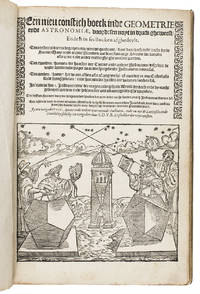
1608ABC_47602Colophon: Rees 1608. Folio 30 x 19.5 cm. Abraham Wijlicx Contemporary vellum sewn on four supports laced through the joints. With a half-page woodcut illustration and some decorations built up from typographic ornaments on the title page 74 woodcuts of various sizes in text many near full- and half-page with some woodcut decorated initials various series a headpiece built up from typographic ornaments and an ornamental woodcut tailpiece. 111 1 pp. A very rare early seventeenth-century Dutch book on astronomy compiling the knowledge of the German astronomer mathematician and cartographer Peter Apian 1495-1552. A great work on cosmography astronomy perspective and many related subjects. The book is subdivided into six parts highlighting the scales and course of planets the principles of the zodiac signs and their correct identification the calculation of heights and distances as well as the instruments used for calculation and measurement. All of this rendered in readable explanations and numerous clarifying woodcut illustrations. The book showcases marvelous woodcut illustrations of volvelles which are rotating parts of a paper construction known as a wheel chart used to illustrate the position and movement of celestial bodies. Volvelles are recognized as early versions of paper analogue computers and have been utilised in various fields for organization and calculation. The origins of volvelles can be traced back to astronomy books as well as certain Arabic treatises on humoral medicine and the Persian astronomer Abu Rayhan Biruni circa 1000 who played a significant role in their development. Throughout the book the author compiled images taken from Apians influential works. It is unclear who compiled this work as the title page states only the initials S.D.V.B. The work later found its way into the German language in an Ingolstadt edition from 1533 titles Instrument buch here clearly putting the emphasis on the tools rather than the calculations and practical astronomy.With the bookplate of Buijnsters-Smets on the front paste-down. The base of the spine is slightly damaged the boards are slightly dust-soiled internally very slightly browned and foxed throughout. Light damage to spine and book block slighty detached at bottom some browning and foxing. The first and last few leaves are slightly water stained. Otherwise in good condition.l Bierens de Haan 94; Hoogendoorn BSo1; Houzeau/ Lancaster 2909; STCN 86331306X 7 copies; USTC 1035104 6 copies; Van Ortroy Apian 114; WorldCat 65713062 10 copies. ABE CAT Astronomy & Cosmography hardcover
181155844Philadelphia: Published by Kimber and Conrad No. 93 Market Street T.& G. Palmer printers 1811. 8vo. 4 242 pp. Numerous text diagrams and engravings 1 large folding copper-engraved plate at rear for the appendix. Contemporary speckled tree calf gilt ruling on spine red & gilt morocco spine label slight bumping rubbing to corners minor shelfwear very light occasional toning still VG bright copy. First American edition stated of the author’s informative work on astronomy including sections on determining longitude and latitude the discoveries of Kepler the Transits of Venus and Mercury as well as being the first introduction to the American market of the observations by Nevil Maskelyne on the Great Trigonometrical Survey reprinted in this volume. This copy includes the very scarce folding plate often lacking. Vince 1749-1821 was a mathematician astronomer and clergyman at the Univ. of Cambridge awarded the Copley Medal in 1780. Published by Kimber and Conrad, No. 93, Market Street, T.& G. Palmer, printers, unknown
192034817Albany New York: Leander McCormick Observatory University of Virginia 1920. Reprint. Wraps. Good. Green printed stapled wraps. Approx. 11.75" x 10". 8 pages. Folded in the middle. Light creases and toning to the covers. Inscribed and signed by the author on the front cover. <br /> <br /> From wikipedia: Samuel Alfred Mitchell April 29 1874 – February 22 1960 was a Canadian-American astronomer who studied solar eclipses and set up a program to use photographic techniques to determine the distance to stars at McCormick Observatory where he served as the director. Leander McCormick Observatory, University of Virginia unknown
196663677Boston: Houghton Mifflin Co. 1966. 4to. 160 pp. Illustrated title in blue & black illustrated throughout with blue & black text illustrations star maps. Pictorial blue publisher’s cloth cover art illustrations in yellow slight shelfwear w/ d.j. w/ d.j. cover art by Rey which unfolds into a wall-sized sky chart measuring 22 x 26 in. on verso illustrated on recto & verso when folded price-clipped couple minor closed tears minor shelfwear slight bumping to couple corners still NF/VG copy w/ former ownership marking on title. Revised & expanded edition in order to depict constellations and sky charts as far south as Australia and New Zealand of this revolutionary practical star guide first published in a smaller format in 1952. The clear readable text many text illustrations and diagrams and the author’s humor all make the mechanics of star gazing much easier for the beginner astronomer. Houghton Mifflin Co., hardcover
1856D16855Boston: Little Brown and Company 1856. First Edition. Paperback. Good. 8vo. Original tan printed wrappers; rear wrapper detached. 50pp. First Edition. Inscribed by the author to John Pendleton Kennedy American writer and friend of E. A. Poe. Everett was a U.S. Senator and a great orator. It was his address on the field of Gettysburg that preceded the most famous address in U.S. history by Lincoln. In the present oration Everett discusses Charles Babbages newly developed Calculating Engine wherein he mentions asking Babbage if the device could ever be made small enough to one day to fit in ones own pocket. <br/><br/> Little, Brown and Company paperback
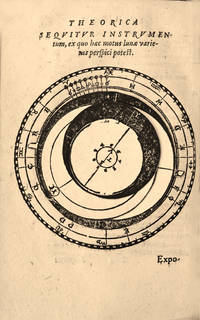
ABAACali8<p>Witebergae Wittenberg Haeredes Johannis Cratonis 1580.</p><p>In-12 of 8 ll. 247 ll. decorated with numerous figures of which 2 with movable parts and 3 folding plates out of text.</p><p>Green vellum with small overlaps gilt filets around the covers fleur-de-lys at the corners coat of arms stamped in gold in the center flat spines traces of silk lakes. <em>Contemporary binding</em></p><p>153 x 83 mm.</p><p><strong>Rare edition of this astronomical work in which the scientific revolution will have its roots.</strong></p><p>"The <em>Theoricæ novæ planetarum</em> of Georg Peurbach 1423-1461 played a decisive role in the beginnings of the scientific revolution.</p><p>A considerable part of the work shows that the representation of the celestial universe elaborated by Peurbach contains an unprecedented innovation and allows to affirm that one century before Copernicus Peurbach had already completed his own astronomical revolution. Astronomy now changes its status: from being an abstract mathematical science it is about to become a science of celestial reality where mathematics assumes a new role. It becomes the foundation of a universe conceived as physically existing. The critical edition of the <em>Theoricæ novæ planetarum</em> accompanied by its French translation as well as a technical commentary allows the reader to measure in a well-founded way the innovative scope of the universe conceived by Peurbach.</p><p>The study of the diffusion of the <em>Theoricæ novæ planetarum</em> from 1454 to 1653 shows how Peurbach's universe aroused the interest of his contemporaries who immediately grasped its innovative scope. This gave life to a real movement of thought which extended for two centuries and influenced the astronomical thought of learned Europe. The result is that on the <em>Theoricæ novæ planetarum</em> a pre-Copernican astronomy was born and established endowed with its own identity and with characteristics that distinguish it from that of the past. In this pre-Copernican astronomy the scientific revolution has its roots". <em>Theoricæ novæ planetarum Georgii Peurbachii In the history of astronomy</em> Michela Malpangotto research director at the CNRS.</p><p><br /><strong>The work is decorated with 82 woodcuts in the text including three folded and two with movable parts.</strong></p><p><strong>A precious copy preserved in its contemporary green vellum with unidentified German arms.</strong></p><p><strong>FR</strong></p><p>Witebergae Wittenberg Haeredes Johannis Cratonis 1580.</p><p>In-12 de 8 ff. 247 ff. ornés de nombreuses figures dont 2 avec des parties mobiles et 3 planches dépliantes hors texte.</p><p>Vélin vert à petits recouvrements filets et fine roulette dentelée dorés encadrant les plats fleur de lys aux angles armoiries frappée or au centre dos lisse orné traces de lacs de soie. <em>Reliure de l'époque</em>.</p><p>153 x 83 mm.</p><p><strong>Rare édition de cet ouvrage d'astronomie dans lequel la révolution scientifique va plonger ses racines.</strong></p><p>" Aux <em>Theoricæ novæ planetarum</em> de Georg Peurbach 1423-1461 revient un rôle décisif dans les commencements de la révolution scientifique.</p><p>Une partie considérable du travail montre que la représentation de l'univers céleste élaborée par Peurbach comporte une innovation sans précédent et permet d'affirmer qu'un siècle avant Copernic Peurbach avait déjà achevé sa propre révolution astronomique. L'astronomie change désormais de statut : de science abstraitement mathématique elle s'apprête à devenir science de la réalité céleste où les mathématiques assument un rôle nouveau. Elles deviennent le fondement d'un univers conçu comme physiquement existant. L'édition critique des <em>Theoricæ novæ planetarum</em> accompagnée de sa traduction française ainsi que d'un commentaire technique permet au lecteur de mesurer de manière fondée la portée novatrice de l'univers conçu par Peurbach.</p><p>L'étude de la diffusion des <em>Theoricæ novæ planetarum</em> de 1454 à 1653 montre la façon dont l'univers de Peurbach a éveillé l'intérêt de ses contemporains qui en ont immédiatement saisi la portée novatrice. Ceci a donné vie à un véritable mouvement de pensée qui s'étend pendant deux siècles et influence la pensée astronomique de l'Europe savante. Il résulte ainsi que sur les <em>Theoricæ novæ planetarum</em> s'est engendrée et assise une astronomie pré-copernicienne dotée d'une identité propre et de caractères qui la distinguent de celle du passé. Dans cette astronomie pré-copernicienne la révolution scientifique plonge ses racines ". <em>Theoricæ novæ planetarum Georgii Peurbachii Dans l'histoire de l'astronomie</em> Michela Malpangotto directrice de recherche au CNRS.</p><p><strong>L'ouvrage est orné de 82 figures sur bois dans le texte dont trois repliées et deux à parties mobiles.</strong></p><p><strong>Précieux exemplaire conservé dans son vélin vert de l'époque aux armes allemandes non identifiées.</strong></p> hardcover
1958056362New Haven: Dover Publications 1958. First Edition Thus . Soft cover. Very Good . Photographs Throughout. Xiv 207 Pp. Glossy Soft Cover Early Reprint New Introduction By Allan Sandage Price $1.50 Light Usage And Wear. Name Stamp Of Aeronautical Engineer Lois M. Webb. <br/> <br/> Dover Publications paperback
187197507New Haven: Printed by Tuttle Morehouse & Taylor 1871. 1871. Good. THE FIRST APPEARANCE OF THE ESSAY "ON JUPITER AND ITS SATELLITES" BY THE FIRST FEMALE ASTRONOMER IN THE U.S.A. - Octavo 8-1/2 inches high by 5-3/8 inches wide. The contemporary brown calf and marbled boards are detached but present and the spine has perished and is thus lacking. The text block is intact and tight. 978 pages in all with the pagination as follows: Volume I: pages i-viii & 1-484; and Volume II: pages i-viii & 1-480. Pages 327/328 are skipped in numbering as published which collates with the copy at the Peter H. Raven Library at the Missouri Botanical Garden. The volume is illustrated with 3 plates including one folding as well as several textual illustrations. Although the title page to the second volume indicates the presence of a map intended to illustrate E.W. Hilgard's article "On the Geological History of the Gulf of Mexico" page 391 the map is not here present if it ever was included. The endpapers are foxed and there is some light soiling to the title page of the first volume. The edges of the first few leaves are lightly darkened with a tiny spot of dampstaining to the top edge of those leaves. A very good tight copy which would be well worth rebinding. <p>Most noteworthy is the first publication of Maria Mitchell's essay "On Jupiter and its Satellites" illustrated with a plate volume I pages 393-395.<p>The first American scientist to discover a comet Maria Mitchell 1818-1889 was the first female astronomer in the United States. Working as the librarian of the Nantuckett Atheneum Maria Mitchell read through the day and spent her nights with her father at the observatory he built atop the Pacific Bank. Her discovery in 1847 of the comet which came to be named "Miss Mitchell's Comet" brought her international acclaim. She was awarded a gold medal by King Frederick of Denmark and elected as the first woman to join the American Academy of Arts and Sciences the following year. Mitchell traveled throughout Europe after leaving the Atheneum in 1856 meeting with astronomers the world over. She became involved and active in the anti-slavery movement and the suffrage movement and was subsequently instrumental in the formation of the American Association for the Advancement of Women. After the Civil War Mitchell was recruited to join the faculty at Vassar College where with a 12 inch telescope then the third largest in the US she specialized in studying the surfaces of Jupiter and Saturn. She made waves by encouraging her female students to come out at night for classes and celestial observations and brought in noted feminists including Julia Ward Howe to speak on political issues. Continuously championing the advancement of women she gave an important speech entitled "The Need for Women in Science" during the 1876 centennial. Mitchell was one of only 3 women to be elected to the Hall of Fame of Great Americans in 1905. She was also inducted into the National Woman's Hall of Fame in Seneca Falls New York. A lunar crater on the moon was named in her honor.<p>Also worth noting is Professor L. Respighi's essay "On the Solar Protuberances" illustrated with a folding plate volume I pages 283-287.<p>The Italian astronomer Lorenzo Respighi 1824-1889 was appointed appointed professor of mechanics and hydraulics at the University of Bologna. In that context his first works were mathematical and included a well-known memoir on the principles of differential calculus. Captivated by astronomy he succeeded Calandrelli as director of the astronomical observatory at the University of Bologna in 1855. After making observations on comets Respighi became director of the Campidoglio observatory in Rome where he devoted his attention to studying solar phenomena. His studies of the spectra of sunspots were particularly important as he observed the splitting of the absorption lines later described by Hale as the result of the Zeeman effect.<p>Henry James Clark's essay "The American Spongilla a Craspedote Flagellate Infusorian" illustrated with a plate is here published on pages 426 through 436 of volume II.<p>The American naturalist Henry James Clark 1826-1873 was a pupil of Asa Gray at the Cambridge botanical garden. He became an assistant to Louis Agassiz after graduating from Harvard and was professor of Zoology and of Natural History at numerous colleges and universities. From 1872 until his death in 1873 Clark was Professor of Veterinary Science at the Massachusetts Agricultural College in Amherst Massachusetts. He contributed to a number of periodicals and authored "Mind in Nature" 1863 and "Mode of Development of Animals" 1865. New Haven: Printed by Tuttle, Morehouse & Taylor, 1871. hardcover
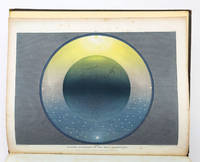
1846ST19286London: Printed by Catchpool & Trent for Simpkin Marshall & Co 1846. FIRST EDITION. 320 x 255 mm. 12 1/2 x 10". xiii 3 96 pp. <br/> Publisher's original blind-decorated dun-colored cloth gilt titling to upper cover smooth spine newer endpapers. WITH 11 COLOR ENGRAVINGS after Frost by W. P. Chubb & Son printed in oil colors by George Baxter all with original tissue guards. Front free endpaper with small ink signature of John Hill. See: Francis Reid "Isaac Frost's 'Two Systems of Astronomy' 1846: Plebeian Resistance and Scriptural Astronomy" in "The British Journal for the History of Science" Vol. 38 No. 2 Jun. 2005 pp. 161-177. Cloth rather spotted corners bumped but the binding solid with no wear to joints or hinges. A few spots of foxing to title page half of the tissue guards with overall very faint foxing/browning the illustrations with minor foxing at edges and in margins but the images themselves clean and bright and all in all a really excellent copy the text wide-margined and quite clean and fresh and the plates with rich coloring.<br/> <br/> Illustrated with beautiful color plates this anti-Newtonian work promotes a view of the universe based on the backward-looking beliefs professed by a Protestant sect known as the Muggletonians. Named after co-founder Lodowicke Muggleton the Muggletonians emerged in London in 1651 based on the claims of two tailors who professed to be the "Last Witnesses" described in the Book of Revelation. Rejecting the new directions in philosophical reason Muggletonians believed in a purely scriptural interpretation of the universe. According to E. P. Thompson's 1994 "Witness Against the Beast" the Muggletonians had curious notions quite contrary to other Protestant denominations: they believed that the soul is mortal that Jesus and God are one and the same that Heaven was left without divine supervision from Jesus' death until the day of judgment that Heaven resides six miles above the Earth that God stands between five and six feet tall and other unconventional things. Although the sect initially avoided both worship and evangelizing during the 19th century some followers became more outspoken about their beliefs and even published books appealing to the general public. Our author Isaac Frost 1793-1858 was a prominent Muggletonian and successful owner of a brass foundry who along with his brother Joseph invested large sums to promote their belief system--the present work being an especially notable example. Divided into two main sections the text first describes the Newtonian system of heliocentric astronomy and then turns to Frost's scriptural interpretation and geocentric views. As Reid tells us "According to Frost Scripture clearly states that the Sun the Moon and the Stars are embedded in a firmament made of congealed water and revolve around the Earth that Heaven has a physical reality above and beyond the stars and that the planets and the Moon do not reflect the Sun's rays but are themselves independent sources of light. Our book was apparently written as a reaction against the lecturers who expressed Newtonian astronomy--which was often for them and their audiences simply shorthand for heliocentrism." The 11 plates that illustrate these extraordinary ideas are the work of George Baxter a pioneering printer who revolutionized color printing techniques by combining metal engravings with woodblock printing using oil-based inks to produce high-quality affordable prints. The plates here are appropriately ethereal and otherworldly utilizing a beautiful palette with subtle gradations and esoteric figures to create memorable pseudo-scientific imagery. Although this work appears at auction with some regularity it is almost always incomplete no doubt because the attractiveness of its plates encourages harvesting. Useful price comparisons include a complete copy said to be in fine condition selling for £7500 in 2016 and six loose prints from the book fetching £6875 in 2015. [Printed by Catchpool & Trent for] Simpkin, Marshall, & Co unknown
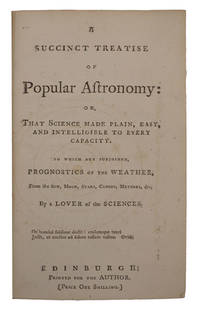
17806577Edinburgh: Printed for the Author 1780. 12mo pp. 48 frontispiece. Extracted from a volume. Slightly spotted. A rare educational pamphlet published at the height of the Enlightenment of scientific discovery and philosophic discourse and pre-dating planetary discoveries including Uranus 1781. As such it only examines the Sun Mercury Venus Earth the Moon Jupiter and Saturn amongst other astronomical features like comets the weather stars and the Copernican System after refuting the Ptolemaic and Tychonian Systems. The frontispiece depicts the Copernican solar system. ESTC locates copies in Aberdeen NLS and BL only with Worldcat adding one more in Stanford. ESTC T70937. Printed for the Author unknown
a88534Coimbra 1936-1945. Seven matching volumes large 4tos pale pink printed wraps with circular photo picture of observatory on covers. Many mounted circular photo illustrations - mostly on solar phenomena -and foldout charts and diagrams. About 200 pages per issue. Text in Portuguese. Very Scarce. Internally VG to Near Fine; covers are Good worn and frayed with some light chipping on spines. Set of seven volumes: . paperback
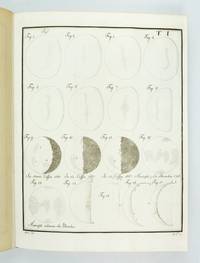
1796ST20813Helmstedt: Printed and commissioned by C. G. Fleckeisen 1796. FIRST EDITION. 275 x 225 mm. 10 3/4 x 9". XVI 250 2 pp. <br/> Contemporary brown paste paper boards smooth spine with red roan label. WITH 10 ENGRAVED PLATES one folding by "G. T." after Schröter. Honeyman 2825; de la Lande p. 635; Poggendorff II 846; cf. DSB XII p. 226 NDB XXIII 590 Schröter and 510 Schrader. See also Sheehan and Baum "Observations and inference: Johann Hieronymous Schroeter 1745-1816" Journal of the British Astronomical Association vol.105 no.4 p.171-175. Joints and extremities somewhat rubbed boards with a hint of chafing occasional very minor foxing including to the final plate half a dozen leaves with faint dampstain to head edge but a really excellent copy the other plates clean and bright the text especially clean and fresh and the binding entirely sound.<br/> <br/> This is a very rarely seen early work on the topography of Venus written by the astronomer who first observed the planet's so-called phase anomaly and illustrated with 10 folding plates. One of a series of "fragments" Schröter published--the others concerning the sun the moon Saturn and Mercury--"Aphroditographische Fragmente" discusses the author's observations of Venus' surface at the same time coining the term "Aphroditographie" in reference to the Greek version of the goddess' name. The most important observation contained in our work concerns the phases of Venus: like the moon Venus appears to wax and wane when observed through a telescope. However due to the thickness of its atmosphere the planet will always appear less full than mathematical calculations indicate it should be. This phenomenon known as Venus' phase anomaly--or the Schröter Effect--first observed by the man who gave it its name in 1793 is discussed in detail in this text which is accompanied by highly detailed plates. Eight of these are focused on Venus primarily depicting its phases; another is a diagram of the telescope; and the other depicts the Orion Nebula to which there is a short addendum. Schröter 1745-1816 built a state-of-the-art observatory at Lilienthal in Lower Saxony equipped with the largest telescopes available at the time. One such instrument which he built in his own workshop was an impressive 27-foot telescope discussed in the present work which has sometimes been incorrectly credited to Schröter's colleague William Herschel 1738-1822. Schröter made systematic long-term observations of the surfaces of the moon and planets something DSB tells us he was the first to do. Not everything he discovered or asserted turned out to be true. Based on his findings he posited the existence of a mountain range on Venus' surface and suggested a rotation period for the planet. Both subsequently were disproven modern scientists have suggested that Schröter's "mountain" may have been an overly optimistic observation of a cloud formation but like the rest of his work they demonstrated the commitment to observational astronomy that leads astronomy historians William Sheehan and Richard Baum to call Schröter "the man who laid the foundations of planetology and modern selenography." His long and impressive astronomical career came to an unfortunate end in 1813 when during the Napoleonic invasion the French reportedly set fire to his observatory. His library instruments unpublished notes and copies of many of his works which were published in small runs at his expense were said to have been destroyed in the fire a fact that may partly explain the current rarity of our book. We have been able to trace at auction only an ex-library copy of the book with significant condition problems that sold in 1981 for a hammer price of £260; the fact that such an unattractive copy came from the distinguished Honeyman collection reinforces how difficult the work is to obtain. Printed and commissioned by C. G. Fleckeisen unknown
1589354109Heidelberg: in Officina Sanctandreana H. Commelin 1589. Title with woodcut vignette 48 woodcut illustrations. Pp. 2 1-170; 1-302 2 First part in Greek and Latin second in Latin. 1 vols. 8vo. Old vellum spine titled in ink. Note on flyleaf in an early hand "cum notii MSS. Alb. Jac. Conradi" heavily annotated in the second part pages 1-156. Paper flaw with loss of page number at L6 p. 167/8. Very good. Title with woodcut vignette 48 woodcut illustrations. Pp. 2 1-170; 1-302 2 First part in Greek and Latin second in Latin. 1 vols. 8vo. Works by Proclus Aratus and Leontius Mechanicus in Greek with parallel Latin text; works by Aratus Cicero Avienus Germanicus Caesar and Hyginus in Latin. STC German 367 not in VD 16; Adams A-2076; Brunet I 533; Houzeau & Lancaster Bibliographie générale de l'astronomie 782; Schweiger I 353; Zinner 3356 in Officina Sanctandreana (H. Commelin?) unknown
a79979Paris 1908 Gauthier Villars. first edition. In French. Hardcover. Sm.4to. 511pp. greygreen cloth. VG light wear. . hardcover
186325702Salem 1863. 1 vols. approximately 3/4 x 1 1/2 inches. The signature tipped in with about 20 other clipped signatures one with initials into the inside wrapper and first and second pages of "Dancing as a Social Amusement. By Professed Christians or their Children" New York: Published by the American Tract Society ca. 1860 Some creasing of signature slips. Pamphlet in original printed wrappers some fraying and creasing text loose discreet pencilled library markings else very good. 1 vols. approximately 3/4 x 1 1/2 inches. Albert Stowell Flint 1853-1923the noted astronomer. Flint born in Salem Mass. a Harvard and M.I.T. graduate was best known for his work on the meridian circle on the paralaxes of stars also his contributions to the reobservation of the secondary stars in Auwer's catalogue and his participation in the determination of the latitude of the Princeton Observatory. In 1881 he was a computer in the Naval Observatory in Washington. He was the author of "Meridian Observations for Stellar Parallax."¶ The other signatures many names of old Salem families are of Augusta Arrington C. H. Hodgdon William Proctor J. McCallum Henry M. Batchelder George Dow Charles W. Winn E. S. Merrill H. Reeves George N. Dow C. Wilson W. B. Winn Albert W. Edgerly Caroline Weeks Edward W. Flint H. E. Lewis Harriet M. Tyler Nathaniel M. Brown John Henry Ropes and the initials "E. H. F." Two of the signatures bear the date March 1863 and one reads Salem Mass. Old Salem Families. <br/><br/> unknown
a852791905. 4to. pp. 187-229 with 3 plates mostly of photo image of Eros removed from Annals of Harvard College Observatory and rebound in later wraps. VG. . unknown
189676030Kiel: Druck von S. Schsidt 1896. First offprint edition. Quarto. 140-47 1 pp. Publisher's printed gray wrappers. Old Crease through the middle cause short seperations at spine and fore-edge old tide mark to upper margin. Russell made measurements at Sydney for many years. Henry Chamberlain Russell Russell was an astronomer meteorologist and one of the most eminent men of science in Australia in the nineteenth century. Upon leaving the University at the end of 1859 he was appointed assistant to the Government Astronomer. He became the Government Astronomer in 1870 and subsequently held the position for 35 years. Druck von S. Schsidt unknown
elala2369cFrance: c1800. 2 parts in 1. 8vo. ff. 90. vellum over paste-board worn tears in vellum several gatherings sprung [cFrance: c1800?] hardcover