1 576 résultats
1881R320072817LIBRAIRIE DE LA BIBLIOTHEQUE NATIONALE. 1881. In-16. Broché. Etat d'usage, Couv. convenable, Coiffe en tête abîmée, Intérieur frais. 187 PAGES - nombreuses figures en noir et blanc dans le texte - Petite dechirure en 2e plat.. . . . Classification Dewey : 520-Astronomie et sciences connexes
1879R320072818LIBRAIRIE DE LA BIBLIOTHEQUE NATIONALE. 1879. In-16. Broché. Etat d'usage, Couv. défraîchie, Dos satisfaisant, Quelques rousseurs. 128 PAGES - nombreuses figures en noir et blanc dans le texte . Rousseurs sans conséquence réelle sur la lecture - . . . . Classification Dewey : 520-Astronomie et sciences connexes
187197507New Haven: Printed by Tuttle Morehouse & Taylor 1871. 1871. Good. THE FIRST APPEARANCE OF THE ESSAY "ON JUPITER AND ITS SATELLITES" BY THE FIRST FEMALE ASTRONOMER IN THE U.S.A. - Octavo 8-1/2 inches high by 5-3/8 inches wide. The contemporary brown calf and marbled boards are detached but present and the spine has perished and is thus lacking. The text block is intact and tight. 978 pages in all with the pagination as follows: Volume I: pages i-viii & 1-484; and Volume II: pages i-viii & 1-480. Pages 327/328 are skipped in numbering as published which collates with the copy at the Peter H. Raven Library at the Missouri Botanical Garden. The volume is illustrated with 3 plates including one folding as well as several textual illustrations. Although the title page to the second volume indicates the presence of a map intended to illustrate E.W. Hilgard's article "On the Geological History of the Gulf of Mexico" page 391 the map is not here present if it ever was included. The endpapers are foxed and there is some light soiling to the title page of the first volume. The edges of the first few leaves are lightly darkened with a tiny spot of dampstaining to the top edge of those leaves. A very good tight copy which would be well worth rebinding. <p>Most noteworthy is the first publication of Maria Mitchell's essay "On Jupiter and its Satellites" illustrated with a plate volume I pages 393-395.<p>The first American scientist to discover a comet Maria Mitchell 1818-1889 was the first female astronomer in the United States. Working as the librarian of the Nantuckett Atheneum Maria Mitchell read through the day and spent her nights with her father at the observatory he built atop the Pacific Bank. Her discovery in 1847 of the comet which came to be named "Miss Mitchell's Comet" brought her international acclaim. She was awarded a gold medal by King Frederick of Denmark and elected as the first woman to join the American Academy of Arts and Sciences the following year. Mitchell traveled throughout Europe after leaving the Atheneum in 1856 meeting with astronomers the world over. She became involved and active in the anti-slavery movement and the suffrage movement and was subsequently instrumental in the formation of the American Association for the Advancement of Women. After the Civil War Mitchell was recruited to join the faculty at Vassar College where with a 12 inch telescope then the third largest in the US she specialized in studying the surfaces of Jupiter and Saturn. She made waves by encouraging her female students to come out at night for classes and celestial observations and brought in noted feminists including Julia Ward Howe to speak on political issues. Continuously championing the advancement of women she gave an important speech entitled "The Need for Women in Science" during the 1876 centennial. Mitchell was one of only 3 women to be elected to the Hall of Fame of Great Americans in 1905. She was also inducted into the National Woman's Hall of Fame in Seneca Falls New York. A lunar crater on the moon was named in her honor.<p>Also worth noting is Professor L. Respighi's essay "On the Solar Protuberances" illustrated with a folding plate volume I pages 283-287.<p>The Italian astronomer Lorenzo Respighi 1824-1889 was appointed appointed professor of mechanics and hydraulics at the University of Bologna. In that context his first works were mathematical and included a well-known memoir on the principles of differential calculus. Captivated by astronomy he succeeded Calandrelli as director of the astronomical observatory at the University of Bologna in 1855. After making observations on comets Respighi became director of the Campidoglio observatory in Rome where he devoted his attention to studying solar phenomena. His studies of the spectra of sunspots were particularly important as he observed the splitting of the absorption lines later described by Hale as the result of the Zeeman effect.<p>Henry James Clark's essay "The American Spongilla a Craspedote Flagellate Infusorian" illustrated with a plate is here published on pages 426 through 436 of volume II.<p>The American naturalist Henry James Clark 1826-1873 was a pupil of Asa Gray at the Cambridge botanical garden. He became an assistant to Louis Agassiz after graduating from Harvard and was professor of Zoology and of Natural History at numerous colleges and universities. From 1872 until his death in 1873 Clark was Professor of Veterinary Science at the Massachusetts Agricultural College in Amherst Massachusetts. He contributed to a number of periodicals and authored "Mind in Nature" 1863 and "Mode of Development of Animals" 1865. New Haven: Printed by Tuttle, Morehouse & Taylor, 1871. hardcover
1875R320011158MASSON. 1875. In-12. Broché. Etat d'usage, Tâchée, Dos abîmé, Quelques rousseurs. 194 pages illustrées de nombreux dessins et croquis en noir et blanc.. . . . Classification Dewey : 520-Astronomie et sciences connexes
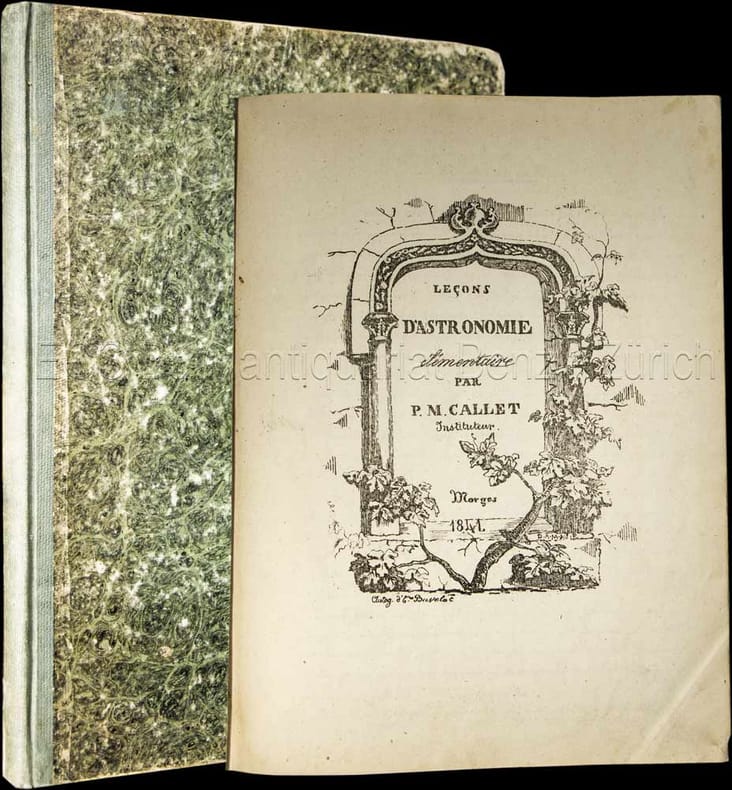
18414235CBMorges, 1841. Kl.-4°. VIII, 119 S. (gedruckte Handschrift). Halbleinenband der Zeit.
18414235CBMorges, 1841. Kl.-4°. VIII, 119 S. (gedruckte Handschrift). Halbleinenband der Zeit. + Wichtig: Für unsere Kunden in der EU erfolgt der Versand alle 14 Tage verzollt ab Deutschland / Postbank-Konto in Deutschland vorhanden +, Abb.
1871307475ABBraunschweig, Vieweg, 1871. 8°. XIX, 524 S., 2 Bl. Mit vielen Ill. und graph. Darst. Original-Halbleder. 18. Auflage. (Einband berieben u. bestoßen, Name a. Vors., sonst gut). = Das Buch der Natur, die Lehren der Physik, Astronomie, Chemie, Mineralogie, Geologie, Botanik, Zoologie und Physiolog
185844404Göttingen, 25. I. u. 27. XII. 1858. Zus. 5 S., Gr.-8°.
1830163097Berlin, Dümmler / Königl. Akademie der Wissenschaften, 1830. 1. Aufl. 500 S. (ca.) Folio, Halbleinenband neuerer Zeit. 1858.
1883011242Braunschweig, Friedrich Vieweg und Sohn, 1883. 2 Blatt, 46 Tafeln. Halblederband der Zeit. Der Rücken berieben und das Vordergelenk oben ca. 6 cm aufgeplatzt. Die Tafeln stockfleckig und zwei mit größerem Einriß, sonst insgesamt jedoch ordentliches Exemplar.
182793744Altona, Hammerich & Heineking, 1827. [1] Bl., 20 S. Gr.-8vo, 24 x 20,5 cm. Bedruckte graublaue Orig.-Broschur, unbeschnitten.
184739274London, George Barclay, 1847. Contemporary half cloth. Sm. 8vo. 16 pp. Library stamps on titlepage.
1895163299Washington, 1895. 4°. M. 1 Taf. LXVI, 420 S. Lwd. Rücken angerissen. Einbd. berieben. Ecken teils bestossen. St. u. Sign. a. Vors. St. a. Tit. (Washington observations for 1890. Appendix 1).
1895163105Washington, Government Printing Office, 1895. 1. ed. 1 Plate, LXVI, 420 p. 4°, original cloth binding.
1870163064Washington, Government Printing Office, 1870. 1. ed. 73 p. 4°, contemporary half-cloth binding.
1898164353London, Her Majesty`s Stationary Office / Darling & Son, 1898. 1. ed. XLIII, 263 p. 4°, contemporary cloth binding.
1835163177London, Royal Astronomical Society, 1835. 1st ed. 82 p. 4°, half-cloth of later times.
1838163192London, Murray, 1838. 1st ed. XXXIV, 130 p. 4°, modern half-cloth.
1898163013London, Taylor & Francis, 1898. 1. ed. XI, 43 S. Gr.-8°, contemporary half-cloth binding.
18342130413Carter Hendee & Co 1834. Reissue. Hard Cover. Fair/No Jacket. Light stain to bottom half of boards & pages does not affect legibility edges rubbed with 1 inch chip from spine head front free endpaper removed lightly foxed throughout. 1834 Hard Cover. viii 184 pp. 12mo. Leather spine printed paper over boards. Eight fold-out plates follow text depicting various aspects of the solar system planets the moon patterns of orbit stars constellations etc. A guide to basic astronomy for the use of students. Includes an introductory sketch of the history of ancient astronomy a glossary of astronomical terms and chapters on: the solar system; causes of the planetary motion; prospect of the heavens as seen from different parts of the solar system; comets; equation of time; the harvest moon; the tides; eclipses; divisions of time; obliquity; parallax; the fixed stars; refraction; twilight; latitude and longitude; meteors; artificial globes. Index precedes text. Though numerous copies were found in institutional holdings appears to be somewhat uncommon in the trade - at the time our copy was cataloged only 2 records of sale at auction in the last fifty years and only 2 other copies offered for sale. Carter, Hendee & Co hardcover books
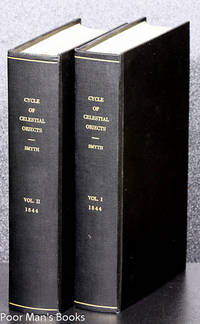
184433052London: John W. Parker. Very Good with no dust jacket. 1844. First English Edition. Hardcover. B&W Illustrations; 8vo 8" - 9" tall; viiii45164pp. ads; xx560 pages; Numerous text illustrations. Half-titles; publisher's 4-page catalogue at end of Volume 2. 2 volumes. 8vo modern gilt-lettered black cloth; old institutional stamps on titles. First edition of a classic guide to amateur astronomy. The first volume is a general introduction to the subject; the second known as the Bedford Catalogue records 850 objects seen from the author's private observatory at Bedford. A career naval officer Smyth 1788-1865 devoted his attention to astronomy from 1830 onward. One of his sons was Charles Piazzi Smyth 1819-1900 astronomer royal for Scotland. BEA page 1070. Illustrated with a large number of textural engravings and drawings. . John W. Parker hardcover
182026937np 1820. Caption title as issued. 8pp stitched. Light wear untrimmed small hole affects a couple of letters. Good. With the contemporary ownership signature of Wm. B. Stilson.<br /> <br /> Descriptions of the major constellations imprint unknown but certainly the United States. This rare pamphlet leads with Orion followed by the Pleiades Castor & Pollux and moves right along. <br /> Not in Sabin American Imprints Eberstadt Decker. OCLC 28681901 3- AAS NYPL Emory. unknown
182026937np 1820. Caption title as issued. 8pp stitched. Light wear untrimmed small hole affects a couple of letters. Good. With the contemporary ownership signature of Wm. B. Stilson.<br/><br/> Descriptions of the major constellations imprint unknown but certainly the United States. This rare pamphlet leads with Orion followed by the Pleiades Castor & Pollux and moves right along. <br/>Not in Sabin American Imprints Eberstadt Decker. OCLC 28681901 3- AAS NYPL Emory. unknown books
1829c1952London: Longman Rees Orme Brown & Green. G: in Good condition without dust jacket. Cover rubbed. Some foxing. 1829. 5th Edition. Brown hardback half-leather cover with marbled boards. 170mm x 110mm 7" x 4". 341pp plates. 4 b/w plates vignettes. . Longman, Rees, Orme Brown, & Green hardcover
1844PHO-3572 VOLUMES EDITION ORIGINALE