Vose JohnABAA
29 résultats
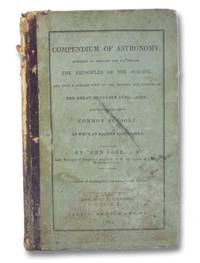
18342130413Carter Hendee & Co 1834. Reissue. Hard Cover. Fair/No Jacket. Light stain to bottom half of boards & pages does not affect legibility edges rubbed with 1 inch chip from spine head front free endpaper removed lightly foxed throughout. 1834 Hard Cover. viii 184 pp. 12mo. Leather spine printed paper over boards. Eight fold-out plates follow text depicting various aspects of the solar system planets the moon patterns of orbit stars constellations etc. A guide to basic astronomy for the use of students. Includes an introductory sketch of the history of ancient astronomy a glossary of astronomical terms and chapters on: the solar system; causes of the planetary motion; prospect of the heavens as seen from different parts of the solar system; comets; equation of time; the harvest moon; the tides; eclipses; divisions of time; obliquity; parallax; the fixed stars; refraction; twilight; latitude and longitude; meteors; artificial globes. Index precedes text. Though numerous copies were found in institutional holdings appears to be somewhat uncommon in the trade - at the time our copy was cataloged only 2 records of sale at auction in the last fifty years and only 2 other copies offered for sale. Carter, Hendee & Co hardcover books
182026937np 1820. Caption title as issued. 8pp stitched. Light wear untrimmed small hole affects a couple of letters. Good. With the contemporary ownership signature of Wm. B. Stilson.<br/><br/> Descriptions of the major constellations imprint unknown but certainly the United States. This rare pamphlet leads with Orion followed by the Pleiades Castor & Pollux and moves right along. <br/>Not in Sabin American Imprints Eberstadt Decker. OCLC 28681901 3- AAS NYPL Emory. unknown books
1789D16582Boston: B. Edes & Son 1789. First Edition. Hardcover. Good. 12mo. 19thcentury ¾ leather and marbled paper over boards. 16pp. Lacking the folding plate which holds the distinction of being the first chart of the solar system produced in the United States. Nevertheless a book that has become quite scarce on the market. Housed in a custom box with a reproduction of the lacking chart folded and laid in. <br/><br/> B. Edes & Son hardcover books
199838700NY:: Plenum Trade. Fine in Fine dust jacket. 1998. Hardcover. 0306457954 . First printing. Fine in a fine dust jacket. . Plenum Trade, hardcover books
200322550NY: Viking. Near Fine in Fine dust jacket. 2003. Hardcover. 0670031798 . First printing. Remainder mark on bottom edge else fine in a fine dust jacket. . Viking hardcover books
198624976NY: Cambridge University Press. Fine in Fine dust jacket. 1986. Hardcover. 0521253918 . Illustrated. A later printing. Fine in a fine dust jacket. . Cambridge University Press hardcover books
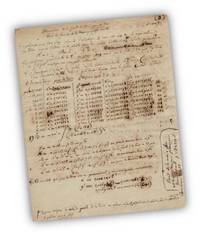
13574Johann Karl Burckhardt 1773-1825 German-born astronomer and mathematician. Burckhardt carried out extensive studies on the orbits of comets and his study of a comet of 1770 now known as Lexell's Comet or D/1770 L1 cemented his professional reputation. This comet is known for passing closer to earth than any other comet in recorded history when it reached only 0.0146 AU from Earth on July 1 1770. Offered here is a 4 page handwritten manuscript of his calculations for that comet of 1770 dated December 1804. Written in French. Burckhardt completed his research in 1807 finding that the comet had an elliptical orbit with a period of 5.57 years. Burckhardt has titled the Manuscript in his hand "Pull of the Comet of 1770 by the Earth from the Formula of the Spatial Mechanics Volume 4." <br/><br/>A small sampling of Burckhardt's extensive calculations and proofs in this manuscript includes the following: <br/><br/>"1 I would take for a constant plane that of the eleptic and for the x axis the vertical radius of Earth. At the moment of the entry of the comet in the field of gravity F; so we will have A1 = 0; B1 = 0; C1 = 0.<br/>2 We will take a day as the limit of t. We will see later on if we could use a smaller interval. <br/>3 I will suppose the point of entry in the field of activity at 273567 this is based on an observation of Mr. Messier The duration of 8 days with the exit on the 5th of July 0.5567. <br/>4 We will therefore have for the Earth Z1 always equal to zero.<br/>6 One sees for the earth generally with great exactitude x=0.000142t2 y=. For the gravitational center of earth.<br/>7 For the Comete one employs the.elements of observation made after the perihelic part of the passage.<br/>N.B. I have neglected to express the precession of the equinoxes.and that the observation requires the movement of a contoured lens."<br/><br/>Burckhardt proceeds to provide detailed calculations of the comets approach and recession from June 27 to July 6 taking extra care to mark the day of its closest approach to earth--July 1.<br/><br/>The comet of 1770 never reappeared and is today considered a "lost comet" but it presented a fascination to astronomers for years afterward. Lexell for whom the comet is named initially calculated the orbit at around 5 and a half years. But the fact that a comet with so short a period had never been previously recorded and that it did not reappear in 1776 threw doubt on Lexell's calculations and induced the Institute of France to establish a prize for whomever could determine its orbit. Burckhardt became the winner when he was able to show through his calculations that the comet's had come within the sphere of Jupiter's attraction in 1767 which swung it into its close 1770 orbit. It did not reappear in 1776 because it was directly in line with the sun rendering it invisible. And why had it never reappeared since Burckhardt determined that in 1779 it had come again within the orbit of Jupiter and from there had been flung off into distant space. He thereby confirmed Lexell's initial calculation and provided a scientific explanation for the comet's very strange activity. Journal of the Franklin Institute Thomas P. Jones M.D. ed. pg. 319-320. Thompson & Homans: Washington D.C. 1832.<br/><br/>Burckhardt's tracing of the orbit of the comet of 1770 cemented his reputation in the scientific community. Today he is remembered in particular for his work in fundamental astronomy and for his lunar theory which was in widespread use for the construction of navigational ephemerides of the Moon for much of the first half of the nineteenth century and for his studies on the orbits of comets. In 1812 he published an improved lunar theory after that of Pierre-Simon Laplace. Burckhardt's lunar tables appear to have been the first to be based on a least squares adjustment of the coefficients to selected lunar observations of which about 4000 were used. They were officially used for computing the lunar ephemerides in the Nautical Almanac from 1821 to 1861. unknown books
2001D16577Bernardston: Martino 2001. Hardcover. Fine. Large quarto. Green cloth with black spine label lettered in gilt. pp. 499. Clean copy. <br/><br/> Martino hardcover books
1988105092<p>4to cloth with slipcase illustrated 335 pp. Spine somewhat faded contents crisp and bright; very good plus to near fine. The San Diego library of rare books on astronomy began with the collection of Dr. Ernst Zinner which the university purchased in 1967. While the Zinner collection exceeded over 5000 items the university added to their library over the next couple of decades. In his introduction to the collection Owen Gingerich points out that in addition to classics by Copernicus Galileo and Kepler the library also includes Tycho Brahe's illustrated Mechanica Flamsteed's Atlas Corlestis and Burges' A Short Account of the Solar System. </p> books
1890BL3894Berlin:: Mayer & Muller 1890. 1890. Tall 8vo. 158 1 pp. 10 plates. Original black cloth-backed printed boards. Penciled ownership name. Near fine. First printing not a reprint!. Contents: Das Konigliche astrophysikalische Observatorium bei Potsdam von J.S. i.e. Julius Scheiner 1858-1913--Das Konigliche meteorologische Institut in Berlin und dessen Observatorium bei Potsdam Johann Friedrich Wilhelm von Bezold 1837-1907--Das Konigliche geodatische Institut von Friedrich Robert Helmert 1843-1917. Mayer & Muller, 1890. hardcover books
199525874NY: Cambridge University Press. Near Fine in Near Fine dust jacket. 1995. Hardcover. 0521444926 . Second edition. Black dot on front free endpaper else near fine in a fine dust jacket. . Cambridge University Press hardcover books
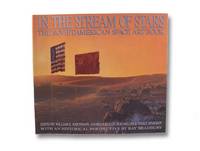
19901854987Workman Publishing New York 1990. 1st Printing. Large Softcover. Near Fine. First printing. Publisher's remainder mark on bottom edge. Otherwise bright copy. 1990 Large Softcover. 183 pp. The first book to bring together rarely seen soviet and American space art. Features essays by Alan Bean Alexei Leonov and others plus introductory essay by Ray Bradbury and over 200 full-color reproductions. Workman Publishing, New York paperback books
1959S2587Stanford;: Stanford University Press 1959. 1959. 8vo. xii 612 pp. Numerous figs. and diagrams index. Cloth dust-jacket; jacket edges worn spine faded. Blind-stamp ownership mark of John P. Capone; stamp of Everett H. Hurlburt. An early work studying current work on radio astronomy. Treats moon reflections radio emissions from Jupiter radio stars etc. Stanford University Press, 1959. hardcover books
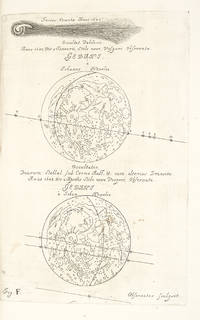
16853340Danzig:: Sumptibus auctoris typis D.F. Rhetii 1685. SOLE EDITION. Folio:. 34.8 x 22.5 cm. 6 lvs. 24 196 pp. Collation: 6 4 4 4 A-Z4 AA6. With engraved title page vignette and 7 1 double-page engraved plates. Bound in 18th c. half calf and marbled boards with very slight wear. Spine with citron morocco label gilt. A nice copy with a few early marginal paper repairs no loss. The final two leaves of the table with repaired tears the second of these with a small natural paper flaw costing a few letters. Complete with the seven plates engraved by Hevelius himself. "Annus Climactericus" was the last of Hevelius' works published in the author's lifetime. The book comprises observations of the planets sun moon and fixed stars many of which were made alongside the English astronomer Edmond Halley. The observations were made from 8 January until 25 September 1679 subsequent to the publication of the second volume of Hevelius' "Machina Coelestis" almost the entire press run of which was lost in the fire that destroyed Hevelius' observatory on 26 September 1679. Hevelius also included new observations of the binary star Omicron Ceti which Hevelius had been observing for 25 years and which he had named "Mira" and grappled with the problem of its changing size and color. In addition the book includes Hevelius' observations of the Great Comet of 1680 illustrated by a magnificent double-page plate engraved by Hevelius the total lunar eclipse of February 1682 the comet of 1682 the solar eclipse of July 1684 each also accompanied by a plate "Observator Sculpsit." observations of several Great Conjunctions etc.There are also numerous letters to and from members of the Royal Society of England: Henry Oldenburg John Wallis John Flamsteed Nehemiah Grew and Halley as well as several European astronomers among them Ismaël Boulliau. The letters deal primarily with Hevelius' feud with Robert Hooke over the merits of the use of telescopic sights for celestial observation vide infra.The "Climactic Year" to which the title of the book refers is 1679 the year in which Hevelius published his "Machinae Coelestis pars Posterior" which comprised 49 years worth of Hevelius' celestial observations; and the year in which his observatory burned to the ground. In the introduction Hevelius gives his own account of the fire that consumed not only the observatory building itself but also Hevelius' instruments "tam astronomicis quam opticis" his library his printing press and print making workshop and the irreplaceable stock of his self-published works. He also describes the psychological and emotional toll that the fire took on him and thanks God that at last his spirit "in cineribus hactenus fere supultum" was revived by the arrival of the Great Comet of 1680 and that he was able to make new observations.Hevelius Hooke and Halley: The Controversy over Open-Sight Instruments vs. Telescopic ObservationThe "Annus Climactericus" is of great importance in the history of science marking as it does the climax of a contentious debate between Hevelius who argued that his "open-sighted" instruments employing fore- and near-sights but no lenses or cross-hairs were more accurate than those fitted with telescopic sights micrometers with telescopic lenses and cross-hairs and Robert Hooke who argued against that position.Hooke and Hevelius had been arguing politely over the relative merits of both kinds of instruments since the 1660s but matters came to a head in 1673 with the publication of Hevelius' "Machinae Coelestis Pars Prior" in which Hevelius forcefully enumerated the limitations of telescopic sights and Hooke's critique of the book in which he wrote that readings taken with Hevelius' instruments could not be more accurate than ½ minute of arc. Moreover he mocked Hevelius' instruments which Hooke asserted were no better than the antiquated ones used by Tycho almost a century earlier his observations and methods. Moreover he asserted that Hevelius was not only providing the scientific community with incorrect data but was impeding scientific progress itself.Hevelius responded with a letter to Henry Oldenburg in which he asserted that his observations were in fact accurate to within 5 seconds of arc that he had never seen data that proved Hooke's assertions and that he resented Hooke's ad hominem attacks. Inevitably the astronomer John Flamsteed was drawn into the controversy and though he had great respect for Hevelius and voiced his disapproval of Hooke's attacks felt compelled to note some of the errors in Hevelius' observations. Hevelius responded and the two men carried on a correspondence in which they argued over the data and during which Hevelius leveled charges of jealousy against Flamsteed and voiced his conviction that Flamsteed and Hooke were now conspiring against him. Fortunately the rift was eventually healed. Part of the correspondence is included in the "Annus Climactericus".1679: A Comparative Test:The arrival at Danzig of Edmond Halley who brought with him his portable 2 –foot quadrant fitted with telescopic sights presented an opportunity to compare results obtained with both types of instruments. The two men made observations side-by-side from 26 May to 18 July 1679 using Halley's instrument and Hevelius' own quadrant "with which he made regular observations of the Sun the large sextant for angular distances between stars planets and the limbs of the Moon and his 12-foot telescope for occultations." Hevelius' wife Elizabeth Hevelius' personal printer and two other observers also participated.Before Halley left Danzig he wrote at Hevelius' request what amounted to a testimonial to the accuracy of Hevelius' open-sighted instruments. Halley wrote that he could testify "to the certainty of the instruments against all who would cast doubt on Hevelius' observations. He had seen with his own eyes that not just occasional observations but many by different observers with the large sextant agreed incredibly well together and any discrepancies were very small which he greatly admired."Cook p. 100In the introduction to the "Annus Climactericus" Hevelius excoriated Hooke and boasted that his calculations demolished Hooke's assertions of the inferiority of Hevelius' methods. The book was reviewed in the Philosophical Transactions of September-October 1685 by Hooke's antagonist John Wallis who censured Hooke for his behavior toward Hevelius and took pains to rehearse each of Hevelius' criticism of Hooke and to summarize the 27 letters of support that Hevelius printed in the "Annus". Hooke responded to Hevelius in February 1686 in an effort to vindicate himself and Hevelius in turn wrote that he would publish his long-awaited star catalog "Uranographia" to furnish proof of the superiority of his methods but Hevelius' death the following year put an end to the dispute.Postscript: Hevelius and HalleyHevelius printed Halley's positive assessment of the Danzig astronomer's instruments and calculations in the "Annus Climactericus" p. 101-102 and thereby drew Halley into the controversy with Hooke. Moreover Hevelius misrepresented the reason for Halley's visit stating that he had invited Halley to Danzig the visit was Halley's own idea that he had asked him to bring the telescopic quadrant which Halley had actually brought with him to make observations of the southern constellations on St. Helena and that Halley came to Danzig as an official representative of the Royal Society of which Halley was not yet a member.This all irritated Halley who in order to extricate himself from the Hevelius-Hooke controversy downplayed his original estimation of the accuracy of Hevelius' calculations. Halley also realized that while attesting to the accuracy of Hevelius' instruments he seemed to side with Hevelius against Hooke whose belief in the superiority of telescopic sights was in fact Halley's own.While he never attacked Hevelius he put it forth that his earlier enthusiasm had been in part motivated by a desire to placate a "peevish old man." In the end there was a poetic resolution to the tension between the two men: When Elizabeth Hevelius had her husband's star catalogue printed in 1690 three years after Hevelius' death She included Halley's own catalogue of the stars of the southern hemisphere which was based on Halley's observations made on St. Helena with the 2-ft quadrant just before his visit to Hevelius in 1679. VD17 39:125045B; DSB 6 363; Honeyman 1675. For a thorough discussion of the Hevelius-Hooke controversy see Saridakis "Converging Elements in the Development of Late Seventeenth-Century Disciplinary Astronomy: Instrumentation Education and the Hevelius-Hooke Controversy" p. 129 ff.; For an assessment of the relative accuracy of Halley's and Hevelius' computations at Danzig see Cook "Edmond Halley: Charting the Heavens and the Seas" p. 93 ff.; For Hevelius' work on the binary star Mira Ceti see Hatch "Hevelius- History and Identity" in "Change and Continuity in Early Modern Cosmology" p 158 ff.; For D. Capellus' contemporary account of the fire and a detailed inventory of Hevelius' losses see MacPike "Hevelius Flamsteed Halley" Appendix I. London 1937 Sumptibus auctoris, typis D.F. Rhetii, books
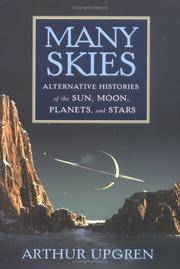
200538479New Brunswick:: Rutgers University Press. Near Fine in Fine dust jacket. 2005. Hardcover. 0813535123 . First edition. Small spot of soiling on fore edge else fine in a fine dust jacket. . Rutgers University Press, hardcover books
1913D16570Boston: Little Brown and Company 1913. First Edition. Hardcover. Very Good. 8vo; pp 192 2 pages ads. Illustrated with plates and a frontispiece. Publisher's red cloth stamped with gilt depiction of Mars lettered in black spine lettering and t.e.g. Inscribed by the author and also separately by his wife. <br/><br/> Little, Brown and Company hardcover books
1871830281871. PERIODICALS - ASTRONOMY. MEMOIRS OF THE ROYAL ASTRONOMICAL SOCIETY PART I VOL. XXXIX 1870-1871: ON THE GRAPHICAL CONSTRUCTION OF A SOLAR ECLIPSE BY PROF. ARTHUR CAYLEY. London: Published by the Society 1871. 17 pp. 1 two-color plate a diagram. 4to. text side-sewn within printed paper wrappers. Wrappers are age-toned and split along spine with a Small pencil initial to top of front wrapper. Text and plate clean and fresh. Very good. unknown books
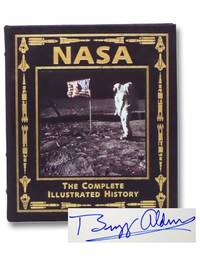
20052274856Merrell / The Easton Press 2005. Full-Leather. Fine/No Jacket. Signed by author. Signed by Buzz Aldrin on front flyleaf with certificate of authenticity and blank publisher's bookplate laid in. A couple tiny imperfections to page ridges otherwise an excellent copy. 2005 Full-Leather. 304 pp. Original full black leather gilt titles and decorations photographic plate mounted on front board all edges gilt silk moire endpapers ribbon marker bound in. Merrell / The Easton Press hardcover books
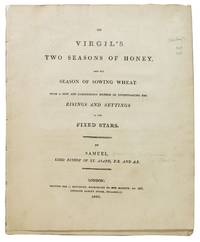
180547484London: Printed for J. Hatchard Bookseller to Her Majesty 1805. 1st Edition. Disbound now housed in an archival mylar sleeve. Age-toning Very Good. 4 40 pp. Two folding copperplate engravings. 4to. 9-3/4" x 8" <br/><br/> Printed for J. Hatchard, Bookseller to Her Majesty unknown books
1931D16575Berkeley: University of California Press 1931. Hardcover. Near Fine. Folio; black cloth lettered in gilt; pp. 482. A nice clean copy aside from small ownership signature of astronomer D. K. Yeomans. Part 1 Solar Atmosphere. Part II Halley's Comet. <br/><br/> University of California Press hardcover books
1908S2472Teddington:: Parrott & Ashfield 1908. 1908. 261 x 194 mm. 8vo. 45 pp. Tables. Printed wrappers. Ex library spine label. Very good. Parrott & Ashfield, 1908. unknown books
1910S2473Teddington:: W. R. Parrott 1910. 1910. 262 x 195 mm. 8vo. 62 pp. Tables. Printed wrappers. Ex library rubber stamps on top cover. Very good. W. R. Parrott, 1910. unknown books
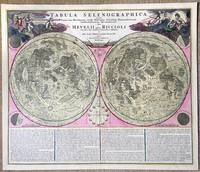
17428423<p><b>TABULA SELENOGRAPHICA IN QUA LUNARIUM MACULARUM EXACTA DESCRIPTIO SECUNDUM NOMENCLATURAM PRAESTANTISSIMORUM ASTRONOMORUM TAM HEVELIIi QUAM RICCIOLI</b></p><p>Original copperplate engraving from J.G.Doppelmayr's <b><i>Atlas Coelestis </i></b>published in Nuremberg by Homann in the early 1700s. Image is about 19x22 ½ inches. Each hemisphere is approximately 11 inches 28 cm in diameter. The condition of this sheet is extremely fine. Full bright original hand color very good wide margins. The plate is a bit large for the atlas size and often the lower margin is trimmed. There are a few minute wormholes in the margin not affecting the platemark or image. This is one of the nicer copies we have had. There is no letterpress text on verso.</p><p>This is a famous double-moon map. The left hemisphere shows the Moon's surface with the features named by Hevelius the astronomer who constructed the first Moon atlas. On the right is the nomenclature of Riccioli a Jesuit anti-Copernican. Riccioli's nomenclature prevailed and is still in use today.</p> Homann books
18112222177<p>Fifth edition. 16mo. Frontispiece pictorial title page with secondary title "The Ruins or A Surrey of the Revolutions of Empires." Later full gilt stamped green leather. Folding map; folding astrological chart at end. Very good. 232 pages.</p><p>Printed by Plummer and Brewis Love-Lane Little Eastcheap.</p><p>Bookplate of poet and critic Vivian De Sola Pinto 1895-1969.</p> Printed for Thomas Tegg hardcover books
18561620Albany: Charles van Benthuysens Print 1856. First Edition. Engraved Portrait after a photograph by Mathew Brady. 1 vols. 8vo. Later 3/4 brown morocco over marbled boards spine gilt with raised bands bound by Stikeman. Extremities slightly rubbed; a Very Good copy. First Edition. Engraved Portrait after a photograph by Mathew Brady. 1 vols. 8vo. NO COPY LOCATED IN NUC. In addition to the "Discourse" by Everett this book issued in honor of the dedication of the Dudley Observatory at Albany contains various speeches and a long poem dedicated to the American Association for the Advancement of Science by Alfred B. Street. The speeches include a eulogy by Washington Hunt and remarks by A. B. Gould Benjamin Pierce and A.D. Bache. The Observatory had not as yet been built when this book was published. This was simply it seems a celebration of sorts given in honor of the donors of funds to build it. Mr. Dudley's widow to whom the discourse is dedicated was the most generous of donors pledging the then enormous sum of $12000. Although other editions of the "Discourse" with condensations of the events appear in NUC there seems to be no copy of this edition located. Charles van Benthuysens Print unknown books