650 résultats
173455790London: Printed for J. Osborn; and S. Birt 1734. 8vo. vi 2 219 1 pp. including publisher’s ads. With 10 folding copper engraved plates. Contemporary dark polished calf red & gilt morocco spine label very faint tidemark at gutter margin of last couple leaves expertly restored at head & foot of spine still a very good fresh copy from the libraries of John Morris and Robert Harland Waterford w/ ownership markings on title and last page of introduction. Second edition revised & expanded of this excellent posthumous work on spherical projection and applications for astronomy by the former assistant to the astronomer John Flamsteed. The first edition was published posthumously in 1714 and then revised and expanded by Hodgson former assistant to Flamsteed for this edition. Witty 1679-1711/12 was employed by Flamsteed from 1705-1706 in order to oversee the computations necessary to prepare Flamsteed’s notorious Historia Coelestis for the press. Flamsteed after the death of Queen Anne in 1714 retrieved 300 of the 400 copies printed and destroyed them with only 60 surviving copies. After leaving Flamsteed when Newton had withheld payment for the massive work Witty became a chaplain for a gentleman in Hampshire was ordained priest in 1708 and became curate at St. Vedast London until his death. Houzeau & Lancaster 9674 1714 ed. Printed for J. Osborn; and S. Birt, unknown
1810d1090bLondon: Dudley Adams. G : in Good condition without dust jacket. Cover rubbed scuffed and stained. Heavy marginal staining in early pages. Some foxing. Marginal staining to some plates. 1810. 30th Edition. Brown hardback half-leather cover with marbled boards. 210mm x 130mm 8" x 5". xxiv 242pp. 14 b/w plates some folding. . Dudley Adams hardcover
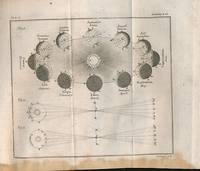
1843j1944dLondon: N H Cotes. G: in good condition without dust jacket. Cover rubbed and marked. Bowing to boards. Splitting to outer hinges. Inner hinge cracking. Staining to paste-downs and eps. Occasional thumbing and marking. Loss to rear ep. 1843. Second Edition. Green hardback cloth cover. 180mm x 110mm 7" x 4". viii 172pp. B/w in-text illustrations. . N H Cotes hardcover
184915373Albany and Cincinnatti: Erastus H. Pease & Co. And Jacob Ernst. Good. 1849. First Edition. Hardcover. Brown leather cover with black panel on spine gilt lettering. Leather is scuffed primarily near edges and cracked at joints. Spine scuffed and has loss of about 1/4 inch at head and tail of spine. Binding sound. Endpapers and several adjoining leaves heavily foxed around edges due to acid in leather. Pages lightly tanned. No marks in text. ; 8vo 8" - 9" tall; 228 pages . Erastus H. Pease & Co. And Jacob Ernst hardcover
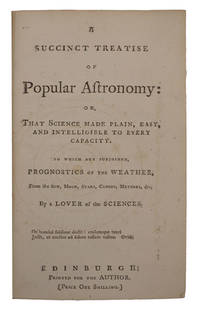
17806577Edinburgh: Printed for the Author 1780. 12mo pp. 48 frontispiece. Extracted from a volume. Slightly spotted. A rare educational pamphlet published at the height of the Enlightenment of scientific discovery and philosophic discourse and pre-dating planetary discoveries including Uranus 1781. As such it only examines the Sun Mercury Venus Earth the Moon Jupiter and Saturn amongst other astronomical features like comets the weather stars and the Copernican System after refuting the Ptolemaic and Tychonian Systems. The frontispiece depicts the Copernican solar system. ESTC locates copies in Aberdeen NLS and BL only with Worldcat adding one more in Stanford. ESTC T70937. Printed for the Author unknown
1964AS-39New York: Viking Press 1964. Classic text presents a survey of the Sun's solar spectrum the solar surface atmosphere and its corona the firey interior surface. Includes an analysis of stellar energy at different stages in a star's lifespan; comparison of the Sun to other stars; origins of stellar families; etc. 208 pp. Numerous illustrations. Inscribed by "George" on front endpaper and notations by him that he removed the opposing endpaper inscription not signed. From the personal library of a close friend and colleague of Gamow. Decorative endpapers. Very minor rubbing to dustjacket edges; in mylar. Gilt spine. . . First Edition. Hard Cover. Very Good/Very Good. 8vo - over 7¾" - 9¾" tall. Viking Press Hardcover
1789D16582Boston: B. Edes & Son 1789. First Edition. Hardcover. Good. 12mo. 19thcentury ¾ leather and marbled paper over boards. 16pp. Lacking the folding plate which holds the distinction of being the first chart of the solar system produced in the United States. Nevertheless a book that has become quite scarce on the market. Housed in a custom box with a reproduction of the lacking chart folded and laid in. <br/><br/> B. Edes & Son hardcover
1981033876Pasadena: National Aeronautics And Space Administration / Jet Propulsion Laboratory 1981. 1st Edition 1st Printing. Soft cover. Fine. Preprint Fine No Wear Ownership Signature Of Newburn. Later Published As Esa Sp-174 Comet Hallery Dual And Gas Environments Workshop 1982 <br/> <br/> National Aeronautics And Space Administration / Jet Propulsion Laboratory paperback
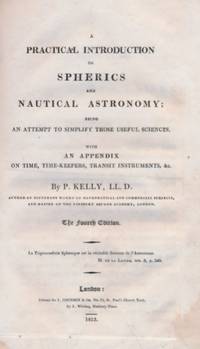
18130678aLondon: J Johnson. G : in Good condition without dust jacket. Cover rubbed with 1" split at top of front hinge. Occasional light foxing. 1813. Fourth Edition. Brown hardback leather cover. 240mm x 150mm 9" x 6". pp. 232 xvi plates. 20 b/w plates - 8 fold-out. Dedicated to Nevil Maskelyne. Includes a section on time. . J Johnson hardcover
1991biblio619Cambridge: Cambridge University Press 1991. Fine. <p>4to xxiv 240p ill B&W blue cloth under DJ small tear</p> Cambridge University Press hardcover
1836j3149bLondon: Sherwood & Co. Worn condition. Front board detached. Frontis plate torn and ragged. Closed tear to plate xiii. Content in overall good condition. 1836. New Edition. Green hardback leather cover. 160mm x 110mm 6" x 4". 287pp. 34 b/w plates some fold-out. . Sherwood & Co hardcover
0282250409.Gpaperback. Good. Access codes and supplements are not guaranteed with used items. May be an ex-library book. paperback
1999Q-0395934311Houghton Mifflin Harcourt 1999-11-23. Paperback. New. In shrink wrap. Looks like an interesting title! Houghton Mifflin Harcourt paperback
1961053228Oxford / London: Pergamon Press / Agard Conference On Low Noise Electronics 1961. First Separate Edition . Soft cover. Fine. Dd-1 To Dd-10. Offprint Stapled. Fine. <br/> <br/> Pergamon Press / Agard Conference On Low Noise Electronics paperback
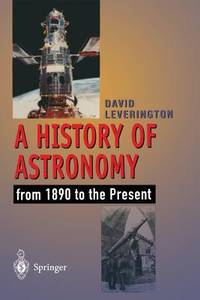
1995AS-11Berlin-Heidelberg: Springer-Verlag 1995. Scholarly text presents a detailed history of the progress of astronomy from a time when Newtonian physics reigned supreme photography was in its infancy and radio astronomy was decades in the future. Paradoxically the theories of Einstein Planck and Heisenberg along with modern radio X-ray and space-borne telescopes mean that the cosmos seems to hold more mysteries today than it did a hundred years ago. 390 pgs. Illustrated. First Edition. Original Wraps. As New/ . 8vo - over 7¾" - 9¾" tall. Springer-Verlag Paperback
1334032998.Gpaperback. Good. Access codes and supplements are not guaranteed with used items. May be an ex-library book. paperback
1829c1952London: Longman Rees Orme Brown & Green. G: in Good condition without dust jacket. Cover rubbed. Some foxing. 1829. 5th Edition. Brown hardback half-leather cover with marbled boards. 170mm x 110mm 7" x 4". 341pp plates. 4 b/w plates vignettes. . Longman, Rees, Orme Brown, & Green hardcover
1952007458Columbia N.J. : Privately Published. 1952. A solid copy of this rare item. INSCRIBED: "To the Frankford Arsenal library With the complements sic of the author signed W. M. Stempel." Inner hinges are perfectly sound. WITHDRAWN stamp and a few other library markings. Text pages are clean. No underlining. No highlighting. No margin notes. Bound in the original dark blue cloth lettered in shiny gold on the front cover. A preliminary version of this book appears to have been published as A DIFFERENTIAL ADJUSTMENT METHOD OF REFINING OPTICAL SYSTEMS in Journal of the Optical Society of America JOSA Vol. 38 Issue 11 pp. 935-953 November 1948. Born 1881 in Ft. Madison Lee County Iowa to Prussian immigrants the author went on to become an optical designer and Professor of Physics at the Stevens Institute of Technology Hoboken New Jersey. . INSCRIBED / SIGNED by the AUTHOR. First Edition so stated. Hardcover. Very Good EX-LIBRARY./No Jacket. 8vo. vi 99pp. Privately Published. Hardcover
182026937np 1820. Caption title as issued. 8pp stitched. Light wear untrimmed small hole affects a couple of letters. Good. With the contemporary ownership signature of Wm. B. Stilson.<br /> <br /> Descriptions of the major constellations imprint unknown but certainly the United States. This rare pamphlet leads with Orion followed by the Pleiades Castor & Pollux and moves right along. <br /> Not in Sabin American Imprints Eberstadt Decker. OCLC 28681901 3- AAS NYPL Emory. unknown
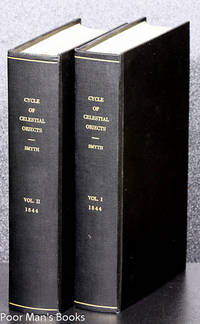
184433052London: John W. Parker. Very Good with no dust jacket. 1844. First English Edition. Hardcover. B&W Illustrations; 8vo 8" - 9" tall; viiii45164pp. ads; xx560 pages; Numerous text illustrations. Half-titles; publisher's 4-page catalogue at end of Volume 2. 2 volumes. 8vo modern gilt-lettered black cloth; old institutional stamps on titles. First edition of a classic guide to amateur astronomy. The first volume is a general introduction to the subject; the second known as the Bedford Catalogue records 850 objects seen from the author's private observatory at Bedford. A career naval officer Smyth 1788-1865 devoted his attention to astronomy from 1830 onward. One of his sons was Charles Piazzi Smyth 1819-1900 astronomer royal for Scotland. BEA page 1070. Illustrated with a large number of textural engravings and drawings. . John W. Parker hardcover
1988040391New York: Bantam Books 1988. First American Edition Second Issue 1st Printing. Black Cloth / Boards. Near Fine/Near Fine. Charts and Tables Throughout. X 198 Pp. First Printing Of The Final Version After A Suppressed First Issue Which Lacked A Table Of Contents And Had Slightly Different Text. Near Fine In Near Fine Dj No Names Or Marks Dj Not Price-Clipped. <br/> <br/> Bantam Books hardcover
1947041180Toronto: University Of Toronto Press 1947. 1st Edition 1st Printing. Soft cover. Very Good. Pp 383-469 In Blue Wrappers Printed In Black. Very Lightly Used Near Fine Except Some Browning Along Spine. Ownership Signature Of Jpl Astronomer And Halley Watch Manager Ray L. Newburn. Per Wikipedia Helen Battles Sawyer Hogg 1905 -1993 Was An American-Canadian Astronomer Who Pioneered Research Into Globular Clusters And Variable Stars. She Was The First Female President Of Several Astronomical Organizations And A Scientist When Many Universities Would Not Award Scientific Degrees To Women. Her Scientific Advocacy And Journalism Included Astronomy Columns In The Toronto Star "With The Stars" 1951-81 And The Journal Of The Royal Astronomical Society Of Canada "Out Of Old Books" 1946-65. She Was Considered A "Great Scientist And A Gracious Person" Over A Career Of Sixty Years. After Graduating From Mount Holyoke Hogg Received A Fellowship For Graduate Study At Harvard Observatory In The Fall Of 1926 With The Help Of Dr. Cannon.3 Once At Harvard Hogg Worked With Dr. Harlow Shapley The Director Of The Graduate Program In Astronomy. Hogg Received Her Master's Degree In 1928 And Her Doctoral Degree In 1931 Both From Radcliffe College As Harvard Refused To Award Graduate Degrees In Science To Women At The Time. For Her Advances In Astronomy Hogg Received Honorary Doctoral Degrees From Six Canadian And U.S. Universities Including Mount Holyoke College And The University Of Toronto. While Completing Her Doctoral Degree Hogg Taught Astronomy At Mount Holyoke And At Smith College. After Graduation She Moved To Victoria British Columbia Where She Began Research At The Dominion Astrophysical Observatory. Hogg Began Taking Photos Of Variable Stars With The 72-Inch Reflecting Telescope Cataloguing The Cyclical Changes In The Brightness Of The Variable Stars. At The Dominion Astrophysical Observatory Hogg Found 132 New Variable Stars In The Globular Cluster Messier 2. Hogg Published This Groundbreaking Work In Astronomical Catalogues That Are Still Used Today. Notably Hogg Accomplished All Of This As A Volunteer Assistant To Her Husband As The Dominion Astrophysical Observatory Would Not Offer Her A Job. In 1935 Hogg Moved To The University Of Toronto After Her Husband Had Received A Job Offer To Work At The David Dunlap Observatory.6 For Her First Year There Hogg Continued Her Work Photographing Globular Clusters Amassing Thousands Of Photographs Which She Used To Identify Many Thousands Of Variable Stars. She Published Catalogue Of 1116 Variable Stars In Globular Clusters In 1939 The First Of Three Catalogues She Completed With A Fourth In The Works At The Time Of Her Death. In Addition To Her Work On Variable Stars In Globular Clusters Hogg Used The Period-Luminosity Relationship Of Cepheid Variable Stars Discovered By Henrietta Swan Leavitt In 1908 To Enhance The Understanding Of The Milky Way Galaxy's Age Size And Structure. During The Late 1930S Hogg Became One Of The First Astronomers To Travel And Work Around The World To Advance Her Research As The Globular Clusters She Was Observing Were Best Seen From The Southern Hemisphere. From 1939 To 1941 Hogg Returned To America To Serve As The President Of The American Association Of Variable Star Observers 1939-1941 And The Acting Chair Of Mount Holyoke's Astronomy Department 1940-1941. Upon Returning To The David Dunlap Observatory She Took On Teaching Duties At The University Of Toronto Largely As A Result Of Male Staff Being Away Due To World War Ii.35 Retaining Her Position After The Men Returned From War Hogg Advanced To Assistant Professor In 1951 Associate Professor In 1955 Full Professor In 1957 And Professor Emerita In 1976 Upon Her Retirement. Over Her Research Career Hogg Published More Than 200 Papers And Was A Leading Authority In Astronomy. <br/> <br/> University Of Toronto Press paperback
1963040780Circa 1963 - 1984 1963. 1st Edition . Soft cover. Fine. 37 Separate Publications Plus 11 Issues Of The Amateur Observer's Watch Bulletin. Newburn Was Ihw Leader Western Hemisphere. Two 1963 Reports On Proposals For 48" And 60" Telescopes For Use In The Space Program And A 1967 Jpl Publication On Preliminary Objectives And Experiments For Mission To A Comet Are Signed By Him. <br/> <br/> Circa 1963 - 1984 paperback
1989009714Arlington Virginia: Air Traffic Control Association 1989. 7" wide by 10" tall. A few dog-eared pages. No owner's name or bookplate. Clean square tight unmarked copy. Photo illustrated. Proceedings of a conference held in Arlington Virginia October 30 - November 2 1989. Original gold-colored wraps. ISSN:0192-8740. . First Printing of the First Edition. Trade Paperback. Very Good condition. xxi 529pp . Air Traffic Control Association Paperback
187197507New Haven: Printed by Tuttle Morehouse & Taylor 1871. 1871. Good. THE FIRST APPEARANCE OF THE ESSAY "ON JUPITER AND ITS SATELLITES" BY THE FIRST FEMALE ASTRONOMER IN THE U.S.A. - Octavo 8-1/2 inches high by 5-3/8 inches wide. The contemporary brown calf and marbled boards are detached but present and the spine has perished and is thus lacking. The text block is intact and tight. 978 pages in all with the pagination as follows: Volume I: pages i-viii & 1-484; and Volume II: pages i-viii & 1-480. Pages 327/328 are skipped in numbering as published which collates with the copy at the Peter H. Raven Library at the Missouri Botanical Garden. The volume is illustrated with 3 plates including one folding as well as several textual illustrations. Although the title page to the second volume indicates the presence of a map intended to illustrate E.W. Hilgard's article "On the Geological History of the Gulf of Mexico" page 391 the map is not here present if it ever was included. The endpapers are foxed and there is some light soiling to the title page of the first volume. The edges of the first few leaves are lightly darkened with a tiny spot of dampstaining to the top edge of those leaves. A very good tight copy which would be well worth rebinding. <p>Most noteworthy is the first publication of Maria Mitchell's essay "On Jupiter and its Satellites" illustrated with a plate volume I pages 393-395.<p>The first American scientist to discover a comet Maria Mitchell 1818-1889 was the first female astronomer in the United States. Working as the librarian of the Nantuckett Atheneum Maria Mitchell read through the day and spent her nights with her father at the observatory he built atop the Pacific Bank. Her discovery in 1847 of the comet which came to be named "Miss Mitchell's Comet" brought her international acclaim. She was awarded a gold medal by King Frederick of Denmark and elected as the first woman to join the American Academy of Arts and Sciences the following year. Mitchell traveled throughout Europe after leaving the Atheneum in 1856 meeting with astronomers the world over. She became involved and active in the anti-slavery movement and the suffrage movement and was subsequently instrumental in the formation of the American Association for the Advancement of Women. After the Civil War Mitchell was recruited to join the faculty at Vassar College where with a 12 inch telescope then the third largest in the US she specialized in studying the surfaces of Jupiter and Saturn. She made waves by encouraging her female students to come out at night for classes and celestial observations and brought in noted feminists including Julia Ward Howe to speak on political issues. Continuously championing the advancement of women she gave an important speech entitled "The Need for Women in Science" during the 1876 centennial. Mitchell was one of only 3 women to be elected to the Hall of Fame of Great Americans in 1905. She was also inducted into the National Woman's Hall of Fame in Seneca Falls New York. A lunar crater on the moon was named in her honor.<p>Also worth noting is Professor L. Respighi's essay "On the Solar Protuberances" illustrated with a folding plate volume I pages 283-287.<p>The Italian astronomer Lorenzo Respighi 1824-1889 was appointed appointed professor of mechanics and hydraulics at the University of Bologna. In that context his first works were mathematical and included a well-known memoir on the principles of differential calculus. Captivated by astronomy he succeeded Calandrelli as director of the astronomical observatory at the University of Bologna in 1855. After making observations on comets Respighi became director of the Campidoglio observatory in Rome where he devoted his attention to studying solar phenomena. His studies of the spectra of sunspots were particularly important as he observed the splitting of the absorption lines later described by Hale as the result of the Zeeman effect.<p>Henry James Clark's essay "The American Spongilla a Craspedote Flagellate Infusorian" illustrated with a plate is here published on pages 426 through 436 of volume II.<p>The American naturalist Henry James Clark 1826-1873 was a pupil of Asa Gray at the Cambridge botanical garden. He became an assistant to Louis Agassiz after graduating from Harvard and was professor of Zoology and of Natural History at numerous colleges and universities. From 1872 until his death in 1873 Clark was Professor of Veterinary Science at the Massachusetts Agricultural College in Amherst Massachusetts. He contributed to a number of periodicals and authored "Mind in Nature" 1863 and "Mode of Development of Animals" 1865. New Haven: Printed by Tuttle, Morehouse & Taylor, 1871. hardcover