NICERON Jean-François.Livre Rare Book
809 résultats
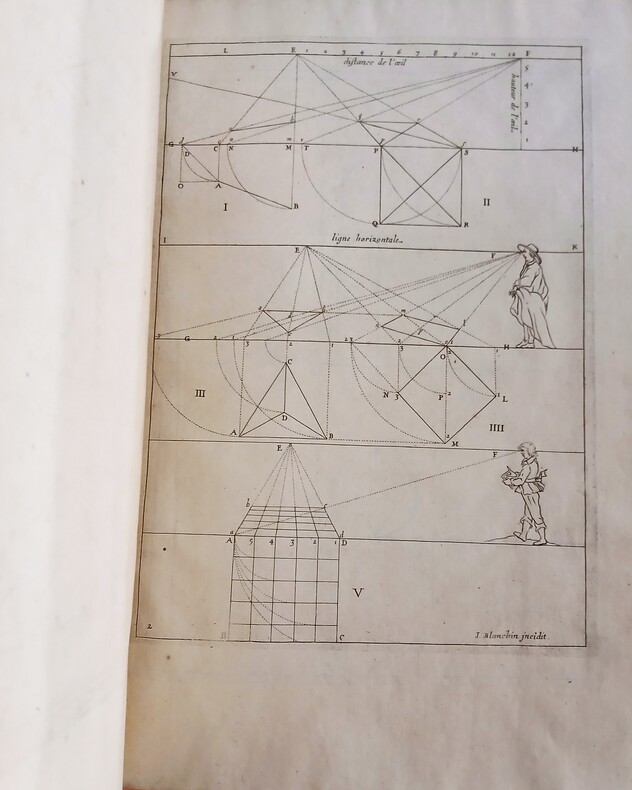
16382072A Paris, Chez Pierre Billaines, 1638.
10544Deux parties en un volume in 4 plein cuir fauve raciné, pièce de titre chagrin rouge, caissons dorés, roulettes dorée sur coupes. Portrait de DESCARTES d’après le tableau de Frans HALS, gravé par EDELINCK Première partie gravure en tête, LXII-417pages. Seconde partie titre, XVI 602 pages, une planche double figure le tombeau de DESCARTES avec son épitaphe, une gravure dans le texte, tranches jaspées. Chez Daniel HORTHEMEL 1691. Edition originale. Petite restauration, ancienne, au mors inférieur, droit sinon très bon état.
1740106497BBLausanne & Genevae, Bousquet & Sociorum, 1740. 4° (25 x 20 cm.). XXXII, 363, (1) S. mit Titel in Rot u. Schwarz, gestoch. Titelvignette, gestoch. Frontispiz (Portrait), figürl. Initialen u. 12 gefalt. Kupfertafeln. Prgt. d. Zt. mit goldgepr. Rückenschild. [11 Warenabbildungen] Editio novissima.
2520P., Gueffier, 1769-1770, 4 VOLUMES in 8 relié en plein veau marbré, dos ornés de fers dorés (reliures de l'époque), (2 coiffes émoussées), T.1 : 2 feuillets non chiffrés (faux-titre et titre), IVpp. (épitre), XXIIIpp. (discours+explication des planches), 243pp. (page 3-4du texte en double et relié entre les pages 242 et 243), 1pp.non chiffrée (début de la table), 2feuillets non chiffrés (suite et fin de la table, IVpp (privilège, mal relié mais complet), 1 feuillet non chiffré (PRIX de toutes les pièces de récréations...), 23 PLANCHES EN COULEURS numérotées 1 à 23, 1 TABLEAU DEPLIANT, T.2: 2 feuillets non chiffrés (faux-titre & titre), Xpp. (discours + explication des planches, 1 feuillet non chiffré (privilège), 322pp., 1feuillet non chiffré (PRIX DE TOUTES LES PIECES...), 16 PLANCHES EN COULEURS numérotées 1 à 16, T.3 : XVIpp. (faux-titre, titre, discours, explications des planches, 240pp., 1 feuillet non chiffré (PRIX DE TOUTES LES PIECES...), 4 feuillets non chiffrés (table), 23 PLANCHES EN COULEURS numérotées 1 à 23), T.4 : 2 feuillets non chiffrés (faux-titre & titre), XVIpp. (avant-propos + explication des plalnches), 232pp., 5 feuillets non chiffrés (table + 1 FEUILLET DE PRIX DE TOUTES LES PIECES...), 3 TABLEAUX hors texte dont deux imprimés recto-verso, 11 PLANCHES EN COULEURS numérotées 1 à 10 (2 planches 9 numérotées 9 et 9bis), 1 feuillet non chiffré (PRIX DE TOUTES LES PIECES...) -- SOIT 73 PLANCHES FINEMENT COLORIEES, 4 TABLEAUX HORS TEXTE, 4 PLANCHES DE PRIX
8754Paris et Londres, Gombert, 1780, un volume grand in 8 relié en plein veau marbré, dos orné de fers dorés, filets dorés sur les plats, toutes tranches dorées (reliure de l'époque), (1), 141pp.
1973CH-22Michigan: Ann Arbor Science 1973. Classic comprehensive reference set presents by photomicrographs and electron micrographs the relationship between the appearance of images of many different types of particles and their identities including improvements in ultramicroscopy automatic image analysis electron microprobe analyses fractionation methods source testing applications of dispersion staining etc. Set includes: Vol. 1: Principles and Techniques Vol. II: The Light Microscopy Atlas Vol. III: The Electron Microscopy Atlas Vol. IV: The Particle Analyst's Handbook Vol. V: Light Microscopy Atlas and Techniques & Vol. VI: Electron Optical Atlas and Techniques. 1454 pp. collectively. Illustrated. Gilt front covers and spines. Corners and spine edges slightly rubbed on some volumes. Vol. I rear endpaper taped and tiny chip to bottom of pp. 295-296. Former ownership label pastedown and small stamps on the front endpaper title page and outer edge of all volumes. Minor light rubbing to lower spine on some volumes from label removal no residue. Text crisp and clean with no marks or highlights. Minimal shelfwear. Heavy item. Scarce. . . Second Edition. Hard Cover. Very Good. Folio - over 12" - 15" tall. Ex-Professional Library. Ann Arbor Science Hardcover
1391P., Durand, 1752, un volume in 4 relié en plein veau marbré, dos orné de fers dorés, tranches rouges (reliure de l'époque), (habiles restaurations aux mors et à la coiffe, quelques cahiers uniformément jaunis), (1-tiotre), 5pp., (1pp.-errata), 202pp. (mal chiffrées 192), 3 feuillets non chiffrés dont 2 feuillets de privilège et 1 feuillet blanc, 7 PLANCHES DEPLIANTES
In-4°, XX, pp.210, tavola fuori testo legatura in cartonato. Christian Kramp fu un astronomo, fisico e matematico francese, scrisse di vari argomenti e molti trattati di matematica pura. La sua opera principale benché di carattere astronomico è - Analyse des refractions astronomiques et terrestres - In questa opera affronta il problema della elasticità dell'aria in relazione alla sua densità ma soprattutto presenta una dettagliata tavola numerica delle funzioni trascendentali che cosi divenne importante nel CALCOLO DELLE PROBALITA' da essere chiamata " Kramp's trascendental", introdusse anche la funzione "n". Come Bessel, Legendre e Gauss egli estese la nozione di fattoriale ai sistemi di numeri non interi (non-whole). DSB ad vocem. In-4°, XX, pp.210, plate, cardboard binding Christian Kramp was a French astronomer, physicist and mathematician, he wrote of various and many subjects treatises on pure mathematics. His main work although of an astronomical nature is - Analyze des refractions astronomiques et terrestres - In this work he addresses the problem of air elasticity in relation to its density but above all it presents a detailed numerical table of transcendental functions which thus became important in the CALCULATION OF PROBALITIES to be called "Kramp's transcendental", also introduced the function "n". Like Bessel, Legendre and Gauss he extended the notion of factorial to non-whole number systems. (See DSB)
"Marca tipografica frontespizio e numerosi diagrammi xilografici nel testo. 4 p.l., 78 pp., 1 carta di errata. Piccolo 4to, pergamena coeva. Venezia: T. Baglionus, 1611. Frontespizio con un piccolo restauro. Prima edizione di questa rara e importante opera nella storia dell'ottica e del telescopio; ha avuto una grande influenza sulle teorie ottiche di Newton ed è di grande interesse galileiano. De radiis visus et lucis si occupa di lenti, telescopi e arcobaleno. De Dominis sapeva come la luce si rifrangeva nel suo passaggio da un mezzo all'altro. Dopo l'invenzione del telescopio De Dominis ha aggiunto la sua spiegazione teorica al suo lavoro. La sua spiegazione non fu del tutto soddisfacente, tuttavia, perché la sua conoscenza della legge di rifrazione era incompleta. De Dominis descrive in modo particolareggiato l'effetto sull'angolo di vista di una lente di maggiore curvatura o di maggiore distanza tra la lente e l'oggetto che si sta osservando. Con la stessa accuratezza ha esaminato le combinazioni di lenti, in particolare la combinazione di un oggetto di vetro convesso e di un oculare concavo. Questo lavoro ha portato alla sua scoperta delle condizioni in cui è possibile l'ingrandimento di un'immagine. ""- DSB, IV, p. 158. Nella prefazione, Giovanni Bartoli, che fu ambasciatore della Toscana a Venezia e uno dei primi sostenitori delle scoperte di Galileo, descrive il cannocchiale di nuova invenzione (attribuendo la sua invenzione a Galileo) e le scoperte rese possibili da questo strumento. De Dominis fornisce anche un resoconto del cannocchiale (pp. 34-43) e suggerisce addirittura i tiranti, entrati in uso molto più tardi . Questo libro contiene anche la famosa teoria dell'arcobaleno di De Dominis che influenzò molto Newton. Nel 1704, Newton scrisse nel suo Optics: ""Questa rifrazione è stata recentemente scoperta e spiegata più completamente dal famoso Arcivescovo Antonius de Dominis di Spalato, nel suo libro De Radiis Visus et Lucis, pubblicato dall'amico Bartolus a Venezia, nell'anno 1611, e scritto sopra 20 anni prima. Perché vi insegna come l'arco interno è realizzato da gocce di pioggia rotonde da due rifrazioni della luce solare. ""Per una discussione approfondita sulla spiegazione dell'arcobaleno di De Dominis, vedere Boyer, The Rainbow (pp. 187-92 & passim ), che lo definisce ""superiore a qualsiasi altro pubblicato nell'intervallo di tre secoli dal 1311 al 1611"". Newton possedeva una copia del presente libro che ora si trova al Trinity College di Cambridge (vedi Harrison, The Library of Isaac Newton, 535). De Dominis (1560-1626), gesuita dalmata, tenne conferenze di matematica, logica e filosofia a Verona, Padova e Brescia. In seguito fu nominato arcivescovo di Spalato (Spalato). La sua fede nell'unità di tutti i cristiani chiese e la pace tra le nazioni lo portarono a fuggire in Inghilterra. Poco dopo il suo ritorno a Roma, fu imprigionato dall'Inquisizione. Morì in una prigione e dopo la sua morte fu riconosciuto colpevole di eresia e il suo corpo fu bruciato. Goethe scrisse di De Dominis che ""ha scoperto lo spettro solare mentre diceva messa"" Cinti 33. Poggendorff, I, 589-90. Riccardi, I, 417-18– ""importantissimo libro"". Printer’s mark on title page & numerous woodcut diagrams in the text. 4 p.l., 78 pp., 1 leaf of errata. Small 4to, contemporary calf. Venice: T. Baglionus, 1611. Title page with a small restoration. First edition of this rare and important work in the early history of optics and the telescope; it had a major influence on the optical theories of Newton and is of great Galilean interest. De radiis visus et lucis deals with lenses, telescopes, and the rainbow. De Dominis knew how light was refracted in its passage from one medium to another. After the invention of the telescope Dominis added its theoretical explanation to his work. His explanation was not entirely satisfactory, however, because his knowledge of the law of refraction was incomplete. De Dominis describes in particular detail the effect on the angle of sight of a lens of greater curvature or of a greater distance between the lens and the object being viewed. With the same thoroughness he examined lens combinations, in particular the combination of a convex object glass and a concave eyepiece. This work led to his discovery of the conditions under which the magnification of an image is possible.""–D.S.B., IV, p. 158.In the Preface, Giovanni Bartoli, who was Tuscan Ambassador at Venice and an early advocate of Galileo’s discoveries, describes the newly invented telescope (attributing its invention to Galileo) and the discoveries made possible by this instrument. De Dominis also provides an account of the telescope (pp. 34-43) and even suggests draw-tubes, which came into use much later. This book also contains De Dominis’ famous theory of the rainbow which greatly influenced Newton. In 1704, Newton wrote in his Optics: ""This Refraction was of late more fully discover’d and explain’d by the famous Antonius de Dominis, Archbishop of Spalato, in his book De Radiis Visus et Lucis, published by his friend Bartolus at Venice, in the Year 1611, and written above 20 Years before. For he teaches there how the interior Bow is made in round Drops of Rain by two Refractions of the Sun light."". For a thorough discussion of De Dominis explanation of the rainbow, see Boyer, The Rainbow (pp. 187-92 & passim), who calls it ""superior to any other published in the interval of three centuries from 1311 to 1611."" Newton owned a copy of the present book which is now at the Trinity College, Cambridge (see Harrison, The Library of Isaac Newton, 535). De Dominis (1560-1626), a Dalmatian Jesuit, lectured on mathematics, logic, and philosophy at Verona, Padua, and Brescia. He was later appointed archbishop of Split (Spalato). His belief in the unity of all Christian churches and peace among nations caused him to flee to England. Soon after his return to Rome, he was imprisoned by the Inquisition. He died in a dungeon and after his death he was found guilty of heresy and his body was burned. Goethe wrote of De Dominis that ""he discovered the solar spectrum while celebrating Mass"" Cinti 33. Poggendorff, I, 589-90. Riccardi, I, 417-18–""importantissimo libro"" "