546 résultats
1869AR019Paris, (1869) J. Mesnard. Folio, 400 p. Tres nobreuses gravures et chromolith. in et hors textes. Reliure 1/3 basane a coins, dos orne a nerfs, exemplaire propre.
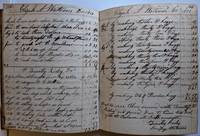
1846769Boston 1846. 8vo.  230 x 185 mm. 7 ¼ x 9 inches.  114 pp. Contemporary boards leather tips. Spine broken with some signatures sprung.  Written in a legible hand in ink. One of the more detailed account books that documents not only the personal business transactions of a Boston Brahmin but also his payments to dozens of local churches societies poor houses and libraries including his membership dues in the Boston Athenaeum. Freeman Allen was born in 1800 and according to the Abner Forbes in his Book Rich Men of Massachusetts was worth over $ 300000 in 1852. "He began poor. Became of shoe dealer one of the largest in Boston." The business accounts cover personal investments loans income and expenditures of the partnership of Allen Harris & Potter Company Boot Shoe and Leather dealers.  The company was listed in the Boot and Shoe Recorder as ". one of Boston's largest and most successful houses in the shoe trade" Allen Harris & Potter was organized in 1846 and continued until 1853 when Allen's stack was purchased by John Cheney Potter and a new partnership. The account book records the initial investments in Allen Harris and Potter and the terms of the partnership. Among the many transactions listed are a "Store 55-57 Pearl St bought of Dowley for $5500 pd for in cash" "Nov 12 1852 1 share Boston Athenaeum cost $151" stock in third municipality New Orleans many bank and railroad shares and a lot at Mt Auburn. In 1850 he bought two tickets to a Jenny Lind concert. Allen's business brought him wealth and he contributed to the Newton Whig Campaign and bought a piano forte from Chickering. The household kept servants and for his daughter Harriet Elizabeth Allen he paid tuition at Emerson School and for French Lessons and Riding School. For son Henry Freeman Allen he purchased skates a sleigh ride paid for "Mr. Sullivan School" eye glass congress boots and Chess men and board. In 1857 he was paying tuition for his son at Harvard. Freeman Allen married Harriet Reed moved to Newton and had children Henry Freeman Allen and Harriet Elizabeth Allen. His son Henry Freeman Allen 1838-1914 became an Episcopal priest and married Georgiana May Stowe 1843-1890 the youngest daughter of Harriet Beecher Stowe and Calvin E. Stowe in 1865.  He had estates in Newton and in Boston at 29 Pemberton Square. Another address was 37 1/2 Beacon Street. A humorous anecdote appeared about the firm summing up the partnership Allen Harris & Potter in the Shoe and Leather Reporter 1890. "Of the firm for instance Allen Harris & Potter Mr. Potter was the principal sales man when I knew him. . . . Mr. Harris took care of the counting room; I never saw him out of it except in the street on his way to and from dinner. Mr. Allen did what he had a mind to." Forbes Abner. Rich Men of Massachusetts Boston 1852 pp. 10 148. Boot and Shoe Recorder 1890. Volume 33 pp. 75. Shoe and Leather Reporter 1890. p. 1021. unknown books
187121223Esslingen, Schreiber, 1871. 3 Bll., 47 S. 20 doppelblattgr. farblithogr. Tafeln. 4°.HLwd. d. Zt. (Kapitelle mit Einrissen, stärker beschabt und bestoßen). [5 Warenabbildungen]
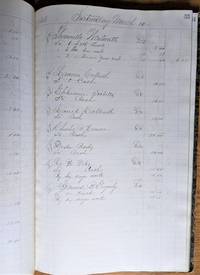
1833768Glastonbury CT. 1833. Square 8vo.  195 x 160 mm. 7 ¾ x 6 ¼ inches. 300 manuscript pages in ink written in a legible hand including an index on the front free endpaper. Bound in contemporary leather backed marbled paper boards and tips; binding showing some wear marbled paper edges of lined paper is brown with age but in good condition. Very good and attractive account book. Unusually interesting book of accounts that graphically reflect the barter economy of early 19th century in New England. Skilled labor Yankee ingenuity and willingness to do take on all kinds of work is traded for food and household goods and finally reconciled for the exchange of small cash payments. These accounts show a brisk business in the making of powder kegs hoops and all types of barrels soap cider oyster etc. There are accounts recording payment to Waltrous's son Elijah who worked for him for six months in 1817 and was paid $96.00.  The ledger shows the cost of "Taping" or mending shoes cost anywhere from twenty to fifty cents and the crafting of a new pair about two dollars.  It also shows the costs of purchasing wood and other supplies to make his barrels and the differing cost for white oak red oak willow chestnut and pine are recorded. Most citizens of the town are named in his accounts including Moses Ensign Levi Smith Isabella Post Capt. Daniel W. Griswold Samuel Pitkin Leverett and Lucius Talcott John Moseley Jonathan Welles and Stephen Bell.  There are also a number of detailed of accounts for some women of Glastonbury including Isabella Post ff. 128 133 Eunice Mosley ff. 49 140 and Dorance Wells ff. 119. Also mentioned as a client is the Eagle Factory. Watrous settled his accounts periodically and often these notations contain the signatures of the debtor if the accounts were found owing. His own purchases are included and range from food staples to shoe leather a sealskin cap an almanack. and an English reader a sley sic to W. Hartford and various goods for "Mrs. Watrous". Dudley Watrous or Waterhouse was born in 1790 in Hebron Connecticut of Jonathan and Abiah Webster Watrous. Dudley's father served in the Revolutionary War at times under his grandfather Lieutenant Nathaniel Waterhouse. His mother was a descendant of Gov. John Webster of Connecticut. Dudley worked as a cooper and also as a shoemaker and shoe repairer. He married Prudence S. Nichols and lived most of his life in Glastonbury outside Hartford. He died at the age of 77 in Hebron. unknown books
183556244Wien, Carl Gerold, (1835). 8°. Titel m. kl. Holzschn.-Wappen (Doppeladler). XXXII, 400 S., Interims-Kart. d. Zt.
186618-1-77Chemnitz, Bach & Rouvroy, 1866. Fotomaße: ca.31,5 cm x 16,5 cm; Kartonmaß:ca. 33,5 cm x 22 cm
187230961Lyon, Librairie de Charles Méra, sans date [1872]. In-8 relié (18,5 x 14,5 cm), reliure demi-basane vert foncé, titre et fleurons dorés sur le dos, 506 pages. Intérieur frais, reliure solide en bon état. Glossaire spécial à l'industrie de la soie. Synonymie en cinq langues, texte en français. Peu courant.
1841145231841 10 volumes (ten books), demi-reliure en basane havane in-octavo (half binding leather in-octavo), dos long richement décoré or (spine without raised band richly gilt decorated) - titre frappé or (gilt title) et pièce de tomaison sur fond bleu-marine avec filet or (label of volume numbering with gilt line), papier peigné aux plats (cover with painting paper), certains coins émoussés (some corners blunt), toutes tranches jaspées (all marbled edges), pages de garde à motif "caillouté" (painting endpapers), page de faux-titre avec des références bibliographiques sur son verso (bibliographical references on the back of half title page), illustrations : 1203 figures (illustrations : 1203 pictures), de naissances de rousseurs à légères rousseurs (of beginning of the redness marks in light redness marks), sans mouillure (without scar of waterstain), entre 573 et 912 pages par volume (between 573 pages and 912 pages by volume), 1833-1841 à Paris Chez J.-B. Baillière Libraire de l'Académie Royale de Médecine rue de l'Ecole-de-Médecine numéro 13 bis - à Londres même Maison 219 Regent Street,
18496043227Stuttgart, Cotta 1849. 8°. XII, 467 pp., 6 lithographierte Falttafeln. Dekoratives Halbleder der Zeit mit 2 gestochenen Titelschildchen (grün und orange) sowie vergoldeter Rückenprägung und marmorierter Deckelkaschierung. Alterstypische Patina. Block sauber und fest. Tafeln hin und wieder mit kleinerem Staubrand. Schnitt angestaubt. Vorsatzpapiere in den Ecken leicht leimschattig.
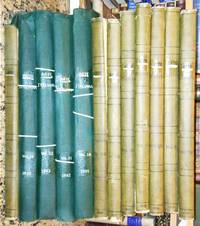
18991511030139Milano : Ulrico Hoepli; Instituto Italiano d'Arti Grafiche 1899-01-01. Hardcover. Acceptable. 12 volumes. Contains: vols. 8-19. Folios. Publisher's boards with later spines. Hardcover. 4 volumes with portfolio style binding. 8 volumes in full buckram. Soiling to covers. Some wear gash in cover edge where twine was too tightly bound in the portfolio volumes. Library stamps and markings. Primarily illustrated. Lovely color chromolithographic plates. An important periodical of decorative art in folio format; first published in 1890. <br> Milano : Ulrico Hoepli; Instituto Italiano d'Arti Grafiche hardcover
185017179Paris, (ohne Drucker), o. J. (ca. 1850). Ca. 64 cm x 88 cm. [6 Warenabbildungen]
1866854Dover New Hampshire 1866. <p>Tall folio. 340 x 215 mm. 13 ¾ x 8 ½ inches. 106 pp. Lined numbered pages. Text in very legible hand. Leather spine over marbled board covers. Spine rubbed some wear to the marbled paper covering; otherwise very good condition. Legible ink.</p><br /> <p>Fine ledger of the nineteenth century shoe industry in New Hampshire particularly Farmington and Dover. The first leaves of the ledge record expense for machines purchased tools and supplies such as uppers lasts blacking nails brushes paste and stiffenings suggesting the opening or reopening of a business six months after the end of the Civil War. Dozens of employees are named and a typical worker James B. Edgley received thirteen dollars for six days work in 1865 averaging about $2.50 per day.</p><br /> <p>Prior to the mid-19th century and the advent of shoemaking machinery shoes and boots were handmade by local cordwainers. Subdivision of labor inherent in a factory system was introduced in these small shops with one man occupied in cutting another stitching and another attaching the sole. It was also common for larger shops to prepare the leather stock that was then sent out to local cordwainers or smaller shops to be assembled into the finished shoe. It is believed that the first shoe "factory" of this type in New Hampshire was established in Weare in 1823 followed by those in Farmington 1835 Rochester 1843 then Dover 1847. By 1859 there were six boot/shoe manufacturers listed in the Dover city directory.</p><br /> <p>During the Civil War many companies had to stop production but advances in shoemaking machinery post war allowed for major expansion of the shoemaking industry in Dover and elsewhere. The number of boot and shoe manufacturers in Dover remained fairly steady in the 1860s and 1870s with about a half dozen active factories at any one time. It was not uncommon for two competing shoe manufacturers to share the same building. By 1874 there were eight boot/shoe manufacturers operating in Dover.</p><br /> <p>Elvin C. Kinnear was born in New Castle Rockingham New Hampshire in 1827 of William and Mary Martin Kinnear. He married Catherine M. Curtis and they had at least four children. Kinnear was one of the largest manufacturers in Farmington New Hampshire for a number of years. He continued for some ten or twelve years when he moved to Dover and continued the manufacture until 1880 when he moved to Rockland Massachusetts. Moving again sometime after 1880 Kinnear died in Fargo North Dakota in 1904. He was listed as a "merchant" at that time.</p>. unknown books
1869STLD0208Weimar, Voigt 1869. Kl.-8°, XII, 262 S., 1 Bl. Vlgsanz., mit 64 Abb. auf 6 Taf., HLn. d. Zt., berieben, Ecken u. Kanten leicht bestoß., Name, Dat. u. Ort verso Reihentit., Text gebr., Taf. etwas stockfleckig, Taf. V mit leicht rissigem Rand, Taf. VI mit stärkeren Randeinrissen sowie staubdunklem Rand. ( = Neuer Schauplatz der Künste und Handwerke; 289). Erste Ausgabe. - Mit einer Reihe der bewährtesten Vorschriften für Phosphor-, Antiphosphor und phosphorfreie Zündhölzchen, mit besonderer Berücksichtigung der in den Phosphorzündholzfabriken vorkommenden Krankheiten und wie denselben zu begegnen ist.
1869FD10-910Leipzig, Verlag von Otto Wigand, 1869. 2. wohlfeile Ausgabe, Halblederband der Zeit, 8?, VIII, 568 Seiten; Zustand: Exemplar mit Signaturetikett, gestempelt, vorderes Innengelenk offen, Kanten und Ecken st?rker berieben, gutes und solides Exemplar
1865BD3-1141Heidelberg, Verlagsbuchhandlung Friedrich Bassermann, 1865. Halbleinenband der Zeit, 8?, VIII, 164 Seiten und 18 lithographierten Tafeln, ehemaliges Bibliotheksexemplar, gestempelt, eine Einband Kante stark berieben, Tafeln komplett jewiel gestempelt
1885BA9-413Wien, (Gerold's Sohn), 1885. Halbleinenband der Zeit, gr.-8?, Seite 285- 556 Seiten und 10 Seiten Jahresbericht des k.k. Oesterr. Museums f?r Kunst und Industrie f?r 1884., ehemaliges Bibliotheksexemplar, gestempelt, Vorsatz fehlt, mit handschriftlicher Signatur auf dem 1. Heft, sonst guter Zustand
18445114Paris, Imprimerie de Fain et Thunot, 1844. 2 vol. in-8 (230 x 136 mm), (2) ff., 978-(2) pp. + (2) ff., 842-(2) pp. Reliure d'époque signée "Lebrun relieur", dos à nerfs, encadrements de triple filets dorés aux dos et sur les plats, filets dorés sur les coupes, tranches dorées, roulettes intérieures dorées. Tome II : mors fendu sur 42 mm, tome II et III : coins, mors et coupes frottées, épidermures sur les plats, quelques claires rousseurs sinon bel état intérieur.
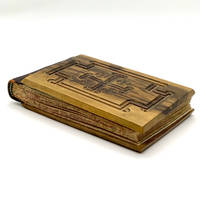
18907243Jerusalem Palestine: Printed at the London Jews' Society's House of Industry Jerusalem N.D. Circa 1890's. First Edition. Hardcover. Unpaginated fourteen unnumbered leaves. Oblong 12mo. measuring 12 x 18 cm. Original quarter maroon leather over gorgeous polished bevelled olive-wood boards bearing "Jerusalem" in black atop a deeply carved Jerusalem cross to the front board; like carving to the rear boards with Jerusalem printed in Hebrew characters to the centre; marbled edges and ivory silk-moire endpapers. Comprises of eleven beautifully arranged dried flower specimens mounted on stiff leaves most excepting two accompanied with their original remarkably well-preserved tissue-guards and individually captioned with their respective geographic origins e.g.: "Flowers from Mount Zion" "Flowers from the Mount of Olives" etc. Lightest wear to the leather spine else no other flaws noted to the extremities. Faint toning to the title page otherwise contents remain near-uniformly without blemish and with firm sound binding. A most lovely and unique period offering from the Holy Land. Rare to be offered in commerce in this edition and state. This edition unrecorded in WorldCat however nominally corresponds to OCLC #753636624 with notable differences in pagination and the number of specimens. See also OCLC #698494522. Rare indeed. <br/><br/>¶ Title leaf cites Biblical verse Matt. VI 28 29 30 which reads in part: "28 Why are you anxious about clothes Learn from the way the wild flowers grow. They do not work or spin. 29 But I tell you that not even Solomon in all his splendor was clothed like one of them. 30 If God so clothes the grass of the field which grows today and is thrown into the oven tomorrow will he not much more provide for you O you of little faith" Although no author nor compiler is given within the present offering corresponds to other similar such works attributed to German missionary and cabinet-maker Ferdinand Vester see references above who had moved to Jerusalem in 1853 to join the Swiss-German Mission. Accordingly the present work may have been the result of his collaboration with the efforts of the London Jews' Society's' "House of Industry" an Anglican missionary society located at Christ Church Jerusalem which offered vocational training to Jewish boys in various trades such as carpentry turnery shoemaking etc. The products produced by these boys would in-turn be sold to other missionaries or as religious souvenirs to passing tourists or those migrating to the West. Vester's son Frederick would carry on his father's business later marrying Bertha Spafford herself the daughter of the founder of the American Colony in Jerusalem Horatio Gates Spafford and his Norwegian wife Anne Tobine Larsen Øglende. Printed at the London Jews' Society's House of Industry, Jerusalem hardcover
189715029ABTokyo, Yamaguchi, 1897. 18,5 : 12,5 cm. 3 leves, 315 pages, 1 leaf, with 9 (2 folded and 7 double-page) maps and plans. Red original cloth.
1828212DuParis Audot 1828 In16 - demi basane d'époque , dos à faux nerfs , titres dorés - 106 & 107 pages - mors supérieur fendu sur 2 cm - frontispice couleur + 21 + 8 planches dépliantes - rousseurs éparses . Joli petit ouvrage permettant des réalisations papier et carton , riche en descriptions précises .
187381374Bernhard Friedrich Voigt, Weimar 1873. XV, 341 S. mit 4 gefalteten lithogr. Tafeln, 8°, marmoriertes Haldleder der Zeit, Bibliotheks-Exemplar (Privatbibliothek) mit 2 kleinen Rückenschildern, Stempel auf Vorsatz und Titel, Einband in selbstklebende transparente Schutzfolie eingeschlagen, Ecken und Rücken berieben und bestoßen, Papier leicht gebräunt und vereinzelt braunfleckig, geringe Bleistiftanstreichungen und Marginalien, insgesamt gutes und innen sauberes Exemplar,
18585883Haupt- und Residenzstadt München. Mit gefalt. Plan von C. Wolf & Sohn. München, Druck von C. Wolf & Sohn, 1858. 8vo. (17,0 x 11,5 cm). IV, 79 S. Blauer Interims-Umschlag d. Zt.
189863143Wien, Artaria & Co., 1898. Fol. Mit zahlr. Abbildungen im Text u. auf tlw. farb. Tafeln. VI, 420 S., Illustr.-OLwd. (v. Heinrich Lefler).
1899LUE-24123Stuttgart, Leipzig. Deutsche Verlags-Anstalt, 1894 - 1899. Vollständiges Werk (A - Z) in 7 Bänden. Schwarze Original-Halblederbände im Format 27 x 20 mit goldgeprägten Rückentiteln auf rotem Rückenschild sowie goldgeprägter Ornamentik im Jugendstil-Dekor; Deckel mit hellgrauen seidenähnlichen Bezügen, Lederecken sowie goldgeprägten Technik-Insignien (Zirkel, Lineal) im Lorbeerkranz; farbig illustrierte Vorsätze in floralem Design; Druck auf holzfreiem Papier. Im Verein mit Fachgenossen herausgegeben von Otto Lueger. Mit zahlreichen Abbildungen. Führende deutsche Technik-Enzyklopädie des 19. und 20. Jahrhunderts, mit der eine Lücke innerhalb der Fachliteratur geschlossen wurde. "Für Architekten, Technologen, Chemiker, Mathematiker, Physiker etc. sind encyklopädische Werke geschaffen worden; allein ein die gesamte Technik und ihre Hilfswissenschaften behandelndes Buch, das gleichzeitig die zurzeit vorhandene Litteratur genügend berücksichtigt und angibt, fehlte bis jetzt", heißt es im Vorwort des Werkes. Im Gesamtumfang von ca. 6.000 Seiten. Durchgehend und überaus reichhaltig illustriert mit Holzschnitt-Illustrationen zu nahezu allen Technikfeldern. Inspirierende Quelle für alle technikgeschichtlich Interessierten. Bände im Einzelnen: Bd. I: A bis Ballistisches Pendel, 800 S. Bd. II: Ballistisches Problem bis Calciumkarbonat, 800 S. Bd. III: Calciumoxyd bis Essigmutter, 800 S. Bd. IV: Essigsäure bis Grundtemperatur, 800 S. Bd. V: Grundwasser bis Kupplungen, 800 S. Bd. VI: Kupplungen bis Reibung, 960 S. Bd. VII: Reibung bis Zwischentransport, 1.031 S. [11 Warenabbildungen]