66 résultats
38539185 pp. study of the urban form of Regensburg and proposals for rational development presented at a seminar there in 1966 illustrated including photos drawings charts plans and maps some folding many in color. Large oblong 4to. Cloth d.j. Dusseldorf Econ Verlag ca. 1967. hardcover books
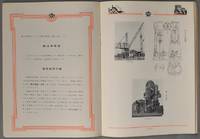
1934876181934. PREWAR INDUSTRY CHÛO KÔGYÔ-SHA. .OYOBI KAGAKU KÔGYÔYÔ KIKAI NARABI NI SÔCHI 2594 Tokyo 26.3 X 19.4 cm printed wrappers 50pp. Interesting and informative pamphlet on Chuo Kôgyô's machinery and plant construction for chemical and coal gasification works. Many photographic illustrations. An excellent example of a consciousness of "the machine as art" - the layout diagrams and illustrations enhance and demonstrate the essential visual artfulness of these utilitarian machines and structures. In very good condition. unknown books
1930253020Tokyo Japan: Mitsubishi Goshi Kaisha 1930. Illustrated with photographs. 10103 pp. 1 vols. 8vo. Original dtraight grained blue cloth. Almost fine. Illustrated with photographs. 10103 pp. 1 vols. 8vo. Abundantly illustrated account of the history and current activities of the diversified Mitsubishi concerns in 1930 including shipbuilding engine and aircraft production; banking investments and real estate; economic research; and other enterprises with portrait of Baron Koyata Iwasaki President. Mitsubishi Goshi Kaisha] unknown books
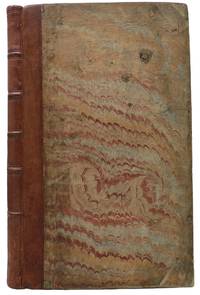
175147454Edinburgh: Printed by the Assigns of Robert Freebair His Majesty's Printer 1751. 1st Edition Goldsmith 8609. Brown quarter calf binding over period marbled paper boards. Average binding wear. Period ink annotation to front paste-down: "22 Octb 1751" Binding offset to eps. A VG copy. 6 157 1 blank pp. Printed glosses. 8vo. 8-1/8" x 4-7/8" <br/><br/>A comprehensive gathering of 15 Acts of Parliament all affecting the linen industry from ca. 1713 to 1751. With excellent indexes and subject cross-references. Printed by the Assigns of Robert Freebair His Majesty's Printer hardcover books
172748366London: Printed for J. Roberts near the Oxford-Arms in Warwick-Lane 1727. 1st Edition Goldsmith . Brown quarter calf binding over period marbled paper boards. Average binding wear. Period ink annotation to front paste-down: "22 Oct 1751" Binding offset to eps. A VG copy. 6 157 1 blank pp. Printed glosses. 8vo. 8-1/8" x 4-7/8" <br/><br/>A comprehensive gathering of 15 Acts of Parliament all affecting the linen industry from ca. 1713 to 1751. With excellent indexes and subject cross-references. Printed for J. Roberts, near the Oxford-Arms in Warwick-Lane hardcover books
1832WRCAM16639Np 1832. 32pp. Later half calf and marbled boards a very good copy. Rare tariff pamphlet focusing on the evils of free trade. Includes excerpts from Alexander Hamilton's manufactures report and a speech by Calhoun defending the tariff. The NUC locates only one copy at Union College. SHAW & SHOEMAKER 12521. hardcover books
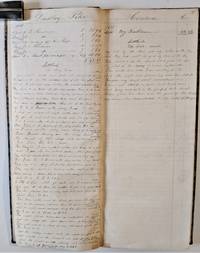
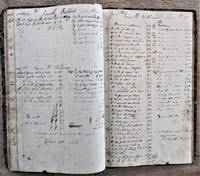
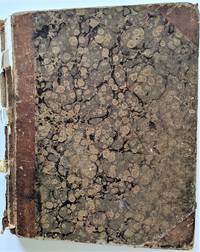
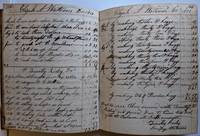
1836765Wolfeboro N. H. 1836. Tall Folio. 385 x 155 mm. 15 ¼ x 6 inches. 68 pp. Contemp. marbled boards leather spine; some minor deterioration to parts of the calf spine a few signatures sprung otherwise a good sound ledger. Cobbler David H. Whitehouse 1807-1839 lived primarily in Wolfeboro Carroll County New Hampshire. This volume of records appears to have kept up to his death at age 33. His wife was Mary M. Giles Whitehouse 1806 - 1899 and they had two children; Joseph and Abigail. Whitehouse's customers came mostly from Carroll County including the towns of Brookfield Conway Moultonborough and Wakefield.  Whitehouse's signature appears on the front fly leaf and on the folio numbered 27. Entries include the date cost and job including various types of shoes; slippers calfskin shoes repairing boots boots and women's shoes. Whitehouse also purchases material for his trade including a shoemaker's seat and tools. The book also includes some household expenses and foodstuffs etc. Customer names include Dudley Pike Ephraim Parsons James C. Perkins John Chadwick Charles Colman Thomas W Mordough Joseph Malcham John Rollins and  Nathaniel Barker to name a few of the local names prominent in the ledger.  The first two pages of the book has a written transcript of the first 11 stanzas of Tennyson's poem "The May Queen'; two stanzas of the "Pirate Song or Serenade"; and a seven-stanza poem "To my Sister" dedicated at the bottom "To my sister Abby." All the text appears to be in the same hand.  . unknown books
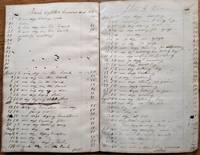
1851859Bellefonte PA 1851. <p>Large 4to.  305 x 200 mm. 12 ¼ x 8 inches. 170 pp. Well used manuscript written in ink. Contemporary calf backed boards; rubbed and a bit worn spine chipped.</p> <br /> <p>This is a ledger account book belonging to John Robison a Pennsylvania shoemaker. Like many artisans in Nineteenth century America Robison found income not only in his trade but also through other sources. Robison farmed the land he lived on selling products such as grain wheat and potatoes. Robison also ran a general store providing neighbors with commodities such as butter flour wool salt and vinegar. Shoemaking however proved to be Robison's most lucrative form of income and there are accounts for heeling. mending "half soaling" and "soaling."</p> <br /> <p>The exact location of Robison's business is difficult to determine although two Pennsylvania towns Bellefonte and Elk Township are both mentioned in the book. Most of the entries are ledger lines naming a customer the service provided or item sold to them and the amount received. In some cases the ledger details wages Robison paid to laborers hired to work his fields who provided services such as plowing and mowing hay. It also seems that Robison occasionally let a spare room in his house to boarders charging two dollars per week.</p> <br /> <p>The most interesting entries do not deal with Robison's business transactions. On one page a "spiritual song" is transcribed. On the facing page is a "cure for the splint" a malady effecting horses. The following page recounts an adventure of Robison in Elk Township in which he assisted a "subscriber" in catching a five year old mare that had escaped his property.</p> <br /> <p>This ledger is a very interesting record of the daily activities of a craftsman in a rural nineteenth century town. It provides a unique look into the means by which such people made their living as well as the workings of rural Pennsylvania markets.</p> <br /> <p> </p> . unknown books
1859855Androscoggin County Maine 1859. <p>Tall folio. 320 x 200 mm. 13 x 8 inches. 85 pp. Contemporary marbled boards calf spine; head of spine chipped and a bit torn; text block foxed. With faults a sound and well-organized ledger written in a legible hand.</p><br /> <p>Early shoemaker's account book from Lisbon Androscoggin County Maine. William Booker 1812-1881 lived with his second wife Martha and several children in Lisbon which is located west of Portland. Although Booker's name does not appear on a title page we derive his name through account settlements in the book.</p><br /> <p>Income and expenses are shown including cost of tanned leather from sheep and calf of various qualities and sizes leather making supplies nails etc. and income is derived from shoes manufacture and repair.  Intermingled with the costs of doing business Booker records in detail the costs of living in the town of Lisbon. His ledger is a veritable roadmap to the economy of the town its residents and its service businesses that he supplied and which in turn supplied his family. </p><br /> <p>Some of the larger customer accounts are Lyman Jordan of Brunswick Ebenezer Combs of Lisbon Ammi Merrill Henry I. Holland Hale Huskey Josiah Fransworth James M. Brickett Jackson Webber and Joshua Remington.  The last few pages of the book show an account for "letting of Horse" Hackett & Webber as well as a total of shoes made from "3rd March 1842"; 1 025 pairs.</p><br /> With fertile and easily cultivated soil farming was an early industry in the small town of Lisbon. Sawmills and gristmills were built using water power from the streams. Larger brick mills followed to manufacture textiles. In 1864 the Worumbo Mill was established to produce woolens and would remain a principal employer until it burned in 1987. By 1880 Booker had changed his profession to stone mason perhaps signifying the phasing out of the handmade shoe industry. unknown books
1846769Boston 1846. 8vo.  230 x 185 mm. 7 ¼ x 9 inches.  114 pp. Contemporary boards leather tips. Spine broken with some signatures sprung.  Written in a legible hand in ink. One of the more detailed account books that documents not only the personal business transactions of a Boston Brahmin but also his payments to dozens of local churches societies poor houses and libraries including his membership dues in the Boston Athenaeum. Freeman Allen was born in 1800 and according to the Abner Forbes in his Book Rich Men of Massachusetts was worth over $ 300000 in 1852. "He began poor. Became of shoe dealer one of the largest in Boston." The business accounts cover personal investments loans income and expenditures of the partnership of Allen Harris & Potter Company Boot Shoe and Leather dealers.  The company was listed in the Boot and Shoe Recorder as ". one of Boston's largest and most successful houses in the shoe trade" Allen Harris & Potter was organized in 1846 and continued until 1853 when Allen's stack was purchased by John Cheney Potter and a new partnership. The account book records the initial investments in Allen Harris and Potter and the terms of the partnership. Among the many transactions listed are a "Store 55-57 Pearl St bought of Dowley for $5500 pd for in cash" "Nov 12 1852 1 share Boston Athenaeum cost $151" stock in third municipality New Orleans many bank and railroad shares and a lot at Mt Auburn. In 1850 he bought two tickets to a Jenny Lind concert. Allen's business brought him wealth and he contributed to the Newton Whig Campaign and bought a piano forte from Chickering. The household kept servants and for his daughter Harriet Elizabeth Allen he paid tuition at Emerson School and for French Lessons and Riding School. For son Henry Freeman Allen he purchased skates a sleigh ride paid for "Mr. Sullivan School" eye glass congress boots and Chess men and board. In 1857 he was paying tuition for his son at Harvard. Freeman Allen married Harriet Reed moved to Newton and had children Henry Freeman Allen and Harriet Elizabeth Allen. His son Henry Freeman Allen 1838-1914 became an Episcopal priest and married Georgiana May Stowe 1843-1890 the youngest daughter of Harriet Beecher Stowe and Calvin E. Stowe in 1865.  He had estates in Newton and in Boston at 29 Pemberton Square. Another address was 37 1/2 Beacon Street. A humorous anecdote appeared about the firm summing up the partnership Allen Harris & Potter in the Shoe and Leather Reporter 1890. "Of the firm for instance Allen Harris & Potter Mr. Potter was the principal sales man when I knew him. . . . Mr. Harris took care of the counting room; I never saw him out of it except in the street on his way to and from dinner. Mr. Allen did what he had a mind to." Forbes Abner. Rich Men of Massachusetts Boston 1852 pp. 10 148. Boot and Shoe Recorder 1890. Volume 33 pp. 75. Shoe and Leather Reporter 1890. p. 1021. unknown books
1833768Glastonbury CT. 1833. Square 8vo.  195 x 160 mm. 7 ¾ x 6 ¼ inches. 300 manuscript pages in ink written in a legible hand including an index on the front free endpaper. Bound in contemporary leather backed marbled paper boards and tips; binding showing some wear marbled paper edges of lined paper is brown with age but in good condition. Very good and attractive account book. Unusually interesting book of accounts that graphically reflect the barter economy of early 19th century in New England. Skilled labor Yankee ingenuity and willingness to do take on all kinds of work is traded for food and household goods and finally reconciled for the exchange of small cash payments. These accounts show a brisk business in the making of powder kegs hoops and all types of barrels soap cider oyster etc. There are accounts recording payment to Waltrous's son Elijah who worked for him for six months in 1817 and was paid $96.00.  The ledger shows the cost of "Taping" or mending shoes cost anywhere from twenty to fifty cents and the crafting of a new pair about two dollars.  It also shows the costs of purchasing wood and other supplies to make his barrels and the differing cost for white oak red oak willow chestnut and pine are recorded. Most citizens of the town are named in his accounts including Moses Ensign Levi Smith Isabella Post Capt. Daniel W. Griswold Samuel Pitkin Leverett and Lucius Talcott John Moseley Jonathan Welles and Stephen Bell.  There are also a number of detailed of accounts for some women of Glastonbury including Isabella Post ff. 128 133 Eunice Mosley ff. 49 140 and Dorance Wells ff. 119. Also mentioned as a client is the Eagle Factory. Watrous settled his accounts periodically and often these notations contain the signatures of the debtor if the accounts were found owing. His own purchases are included and range from food staples to shoe leather a sealskin cap an almanack. and an English reader a sley sic to W. Hartford and various goods for "Mrs. Watrous". Dudley Watrous or Waterhouse was born in 1790 in Hebron Connecticut of Jonathan and Abiah Webster Watrous. Dudley's father served in the Revolutionary War at times under his grandfather Lieutenant Nathaniel Waterhouse. His mother was a descendant of Gov. John Webster of Connecticut. Dudley worked as a cooper and also as a shoemaker and shoe repairer. He married Prudence S. Nichols and lived most of his life in Glastonbury outside Hartford. He died at the age of 77 in Hebron. unknown books
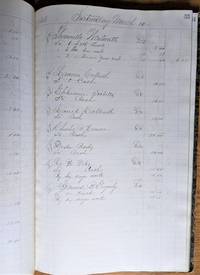
1866854Dover New Hampshire 1866. <p>Tall folio. 340 x 215 mm. 13 ¾ x 8 ½ inches. 106 pp. Lined numbered pages. Text in very legible hand. Leather spine over marbled board covers. Spine rubbed some wear to the marbled paper covering; otherwise very good condition. Legible ink.</p><br /> <p>Fine ledger of the nineteenth century shoe industry in New Hampshire particularly Farmington and Dover. The first leaves of the ledge record expense for machines purchased tools and supplies such as uppers lasts blacking nails brushes paste and stiffenings suggesting the opening or reopening of a business six months after the end of the Civil War. Dozens of employees are named and a typical worker James B. Edgley received thirteen dollars for six days work in 1865 averaging about $2.50 per day.</p><br /> <p>Prior to the mid-19th century and the advent of shoemaking machinery shoes and boots were handmade by local cordwainers. Subdivision of labor inherent in a factory system was introduced in these small shops with one man occupied in cutting another stitching and another attaching the sole. It was also common for larger shops to prepare the leather stock that was then sent out to local cordwainers or smaller shops to be assembled into the finished shoe. It is believed that the first shoe "factory" of this type in New Hampshire was established in Weare in 1823 followed by those in Farmington 1835 Rochester 1843 then Dover 1847. By 1859 there were six boot/shoe manufacturers listed in the Dover city directory.</p><br /> <p>During the Civil War many companies had to stop production but advances in shoemaking machinery post war allowed for major expansion of the shoemaking industry in Dover and elsewhere. The number of boot and shoe manufacturers in Dover remained fairly steady in the 1860s and 1870s with about a half dozen active factories at any one time. It was not uncommon for two competing shoe manufacturers to share the same building. By 1874 there were eight boot/shoe manufacturers operating in Dover.</p><br /> <p>Elvin C. Kinnear was born in New Castle Rockingham New Hampshire in 1827 of William and Mary Martin Kinnear. He married Catherine M. Curtis and they had at least four children. Kinnear was one of the largest manufacturers in Farmington New Hampshire for a number of years. He continued for some ten or twelve years when he moved to Dover and continued the manufacture until 1880 when he moved to Rockland Massachusetts. Moving again sometime after 1880 Kinnear died in Fargo North Dakota in 1904. He was listed as a "merchant" at that time.</p>. unknown books
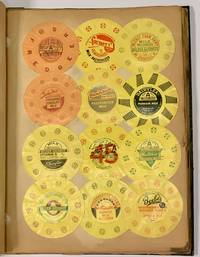
193849246n. p. 1938. Album two-toned green & white faux leather internal string tie. Color pictorial onlay to front cover chipped at bottom. Album shows wear & soiling with mounting paper age-toned & brittle showing a bit of edge-chipping. Penciled to front cover inside: "Sept 1938". Tops used though generally in Very Good condition. 55 leaves of mounting paper of which 24 have a total of 262 circular printed paper / foil milk bottle tops mounted 9 - 15 per page all mounted on leaf recto. Album: 14" x 10-5/8". Tops: various sizes & colors 2-7/8" - 4-1/8" <br/><br/>A no-doubt unique collection of milk bottle tops / caps from the late 1930s generally from the North East U.S. e.g. Sheffield Farms Maplehurst; R. G. Miller & Sons Hartford CT; New London & Mohegan Dairies Inc. New London CT. That said we find others from as far afield as A. R. Beavers & Sons North Tazewell VA & Superior Dairies Inc St. Augustine FL. <br /> <br />It been opined that this was a collection from the printer of these tops though that factoid while plausible is unproven. hardcover books
1949D11294Germany 1949-1950. Hardcover. Very Good. Two-ring binder with heavy cardstock wraps; oblong 282x184 mm; contains more than 1200 silver contact prints ranging in size from about 25x32 to 58x58 mm mounted to the recto and verso of 130 leaves; most images have a numerical caption in ink some have longer captions in German. A few leaves loose; some images torn away leaving either a scuff mark or a chip in the paper; but most pages are complete and the images that remain are fine. <br/><br/>Photo album of tremendous variety documenting German industry and European trade fairs. Up-close and aerial views of garden shows fashions shows equestrian shows food preparation farming manufacturing interiors and more. Highlights the golden age of post-WWII economy in western Europe showing consumer and office products as well as industrial factories heavy machinery and parts and generators. Leitz was founded in 1871 by Louis Leitz who developed and introduced the Leitz-Ordner i.e. the lever arch file. Subsequently the now-common round hole in the back of the file was added. hardcover books
194240874Paris 1942. unknown books
1929302295Los Angeles 1929. 100 pp of typed documents and an additional 50 album leaves mounted with approximately 50 photographs various sizes and processes and various documents. Folio. Limp leatherette with title and recipient name stamped in gilt to upper cover. Large black quarter morocco clamshell box gilt. 100 pp of typed documents and an additional 50 album leaves mounted with approximately 50 photographs various sizes and processes and various documents. Folio. "It is proposed that a COMPLETE ZOOLOGICAL GARDENS be opened to the public on a fifty cent admission basis which is to be properly laid out as an attractive Zoological and Botanical Garden with the finest and largest private collection of animals birds and reptiles to be seen anywhere on the continent."<br/><br/>The advent of the motion picture industry in California had many wide-ranging ramifications on the business world and one was that it created a new market for firms who traditionally supplied animals to circuses and zoos both public and private owned by the likes of William Randolph Hearst. <br/><br/>This archive is a report by the Investment Auditors of California for the Horne Corporation that was looking to expand by establishing a zoological garden in the environs of Los Angeles. The Horne Corporation was the largest and most successful of its type at the time apparently the only company in the US that could completely outfit a circus with both animals and show equipment. They were to purchase the Los Angeles Zoological Garden and Jungle Studio for $250000 and thereby sought to provide a similarly complete service to the film studios with both animals and suitable locations for film sets.<br/><br/>The head of the company I.S. Horne for whom this report was compiled commenced trading in animals from Kansas City MO around 1914. The range of animals at the their disposal included big game birds reptiles and many of the documents concern the prospect of importing reindeer from Alaska.<br/><br/>The material is held in a presentation album and includes the certificate of incorporation in Wilmington Delaware May 13 1929 as well as the by-laws of the corporation minutes of the first meeting the proposal for Los Angeles Zoological Garden and Jungle Studio and a balance sheet. At this stage the company had total assets of $57700 & liabilities of $625388.46; an enumeration of the various animals in inventory including wildebeest sables leopard lynx Rhodesian baboons bushbaby and a large aardvark.<br/><br/>Of real interest are the plans for the park including artist's impressions which would be furnished with circus attractions "Monkey Island" jungle setting for motion pictures and an acknowledgment that "before the introduction of the motion picture industry the art of showmanship was not quite so highly developed as it is today." In fact one of the first pictures they supplied animals for was - appropriately enough - Trader Horn which was nominated for the 1931 Academy Award for Best Picture. <br/><br/>On a more practical level there is a "Descriptive Classification of Principal Commercial Wild Animals" which lists 340 different animals in some details. There is also an account of hunting wild animals in East Africa as well as a section on animals that have been trained to hunt by man. Furthermore there is also much correspondence which provides much insight into the game industry its clients and the prospects for its future.<br/><br/>Horne's venture subsequently became known as the World Jungle Compound in Thousand Oaks California eventually being acquired by 20th Century Fox studios. This archive is a record of a new phase of the entertainment industry. unknown books