685 résultats
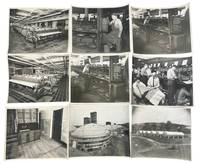
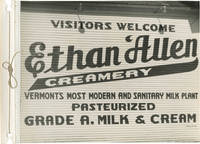
1930149350N.p.: N.p. 1930. Archive of six double weight borderless photographs of the Ethan Allen Creamery in Essex Junction VT circa 1930s. The photographs contain images of both the creamery buildings and interior of the facilities including the vats used to pasteurize milk at what the creamery's sign claims is "Vermont's most modern and sanitary milk plant."<br/><br/>Photographs roughly 9.75 x 7.75 inches. Fine. Tipped onto linen on the left edge and bound with a string. Housed in a contemporary card folder with a vintage photography studio label to the rear pastedown. N.p. unknown books
197645761Stuttgart Germany: Porsche KG 1976. Original Porsche red vinyl 4 ring binders with printed title label in spine compartment. General wear & soiling. Some foxing to paper. Some leaves detached some dividers chipped. Overall Very Good. 4 volumes. Divers paginations. Plastic tabbed section dividers. Illustrated with photographic images drawings schematics graphs etc. 12-1/8" x 10" <br/><br/>Covers Assembly Groups: 1 2 3 4 5 6 7 8 9 0. Essential reference for 1970s Porsche 911 enthusiasts. Porsche KG unknown books
1969010510Paris Service de la Création Artistique, Service des Expositions, Caisse Nationale des Monuments Historiques 1969 In-4 carré Broché, couverture illustrée Dédicacé par l'illustrateur
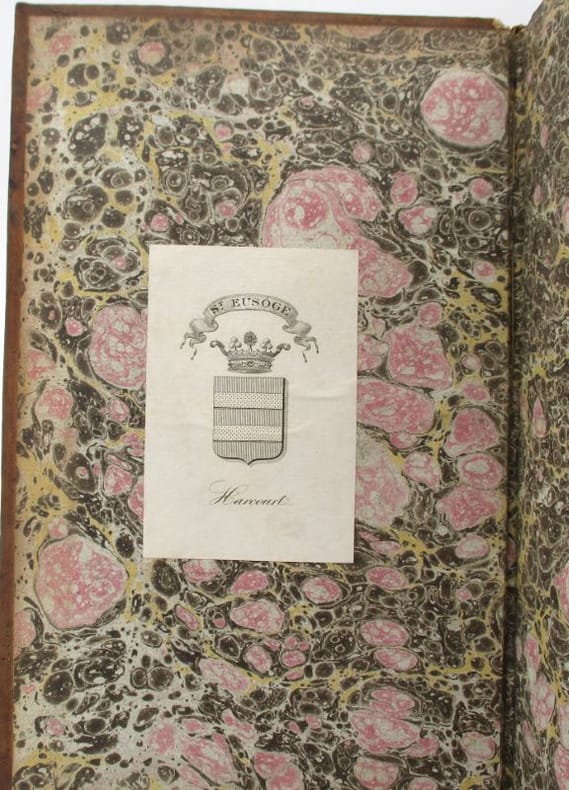
21504Paris, Imprimerie de Crapelet, 1807. 4 vol. in-8, LXXIX-302 pp. 10 pl. + VIII-544 pp. 1 pl. + VIII-534 pp. 1 pl. + VIII-554 pp., basane mouchetée havane, dos long orné de frises et fleurons dorés, pièce de titre rouge, pièce de tomaison verte, tranches jaunes mouchetées de rouge (petites épidermures, quelques petites rousseurs éparses).
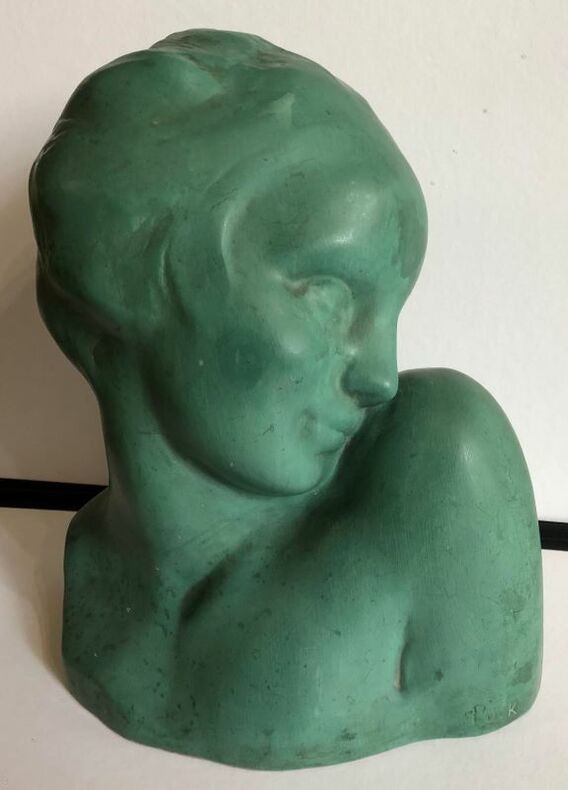
1925206361925 Terre cuite à patine verte signée sur l'épaule droite, (1925), H.36, 5 x L.30 x p.20 cm.
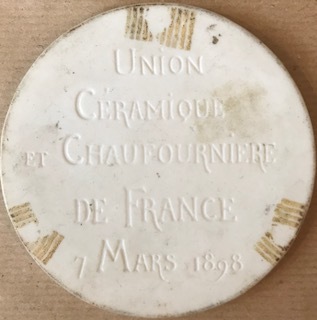
1898230071898 1 Médaille, bas relief, en biscuit ciselé et moulé, datée du 7 mars 1898, diamètre 9,3 cm., épaisseur 0,7 cm.
Abundant black and white illustrations and reproductions of photos. Features: Barton's Grizzly - Well-known Western hunter and guide J. Barton sets out to single-handedly capture a live California grizzly bear (includes cover illustration); In Search of Adventure - Part IV - the story of a chequered cruise; Kidnapped - A Tale of the Burmese Border in which Sir Robert Carson retrieves his kidnapped daughter; An Interrupted Holiday - John Hawkins was tramping through Idaho in 1886; Down the Amazon From Source to Mouth - Part II - J. Campbell Besley and his party continue their journey from the source of the Amazon to the Atlantic, fighting for their lives along the way; Three Years off the Beaten Track - H.E. Weller spent three years in Northern Canada running a small steamer for the Hudson's Bay Company among fur traders and Indians - article with many interesting photos; A Prize-Fight in Mexico - amusing story of what happened when a Spaniard fought an American; Life Among the Eskimos - Clint Wiseman describes a visit he paid to these hardy little hunters of north, complete with photos; The Story of the Missing Fingers - the awful experience of Melvin Parker who fell overboard and clung to a bell-buoy for many hours in the depth of winter; Fallen Among the Theives - exciting adventures of two novice rubber-collectors in Central America, by Rowland W. Cater; Hotel-Keeping in the Wilds - two ex-members of the Cape Mounted Rifles and their hotel-keeping adventures out on the veldt; and more. pp. 9 [ads], 94, 10-32 [ads]. Clean and unmarked with moderate wear. A sound vintage copy. Book
615 pages. "In the preparation of the third edition of this standard textbook for the boot and shoe industry, all the necessary revision has been made to keep it fully up to date. In particular the chapter on Direct Moulded Construction has been considerably modified and includes a new section on Injection moulding. The general arrangement into nine parts has been retained: Shoe Design - its Basis and Development; Pattern Cutting; Clicking; Closing; Bottom Stock; Making; Finishing; Shoe Room; Slipper Manufacture. This new edition is a complete textbook describing for students all the methods in use in the manufacture of boots and shoes and is also an invaluable reference book for foremen, managers and directors in the industry who need to keep abreast of modern techniques." - from dust jacket. Above-average wear. Usual library markings. Back hinge open. A worthy reference copy of this excellent reference. Book
1940233241940. Dictaphone Corporation factory photographs documenting women and men manufacturing dictating machines in Bridgeport Connecticut circa 1940s showcasing the postwar expansion of women's employment inside a growing communications technology industry. The group centers on Dictaphone's Bridgeport plant at 335 Howard Avenue where workers appear at long rows of benches with recording and transcription equipment tool drawers lamps wiring and partly assembled machines placing this archive within the larger World War II and postwar reorganization of American factory labor. Several photographs give women a central place within that system not as incidental figures but as seated operators bench workers and posed employees inside the production rooms themselves grounding the archive in the history of women's industrial employment as office technology manufacturing expanded beyond clerical use into large scale commercial production.<br /> <br /> Archive of 21 pieces including 20 black and white and one red photographs ranging from 2" x 2" to 5" x 7" and original envelope. Bridgeport Connecticut circa 1940s. One original company envelope is printed "DICTAPHONE CORPORATION / 335 HOWARD AVENUE / BRIDGEPORT CONN." fixing the factory location. Interior views show crowded production rooms under fluorescent strip lighting with dozens of workers seated at benches operating or assembling dictating machines and related components; in the largest image male workers fill a deep factory floor while several men in the foreground lean into handsets or testing devices at stations packed with equipment. One view shows a male worker alone at a bench in a long machine lined room with belts tools and suspended mechanisms overhead; several smaller prints show women seated at desks or worktables women and men posed together on the shop floor and mixed groups of workers assembled outdoors or around demonstration tables with supervisors and visiting men in suits. The images repeatedly emphasize rows of benches machine bodies cords lamps and standardized work positions while the envelope and repeated factory interiors tie the lot to Dictaphone's manufacturing operation rather than to sales or office promotion alone.<br /> <br /> During World War II and the immediate postwar years firms producing office equipment occupied an important place in the broader American communications and business machine economy supplying devices that organized dictation transcription record keeping and administrative workflow for corporations law offices and government users. This archive makes that industrial system visible at the level of labor showing how the growth of business technology relied on factory discipline gendered employment patterns and the integration of women into production space during a period when wartime labor demand altered who worked at the bench and who appeared in the industrial workforce. Light edge wear envelope toned. Overall very good condition. A concentrated visual record of 1940s office machine manufacturing placing women's industrial labor inside the production history of one of the leading American dictation companies. unknown
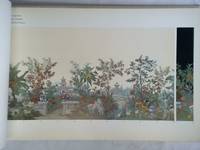
1q20007TZuber & Cie Rixheim um 1968. 50 Blätter mit einfarbigen und farbigen Tapeten-Mustertafeln betitelte Original-Leineneinband mit Schraubbindung Imperialfolio-quer ca. 675 x 43 cm teils leicht fleckig/Titelseite mit leichter Knickspur/Namensschildchen auf Vorsatz. - sonst gutes Exemplar / Klassische Landschaften aus Vorlagen von 1804 - 1930 meist von Mongin / Pierre-Antoine Mongin 1761 - 19. Mai 1827 war ein französischer Maler und Kupferstecher. Mongin entwarf die 1807 von Zuber & Cie herausgegebene Bildtapete LHindoustan / Die Preise für eine Wand variieren von 5.500 bis 30.600 DM / dreisprachig: französisch englisch und deutsch - unknown
1930149350N.p.: N.p. 1930. Archive of six double weight borderless photographs of the Ethan Allen Creamery in Essex Junction VT circa 1930s. The photographs contain images of both the creamery buildings and interior of the facilities including the vats used to pasteurize milk at what the creamery's sign claims is "Vermont's most modern and sanitary milk plant."<br /> <br /> Photographs roughly 9.75 x 7.75 inches. Fine. Tipped onto linen on the left edge and bound with a string. Housed in a contemporary card folder with a vintage photography studio label to the rear pastedown. N.p. unknown
First Edition, vii,[i]pp., 283,[1]pp., 11 engraved plates showing such goods as hose pipes, carriage wheel tire, air proof cushions, beds, swimming belts, Yachting boats, mud boots, tents, fishing trousers, cricket bat, -leg protector, -gloves, foot balls, etc., orig. embossed cloth, small tear to head and foot of spine. "Hancock, Thomas (1786?1865), rubber manufacturer and inventor... Hancock took out sixteen patents in all relating to rubber between 1820 and 1847. He displayed remarkable ingenuity in suggesting uses for what was practically a new material, and the specifications of his patents cover the entire field of rubber manufactures, though many of his ideas were not carried out at the time."?(Oxford DNB).
19692081402109803362Koyu-sha 1969. Soft Cover. Fine. Volume: 1 Koyu-sha paperback
1960016069Saint-Maurice d'Ételan Pierre Bettencourt 1960 In-16 Broché, couverture rempliée
187127826BORDEAUX A. BELLIER & Cie 1871-73 une affiche Lithographiée en noir sur fond jaune et papier brillant et entoilée : format : 36 cm de haut par 53 cm de large, sans date (1871-1873 car cet imprimeur a créé son activité en 1971 et est mort en 1873) BORDEAUX A. BELLIER & Cie . IMPRIMEUR, 16, rue Cabirol Editeur,
186429021415Anthony Coventry RI 1864-1894. General wear and toning. The smaller of the two notebooks has semi detached covers. . A set of two notebooks containing nearly thirty years of the meeting minutes of the annual July 4 gathering of the Coventry Factory Fire Engine Company. These minutes includes a list of members and officers voted in each year as well all the outcome of any topic put to vote. The meetings take place in Anthony RI which is a small village within Coventry RI. The smaller copybook is completely full and contains minutes from their annual meetings dating from 1864 to 1881. The second and larger notebook begins where the first notebook left off in 1882 and continues until 1890 when at the annual meeting there was no quorum present and as such "the charter of the company was declared forfeited sic and the company disbanded." In August of 1893 the company was reorganized under the old charter. Four more meetings follow in 1893 with the last meeting recorded stating that the fire company met to compete at the Kent Co. Fair and won the third prize of ten dollars. Included with this set are several receipts and notes of the fire company. There are eight 8 receipts dating between 1893-1894 two of them are undated. One scrap piece of paper which served as a draft for a portion of one of the annual meeting minutes. A roll call list of members from the 1893 annual meeting. A list of dues paid by each individual member. And lastly a note dated September 15 1893 which certifies that the fire company won the third prize in the Hand Engine Contest Open at the Kent Co. Fair. Below is an excerpt from one of the entries: "The squirt gun was tested and proved very satisfactory. It was voted that Lt Capt Byron Matteson be a committed to inspect the Hay Cart and any other machine he may see fit and report as soon as posable. There being more business the meeting adjourned to the call of the Captain." - August 3 1893 Meeting These journals most likely belonged to Arthur J. Matteson 1859-1925 who was the Secretary of the Company from 1888-1893. Matteson lived in Coventry RI and worked as a machinist. Small Notebook: Brown illustrated wrappers depicting several scenes of children on a farm. The back cover has a multiplication table and a decorative border. String binding. Completely full. Measures 8" x 6 1/2" Large Notebook: Black decorative paper over boards. Red fore edge. One fourth filled. Measures 8 1/2" x 6 3/4" <br/><br/> hardcover books
1945234071945. Reading Pennsylvania factory photo archive documenting textile machinery production and hosiery manufacturing work circa late 1940s to early 1950s at or near the Wyomissing industrial complex associated with Textile Machine Works and Berkshire Knitting Mills. Reading became one of the major American centers for full fashioned knitting machinery after Ferdinand Thun and Henry Janssen founded Textile Machine Works in 1892 and the equipment seen here belongs to the world of stocking manufacture before seamless nylon hosiery reshaped the industry in the 1950s.<br /> <br /> Photo archive of 17 large silver gelatin photographseach 8 x 10 inches Reading or Wyomissing Pennsylvania circa 1940s to early 1950s. Rows of large knitting machines fill long factory rooms under fluorescent lighting; workers stand beside circular or braiding machinery marked with chalked Greek words; an engineering office includes men studying large technical drawings; machine tools metal stock exterior factory buildings tanks and utility structures place the scenes within a large industrial plant. Several versos are stamped "Paul Bauer Photographer 608 Franklin St. Reading Pa." and "Photo by Paul Bauer." Several shop-floor views include a chalked Greek vocabulary list beside the machinery a striking detail in a Reading industrial region that had an established Greek immigrant community by the early twentieth century.<br /> <br /> The archive records the machinery workers drafting practices and plant environment behind Pennsylvania's textile machinery economy at the point when American hosiery manufacturing still depended on large specialized mechanical systems and skilled shop labor. Documenting the production floors machine details engineering rooms workers and exterior plant views. Minor edge and curling; images remain clear and well preserved. Overall in very good condition. unknown
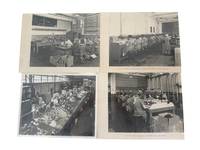
1940235071940. Women's wartime factory labor photo archive depicting rubber molding inspection precision trimming packing and bench production in the United States during the World War II era. More than six million women took wartime jobs in American factories and wartime labor needs moved women into industrial work involving machinery inspection aircraft parts laboratory work and other production roles previously coded as male labor. The captioned Parker views place women inside a rubber parts operation where quality control hand finishing and distribution preparation were treated as essential production work. The archive records the practical shop-floor labor behind the larger wartime shift: long tables stools bins boxed parts inspection lamps trimming tools and women working in sequence across a factory interior.<br /> <br /> Photo archive of 4 large silver gelatin photographs each measuring 8" x 10.75" United States circa 1940s. One caption reads "View of inspection of Parker-molded rubber parts" with women seated along a long worktable examining parts before distribution. Another caption reads "Operators with equipment for precision-trimming of mold rubber parts" showing women working at a row of bench stations with overhead cords boxes and factory equipment. Additional scenes show women packing sorting and assembling small molded components at long tables surrounded by stacked cartons metal containers industrial windows and production shelving.<br /> <br /> During and after World War II women's factory labor did not simply fill temporary vacancies; it proved women could perform skilled industrial tasks in defense-related production even as many employers pushed women out of those jobs when men returned from military service. Light handling wear corner wear minor creasing and curling; photos generally clean and clear and captions remain legible on two mounts. Overall in very good condition. This archive shows the wartime demand for women's labor in order to keep American production moving during the war. unknown
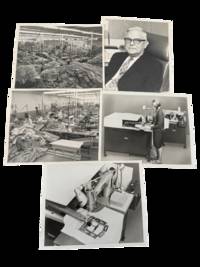
1950233261950. Garment factory photographs documenting women's industrial sewing labor machine based apparel production and managerial oversight in the postwar United States circa 1950s with direct evidence of how mass clothing manufacture depended on large sewing rooms specialized equipment and gendered factory work. Archive documents the production floor as a working system rather than a single portrait scene placing rows of women at Pfaff machines beside piles of cut or partly finished garments while a separate executive portrait and staged equipment views link shop floor labor to administration and industrial sales culture. The group matters because postwar clothing production relied heavily on women's wage labor in factories where speed repetition and machine specialization turned fabric into standardized output for a growing consumer economy.<br /> <br /> Photo archive of 5 Large silver gelatin photographs each 8" x 10" circa 1950s. Two photographs show the main sewing room from wider angles with long rows of women seated at machine stations beneath suspended electric lines and task lighting while large heaps of striped fabric or finished garments spill across tables and benches in the foreground. The workers are positioned close together in a dense production space organized around straight runs of tables and sewing heads with little separation between labor stations and material flow. One photograph isolates a woman operating a large Pfaff industrial unit in a cleaner demonstration setting while another gives a close technical view of a Pfaff machine head and work plate. A fifth photograph shows an older male executive or manager seated in an office.<br /> Postwar apparel production expanded through factories that combined assembly line logic with skilled but repetitive needlework and women formed a large share of that labor force in garment plants across the United States. The Pfaff machines represent the technological side of production while the sewing room views show the human structure that made the machines profitable with women handling fabric continuously at closely arranged stations under managerial control. Light handling wear and minor curling to edges. Overall very good condition. The archive preserves the relationship between labor machinery and output at a moment when industrial clothing manufacture still depended on concentrated factory work before later shifts toward overseas production transformed the industry. unknown
2007165430New York: Chronicle Books 2007. Hardcover. First American Edition. As New. Still in publisher's shrinkwrap.<br /> <br /> Between 1978 and 1992 Factory Records was one of the most important record labels in Britain. It launched the careers of Joy Division New Order and the Happy Mondays and others. The entity was launched jointly with the legendary Hacienda Club and Dry Bar both in Manchester; and it introduced along with its new music a new concept of high-quality cutting-edge design. <br /> <br /> A complete full-color chronological catalog of the label's output with each release accompanied by its original inventory number along with photos of album sleeves singles special editions flyers posters stationery and architectural projects. <br /> <br /> Oversize volume shipping billed at cost. Chronicle Books unknown
1q20006TZuber & Cie Rixheim um 1980. 61 Blätter mit zahlreichen Tapeten-Mustertafeln mit Bordüren jeweils mit kartonierten Zwischenblättern original Leineneinband mit goldgeprägtem Deckeltitel und Schraubbindung Imperialfolio-quer ca. 65 x 43 cm etwas bestoßen/Einband etwas fleckig/eine Tafel mit Randeinriß. - sonst gutes Exemplar / Beinhaltet Klassische Motive meist in verschiedenen Varianten. Artikelbeschreibung: Décor "Directoire" / "Draperie Josephine" / Décor "Reveillon" / Decor a Colonnes / Décor à Colonnes variante "Pompei" / Décor "Colonnettes et Lambris" / Décor "Boiserie" / Décor "Azulejos" / Décor "Villa Ciceron" / Décor "Etrusque" / Bordure "Baroque" / Décor "Mosaique" de Paulin Paris pour Zuber / Décor "Roseraie" / Décor "Atrium" / Text französisch - unknown
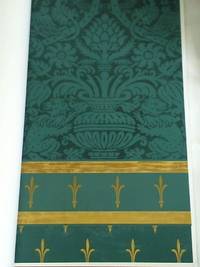
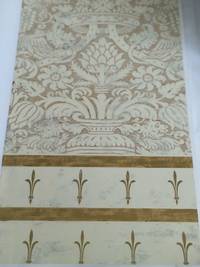
1q20017TZuber & Cie Rixheim ca. 2000. 31 auf Karton gezogene Tapetenmuster zweigeteilt und jeweils mit separater Bordüre Unterteil mit Bourbonenlilie original Leineneinband mit goldgeprägtem Deckeltitel und Schraubbindung Imperial-folio ca. 55 x 815 cm Einband etwas randfleckig und lichtschattig. - sonst gute Erhaltung / Die Tapeten dieser Kollektion sind von Hand gedruckt und patiniert. Im Stil der Klassischen Tapetenmacher Frankreichs / Text französisch - unknown
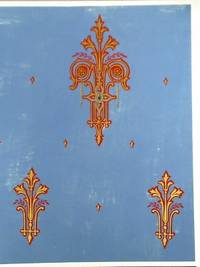
1q20016TZuber & Cie Rixheim ca. 2000. 46 auf Karton gezogene Tapetenmuster original Leineneinband mit goldgeprägtem Deckeltitel und Schraubbindung Imperial-folio ca. 547 x 575 cm Einband gering fleckig. - sonst gutes Exemplar / Die Tapeten dieser Kollektion sind von Hand gedruckt und patiniert. Hier wurde eine Tapetenrolle für 540 Euro angeboten / Text französisch - unknown
1q20021TZuber & Cie Rixheim ca. 2000. 29 auf Karton gezogene Tapetenmuster zweigeteilt und jeweils mit separater Bordüre Unterteil mit Bourbonenlilie original Leineneinband mit goldgeprägtem Deckeltitel und Schraubbindung Imperial-folio ca. 55 x 815 cm Einband etwas randfleckig und lichtschattig/Einbandecken leicht bestoßen. - sonst gute Erhaltung / Die Tapeten dieser Kollektion sind von Hand gedruckt und patiniert. Im Stil der Klassischen Tapetenmacher Frankreichs / Text französisch - unknown
193946634Shanghai: Nishimura Company 1939. Edition not stated. Quarto 26.5cm; black simulated leather stamped in red and gilt in brown paper slipcover; unpaginated photo-illustrated plates w/ rice paper overlays. Wear minor scuffs and soiling to boards; toning and foxing intermittent throughout text especially on overlays; some overlays creased or torn. Slipcover worn and chapped with abrasions and two large one repaired tears across front panel. Photo-illustrated pastedowns and endpapers. Very Good in Good slipcover. All text in Japanese with some obsolete/antiquated kana/kanji oriented right to left. This is a privately-issued commemorative yearbook-type photo album shashin-cho published on behalf of the Imperial Japanese Army medical forces during the Second Sino-Japanese War 1937-1945. Specifically it was produced for those who served under military physician captains/commanding officers Nobuo Isa and Tetsuo Fukaya who were stationed in or near Shanghai at the time.<br /> <br /> By July 1939 the Imperial Japanese Army was beginning to feel the impact of its own mounting casualties and costs; the Chinese Red Army would launch a major offensive later that November. While the Japanese occupation of Shanghai was notably brutal there is little evidence of violence in this album. However some photographs do depict the aftermath of battle with ruined buildings and soldiers being treated for injuries. Other subjects are mundane in nature: Staff and group portraits hospitals and other facilities physicians at work company events and ceremonies. Also includes photographs of Shanghai and a fold-out map of the Hangzhou Bay area. Apparently not cataloged in OCLC or available commercially as of November 2019. Nishimura Company unknown