Great Britain Factory InspectorateBiblio.com
343 résultats
0366971387.Ghardcover. Good. Access codes and supplements are not guaranteed with used items. May be an ex-library book. hardcover
0332635082.Ghardcover. Good. Access codes and supplements are not guaranteed with used items. May be an ex-library book. hardcover
37179London: Printed for J. Roberts 1727. First edition small 8vo 185 x 115 mm 4 31 5 pp. with half-title blindstamp of Manchester Free Library on title and last leaf woodcut head- and tail-pieces in the text later vellum-backed marbled boards lettered in gilt on spine. Kress 3719; Goldsmith 6505; Hanson 3668. London: Printed for J. Roberts, 1727 hardcover
0483059633.Ghardcover. Good. Access codes and supplements are not guaranteed with used items. May be an ex-library book. hardcover
19742092902141201529Chinese book office 1974. Soft Cover. Fine. The book is in fine condition. Chinese book office paperback
20042091202133212984Public Symposium “Distribution and Exchange in Medieval Warfare†Executive Committee 2004. Soft Cover. Fine. Volume: 1 Public Symposium “Distribution and Exchange in Medieval Warfare†Executive Committee paperback
11596Dated 1 August 1907. 12pp. 4to plus three leaves of plates on art paper. Stapled in original buff printed wraps. A fragile item. Fair on aged high-acidity paper in chipped and worn wraps. Images captioned 'The First Photograph of the Sympathy Society' 'At School' 'At Play' and 'The Home'. Sections on the conversion of Shinjiro Omoto and the 'Sympathy Home' 'Dojokwan'. Final 'Financial Statement' and 'Plans for Enlargement'. No copy on COPAC. Dated 1 August 1907. paperback
1334752672.Gpaperback. Good. Access codes and supplements are not guaranteed with used items. May be an ex-library book. paperback
1334960305.Gpaperback. Good. Access codes and supplements are not guaranteed with used items. May be an ex-library book. paperback
1334961786.Gpaperback. Good. Access codes and supplements are not guaranteed with used items. May be an ex-library book. paperback
0332214907.Ghardcover. Good. Access codes and supplements are not guaranteed with used items. May be an ex-library book. hardcover
0483042153.Ghardcover. Good. Access codes and supplements are not guaranteed with used items. May be an ex-library book. hardcover
0656315741.Ghardcover. Good. Access codes and supplements are not guaranteed with used items. May be an ex-library book. hardcover
0331251744.Ghardcover. Good. Access codes and supplements are not guaranteed with used items. May be an ex-library book. hardcover
1333670931.Gpaperback. Good. Access codes and supplements are not guaranteed with used items. May be an ex-library book. paperback
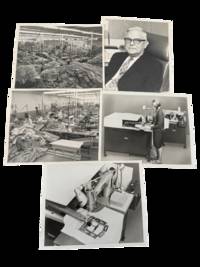
1950233261950. Garment factory photographs documenting women's industrial sewing labor machine based apparel production and managerial oversight in the postwar United States circa 1950s with direct evidence of how mass clothing manufacture depended on large sewing rooms specialized equipment and gendered factory work. Archive documents the production floor as a working system rather than a single portrait scene placing rows of women at Pfaff machines beside piles of cut or partly finished garments while a separate executive portrait and staged equipment views link shop floor labor to administration and industrial sales culture. The group matters because postwar clothing production relied heavily on women's wage labor in factories where speed repetition and machine specialization turned fabric into standardized output for a growing consumer economy.<br /> <br /> Photo archive of 5 Large silver gelatin photographs each 8" x 10" circa 1950s. Two photographs show the main sewing room from wider angles with long rows of women seated at machine stations beneath suspended electric lines and task lighting while large heaps of striped fabric or finished garments spill across tables and benches in the foreground. The workers are positioned close together in a dense production space organized around straight runs of tables and sewing heads with little separation between labor stations and material flow. One photograph isolates a woman operating a large Pfaff industrial unit in a cleaner demonstration setting while another gives a close technical view of a Pfaff machine head and work plate. A fifth photograph shows an older male executive or manager seated in an office.<br /> Postwar apparel production expanded through factories that combined assembly line logic with skilled but repetitive needlework and women formed a large share of that labor force in garment plants across the United States. The Pfaff machines represent the technological side of production while the sewing room views show the human structure that made the machines profitable with women handling fabric continuously at closely arranged stations under managerial control. Light handling wear and minor curling to edges. Overall very good condition. The archive preserves the relationship between labor machinery and output at a moment when industrial clothing manufacture still depended on concentrated factory work before later shifts toward overseas production transformed the industry. unknown
0915299313New. Brand new and still unused unknown
1989Q-0915299313Productivity Press 1989-02-01. Hardcover. New. In shrink wrap. Looks like an interesting title! Productivity Press hardcover
1989DADAX0915299313Routledge 1989-02-01. 1. hardcover. New. 9.00x0.75x11.75. Buy with confidence. Excellent Customer Service & Return policy. Routledge hardcover
1988x-0915299313Productivity Pr 1988. Hardcover. New. 1st edition. 304 pages. 11.75x9.00x0.75 inches. Productivity Pr hardcover
101035like new. unknown
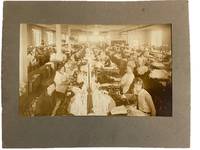
1920173461920. 1920s vintage sepia photograph of around 50 women at work in a textile factory. The photographer's board is 10" x 8" inches and image is 8.25" x 5" inches. The women are seated in long rows and armed with sewing machines and seem to be turning bundles of cloth into garments. Spools of thread hang down from a center rail in the middle of the table to be fed into the sewing machines. Some of the cloth appears to be polka-dotted similar to the dresses that several women pictured appear to be wearing. The factory is consisted almost entirely of women - there is one man in a waistcoat walking around accompanied by an older woman. The working women seem to be of varying ages from their early 20s into their 50s. Textile manufacturing was unique at the time for its overwhelmingly female labor force. Sepia toned very good condition with great detail. unknown
193433126Allegan: Baker Furniture Factory 1934. Hardcover. Good. Hardcover. 112pp index. Binding shaken but hinges firm prelims foxed pages tanned else a good copy in publisher's cloth backed boards that have some dampstaining to the edges and superficial loss to the spine. <br/><br/> Baker Furniture Factory hardcover
191645078Chicago and New York:: Paris Garters made by A. Stein & Co. ca. 1916. Some light foxing; but extremely attractive. Consisting of a sample men's garter and men's arm band each with original printed cardboard mounting set into the original box illustrated in color with two attractive young ladies gathering roses. The garter "No metal can touch you" was patented in 1908 and 1914; the armband was patented 1916. Paris Garters, made by A. Stein & Co., unknown