131 résultats
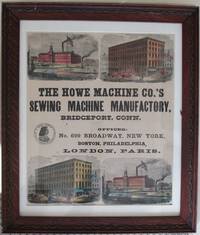
187636504np 1876. Beautifully handcolored engraving depicting four eye-level views of Howe Machine Company factories surrounded by busy streets ferries and carriages. A coin with profile of Elias Howe Jr. is at center left. Attractively framed and matted. Image 13-1/4" x 15-1/4" by sight. Not examined out of frame. Fine. <br/><br/> The Company's New York offices were located at 699 Broadway from 1867-1876. We locate this extremely attractive broadside only in the Jay Last Collection at the Huntington Library. unknown books
1801024864Meurant, Paris 1801. Karton/ Leder Gut
187643524London, Taylor and Francis, 1876-79. Witout wrappers as three issues from ""Proceedings of the Royal Society of London"", Vol. 24, No. 167+ Vol. 27, No.187+ Vol. 28, No. 191. Pp. 250-344, pp. 284-408 a. pp. 103-232. Papers: In No. 167:pp. 262-265 (James Thomson), pp. 266-68, pp. 269-271, pp. 271-275. In No. 187: pp. 371-373. In No. 191: pp. 111-113 (W. Thomson). Titlepages to vols. 24, 27 a. 28 present. 2 papers with textillustrations.
187643524London Taylor and Francis 1876-79. Witout wrappers as three issues from "Proceedings of the Royal Society of London" Vol. 24 No. 167 Vol. 27 No.187 Vol. 28 No. 191. Pp. 250-344 pp. 284-408 a. pp. 103-232. Papers: In No. 167:pp. 262-265 James Thomson pp. 266-68 pp. 269-271 pp. 271-275. In No. 187: pp. 371-373. In No. 191: pp. 111-113 W. Thomson. Titlepages to vols. 24 27 a. 28 present. 2 papers with textillustrations. <br/><br/><em>First appearance of all the 6 founding papers around the invention of the "Harmonic Analyzer" and with the mathematical theory for the differential analyzor containing both the mathematical theories and the practical descriptions of the analyzer and further also having the paper by Lord Kelvin's brother the first paper offered in which the machinery is shown for the first time."A ball and disk integrator was the vital invention needed to build the FIRST AUTOMATIC ANALOG COMPUTING MACHINES. Lord kelvin used this integrator -devised for a planimeter in the 1860s by his brother James Thomson - on two new kinds of analog computers: a harmonic analyzer and a tide predictor. he later specified a more general machine - a differential analyzer."Eames in "A Computer Perspective"."The harmonic analyzer was used in conjunction with Thomson's tide predictor.The present paper "Harmonic Analyzer" contains the first full description of the harmoniz analyzer which was "designed rudimentally" p. 371 in Thomson's "On an integrating machine having a new kinematic principle"also offered hereJames Thomson's integrator - "one of the first really workable integrating devices" Williams 1985 207 - served as the basis for other analog machines designed by William Thomson for solving simultaneous linear equations and integrating differential equations. Thomson first described such a machine composed of several Thomson integrators connedted together in his paper on "Mechanical integration of the linear differentialequations of the decond order." also offred here; however the "idea could then hardly be carried out forone reason because an integrator which is simply a variable- speed drive could not then be buitl both accurate and capable of carrying sufficient load to move numerous mechanical parts" Bush 193 450. The full realization of Thomson's idea did not come until fifty years later when Vannevar Bush invented the torque amplifier for use in his differential analyzer."Hook and Norman. </em> unknown
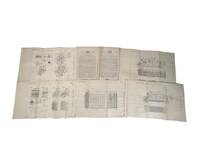
1900205091900. EngineeringInvention and Business Felt Dorr Eugene. British Patents for Improvements in Calculating Machines 1900-1904 document the development of one of the earliest commercially successful key-driven mechanical calculators reflecting the rapid mechanization of clerical labor at the turn of the twentieth century. These patents relate to the Comptometer first introduced in 1890 by the Chicago firm Felt and Tarrant and represent the extension of American technology into British commercial and financial systems. Banking insurance railways and trade demanded increasingly rapid numerical computation at the turn of the century meaning mechanical calculation was becoming integral to infrastructure.<br /> <br /> Calculating Machines. British Patents: together 2 patents. Patent No. 19675 1900 includes 3 pages and 3 folding diagrams; Patent No. 13094 1904 includes 11 pages and 5 folding diagrams. 1900-1904. The 1900 patent specification describes modifications "intended to adapt such machines to be used in making calculations in British money" addressing the complexities of pounds shillings and pence within a decimal-based mechanical framework. The 1904 patent details improvements to the Comptometer's registering wheels refining accuracy and mechanical efficiency. These documents trace the technical evolution of Felt's invention whose origins lay in his 1885 "macaroni box" prototype and whose commercial success positioned the Comptometer as a principal rival to Burroughs calculators in the early twentieth century. Together the specifications and folding diagrams provide primary evidence of iterative design in early computing machinery and the formal legal mechanisms through which intellectual property structured industrial competition.<br /> <br /> Disbound some leaves loose. Overall very good. As working technical documents issued during a formative period in mechanical computation these patents illuminate the foundations of modern calculating technology in the pre-electronic era. unknown
188850460Dunod ; E. Lacroix 1888 14 volumes in-folio, demi-toile, plats imp. Chaque volume : table annuelle, 12 livraisons, ch. près de 140 pp. & 50 à 60 planches, certaines doubles, l’ensemble sur onglet, texte sur 2 colonnes.