J I CASE THRESHING MACHINE COBiblio.com

458 résultats
190543701Milwaukee: Meyer-Rotier Printing Co. 1905. 1905. TRADE CATALOG. WISCONSIN. First edition. Color pictorial stiff wrappers encased in a 9 1/4" x 12" oblong cloth binder with title stamped in gold gilt on the front cover 72 pp. illustrated throughout in black & white with over 150 text woodcut engravings photo-lithograph engravings and lithograph text illustrations. price lists. Color chromolithograph illustrated softcovers splendid front cover art of Ceres blowing a bugle and holding Case globe & "Old Abe" bald eagle logo and draped in the American flag surrounded by sheaf of wheat. Louisiana Purchase Exposition Grand Prize Exhibition Ribbon & Medal for 1904 illustrated on rear cover for the J. I. Case Threshing Machine Company. First edition of this exceedingly rare salesman sample display catalogue for the Case Threshing Machine Company issued just after the Company had won the Grand Prize at the Louisiana Purchase Exposition where they introduced their prototype gasoline tractor. This catalogue was designed by the Case Co. for their salesman to use with ruled paper blanks for orders to be recorded and for a cloth portfolio to better preserve the catalogue from wear and tear. Jerome Increase Case 1819- 1891 began building threshing machines in 1847 in Racine WI and by 1869 had engineered and built Case Steam Engine Number One. Subsequently Case began producing a whole line of self-propelled traction engines portable engines twine binder machines separators stackers and more. This catalogue also illustrates and includes such attachments as weighers loaders baggers clover hulling attachments and even for plowing with steam. The splendid color chromolithograph covers were printed by the Gugler Lithographic Co. in Milwaukee founded originally by German-American Henry Gugler 1816-1880 and then operated by his sons. They printed labels for Pabst Blue Ribbon beer as well as billboards broadsides and advertising across the country. Worldcat locates no copies; See: Case Construction Equipment History 2013; Leffingwell Classic Farm Tractors: History of the Farm Tractor Chapter 2; Bill Ganzel Wessels Living History Farm York Nebraska 2014. Spine of stiff wrappers has been replaced pages 41 through 59 have a small corner crease to top edge of each page slight edge wear to covers and a few pages rear cover lightly soiled with a small corner crease at bottom else a very good solid copy. Housed loosely into the original cloth binder that has crayon marks to the rear pastedown sheet and is rubbed on the front and rear covers. Meyer-Rotier Printing Co., 1905. paperback
187643524London Taylor and Francis 1876-79. Witout wrappers as three issues from "Proceedings of the Royal Society of London" Vol. 24 No. 167 Vol. 27 No.187 Vol. 28 No. 191. Pp. 250-344 pp. 284-408 a. pp. 103-232. Papers: In No. 167:pp. 262-265 James Thomson pp. 266-68 pp. 269-271 pp. 271-275. In No. 187: pp. 371-373. In No. 191: pp. 111-113 W. Thomson. Titlepages to vols. 24 27 a. 28 present. 2 papers with textillustrations. <br/><br/><em>First appearance of all the 6 founding papers around the invention of the "Harmonic Analyzer" and with the mathematical theory for the differential analyzor containing both the mathematical theories and the practical descriptions of the analyzer and further also having the paper by Lord Kelvin's brother the first paper offered in which the machinery is shown for the first time."A ball and disk integrator was the vital invention needed to build the FIRST AUTOMATIC ANALOG COMPUTING MACHINES. Lord kelvin used this integrator -devised for a planimeter in the 1860s by his brother James Thomson - on two new kinds of analog computers: a harmonic analyzer and a tide predictor. he later specified a more general machine - a differential analyzer."Eames in "A Computer Perspective"."The harmonic analyzer was used in conjunction with Thomson's tide predictor.The present paper "Harmonic Analyzer" contains the first full description of the harmoniz analyzer which was "designed rudimentally" p. 371 in Thomson's "On an integrating machine having a new kinematic principle"also offered hereJames Thomson's integrator - "one of the first really workable integrating devices" Williams 1985 207 - served as the basis for other analog machines designed by William Thomson for solving simultaneous linear equations and integrating differential equations. Thomson first described such a machine composed of several Thomson integrators connedted together in his paper on "Mechanical integration of the linear differentialequations of the decond order." also offred here; however the "idea could then hardly be carried out forone reason because an integrator which is simply a variable- speed drive could not then be buitl both accurate and capable of carrying sufficient load to move numerous mechanical parts" Bush 193 450. The full realization of Thomson's idea did not come until fifty years later when Vannevar Bush invented the torque amplifier for use in his differential analyzer."Hook and Norman. </em> unknown
19162111902160201053Nagano yubinkyoku 1916. Soft Cover. Fine. Volume: 1 Nagano yubinkyoku paperback
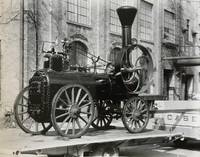
190950392Racine WI; St. Joseph MI; Chicago IL: J.I. Case Threshing Machine Co.; American Society of Agricultural Engineers; Farm Equipment Institute ca. 1909 - 1962. Eighty-three original photographs printed on glossy photo stock sized from 2.5 x 4.5 in. up to 7.5 x 9.5 in. 49 are 7.5 x 9.5 in. some duplicates; 58 photos & 23 negatives mounted and preserved in original printed file folders w/ typed & ink captions annotations on covers occasional edgewear couple w/ slight scuffing affixed on front; 5 additional collotype photos included each w/ negative number in lower margin of image slight toning; together with 5 works. 4to. 40; 28; 6; 165 1; 14 pp. 100s of photo illusts. diagrams text illusts. First work: over 100 text illustrations diagrams with Arts & Crafts painting cover art showing completed road heading off into the distance some edgewear rubbing annotations on title scuffing to corners; 2nd work with over 50 text photos & illustrations w/ gray softcovers blue-tinted image of steam roller on front some soiling edgewear darkening; 3rd with 4 plates self-printed triptych catalogue pages printed in light green white borders and black & white illustrations; 4th work with over 100 photo images text illustrations inserted material with additional diagrams illustration Case letterhead; 5th work with red & black tables printed softcovers. All preserved in slipcase. This remarkable archive of over 100 factory photographs & negatives and original catalogues for the Case Threshing Machine Company offer an excellent record of the famed manufacturer of steam engines farm equipment tractors road building machinery and more. Jerome Increase Case 1819- 1891 began building threshing machines in 1847 in Racine WI and by 1869 had engineered and built Case Steam Engine Number One the first steam engine for agricultural use and depicted in two of the photographs. One of the images shows the historic engine being hauled on a trailer behind a 1962 Case work truck before it was donated to the Smithsonian. This rolling steam engine revolutionized farming and road building machinery. By 1912 Case was manufacturing a complete line of heavy equipment for road building including Case Steam Road Rollers which weighed up to 10 tons and were powered by excellent 36 - 75 horsepower multi-purpose steam engines along with Graders Rock Crushers Elevators Screens and Bins. A number of the photos are reproduced in the Case Road Building Catalogue and the Case Road Roller Catalogue. The file photos include images by H.A. Wright of 10†Case Rock Crushers being pulled by LI Tractors in Washington County IN; a Case LI Motor Patrol Galion with Scarifier by H.A. Caraway mixing oil with gravel in Montana; LI Tractors & Adams Maintainers by Daubert building roads in Polk County IA and more. Many of the images depict the Case Model C 1929-1939 and Case Model D gasoline engine tractors introduced in 1939 and developed through the 1940s and 1950s. The original photos show CI tractors fitted with Roustabout Cranes; cranes cleaning boulders from fence rows in 1929; equipped with a portable Stover Wood Saw for mills and logging; DI tractors with Hough Hydraulic Shovels; equipped with Hough fork lift; 42-inch bucket shovel; outfitted with caterpillar tracks and much more. Of particular interest in the archive is the exceedingly scarce Case Automobile catalogue for Mexico and other automobiles can be seen in the Road Building Machinery catalogue as well. In 1910 Case had purchased the Pierce Motor Co. and quickly began manufacturing the Pierce-Racine automobile and later the Case Auto employing Pierce Motor Cos.’ 8000 dealers and agents worldwide. Case produced touring models sedans coupes and limousines as well as race cars. They ceased production of autos in the mid-1920s. Of additional interest are the two reports included on the productivity gains made by the rapidly improving farm equipment manufactured by Case with graphs and details showing how farmers were benefitting from the technology improvements. Worldcat locates no copies of 1st & 3rd catalogues; 1 copy of 2nd NYPL; See: Case Construction Equipment History 2013; Leffingwell Classic Farm Tractors: History of the Farm Tractor Chapter 2; Bill Ganzel Wessels Living History Farm York Nebraska 2014. J.I. Case Threshing Machine Co.; American Society of Agricultural Engineers; Farm Equipment Institute, paperback
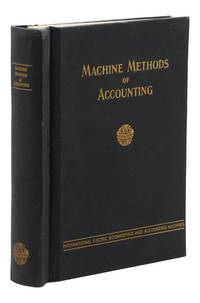
1936140948176New York: International Business Machines Corporation 1936. First Edition. Near Fine. First edition of IBM's manual published while the company dominated the punch-card tabulator calculating and data-processing machine market while standing just on the cusp of the dawn of the electronic computer. In 23 separately paginated sections with black and white diagrams and illustrations of IBM's patented accounting machines with the first section on IBM's history. Bound in publisher's black cloth pressure binder stamped in gilt. Near Fine with light wear and trivial soiling to covers. A lovely copy. International Business Machines Corporation unknown
193611036New York: IBM 1936. First Edition Revised/With Additions. Hardcover. Very Good. First Edition Revised/With Additions. Hardcover. 24 separately paginated pamphlets plus 8pp. preliminaries and including the 1942 pamphlet 19A 'Automatic Reproduction Punch / Type 513' not indicated on 24 pamphlet list all bound together as provided to the customer. This copy issued to the Amicable Life Insurance Company founded in Waco TX. 1910. 1936 copyright for all pamphlets except 20A 1940 and 19A 1942 Includes numerous illustrations and diagrams. <br /> This book was one of the "key publications from IBM". Cortada Before the Computer 307<br /> "Primarily this book was written to provide a single volume from which employees of International Business Machines Corporation may thoroughly familiarize themselves with the complete list of bookkeeping and accounting machines manufactured by their Company and with the operation of such machines of furnishing figure-facts automatically" from preliminaries p 6 <br /> The first section 14 pages is devoted to the history of IBM and sections 2 through 8 provide background on principles the punch card codes organization supervision training and controls. The remaining sections illustrate and explain numerous machines and their operation. Originally issued with 23 sections; this version was updated in 1940 and 1942 with two additional sections 19a and 20a bringing the volume current.<br /> Uncommon generally scarcce as nice as is found here. Light shelf/edge wear gilt toned ownership signature at bastard title page else tight bright and unmarred. Black pebbled cloth boards gilt lettering and decorative elements stiff black endpages. 4to. var. pag. Illus. b/w plates. IBM hardcover
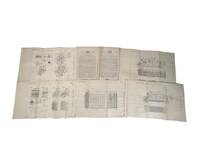
1900205091900. EngineeringInvention and Business Felt Dorr Eugene. British Patents for Improvements in Calculating Machines 1900-1904 document the development of one of the earliest commercially successful key-driven mechanical calculators reflecting the rapid mechanization of clerical labor at the turn of the twentieth century. These patents relate to the Comptometer first introduced in 1890 by the Chicago firm Felt and Tarrant and represent the extension of American technology into British commercial and financial systems. Banking insurance railways and trade demanded increasingly rapid numerical computation at the turn of the century meaning mechanical calculation was becoming integral to infrastructure.<br /> <br /> Calculating Machines. British Patents: together 2 patents. Patent No. 19675 1900 includes 3 pages and 3 folding diagrams; Patent No. 13094 1904 includes 11 pages and 5 folding diagrams. 1900-1904. The 1900 patent specification describes modifications "intended to adapt such machines to be used in making calculations in British money" addressing the complexities of pounds shillings and pence within a decimal-based mechanical framework. The 1904 patent details improvements to the Comptometer's registering wheels refining accuracy and mechanical efficiency. These documents trace the technical evolution of Felt's invention whose origins lay in his 1885 "macaroni box" prototype and whose commercial success positioned the Comptometer as a principal rival to Burroughs calculators in the early twentieth century. Together the specifications and folding diagrams provide primary evidence of iterative design in early computing machinery and the formal legal mechanisms through which intellectual property structured industrial competition.<br /> <br /> Disbound some leaves loose. Overall very good. As working technical documents issued during a formative period in mechanical computation these patents illuminate the foundations of modern calculating technology in the pre-electronic era. unknown
192453007Rochester NY: Consolidated Machine Tool Corp. 1924-1953. Two vols. 4to. 147; 131 leaves all w/ 278 silver gelatin photos sized 8.5 x 11 in. all preserved in archival mylar sleeves and nearly all with typed captions dated and often pen & pencil annotations on versos most with hole punches at gutter blank margin from being bound originally in 3-ring factory binders. Uniformly bound in recent black cloth post-binders gilt lettering stamped on covers & spines NF set. This remarkable factory photo archive documents the durable and invaluable machine tools which built American industrial production through the 1920s and the post-World War II era. The Colburn drill presses turning lathes boring machines and boring mills were essential for such companies as Ford Motor Co. Maxwell Motorcar Co. John Deere Oakland Motor Car Co. Delco Light Co. International Harvester Nash Motors Co. Allis Chalmers Manufacturing Co. Caterpillar Tractor Co. Monarch Tractors Co. Hughes Tool Co. of Los Angeles part of Hughes Aviation Westinghouse and so many others. Many of the images show the connecting rods gears bearings engine blocks and other parts manufactured by these massive machines. A large number of the photos in the first volume show machines built and installed for the first National Machine Tool Builders’ Exposition which was held Sept. 19-23 1927 in the Cleveland Auditorium and attracted over 12000 attendees including Henry Ford the Dodge Brothers Durant George Westinghouse and many other automotive and industrial innovators and builders at the time. A number of these machines were also sold to Railroad companies including the Missouri Pacific the International & Great Northern Railway in Palastine TX the Chesapeake & Ohio Railway Co. in Huntington WV and more. The second volume includes Newton duplex milling machines cold saws and hot saws for metal especially aluminum and more. These photos show Newton machines being sold to Dodge Chrysler Buick General Motors Ford Bendix Wright Aeronautical Corp. ALCOA as well as photos showing engine blocks being milled and the internal works of many of the machines. Newton was originally founded in 1880 by Charles C. Newton who specialized as a twist drill manufacturer in Philadelphia and continued to expand operations until merged with Betts Machine Co. and Colburn Machine Tool Co. in 1922 to form the Consolidated Machine Tool Corp. of Rochester NY. Colburn Machine Tool Co. was founded sometime in 1890 by Henry J. Colburn and after his death in 1902 was run by his son Leslie who died in 1918. The Company which maintained a number of machinery patents for drill presses and table saws was merged later with Consolidated in 1922. Consolidated Machine Tool Corp. operated on Blossom Road in Rochester NY producing tools and machinery used in metal and plastics manufacturing. In 1951 they were acquired by the Farrel-Birmingham Co. operating until 1983 when they were sold to the Conlon Corp. See: Directory of American Toolmakers: Early American Industries Association 1999; Betts Machine Co. Manufacturers Index Vintage Machinery 2017; Colburn Machine Tool Co. Franklin PA Manufacturers Index Vintage Machinery 2017. Consolidated Machine Tool Corp., hardcover