Tabulating Machine Company; IBMBiblio.com

458 résultats
191344659New York 1913. <p>Tabulating Machine Company - C-T-R - IBM The Tabulating Machine Company. A business compass: Facts made immediately available for determining business policy. New York ©1913. Original gray printed wrappers. Very good. 48pp. Illustrated. 228 x 152 mm.</p> <p> Herman Hollerith a clerk at the U S Census Bureau invented the punch-card tabulator applying for his first patent in 1884; his punched-card system reigned as the primary large-scale data-processing system until the advent of the electronic digital computer. In 1896 Hollerith formed the Tabulating Machine Company; the British branch known as the British Tabulating Machine Company was formed in 1907 and remained connected to its American counterpart until 1949. Hollerith remained head of the Tabulating Machine Company until 1911 when he sold it to industrialist Charles R. Flint who renamed the company C-T-R. In 1915 Thomas J. Watson became president of the new company and in 1924 Watson renamed the company International Business Machines IBM. Origins of Cyberspace 373.</p> . unknown
BN107706IVAM Centre Julio Gonzalez. Hardcover. Francis Picabid <br/><br/>Francis Picabid IVAM Centre Julio Gonzalez hardcover
19692080502106912543Not Available 1969. Soft Cover. Fine. The book is in fine condition. Not Available paperback
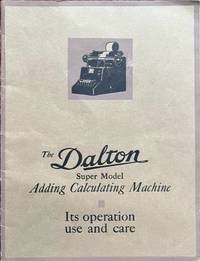
192258968Cincinnati OH: The Dalton Adding Machine Sales Co. 1922. 4to. 48 pp. Numerous photo illustrations text illustrations diagrams 1 printed in red & black. Illustrated tan softcovers lavender-coloured borders lozenge cover illust. of Dalton Super Model Machine minor shelfwear slight rubbing still VG bright copy. First edition of this uncommon promotional instruction manual and catalogue for the famed Dalton Adding Calculating Machine Super Model -- considered to be the first ten key adding machine. Dalton 1866-1926 was a successful amateur mechanic and businessman who was brought into developing the first adding machine by William & Hubert Hopkins who desperately needed money to finance their manufacturing. They set up a company in 1902 but afterwards through some secret and possibly illegal business moves by Hopkins who secretly sold his stock to the Addograph Co. Dalton managed to buy control of all rights to produce and develop adding machines and patented the invention by 1904. He would often carry a large sample machine with him fitted with glass sides to show the workings demonstrating his calculating machine becoming so successful that by 1922 over 150 models were available and over 50000 machines sold. After Lewis’ death the company was sold and merged with Remington-Rand in 1927. Worldcat locates 3 copies Oakland Pub. MT Hist. Soc. Ohio Hist. Connctn.; See: Dalton Adding Machine - Complete History of the Dalton Adding Machine History Computer Oct. 19 2021; The Computer Museum No. 106. The Dalton Adding Machine Sales Co., paperback
191444664London 1914. <p>Muldivo Calculating Machine Company. The Muldivo calculating machine. Made in France. London n.d. ca. 1914. Original printed wrappers. 12pp. Illustrated. 248 x 187 mm. VG. Advertising brochure published by the British branch of the Muldivo company. The brochure includes views of Muldivo's French factories. Origins of Cyberspace 340.</p> . unknown
MA01C-01664The Howe Machine Company. Used - Very Good. NY: The Howe Machine Company 1876. Sm 8vo Paperback. 32pp. B/W illustrations. Very Good book. Beautiful multicolor wrappers. Light edgewear to the spine. Light soiling to covers. Light occasional foxing to margins. In polypropylene bag. machinery technology trade catalog Inquire if you need further information. The Howe Machine Company paperback
19701272<p>Boxed board game gameboard instructions 23 deeds cards dice 4 black pawns 5 white pawns 26 cardboard "black power" strips play money ; box 30 x 23 x 6 cm. Very good. Contents loose in box with formed Styrofoam compartments. 1272</p><p><em>A game designed to spread awareness of structural racism though role play. Blacks & Whites was created to highlight economic injustices against African Americans and to promote societal change. The original version which made it impossible for the black players to win was highly controversial. After testing the game further with multiracial participants Psychology Today redesigned the scenario issuing new rules that allowed black players to give extra bonus cards to a brother or sister and encouraging solidarity between black players through property swapping and personal loans. Black players then became the agents of change and the game came to emphasize the absurdity of living in different worlds while playing on the same board. "Originally published as a free game insert with paper board and unmounted cards that had to be cut out in the March 1970 issue of Psychology Today magazine which simultaneously advertised a version in a long cardboard box with better components and play money for $5.95 'Blacks & Whites' was a socially-conscious game which not only reflected the signs of the times but was also meant to effect change. In a sense it was something more akin to a social experiment and performance art in game form" --Boardgamegeek.com. Complete sets in good condition are extremely rare.</em></p> Psychology Today Games (Anaheim, Calif.) Distributed by Dynamic Design Ind. Inc.
4-44977Dresda anni '30 c.a 8vo grande br. pp. 170 con 157 tav. n.t. Testo trilingue inglese tedesco e francese. Bello ed importante catalogo sulle macchine automatiche per la confezione di sigarette con raffigurati centinaia dei pezzi che le compongono. Importante. unknown
186348991Paris Mallet-Bachelier 1863. 4to. No wrappers. In: "Comptes Rendus Hebdomadaires des Séances de L'Academie des Sciences" Tome 56 No 8. Pp. 317- 364. Entire issue offered. The paper: pp. 330-339. <br/><br/><em>First apperance of this detailled report and examination by the French mathematiciens Mathieu Chasles and Delaunay of the calculating machine invented by Martin Wiberg as an improvement on the Scheutz machine. The machine could produce tables of logarithms."Wiberg modified the Scheutz difference engine making it smaller and lighter and used it to calculate a series of interest tables published in 1860. Efter improving the print mechanism of his machine Wiberg presented it to the Academy of Sciences in Paris which voted in 1863 to "accorder son approbation à cette belle et ingénieuse machine" the paper offered. Wiberg later used the machine to produce a set of tables of seven-place logarithms of the numbers from 1 to 1000000 together with logarithms of trigonometric functions published in 1876 under the title 'Tables de logarithmes calculées et imprimées au moyen de la machine à calculer sw M. Wiberg'. Hook & Norman "Origins of Cyberspace" No. 82. </em> unknown
186359088Paris Mallet-Bachelier 1863. 4to. No wrappers. In: "Comptes Rendus Hebdomadaires des Séances de L'Academie des Sciences" Tome 56 No 8. Pp. 317- 364. Entire issue offered. The paper: pp. 330-339. <br/><br/><em>First apperance of this detailled report and examination by the French mathematiciens Mathieu Chasles and Delaunay of the calculating machine invented by Martin Wiberg as an improvement on the Scheutz machine. The machine could produce tables of logarithms. </em> unknown
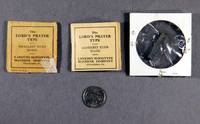
192043960Philadelphia: Lanston Monotype Machine Company 1920. Miniature book approx. an inch-and-a-half square 38 x 38 mm unpaged text printed on rectos only; illustrations; printed staplebound self-wrappers volume laid into publisher's printed bifolium toned accompanied by one piece of type measuring 1/6 of an inch square on which is cast the Lord's Prayer; tear and loss to bifolium the former crudely repaired the latter not affecting text; text volume and cast fine. The Lord's Prayer "can be plainly read with the aid of a good reading glass. Lanston Monotype Machine Company unknown
2002Adhya-9783540440369SPRINGER 2002. Paperback. New. SPRINGER paperback
2002Adhya-9783540440369SPRINGER 2002. Paperback. New. SPRINGER paperback
188642668London Harrison and Sons 1886. 4to. No wrappers as extracted from "Philosophical Transactions" 1885. Vol. 176 - Part II Pp. 367-402 a. 34 textillustr. <br/><br/><em>First appearance of an importent paper in the history of calculating machines."In his first year at Liverpool he published a paper on 'The theory of continuous calculating machines and of a mechanism of this class on a new principle' in the prestigious Philosophical Transactions of the Royal Society. This work investigated how to advance the design of integrator mechanisms and fit them for tasks more complex than mere numerical calculating machines and was extremely important in the development of analogue computing."Jane Carruthers </em> unknown
191853953Washington D.C.: Government Printing Office 1918. 12mo. 72 pp. With 9 plates a couple photographic 2 large folding. Light blue printed softcovers minor edgewear dustsoiling very minor creasing to corners still VG copy from the library of former Sergeant Errol George Sinclair 1895-1971 enlisted in 1917 trained with the Machine Gun Company at Fort Logan CO and Fort Douglas UT and then transferred in 1918 to the 10th Division at Camp Funston Fort Riley KS. First edition of this very scarce and excellent United States Army manual on the updated M1917 Machine Gun developed by Carl Swebilius a longtime Swedish-American Marlin gunsmith and engineer which was sold originally to the Army as a machine gun for tanks. This improved version was designed for use in Army Air Corps airplanes with many aluminum parts to conserve weight using Constantinesco-Colley synchronizing gear firing through the plane’s spinning propellers and were well received as they did not have the problems of freezing experienced by the Lewis machine guns. Twenty-two squadrons of the US Army Air Corps in France weresupplied with Marlin Machine guns and more than 1500 were sent to the AEF who held them in front line service until 1925. Worldcat locates 4 copies Yale Hagley Cleveland US Army War College. Government Printing Office, paperback
1914446631914. <p>Muldivo Calculating Machine Company. A masterpiece of French mechanism. N.p. n.d. ca. 1914. Unbound circular. Single sheet. 272 x 215 mm. Tears in lower margin not affecting text readability. Good. Lists three models of the Muldivo calculator.Origins of Cyberspace 341.</p> . unknown
1884120254Hartford Conn. : Hartford Sorghum Machine Co 1884. First Edition. Hardback. Very good copy in finely bound in full gilt-blocked brown buckram. ; Description: ill. Subjects: Sugar pamphlets. Spine tile: ""Sugar Pamphlets"". Date is suggested/cannot be verified. Hartford, Conn. : Hartford Sorghum Machine Co hardcover
Dahlgren, Anna, Dag PeterIn Pristine Condition. unknown
1970ZB253512Pergamon Press 1970. volumes 5 17 19-20 26-32 1970-1997 all complete volumes mostly original paper wrappers ex library good price is for the lot. - If you are reading this this item is actually physically in our stock and ready for shipment once ordered. We are not bookjackers. Buyer is responsible for any additional duties taxes or fees required by recipient's country. Photos available upon request. Pergamon Press unknown
19602092902140601173Japan Machine Paper Association Keiji Kyushu Hyogo Osaka 4 Branch Joint Editing Desk 1960. Soft Cover. Fine. Size: B6 Number of books: 4 Japan Machine Paper Association Keiji Kyushu Hyogo Osaka 4 Branch Joint Editing Desk paperback
19942092902137400535Toho shoten 1994. Soft Cover. Fine. Number of books: 1 book Toho shoten paperback
191824873Cupples & Leon Company London 1918. HBDJ1918. 1st Edition 1st Printing Pretext Lists thru this Title Hardcover. Book Condition: Very Good. Dust Jacket Condition: Very Good- AS-IS with tiny edge chips Tears but Illustration & titles INTACT on front & Spine DJ. Decorative cloth boards have a lightly bumped corner and spine head & tail but are otherwise fine. Some dust-staining of the top text block edge. Otherwise a very clean well-bound copy. DJ which features a color illustration by Botkin has a couple of closed edge tears with related light creasing and moderate shelf wear. Nevertheless this remains a sharp-looking copy. NOT an ex-library copy! Interior nice tight clean light wear fox 202 pgs ADS in back thru Fred Fenton Marathon Runner . fighting in the trenches of Europe. Boys Reach France & After Some Intensive training in sound of the Battle Front are sent to Trenches. in the Raids Across No-Mans Land they have Numerous Tragic adventures that Show what great Work is being performed by our Soldiers It Shows What Makes Heroes. First Edition. Hard Cover. Cupples & Leon Company, London hardcover
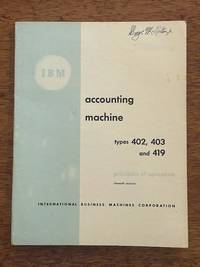
19535583n.p.: International Business Machines Corporation IBM 1953. Eleventh Revision. Paperback. Very good. Originally published 1949. Detailed user manual for IBM's workhorse tabulating accounting machine controlled by a removable plugboard. Very good softcover text clean previous owner's name light wear to covers. 157 pp illustrated. International Business Machines Corporation (IBM) paperback
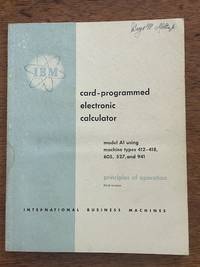
19545584n.p.: International Business Machines Corporation IBM 1954. Third Revision. Paperback. Good-. Originally published 1951. Detailed user manual for IBM's "externally programmed automatic calculator" combining a calculator electronic accounting machine and external relay memory. Not quite a stored-program computer because instructions were executed directly from cards it was still called the "poor man's ENIAC". Good- softcover some water damage to back cover text clean previous owner's name light wear to covers. 135 pp illustrated. International Business Machines Corporation (IBM) paperback
194161344Fort Lewis WA: United States Army 752nd Tank Battalion Medium 1941. Oblong 4to. 10.5 x 8 in. 64 pp assorted paginations. mimeographed 1 pp. large folding. With photo illustrations and blueprint diagrams for Thompson submachine guns throughout. Front cover w/ mimeograph title stapled at gutter margin as issued B-1351 stamped on 3 different section titles on multi-coloured papers age toning to fore-edges minor scuffing edgewear still VG copy from library of Sergeant Bill Godwin of the 752nd Tank M.edium Battalion stationed in 1941 after being activated in Fort Knox KY at Fort Lewis Washington. First edition of this exceedingly scarce World War II manual for the Thompson Submachine gun which clearly illustrates the disassembly and assembly of the gun; all the parts; blueprints of the gun features; and specific care and cleaning instructions. All of these steps are clearly delineated in large photos with step-by-step descriptions. First conceived and designed in 1918 by John T. Thompson for a high velocity and lightweight weapon for soldiers on the Western Front during World War I the submachine gun did not start rolling off the assembly lines until 1921 and subsequently became known as the ruthless weapon of the mob wars and later soldiers during World War II with monikers of “Chicago Organ Grinder†“Trench Broomâ€and “The Annihilator.†It was initially not issued to police departments around the country due to the fact that the rapid fire of the gun was uncontrollable and could potentially injure or kill an innocent bystander. No copies in Worldcat. United States Army, 752nd Tank Battalion (Medium), unknown