American Machinist Vol. 48
0282633863.Gpaperback. Good. Access codes and supplements are not guaranteed with used items. May be an ex-library book. paperback
Bonita · États-Unis78,71 $US≈ 66,60 €
458 résultats
2111902153102341Nainen Publishing N.A. Soft Cover. Fine. Number of books: 1 Nainen Publishing paperback
0282633863.Gpaperback. Good. Access codes and supplements are not guaranteed with used items. May be an ex-library book. paperback
1333769628.Gpaperback. Good. Access codes and supplements are not guaranteed with used items. May be an ex-library book. paperback
188499137A. & F. Brown New York 1884. Pamphlet. Used - Very Good. 1882. 81 pages. Illustrated: pulleys hangers floor mule stands journal box pillow blocks clutch couplings countershaft binder frame universal joint folding plate of cone sections. 7 x 4.75" printed wrapper. VG. A. & F. Brown, New York unknown
19622110502150411669Iwasaki shoten 1962. Soft Cover. Fine. Number of books: 7 Iwasaki shoten paperback
191853954Washington D.C.: War Plans Division Office of the Adjutant General August 1918. 12mo. 40 pp. With 9 plates couple photographic 1 large folding. Light tan printed softcovers minor edgewear still NF copy from the library of former Sergeant Errol George Sinclair 1895-1971 enlisted in 1917 trained with the Machine Gun Company at Fort Logan CO and Fort Douglas UT and then transferred in 1918 to the 10th Division at Camp Funston Fort Riley KS. First edition of this very scarce United States Army manual on the famed Browning Automatic Rifle BAR and the M1918 version was chambered for the .30-06 Springfield rifle cartridge and designed by John Browning in 1917 for the AEF. Although designed to be used firing from the hip with a sling over the shoulder in practice this light machine gun was often fired from a bipod and eventually became standard issue in the US Army in 1938 used extensively through World War II and the Korean War. Worldcat locates 6 copies Connecticut State Library Hagley US Army Combined Arms War College Western Reserve Wisconsin Vet Museum. War Plans Division, Office of the Adjutant General, paperback
191853953Washington D.C.: Government Printing Office 1918. 12mo. 72 pp. With 9 plates a couple photographic 2 large folding. Light blue printed softcovers minor edgewear dustsoiling very minor creasing to corners still VG copy from the library of former Sergeant Errol George Sinclair 1895-1971 enlisted in 1917 trained with the Machine Gun Company at Fort Logan CO and Fort Douglas UT and then transferred in 1918 to the 10th Division at Camp Funston Fort Riley KS. First edition of this very scarce and excellent United States Army manual on the updated M1917 Machine Gun developed by Carl Swebilius a longtime Swedish-American Marlin gunsmith and engineer which was sold originally to the Army as a machine gun for tanks. This improved version was designed for use in Army Air Corps airplanes with many aluminum parts to conserve weight using Constantinesco-Colley synchronizing gear firing through the plane’s spinning propellers and were well received as they did not have the problems of freezing experienced by the Lewis machine guns. Twenty-two squadrons of the US Army Air Corps in France weresupplied with Marlin Machine guns and more than 1500 were sent to the AEF who held them in front line service until 1925. Worldcat locates 4 copies Yale Hagley Cleveland US Army War College. Government Printing Office, paperback
194161344Fort Lewis WA: United States Army 752nd Tank Battalion Medium 1941. Oblong 4to. 10.5 x 8 in. 64 pp assorted paginations. mimeographed 1 pp. large folding. With photo illustrations and blueprint diagrams for Thompson submachine guns throughout. Front cover w/ mimeograph title stapled at gutter margin as issued B-1351 stamped on 3 different section titles on multi-coloured papers age toning to fore-edges minor scuffing edgewear still VG copy from library of Sergeant Bill Godwin of the 752nd Tank M.edium Battalion stationed in 1941 after being activated in Fort Knox KY at Fort Lewis Washington. First edition of this exceedingly scarce World War II manual for the Thompson Submachine gun which clearly illustrates the disassembly and assembly of the gun; all the parts; blueprints of the gun features; and specific care and cleaning instructions. All of these steps are clearly delineated in large photos with step-by-step descriptions. First conceived and designed in 1918 by John T. Thompson for a high velocity and lightweight weapon for soldiers on the Western Front during World War I the submachine gun did not start rolling off the assembly lines until 1921 and subsequently became known as the ruthless weapon of the mob wars and later soldiers during World War II with monikers of “Chicago Organ Grinder†“Trench Broomâ€and “The Annihilator.†It was initially not issued to police departments around the country due to the fact that the rapid fire of the gun was uncontrollable and could potentially injure or kill an innocent bystander. No copies in Worldcat. United States Army, 752nd Tank Battalion (Medium), unknown
191560859New York & San Francisco CA: Singer Sewing Machine Manufacturing Co. 1915. Oblong 12mo. 5.4 x 4 in. 13 3 pp. printed in sepia. With numerous illustrations. Colour-printed softcovers in green illust. of seamstress sewing on a Singer on verso of front cover and illustration of the Singer Pavilion on verso of back cover minor dustsoiling slight shelfwear still VG bright copy from the library of Prof. Marvin Nathan. First edition of this very scarce Singer Sewing Machine company exhibit catalogue for the Panama-Pacific International Exposition display which included an entire series of paintings recreated with sewing machine embroidery “Costumes of All Nations†featuring national dress on dress mannequin’s along with cases displaying sewing samples created as part of the instructional book system at Singer Sewing Centers. The illustrations depict those items which could be created by the homemaker on their own Singer. Worldcat locates 2 copies Cal State Library Sutro. Singer Sewing Machine Manufacturing Co., paperback
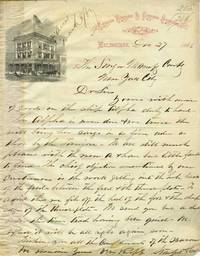
1866197671866. Very good condition. A letter dated December 27 1866 on illustrated letterhead paper showing the Stanford & C. Singer Sewing Machine building in Melbourne Corner Bourke & Russell Streets to the Singer Sewing Machine Company New York City discussing a recently delivered order and making suggestions on design changes based on customer complaints. "We send you but a short order this time trade having been quiet. We expect it will be all right again soon." 8 x 10" 1862 watermarked cream paper with engraving of Stanford building printed in black address printed in red. One inch strip of paper used to tip into volume on verso. unknown
192453007Rochester NY: Consolidated Machine Tool Corp. 1924-1953. Two vols. 4to. 147; 131 leaves all w/ 278 silver gelatin photos sized 8.5 x 11 in. all preserved in archival mylar sleeves and nearly all with typed captions dated and often pen & pencil annotations on versos most with hole punches at gutter blank margin from being bound originally in 3-ring factory binders. Uniformly bound in recent black cloth post-binders gilt lettering stamped on covers & spines NF set. This remarkable factory photo archive documents the durable and invaluable machine tools which built American industrial production through the 1920s and the post-World War II era. The Colburn drill presses turning lathes boring machines and boring mills were essential for such companies as Ford Motor Co. Maxwell Motorcar Co. John Deere Oakland Motor Car Co. Delco Light Co. International Harvester Nash Motors Co. Allis Chalmers Manufacturing Co. Caterpillar Tractor Co. Monarch Tractors Co. Hughes Tool Co. of Los Angeles part of Hughes Aviation Westinghouse and so many others. Many of the images show the connecting rods gears bearings engine blocks and other parts manufactured by these massive machines. A large number of the photos in the first volume show machines built and installed for the first National Machine Tool Builders’ Exposition which was held Sept. 19-23 1927 in the Cleveland Auditorium and attracted over 12000 attendees including Henry Ford the Dodge Brothers Durant George Westinghouse and many other automotive and industrial innovators and builders at the time. A number of these machines were also sold to Railroad companies including the Missouri Pacific the International & Great Northern Railway in Palastine TX the Chesapeake & Ohio Railway Co. in Huntington WV and more. The second volume includes Newton duplex milling machines cold saws and hot saws for metal especially aluminum and more. These photos show Newton machines being sold to Dodge Chrysler Buick General Motors Ford Bendix Wright Aeronautical Corp. ALCOA as well as photos showing engine blocks being milled and the internal works of many of the machines. Newton was originally founded in 1880 by Charles C. Newton who specialized as a twist drill manufacturer in Philadelphia and continued to expand operations until merged with Betts Machine Co. and Colburn Machine Tool Co. in 1922 to form the Consolidated Machine Tool Corp. of Rochester NY. Colburn Machine Tool Co. was founded sometime in 1890 by Henry J. Colburn and after his death in 1902 was run by his son Leslie who died in 1918. The Company which maintained a number of machinery patents for drill presses and table saws was merged later with Consolidated in 1922. Consolidated Machine Tool Corp. operated on Blossom Road in Rochester NY producing tools and machinery used in metal and plastics manufacturing. In 1951 they were acquired by the Farrel-Birmingham Co. operating until 1983 when they were sold to the Conlon Corp. See: Directory of American Toolmakers: Early American Industries Association 1999; Betts Machine Co. Manufacturers Index Vintage Machinery 2017; Colburn Machine Tool Co. Franklin PA Manufacturers Index Vintage Machinery 2017. Consolidated Machine Tool Corp., hardcover
52990Washington: G.P.O. 1896. 4to. 95 1 pp. Numerous plates diagrams. Salmon-coloured printed softcovers minor chipping to corners some dustsoiling edgewear rebacked still a VG copy. First edition of this excellent work examining the development deployment mountings carriages and cartridges and of such Machine Guns as the Gatling Gun produced by the Colt’s Arms Company Gardner Machine Gun and the Hotchkiss revolver cannon which were employed by the U.S. Army through the Spanish-American War before the adoption of the Maxim. G.P.O., paperback
1999Q-1897884516Brown Books 1999-01-01. Hardcover. New. In shrink wrap. Looks like an interesting title! Brown Books, hardcover
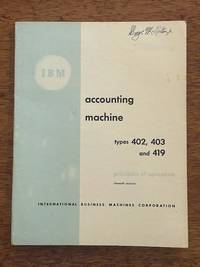
19535583n.p.: International Business Machines Corporation IBM 1953. Eleventh Revision. Paperback. Very good. Originally published 1949. Detailed user manual for IBM's workhorse tabulating accounting machine controlled by a removable plugboard. Very good softcover text clean previous owner's name light wear to covers. 157 pp illustrated. International Business Machines Corporation (IBM) paperback
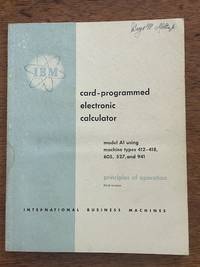
19545584n.p.: International Business Machines Corporation IBM 1954. Third Revision. Paperback. Good-. Originally published 1951. Detailed user manual for IBM's "externally programmed automatic calculator" combining a calculator electronic accounting machine and external relay memory. Not quite a stored-program computer because instructions were executed directly from cards it was still called the "poor man's ENIAC". Good- softcover some water damage to back cover text clean previous owner's name light wear to covers. 135 pp illustrated. International Business Machines Corporation (IBM) paperback
192359273Racine WI: J.I. Case Threshing Machine Co. 1923. Two vols. 1st - 4to. 75 1 pp. Tables throughout. Printed illustrated gray softcovers black lettering & illust. of Case Thresher on front cover minor bumping to corners dustsoiling closed tear still VG-; 2nd - 8vo. 87 1 pp. With over 71 photo and text illustrations. Quarter-tan cloth over tan printed softcovers minor chipping & wear to corners edgewear still G copy. First edition of the very rare parts catalogue for the Case Threshing Machine Company steel threshers and third edition of the manual. The parts catalogue includes specific measurements part nos. and details on axles belts cylinder bearings grain conveyors augers sieves shoe shakes and more. Jerome Increase Case 1819- 1891 began building threshing machines in 1847 in Racine WI and by 1869 had engineered and built Case Steam Engine Number One. Subsequently Case began producing a whole line of self-propelled traction engines portable engines twine binder machines separators stackers and more. No copies in Worldcat of 1st; 2 copies of 2nd; See: Case Construction Equipment History 2013; Leffingwell Classic Farm Tractors: History of the Farm Tractor Chapter 2; Bill Ganzel Wessels Living History Farm York Nebraska 2014. J.I. Case Threshing Machine Co., paperback
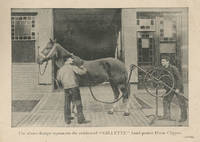
189750186N.P.: Privately printed n.d. ca 1897. ca 1897. First edition. 3 3/4" x 5 1/4" original black and white paper advertisement printed on both sides. Front side offers a photo of two men man using the "Gillette" hand-power horse clipper. Opposite side offers pricing and general information about the machine. Hand Power Machine $50; Steam of Electric Power Machine $75. Light soiling and with light wear to edges. Very good. Privately printed, n.d. (ca 1897). unknown
1905u3820Fitchburg MA: Fitchburg Machine Works 1905. Brief technical treatise on this machine tool listing its advantages and uses discussion of problems of other lathe types. Hardcover full green cloth gilt titling. Handsome typography with red paragraph headers; printed by Bartlett & Company the Orr Press NY. Light wear corners slightly frayed minor bubbling to spine light discoloration in the gutters. Text clean; 28 pages 4 b/w plates. First Edition. Cloth. Very Good. 6¼" by 9¼". Fitchburg Machine Works Hardcover
193953215New York: Singer Sewing Machine Manufacturing Co. Departamento de Educacion January 1941; 1939. Two vols. 1st - Tall 8vo. 225 1 pp. Over 150 colour and black & white photo illustrations diagrams. Black textured softcovers gilt lettering & decoration printed on front cover edgewear bumping to corners minor soiling old tape repairs to front cover still G- copy; 2nd -- Oblong 4to. 12 x 7.75 in. 54 pp. on pink-tinted paper with 57 tipped-in fabric embroidered sewing samples including over on linen silk lace satin and wool textiles each w/ school stamp approving sample. Half-blue cloth post-binder over blue goards gilt lettering stamped on front cover sewn at gutter margin w/ white silk ribbon soiling minor dampstain curving to covers from the bulk of the tipped-in samples on the leaves still a VG exemplar. Both preserved in blue textured cardboard box & lid minor edgewear faint tidemark to lower fore-edge 1 corner. Fourth revised edition of this well-illustrated embroidery guide on stitches to be learned and executed on Singer Sewing Machines together with a beautifully done sample book showing Ms. Alos’ skills in learning the necessary skills in her Singer school in Villa Canas Argentina. The Singer Sewing Machine company developed special Singer Sewing Academia in Argentina Mexico and many other South American countries as well as Spain between the World Wars. These special private schools for professional dressmakers using the Singer manuals allowed female-owned dressmaking businesses to grow and create professional spaces separte from men. In addition these academias allowed women to pay by the class and embroidery was one of the advanced skills which commanded higher wages for women at the time. Singer actively encouraged this movement in order to develop home-based businesses and academias which in turn increased their sales of sewing machines. The sample book begins with a number of decorative types of embroidery stitches monograms and then displays floral patterns spider-web patterns laces a beautifully embroidered red roses and carnations on purple silks and satins. Worldcat locates 2 copies of the Libro Singer Bibliotecas del Tecnologico de Monterrey Mexico; British Library 3rd editions; See: Ketteler Sewing through the years in art women and society; Paula de la Cruz-Fernandez Atlantic Threads: Singer in Spain and Mexico 1860-1940 pp. 198-210. Singer Sewing Machine Manufacturing Co., Departamento de Educacion, paperback
291165Rochester: Davenport Machine Tool Co. paperback. near fine. Illustrated b/w. 24 pages. Slim 4to blue flexible boards with decorative cover. Rochester: Davenport Machine Tool Co. no date c. 1910. A near fine copy.<br/> <br/> Davenport Machine Tool Co unknown
1979022247Rochester NY: George Eastman House Publisher 1979. Unbound. Good. Approximately 9 by 12 inch folder with 6 8 ½ by 11 inch sheets of paper and a folded George Eastman House Newsletter. Folder with color artwork a Xerox 6500 print by Erin Goodwin on the front cover. A collection of handouts describing the agenda for the November 10-11 1979 symposium at the George Eastman House titled "Electroworks." This symposium and art exhibit focused on work by artists using copy machines Xerox and other electromechanical reproductive machines to create art. The symposium featured many lectures on creating art the preservation of the art the use of Xerox and electrostatic printing and other subjects. Included in the folder are itineraries a map and list of nearby restaurants a newsletter with an article on Electroworks etc. The exhibit itself was the first of its kind but according to Artforum the art did not live up to its expectations. GOOD condition. Some wrinkling toning and creasing to the folder with scuffing along the edges. Some of the inserts with ink notes written on them. George Eastman House, Publisher unknown
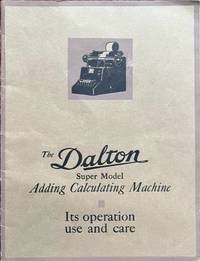
192258968Cincinnati OH: The Dalton Adding Machine Sales Co. 1922. 4to. 48 pp. Numerous photo illustrations text illustrations diagrams 1 printed in red & black. Illustrated tan softcovers lavender-coloured borders lozenge cover illust. of Dalton Super Model Machine minor shelfwear slight rubbing still VG bright copy. First edition of this uncommon promotional instruction manual and catalogue for the famed Dalton Adding Calculating Machine Super Model -- considered to be the first ten key adding machine. Dalton 1866-1926 was a successful amateur mechanic and businessman who was brought into developing the first adding machine by William & Hubert Hopkins who desperately needed money to finance their manufacturing. They set up a company in 1902 but afterwards through some secret and possibly illegal business moves by Hopkins who secretly sold his stock to the Addograph Co. Dalton managed to buy control of all rights to produce and develop adding machines and patented the invention by 1904. He would often carry a large sample machine with him fitted with glass sides to show the workings demonstrating his calculating machine becoming so successful that by 1922 over 150 models were available and over 50000 machines sold. After Lewis’ death the company was sold and merged with Remington-Rand in 1927. Worldcat locates 3 copies Oakland Pub. MT Hist. Soc. Ohio Hist. Connctn.; See: Dalton Adding Machine - Complete History of the Dalton Adding Machine History Computer Oct. 19 2021; The Computer Museum No. 106. The Dalton Adding Machine Sales Co., paperback
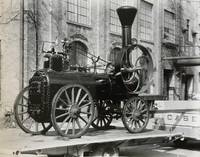
190950392Racine WI; St. Joseph MI; Chicago IL: J.I. Case Threshing Machine Co.; American Society of Agricultural Engineers; Farm Equipment Institute ca. 1909 - 1962. Eighty-three original photographs printed on glossy photo stock sized from 2.5 x 4.5 in. up to 7.5 x 9.5 in. 49 are 7.5 x 9.5 in. some duplicates; 58 photos & 23 negatives mounted and preserved in original printed file folders w/ typed & ink captions annotations on covers occasional edgewear couple w/ slight scuffing affixed on front; 5 additional collotype photos included each w/ negative number in lower margin of image slight toning; together with 5 works. 4to. 40; 28; 6; 165 1; 14 pp. 100s of photo illusts. diagrams text illusts. First work: over 100 text illustrations diagrams with Arts & Crafts painting cover art showing completed road heading off into the distance some edgewear rubbing annotations on title scuffing to corners; 2nd work with over 50 text photos & illustrations w/ gray softcovers blue-tinted image of steam roller on front some soiling edgewear darkening; 3rd with 4 plates self-printed triptych catalogue pages printed in light green white borders and black & white illustrations; 4th work with over 100 photo images text illustrations inserted material with additional diagrams illustration Case letterhead; 5th work with red & black tables printed softcovers. All preserved in slipcase. This remarkable archive of over 100 factory photographs & negatives and original catalogues for the Case Threshing Machine Company offer an excellent record of the famed manufacturer of steam engines farm equipment tractors road building machinery and more. Jerome Increase Case 1819- 1891 began building threshing machines in 1847 in Racine WI and by 1869 had engineered and built Case Steam Engine Number One the first steam engine for agricultural use and depicted in two of the photographs. One of the images shows the historic engine being hauled on a trailer behind a 1962 Case work truck before it was donated to the Smithsonian. This rolling steam engine revolutionized farming and road building machinery. By 1912 Case was manufacturing a complete line of heavy equipment for road building including Case Steam Road Rollers which weighed up to 10 tons and were powered by excellent 36 - 75 horsepower multi-purpose steam engines along with Graders Rock Crushers Elevators Screens and Bins. A number of the photos are reproduced in the Case Road Building Catalogue and the Case Road Roller Catalogue. The file photos include images by H.A. Wright of 10†Case Rock Crushers being pulled by LI Tractors in Washington County IN; a Case LI Motor Patrol Galion with Scarifier by H.A. Caraway mixing oil with gravel in Montana; LI Tractors & Adams Maintainers by Daubert building roads in Polk County IA and more. Many of the images depict the Case Model C 1929-1939 and Case Model D gasoline engine tractors introduced in 1939 and developed through the 1940s and 1950s. The original photos show CI tractors fitted with Roustabout Cranes; cranes cleaning boulders from fence rows in 1929; equipped with a portable Stover Wood Saw for mills and logging; DI tractors with Hough Hydraulic Shovels; equipped with Hough fork lift; 42-inch bucket shovel; outfitted with caterpillar tracks and much more. Of particular interest in the archive is the exceedingly scarce Case Automobile catalogue for Mexico and other automobiles can be seen in the Road Building Machinery catalogue as well. In 1910 Case had purchased the Pierce Motor Co. and quickly began manufacturing the Pierce-Racine automobile and later the Case Auto employing Pierce Motor Cos.’ 8000 dealers and agents worldwide. Case produced touring models sedans coupes and limousines as well as race cars. They ceased production of autos in the mid-1920s. Of additional interest are the two reports included on the productivity gains made by the rapidly improving farm equipment manufactured by Case with graphs and details showing how farmers were benefitting from the technology improvements. Worldcat locates no copies of 1st & 3rd catalogues; 1 copy of 2nd NYPL; See: Case Construction Equipment History 2013; Leffingwell Classic Farm Tractors: History of the Farm Tractor Chapter 2; Bill Ganzel Wessels Living History Farm York Nebraska 2014. J.I. Case Threshing Machine Co.; American Society of Agricultural Engineers; Farm Equipment Institute, paperback
192033244Suffolk Virginia: Benthall Machine Company Inc 1920. Wraps. Good. Staple color illustrated wraps. 16 pages. Color illustrated covers with title on the front cover. Illustrated with photographs and diagrams. There are 2 exact same tri-folding illustrated "Recent Improvements Benthall Peanut Packers" inserts in this promotional advertisement. Some light occasional foxing to the contents. No date given for publication. A date of 1927 listed under the "General Description Benthall Machine Company, Inc unknown
192054906Providence R.I.: The Beaman & Smith Co. 1920. 8vo. 40 pp. Frontisp. birds-eye view of factory 1 map photo illustrations and text illustrations throughout. Gray printed softcovers blue lettering front cover minor dustsoiling still NF copy. First edition of this rare catalogue presenting their complete line of boring and milling machines for use in manufacturing automobile engines and parts. These include the continuous milling machine vertical eight spindle cylinder boring machine crank case boring machine and others which drove the rapid expansion of automobile production in the United States following World War I. Beaman and Smith were a manufacturer of precision machine tools founded in 1886 and would continue successfully operate until closing in 1926. No copies located in Worldcat; See: Beaman and Smith Company Mill Providence RI National Register of Historic Places National Park Service 2005 Section 8 pp. 1-10. The Beaman & Smith Co., paperback