251 résultats
5 voll. Folio. viii pp. (incl. frontespizio inciso) + 596 + 607–638; + 252 (ultima carta bianca); + 244 + 84 + 184 (ultima carta bianca); + viii + 340 (ultima carta bianca) + 348 + xx (ultima carta bianca); + viii + 552 + xii + 60 + 244; + xii + 624 (ultima carta bianca) + 124 (ultima carta bianca) + 60 + 20 + 24 pp. Numerosi legni e diagrammi nel testo. Legatura in pelle coeva, dorso dorato. Bruniture omogenee della carta. The evidence of the attempts to leave the Aristotelianism for the modern method and an important proof of the Galileian revolution.Clavius's work includes in addition to commentary on arithmetic and algebra one on Euclid, Teodosio and Sacrobosco; his contribution to the study of trigonometry and astronomy; his work on the calendar. Clavius has been for mathematics in Renaissence a real turning point: “Probably the man who did the most of all the German scholars of the 16th century to extend the knowledge of mathematics… was Cristopher Clavius, a Jesuit, who passed the later years of his life in Rome. He was an excellent teacher… His Algebra appeared in 1608 and was one of the best textbooks on the subject that had been written up to that time… (he was) engaged in the reform of the calendar…” (Smith). Opera Mathematica in his third volume contains the Sphaera in his last editorial, to which Clavius worked during 1610 and which was printed in 1611. Shortly thereafter, in February 1612, Clavius was dying after a period of illness. In March 1610 following his comments on the telescope, Galileo published in Sidereus Nuncius his latest astronomical discoveries. These findings, perhaps only for a lucky snap of dates, are among the topics covered in the review of Sphaera, where Clavius shows to recognize the meaning. Clavius and the Jesuits in those years had to go back to seriously consider the observations of Galileo, and had to acquire the telescope also to repeat the observations and then verify their accuracy. Clavius led directly the observations (especially on the phases of Venus and the moons of Jupiter, but also on the lunar spots) along with a group of young Jesuit mathematicians and astronomers, first of all Grienberger, thus removing, towards the end of his life and following a long friendship with Galileo, his skepticism about the Copernican theory. Galileo himself in a letter to Madame Christina of Lorraine in 1615 wrote that “altri matematici, i quali mossi da gli ultimi miei scoprimenti, hanno confessato essere necessario mutare la già concepita costituzione del mondo, non potendo in conto alcuno più sussistere”. Galilei continues that one of them was just Clavius, and the reference is certainly to the pitch of the Opera Mathematica Tomo III, p. 75, where as the result of the list of Galileo's discoveries, the Jesuit ends “Quae cum ita sint, videant Astronomi quo pacto orbes coelestes constituendi sint ut haec phaenomena possint salvari”. It 's an extraordinary moment in the history of cosmology and Church, which has marked the highlight of the heliocentric theory, which no major scientists, mathematicians and astronomers of the Society of Jesus, thought no more be able to object. As D'Elia notes (pp. 14-15): "The confirmation from him on the discoveries of the astronomer from Pisa and on the copernican interpretation he deduced, had definitive influence and perhaps even dominate, to ensure the discoveries the almost universal acceptance in the intellectual world, even if the disappearance of the old professor and that of several of his closest disciples could not prevent the ecclesiastical Authority’s precept of 1616 and the condemnation of 1633 ". Clavius had even got that Galileo was received at the Roman College, and was himself to "explain" to Cardinal Bellarmine scientific discoveries of Galilei. So while the academic and obviously ecclesiastical circles did not leave officially by the Aristotelian position, a scientist of them, for evidence and intellectual honesty, was preparing the way for the acceptance of Galileo's discoveries, and could do so given the authority of his position, achieved mainly thanks to its capital contribution asked by Gregory XIII to reform the Julian calendar, which led to the drafting of the Gregorian Calendar. Christoph Clavius (Bamberg 1538-1612) Jesuit and mathematician, astronomer, he entered the Jesuit College in Rome in '55 and then went to Coimbra, where he studied mathematics and science; back to Rome to study theology, he remained as a professor for fortyfive years. He became a pivotal figure for the general mathematical and scientific renewal that had in the Compagnia di Gesù a driving force, entering into the main controversies of the time, from the squaring of the circle to the comparison between the Ptolemaic and Copernican theories. He was the master, among other things, of Matteo Ricci, who with the help of his students, translated many works of Clavius in China, including the six books of Euclid's Elements (1574), which had several editions and updates; a work who had an enormous influence, providing a compendium of knowledge on geometry. His other important works were the Commentaries on Sphaera di Sacrobosco, a treatise on spheres’ geometry and astronomy, and work on the astrolabe. He determined the subsequent development of algebra. De Backer & Sommervogel, 2, cols. 1222–3 (with details of contents). DSB, 3, pp. 311–2. D’Elia, Pasquale, Galileo in Cina, Roma, Università Gregoriana, 1947. Jardine, Nicholas. "The Forging of Modern Realism: Clavius and Kepler against the Sceptics." Studies in History and Philosophy of Science 10 (1979): 141-73. Lattis, James M. Between Copernicus and Galileo: Christoph Clavius and the Collapse of Ptolemaic Cosmology. Chicago: University of Chicago Press, 1994 Proceedings of the Symposium on Christoph Clavius (1538–1612), July 21, 2005, University of Notre Dame, Edited by Dennis Snow. D. E. Mungello, Curious land. Jesuit accomodation and the Origins of Sinology, 1985, p. 26. Eberhard Knobloch, Christoph Clavius – Ein astronom zwischen Antike und Kopernikus”, in Cvortrage des ersten Symposions des Bamberger Arbeitskreises Antike Naturwissenschaft und ihre Rezeption, 113-40, Wiesbaden, 1990.
In-4°, 3 volumi rilegati in mezza pergamena, Pars I: Versio latina capitum cum animadversionibus (1903), LXXX, 327pp. Pars II: Versio latina tabularum omnium cum animadversionum, glossarium, indicibus (1907), XXXI, 413pp. Pars III: Textus arabicus capitum et tabularum selectarum (1899), 280pp. Al Battani compì studi approfonditi, ricavando formule ed esponendole in un trattato, Opus Astronomicum, dove affrontò problemi di geometria sferica e trigonometria, quale, per esempio, la tecnica per determinare gli elementi di un triangolo sferico una volta noti due lati ed un angolo. I contributi dati riguardano l’introduzione del seno di un arco, una tavola di cotangenti e la formulazione di alcune proposizioni fondamentali di trigonometria sferica. Al Battani, inoltre, contestò i principi di trigonometria introdotti dai greci Ipparco di Nicea e Tolomeo; in particolare, contestò il seno e la corda d’Ipparco, formulando i rapporti trigonometrici così come sono conosciuti oggi, e le soluzioni quadrilaterali di Tolomeo sostituendole con quelle triangolari. A lui contemporanei furono Abu Nasr Mansua (900 d.C.) a cui viene attribuito il teorema dei seni per la risoluzione dei triangoli semplici, e il matematico persiano Muammad ibn Musa Al Kuwarizmi il quale compilò tavole dei seni e delle tangenti dando contributi anche alla trigonometria sferica e soprattutto entrando in contatto con gli studi indiani ripresi dall’opera astronomica Sindhind, dalla quale venne ricavato un più corretto sistema di numerazione e di calcoli usato ancora oggi. In-4°, 3 volumes half parchment binding, Pars I: Versio latina capitum cum animadversionibus (1903), LXXX, 327pp. Pars II: Versio latina tabularum omnium cum animadversionum, glossarium, indicibus (1907), XXXI, 413pp. Pars III: Textus arabicus capitum et tabularum selectarum (1899), 280pp. Al Battani carried out in-depth studies, obtaining formulas and exposing them in a treatise, Opus Astronomicum, where he addressed problems of spherical geometry and trigonometry, such as, for example, the technique for determining the elements of a spherical triangle once two sides and an angle were known. The contributions given concern the introduction of the sinus of an arch, a table of cotangents and the formulation of some fundamental propositions of spherical trigonometry. Al Battani also contested the principles of trigonometry introduced by the Greeks Hipparchus of Nicaea and Ptolemy; in particular, he contested Hipparchus's sinus and corda, formulating the trigonometric ratios as they are known today, and Ptolemy's quadrilateral solutions replacing them with triangular ones. To him contemporaries were Abu Nasr Mansua (900 AD) to whom the sinus theorem for the resolution of simple triangles is attributed, and the Persian mathematician Muammad ibn Musa Al Kuwarizmi who compiled tables of the sinuses and also contributed to spherical trigonometry and above all by getting in touch with the Indian studies taken up by the astronomical work Sindhind, from which a more correct numbering and calculation system is still used today.
In 8 (cm 16 x 21), pp. (8) + 514 + (2). Legatura coeva in piena pergamena con rinforzo in pergamena al dorso. Carte uniformemente brunite, qualche sporadica lieve gora ma nel complesso esemplare in buone condizioni. Annotazioni manoscritte al frontespizio. Stemma della Compagnia di Gesu' impresso al frontespizio e ripetuto all'ultima carta, capilettera, figure geometriche xilografate nel testo, numerose tabelle. Edizione originale del Commento del Clavio a Sphericae (Sphairikon biblia III), l'opera di Teodosio Triopolita (di Bitinia). Clavio non solo spiega compiutamente i tre libri della teoria della sfera dello scienziato tripolita, con sue nuove dimostrazioni e con laggiunta di numerosi scolii, ed espone anche una sua teoria completa della trigonometria piana e sferica.
2805<p>Manuscript 4to. 23.5 x 17.5 cm 2 ff. pencil sketch of arms Marlborough and blank 196 ff. and with 27 drawn folding plates many of which are colored. Bound in contemporary French calf spine gilt in six decorative compartments with title on letterpiece. Excellent with all plates drawn and many some colored in a very professional hand.<br /><br /></p><p>Very attractive early 18th-century French illustrated manuscript of practical geometry in seven books including individual sections on longimetry planimetry and stereometry—the fundamentals of precision surveying and draftsmanship. The manuscript closely follows but is not identical to Jacques Ozanam's <i>Géométrie Pratique du sr Boulenger</i> Paris 1684 which itself was a revision of <i>La Géométrie pratique </i>Paris 1640 by the mathematician Jean Boulenger. Though the work was reprinted well into the 18th C the present volume seems to follow Ozanam's 1693 edition most closely. Ozanam's book however lacks the drawn and colored figures of the present volume many of which are quite elaborate. The facade of Notre Dame is shown in an exercise for calculating the height of a wall and a segment on proportion features detailed miniature maps of the Brittany coastline identifying towns such as St. Malo and Mont St. Michel. <br /></p><p>The manuscript exemplifies the early 18th C approach to applied trigonometry—a field that by the mid-17th C was starting to resemble an exact science. Book II defines the common functions sine cosine secant etc.; Book V treats longimetric puzzles such as determining the height of a mountain or a spire or measuring the length of bodies of water; the final two books treat planimetry and stereometry including applied trigonometry—calculating the volumes of real bodies i.e. barrels pipes etc. Those sections of the manuscript that do not appear in <i>Géométrie Pratique</i>—mainly a tract on logarithms and a discussion of surveying instruments—also fall within Ozanam's oeuvre as he published a monograph on compasses in 1673 and a book of logarithmic tables and trigonometric functions in 1685.</p><p>Jacques Ozanam 1640-1717 was best known for his <i>Récréations mathematiques</i> Paris 1694 which "may be regarded as the forerunner of modern books on mathematical recreations." In addition to Boulenger's work he also revised that of Adriaan Vlacq 1600-1667 and the Jesuit mathematician Claude-François Milliet Dechalles.</p> DSB.10 pp.263-265. [France, early 18th century].
2805<p>Manuscript 4to. 23.5 x 17.5 cm 2 ff. pencil sketch of arms Marlborough and blank 196 ff. and with 27 drawn folding plates many of which are colored. Bound in contemporary French calf spine gilt in six decorative compartments with title on letterpiece. Excellent with all plates drawn and many some colored in a very professional hand.<br /><br /></p><p>Very attractive early 18th-century French illustrated manuscript of practical geometry in seven books including individual sections on longimetry planimetry and stereometry—the fundamentals of precision surveying and draftsmanship. The manuscript closely follows but is not identical to Jacques Ozanam's <i>Géométrie Pratique du sr Boulenger</i> Paris 1684 which itself was a revision of <i>La Géométrie pratique </i>Paris 1640 by the mathematician Jean Boulenger. Though the work was reprinted well into the 18th C the present volume seems to follow Ozanam's 1693 edition most closely. Ozanam's book however lacks the drawn and colored figures of the present volume many of which are quite elaborate. The facade of Notre Dame is shown in an exercise for calculating the height of a wall and a segment on proportion features detailed miniature maps of the Brittany coastline identifying towns such as St. Malo and Mont St. Michel. <br /></p><p>The manuscript exemplifies the early 18th C approach to applied trigonometry—a field that by the mid-17th C was starting to resemble an exact science. Book II defines the common functions sine cosine secant etc.; Book V treats longimetric puzzles such as determining the height of a mountain or a spire or measuring the length of bodies of water; the final two books treat planimetry and stereometry including applied trigonometry—calculating the volumes of real bodies i.e. barrels pipes etc. Those sections of the manuscript that do not appear in <i>Géométrie Pratique</i>—mainly a tract on logarithms and a discussion of surveying instruments—also fall within Ozanam's oeuvre as he published a monograph on compasses in 1673 and a book of logarithmic tables and trigonometric functions in 1685.</p><p>Jacques Ozanam 1640-1717 was best known for his <i>Récréations mathematiques</i> Paris 1694 which "may be regarded as the forerunner of modern books on mathematical recreations." In addition to Boulenger's work he also revised that of Adriaan Vlacq 1600-1667 and the Jesuit mathematician Claude-François Milliet Dechalles.</p> DSB.10 pp.263-265. [France, early 18th century]. books
164617092(Am Ende:) Parma, Mario Vigna, 1646. 1 Bl., 119 S. mit zahlr. Textkupfern. 1 Kupfertitel, 2 Kupfer-Porträts und 3 gefalt. Kupfertafeln. Kl.-4°. Mod. HLdr.
189113962Istanbul, Typographie et Lithographie Osmanie, 1891. 1 Bl., 214 S. (französischer Text), 157 S. (arabischer Text) mit einigen Textabb. Gr.-8°. OHLdr. (leicht bestoßen und berieben).
In -8°, pp. (2), 112; mezza pergamena. Prima edizione in volume del trattato di Menelao Alessandrino (I sec. d.C.), considerato il primo trattato di trigonometria sferica che si conosca, e che contiene anche la dimostrazione del teorema ancor oggi noto come Teorema di Menelao. Una edizione precedente dei tre libri compare anche nell’insieme di testi curato da Francesco Maurolico, che tradusse Teodosio, Euclide, Autolico e appunto Menelao in un suo lavoro dedicato agli studi della sfera (Messina, 1558). Nel 1644 Mersenne ripubblica gli “Sphaericorum libri”, sempre in un volume che comprende altri scritti (“Universae geometriae...”, Parigi, Bertier: il volume è citato da Leopardi nella sua “Storia dell’astronomia”), e sulla base del volume precedentemente citato. La presente edizione era stata curata, su fonti non coincidenti con le edizioni rammentate, dal celebre astronomo Edmund Halley per la stampa universitaria oxfordiana, nel 1712. Ma l’edizione del ’12, stampata solo parzialmente, non fu completata se non nel ’58 come postuma, quando fu chiesto a George Costard e James Bradley, entrambi astronomi a Oxford di curare la pubblicazione del lavoro. Mancano, in questa copia, le otto pagine di prefazione di Costard, numerate a parte, mentre il trattato in sé è completo: la copia è perfettamente conforme a quella conservata nella biblioteca bodleiana di Oxford. Una copia, sempre conforme a questa, e qualificata come quella del 1713-14 è stata venduta nel 2005 da Sotheby’s, asta Macclesfield. First edition in a volume of the Menelaus Alexandrinus work, considered the first spheric trigonometry essay ever known, also containing the demonstration of the theorem still known after Menelaus name. An earlier edition of the three books was also published in a collection of texts edited by Francesco Maurolico, who translated Theodosius, Euclides, Autholicus and Menelaus in a work dedicated to sphere studies (Messina, 1558). In 1644 Mersenne republish the “Sphaericorum libri”, always in a volume including more works (“Universae geometriae…”, Paris, Bertier), based on the Maurolico’s work. The Oxford edition was edited, based on different sources than the Maurolico ones, by the famous astronomer Edmund Halley, in 1712. But that edition was never published, and it was only partially printed in 1713-14. Only in 1758 the book was completed by George Costard and James Bradley, both Oxford’s astronomers. In the present copy the eight introduction pages of Costard are missing, while the essay is complete: the copy is identical to the one kept by the Bodleian Library of Oxford. A copy, still similar to this one and qualified as the 1713-14’s one, was sold in 2005, at Sotheby’s, Macclesfield auction.
16580444-21London: Printed by R. & W. Leybourn, and are to be sold by George Hurlock ... Joshuah Kirton ... Thomas Pierrepont ... and William Fisher 1658. kl.4°. (8),96;(188);(92);(26),(1) S. errata, mit zahlr. Holzschnittillustr. im Text. Hld. d.Zt. auf 5 Bünden mit Rückentitel u. dekorativer Vergoldung, stark berieben, Überzugspapier tlw. abgeschabt, Besitzstempel a.d. Vorsatz, 1 Bl. mit kleinem Ausriß im weißen Rand, 1 Bl. mit Eckabriß (minimaler Textverlust), wenige Bl. mit geklebten Einrissen, durchgehend unterschiedlich (finger)fleckig, einige hs. Anmerkungen v. alter Hand, trotz dieser Mängel insges. aber noch durchaus gut erh.
in-4, pp. 272, leg. coeva p. perg., tit. ms. al dorso. Fregi ed iniz. silogr. Con una bella fig. silogr. a pag. 182 e 6 tavole inc. in rame da Canossa ripieg. f.t. in fine. Dedicato ad Annibale Albani, nipote di Clemente XI. Prima edizione di quest'opera del noto matematico, nato nel ducato di Modena (1652-1735), bibliotecario e poi insegnante di matematica, arte delle fortificazioni e di idraulica nell'Università di Bologna; diresse anche i lavori contro gli straripamenti del Po presso Ferrara. Per la purezza del linguaggio, l'opera viene registrata anche dal Gamba. Bell'esemplare.. Riccardi I, 391. Gamba, Testi di Lingua, n.2070.-.
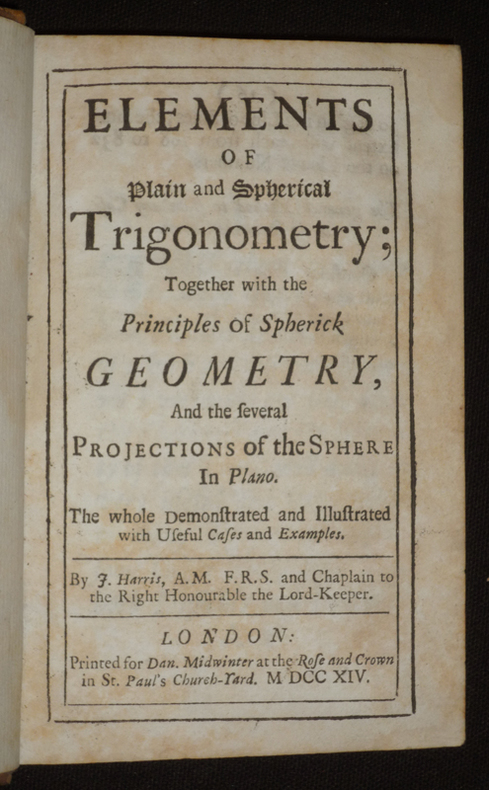
1714ys3467London, printed for Dan. Midwinter at the Rose and Crown in St. Paul's Church-Yard Relié 1714 TRES RARE. In-12 (10,5 x 16 cm), reliure pleine peau, dos à 4 nerfs, texte en anglais, adresse au lecteur non paginée puis 177 pages, 5 planches hors texte dépliantes, 1 tableau dépliant, édition originale bien complète ; mors supérieur usé, quelques épidermures et marques d'usage sur les plats, par ailleurs intérieur frais, bon état. Livraison a domicile (La Poste) ou en Mondial Relay sur simple demande.
15006o.J. Kl.4° (ca. 17 x 21 cm), Leder der Zeit, Bayer. Wappeneinband, auf dem Hinterdeckel mit "Bene Meritis", Goldschnitt. Goldgeprägte ornamentale Fileten auf beiden Deckeln, das Gold jedoch zum größten Teil verblichen, der Rücken auf 5 Bünden, Fleurons in den 6 Feldern, auch hier das Gold verblichen. An zwei Ecken bestoßen, an den Außenfalzen etwas eingerissen. Hübsche Vorsätze aus Cattunpapier.
175421703Graz, Wdmanstätter, 1754. 3 Bll., 40, 33, 62, 44, 11, 71, 49 S. 10 (statt 11) gefalt. Kupfertafeln. 8°. Ldr. der Zeit mit Rückenschild (beschabt unjd etw. bestoßen). [5 Warenabbildungen]
In-8 p. (mm. 229x173), p. pelle bazana coeva (restaur.), cornice dorata ai piatti, dorso a cordoni con decoraz. e tit. oro, tagli dorati, pp. (4),XVI,461, con 6 tavv. f.t. contenenti 93 figure trigonometriche e 12 tabelle (3 sono bis), piu' volte ripieg. e inc.in rame. "Prima edizione" di questo ampio e importante trattato. Il libro ottenne un notevole successo e nel 1804 se ne ebbe una seconda ediz., stampata a Bologna dal Masi, corretta e ampliata; nel 1788 fu tradotto anche in francese. Cfr. Brunet,I,1463 e Graesse,II,11 che citano la seconda ediz. del 1804 "de cet ouvrage estimé" - Choix de Olschki,VI,6238 - Poggendorf,I,359. “Antonio Cagnoli, astronomo, meteorologo, matematico (Zante 1743 - Verona 1816), dapprima diplomatico della Repubblica Veneta, a 37 anni iniziò gli studi di astronomia con Lalande a Parigi; costruì a Verona un osservatorio a sue spese ma, caduta la città in mano dei Francesi, ne trasportò gli strumenti all’osservatorio di Brera. Fino al 1807 insegnò calcolo sublime alla scuola militare di Modena. Fu uno dei sistematori della trigonometria e il suo nome è legato a tre formule di trigonometria sferica”. Così Diz. Treccani,II, p. 597. Pagine ingiallite per la qualità della carta e con qualche fiorit. ma certam. un buon esemplare.
171217468Ulm, Daniel Bartholomae, 1712. gest. Frontispiz, Titel in rot-schwarz Druck, 338 SS., 6 n.n. Bll. Register und Bericht an den Buchbinder. 110 Tafeln (vollst.). 8°, Leder der Zeit. Bezug am Schwanz ca. 3x3 cm fehlend, fliegende Vorsätze fehlend, Frontispiz verso bestempelt. Tafeln tls. etw. fleckig, gegen Ende im Bug braunfleckig.
In-8°, tre volumi in uno, viii, 184pp, XIV carte di tavola ripiegate; iv, 32; (viii), 240pp, VIII carte di tavola ripiegate. Legatura in piena pelle coeva, titolo in oro al dorso su tassello in marocchino, nervature. Prima edizione, buona copia. In-8 °, three volumes in one, viii, 184pp, XIV folding plates; iv, 32; viii, 240pp, VIII folding plates. Contemporary calf binding, gilt title on the back on a morocco label, bands. First edition, good copy.
109902Turin Augustae Taurinorum [Turin], Ex Typographia Caroli Janelli, 1657, 1 volume in-folio de 300x210x35 mm environ, 1f.blanc, 9ff. (faux-titre, frontispice gravé, titre, epitre, lectori, Epigramma, Index), 376 pages, 1f.blanc, pleine basane fauve, dos à nerfs portant titres dorés, orné de caissons à motifs dorés, double encadrement des plats de filets dorés avec fleurons à chaque angle, contreplats marbrés avec une ex-libris sur le premier et traces d'étiquettes arrachées, un titre-frontispice de Giovenale Boetto, tranches mouchetées de rouge. Frottements épidermures et petits accrocs sur le cuir avec des manques de matière sur coins et coupes, rousseurs fortes par endroits et pages brunies, des mouillures dans les marges, des pages tachées. Texte en latin orné de belles lettrines de bandeaux, culs-de-lampe, et de figures dans le texte.
In-4° grande, pp. LXVI, 612, e 2 tavole ripiegate; legatura in mezza pelle coeva con angoli tassello e titolo in oro al dorso, tagli in rosso. Edizione originale dell’opera del matematico italiano Pietro Ferroni (1744-1825), dedicata a Leopoldo d’Austria; Ferroni fu professore di matematica a Pisa e Firenze, ed ebbe l’incarico di matematico regio presso Leopoldo. L’opera è suddivisa in 10 capitoli, su argomenti quali il binomio di Newton, le serie logaritmiche, le serie trigonometriche, il calcolo infinitesimale, il calcolo integrale ecc., preceduti da un excursus storico sulla storia della matematica. matematica geometria trigonometria
In -folio, pp. 20 e due tavv. ripiegate. Manca l’“Appendice...”, descritta in Iccu e presente in altre edizioni consultate, mentre sono presenti le due tavole relative al testo.
In 8, pp. VII + (1b) + 208 con 7 tavv. f.t. rip. inc. all'acq. raff. figure geometriche (la terza e' rilegata al contrario). Legatura in mz. pg. coeva. Leggere scoloriture al marg. sup. delle cc. Esemplare stampato su carta azzurrina di questo manuale di geometria-trigonometria, definita da Francesco Carlini in Notizie sulla vita e sugli scritti di Antonio Cagnoli, opera nella quale 'si conserva tutto il rigore e lo stile de' geometri greci'. Cagnoli (1743-1816) e' noto anche per gli studi di astronomia e astrologia. Graesse, II, 12. Brunet, VI, 7979.
In-4°, legatura in mezza pergamena coeva con titolo e fregi in oro; pp. XX, 533 (1) + 8 tavole di figure ripiegate+12 tavole di formule ripiegate. Antonio Cagnoli, astronomo, meteorologo, matematico (Zante 1743 - Verona 1816), dapprima diplomatico della Repubblica Veneta, a 37 anni iniziò gli studi di astronomia con Lalande a Parigi; costruì a Verona un osservatorio a sue spese ma, caduta la città in mano dei Francesi, ne trasportò gli strumenti all'osservatorio di Brera. Fino al 1807 insegnò calcolo sublime alla scuola militare di Modena. Fu uno dei sistematori della trigonometria e il suo nome è legato a tre formule di trigonometria sferica . Così Diz. Treccani,II, p. 597. In-4°, half parchment binding with title and friezes in gold; pp. XX, 533 (1) + 8 fold out figures + 12 fold out tables. Antonio Cagnoli, astronomer, meteorologist, mathematician (Zante 1743 - Verona 1816), first diplomat of the Venetian Republic, at the age of 37 he began to study astronomy with Lalande in Paris; he built an observatory in Verona at his own expenses but, having fallen the city into the hands of the French, he transported the instruments to the Brera observatory. Until 1807 he taught calculus at the military school of Modena. He was one of the trigonometry fixers and his name is linked to three formulas of spherical trigonometry ". See Diz. Treccani, II, p. 597.
In-8°, xi, 276pp; 80pp. Legatura in piena pelle coeva, con titolo al dorso in oro su tassello in marocchino, nervature, numerose illustrazioni nel testo. Buona copia. In-8°, xi, 276pp; 80pp. Contemporary full calf binding, gilt title at the back on morocco label, bands. Illustrated with a profusion of in-text illustrations. Fair copy.
182242079ABBerlin, Maurerschen Buchhandlung, 1822. Dt. EA. 8°. VIII, 518 S. Mit 15 gef. Kupfertaf. Halbleder. Rückenvergold. Ber. u. best. Gebr., tls. wasserrandig. Selten.
1823MATH0310Wien, Überreuter 1819/1823. 5 Bl., 396 S., 1 Bl.; 3 Bl., 636 S., 1 Bl. Mit zus. 52 gef., gest. Tafeln. Halblederbände der Zeit, Kanten beriebven, Kap. mit Einrissen u. Fehlstellen. Titelbl. mit Eignereintrag. Poggendorf I,1037. - Erstmals 1778 erschienen, in unserer Ausgabe wesentlich erweitert. Kluger v. Teschenberg war Offizier und Mathematik-Lehrer an der k.k.Ingenieurs-Akademie. - Die von Bernahrd Biller gestochenen Tafeln zeigen geometrische Figuren, einige Pläne u. detailgetreu Meßinstrumente. [2 Warenabbildungen]
185414854Kassel, J.Georg Luckhardt, 1854. Privater Pappband der Zeit, gr-8°, XVI, 417 S., 2 gefaltete Tafeln; -Kanten berieben, wenige Bleistifteintragungen, 1 Lage etwas gelockert, gutes Exemplar.