19 résultats
167999767In Torino, Nella Stamperia degli Heredi di Carlo Gianelli 1679 In-16 17 x 11 cm. Reliure de l’époque vélin; dos à nerfs muet, 176-[46] pp.. Reliure défraîchie, partiellement restaurée amateur, intérieur correct. En l’état.
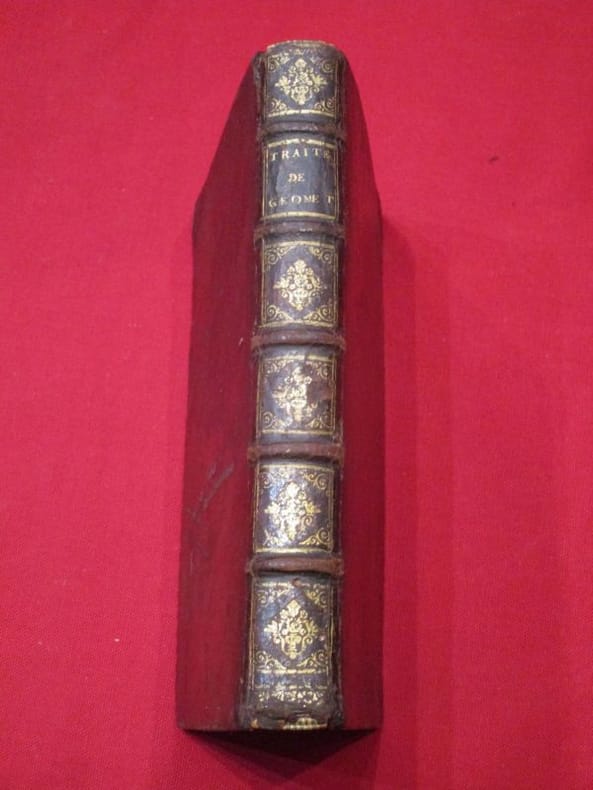
1690118650Jombert 1690 A Paris, Chez Jean Jombert, 1690, 1 volume in-8 de 120x185 mm environ, (2) ff., 249 pages (paginées 229), sans le frontispice allégorique dédicacé à Louvois. Contient de très nombreuses figures, dont 16 gravures à pleine page. Plein veau granité, dos à cinq nerfs portant titres dorés et caissons ornés, roulette dorées sur les coupes, tranches mouchetées, gardes blanches. Reliure restaurée, coiffes manquantes, des taches sur les plats, petites traces de mouillures en bas des marges sur quelques feuillets, un feuillet déchiré sans manque, plusieurs ex libris sur le contreplat, bon état général.
1696V39550Nürnberg (Christoff Riegels) 1696 (= Erste Ausgabe). Quer-8°, 3 Bände in einem Band, Pergament der Zeit (Hardcover), 1 doppelseitiges handschriftliches Register, 1 Titelkupfer, 265 + 400 + 302 S., 1
166623289paris Estienne Loyson 1666 -in-12 plein-veau un volume, reliure plein veau brun moucheté (binding full calfskin) in-douze (duodecimo), dos 5 nerfs (spine with raised bands), décoré "or" et à froid (gilt and blind stamping decoration), titre frappé "or" (gilt title) avec un filet "or" en encadrement, entrenerfs à fleuron "or" dans un encadrement d'un filet "or" avec rinceaux "or" aux angles, filet à froid de part et d'autre des nerfs, roulette large "or" en pied (coiffe supérieure manquante), coins écornés, roulettes sur les coupes (fillets on the cuts) avec manque de dorure, toutes tranches lisses jaspées rouge, ex-libris manuscrit à l'encre brune en haut de la page qui fait face à la page de titre : " Alexis DAVIGNON, le 13 Juillet 1773", ce livre à subi la colère révolutionnaire sur la page de titre : ...La Fontaine ingénieur du roy , le mot ROY à été rayé à l'encre brune ainsi que les mots "avec privilège du roy" en dessous de la date, de plus le feuillet du privilège "à Monsieur Frère du ROY" situé aprés la page de titre a été carrement arrachée....,c'était une époque ou il n'était pas bien vu d'avoir des simpathies pour le ROY, fallait choisir son camp ou mourir...., orné de 26 planches doubles gravées sur cuivre dont 2 planches dépliantes ( petit manque de papier à la planche dépliante 21 intitulée : perspective P4 fig.13) + un front de chapitre historié et une lettrine gravés sur bois en noir, vi + 150 pages + (26 planches doubles imprimées d'un seul côté et montées sur onglet), 1666 à Paris Estienne Loyson Editeur,
1676ZNC-141A Paris, chez Charles de Sercy, 1676, in-12°, 1 feuillet pour le titre gravé, 1 feuillet pour le titre typographié, 10 feuillets non chiffrés -103 pages - 7 feuillets non chiffrés - 37 pages - 14 pages, plein veau, dos à nerfs orné de fleurons dorés, reliure assez usée de l'époque.
168216024A Paris, Sur le quay des Augustins joignant la porte de l'Eglise, à l'Image Nostre-Dame, 1682. In-12 de [8]-188-[8] pages, plein veau brun, dos à nerfs orné de filets et fleurons dorés, pièce de titre bordeaux.
167916026Paris, André Pralard, 1679. In-12 de [12]-452 pages non rognées, demi-basane brune moderne, dos lisse orné de filets et fleurons dorés.
168215979ABParis, 1682. 12°. 2 Bl, 187 S, 4 Bl. 1 gest. Frontisp. u. 81 ganzs. Kupfer.. Orig.-Ldr m. Rückenverg.
168215979ABParis, 1682. 12°. 2 Bl, 187 S, 4 Bl. 1 gest. Frontisp. u. 81 ganzs. Kupfer.. Orig.-Ldr m. Rückenverg. + Wichtig: Für unsere Kunden in der EU erfolgt der Versand alle 14 Tage verzollt ab Deutschland / Postbank-Konto in Deutschland vorhanden +
1626N334Nürnberg, Simon Halbmaier, 1626. Mit der meist fehlenden großen Falttafel - Erste Ausgabe. Als einzeln paginierter Druck und mit einem eigenen Titelblatt zusammen mit dem "Centiloquium Circini Proportionum" des Georg Galgemair erschienene Abhandlung über das "Organon Catholicum", es ?behandelt Herstellung (bzw. Aufbau) und Gebrauch von Peilinstrumenten, die der ältere Apian erfand. Dies geht aus den Vorworten unmißverständlich hervor. Galgemair hat freilich seine Vorlagen gründlich und selbständig durchdacht und mit bemerkenswertem didaktischem Geschick präsentiert. Das sogenannte Inventum Apiani ist ausschließlich für terrestrische Anwendungen bestimmt. Im Titel des Inventum wird betont, daß man ohne alle Rechnung auskomme ? Galgemair ? ist ein kompetenter Sachbuchautor, kein selbständiger Forscher? (Gerhard Betsch, Praxis geometrica und Kartographie an der Universität Tübingen im 16. und frühen 17. Jahrhundert, in: Friedrich Seck (Hrsg.). Zum 400. Geburtstag von Wilhelm Schickard: zweites Tübinger Schickard-Symposion, 25. bis 27. Juni 1992, Sigmaringen 1995, S. 213). Die Holzschnitt-Tafeln zeigen geometrische Figuren ?Dorsum sine Rotula?, die große einen astrologischen Jahreskreis (36,5 x 30,5 cm!) mit dem von Galgemair nach Apian erfundenen Instrument: ?Nun ist die Peilscheibe des Inventum mit einem Quadratnetz überzogen, ähnlich unserem Millimeterpapier, nur nicht so fein unterteilt. Mit Hilfe dieses Quadratnetzes, und mit etwas Übung, kann man die gesuchte 4. Proportionale direkt auf der Peilscheibe ablesen. Ganz ohne Rechnung geht es im Grunde freilich doch nicht, denn das Quadratnetz muß als passender Maßstab interpretiert werden? (ebenda). Der Titel mit einer großen Ädikula mit zahlreichen geometrischen Messinstrumenten und einer Weltkugel. Nur unwesentlich gebräunt, sehr sauber und wohlerhalten sowie vollständig ? mit der meist fehlenden großen Falttafel.VD17 23:289322W. Zinner 5025. Ortroy 116. [2 Warenabbildungen]
160720478Frankfurt, Hoffmann, 1607. Kommentiert und Herausgegeben von Chr. Clavius. Beide Teile in 4. verb. Auflage. 64 n.n. Bll., 671 SS., 680 SS., unzählige Textholzschnitte mit geometrischen Abbildungen. 8°, Halbpergament der Zeit, Deckel fachmännisch erneuert.
1669113<p>Renowned italian treatise on mathematic and Practical geometry</p><p>the use of the "Squadro Geometrico" Set Square </p><p>the multiplication "<em>per crocetta</em>" and the first mention of the <em>surveyor's cross</em></p><p> Feliciano Francesco<strong>.</strong> <em>Scala Grimaldelli libro di aritmetica e geometria speculatiua e pratticale di M. Francesco Feliciano Veronese. Diuiso in tre libri. Nel primo si tratta di cose pertinenti a Mercatanti . Nel secondo si tratta dell'arte maggiore di algebra .accresciuto in quest'vltima impressione di dottissimi problemi . Nel terzo & vltimo si dimostra il misurar della Terra . i nuovo ristampato e da molti errori corretto e accresciuto di molte cose da M. Filippo Macario Veronese . </em>Venetia : presso Gio. Giacomo Hertz 1669.</p><p>4to 188 x 120 mm contemporary paper board handwrtten titles at front board in sepia ink pp. 8 240 printer device with <em>Galleon</em> at title page xylographic head-letters head-pieces and end-pieces.</p><p> Last printed edition of this milestone in the history of mathematic </p><p>The <em>Scala Grmaldelli</em> is a work of outstanding importance in the history of mathematics and more than any other work influenced the teaching of this science in the sixteenth century.</p><p>The book deals with commercial arithmetic treatment of roots the rule of false position algebra and a section on practical geometry. </p><p>At leaf d2 <em>recto</em> Feliciano illustrates the method of multiplication "<em>Per Crocetta</em>" one of several methods that were in use in the Italian Renaissance.</p><p>It is noteworthy in the part dealing with practical geometry the constant use of the "Squadro Geometrico" geometric square which appears to have been practiced in Italy since the XV century.</p><p>The <em>Scala Grimaldelli</em> when first published was the first book describing the use of the <em>Surveyor's Cross</em> a simple instrument made of two bars forming a right-angled cross with sights at each end and used in setting out right angles in surveying an innovative tool at a time when long distances were often merely estimated by sight.</p><p>The book was so important in the teaching of elementary mathematics that he was reprintd in numerous editions including this last one in 1669 143 years after the original edition.</p><p>"Few books had greater influence on the subsequent teaching of elementary mathematics" Smith. </p><p>The symbology expressed in the title is fascinating: just as you need a ladder to attack a fortress and a lockpick to open a lock in the same way to approach complex mathematics you need this book.<!--endif--></p><p>Francesco Feliciano was a mathematician of Lazesio Veronese who lived in the second half of the century. XV and in the first quarter of the XVI. </p><p>He published in 1517 <em>Libro di abbaco</em> printed in several editions but he is best known for the book of arithmetic and speculative and practical geometry described here: <em>Scala Grimaldelli </em>1526 whose subsequent editions reached the end of the XVII century.</p><p> This important treatise disseminated outside Italy the ideas the notions and the methods in the field of arithmetic geometry algebra and their applications that were first exposed by Leonardo Pisano and then cultivated in italian schools.</p><p> Conditions: this book was meant to be heavily used so it's rare find a copy in good condition as despite few marls of use this copy in its original binding can be defined. </p><p> Provenance: I. Faded handwriten ownership signature at title page II. Contemporary handwrtten annotations and calculations on margins.</p><p> Reference: Honeyman IV 1288; Michel-Michel III-29; Riccardi II-22.</p> Giacomo Hertz
1665SC047Antwerpiae, I. Meursium, 1665. In-12o, XXIV+350+INDEX 9 p. et 6 planches hors-texte. Initiales, culs-de-lampe et dessins in-texte xylographies. Ex-libris imprime et manuscrit. Rel. XIXe pleine veau, dos a nerfs. Page de titre noircie, exemplaire propre. IIe edition, la premiere a 1654.
168815606Paris, Etienne Michallet (Imprimerie Estienne Chardon), 1688 ; in-8 ; plein veau havane marbré, dos à nerfs décoré et doré, titre doré, roulette dorée sur les coupes, tranches mouchetées de rouge (reliure de l'époque) ; 138 pp., (1) f. blanc, nombreuses figures dans le texte et 2 planches hors-texte gravées "Figure du Compas de proportion faite par Chapotot".
167328681Cremona: Per Gio. Pietro Zanni 1673. Mit zahlr. Abb. i. Text u. z.T. ganzsseitig. 9 Bll., 162 S. Pappbd. d. Zeit. 24x17 cm. [5 Warenabbildungen]
164762212ABAmstelodami, Janssonius, 1647. 2o. 50 Textseiten, 73 doppelblattgrosse Kupfertafeln m. perspektivischen Darstellungen von Räumen, Gebäuden, Formen und Köpern, incl. Ansichten aus Rom. Kupfer No. 1-31, 41- 80, Halbleder, Kanten berieben, Seiten tls. wasserrandig, altersgemäßer, guter Zustand.
1612953521Moguntiae [Mainz]: Anton Hierat. 1612. Quart, 33 x 20 cm. (Einband gebräunt und fleckig, die beiden Bindebänder erneuert, Titel mit handschriftlichem Besitzvermerk und an den Rändern mit Japanpapier verstärkt, innen teils stark gebräunt und feuchtigkeitsrandig) [16 Warenabbildungen] 6 Blatt, 596 Seiten, 14 Bl., 122 S., 1 weißes Blatt, 59, 20, 23 S. Ganzpergament der Zeit, vollständig restauriert und neu aufgezogen,
162721055Nürnberg, Simon Halbmayer, 1625, 1623, 1626, 1627 (laut Chronogrammen am Schluß der Dedicationen). 4 statt 6 Bll., 296 SS., 8 Bll, 198 SS., 3 Bll., 6 Bll., 101 SS., 1 Bl., 83 SS., 2 Bll. mit 1 gest. Porträt, gestochene Titel (2 x in Holzschnitt wiederholt) und ca. 200 Holzschnitte im Text (Messinstrumente, Zirkel, Messungslinien in Landschaften und Städten sowie zahlreiche Diagramme und Schemata. Es fehlen im 1. Buch der Titel und ein Blatt der Dedikation. 4° (ca. 15, 5 x 19, 5 cm), Pergament der Zeit über 4 Bünden, Initialen "FIVG" und die Jahreszahl 1630 auf dem Vorderdeckel, blindgeprägte Wappensupralibros auf beiden Deckeln. Wappen der Familie von Grünthal. Einband etwas angegraut und leicht knittrig.
163121158Rom, Grignani, 1631. 4 Bll., 108 S. mit 29 Textkupfern. 1 Kupfertitel. Gr.-8°. Mod. flex. Pgmt. [5 Warenabbildungen]