70 résultats
2000x-0792367111Springer 2000. Hardcover. New. 1st edition. 416 pages. 9.50x6.50x1.00 inches. Springer hardcover
1997__3110147920De Gruyter 1997. Hardcover. New. reprint 2011 ed. edition. 431 pages. 9.75x7.25x1.00 inches. De Gruyter hardcover
20092081502111901968china map 2009. Soft Cover. Fine. Size: 30cm Hardcover china map paperback
183441598Berlin G. Reimer 1834. 4to. No wrappers. In "Journal für die reine und angewandte Mathematik. Hrsg. von A.L. Crelle" Bd. 12 Heft 1 IV88 pp. the whole issueHeft 1 offered with titlepage to volume 12. Jacobi's paper: pp. 1-69. a. 1 engraved plate. <br/><br/><em>First edition of a main paper dealing with n-dimensional geometry."Of the papers devoted to n-fold integrals Jacobi's 1834 paper "De binis quibuslibit." is of crucial importence in this connection the theory of algebraic forms of variables. Here besides the problem of computing multiple integrals an importent problem of the theory of algebraic forms is solved." Andrei Nik. Kolmogorov. </em> unknown
182941605Berlin G. Reimer 1829. 4to. No wrappers. Extracted from "Journal für die reine und angewandte Mathematik. Hrsg. von A.L. Crelle" Bd. 4. - Plücker's paper pp. 349-370 <br/><br/><em>First edition of a major paper in the arithmetization of geometry introducing the so-called triangular coordinates. "In 1829 Plücker contributed to Crelle's Journal the paper offered here with a revolutionary point of view that broke completely with the old Cartesian view of coordinates as line segments. The equation of a straight line in homogenous coordinates has the form ax by ct=0.Plücker saw that one could modify the usual language and call abc the homogenous coordinates of a line.Plücker had discovered the immidiate analytic counterpart of the geometric principle of duality about which Gergonne and Poncelet had quarreled; it now became clear that the justification that pure geometry had sought in vain was here supplied by the algebraic point of view." Boyer History of Mathematics. </em> unknown
2002mon0000403113Amer Mathematical Society 2002-12-01. Paperback. Very Good. 0.8700 in x 9.8400 in x 7.0100 in. Amer Mathematical Society paperback
172745242London T. Bowles 1727. Small 8vo. Contemp. full calf raised bands blindtooled covers Cambridge-binding. Wear to spine ends and spine. Hinges weakening but still holding. Titlepage in red/black. 21956 pp. and 80 full page engraved illustrations. Some soiling and browning mainly marginal last 10 engravings with a faint dapmstain. The charming plates are engraved by Leclerc. <br/><br/><em>Scarce English edition the third of Leclerc's charming and very popular treatise on elementary practical geometry and perspective.Sebastien Leclerc 1637-1714 was originally an engraver who studied physics and geometry in relation to perspective theory a field of which he became famous. In 1672 he was appointed to "l'Academie de Peinture" as professor in perspective. He was also engraver to Louis XIV and was appointed professor at "l'Ecole des Gobelins". </em> hardcover
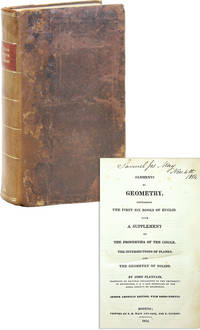
181447988Boston: T.B. Wait and Sons 1814. Second American Edition With Improvements. Octavo 23cm.; contemporary calf recently rebacked new red morocco spine label retaining original endpapers; 2xxviii4315152pp. Boards rather rubbed small dampspot to upper cover some browning to endpapers a few tiny holes to rear free endpaper else Good or better internally sound. Provenance: Copy of seventeen-year-old Samuel Joseph May 1797-1871 future reformer abolitionist and women's rights advocate with his ownership signature dated November 4 1814 to title page front pastedown p. 1 together with his gift inscription to fellow Harvard student Warren Goddard to rear flyleaf verso with Goddard's lengthy ownership inscription as a student at Harvard on front free endpaper a second ownership inscription of Goddard's on front flyleaf noting that the book was actually bought off of May. May graduated from Harvard in 1817 and went on to serve as a Unitarian clergyman collaborating with his friend William Lloyd Garrison in co-founding the New England Anti-Slavery Society the American Anti-Slavery Society and the pacifist New England Non-Resistance Society. SHAW & SHOEMAKER 32520. T.B. Wait and Sons unknown
1998x-0824701534Marcel Dekker Inc 1998. Paperback. New. 1st edition. 352 pages. 10.25x7.25x0.75 inches. Marcel Dekker Inc paperback
178544970Paris Moutard 1785. 4to. Extracted from "Mémoires fe Mathematique et de Physique Présentés à l'Academie des Sciences par divers Savans" Tome X. Pp. 511-550 a. 2 folded engraved plates. Clean and fine. <br/><br/><em>First appearance of this importent paper by the "greatest geometer of the century" in which he solves some main problems in coordinate geometry especially he introduced the "distant formula" for three dimensions years before it was used by Lagrange. He laid the foundation of a completely new branch of mathematics known as descriptive geometry. The paper was delivered already in 1771 but not published until 1785. "His first important original work was "Memoire sur les développées les rayons de courbure et différents genres d inflexions des courbes á double courbure" He published an extract from it in June 1769 in the Journal encycyclop´matiques and in October 1770 he finished a more complete version that he read before the Academie des Sciences in August 1771; the latter however was not published until 1785 Mémoires de mathématiques et de physique présentés á ’Academic par divers scavanns. By then some of the most important ideas in the memoir no longer seemed so original because Monge had employed them in other works published in the intervening years. Nevertheless this memoir is of exceptional interest for it presents most of the new conceptions that Monge developed in his later works as well as his very personal method of exposition which combined pure geometry analytic geometry and infinitesimal calculus."DSB. </em> unknown
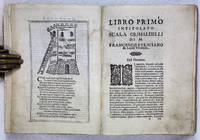
1669113<p>Renowned italian treatise on mathematic and Practical geometry</p><p>the use of the "Squadro Geometrico" Set Square </p><p>the multiplication "<em>per crocetta</em>" and the first mention of the <em>surveyor's cross</em></p><p> Feliciano Francesco<strong>.</strong> <em>Scala Grimaldelli libro di aritmetica e geometria speculatiua e pratticale di M. Francesco Feliciano Veronese. Diuiso in tre libri. Nel primo si tratta di cose pertinenti a Mercatanti . Nel secondo si tratta dell'arte maggiore di algebra .accresciuto in quest'vltima impressione di dottissimi problemi . Nel terzo & vltimo si dimostra il misurar della Terra . i nuovo ristampato e da molti errori corretto e accresciuto di molte cose da M. Filippo Macario Veronese . </em>Venetia : presso Gio. Giacomo Hertz 1669.</p><p>4to 188 x 120 mm contemporary paper board handwrtten titles at front board in sepia ink pp. 8 240 printer device with <em>Galleon</em> at title page xylographic head-letters head-pieces and end-pieces.</p><p> Last printed edition of this milestone in the history of mathematic </p><p>The <em>Scala Grmaldelli</em> is a work of outstanding importance in the history of mathematics and more than any other work influenced the teaching of this science in the sixteenth century.</p><p>The book deals with commercial arithmetic treatment of roots the rule of false position algebra and a section on practical geometry. </p><p>At leaf d2 <em>recto</em> Feliciano illustrates the method of multiplication "<em>Per Crocetta</em>" one of several methods that were in use in the Italian Renaissance.</p><p>It is noteworthy in the part dealing with practical geometry the constant use of the "Squadro Geometrico" geometric square which appears to have been practiced in Italy since the XV century.</p><p>The <em>Scala Grimaldelli</em> when first published was the first book describing the use of the <em>Surveyor's Cross</em> a simple instrument made of two bars forming a right-angled cross with sights at each end and used in setting out right angles in surveying an innovative tool at a time when long distances were often merely estimated by sight.</p><p>The book was so important in the teaching of elementary mathematics that he was reprintd in numerous editions including this last one in 1669 143 years after the original edition.</p><p>"Few books had greater influence on the subsequent teaching of elementary mathematics" Smith. </p><p>The symbology expressed in the title is fascinating: just as you need a ladder to attack a fortress and a lockpick to open a lock in the same way to approach complex mathematics you need this book.<!--endif--></p><p>Francesco Feliciano was a mathematician of Lazesio Veronese who lived in the second half of the century. XV and in the first quarter of the XVI. </p><p>He published in 1517 <em>Libro di abbaco</em> printed in several editions but he is best known for the book of arithmetic and speculative and practical geometry described here: <em>Scala Grimaldelli </em>1526 whose subsequent editions reached the end of the XVII century.</p><p> This important treatise disseminated outside Italy the ideas the notions and the methods in the field of arithmetic geometry algebra and their applications that were first exposed by Leonardo Pisano and then cultivated in italian schools.</p><p> Conditions: this book was meant to be heavily used so it's rare find a copy in good condition as despite few marls of use this copy in its original binding can be defined. </p><p> Provenance: I. Faded handwriten ownership signature at title page II. Contemporary handwrtten annotations and calculations on margins.</p><p> Reference: Honeyman IV 1288; Michel-Michel III-29; Riccardi II-22.</p> Giacomo Hertz
179788<p>RARE FIRST EDITION OF LORENZO MASCHERONI's TREATISE ABOUT THE USE OF THE COMPASS IN GEOMETRY</p><p>UNTRIMMED AND UNCUT COPY IN ORIGINAL PAPER WRAPPER</p><p>Mascheroni Lorenzo. <i>La geometria del compasso di Lorenzo Mascheroni. </i>Pavia : presso gli eredi di Pietro Galeazzi anno V della Repubblica francese 1797.</p><p>8to 223 x 130 mm original printer's wrappers; pp. 2 XVIII 264 14 leaves of folding plates woodcut decoration at title page friezes and headletters. </p><p>The principle of economy in geometric constructions</p><p>First edition of Mascheroni's most important work with a dedication in verse to Napoleon in which he proves that any geometrical construction of Euclidean geometry can be carried out by means of compasses alone admitting that a straight line is constructed once two of its points have been defined thus demonstrating how a certain principle of economics in geometric constructions proclaimed by all the great mathematicians of the past from Pappus to Descartes was regularly and violated by the use of two tools where only one was enough.</p><p>His approach was to first demonstrate how to use the compass alone to bisect a given arc of a circle add and subtract two given segments find the fourth proportional given three segments find the point of intersection of two given lines and the points of intersection between a given line and a circle.</p><p>At this point Mascheroni theoretically demonstrated how all constructions completed with ruler and compass can be considered as a composition of the elementary operations defined above and therefore obtained using only the compass. In the spirit of the Enlightenment this work is not meant to be just theoretical but is also designed to facilitate the construction of precision instruments. </p><p>Although some authors such as the Danish G. Mohr had sought before Mascheroni the solution of certain geometrical problems by using the compass alone he was able to deal with the subject of the geometry of the compass with such depth and in such a general way to make his forerunner forgotten.</p><p>Lorenzo Mascheroni 1750 - 1800 was an Italian mathematician scholar and academic who since 1778 taught physics and mathematics at the Bergamo seminary.</p><p>His most important contributions concern mathematical analysis with studies related to integral calculus and natural logarithms construction science with its original studies on arc-breaking calculus and geometry with the demonstration that solvable problems with row and compasses can also be solved with just the compass.</p><p>His name is also linked to the Euler-Mascheroni constant of which he calculated the first 32 decimal digits. The Euler – Mascheroni constant also called Euler's constant is a mathematical constant recurring in analysis and number theory usually denoted by the lowercase Greek letter gamma γ.</p><p>It is defined as the limiting difference between the harmonic series and the natural logarithm.</p><p>Napoleon whose passion for science and mathematics is known met Mascheroni in 1796 during the invasion northern Italy and was intrigued by his theories ion the use of the compasses becoming they say a great expert. "General we could expect from you everything but geometry lessons": with this sentence the mathematician Laplace and Lagrange welcomed Napoleon's explanations on Mascheroni's constructions whose book just a year after the Italian edition in 1798 was translated into French by Charette.</p><p>Conditions: Light marks of use along the text small warmholes never touching the text in general very good copy printed on strong paper untrimmed and uncut in its original paper wrapper.</p><p>References: RICCARDI P. "Biblioteca Matematica Italiana Milano 1952 vol. 1 134 9.1 "Pregiata e Rara".</p> Pietro Galeazzi paperback
185942296London Richard Taylor and William Francis 1859. 4to. No wrappers as extracted from "Philosophical Transactions" Vol. 149 - Part I. Pp. 61-90. Clean and fine. <br/><br/><em>First appearance of this pathbreaking paper in which Cayley unites 'Metrical Geometry' and 'Projectice Geometry' by introducing "imaginary" elements to metrical properties."The fundamental notions in metrical geometry are the distance between two points and the angle between two lines. Replacing the concept of distance by another also involving "imaginary" elements Cayley provided the means for unifying Euclideangeometry and the common non-Euclidean gemoetries into one comprehensive theory."Bell in "Men of Mathematics".In non-Euclidean geometry prepared the way for Klein's splendid discovery that the geometry of Euclid and the non-Euclidean geometries of Lobatchewsky and Riemann are all threee merely different aspects of a more general kind of geometry which includes them as special cases.Dealing with the relations between metrical and projective geometry Klein remarks In "Entwicklung der Mathematik" Teil I p. 148: "Vor allem kommt für uns sein Cayley's berühmtes 'A Sixth Memoir upon Quantics" im betrachtt. Quantioc heisst soviwel "Form" d.h. homogenes Polynom von zwei drei oder mehr Variablen wonach man binäre tertiäre usw. Formen unterscheidet." </em> unknown
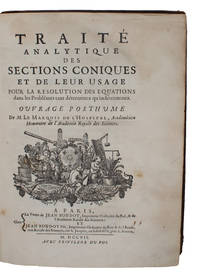
170748217Paris Jean Boudot et Jean Boudet fils 1707. 4to. Contemporary full calf. A bit of cracking to front hinges so that cords are seen but cover not loosening. Spine with 6 raised bands richly gilt compartments. Wear to top of spine. Two small old paperlabels one to upper compartment one to frontcover. Covers slightly rubbed. 44595 pp. Large woodcut vignette on titlepage 2 other vignettes one engraved one in woodcut. 32 folded engraved plates and one smaller folded plate Fig. A. An old owners stamp on flyleaf. Internally clean and fine. A few tiny brownspots. Wide-margined and printed on good paper. <br/><br/><em>Scarce first edition of l'Hôspital's second book - his second successfull textbook - the manuscript of which was left completed at his death in 1704. His first book "Analyse des infiniment petits pour l’intelligence des lignes courbes" 1696 was the first textbook of the differential calculus and his name lives on in the name of the rule for finding the limiting value of a fraction whose numerator and denominator tend to zero. His mathyematical teacher was Jean Bernoulli.The year in which Newton published the anti-Cartesian "Arithmeticus" there appeared in France a conspicuously successfull textbook on Cartesian geometry along the lines of that of Guisnée. This was the "Traité Analytique des Sections Coniques". a book which contains less original material than that of Guisnée but which is more extensive and closer to the modern manner of treatment. The work had been intended for publication at the time the authors famous calculus textbook appeared in 1696 but l'Hospital's illness apparently led to delay and it appeared posthumously in 1707. It is Cartesian in emphasis and although it consists of but one volume follows generally the tripartite plan of Lahire and Ozanam: first an algebraic quasi-analytic treatment of the Conic Sections along the lines of Apollonian theory; then an analytic study of the loci and finally a long section on the customary construction by conics of the roots of cubic and quartic polynominal equations. LHospital sometimes used two axes and seems to have recognized the interchangeability of these but he betrays some hesitation. In general L'Hospital like Descartes was more interested in analytic geometry as a measure of ecpressing loci algebraivcally than as a method of deriving the properties of a curve from its equation." Carl B. Boyer "History of Analytic geometry" pp. 150-154. </em> hardcover
187353254London and New York Macmillan and Co. 1873. 4to. Orig. full brown cloth gilt spine pictorial gilt frontcover. Near mint condition. Small embossed stamp at upper corner of title-page David Dunlop ObservatoRy Library. In: "Nature a weekly illustrated Journal of Science." Volume VIII May 1873 to October 1873. XII562 pp. Entire volume offered. Riemann's paper: pp. 14-17 a. 36-37. Internally clean and fine no traces of use. <br/><br/><em>First English translation of this milestone work on the foundations of geometry. It "is one of the key work from which derives the modern study of differential geometry and especially the study of manifolds of dimension greater than two. It was to prove central to the overthrow of Euclidean geometry as the source of geometrical ideas and to Einstein's general theory of relativity after 1915." Grattan-Guiness "Landmark Writings in Western Mathematics 1640-1940.It is a translation of Riemann's famous Habilitationsvortrag held in 1854 in secondary literature it is often misidentified as his Habilitationsschift but that was concerned with Fourier series and was delivered the year before. Riemann begins his lecture with a remark about a certain darkness that lies at the foundation of geometry. This darkness obscures the relations between that which geometry assumes i.e. the notion of space and the first principles of constructions in space. In Riemann's oponion one must take another approach towards this problem than the usual axiomatic method used ever since Euclid. The approach taken by Riemann is to a large extent guided by Gauss's work on the intrinsic geometry of surfaces; 'Disquisitiones generales circa superficies curvas' 1828. In this work Gauss showed that the curvature of a surface can be determined without reference to the ambient Euclidean space in which it lies i.e. that the curvature is an intrinsic property of the surface. Based on this Gauss showed several fundamental theorems about figures on the surface by referring only to the surface itself i.e. indicating that the surface itself is a space with its own geometry independent of the geometry of the ambient Euclidean space. Riemann argues that the true objects and properties of geometry are those which can be studied within the space itself and he defines a general n-dimensional space in a similar manner to the parametric representation of a surface. Riemann believed that we know space only locally he therefore bases his study of the geometry of such a general space or manifold as they are known today on the infinitesimal methods of calculus. This choice is a crucial departure from the classical axiomatic methods used by Euclid Lobachevsky and Bolyai. The notion of distance or metric on a manifold is a generalization of the usual Euclidean distance formula in n-dimensions. Particular choices of space and metric reveal both the hyperbolic geometries of Lobachevsky and Bolyai and elliptic or Riemannian geometry. Riemann's approach to geometry is of paramount importance this work "did more to change our ideas about geometry and physical space than any work on the subject since Euclid's Elements." Landmark Writings in Western Mathematics p.507. "The importance of this treatise is not confined to pure mathematics. Without it Einstein would not have been able to develop his general theory of relativity." Printing and the Mind of Man p.177. </em> hardcover
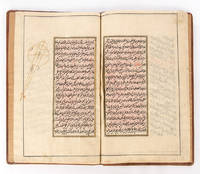
114244India Jumadi 1284 AH 1867 AD. . Single volume illuminated manuscript on thin polished Indian laid paper text-block sprinkled in red and pink in Farsi Persian manuscript on paper black ink on paper 34 leaves 268 x 160 mm; 16 lines bold nasta'liq verging on shekasteh text-block ruled in gilt numerous diagrams in the text and adorning the margins most of these in gold some contemporary annotations to margins a few spots to preliminary leaves gilt ruling to text-block oxidised and caused closed tears in come instances mostly to inner ruling close to gutter some margins repaired; contemporary red sheep over pasteboards covers ruled in blind with central stamped motifs also in blind rebacked and edges repaired new endpapers and pastedowns covers rubbed.<br /> An attractive treatise on geometry and astronomy likely copied in India for a certain Alim al-Din Hussayn bin Abd'Allah al-Ansari in 1867 AD. The work includes many diagrams in the text showing various geometrical shapes diagrams of stars and planets and diagrams of various eclipses and spheres in orbit.<br /> India, Jumadi 1284 AH (1867 AD). hardcover
177031785Berlin Haude & Spener 1770. 4to. No wrappers as issued in "Mémoires de l'Academie Royale des Sciences et Belles Lettres" tome XXIV pp. 327-354 and 1 engraved plates. <br/><br/><em>First edition. Lambert's work on non-Euclidean geometry is among the most important in the field. Carl Boyer writes "No one else came so close to the truth without actually discovering non-Euclidean geomtry." History of Mathematics pp. 504. Lambert wrote his famous book 'Theorie der Parallellinien' in 1766 but it was not published until 1786 nearly a decade after his death. Lambert originally set out to prove Euclid's parallel postulate in a similar way to that which Saccheri had used in his 'Euclides Vindicatus' but in contrast he did not interpret the consequences of non-Euclidean geometry as absurd. The offered paper 'Observations Trigonometriques' is the only work by Lambert on non-Euclidean geometry which was published during his life-time. Here he made the important discovery of the duality between spherical and hyperbolic geometry i.e. that hyperbolic trigonometries can be deduced from spherical trigonometries by using imaginary angles and consequently he introduced the hyperbolic functions for the first time. By illustrating this duality Lambert gave strong evidence of the consistency of non-Euclidean geometries. See Kline's Mathematical Thought from Ancient to Modern Times pp. 404 & 868. </em> unknown
1728315966University of Halle 1728. Abundantly illustrated with watercolor drawings and tables. 1 vols. 4to. Disbound remnants of contemporary reversed calf and marbled boardslosses to top edges. Abundantly illustrated with watercolor drawings and tables. 1 vols. 4to. Extensive German manuscript on geometry with handsome period-colored illustrations. The first part discusses the relationship of the diameter to the circumference with an introduction on Pi comparing findings by Euclid Archimedes and Ptolemy as well as 16th- and 17th-century scholars like Augustin Hirschvogel Albrecht Dürer Nicolaus de Cusa Ludolph van Ceulen Kepler Adam Kochansky François Viète Carlo Renaldini and Adriaan Metius. The second features problems theorems and solutions to geometrical exercises on linear and proportional measures of inscribed and circumscribed polygons. A few pages contain occasional verse and notes on chemical preparations.<br /> <br /> Johann Gottlieb Arndt was an engineer and taught mathematics at the University of Halle in 1728-32. He also published on physical mathematical and economic education. unknown