RIQUIER CharlesLivre Rare Book
140 résultats
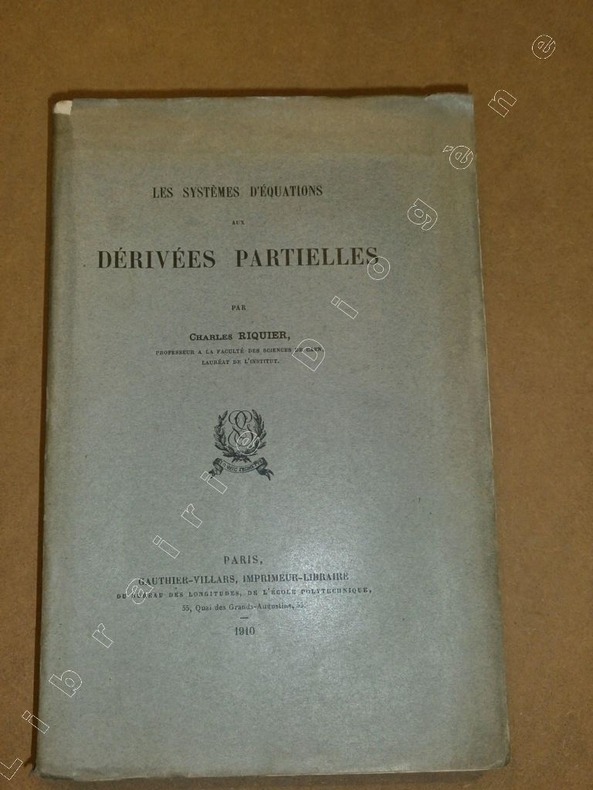
1910893921910 Gauthier-Villars, 1910, 590 p., broché, petit manque de papier sur le haut du dos et en bordure du premier plat, une déchirure sans manque d'environ 1cm en bordure du second plat, intérieur propre.
19811254091981 Springer-Verlag New York / Berlin / Heidelberg - 1981 - In-8 relié - 161 pages - Illustré de 17 figures en N&B dans le texte
19741256701974 Société mathématique de France - Revue Astérisque - N° 18 - 1974 - In-8 broché, couverture illustrée - 87 pages
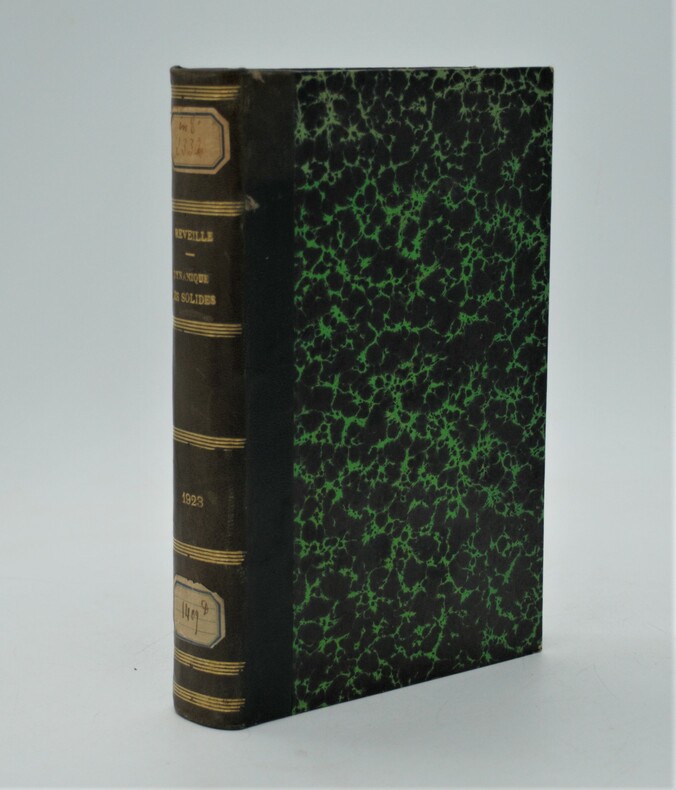
PHO-836Paris, Jean-Baptiste Baillière et fils, 1923, in-8, 506 pages, illustré de 135 figures dans le texte , relié demi cuir époque , dos lisse avec auteur , titre et date , dos insolé , cachet , bon exemplaire. P2-5C
Near Fine hardcover. 282 pp.
180916781Paris Courcier 1809 In-12 VII + 256 pp + 3 tableau dépliants de tables trigon. et 5 planches dépliantes, quelques rousseurs.
183441606Berlin G. Reimer 1834 4to. No wrappers. Extracted from "Journal für die reine und angewandte Mathematik. Hrsg. von A.L. Crelle" Bd.12. - Plücker's paper pp. 105-108. <br/><br/><em>First printing of the paper containing the famous "Plücker Equations". ".one of Plücker's great achievements published in Crelle's Journal for 1834 was the discovery of four equations bearing his name the paper offered that relate the class and order of a curve with the singularities of the curve." Boyer. History of Mathematics. </em> unknown
19058657Paris Gauthier-Villars 1905 In-8 167 pp, Conférences faites en Amérique. Exemplaire non coupé. 1er plat légèrement passé avec faibles rousseurs et coins cornés ; frottis sur coiffe supérieure
196161778New York, Dover, 1961. IX, 301 S. Leinenband / gebundene Ausgabe
200076106New York/London, Springer (Applied Mathematical Sciences, 44), ca. 2000. X, 279 S. (24 cm) Pappband / gebundene Ausgabe
0470054565-GUsed - Good. A Good Used Book has a good binding with some shelf wear. May have minimal notes or highlighting. A Good Used Book has a good binding with some shelf wear. May have minimal notes or highlighting. unknown
0470054565-VGUsed - Very Good. Very Good Condition! Crisp copy with a sturdy binding and light shelf wear. May have minimal notes or highlighting. Very Good Condition! Crisp copy with a sturdy binding and light shelf wear. May have minimal notes or highlighting. unknown
1973LFA-1267328914 volumes de 192, 187, 192 et 216 pages, format 160 x 240 mm, illustrés, brochés, publiés en 1973-1976, Masson et Cie, collection "Enseignement Technique"
198952750Cambridge: Cambridge University Press (Cambridge texts in applied mathematics), 1989. Stretching, chaos, and transport XIV, 364 S. (23 cm) Broschierte Ausgabe
19659444-nnew. unknown
19659444like new. unknown
1921AUB-5820Ed. Gauthier-Villars et Cie 1921 (2e éd. avec de nombreux compléments). Bel exemplaire relié, gd in-8, XXIV + 484 pages.
182149138Paris Crochard 1821. No wrappers. In 'Annales de Chimie et de Physique' Volume 19 Cahier 3. Pp. 225-236 Entire issue offered with halftitle to vol. 19. Navier's paper: pp. 244-260. A few scattered brownspots. Some browning to halftitlepage. <br/><br/><em>First appearance of Navier's famous paper in which he describes the relations between fluid flow and friction giving the FUNDAMENTAL EQUATIONS OF THE MATHEMATICAL THEORY OF ELASTICITY. The full paper was not published until 1828. Stokes's analysis of the internal friction of fluids was published in 1845 and as he was not familiar with the French litterature of mathematical physics he derived independently his own equations which accounts for the double-name of the equations. "The Navier-Stokes equation is now regarded as the universal basis of fluid mechanics no matter how complex and unpredictable the behavior of its solutions may be. It is also known to be the only hydrodynamic equation that is compatible with the isotropy and linearity of the stress-strain relation." Olivier Darrigol."Navier studied the motion of solid and liquid bodies deriving the partial differential equations to which he applied Fourier's methods to find particular solutions. This theoretical research led him to formulate the well-known equation identified with his name and that of Stokes. Navier viewed bodies as made up of particles which are close to each other and which act on each other by means of two opposing forces - one of attraction and one of repulsion - which when in a state of equilibrium cancel each otherout. The repelling force resulted from the caloric that a body possessed. When equilibrium is disturbed in a solid a restoring force acts which is proportional to the change in distance between the particles."DSB X p. 4."The equations are useful because they describe the physics of many things of academic and economic interest. They may be used to model the weather ocean currents water flow in a pipe and air flow around a wing. The Navier-Stokes equations in their full and simplified forms help with the design of aircraft and cars the study of blood flow the design of power stations the analysis of pollution and many other things. Coupled with Maxwell's equations they can be used to model and study magnetohydrodynamics. "Wikipedia. </em> unknown
182147074Paris Crochard 1821. Contemp. hcalf. Spine gilt with tome-and titlelabels with gilt lettering. Wear to top of spine. A crack along first hinge but cover not loose. In 'Annales de Chimie et de Physique' Volume 19. Entire volume offered. 448 pp. a. 2 plates. Navier's paper: pp. 244-260. A faint dampstain to margins of the first 20 leaves and a bit seen on the following pages decreasing. <br/><br/><em>First appearance of Navier's famous paper in which he describes the relations between fluid flow and friction giving the FUNDAMENTAL EQUATIONS OF THE MATHEMATICAL THEORY OF ELASTICITY. The full paper was not published until 1828. Stokes's analysis of the internal friction of fluids was published in 1845 and as he was not familiar with the French litterature of mathematical physics he derived independently his own equations which accounts for the double-name of the equations. "The Navier-Stokes equation is now regarded as the universal basis of fluid mechanics no matter how complex and unpredictable the behavior of its solutions may be. It is also known to be the only hydrodynamic equation that is compatible with the isotropy and linearity of the stress-strain relation." Olivier Darrigol."Navier studied the motion of solid and liquid bodies deriving the partial differential equations to which he applied Fourier's methods to find particular solutions. This theoretical research led him to formulate the well-known equation identified with his name and that of Stokes. Navier viewed bodies as made up of particles which are close to each other and which act on each other by means of two opposing forces - one of attraction and one of repulsion - which when in a state of equilibrium cancel each otherout. The repelling force resulted from the caloric that a body possessed. When equilibrium is disturbed in a solid a restoring force acts which is proportional to the change in distance between the particles."DSB X p. 4."The equations are useful because they describe the physics of many things of academic and economic interest. They may be used to model the weather ocean currents water flow in a pipe and air flow around a wing. The Navier-Stokes equations in their full and simplified forms help with the design of aircraft and cars the study of blood flow the design of power stations the analysis of pollution and many other things. Coupled with Maxwell's equations they can be used to model and study magnetohydrodynamics. "Wikipedia. </em> unknown
182143864Paris Crochard 1821. Without wrappers. In 'Annales de Chimie et de Physique' Volume 19 Cahier 3. Titlepage to vol. 19. Pp. 225-335. Navier's paper: pp. 244-260. Verso of titlepage with small stamps. Clean and fine. <br/><br/><em>First appearance of Navier's famous paper in which he describes the relations between fluid flow and friction giving the FUNDAMENTAL EQUATIONS OF THE MATHEMATICAL THEORY OF ELASTICITY. The full paper was not published until 1828. Stokes's analysis of the internal friction of fluids was published in 1845 and as he was not familiar with the French litterature of mathematical physics he derived independently his own equations which accounts for the double-name ofthe equations. "The Navier-Stokes equation is now regarded as the universal basis of fluid mechanics no matter how complex and unpredictable the behavior of its solutions may be. It is also known to be the only hydrodynamic equation that is compatible with the isotropy and linearity of the stress-strain relation." Olivier Darrigol."Navier studied the motion of solid and liquid bodies deriving the partial differential equations to which he applied Fourier's methods to find particular solutions. This theoretical research led him to formulate the well-known equation identified with his name and that of Stokes. Navier viewed bodies as made up of particles which are close to each other and which act on each other by means of two opposing forces - one of attraction and one of repulsion - which when in a state of equilibrium cancel each otherout. The repelling force resulted from the caloric that a body possessed. When equilibrium is disturbed in a solid a restoring force acts which is proportional to the change in distance between the particles."DSB X p. 4."The equations are useful because they describe the physics of many things of academic and economic interest. They may be used to model the weather ocean currents water flow in a pipe and air flow around a wing. The Navier-Stokes equations in their full and simplified forms help with the design of aircraft and cars the study of blood flow the design of power stations the analysis of pollution and many other things. Coupled with Maxwell's equations they can be used to model and study magnetohydrodynamics. "Wikipedia. </em> unknown
19811258841981 Dover Publications, Inc - 1981 - In-8 broché, couverture illustrée - 200 pages
1885PHO-9021885, Paris, Gauthier-Villars. Fort in-8 - (15x 21cm.) ,568pp , figures dans le texte ,relié en demi-basane, dos lisse avec auteur , titre et date , dos frotté , cachet dépôt de la marine, bel exemplaire.
177644968Paris Imprimerie Royale 1776. 4to. Extracts from "Mémoires de Mathematique et de Physique Présentés à l'Academie des Sciences par divers Savans" Année 1773. Pp. 305-327. Clean and fine. <br/><br/><em>First printing of Monge's second paper on the theory of partial differential equations.In this memoir Monge continued his investigations in "a field of study that was to hold his interest for many years: the theory of partial differential equations. In particular he undertook the parallel examination of certain equations of this type and of the families of corresponding surfaces. The geometric construction of a particular solution of the equations under consideration allowed him to determine the general nature of the arbitrary function involved in the solutions of a partial differential equation. Moreover this finding enabled him to take a position on a question then being disputed by d Alembert Euler and Daniel Bernoulli."DSB. </em> unknown
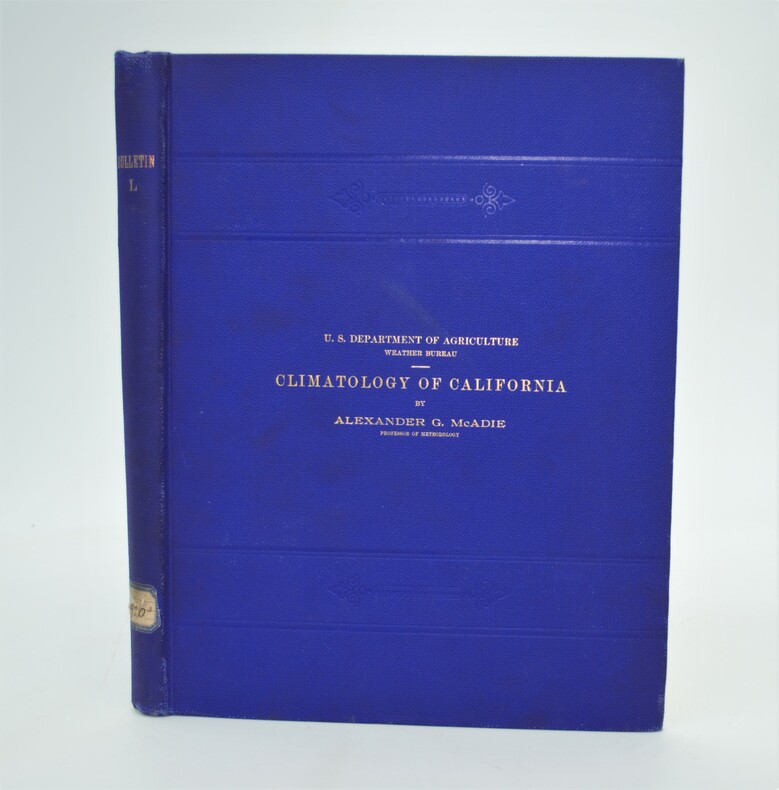
1903PHO-806Washington ,Government Printing Office, 1903. Grand in-4° , 270pp , illustré de nombreuses illustrations et photos , relié pleine percale éditeur , titre en or sur le plat dos lisse avec «bulletin L». receuil d’informations sur le climat en Californie au début du 20éme siècle ,très bon état .
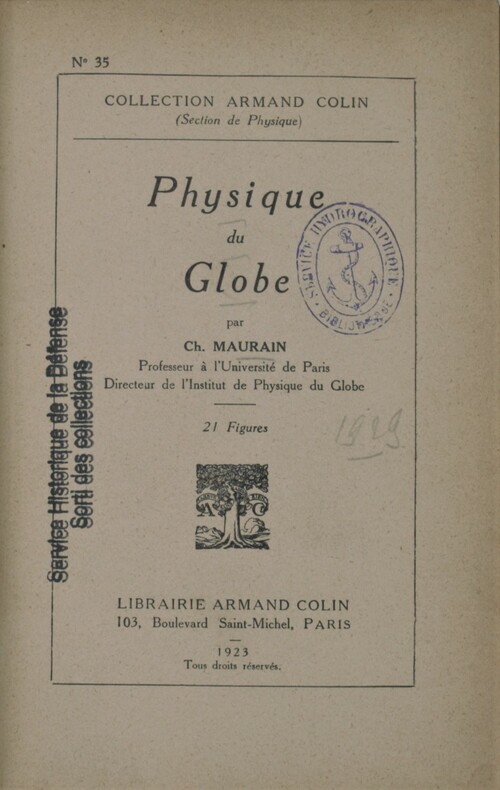
1923PHO-826Paris, Armand Colin. 1923. In-12 , relié demi cuir époque , dos lisse avec titre et auteur, 204 pages. 21 figues en noir et blanc, dans le texte, catalogue en fin d’ouvrage,bon état.P2-5C