30 résultats
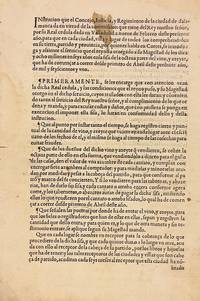
16013683Salamanca: S.n. 1601. First edition. Signed at foot by a municipal officer Diez de la Puente. One-page contemporary manuscript on p. 3 relating to the administration of the tax. Unbound as issued. Pinholes at gutter some edge chipping and small dents brown stain affecting the upper portion throughout. Otherwise a good well-preserved copy. First edition. Signed at foot by a municipal officer Diez de la Puente. One-page contemporary manuscript on p. 3 relating to the administration of the tax. Unbound as issued. 4 last 2 blank p. <p><br /> Unrecorded 1601 ordinance from Salamanca enforcing the Armada-era servicio de millones Spain’s foundational fiscal levy.<br /> <p><p><br /> Printed ordinance issued by the municipal council of Salamanca implementing the royal tax known as the servicio de los dieciocho millones. In accordance with the royal cédula of 9 February 1601 the Concejo Justicia y Regimiento instructs subordinate towns and villages to collect an eighth part of all wine and olive oil sold to be remitted through a chain of local receivers. The text regulates how wine and oil must be measured recorded and taxed forbids additional repartimientos and orders prompt transfer of funds to the city’s main treasury. Dated at Salamanca 10 March 1601 and naming four municipal commissioners appointed for its execution it represents the earliest stage of local enforcement of Philip III’s fiscal scheme transforming the national levy into a functioning municipal excise. A contemporary handwritten endorsement below the text signed by Diez de la Puente attests its execution. Accompanying the printed ordinance is a contemporary manuscript headed on p. 3 “Dudas que se ofrecen en la administración de las sisas†listing practical questions concerning the execution of the tax—registration and measurement of goods roles of administrators and receivers form of payment penalties and conditions of tax farming arrendamiento.<br /> <p><p><br /> The servicio de los dieciocho millones formed part of the broader system of millones taxes created by the Cortes of Castile to meet the Crown’s desperate financial needs after the prolonged wars of Philip II. The servicio de millones had first been introduced by royal request and approved by the Cortes on 4 April 1590 conceived to raise eight million ducats over six years to finance the royal expenditure associated with the Armada campaign against England and other military commitments. Rather than remaining temporary it evolved into a regular levy on six staple items—wine oil vinegar meat soap and tallow candles—collected through local sisas and eventually forming the backbone of Castile’s fiscal structure. By 1600–1601 under Philip III the scheme was renewed and expanded to eighteen million ducats its collection entrusted to municipal governments such as Salamanca’s Concejo Justicia y Regimiento. As described in Bartolomé Yun Casalilla’s Sobre la transición al capitalismo en Castilla this marked a transition from feudal income to a centralized fiscal system financed through municipal taxation embedding local economies within the machinery of the Habsburg war state. The present ordinance captures this process of consolidation—when the monarchy sought tighter control over municipal revenues demanded proper accounting and remittance of surpluses and aimed to prevent arbitrary over-taxation—reflecting both the fiscal strain and administrative centralization characteristic of early-seventeenth-century Spain.<br /> <p><p><br /> Reference: Yun Casalilla B. 1987. Sobre la transición al capitalismo en Castilla: EconomÃa y sociedad en Tierra de Campos 1500–1830. Valladolid: Junta de Castilla y León ConsejerÃa de Educación y Cultura.<br /> <p>. [S.n.] unknown
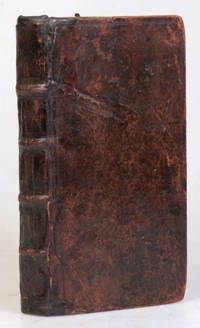
166434135Kantabrigia Cambridge: Ioannou Phieldou John Field 1665 1664. Two works in one volume 12mo xxxvi 126 2 ii 115 3 117-171 1 pp. Marginal loss to O6 in the second work without loss of text contemporary signature to the title page of the first work. Contemporary calf a little worn recent restoration to the spine ends and joints with a new fly leaf inserted. Griffiths 45-3. Wing B3632 & B2720A. The first work has the phrase "kai ton allon" set in both upper- and lowercase type. Kantabrigia [Cambridge]: Ioannou Phieldou [John Field] unknown
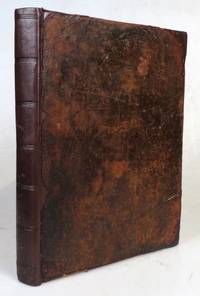
167548029Oxford: At the Theater 1675. Two works bound in one 8vo viii 96; 96 pp. Common Prayer lacking its frontispiece but extra illustrated with nine 18th century engravings several mounted or with repair to the lower margin 18th century manuscript to a rear blank recording three births. Contemporary calf worn rebacked with repairs to the corners also. Wing B3644 & B2518. Griffiths p.119 - "the first Oxford printing of the Book of Common Prayer & the first English BCP printed using the Fell type. Oxford: At the Theater unknown
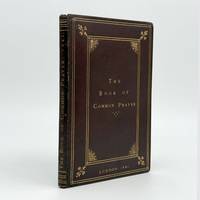
1641371384London: Robert Barker printer to the Kings most excellent Majestie and by the Assignes of John Bill 1641. Title within woodcut border. Text in two columns. 104pp. 8vo. Nineteenth-century full dark red morocco stamped in gilt. Gilt edges. Marbled endpapers with GTS bookplates on first pastedown. Pages cropped. Autograph initials on title page with additional ownership inscription on A3. Title within woodcut border. Text in two columns. 104pp. 8vo. This compact Book of Common Prayer was published during a period of particularly fractious religious tumult just prior to the start of the First English Civil War which was fueled in part by what was seen as King Charles I's pro-Catholic sympathies exemplified by his implementation of a more ceremonial sacramental version of High Anglicanism. Some of these contentious changes - as well the disquiet fomented by them - are alluded to in the Preface and "Of Ceremonies Why Some Be abolished and some retained" all of which follow "An Act for the Uniformitie of Common Prayer" on A2-A3. "Cum privilegio" printed at the foot of the title page.<br /> <br /> A gift to the General Theological Seminary from the then-Dean of Trinity Cathedral George McCormick. ESTC R37432; Griffiths Common Prayer 1641:5; Wing B3612A Robert Barker, printer to the Kings most excellent Majestie, and by the Assignes of John Bill unknown
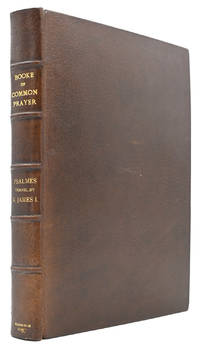
16378201Edinburgh: Printed by Robert Young 1637. Folio pp. 456. Bound with as often: The Psalmes of David: Translated by King Iames. London: Printed by Thomas Harper 1636. Folio pp. ii 147 1. First title-page and Calendar printed in red and black two proof leaves loosely inserted see below. 20th-century crushed brown morocco spine divided by raised bands second and fourth compartments gilt-lettered direct edges gilt. Somewhat soiled and toned waterstaining to corners most prominently at beginning and end first title-page and that of the Psalmes trimmed at fore-edge and renewed at foot proof leaves fragmentary with significant loss from edges. Spine very slightly mellowed. ‘Alexander’ in an early hand to margin of D8 verso that name repeated to one of the proof sheets along with plentiful pen trials and scribbles and ownership inscriptions of James Allan dated 1799 and 1805 more modern bibliographical notes in pencil to pastedown along with a typed slip. The famous Prayer Book imposed on Scotland by Charles I resulting in riots in St Giles’s Edinburgh when first used in a service - the catalyst being a stool thrown at the dean while he read by an anonymous woman traditionally named as ‘Jenny Geddes’. The follow-on effects of this book included the National Covenant of 1638 the Bishops’ Wars Charles I’s downfall and the English Civil War and it ‘provided a model for the American BCP of 1789 and its successors; the prayer books of the Scottish Episcopal Church 1929 & the Province of South Africa 1954’ Griffiths. An impressive as well as an important piece of printing it was produced in considerable numbers thanks to an act mandating two copies in every parish in Scotland though this was only issued after printing had started leading to a frantic process of resetting and reprinting with attendant multiple variations cancels etc. The prose Psalter here is the ‘first edition’ described by Morgan in The Bibliotheck 5 p. 16 with the catchword ‘Certaine’ on kk6 and the Psalter title reading ‘According to the translation.’. Leaf hh3 was cancelled in both editions and a cancellans printed in two separate settings resulting in copies having one of four potential leaves two cancellans two cancellanda; in this case the cancellans with line 1 verso ending ‘he’ is present. Morgan also notes that the 1636 London printing of the Psalms is as here ‘frequently found bound with copies of this Prayer Book and is present in eighteen of the thirty-seven copies examined. Presumably Young the printer ordered a consignment to be sent from London to Edinburgh to be bound with the Prayer Book’ p. 19. This copy additionally preserves almost certainly from an earlier binding two proof sheets both printed on one side only and with textual variants to the pages in the full book. The proof sheets are of aa2 verso and aa7 recto and are different variants to those recorded by Morgan as present in the proof sheets preserved in copies in the NLS and Glasgow. ESTC S101893; Griffiths 1637.9. Printed by Robert Young hardcover