(Book of Common Prayer)Biblio.com
30 résultats
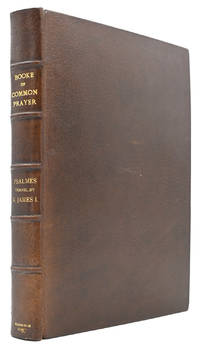
16378201Edinburgh: Printed by Robert Young 1637. Folio pp. 456. Bound with as often: The Psalmes of David: Translated by King Iames. London: Printed by Thomas Harper 1636. Folio pp. ii 147 1. First title-page and Calendar printed in red and black two proof leaves loosely inserted see below. 20th-century crushed brown morocco spine divided by raised bands second and fourth compartments gilt-lettered direct edges gilt. Somewhat soiled and toned waterstaining to corners most prominently at beginning and end first title-page and that of the Psalmes trimmed at fore-edge and renewed at foot proof leaves fragmentary with significant loss from edges. Spine very slightly mellowed. ‘Alexander’ in an early hand to margin of D8 verso that name repeated to one of the proof sheets along with plentiful pen trials and scribbles and ownership inscriptions of James Allan dated 1799 and 1805 more modern bibliographical notes in pencil to pastedown along with a typed slip. The famous Prayer Book imposed on Scotland by Charles I resulting in riots in St Giles’s Edinburgh when first used in a service - the catalyst being a stool thrown at the dean while he read by an anonymous woman traditionally named as ‘Jenny Geddes’. The follow-on effects of this book included the National Covenant of 1638 the Bishops’ Wars Charles I’s downfall and the English Civil War and it ‘provided a model for the American BCP of 1789 and its successors; the prayer books of the Scottish Episcopal Church 1929 & the Province of South Africa 1954’ Griffiths. An impressive as well as an important piece of printing it was produced in considerable numbers thanks to an act mandating two copies in every parish in Scotland though this was only issued after printing had started leading to a frantic process of resetting and reprinting with attendant multiple variations cancels etc. The prose Psalter here is the ‘first edition’ described by Morgan in The Bibliotheck 5 p. 16 with the catchword ‘Certaine’ on kk6 and the Psalter title reading ‘According to the translation.’. Leaf hh3 was cancelled in both editions and a cancellans printed in two separate settings resulting in copies having one of four potential leaves two cancellans two cancellanda; in this case the cancellans with line 1 verso ending ‘he’ is present. Morgan also notes that the 1636 London printing of the Psalms is as here ‘frequently found bound with copies of this Prayer Book and is present in eighteen of the thirty-seven copies examined. Presumably Young the printer ordered a consignment to be sent from London to Edinburgh to be bound with the Prayer Book’ p. 19. This copy additionally preserves almost certainly from an earlier binding two proof sheets both printed on one side only and with textual variants to the pages in the full book. The proof sheets are of aa2 verso and aa7 recto and are different variants to those recorded by Morgan as present in the proof sheets preserved in copies in the NLS and Glasgow. ESTC S101893; Griffiths 1637.9. Printed by Robert Young hardcover
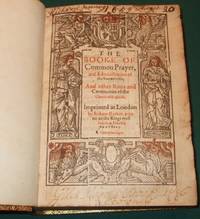
1605097215London: Robert Baker 1605. Book measures 7 1/2 x 5 1/2 inches. Titles. The Book of Common Prayer. The Psalter. Both printed by Robert Baker. Printed in the year 1605. First title page printed in red & black second in black. Signatures A1Hh8 in 8s slightly erratic signatures but follow on correct. Bound with The whole booke of Psalmes: collected into English meeter by tho. Sternh. Ioh. Hopkins and others: conferred with the hebrue with apt notes to sing them withall.for the Companie of Stacioners. London. 1606. Signatures A1M8 in 8s. Second edition. Both works printed in black letter. Bound in later full tree calf note on endpaper states 1882 raised bands gilt lines and centre stamp gilt lines on boards leather title label inner dentelles marble endpapers. Calf lightly rubbed on joints and edges. Binding in good clean firm condition. Internally Loss of about 1inch on top margin of a5 including some text loss of part of margin and some text on x5 . Early previous owners name date 16591776 on top and bottom margin of title page. Pages in very good clean condition. A very nice copy in a very attractive binding. . Full-Leather. Very Good. 8vo. Robert Baker Hardcover
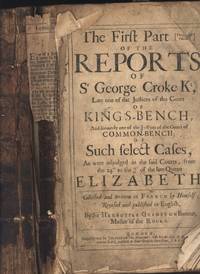
1661009117Printed by and for John Field and Tho. Newcomb also for W. Lee D. Pakeman and Gabriel Bedell . London 1661 1661. 1st Edition 1st Printing. Hardcover. Fair. 10 920 64 pages : portrait missing ; 30 cm OCLC 13205839 ; full leather with five bands. rebound ; this is the first of the three volumes of the first impression;interestingly a copy of the later third impression was owned by Thomas Jefferson in Monticello & is now in the Jefferson Exhibit collection of the Library of Congress ; Croke was brought into Parliament for Bere Alston by his relative Charles Blount 8th Lord Mountjoy. He served on the committees concerning tillage 13 Dec. 1597 lewd & wandering persons 20 Dec. costs in civil lawsuits 27 Jan. 1598 & on two conferences with the Lords 16 Jan. on defence and 3 Feb. on wine casks. He was probably the 'Mr. George Cooke' who was appointed to the committee on tellers and receivers on 12 Dec. Croke began reporting law cases in 1581& is mentioned as an advocate in his own reports in 1588. He established a lucrative practice & built up estates in Oxfordshire & Buckinghamshire. He was associated with the Hampden family was named as overseer in the will of William Hampden & must have known John Hampden for whom he later gave judgment in the ship-money case. Croke's marriage 'fell out unexpected to his friends that conceived a purpose in him never to have married' she being some 20 years of age & he 'an ancient bachelor'. Croke's law reports published after his death in a translation from the law French by Harbottle Grimston his son-in-law soon occupied a considerable place in the authoritative literature of the common law. The 12 active years which he spent on the King's bench coincided with some of the great constitutional cases of the century. He is best remembered in connexion with ship-money. In 1637 Charles submitted the question to the judges all of whom-save for Croke and Sir Richard Hutton-agreed that the King could demand such financial aid from his subjects in time of danger. The two dissidents signed this general statement in the belief that they were bound to yield to the majority opinion. However when the problem came before him judicially in the Hampden case he made an outright statement declaring that there was no precedent for such a prosecution and that only Parliament might set a charge upon a subject. 'The King has ship money by hook but not by Croke' said the wits. In 1641 Croke retired retaining the title salary & allowances of a judge. He died at Waterstock 16 Feb. 1642 leaving two wills the first being concerned with the disposal of land to his wife and son Thomas. In the second made 1640 and proved 3 May 1642 he asked to be buried without 'heraldry' hearse or any 'unnecessary ceremonies'. The widow was appointed sole executrix.--historyofparliamentonline ; Sir Harbottle Grimston 1603-1685 English politician second son of Sir Harbottle Grimston Bart. d. 1648 was born at Bradfield Hall near Manningtree on the 27th of January 1603. Educated at Emmanuel College Cambridge he became a barrister of Lincoln's Inn then recorder of Harwich & recorder of Colchester. As member for Colchester Grimston sat in the Short Parliament of 1640 & he represented the same borough during the Long Parliament speedily becoming a leading member of the popular party. He attacked Archbishop Laud with great vigour; was a member of the important committees of the parliament including the one appointed in consequence of the attempted seizure of the five members; & became deputy-lieutenant of Essex after the passing of the militia ordinance in January 1642. He disliked taking up arms against the king but remained nominally an adherent of the parliamentary party during the Civil War. In the words of Clarendon he "continued rather than concurred with them." .He translated the law reports of his father-in-law the judge Sir George Croke 1560-1642 which were written in Norman-French & five editions of this work have appeared.-1911 Britannica ; thick volume; marginalia; FAIR <br/> <br/> Printed by and for John Field and Tho. Newcomb, also for W. Lee, D. Pakeman, and Gabriel Bedell ..., London, 1661 hardcover
1639WRCLIT66472London: Imprinted . by Robert Barker . and by the Assignes of John Bill 1639. A8 /-A5 B6. Folio. Extracted from nonce pamphlet volume. Minuscule worm penetration in upper margin some soiling in margin of B5 lower extremity of gutter a bit ragged with some old soiling but a good copy. An uncommon separate printing of the Ordinal one of several printings by Barker and his assignes in this format made beginning in 1596. ESTC S123385. STC 16478. Imprinted ... by Robert Barker ... and by the Assignes of John Bill unknown books
166540968Cambridge: James Field 1665. 12mo 14.5 cm 5.75". 18 ff. 126 pp. 1 blank f. <br><br>also bound in Bible. Psalms. Greek. 1664. title-page in Greek romanized asPsalterion tou David. Kata tous Hevdomekonta. Cambridge: James Field 1664. 12mo. 1 f 171 1 blank pp. lacks blank leaf k6.<br>Â Â Â Â The mid-17th century was a low point in the history of English typography but in this pair of Anglican religious texts James Field printer to the University of Cambridge produced => a very good example of the printer's art of Greek printing especially in the use of a small point size. The guiding force behind their production was James Duport 160679 dean of Peterborough and master of Magdelene College Cambridge a noted scholar of Latin and Greek and supporter of the university press. The preface to the Book of Common Prayer is signed with his initials and it is established that he was the editor of the Psalms; the texts were almost certainly issued together but are also at times found individually in contemporary binding.<br>Â Â Â Â Field's minute typography here is dense and presented chiefly in double-column format in both works; and instead of woodcut head- or tailpieces and xylographic initials he deploys printer's ornaments to enliven the text at the top of some sections and occasionally elsewhere. => The layout is overall lovely and thoughtful and the printing is extremely clear and precise.<br>Â Â Â Â Binding: Contemporary morocco with covers framed in a single blind fillet; spine with gilt-stamped leather title-label and gilt-stamped compartment decorations. Marbled endpapers all edges gilt. => All pages ruled in red in the best style of the era.<br>Â Â Â Â Provenance: Isaac Watts 16741748 the godfather of English hymnody is also fondly remembered for his Psalms of David: Imitated in the Language of the New Testament a work that was reprinted over a thousand times. His ownership signature is on the blank leaf opposite the BCP title-page here. Later the volume was owned by Charles Mayo 17671858 a scholar of Old English who dated his ownership as "St. John's College Oxford 1787." Most recently in the library of American collector of Greek printing Albert A. Howard small booklabel "AHA" at rear. <br>Â Â Â Â <br>Â Â Â Â BCP: Benton Book of Common Prayer 2nd ed. p. 25 no. 122; ESTC R24205; Wing 2nd ed. B3632; Griffiths Bibliography of the Book of Common Prayer 453. Psalms: STC R204252; Wing 2nd ed. 1994 B2720A. Bound as above extremities a little rubbed with small chip at head of spine and edges of label chipped; joints strengthened some time ago and volume varnished. Inscriptions and small booklabel as above; pages gently age-toned otherwise clean. => A solid and attractive copy of an attractive production with wonderful provenance. James Field hardcover books