19 006 résultats
186454755London, Taylor and Francis, 1864. 4to. In plain white paper-wrappers with title-page of journal volume pasted on to front wrapper. In ""Transactions of the Cambridge Philosophical Society"", Volume 10. Fine and clean. Pp. (27)-83, (1) + the pasted on title-page.
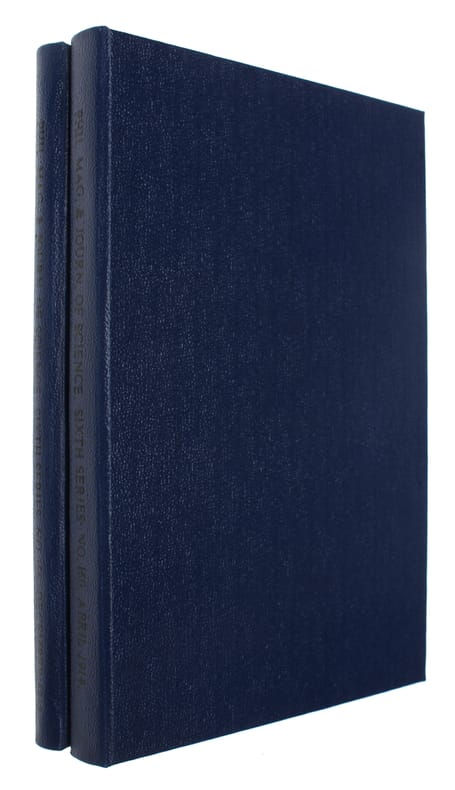
191360037London, 1913 & 1914. 8vo. 2 volumes, uniformly bound with the original wrappers in recent full blue cloth. In ""The London, Edinburgh and Dublin Philosophical Magazine"", Sixth Series, Vol. 26, no. 156, December 1913 & vol. 27, no. 160, April 1914. Lower part of index (pp. 1059-1064) in vol 26 with horisontal repair to lower part, affecting last three line (but legible). A fine and clean set. Moseley's papers: pp. 703-13" pp. 1024-1034. [Entire issues: pp. 937-1064" pp. 541-756].
London, Harrison and Sons, 1928. Royal8vo. In the original printed wrappers. In ""Proceedings of the Royal Society of London, Series A, Vol. 117, No. 778"". Black cloth backstrip pasted on to spine, otherwise a fine copy (without institutional stamps). [Dirac's paper:]Pp 610-624. [Entire issue:] Pp. 541-730, (2), XXXVI, X + 6 plates.
Berlin, Königlich Akademie der Wissenschaften, 1925-1929. 1. Einheitliche Feldtheorie von Gravitation und Elektrizität., 1925, pp. 414-419. Uncut, unopened n the original printed wrappers. missing small parts of spine and upper part of front wrapper detached, otherwise fine. (Weil 147 / Boni 155).2. Neue Möglichkeit für eine einheitliche Feldtheorie von Gravitation und Elektrizität. Offprint: S. B. preuss. Akad. Wiss., 1928, pp.235-245. In the original yellow wrappers. Very fine and clean. (Weil 162/ Boni 175).3. Zur einheitlichen Feldtheorie. Offprint: S. B. preuss. Akad. Wiss., 1929, pp.2-7. In the original yellow wrappers. Very fine and clean. (Weil 165/ Boni 183).4. Einheitliche Feldtheorie und Hamiltonsches Prinzip. Offprint: S. B. preuss. Akad. Wiss., 1929, pp.156-159. In the original yellow wrappers. Very fine and clean. (Weil 166/ Boni 184).
London, Taylor and Francis, 1864. 4to. In plain white paper-wrappers with title-page of journal volume pasted on to front wrapper. In ""Transactions of the Cambridge Philosophical Society"", Volume 10. Fine and clean. Pp. (27)-83, (1) + the pasted on title-page.
(London, Taylor and Francis, 1911). 8vo . In recent half cloth with cloth title-label with gilt lettering to front board. Extracted from ""The London, Edinburgh, and Dublin Philosophical Magazine and Journal of Science"" Sixth Series, Vol. XXI. A fine and clean copy. [Rutherford's paper:] pp. 669-688. [Withbound:] Pp. 585-696.
Paris, Crochard, 1820. Recent hcloth. Some repairs to inner margin of titlepage to ""Annales"". In ""Annales de Chimie et de Physique, Par MM. Gay-Lussac et Arago"" Tome XIV pp. 417-25. The whole volume present: 448 pp. and 3 folded engraved plates.
1924172973Leipzig, Hirzel, 1905-1924. Gr.-8°. M. 30 Taf. u. zahlr. Textfig. Zus. über 10.000 Seiten Text. Versch. Hlwdbde. m. Rsign. Gest. Bibl.-Ex,.
173744514Napoli, , 1737. In-4 de XI-(1)-300-(2) pp., frontispice gravé, errata, veau brun, dos orné à nerfs, pièce de titre en maroquin rouge (reliure de l'époque).
1911194708London, Taylor & Francis, 1911. In: The London, Edinburgh, and Dublin Philosophical Magazine and Journal of Science. Series 6 Vol. 21 = Januar-June 1911, No. 125, pp. 669-688. Bound in half leather with gilt-stamped title on spine. Cover bumped and rubbed. Edges, table of contents and title page brown-spotted.
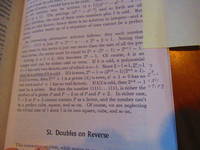
1968056493Dover Publications T1846 1968. 1st Edition . Soft cover. Near Fine. Vi 125. Soft Cover Apparently First Printing Priced $1.75 No Isbn. Inscribed "To Dick Feynman -Bill Mcmillan Ucla Chemistry". On P. 121 Feynman Has Underlined "2 To The K Power-1 Must Be A Prime If K Is Odd" And Added A Marginal " 2 To The 9Th - 1 = 511 = 7 X Actually He Uses A Period As A Multiplication Sign 73". Per Ucla William George Mcmillan 1919-2002 Graduated From Ucla With A B.A. In Chemistry In 1941. He Continued His Studies At Columbia University Where He Received An M.S. In Chemistry In 1943 And A Ph.D. In Chemical Physics In 1945. Bill'S Dissertation Research In Statistical Mechanics With Joseph E. Mayer Was Concerned With The Theory Of Solutions. The Results Known As The Mcmillan-Mayer Theory Are Still Widely Cited. From 1944 To 1946 Still At Columbia He Was A Research Chemist On The Manhattan Project Working On The Separation Of U235. Upon Receiving A Guggenheim Fellowship In 1946 Bill Carried Out Research In Nuclear Physics At The University Of Chicago With Edward Teller. In 1947 He Came To Ucla As An Assistant Professor And Rose To The Rank Of Full Professor In 1959. Bill Became Chair Of The Department In 1959 And Served Until 1965. He Led The Department Through A Period Of Rapid Growth And Development Of Its Research And Teaching Programs As Well As Established A Strong Infrastructure. His Strong Leadership Was Instrumental In Bringing The Department To National Attention. Unlike Many In Academe He Thought The Country Was Continually In Mortal Danger From The Soviet Union. He Worked For The Rand Corporation As A Consultant To The U.S. Military And Helped Form The Sage Advisory Committee That Reported On Weapons Tests. At Ucla He Established Defense Science Seminars 1964-66 To Help Revitalize The Contact Between Young Scientists In The Universities And Those In Government Service And In The Defense Community. While On Leave From The University Bill Served From 1966 To 1968 Years As Science Adviser To General William Westmoreland In Vietnam Developing Concepts For Artillery And Military Reconnaissance. Although Much Of His Time Was Spent In Service To The Government Service That Gave Rise To Many Specialized Reports Some Still Classified His Academic Publications Deal With A Wide Variety Of Topics. These Range From The Early Work On Multicomponent Systems To Later Statistical Mechanical And Quantum Mechanical Studies On The Thomas-Fermi Model Of The Atom Transitions In Two-Dimensional Adsorbed Layers Dispersion Forces Between Molecules A Comprehensive Review Of The Virial Theorem And Applications To Ions In Solution. In 1971 Bill Founded Mcmillan Science Associates Which He Built Up Over Subsequent Decades As A Wide-Ranging Consulting Company For High Technology And Military Projects. He Was Interested In Topics As Diverse As Traffic Flow Global Warming Ozone Depletion And Atmospheric Studies Of Venus. Always A Part-Time Faculty Member In His Later Years He Continued His Many Activities After Retirement In 1990. Bill Had A Brilliant Mind And Could Talk And Write About Anything From Planetary Physics To The Thermodynamics Of Solutions. He Was An Enthusiastic And Well-Organized Teacher In Courses Ranging From First-Year Chemistry To Graduate Courses In Quantum Chemistry And Statistical Mechanics. He Would Astonish Students In A Computer Age With Quick "Back Of The Envelope" Calculations. Veteran Department Faculty And Staff Remember His Trenchant Memo "What'S Important" Which Emphasized That Furthering Good Teaching And Research Must Override Everything Else In Department Priorities. <br/> <br/> Dover Publications T1846 paperback
157531751Urbini, (D. Frisolini), 1575. Small 4to. Fine recent full vellum in old style with written title on back. Titlepage + 80 leaves (title unnumb. + F 1-80 with 4 leaves misnumb., e.g. F70 instead of 80). The dedicationleaf (unnumb.) after title missing. Text complete, fine and clean with broad margins. One large initial in woodcut and 89 large textillustrations in woodcut.
185144780(Paris, Bachelier, 1851-52). 4to. Later blank wrapper. Extracted from ""Comptes rendus hebdomadaires des séances de l’Académie des sciences"", Vol. 32 and vol. 35. Foucault's papers: pp. 135-138 (1851, vol. 32), pp. 421-424 (1852, vol. 35), pp. 424-427 (1852, vol. 35), pp. 469-470 (1852, vol. 35) and p. 602 (1852, vol. 35).
Paris, Crochard, 1825. 8vo. Bound in 2 uniform later hcloth. Gilt lettering to spines. In: ""Annales de Chimie et de Physique, Par MM. Gay-Lussac et Arago."", tome 29 a. 30. - 448 pp. and 3 folded engraved plates + 448 pp. and 2 folded engraved plates. (The entire volumes offered). Ampère's papers: pp. 381-404 (tome 29) + Suite pp. 29-41 (tome 30) + ""Lettre à Gerhardi"": pp. 373-381 (tome 29). Some scattered brownspots.
Kjöbenhavn (Copenhagen), 1850. 4to. All three bound together in the original blue-green blank glitted gift-binding. Spine and extremities worn (occasional minor loss of paper, especially to spine), and front hinge weak. A bit of brownspotting throughout. 26 pp., 2 folded engraved plates + 20 pp., 2 engraved plates (folded together) + 22 pp.
Urbini, (D. Frisolini), 1575. Small 4to. Fine recent full vellum in old style with written title on back. Titlepage + 80 leaves (title unnumb. + F 1-80 with 4 leaves misnumb., e.g. F70 instead of 80). The dedicationleaf (unnumb.) after title missing. Text complete, fine and clean with broad margins. One large initial in woodcut and 89 large textillustrations in woodcut.
(Paris, Bachelier, 1851-52). 4to. Later blank wrapper. Extracted from ""Comptes rendus hebdomadaires des séances de l’Académie des sciences"", Vol. 32 and vol. 35. Foucault's papers: pp. 135-138 (1851, vol. 32), pp. 421-424 (1852, vol. 35), pp. 424-427 (1852, vol. 35), pp. 469-470 (1852, vol. 35) and p. 602 (1852, vol. 35).
Kaluga, 1915. 8vo. (25,5 x 17,4 cm). Orig. printed, illustrated green wrappers, inside af wrappers also illustrated w. figures. Fading to front wrapper and to edges of back wrapper. Two very small tears to back wrapper. Internally excellent. All in all a very fine copy. Illustr. 10 pp. (= pp. (1)-10).
1913032015London: Macmillan And Co 1913. First English Language Edition 1st Printing. Hardcover. Very Good. Xiv 1 219 Pp 4 Pp Ads At Rear. Blue Cloth Gilt And Blindstamped. Seven Line Inscription And Signature Of Zeeman Dated In December 1924 To Alfred Lande. Light Rubbing At Corners And Front Spine Edge Gilt All Present But Not Brilliant Very Faint Dampstaining In Upper Right Third Of Front Cover And Small Area In Upper Corner Of Rear Cover But No Trace On Contents; Otherwise Clean No Fading To Cloth. From Wikipedia: Alfred Landé 1888 -1976 Was A German-American Physicist Known For His Contributions To Quantum Theory. In 1913 Landé Was Sent By Arnold Sommerfeld His Thesis Advisor At The University Of Munich To Be A Special Assistant For Physics To David Hilbert At The University Of Göttingen To Replace Paul Peter Ewald Whom Sommerfeld Had Sent To The Same Position In 1912. Landé Obtained His Doctorate Under Sommerfeld At The University Of Munich Two Weeks Prior To The Start Of The First World War. He Joined The Red Cross And Served For Two Years On The Eastern Front Before Being Invited By Max Born To Join Him At The Artillery Testing Commission One Of The Few Scientific Sections Of The Army. Apart From Their Work On Artillery Location By Sound Ranging They Began To Examine The Cohesive Forces And Compressibility Of Crystals. This Work Led To The Unexpected Result That The Electron Trajectories In Atoms Were Not At All Like Planetary Orbits Which At The Time Was The Usual Understanding Of The Electron In An Atom. Landé Studied Atomic Structure Intensively For The Next Seven Years. In 1916 Sommerfeld Had Begun To Apply The New Atomic Theory To Form A General Quantization Rule. In 1919 Landé Unexpectedly Turned To Spectroscopy Even Though The Continuation Of The Study Of The Spatial Orientation Of The Atoms Was The Most Pressing Problem Of The Time. He Turned To The Problem Of Atoms With Several Electrons In Particular To The Simplest Case The Spectrum Of Helium. The Spectrum Showed Non-Combining Single And Double Actually Triplet As It Turned Out Later Terms So That It Seemed As If Helium Was Made Of Two Different Substances Which Is Explained Today As The Result Of Electron Spin. Landé's Work Contained Several New Important Ideas Including The Rule Of Vector Addition Of Two Quantum-Mechanical Angular Momenta J1 And J2. His Findings And Postulates Were Later Confirmed By Quantum Theory. Landé's Frankfurt Investigations December 1920 Until April 1921 Ended With The Discovery Of The Well-Known Landé G-Formula And An Explanation For The Anomalous Zeeman Effect. The Landé G-Factor Is Now Defined Through Mj The Magnetic Quantum Number. In 1923 Landé Stated The Landé Interval Rule A Rule Dealing With The Relation Between An Electron's Spin And Orbit. Landé Was A Forerunner In A Phase Of New Interpretation Of Quantum Theory From Which Concrete Physical Statements About Experimentally Verifiable Facts Can Be Made. This Happened After The First Phase Of The Interpretation Of The Theory With Well-Known Discussions Between Niels Bohr Werner Heisenberg And Wolfgang Pauli Who Favoured The Copenhagen Interpretation Opposed In Varying Degrees By Erwin Schrödinger Louis De Broglie And Most Notably Albert Einstein. After 1950 And For The Rest Of His Life Landé Turned Energetically Against The Copenhagen Interpretation Of Quantum Theory Requiring As Did Einstein An Objectively Real Description Of Physical Processes. This Change Was Driven By Landé's Perception That Wave-Particle Duality Was An Unnecessary Misrepresentation Of Quantum Processes That He Explained By Developing A New Unitary Particle Formulation Without Dualistic Reference To Waves. Landé Based His New Formulation Upon Non-Quantal Principles Of Symmetry And Invariance With Duane's Rule For Quantisation Of Momentum Exchange With Space-Periodic Structures And Leibniz's Principle Of Cause-Effect Continuity To Explain The Intrinsically Probabilistic Nature Of Quantum Processes. His Interpretation Is Considered A Minority Interpretation. <br/> <br/> Macmillan And Co hardcover
1958211195Berlin, Akad.-Vlg. 1958-90. Fehlen: Sachreg. zu Jg. 6 u. 7; TI zu Jg. 28.
8079P., Bachelier, 1835/1837, 3 PARTIES reliées un volume in 4 demi-basane marron, dos orné de filets dorés (reliure de l'époque), (dos légèrement frotté, une coiffe émoussée, rousseurs comme souvent), 3 feuillets non chiffrés, 532pp., 1 PLANCHE DEPLIANTE pour le traité publié en 1835 ; 2 feuillets non chiffrés, 72pp. pour LE SUPPLEMENT publié en 1837
Berlin, Julius Springer, 1925. 8vo. Contemp. hcloth. In: 'Zeitschrift für Physik', Volume 31. VIII,952 pp., textillustr. A circular stamp to titlepage.(Entire volume offered). Pauli's paper: pp.765-783. A fine and clean copy, internally as well as externally.
1916107003BBLeipzig, Barth, 1916. 8°. 64 S. Typogr. OKart. [6 Warenabbildungen]
192547417Berlin, Julius Springer, 1925. 8vo. Contemp. full cloth. Gilt spine. Wear to top of spine and with 2 tears to hinges at upper spine. Inner backhinge nearly broken. A stamp to foot of a few leaves In: 'Zeitschrift für Physik', Volume 31. VIII,952 pp., textillustr. (Entire volume offered). Pauli's paper: pp.765-783. Internally clean and fine.
Berlin, Julius Springer, 1925. 8vo. Contemp. full cloth. Gilt spine. Wear to top of spine and with 2 tears to hinges at upper spine. Inner backhinge nearly broken. A stamp to foot of a few leaves In: 'Zeitschrift für Physik', Volume 31. VIII,952 pp., textillustr. (Entire volume offered). Pauli's paper: pp.765-783. Internally clean and fine.