Kronmuller, Helmut & Fahnie, ManfredBiblio.com
1 880 résultats
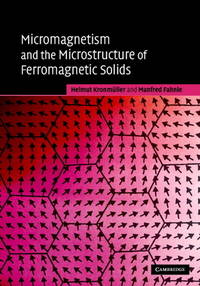
2003PH-213U.K.: Cambridge University Press 2003. Comprehensive reference text presents theoretical and analytical applications of micromagnetism and microstructure to all aspects of advanced magnetic materials including modern developments in computational micromagnetism and its application to spin structures of small particles and platelets. Includes coverage of nanocrystalline and amorphous alloys magnetic aspects of intermetallic compounds nucleation and pinning phenomena etc. 432 pgs. Illustrated. First Edition. Hard Cover. As New/ . 4to - over 9¾" - 12" tall. Cambridge University Press Hardcover
PH-29Oxford U.K.: Pergamon Press Ltd./Addison Wesley 1960. Classic highly acclaimed text deals primarily with the theory of electromagnetic fields in matter and the theory of the macroscopic electric and magnetic properties of matter. Detailed topics include: electrostatics of dielectrics and conductors; constant magnetic field; ferromagnetism; electromagnetic waves; superconductivity magnetic fluid dynamics; passage of fast particles through matter; diffraction of x-rays through crystals; etc. 417 pp. Illustrated. Gilt spine. Upper corner of front endpaper clipped by prior owner. Dustjacket has some minor rubbing to edges; in mylar. Minimal shelfwear. First Edition. Hard Cover. Very Good/Very Good. 8vo - over 7¾" - 9¾" tall. Pergamon Press Ltd./Addison Wesley Hardcover
1984QS-16Orlando FL.: Academic Press 1984. Comprehensive classic text presents detailed topics on parametric processes that occur in liquids and gases including coverage of optical nonlinearities; third-harmonic generation and third-order frequency mixing; higher-order processes; limitations on conversion efficiency due to competing effects; self-action effects and degenerate four-wave mixing; materials studies; applications; etc. 466 pgs. Illustrated. Tiny bump on upper edge of front cover. Gilt spine and front cover. Minimal shelfwear. First Edition. Hard Cover. Fine. 8vo - over 7¾" - 9¾" tall. Academic Press Hardcover
1972PH-57Oxford: Pergamon Press Ltd. 1972. Classic monograph provides full account of the theoretical studies of turbulence phenomena both plasmas and liquids based on the author's lectures given at the Culham Laboratories. 135 pgs. Illustrated. Prior owner's name on front endpaper. Dustjacket has two small closed tears on the upper and lower edge of front cover; in mylar. . First Edition. Hard Cover. Excellent/Very Good. 8vo - over 7¾" - 9¾" tall. Pergamon Press Ltd. Hardcover
2025x-1800617089World Scientific Europe Ltd 2025. Hardcover. New. 596 pages. 6.00x0.89x9.00 inches. World Scientific Europe Ltd hardcover
1985060164Princeton: Princeton Univ Press 1985. 1st Edition 1st Printing. Hardcover. Near Fine/Fine. X 158. Black Cloth Spine Stamped In Purple Other Printings Have Spine Stamped In Gilt. Early Printing Book With No Marking Of Later Printing Same As First Issue But Without Review Of Peierls Book On Dj Rear Flap First Printings Had An Ad For Peierls Book At The Bottom Of The Rear Flap According To A March 1986 Letter From The Publisher To Feynman. Alix G. Mautner Memorial Lecture On The Theory Of Light Written For A Popular Audience. Book Would Be Fine No Wear But Small Area 1/2" Or Less" Of Very Light Blue Dampstaining At Top Spine Corner Of First And Last Few Pages. Former Owner's Three-Line Sophisticated Critical Comment At Bottom Of P. 19. As New Dj No Trace Of Dampstaining As Damp Spot Was On Top Of Spine Edge Of Boards And Bled Down Up To One Half Inch On Those Introductory And Final Pages Without Affecting The Book Covers Or Dj. <br/> <br/> Princeton Univ Press hardcover
1956047720London: George Allen & Unwin 1956. 1st Edition 1st Printing. Hardcover. Near Fine/Near Fine. 278 Pp. 2 Pp Publisher's Catalog At End. Light Blue Cloth. First Edition Uk Issue With George Allen At Base Of Spine Of Book And Dj 21S Price On Front Flap No Text On Rear Flap And Rear Panel. Near Fine Book No Marks Gilt Bright In Lightly Worn Dj Near Fine. <br/> <br/> George Allen & Unwin hardcover
1981060208Ann Arbor Michigan: UMI Publications 1981. Facsimile . Blue Cloth. Near Fine/No Dust Jacket. 8" Tall. Two Hardcover Volumes Containing A Total Of 1 325 Pages The Author's Personal Copies. Reese Ruiz Taught At Uc Berkeley And Was An Artist Himself. <br/> <br/> UMI Publications hardcover
a88787New York 1951 first edition. Various pagination - about 300 pages in binder. Printed on rectos only. ONR No. NR 390-006. Contract N8 ONR-533. Includes progress reports memoranda and miscellaneous material issued in connection with the study of physics abstracting carried on during the period of October 1948 and December 1949. Very hard to find. VG. . unknown
1961BOOKS 52781 ILightest soiling to boards otherwise fine. Clear jacket shows faint shelfwear but no loss. 1961 Hardback Oblong 4to. Cloth. Short essay and bibliographic note in French followed by eleven mounted group photos of the participants in the Solvay Physics Conference held in Brussels sporadically starting in 1911. On the occasion of the 50th anniversary of the first one. In clear printed jacket. hardcover
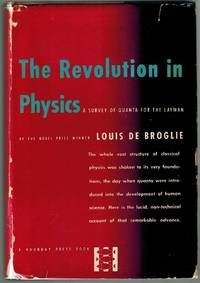
1953010245New York: The Noonday Press 1953. Book. Fine. Decorative Cloth. 1st Edition. 8vo - over 7¾ - 9¾" tall. Fine in a Very Good and SCARCE dust jacket tears and chips at edges and folds. The Nobel Prize winner's "lucid non-technical account of that remarkable advance" the development of the Quantum Theory. . The Noonday Press Hardcover
198052615Laurel MD: Johns Hopkins APL 1980. Presumed First Edition First printing thus. Hardcover. very good. 313 pages. Illustrations some in color. Maps. References. Notes. Indexes. Minor wear/soiling to boards. Bound volume includes Numbers 1-4. Binding has the name of R. J. Thompson in gilt lettering on front board. Dr. Thompson was Special Assistant to the Director of the Applied Physics Laboratory and had a long professional involvement with rocket technology development. He joined the Applied Physics Laboratory in 1974. The Johns Hopkins APL Technical Digest is an unclassified technical journal published quarterly by APL. The objective of the publication is to communicate the work performed at the Laboratory to its sponsors and to the scientific and engineering communities defense establishment academia and industry. Founded on March 10 1942-just three months after the United States entered World War II-APL was created as part of a federal government effort to mobilize scientific resources to address wartime challenges. APL was assigned the task of finding a more effective way for ships to defend themselves against enemy air attacks. The Laboratory designed built and tested a radar proximity fuze that significantly increased the effectiveness of anti-aircraft shells in the Pacific-and later ground artillery during the invasion of Europe. The product of the Laboratory's intense development effort was later judged to be along with the atomic bomb and radar one of the three most valuable technology developments of the war. On the basis of that successful collaboration the government The Johns Hopkins University and APL made a commitment to continue their strategic relationship. The Laboratory rapidly became a major contributor to advances in guided missiles and submarine technologies. Today more than seven decades later the Laboratory's numerous and diverse achievements continue to strengthen our nation. APL continues to relentlessly pursue the mission it has followed since its first day: to make critical contributions to critical challenges for our nation. Johns Hopkins APL hardcover
198652621Laurel MD: Johns Hopkins APL 1986. Presumed First Edition First printing thus. Hardcover. good. 423 illus. some in color diagrams references notes index bound volume includes Numbers 1-4. Scuff/chip to top of front board at spine. This copy belonged to R. J. Thompson special assistant to the Director of the Applied Physics Laboratory. The Johns Hopkins APL Technical Digest is an unclassified technical journal published quarterly by APL. The objective of the publication is to communicate the work performed at the Laboratory to its sponsors and to the scientific and engineering communities defense establishment academia and industry. Issue 3 has 11 articles in its 'Theme Articles' section-- most related to computing and microelectronics in significant ways. Other articles address: Artificial Intelligence Computer Vision Expert System Molecular Electronics Nuclear Winter Solar Seismology Satellite Transmitter Viking Satellite Program and Magnetospheres. Founded on March 10 1942-just three months after the United States entered World War II-APL was created as part of a federal government effort to mobilize scientific resources to address wartime challenges. APL was assigned the task of finding a more effective way for ships to defend themselves against enemy air attacks. The Laboratory designed built and tested a radar proximity fuze that significantly increased the effectiveness of anti-aircraft shells in the Pacific-and later ground artillery during the invasion of Europe. The product of the Laboratory's intense development effort was later judged to be along with the atomic bomb and radar one of the three most valuable technology developments of the war. On the basis of that successful collaboration the government The Johns Hopkins University and APL made a commitment to continue their strategic relationship. The Laboratory rapidly became a major contributor to advances in guided missiles and submarine technologies. Today more than seven decades later the Laboratory's numerous and diverse achievements continue to strengthen our nation. APL continues to relentlessly pursue the mission it has followed since its first day: to make critical contributions to critical challenges for our nation. Johns Hopkins APL hardcover
198952623Laurel MD: Johns Hopkins APL 1989. Presumed First Edition First printing thus. Hardcover. very good. 446 illus. some in color diagrams references notes indexes minor wear/soiling to boards bound volume includes Numbers 1-4. The Johns Hopkins APL Technical Digest is an unclassified technical journal published quarterly by APL. The objective of the publication is to communicate the work performed at the Laboratory to its sponsors and to the scientific and engineering communities defense establishment academia and industry. The third issue in this volume has the theme articles focuses on "Computing at APL Moves into the Nineties." Other notable articles in this volume are: Optical Processing Radar Signal Analysis. APL's Master's Degree Program in Computer Science Delta-K Radar Synthetic Aperture Radar Geosat Altimetry and Spacecraft Altimeters. Founded on March 10 1942-just three months after the United States entered World War II-APL was created as part of a federal government effort to mobilize scientific resources to address wartime challenges. APL was assigned the task of finding a more effective way for ships to defend themselves against enemy air attacks. The Laboratory designed built and tested a radar proximity fuze that significantly increased the effectiveness of anti-aircraft shells in the Pacific-and later ground artillery during the invasion of Europe. The product of the Laboratory's intense development effort was later judged to be along with the atomic bomb and radar one of the three most valuable technology developments of the war. On the basis of that successful collaboration the government The Johns Hopkins University and APL made a commitment to continue their strategic relationship. The Laboratory rapidly became a major contributor to advances in guided missiles and submarine technologies. Today more than seven decades later the Laboratory's numerous and diverse achievements continue to strengthen our nation. APL continues to relentlessly pursue the mission it has followed since its first day: to make critical contributions to critical challenges for our nation. Johns Hopkins APL hardcover
199252626Laurel MD: Johns Hopkins APL 1992. Presumed First Edition First printing thus. Hardcover. good. 537 illus. some in color diagrams references notes indexes small tear at bottom of spine bound volume includes Numbers 1-4. The Johns Hopkins APL Technical Digest is an unclassified technical journal published quarterly by APL. The objective of the publication is to communicate the work performed at the Laboratory to its sponsors and to the scientific and engineering communities defense establishment academia and industry. This volume celebrates the 50th anniversary of the Applied Physics Laboratory. Topics in this issue include: Surface Fleet Defense Air and Underwater Systems Space Development and Research Neural Network Complex Systems Scanning Tunneling Microscopy Materials Research Thermal Shock Missile Radome Gallium Arsenide. The fourth issue has a focus on The Johns Hopkins National Search for Computing Applications to Assist Persons with Disabilities Founded on March 10 1942-just three months after the United States entered World War II-APL was created as part of a federal government effort to mobilize scientific resources to address wartime challenges. APL was assigned the task of finding a more effective way for ships to defend themselves against enemy air attacks. The Laboratory designed built and tested a radar proximity fuze that significantly increased the effectiveness of anti-aircraft shells in the Pacific-and later ground artillery during the invasion of Europe. The product of the Laboratory's intense development effort was later judged to be along with the atomic bomb and radar one of the three most valuable technology developments of the war. On the basis of that successful collaboration the government The Johns Hopkins University and APL made a commitment to continue their strategic relationship. The Laboratory rapidly became a major contributor to advances in guided missiles and submarine technologies. Today more than seven decades later the Laboratory's numerous and diverse achievements continue to strengthen our nation. APL continues to relentlessly pursue the mission it has followed since its first day: to make critical contributions to critical challenges for our nation. Johns Hopkins APL hardcover
1976acfgThe Institution of Minning and Metallurgy 1976. Hardcover. Good/Good. the jacket is a little shelf rubbed. tanning. light marks. well bound. good copy.S.K. Our orders are shipped using tracked courier delivery services. The Institution of Minning and Metallurgy hardcover
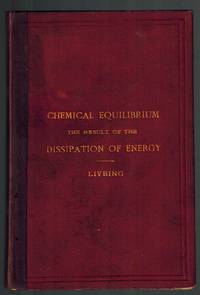
1885010230London: Deighton Bell and Co. 1885. Book. Very Good. Cloth. 1st Edition. 8vo - over 7¾ - 9¾" tall. viii 97 p. two plates 2 16 p publisher's catalogue. Bound in original red cloth with gilt lettering front cover old cloth tape repair to spine Very Good cloth soiled and spotted last few pages with damping at top edge not affecting text small stamp of the Cincinnati Public Library verso of title page no other library markings with slight indication of book plate removal rear paste down. SCARCE."This is to the best of my knowledge the first English-language monograph to deal specifically with chemical dynamics.". George Downing Liveing and the Origins of Chemical Thermodynamics in Great Britain" William B. Jensen Bull. Hist. Chem. Vol. 38 No. 1 2013 . Deighton, Bell and Co. Hardcover
2010021110Palo Alto California: Annual Reviews 2010. NOT a library discard. Appears unread. Fine condition. NO owner's name or bookplate. Pages are clean crisp and unmarked -- apparently never read. 2010. First Edition. 62 expert contributing authors. Illustrations throughout most in full color. Tables/graphs. Bibliography of literature cited after each chapter. Index. Bound in the original red cloth stamped in bright gold over black panels on the spine and front cover. 7.5" wide by 9.5" tall. First Edition. Hardcover. Fine condition/No dust jacket as issued. xii 581pp. Great Packaging Fast Shipping. Annual Reviews Hardcover
1961018606New York: Interscience 1961. Hard Cover. A Very Good Copy. . 261p. The rare English Language edition title is in French the articles are all in English. Very scarce. OCLC reports an English edition in the Denmark National Library. Original articles by Niels Bohr "The Solvay Meetings and the Development of Quantum-Field Theory" and Richard Feynman "The Present Status of Quantum Electro-dynamics". Discussions also appear throughout the book including not only Bohr and Feynman but also Heisenberg Paris Chew Kallen and others are in the discussions of the topics. Bound in maroon cloth spine lettering gilt. A very good copy with no marks or signs of previous ownership. Interscience unknown
1999059923Singapore: World Scientific Publishing Co Inc 1999. 1st Edition 1st Printing. Hardcover. Fine/No Jacket. Xxi 125 Pp. Black Cloth Gilt. First And Only Printing Hardcover Issiue. Fine In Fine Dust Jacket. Text Evolved From Lectures To An Honors Course For Undergraduates. Fine. Mendel Sachs 1927 -2012 Was An American Theoretical Physicist. His Scientific Work Includes The Proposal Of A Unified Field Theory That Brings Together The Weak Force Strong Force Electromagnetism And Gravity. Sachs Earned His Bachelors At The University Of California Los Angeles He Then Moved To Columbia University New York For Postgraduate Study. While At Columbia Sachs Was Taught By Willis Lamb And Hideki Yukawa.5 Yukawa Had Agreed To Be Sach's Thesis Advisor But Sachs Decided To Complete His Doctorate Back At Ucla. Following The Award Of His Phd In 1954 Sachs First Post-Doctoral Position Was At The New University Of California Radiation Laboratory At Both Berkeley And Livermore Which Was Run By Edward Teller And Ernest Lawrence And Was Also Home To Bryce Dewitt Who Sachs Would Later Co-Author Articles With In Physics Today. In 1956 Sachs Became A Senior Scientist At Lockheed Missiles And Space Laboratory While At Lockheed Sachs Began Developing With Solomon Schwebel A Field Theory Of Quantum Electrodynamics That Included Broken Symmetries That Did Not Require Recourse To Renormalization Or Perturbation Techniques - The "Schwebel-Sachs" Model. In 1961 He Became A Research Professor At Mcgill University; This Was Followed By A Post As Associate Professor Of Physics At Boston University 1962-1966. In 1964 While At Boston University Sachs Received An Invitation From Paul Dirac To Visit Cambridge University. Sachs Stayed In England For Three Months Where His Wife Yetty Had Family. Sachs Worked With Paul Dirac At The Department Of Applied Mathematics And Theoretical Physics Cambridge University. While Working With Dirac Sachs Also Had The Opportunity To Discuss Ideas With John G. Taylor John Polkinghorne And Graduate Students At Damtp. In 1965 Sachs Had Had A Breakthrough While At The Aspen Physics Institute Colorado. Sachs Was Able To Derive A Result For A Unified Field Theory If Quantum Mechanics Was Considered To Be A Linear Approximation For A Field Theory Of Inertia Expressed In General Relativity. Sachs Argued That The Work Of Albert Einstein And Erwin Schrödinger In General Relativity Did Not Yet Take Account Of The Inertia Of Matter Which Required Consideration Of The Mach Principle. In The Summer Of 1966 Abdus Salam Invited Sachs To Spend A Few Months At The International Centre For Theoretical Physics In Trieste Italy. During This Time Sachs Published The Details Of His Formal Structure Of Quantum Mechanics From A Generally Covariant Field Theory Of Inertia In The Italian Journal Il Nuovo Cimento. In The Autumn Of 1966 He Was Appointed Professor Of Physics At State University Of New York At Buffalo. <br/> <br/> World Scientific Publishing Co Inc hardcover
1997045794London: Penguin Books 1997. First Softcover Edition 1st Printing. Soft cover. Near Fine. X 274 Pp. Illustrated Wrappers. First Uk Softcover Edition And Apparently First Uk Edition. Very Good Slight Wear Spine Crease Pencil Marginalia Up To Page 15. Generically Inscribed By Barrow. Per Wikipedia John David Barrow Frs 1952 - 2020 Was An English Cosmologist Theoretical Physicist And Mathematician. He Served As Gresham Professor Of Geometry At Gresham College From 2008 To 2011. Barrow Was Also A Writer Of Popular Science And An Amateur Playwright. Barrow's Approach To Philosophical Issues Posed By Physical Cosmology Made His Books Accessible To General Readers. For Example Barrow Introduced A Memorable Paradox Which He Called "The Groucho Marx Effect" See Russell-Like Paradoxes. Here He Quotes Groucho Marx: "I Wouldn't Want To Belong To Any Club That Would Accept Me As A Member". Applying This To Problems In Cosmology Barrow Stated: "A Universe Simple Enough To Be Understood Is Too Simple To Produce A Mind Capable Of Understanding It". <br/> <br/> Penguin Books paperback
1973020095London: Blackie & Son 1973. First Edition First Printing . Blue Cloth. Near Fine/Near Fine DJ. 221 Pp.Blue Cloth Gilt. First Edition The Uk Edition Precedes The American Edition Published By Hafner. Near Fine In Near Fine Dust Jacket Trace Of Wear. <br/> <br/> Blackie & Son hardcover
1931056296Berlin : Verlag Von Julius Springer 1931. 1st Edition 2nd Printing. Hardcover. Near Fine/Near Fine. 469 Pp. Second Printing 1931 18 Pp Longer And With A New Second Preface By Courant. Yellow Cloth. Ownership Signature Of Computer Security Pioneer Donald . Woodbridge On Front Pastedown. Near Fine In Near Fine Dust Jacket <br/> <br/> Verlag Von Julius Springer hardcover
1930034369Cambridge: The Physical Society / Cambridge University Press 1930. First Separate Edition 1st Printing. Soft cover. Good. Photographs Graphs. Pp355-365 Extracted From The Proceedings In Tan Wrappers Printed In Black A Publisher's Offprint. Covers Worn And Browned Tears At Spine Edges And 1/2" Chips At Top And Bottom Of Spine Panel. Pencil Ownership Name Of Hendrik Antoon Kramers Dutch Physicist Who Worked Primarily In Studies Of Magnetism At Top Of Front Cover As Was Kramers' Custom With His Library. Sir James Alfred Ewing Kcb 27 March 1855 7 January 1935 Was A Scottish Physicist And Engineer Best Known For His Work On The Magnetic Properties Of Metals And In Particular For His Discovery Of And Coinage Of The Word Hysteresis. It Was Said Of Ewing That He Was 'Careful At All Times Of His Appearance His Suits Were Mostly Grey Added To Which He Generally Wore - Whatever The Fashion - A White Piqué Stripe To His Waistcoat A Mauve Shirt A White Butterfly Collar And A Dark Blue Bow Tie With White Spots.' He Was Regarded As Brilliant And Successful But Was Conscious Of His Dignity And Position. On Appointment To Head The Newly Created Admiralty Codebreaking Department The Director Of Naval Intelligence Henry Oliver Described Him As 'Too Distinguished A Man To Be Placed Officially Under The Orders Of The Director Of Intelligence Or Chief Of Staff'. His First Wife Annie Was An American A Great Great Niece Of George Washington. In 1890 Ewing Took Up The Post Of Professor Of Mechanism And Applied Mechanics At The University Of Cambridge Initially At Trinity College Though He Later Moved To King's College. At Cambridge Ewing's Research Into The Magnetisation Of Metals Led Him To Criticise The Conventional Account Of Wilhelm Weber. In 1890 He Observed That Magnetisation Lagged Behind An Applied Alternating Current. He Described The Characteristic Hysteresis Curve And Speculated That Individual Molecules Act As Magnets Resisting Changes In Magnetising Potential. Note: According To The Book Sir Alfred Ewing: A Pioneer In Physics And Engineering 1946 By Professor Bates The Discovery Of Magnetic Hysteresis Probably Occurred Before Ewing. However Ewing Re-Discovered It Studied It In Detail And Coined The Word Hysteresis. Ewing Also Researched Into The Crystalline Structure Of Metals And In 1903 Was The First To Propose That Fatigue Failures Originated In Microscopic Defects Or Slip Bands In Materials. In 1895 He Was Awarded The Gold Medal Of The Royal Society For His Work On Magnetic Induction In Iron And Other Metals. Ewing Was A Close Friend Of Sir Charles Algernon Parsons And Collaborated With Him On The Development Of The Steam Turbine And He Later Married Parsons' Surviving Daughter. During This Time Ewing Published The Steam Engine And Other Heat Engines Around This Time. In 1897 He Took Part In The Sea-Trials Of The Experimental Vessel Turbinia Which Set A New Speed Record Of 35 Knots. During World War I From 1914 To May 1917 Ewing Managed Room 40 The Admiralty Intelligence Department Of Cryptanalysis Responsible Predominantly For The Decryption Of Intercepted German Naval Messages. In This Capacity He Achieved Considerable Fame In The Popular Press When Room 40 Deciphered The Zimmermann Telegram In 1917 Which Suggested A German Plot To Assist Mexico In Recovering The Southwestern United States. The Publication Of The Zimmermann Telegram Is Generally Credited As The Trigger Event Which Brought American Into The Great War. In May 1916 Ewing Accepted An Invitation To Become Principal Of The University Of Edinburgh In The Course Of Which He Instituted An Extensive Series Of Effective Reforms And Which He Held Until His Retirement In 1929. In 1927 He Gave A Lecture To The Edinburgh Philosophical Institution Which Contained The First Semi-Official Disclosure Of The Work Done By Room 40. Worldcat Shows Only One Institutional Holding In Scotland. <br/> <br/> The Physical Society / Cambridge University Press paperback
1980035787Cambridge: Cambridge University Press 1980. 1st Edition 1st Printing. Soft cover. Fine. 26 Pp. Yellow Wrappers Printed In Black. First Printing. Fine No Wear Or Marks Or Fading. <br/> <br/> Cambridge University Press paperback