1 880 résultats
1986PH-266Berlin Heidelberg: Springer-Verlag 1986. Classic comprehensive text presents a detailed analysis of electromagnetic systems based on field concepts in preference to the wide-spread lumped-parameter approach. Topics include: principles of magneto-electric interactions; electromagnetic induction: steady-state and transient phenomena; dynamic phenomena; electrodynamics of shielding; etc. 296 pgs. Illustrated with 88 figures. Minimal shelfwear. First Edition. Hard Cover. Fine. 8vo - over 7¾" - 9¾" tall. Springer-Verlag Hardcover
199206844Boston: Kluwer Academic Publishers 1992. USA Presumed 1st edition. No markings Fine; no dust jacket as published. Hardcover xii 444pp index line diagrams. This is a book on the developments in real-time systems engineering. 2.8 JM LVR 206/b1. 1st. Hardcover. Fine/No Dust Jacket. 8vo - over 7¾" - 9¾". Kluwer Academic Publishers Hardcover

1974PH-388Toronto Canada: University of Toronto Press 1974. Comprehensive revised and updated text contains detailed topics covering porous media; fluids; hydrostatics in porous media; Darcy's law; solutions of Darcy's law; physical aspects of permeability; general flow equations; statistical theory of flow through porous media; elementary displacement theory; immiscible multiple phase flow; miscible displacement; etc. 353 pgs. Illustrated. Prior ownership stamps and label removal marks to front endpaper; stamp on outer edge. Corners and spine edges rubbed and worn; small scuff to rear cover. Text contents clean and unmarked. . Third Edition. Hard Cover. Good. 8vo - over 7¾" - 9¾" tall. Ex-Professional Library. University of Toronto Press Hardcover
2012151362Springer 2012. Hard Cover. Near Fine. A clean unmarked book with a tight binding. Slight wear to cover. 434 pages. Springer hardcover
182046032Paris Crochard 1820. Uncut with orig. printed wrappers Juin-issue. In "Annales de Chimie et de Physique Par MM. Gay-Lussac et Arago" Tome XIV Juin issue pp. 113-222. Entire issue in orig. wrappers. Savart's paper: pp. 113-172 and 3 folded engraved plates. <br/><br/><em>First printing of a pioneer paper on the acoustics of the violin and on the construction of the Trapezoidal Fiddle."In his earliest work Savart gave the first explanation of the function of certain parts of the violin. To learn how vibrations are transmitted from the strings to the rest of the instrument he induced vibrations in a free wood plate by passing a vibrating string over a bridge at its center; he also used Chladni’s sand-pattern technique to observe the resulting nodal lines. Savart showed that the bridge transmits the string’s vibrations; that the plate can be made to vibrate at any frequency; and that the corresponding mode is a modification of an unforced mode. He demonstrated that the sound post also serves to transmit vibrations and he explained that it therefore should not be placed under a nodal line. Thinking that symmetry and regularity would produce the best tone Savart built a trapezoidal violin with rectangular sound holes. When the instrument was played before a committee that included Biot the Composer Cherubini and other members of the Academy of Sciences and the Académie des Beaux-Arts its tone was judged as extremely clear and even but somewhat subdued."DSB.The issue also contains Eilhard Mitscherlich' famous paper in the first French version "Sur la Relation qui existe entre la forme cristalline et les proportions chimiques" pp. 172-190. </em> unknown
182046029Paris Crochard 1820. No wrappers. In "Annales". In "Annales de Chimie et de Physique Par MM. Gay-Lussac et Arago" Tome XIV Juin issue pp. 113-222. Entire issue offered with halftitlepage to vol. 14. Savart's paper: pp. 113-172 and 3 folded engraved plates. Plates with some scattered brownspots. <br/><br/><em>First printing of a pioneer paper on the acoustics of the violin and on the construction of the Trapezoidal Fiddle."In his earliest work Savart gave the first explanation of the function of certain parts of the violin. To learn how vibrations are transmitted from the strings to the rest of the instrument he induced vibrations in a free wood plate by passing a vibrating string over a bridge at its center; he also used Chladni’s sand-pattern technique to observe the resulting nodal lines. Savart showed that the bridge transmits the string’s vibrations; that the plate can be made to vibrate at any frequency; and that the corresponding mode is a modification of an unforced mode. He demonstrated that the sound post also serves to transmit vibrations and he explained that it therefore should not be placed under a nodal line. Thinking that symmetry and regularity would produce the best tone Savart built a trapezoidal violin with rectangular sound holes. When the instrument was played before a committee that included Biot the Composer Cherubini and other members of the Academy of Sciences and the Académie des Beaux-Arts its tone was judged as extremely clear and even but somewhat subdued."DSB.The issue also contains Eilhard Mitscherlich' famous paper in the first French version "Sur la Relation qui existe entre la forme cristalline et les proportions chimiques" pp. 172-190. </em> unknown
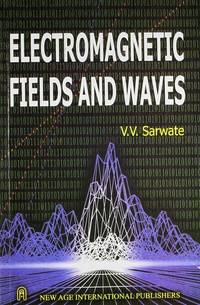
1993PH-372New York: John Wiley & Sons 1993. Comprehensive text emphasizes a physical understanding of fields and waves and their characteristics. 30% of this book deals with theory the rest of it is application of this theory to various situations of different levels of complexity. In each case the reason for the choice of the method is explained Topics covered include Coulomb's Law and static electric fields; Gauss's Law; potential and its gradient; methods of images and conformal transformations; conductors and dielectrics; magnetostatics; Poisson's and Laplace's equations; time-varying fields and electromagnetic waves; the Poynting vector; guided waves and wave guides; antenna and antenna arrays; propagation characteristics of radio waves; etc. 457 pgs. Illustrtaed. Dustjacket in mylar. First Edition. Hard Cover. Fine/Fine. 8vo - over 7¾" - 9¾" tall. John Wiley & Sons Hardcover
1989PH-34Amsterdam The Netherlands: North-Holland/Elsevier Science 1989. Highly acclaimed text was compiled by his friends and admirers in honour of his 80th birthday and concentrates mainly on Casimir's achievements in the field of physics though without ignoring the peripheral areas of the history and philosophy of physics in which he was greatly interested. Text focuses on Casimir's achievements in the field of physics including the history and philosophy of physics theoretical physics science and technology and mathematical techniques in field theory. 361 pgs. Illustrated. First Edition. Hard Cover. Fine. 4to - over 9¾" - 12" tall. North-Holland/Elsevier Science Hardcover
1986PH-104Bristol U.K.: Adam Hilger Ltd. 1986. Classic text consists of a selection of the invited talks given at the Malvern seminar on Dynamical Systems held at RSRE Malvern in April 1985 presenting recent developments in the fields of fluids chemical reactions non-linear and quantum optics and theories of Hamiltonian and dissipative systems. 336 pgs. Illustrated. Prior owner's nameplate pastedown on front endpaper; clean pocket label on rear endpaper; small reference numerals on lower front cover. Minimal shelfwear. First Edition. Hard Cover. Very Good/ . 8vo - over 7¾" - 9¾" tall. Ex-Professional Library. Adam Hilger Ltd. Hardcover
2025x-1800616902World Scientific Europe Ltd 2025. Paperback. New. 550 pages. 6.00x2.00x9.00 inches. World Scientific Europe Ltd paperback
2025x-1800617089World Scientific Europe Ltd 2025. Hardcover. New. 596 pages. 6.00x0.89x9.00 inches. World Scientific Europe Ltd hardcover
2025x-1800617097World Scientific Europe Ltd 2025. Hardcover. New. 432 pages. 6.00x0.79x9.00 inches. World Scientific Europe Ltd hardcover
2025x-1800616937World Scientific Europe Ltd 2025. Paperback. New. 432 pages. 6.00x0.77x9.00 inches. World Scientific Europe Ltd paperback
2025x-1800616961World Scientific Europe Ltd 2025. Paperback. New. 456 pages. 6.00x0.79x9.00 inches. World Scientific Europe Ltd paperback
2025x-1800617100World Scientific Europe Ltd 2025. Hardcover. New. 456 pages. 6.00x0.84x9.00 inches. World Scientific Europe Ltd hardcover
49906249like new. unknown
49906249-nnew. unknown
1980170591UK: Ellis Horwood Limited 1980. cover is in very good condition and d/j is clear plastic covered clear clean and bright. Ex-library with stamps on page block and lending label at front. First Edition. hardcover. Very Good/Very Good. Ex-Library. Ellis Horwood Limited Hardcover
1980170701Chichester: Ellis Horwood Limited 1980. An ex-library copy in good condition. Very small signs of wear to the cover. Pages are clean bright and tight throughout. Ex-library sticker to spine stamping to edges of pageblock and stickers/stamping to inside cover/title pages. hardcover. Good/No Dust Jacket. Ex - Library. Ellis Horwood Limited Hardcover
THPU-75333Hardcover. NEW. US Standard Edition. We will ship same day or next day with trackable delivery method. Expedited Shipping Available. We don't entertain INTERNATIONAL orders ATM. 30-day money-back guarantee. hardcover
THPU-74769Hardcover. NEW. US Standard Edition. We will ship same day or next day with trackable delivery method. Expedited Shipping Available. We don't entertain INTERNATIONAL orders ATM. 30-day money-back guarantee. hardcover
1963015596Various Publications 1963 - 2000 1963. Photocopies . No Binding. Very Good. A Large Collection Of Articles On General Relativity And Specific Topics Related To His New Formulation In The Books General Relativity 1982 And Quantum Mechanics From General Relativity 1986 From The Library Of A Colleague. Each Is A Photocopy Of The Article As Published Without Duplication And The Total Is Over 3" Thick.Mendel Sachs 1927 -2012 Was An American Theoretical Physicist. His Scientific Work Includes The Proposal Of A Unified Field Theory That Brings Together The Weak Force Strong Force Electromagnetism And Gravity. Sachs Earned His Bachelors At The University Of California Los Angeles He Then Moved To Columbia University New York For Postgraduate Study. While At Columbia Sachs Was Taught By Willis Lamb And Hideki Yukawa.5 Yukawa Had Agreed To Be Sach's Thesis Advisor But Sachs Decided To Complete His Doctorate Back At Ucla. Following The Award Of His Phd In 1954 Sachs First Post-Doctoral Position Was At The New University Of California Radiation Laboratory At Both Berkeley And Livermore Which Was Run By Edward Teller And Ernest Lawrence And Was Also Home To Bryce Dewitt Who Sachs Would Later Co-Author Articles With In Physics Today. In 1956 Sachs Became A Senior Scientist At Lockheed Missiles And Space Laboratory While At Lockheed Sachs Began Developing With Solomon Schwebel A Field Theory Of Quantum Electrodynamics That Included Broken Symmetries That Did Not Require Recourse To Renormalization Or Perturbation Techniques - The "Schwebel-Sachs" Model. In 1961 He Became A Research Professor At Mcgill University; This Was Followed By A Post As Associate Professor Of Physics At Boston University 1962-1966. In 1964 While At Boston University Sachs Received An Invitation From Paul Dirac To Visit Cambridge University. Sachs Stayed In England For Three Months Where His Wife Yetty Had Family. Sachs Worked With Paul Dirac At The Department Of Applied Mathematics And Theoretical Physics Cambridge University. While Working With Dirac Sachs Also Had The Opportunity To Discuss Ideas With John G. Taylor John Polkinghorne And Graduate Students At Damtp. In 1965 Sachs Had Had A Breakthrough While At The Aspen Physics Institute Colorado. Sachs Was Able To Derive A Result For A Unified Field Theory If Quantum Mechanics Was Considered To Be A Linear Approximation For A Field Theory Of Inertia Expressed In General Relativity. Sachs Argued That The Work Of Albert Einstein And Erwin Schrödinger In General Relativity Did Not Yet Take Account Of The Inertia Of Matter Which Required Consideration Of The Mach Principle. In The Summer Of 1966 Abdus Salam Invited Sachs To Spend A Few Months At The International Centre For Theoretical Physics In Trieste Italy. During This Time Sachs Published The Details Of His Formal Structure Of Quantum Mechanics From A Generally Covariant Field Theory Of Inertia In The Italian Journal Il Nuovo Cimento. In The Autumn Of 1966 He Was Appointed Professor Of Physics At State University Of New York At Buffalo. <br/> <br/> Various Publications 1963 - 2000 unknown
1974036014Jerusalem: I.P.S.T. / Israel Universities Press / John Wiley & Sons / Halsted Press 1974. 1st Edition 1st Printing. Hardcover. Very Good /No Jacket. Xv 190 Pp. Red Cloth Printed In Black And Pink. First Printing. Inscribed By The Author To The Dedicatee Prof. Abraham Kaplan. Light Wear Rubbing And Bumping At Corners No Fraying Some Fading To Cloth On Spine Panel But Lettering Still Strong. Mendel Sachs 1927 -2012 Was An American Theoretical Physicist. His Scientific Work Includes The Proposal Of A Unified Field Theory That Brings Together The Weak Force Strong Force Electromagnetism And Gravity. Sachs Earned His Bachelors At The University Of California Los Angeles He Then Moved To Columbia University New York For Postgraduate Study. While At Columbia Sachs Was Taught By Willis Lamb And Hideki Yukawa.5 Yukawa Had Agreed To Be Sach's Thesis Advisor But Sachs Decided To Complete His Doctorate Back At Ucla. Following The Award Of His Phd In 1954 Sachs First Post-Doctoral Position Was At The New University Of California Radiation Laboratory At Both Berkeley And Livermore Which Was Run By Edward Teller And Ernest Lawrence And Was Also Home To Bryce Dewitt Who Sachs Would Later Co-Author Articles With In Physics Today. In 1956 Sachs Became A Senior Scientist At Lockheed Missiles And Space Laboratory While At Lockheed Sachs Began Developing With Solomon Schwebel A Field Theory Of Quantum Electrodynamics That Included Broken Symmetries That Did Not Require Recourse To Renormalization Or Perturbation Techniques - The "Schwebel-Sachs" Model. In 1961 He Became A Research Professor At Mcgill University; This Was Followed By A Post As Associate Professor Of Physics At Boston University 1962-1966. In 1964 While At Boston University Sachs Received An Invitation From Paul Dirac To Visit Cambridge University. Sachs Stayed In England For Three Months Where His Wife Yetty Had Family. Sachs Worked With Paul Dirac At The Department Of Applied Mathematics And Theoretical Physics Cambridge University. While Working With Dirac Sachs Also Had The Opportunity To Discuss Ideas With John G. Taylor John Polkinghorne And Graduate Students At Damtp. In 1965 Sachs Had Had A Breakthrough While At The Aspen Physics Institute Colorado. Sachs Was Able To Derive A Result For A Unified Field Theory If Quantum Mechanics Was Considered To Be A Linear Approximation For A Field Theory Of Inertia Expressed In General Relativity. Sachs Argued That The Work Of Albert Einstein And Erwin Schrödinger In General Relativity Did Not Yet Take Account Of The Inertia Of Matter Which Required Consideration Of The Mach Principle. In The Summer Of 1966 Abdus Salam Invited Sachs To Spend A Few Months At The International Centre For Theoretical Physics In Trieste Italy. During This Time Sachs Published The Details Of His Formal Structure Of Quantum Mechanics From A Generally Covariant Field Theory Of Inertia In The Italian Journal Il Nuovo Cimento. In The Autumn Of 1966 He Was Appointed Professor Of Physics At State University Of New York At Buffalo. <br/> <br/> I.P.S.T. / Israel Universities Press / John Wiley & Sons / Halsted Press hardcover
1975056782Dover Publications Inc. 1975. 2nd Edition . Soft cover. Near Fine. Xii 350 Catalog At End. The 1965 Edition Slightly Corrected From The Original. This Copy Inscribed By The Author. Near Fine. <br/> <br/> Dover Publications Inc. paperback
1978PH-4Berlin-Heidelberg: Springer-Verlag 1978. Classic text presents a series of lectures dealing with applied inverse problems in a variety of fields. Topics covered include ray theoretical inverse problems in geophysics; linear inverse theory; analytical extrapolations and inverse problems; regularization of linear inverse problems in Fourier optics; inversion-like integral equations; spectral transform and nonlinear evolution equations; inverse problem for electromagnetic prospection; inverse problem for finite range potentials; Gel'fand-Levitan theory of the inverse problem for singular potentials; etc. Text in English and French. 425 pgs. Illustrated. Small stamp on lower title page and rear endpaper; clean pocket remnant on rear endpaper; reference numerals on lower front cover. Minimal shelfwear. First Edition. Soft Cover. Very Good. 8vo - over 7¾" - 9¾" tall. Springer-Verlag Paperback