186 résultats
188541897(Stockholm, F.& G. Beier), 1885. 4to. No wrappers as extracted from ""Acta Mathematica"", Vol. 7. Pp. 259-288. Clean and fine.
188541897Stockholm F.& G. Beier 1885. 4to. No wrappers as extracted from "Acta Mathematica" Vol. 7. Pp. 259-288. Clean and fine. <br/><br/><em>First appearance of one of Poincaré's main papers."Another famous paper of Poincar´we in celestial mechanics is the one he wrote in 1885 on the shape of a rotationg fluid mass submitted only to the forces of gravitation. Maclaurin had found as possible shapes some ellipsoids of revolution to which Jacobi had added other types of ellipsoids with unequal axes and P.G. Tait and W.Thomson some annular shapes. By a penetrating analysis of the problem Poincaré showed that still other "pyriform" shaoes exosted. One of the features of his interesting argument is that apparently for the first time he was confronted with the problem of minimizing a quadratic form in "infinitely" many variables."DSB. </em> unknown
18346168Aufgesetzt, mit Beiträgen von neuern englischen Konstrukzionen vermehrt und herausgegeben von Franz Anton von Gerstner. 3 Bände u. Atlasband. Mit gest. Porträt, Tabelle (zu Bd. I, S. 478) u. 109 gest. Tafeln (plano, 2 mit Aquatinta). Prag, Gedruckt bei J. Spurny (1 u. 2), 1831-1832 u. Wien, Gedruckt bei J. P. Sollinger, 1834; Atlas: Prag, 1831-1832 u. Wien, 1834. 4to. (27,6 x 20,5 cm) u. Quer-Folio (32,5 x 46,0 cm). Marmorierte Halblederbände d. Zt. mit etwas Rückenvergoldung u. Halblederband d. Zt. (Rücken u. Ecken erneuert).
186042575Paris, Typographie de Firmin Didot frères, 1860. Grand in-folio de (2)-50-(2) pp., 19 planches à double-page, demi-chagrin noir, dos à nerfs, tranches dorées (reliure de l'époque).
18213579Coronata colla medaglia d'oro nella distribuzione de' Premj d' Industria nel dì 4 Ottobre 1815. Mit 4 kolor. gefalt. gest. Tafeln. Mailand, dalla tipografia di Angelo Stanislao Brambilla, 1821. 8vo. (20,8 x 13,7 cm). 19 S. Neuer Umschlag.
185842295(London, Richard Taylor and William Francis, 1858 and Taylor and Francis, 1866. 4to. No wrappers as extracted from ""Philosophical Transactions"" Vol. 148 - Part I. Pp. 17-37, and Vol. 156 - Part I, Pp. 25-35. Clean and fine.
185842295London Richard Taylor and William Francis 1858 and Taylor and Francis 1866. 4to. No wrappers as extracted from "Philosophical Transactions" Vol. 148 - Part I. Pp. 17-37 and Vol. 156 - Part I Pp. 25-35. Clean and fine. <br/><br/><em>First appearance of this outstanding contribution to mathematics announcing his invention and developments of the ALGEBRA OF MATRICES what is now called the Cayley-Hamilton theorem for square matrices of any order. "The subject originated in a memoir of 1858 the paper offered and grew directly out of simple observations on the way in which the transformations linear of the theory of algebraic invariants are combined.a distinctive feature of these rules is that multiplication is not commutative.we get different results according to the order in which we do the multiplication. it seems about as far from anything of scientific or practical use as anything could possible be. Yet sixty seven years after Cayley's invented it HEISENBERG in 1925 recognized in the algebra of matrices exactly the tool which he neede for his revolutionary work in QUANTUM MECHANICS."Bell Men of Mathematics."It was in connection with the study of invariants under linear transformation that Cayley first introduced matrices to simplify the notation involved. Here he gave some basic notions. This was followed by his first major paper on the subject "A Memoir on the Theory of Matrices." the paper offered here. Kline Mathematical Thought.p. 806. </em> unknown
18085856With numerous figures. Revised by Peter Nicholson, architect. Mit zahlr. Holzschnitten im Text u. 2 (1 gest.) gefalt. Tabellen. London, Printed by and for William Savage, 1808. Kl.-4to. (20,1 x 12,6 cm). 2 Bl., II S. "Contents of essay I.", (V)-IX, (11)-184 S. Blauer Pappband d. Zt. mit rotem Rückenschild.
184559278Kington Herefordshire: Charles Humphreys . 1845. Hardcover. Very Good. Vii 303pp sl foxng to prelims bound in red cloth new endpapers The first history of this small market town in Herefordshire it also has the distinction of containing the first published work of famous naturalist Alfred Russell Wallace ' An Essay on the Best Way of Conducting the Kington Mechanics' Institution. Wallace was born in 1823 and wrote this article in 1840 and was at the time a member of the Mechanics Institute as was Richard Parry the author. ; Octavo . Charles Humphreys hardcover
1845051667Kington Herefordshire: Charles Humphreys . 1845. Hardcover. Very Good. vii 303pp folding pedigree which has a repair recently rebound in half brown leather/marbled boards gilt bands and lettering to spine. The first history of this small market town in Herefordshire it also has the distinction of containing the first published work of famous naturalist Alfred Russell Wallace ' An Essay on the Best Way of Conducting the Kington Mechanics' Institution. Wallace was born in 1823 and wrote this article in 1840 and was at the time a member of the Mechanics Institute as was Richard Parry the author. ; Octavo . Charles Humphreys hardcover
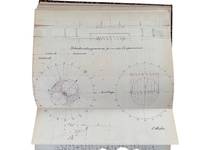
1878215461878. EngineeringPhysics Three manuscript volumes 1878-1879 compiled in Germany notes on nineteenth-century study of applied physics mechanics thermodynamics and fluid engineering at a moment when the German states were consolidating their position as leaders in industrial science and technical education. Produced during the height of Imperial Germany's expansion of polytechnic institutes and research universities these notebooks reflect the rigorous mathematical formalism and applied design training that undergirded the nation's rapid industrialization. The systematic integration of theoretical mechanics with detailed machine drawings situates the work within the educational culture that supported advances in steam power turbine development and precision engineering in the decades following unification in 1871. As working instructional volumes they provide primary evidence of how Newtonian mechanics thermodynamic principles and mechanical design were taught to engineers in the late nineteenth century.<br /> <br /> Three handwritten volumes titled "I. Band" "II. Band" and continuation volume. Germany 1878-1879. The first volume opens with "Allgemeine Mechanik" outlining foundational principles including "Zusammensetzung und Zerlegung der Kräfte" and a carefully drafted "Parallelogramm der Kräfte" accompanied by geometric constructions and vector decompositions central to applied statics. Subsequent sections demonstrate lever calculations and force polygons rendered with precision technical drafting. The second volume advances into applied mechanics addressing "elastische Körper" rotational dynamics and "Zentripetalkraft" with formula derivations and diagrams of circular motion. Detailed gear assemblies and meshing systems indicate practical engagement with machine design while a section devoted to "Schmidt'scher Wassermotor" includes a sectional rendering of a turbine mechanism. The third volume transitions to thermodynamic systems including extended treatment of heat exchangers "Caloriferes" and a large fold-out "Schieberdiagramm für variable Expansion" attributed to G. Huber illustrating valve timing in steam engines through radial plotting. A further fold-out cross-section of a high-pressure steam engine demonstrates piston-cylinder interaction and valve actuation accompanied by efficiency calculations and pressure analyses. The presence of fold-out engineering plates systematic red and black ink notation and sequential theoretical development strongly suggests production within a university or technical institute environment.<br /> <br /> Three volumes. Extensive manuscript text with numerous diagrams and multiple fold-out plates. Original marbled paper boards with manuscript title labels. Bindings intact; minor hinge wear; spine cracking on one volume; pages clean and bright; fold-outs crisp with slight fraying at some edges. Overall very good. As a comprehensive and internally coherent set of engineering study notebooks from the period when German technical education shaped global industrial practice these volumes offer substantive insight into the pedagogical transmission of classical mechanics and steam engineering at a formative moment in modern industrial history. unknown