Jungenickel, AndreaAntiquariat.de

900 résultats
16613788In einem Gespräch / zwischen einem Ingenier und Mechanico, verfasset / und mit 137. Figuren vorgestellet... Und an den Tag gegeben Durch... Ober=Ingenier, Martin Stier. Mit gest. Titel von V. Sommer nach G. A. Böckler u. 137 Textholzschnitten. Nürnberg, P. Fürst, Gedruckt daselbst bey Christoff Gerhard, (1661). 4to. (19,9 x 15,5 cm). 3 Bll., 368 S., 8 Bll. Register. Pergamentband d. Zt.
XXXII-[8]-458-[2] pages et 10 planches veau havane de l'époque, dos à 5 nerfs et fleuronné à l'imitation, pièce de titre en maroquin rouge, tranches rouges, gardes marbrées 1744, 1744, in-4, XXXII-[8]-458-[2] pages et 10 planches, veau havane de l'époque, dos à 5 nerfs et fleuronné à l'imitation, pièce de titre en maroquin rouge, tranches rouges, gardes marbrées, Première édition. Ce texte prolonge le Traité de dynamique paru en 1744 ; l'auteur y applique le principe éponyme d'Alembert, qui "fournit les lois générales d'un mouvement quelconque de systèmes de corps, liés ou non entre eux, libres ou contraints par des forces, en faisant usage de la méthode des déplacements virtuels" (En français dans le texte), à l'hydrodynamique afin d'unifier les sciences mécaniques autour d'une loi mathématique rationnelle unique. Bon exemplaire malgré quelques rousseurs claires et des traces d'humidité sur le bas de certaines pages et planches. Ex-libris anciennement masqués au titre par des pièces de papier contrecollées. Dos habilement restauré. DSB, I, p. 113 ; Robert et Trent, Bibliotheca Mechanica, p.7-8 ; En français dans le texte, p. 167
[250x170 mm], 1 ff., 82 pp., [5] ff. bl., pp. 82-138 et pp. 140-344, [1] ff. bl.,18 pl. depl demi-basane blonde à coins, tranches jaspées vers 1740, vers 1740, in-4, [250x170 mm], 1 ff, 82 pp, [5] ff. bl, pp. 82-138 et pp. 140-344, [1] ff. bl,18 pl. depl, demi-basane blonde à coins, tranches jaspées, Intéressant et beau recueil manuscrit des mémoires de l'Académie des sciences exclusivement consacrés à la mécanique, compilant les travaux publiés depuis l'établissement de cette société, en 1666, jusqu'en 1706. L'Académie royale des Sciences, fondée en 1666 par Colbert, décida la publication des mémoires données en son sein : la première publication parut en 1701 et la dernière en 1793, au moment de sa suppression sous la Terreur. L'ensemble forme 164 volumes. Ce volume manuscrit regroupe les tout premiers mémoires de l'Académie concernant la mécanique, la plupart composés par Varignon. Cette copie manuscrite est très vraisemblablement de la main d'un scientifique averti. D'une petite écriture nette et très lisible, elle contient quelques schémas dans le texte et surtout elle est accompagnée de 18 planches repliées dont deux seulement sont gravées, toutes les autres étant dessinées à la plume. Les figures reproduites montrent l'aisance et la connaissance du copieur. Les seuls renseignements connus concernant ce dernier sont ses initiales, C.Q.F.F.V. , données à la fin du volume. Cette copie forme un premier tome, mais il n'est pas sûr que l'entreprise ait été poursuivie. Détail des mémoires recopiés : 1668 : Comparaison des différentes forces de l'homme et des Machines. 1671 : De la résistance des Corps Solides. 1674 : Du mouvement des Corps et de sa Communication. 1674 : De la Communication Du Mouvement. 1675 : Du Choc Oblique. 1685 : Sur les Moïens d'arretter et de lâcher aisément les Cables sur lesquels on tire. (Perrault) 1691 : Sur une Machine dans laquelle il ne peut y avoir d'Equilibre (Varignon) 1692 : Des espaces parcourus par les Corps (Varignon) 1693 : Sur la force du Coin (Varignon) 1700 : Sur les forces Centrifuges (Marquis de l'Hospital) 30 janvier 1700 : Manière Générale de déterminer les forces, les vitesses, les espaces et les tems, une seule de ces quatre choses étant donnée dans toutes sortes de mouvements rectilignes variés à discrétion. (Varignon) 13 novembre 1700 : Des forces centrales ou des pesanteurs nécessaires aux Planètes pour leur faire décrire les Orbes qu'on leur a supposé jusqu'icy (Varignon) 1702 : De la Résistance des Solides en Général, pour tout ce qu'on peut faire d'hypothèses touchant la force et la ténacité des fibres du corps à rompre ; et en particulier pour les hypothèses de Galilée et de M.Mariotte. (Varignon) 1702 : De la Résistance des Cilindres creux et Solides (Parent) 1702 : De la figure ou Curvité des fusées des horloges a ressort. (Varignon) 30 juin 1703 : Sur les Courbes de la chute des corps. (Varignon) 1703 : Sur les courbes décrites par des forces centrales. (Varignon) 1703 : Sur les forces et les machines en général. 1703 : Sur les frottements. (Amontons) 1703 : Sur la Route que tiennent plusieurs corps liés entre eux par des cordes, et tirés sur un plan horizontal. 1703 : Démonstration Générale du centre de Balancement ou d'oscillation tirée de la nature du levier. 14 juillet 1703 : Du frottement d'une Corde autour d'un Cilindre immobile. ( Sauveur) 1704 : Démonstration du Principe de M.Huygens, touchant le centre de Balancement, et l'identité de ce Centre avec celui de la percussion. Lettre du 3 avril 1704. (Bernouilli) 1704 : Nouvelle Statique avec frottements et sans frottements ou Règles pour calculer les frottements des Machines dans l'état de l'Equilibre. (Parent) 1704 : Manière de discerner les Vitesses des corps mûs en lignes courbes... (Varignon) 1705 : Du mouvement des Planètes sur les Orbes. (Varignon) 1705 : Véritable hypothèse de la Résistance des solides , avec la Démonstration de la Courbure des Corps (Carré) 11 juillet 1705 : Sur la Réfraction des Balles de Mousquet dans l'eau, et sur la résistance de ce fluide. (Carré) 1706 : Comparaison des forces Centrales avec les pesanteurs absolues des Corps mûs de vitesses variées à discrétion le long de telles Courbes qu'on voudra. (Varignon) Excellent état intérieur, reliure usagée
18006206... Nunmehr aber durch den Truck publicirt vnd an den Tag gegeben, durch Octauium de Strada à Rosberg ... Erster Theil (von 2). Mit gest. Titelbordüre von M. Merian, großem gest. Wappen von Balthasar Schwan u. 50 doppelblattgr. gest. Tafeln, davon 20 von Balthasar Schwan. Frankfurt am Main, O. de Strada u. L. Iennis, gedruckt von P. Jacobi, 1617. Folio (28,9 x 18,5 cm). 6 (l. w.) Blatt. Marmorierter Pappband um 1800 mit rotem Rückenschild. [13 Warenabbildungen]
17356197... Ausgefertiget und zusammen getragen von Johann Matthias Beyer und Consorten. 2 Teile in 1 Band. Mit gest. Kopfvign. u. 43 ausfaltbaren gest. Tafeln. Leipzig, W. Deer, 1735. Folio (38,0 x 25,0 cm). (16), 125, (7) S.; (12), 206 (recte 204), 49, (3) S. Neuer Lederband mit blindgeprägtem Rücken.
In-4°, (10cc), 46pp, 1carta ripiegata; 38pp, 4 carte di tavola, due ripiegate; 55pp, due carte di tavv, 16pp, 12pp, una carta ripiegata; 56pp, una carta ripiegata; 16pp, una carta ripiegata. Prima edizione, buone condizioni, legatura in pergamena con titolo manoscritto al dorso. La prima prefazione è di Dilherr, la seconda dell’autore. Poggendorff, II, col. 1133; Houzeau & Lancaster. Astronomie (1964 ed.), 9322, NUC pre-1956, NT In-4° (10cc), 46pp, 1 folded table; 38pp, 4 tables, two folded; 55pp, two folded tables; (2), 16pp, 12pp, one folded table; 56pp, one folded table; 16pp, one folded table. First edition, good copy, contemporary vellum binding, manuscript title at the spine. The first preface is by Dilherr, the second by the author The initial foreword is by Dilherr, the second one by the author. Poggendorff, II, col. 1133; Houzeau & Lancaster. Astronomie (1964 ed.), 9322, NUC pre-1956, NT"
In -4°; mezza pergamena; cc. (4) + 104 + cb. Numerose illustrazioni nel testo. Frontespizio rifoderato con fori marginali di tarlo che si estendono alle prime quattro pagine (non incidono sul testo, così come gli strappetti sugli angoli); le prime pagine piuttosto abrase. Il pesarese Guidobaldo Del Monte (1545-1607), matematico, scienziato e astronomo, fu tra i più importanti sostenitori di Galileo: proprio grazie a Dal Monte, che lo segnalò al proprio fratello Cardinale, Galilei ottenne nel ’29 la cattedra universitaria di matematica all’Università di Pisa. La prima edizione di questo trattato di meccanica del 1577 fu considerata il più importante trattato di statica dai tempi dell’antica Grecia. Restored title, marginally damaged by bookworms, as like the first six pages (text is not touched); first pages are not very fresh. Many illustrations framed in the text. Dal Monte (1545-1607) was a big supporter of Galileo; thanks to Dal Monte, who recommended him to his brother (a Cardinal), Galilei obtained it’s first academic chair at Pisa university. The first edition of this work, in 1577, was considered the most important dissertation on statics, since ancient Greeks.
1961ZB393984Springer 1961. Volumes 1-30. 1961-1990. partly bound library markings textually clean & tight PRICE IS FOR THE LOT. - If you are reading this this item is actually physically in our stock and ready for shipment once ordered. We are not bookjackers. Buyer is responsible for any additional duties taxes or fees required by recipient's country. Photos available upon request. Springer unknown
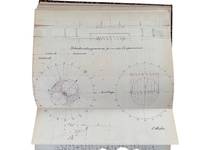
1878215461878. EngineeringPhysics Three manuscript volumes 1878-1879 compiled in Germany notes on nineteenth-century study of applied physics mechanics thermodynamics and fluid engineering at a moment when the German states were consolidating their position as leaders in industrial science and technical education. Produced during the height of Imperial Germany's expansion of polytechnic institutes and research universities these notebooks reflect the rigorous mathematical formalism and applied design training that undergirded the nation's rapid industrialization. The systematic integration of theoretical mechanics with detailed machine drawings situates the work within the educational culture that supported advances in steam power turbine development and precision engineering in the decades following unification in 1871. As working instructional volumes they provide primary evidence of how Newtonian mechanics thermodynamic principles and mechanical design were taught to engineers in the late nineteenth century.<br /> <br /> Three handwritten volumes titled "I. Band" "II. Band" and continuation volume. Germany 1878-1879. The first volume opens with "Allgemeine Mechanik" outlining foundational principles including "Zusammensetzung und Zerlegung der Kräfte" and a carefully drafted "Parallelogramm der Kräfte" accompanied by geometric constructions and vector decompositions central to applied statics. Subsequent sections demonstrate lever calculations and force polygons rendered with precision technical drafting. The second volume advances into applied mechanics addressing "elastische Körper" rotational dynamics and "Zentripetalkraft" with formula derivations and diagrams of circular motion. Detailed gear assemblies and meshing systems indicate practical engagement with machine design while a section devoted to "Schmidt'scher Wassermotor" includes a sectional rendering of a turbine mechanism. The third volume transitions to thermodynamic systems including extended treatment of heat exchangers "Caloriferes" and a large fold-out "Schieberdiagramm für variable Expansion" attributed to G. Huber illustrating valve timing in steam engines through radial plotting. A further fold-out cross-section of a high-pressure steam engine demonstrates piston-cylinder interaction and valve actuation accompanied by efficiency calculations and pressure analyses. The presence of fold-out engineering plates systematic red and black ink notation and sequential theoretical development strongly suggests production within a university or technical institute environment.<br /> <br /> Three volumes. Extensive manuscript text with numerous diagrams and multiple fold-out plates. Original marbled paper boards with manuscript title labels. Bindings intact; minor hinge wear; spine cracking on one volume; pages clean and bright; fold-outs crisp with slight fraying at some edges. Overall very good. As a comprehensive and internally coherent set of engineering study notebooks from the period when German technical education shaped global industrial practice these volumes offer substantive insight into the pedagogical transmission of classical mechanics and steam engineering at a formative moment in modern industrial history. unknown
17716180Oder: Die Kunst, Das Gewässer Zu denen verschiedentlichen Nothwendigkeiten des menschlichen Lebens zu leiten, in die Höhe zu bringen, und vortheilhafftig anzuwenden ... Aus dem Frantzösischen ins Teutsche übersetzet. 2 Teile mit 22 (statt 24) Lieferungen in 4 Bänden. Mit 6 gest. Kopfvignetten u. 203 (statt 219) meist gefalt. gest. Tafeln. Augsburg, J. G. Mertz u. E. Klett, Witwe, 1740-1771. Folio (ca. 33-35 x 21,5-22,5 cm). Etwa 1220 S. 2 Lederbände d. Zt. u. 2 neue Lederbände im Stil d. Zt. alle mit reicher Rückenvergoldung.
180057912 Bände. Mit 12 gefalt. gest. Tafeln. Leipzig, Sommer, 1799-1800. 8vo. (20,5 x 12,0 cm). 1: XX, 412 S. 2: Titel, 530 S. Pappbände d. Zt. mit rotem Rückenschild. [4 Warenabbildungen]
1845051667Kington Herefordshire: Charles Humphreys . 1845. Hardcover. Very Good. vii 303pp folding pedigree which has a repair recently rebound in half brown leather/marbled boards gilt bands and lettering to spine. The first history of this small market town in Herefordshire it also has the distinction of containing the first published work of famous naturalist Alfred Russell Wallace ' An Essay on the Best Way of Conducting the Kington Mechanics' Institution. Wallace was born in 1823 and wrote this article in 1840 and was at the time a member of the Mechanics Institute as was Richard Parry the author. ; Octavo . Charles Humphreys hardcover
184559278Kington Herefordshire: Charles Humphreys . 1845. Hardcover. Very Good. Vii 303pp sl foxng to prelims bound in red cloth new endpapers The first history of this small market town in Herefordshire it also has the distinction of containing the first published work of famous naturalist Alfred Russell Wallace ' An Essay on the Best Way of Conducting the Kington Mechanics' Institution. Wallace was born in 1823 and wrote this article in 1840 and was at the time a member of the Mechanics Institute as was Richard Parry the author. ; Octavo . Charles Humphreys hardcover
P., Mérigot, Didot, 1786. 2 volumes in-4 (18 x 24 cm), reliure pastiche demi-basane, dos long orné, p. de t.-LIV-1 f.- 477 pp.ch.-5 ff..-19 planches dépliantes pour le premier volume ; p. de fx-t.-p;de t.-VIII- 451 pp.- 19 planches dépliantes num. (20-38) pour le second volume. Seconde édition (la première est de 1763). Le texte "Eclaircissements..."est publié par P., Muselier, 1773. VIII-164 pp. Rousseurs, restauration complète du dos de la reliure avec les plats d'origine conservés, salissures. Orné de 38 planches gravées par Choffard d'après Goussier exposant toutes sortes de montres, horloges, pièces, mécanismes, engrenages, etc. Peu courante réunion des 2 textes (les "Eclaircissemens" constituent une justification de l'ancienneté et de la paternité du travail de Berthoud sur la longitude en mer). Né à Neuchâtel, Ferdinand Berthoud (1727-1807) devint en France horloger du roi et de la Marine, avant d'être reçu à l'Académie des Sciences en 1795. Il est l'inventeur de l'horloge marine permettant de connaître la longitude en mer.
57701Providence: January 30 1837. 4to approx. 10" x 8 5 leaves of ruled stationery with manuscript in ink on rectos only in a neat secretarial hand bound with blue silk ribbon; previous folds very light staining otherwise near fine. Interesting chapter in the historical evolution of the Providence school system. The Providence Association of Mechanics and Manufacturers was politically involved in city affairs as early as 1799 when "the want of a better system of school instruction being deeply felt by the members a memorial was prepared and presented to the General Assembly urging the establishment of free schools throughout the State and reminding that body that liberty and security under a republican form of government depend on a general diffusion of knowledge amoug the people" A History of Public Education in Rhode Island: from 1636 to 1876 byThomas B. Stockwell 1876 In 1837 the association under President George Baker and Samuel Tingley Jr. Secretary whose names appear on page four presented the petition: "Your memorialists have been struck with one fact . that the instruction of youth in the public schools is a heavy tax upon the middling classes without an adequate return as they do not participate in the benefit of this public instruction. This argument which is evidently weighty in the present condition of these schools would be destroyed if they were raised to the condition desired by your memorialists. "Why is it that the middling classes do not become participants in this instruction There is evidently but one reason. They perceive that the crowded state of the schools alone would prevent proper attention to the pupil; and they are aware that with the small sum which the instructors receive it is difficult to procure and retain the services of competent persons to fill the station. But let the schools be made so numerous that the scholars may receive as much attention as they do in the private schools and let the salaries be so large as to induce men of equal ability to take charge of them and that which is now considered as a tax would then be viewed as an alleviation of one of the heaviest burdens put upon the middling classes. "Your honorable body have no doubt . perceived how far we are behind our neighboring cities in this particular. Whilst they are constantly aiming at perfection in their free school system we have been at a stand or retrograding . To remedy the defect in our present system your memorialists would suggest that a grade of schools be established between the primary and writing schools for reading writing and arithmetic only the design of which is to give a thorough instruction in these branches to those children whose parents need their services at as early an age as twelve or thirteen years and who under the present arrangement are compelled to leave school with a very superficial knowledge of those branches which are so necessary for obtaining a livelihood in any business . To effect an essential reform in our public school system great expense must necessarily be incurred; and your memorialists who represent a large portion of the heads of families of the city would meet this increased expense with hearty encouragement." The document is signed "George Baker President. Samuel Tingley Jr. Secretary." Page 5 is entitled "Resolutions" and includes a list of seven statements relative to the Association's petition beginning with "Resolved that no subject can be of more importance to the inhabitants of this city than the education of the rising generation" and that "the members of this association were the pioneers in the establishment of the Public Schools." "This petition or memorial was referred to a committee who subsequently reported a plan for the improvement of the schools; but the provisions of it were deemed unsatisfactory. A second plan was presented comprising twelve primary eight intermediate and four upper schools. With these modifications the bill was returned to the common council who refused to concur. After frequent meetings and protracted debates with no unity the board of aldermen devised a plan embracing ten primary schools six intermediate schools two upper schools and two schools for colored children. This when presented to the common council was voted down by a large majority and without any final decision the municipal year closed. The feeling on the school question was now stronger than ever" Stockwell. January 30, 1837 unknown
57701Providence: January 30 1837. 4to approx. 10" x 8 5 leaves of ruled stationery with manuscript in ink on rectos only in a neat secretarial hand bound with blue silk ribbon; previous folds very light staining otherwise near fine. Interesting chapter in the historical evolution of the Providence school system. The Providence Association of Mechanics and Manufacturers was politically involved in city affairs as early as 1799 when "the want of a better system of school instruction being deeply felt by the members a memorial was prepared and presented to the General Assembly urging the establishment of free schools throughout the State and reminding that body that liberty and security under a republican form of government depend on a general diffusion of knowledge amoug the people" A History of Public Education in Rhode Island: from 1636 to 1876 byThomas B. Stockwell 1876 In 1837 the association under President George Baker and Samuel Tingley Jr. Secretary whose names appear on page four presented the petition: "Your memorialists have been struck with one fact . that the instruction of youth in the public schools is a heavy tax upon the middling classes without an adequate return as they do not participate in the benefit of this public instruction. This argument which is evidently weighty in the present condition of these schools would be destroyed if they were raised to the condition desired by your memorialists. "Why is it that the middling classes do not become participants in this instruction There is evidently but one reason. They perceive that the crowded state of the schools alone would prevent proper attention to the pupil; and they are aware that with the small sum which the instructors receive it is difficult to procure and retain the services of competent persons to fill the station. But let the schools be made so numerous that the scholars may receive as much attention as they do in the private schools and let the salaries be so large as to induce men of equal ability to take charge of them and that which is now considered as a tax would then be viewed as an alleviation of one of the heaviest burdens put upon the middling classes. "Your honorable body have no doubt . perceived how far we are behind our neighboring cities in this particular. Whilst they are constantly aiming at perfection in their free school system we have been at a stand or retrograding . To remedy the defect in our present system your memorialists would suggest that a grade of schools be established between the primary and writing schools for reading writing and arithmetic only the design of which is to give a thorough instruction in these branches to those children whose parents need their services at as early an age as twelve or thirteen years and who under the present arrangement are compelled to leave school with a very superficial knowledge of those branches which are so necessary for obtaining a livelihood in any business . To effect an essential reform in our public school system great expense must necessarily be incurred; and your memorialists who represent a large portion of the heads of families of the city would meet this increased expense with hearty encouragement." The document is signed "George Baker President. Samuel Tingley Jr. Secretary." Page 5 is entitled "Resolutions" and includes a list of seven statements relative to the Association's petition beginning with "Resolved that no subject can be of more importance to the inhabitants of this city than the education of the rising generation" and that "the members of this association were the pioneers in the establishment of the Public Schools." "This petition or memorial was referred to a committee who subsequently reported a plan for the improvement of the schools; but the provisions of it were deemed unsatisfactory. A second plan was presented comprising twelve primary eight intermediate and four upper schools. With these modifications the bill was returned to the common council who refused to concur. After frequent meetings and protracted debates with no unity the board of aldermen devised a plan embracing ten primary schools six intermediate schools two upper schools and two schools for colored children. This when presented to the common council was voted down by a large majority and without any final decision the municipal year closed. The feeling on the school question was now stronger than ever" Stockwell. <br/><br/> January 30, 1837 unknown books
18085856With numerous figures. Revised by Peter Nicholson, architect. Mit zahlr. Holzschnitten im Text u. 2 (1 gest.) gefalt. Tabellen. London, Printed by and for William Savage, 1808. Kl.-4to. (20,1 x 12,6 cm). 2 Bl., II S. "Contents of essay I.", (V)-IX, (11)-184 S. Blauer Pappband d. Zt. mit rotem Rückenschild.
In -folio, pp. (16), 204, 12 grandi tavole di cui una doppia; cartonato coevo. Si tratta della seconda edizione aumentata, con un bell’obelisco inciso all’antiporta. In –folio, 12 big plates of mechanics (one is double), this is the second edition (increased), with a beautiful obelisk engraved on frontispiece, contemporary boards.
173542459Paris Imprimerie Royale 1735. 4to. Fine recent marbled boards. Printed titlelabel on frontcover. 6144 pp. and 1 double-page folded engraved plate. Johann B's paper: pp. 1- 91. - Daniel B's papers: pp. 93- 122 and pp. 123-144. A few marginal brownspots. <br/><br/><em>First edition of these prize winning papers by father Jean and son Daniel. - Both papers deals with the cause of the inclination of the planetary orbits relative to the solar equator. - In Daniel's paper he put foreward the hypothesis of the existence of an atmosphere resempling air and rotating around the solar axis resulting in an increasing inclination of the planetary orbits toward the equator of the sun. Daniel was the first importent Newtonian outside Great Britain. The problems faced here by Daniel are treated in Newtonian manner.The publication of these papers by father and son resulted in a controversy between the two forcing Daniel to leave his fathers house. - Poggendorff I:161. </em> hardcover
185842295London Richard Taylor and William Francis 1858 and Taylor and Francis 1866. 4to. No wrappers as extracted from "Philosophical Transactions" Vol. 148 - Part I. Pp. 17-37 and Vol. 156 - Part I Pp. 25-35. Clean and fine. <br/><br/><em>First appearance of this outstanding contribution to mathematics announcing his invention and developments of the ALGEBRA OF MATRICES what is now called the Cayley-Hamilton theorem for square matrices of any order. "The subject originated in a memoir of 1858 the paper offered and grew directly out of simple observations on the way in which the transformations linear of the theory of algebraic invariants are combined.a distinctive feature of these rules is that multiplication is not commutative.we get different results according to the order in which we do the multiplication. it seems about as far from anything of scientific or practical use as anything could possible be. Yet sixty seven years after Cayley's invented it HEISENBERG in 1925 recognized in the algebra of matrices exactly the tool which he neede for his revolutionary work in QUANTUM MECHANICS."Bell Men of Mathematics."It was in connection with the study of invariants under linear transformation that Cayley first introduced matrices to simplify the notation involved. Here he gave some basic notions. This was followed by his first major paper on the subject "A Memoir on the Theory of Matrices." the paper offered here. Kline Mathematical Thought.p. 806. </em> unknown
P., 1928. 2 volumes in-4 relié demi basane, premiers plat de couverture conservés, XVI-348 et 352 pp. - 3 ff. 540 planches et figures, VII hors-textes en couleur sous serpente légendée. Envoi de Gélis ( l'un ds contributeurs). EX. 56/1000 numéroté sur papier chromo. Court accroc en haut du dos au vol.II sinon très bon état. L'ouvrage débute par les automates primitifs-premières figures articulées, à l'automatisme dans l'orthopédie, en passant par les horloges, jouets,tabatières, oiseaux chantants, androïdes.. Bibliographie in fine.
18213579Coronata colla medaglia d'oro nella distribuzione de' Premj d' Industria nel dì 4 Ottobre 1815. Mit 4 kolor. gefalt. gest. Tafeln. Mailand, dalla tipografia di Angelo Stanislao Brambilla, 1821. 8vo. (20,8 x 13,7 cm). 19 S. Neuer Umschlag.
1967ME-75Syracuse N.Y.: Syracuse University Press 1967. Comprehensive three-volume Vol. II & IIA are bound as one volume standard reference set compiled by Syracuse University under USAF contract administered under the direction of the Information Processing Section Materials Information Branch Air Force Materials Laboratory Research & Technology Division Air Force Systems Command Wright- Patterson Air Force Base Ohio. Each volume is self contained in a black vinyl covered heavy-duty 4-post loose-leaf binder. Each volume covers a general discussion of alloys and their properties; physical chemical and mechanical properties; and fabrication. Vol.I contains sections on martensite stainless steels; age hardening steel; nickel chromium steels; austenitic stainless steels; ultra-high strength steels; carbon and low alloy steels. Vol.IIA contains sections on nickel base alloys; cobalt base alloys; beryllium alloys; columbium alloys; molybenum alloys; tantalum alloys; tungsten alloys; vanadium alloys; zirconium alloys. Vol.II contains sections on aluminum alloys: wrought heat treatable AIWT and wrought non-treatable AIWN; magnesium alloys: wrought heat treatable MgWT and wrought non-treatable MgWN; titanium alloys. Alloys are in numerical sequence by alloy code number. Handbook includes data source references; physical chemical and mechanical properties; fabrication; glossary of terms discussion of fracture toughness and a cross reference of the alloys. Tab-indexed pages. Total number of alloy chapters currently contained in this Handbook is 180; 66 in Volume I; 56 in Volume II and 58 in Volume IIA. Over 2000 pgs. Illustrated. Minimal shelfwear. Heavy item. Scarce. Fourth Revised Edition. Looseleaf Binding. Very Good. 4to - over 9¾" - 12" tall. Syracuse University Press unknown
In -8°, pp. (4), XII, 284; cartonato. Prima edizione. Crespe era un orologiaio ginevrino: l’orologio a ripetizione è un tipo di orologio che suona l’ora a richiesta e che fu notevolmente migliorato da Crespe, che racconta di aver scritto questo lavoro, all’origine, a beneficio solo dei propri operai. Raro. Crespe was a watchmaker in Geneva: the repetition clock (a kind of clock that chimes on request) was strongly improved by him, who explains this treaty to be conceived only for his workers. Rare.
192647172Minneapolis Minn. The Physicalreview 1926. 4to. Contemp. full buckram. Small tear to first hinge at foot. A stamp in upper right corner on titlepage and 2 other pages. In: "The Physical Review. Conducted by the American Physical Society" Vol. 28 Second Series. VI1343 pp. Entire volume offered.Schrödinger's paper: pp. 1049-1070. Internally clean and fine. <br/><br/><em>First appearance of the first treatment of Wave Mechanics in English.The paper reviews Schrödinger's own wave-mechanics and De Broglie's "phase waves" and covers all the results Schrödinger had hitherto obtained in his main communications of 1926 the 3 papers in German. An English translation of Schrödinger's main papers was not published until 1928."The paper gives an account of the author's work on a new form of quantum theory. §1. The Hamiltonian analogy between mechanics and optics. §2. The analogy is to be extended to include real "physical" or "undulatory" mechanics instead of mere geometrical mechanics. §3. The significance of wave-length; macro-mechanical and micro-mechanical problems. §4. The wave-equation and its application to the hydrogen atom. §5. The intrinsic reason for the appearance of discrete characteristic frequencies. §6. Other problems; intensity of emitted light. §7. The wave-equation derived from a Hamiltonian variation-principle; generalization to an arbitrary conservative system. §8. The wave-function physically means and determines a continuous distribution of electricity in space the fluctuations of which determine the radiation by the laws of ordinary electrodynamics. §9. Non-conservative systems. Theory of dispersion and scattering and of the "transitions" between the "stationary states." §10. The question of relativity and the action of a magnetic field. Incompleteness of that part of the theory." From the Abstract in front of the paper. </em> hardcover