LAVOISIER, ANTOINE-LAURENT, ET ALBiblio.com
414 résultats
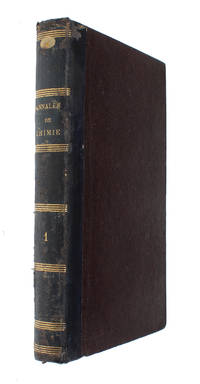
178943634Paris Rue et Hotel Serpente 1789. 8vo. Contemporary half calf. Gilt spine slightly rubbed light wear to spine ends. "Annales de Chimie: ou Recueil de Mémoires Concernant la Chimie et les Arts qui en Dépendent. Par MM. de Morveau Lavoisier Monge Berthollet De Fourcroy le Baron de Dietrich Hassenfratz & Adet." Tome Premier. 23122 pp. The entire volume offered. Some scattered brownspots. A small wormtract to upper margin of ab. 20 leaves no loss of letters. <br/><br/><em>First edition of the first volume of this very important journal founded by Lavoisier and his friends collaborating in establishing THE NEW SCIENCE of Anti-Phlogistic theory in chemistry. Crosland in "The two French Revolutions" and "The Imperial Despotism of Oxygen" claims that for a clear understanding of the CHEMICAL REVOLUTION THE NEW JOURNAL of ANNALES DE CHIMIE can be rightly considered as FUNDAMENTAL as the "Traite élementaire de Chimie"."A third and most important instrument was the establishment of a new scientific journal edited - and dominated - by the votaries of the "new chemistry". The first number of this journal of the Annales de chimie appeared in 1789 the year of the Revolution. Its editors were besides Lavoisier his early disciples - Guyton Berthollet Fourcroy and Monge - with the addition of three new recruits: the Strassbourf metallurgist the Baron de Dietrich Jean-henri Hssenfratz and Pierre Auguste Adet."DSB VIII p.81.LAVOISIER'S paper on COMBUSTION pp. 19-30 contains his important interpretation of the phenomena of combustion in air making the fundamental distinction between burning and combustion. By this "Lavoisier gave to the study of chemistry a new life a new direction and a wider outlook." Alexander Findley."The Lavoisierian memoir on combustion of iron stood out among the large number of interesting papers discussed in the first volume of the "Annales". In his account Lavoisier sustained that in nature combustion without flames did occur. Thus he clarified the distinction between ordinary burning and combustion: an issue on which the majority of traditional chemists were confused. The need for accuracy and precision in laboratory practices was emphasised in his study as it was a means to determine quantities rather than assuming them."Angela Bandinelli in "Scientific Communication During a Major Change .Empirical Research: Annales de chimie vs Obs. sur la physique/ Journal de physique 1789-1803.The volume furthermore contains important papers by: Adet Fourcroy 3 papers Berthollet 3 papers Chaptal Hassenfratz 5 papers Baron de Dietrich 2 papers Klaproth 2 papers Girtanner Dollfuss Bonz de Ettingen Crell De Morveau. </em> unknown
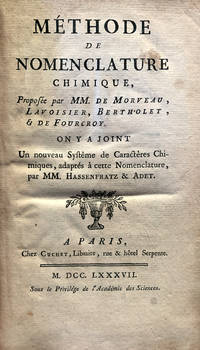
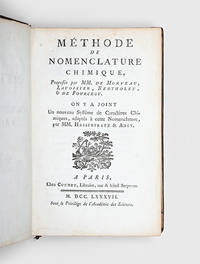
178718453Paris: Chez Cuchet 1787. FIRST EDITION. With half-title 6 large folding copperplates and 1 large folding table title vignette woodcut headpiece above first text leaf pages 257-272 misnumbered. Contemporary tree calf spine label very small crack at top of spine and rear cover otherwise an excellent copy printed partially on blue paper from the library of Melchet Court Romsey and a small book label with the heraldic motto “virus in arduis†on the paste-down. First edition of one of the most important works in the history of modern chemistry. Lavoisier’s discoveries brought about a critical need to develop a new chemical nomenclature. Its importance was first recognized by Guyton de Morveau an adherent of the phlogiston theory. De Morveau was invited to join a group of the leading anti-phlogistonists to discuss the possibility of applying his nomenclature to Lavoisier’s chemistry and in the process was converted to Lavoisier’s doctrines. The result of this collaboration of Bertholet Fourcroy de Morveau Lavoisier and others is contained in this volume and marks the foundation of modern chemical nomenclature.<br /> <br /> Cole Chemical Literature 1700-1860 566C under Guyton de Morveau; Duveen 126; Duveen & Klickstein p. 127; Norman 1291; see Printing & the Mind of Man 238; Sparrow Milestones of Science 125. Chez Cuchet unknown
thl51Paris: Cuchet 1789. First Edition Second Issue of “one of the most important books in the history of chemistry which finally freed the science from its phlogiston chains and formed the starting point of its modern progress. It may be said to have done almost as much as for chemistry as Newton’s ‘Principia’ did for physics.†Zeitlinger quoted in Duveen Lavoisier’s ‘Traité’ “was a decisive move in the final overthrow of alchemy and the phlogiston theory introduced by Stahl a century earlier. By the use of the balance of weight determination at every chemical change and the building of a rational system of elements Lavoisier laid the foundation of modern chemistry. He introduced a modern definition of element and compound explained burning and rusting as a chemical combination with oxygen and included emission and absorption of heat in his chemical system. His concepts of the principles of the indestructibility and conservation of matter guided him in formulating his methods of organic analysis.†Dibner This edition contains tables and several excerpts from the records of the Academy of Sciences not included in the first edition of which only two copies are known. Dibner 43. Duveen p. 340. Grolier 64. Honeyman 1939. Printing and the Mind of Man 238. Sparrow 127. cfFerguson II p. 12. cfNeu 2253-54. 2 Volumes in 1. 8vo. pp. xliv 322; viii 323-651 2errata. with half-titles. 2 folding tables & 13 folding plates drawn & engraved by Lavoisier’s wife. woodcut ornaments & title vignettes. 19th century half calf joints cracked creases in spine library rubberstamp on front paste-down & title & number on spine of the Royal Society of Edinburgh. thl51 Paris: Cuchet, 1789 unknown
1791CLL-37Paris, de l'Imprimerie nationale, 1791 In-8 de (1) f., 48 pp., cartonnage à la Bradel de papier gris marbré, dos lisse, titre doré en long, tranches nues (reliure moderne).
63692Paris, 14 septembre 1793, l'an 2e de la République, , un billet de 180 x 130 mm, rédigé à l'encre brune, portant en-tête le cachet de minute notarial à l'emblème de la République et avec la devise "la loi le roi", , Intéressante pièce autographe du peintre Pierre-Joseph Redouté : elle témoigne de son activité de dessinateur scientifique et de ses relations avec deux des plus grands noms du monde des sciences et de la physique de la fin du XVIIIe siècle, Antoine Lavoisier (1743-1794) et Jean-Charles Borda (1733-1799), au sujet de l'élaboration du système métrique. En 1792, Redouté, qui passera à la postérité pour ses peintures de fleurs, est employé par l'Académie des sciences. Il signe ici une reconnaissance de paiement perçu de la part du très célèbre Lavoisier : "pour deux dessins que j'ai fait à Mr Borda relatifs aux opérations pour mesurer la longueur du pendule à seconde". Nous avons donc là une minute exceptionnelle, en lien avec l'une des dernières préoccupations de Lavoisier à la veille de son emprisonnement, le 24 novembre 1793, et de son exécution, le 8 mai 1794 : appelé par le gouvernement pour fixer les règles du nouveau système métrique, Lavoisier s'était adjoint l'aide du physicien et navigateur Jean-Charles Borda, rendu indispensable pour l'exactitude de ses opérations de pesage. L'importance de cette tâche était de taille : il s'agissait d'uniformiser le système des poids et des mesures dans l'ensemble de la France. Dans ces conditions, Lavoisier fut exceptionnellement autorisé, par délibération de la Commission le 28 frimaire An II (18 décembre 1793), à sortir de sa prison chaque matin accompagné d'un gendarme, pour continuer ses expériences. C'est Borda lui-même qui signa la délibération : "la présence permanente du citoyen Lavoisier, en raison de son talent particulier pour tout ce qui exige de la précision, est irremplaçable. Il est urgent que ce citoyen puisse être rendu aux travaux importants qu'il a toujours suivis avec autant de zèle que d'activité ". Bel état, en dépit d'un renfort marginal au revers et une petite déchirure de 2 cm, sans atteinte au texte. Couverture rigide
46368Cuchet - edition originale premier tirage In-8 iv-314pp. un grand tableau depliant 6 planches et tableaux depliants in-fine reliure demi-basane de l'epoque dos orne fers et filets dores piece de titre vert emeraude legeres usures aux coiffes ex-libris manuscrit Nb-0107 Publiee en Aout 1787 cette premiere edition regroupe et fait la synthese des differents memoires publies sur les nouvelles denominations chimiques et ses nouveaux symboles depuis 1780 habituellement attribuee a Lavoisier. unknown
1790EBS100146Edinburgh: William Creech 1790. 1st Edition. Hardcover. Very Good/No Jacket. Robert Kerr 1755-1813 undertook this first English translation of Lavoisier's Traité elementaire de Chimie Paris 1789. Printing & the Mind of Man headlines the original edition as "A new epoch in chemistry." <br /> <br /> A more recent analysis pinpoints the importance of this book: "Lavoisier's most fundamental innovations transformed how one presents how one argues scientific knowledge and how as a result one develops and transmits it. The transformation of the terms and structures of scientific discussions had consequences beyond chemistry-consequences that Lavoisier himself did not foresee". W. C. Anderson Between the library & the laboratory John Hopkins 1984. <br /> <br /> BOOK DETAILS AND CONDITION: First Eng. Ed 8vo: 50 511 1 pp with 2 folding tables and 13 folding copper plates Duveen and Klickstein pp 180-182 Cont. leather w/some wear missing head and tail bands. Neville II p 24: Some alterations have been made in the tables in the appendix to accommodate the English reader: e.g. rules for converting French weights and measures are added and temperatures are given in degrees Fahrenheit. See A. Greenberg From Alchemy to Chemistry in Picture and Story John Wiley & Sons New York 2007 pp 309310316. Overall: VG.<br /> <br /> RARITY: Rare Book Hub shows eleven copies have sold in the last century.<br /> <br /> PROVENANCE: Signatures of three past owners in book: Alfred Brunton 1843; Henry Hallett and Charles Lucy. This book was also owned by Arthur Greenburg. Henry Hallett shared the 1936 Nobel Prize in physiology for discovery of the role of acetylcholine in neural transmission. Greenburg is a well known historian of chemistry. Edinburgh: William Creech hardcover
16004(Paris), (vers 1805).
2757Edinburgh: Printed for William Creech and sold in London by G.G. and J.J. Robinsons 1790. Hardcover. Good. Octavo. l 511 ipp. With the half-title present. First English edition. Contemporary calf. Frontispiece portrait of Lavoisier two folding tables and thirteen plates. ESTC T138882. First English edition of one of the milestone books of chemistry. <br/> <br/> Edinburgh: Printed for William Creech, and sold in London by G.G. and J.J. Robinsons, 1790. hardcover
1787173027Paris: Chez Cuchet 1787. Modern chemistry therefore starts in 1787 First edition second issue of the work which introduced modern chemical terminology among the most fundamental scientific texts of the 18th century. The folding tables outline the first taxonomic system of chemical substances arranged according to their composition a system which proved immediately influential; even established figures like Priestley felt obliged to adopt the new terminology. The late 18th century witnessed considerable debates over the theory and practice of chemistry. The chief theoretical shift was the identification of oxygen in place of the hypothesized phlogiston which led many contemporaries to view the existing chemical terminology as outdated and confused. This move was largely driven by Lavoisier 1743-1791 and his fellow authors of the Méthode Louis Bernard Guyton de Morveau 1737-1816 Claude-Louis Berthollet 1748-1822 and Antoine-François de Fourcroy 1755-1809. In the Méthode they develop a systematic nomenclature largely derived from oxygen theory arguing that chemical substances should be named according to their constituents. Simple substances should receive simple names and compounds should receive complex names deriving from their constituents. "The new terms were soon translated and adapted into other languages and became the basis of the modern nomenclature of inorganic chemistry. In the purely pragmatic terms of the terminology used modern chemistry therefore starts in 1787" Crosland p. 411. There were two issues of the first edition: this second is identified by misnumbering pages 258-9 262-3 266-7 and 270-1. The first edition itself there were two in 1787 is identified by the woodcut on the title page depicting a cherub supervising distillation. Octavo 185 x 120 mm pp. 4 314. With 7 folding tables woodcut title page vignette head- and tailpieces. Contemporary mottled sheep spine with foliate decoration in gilt brown calf label lettered in gilt raised bands covers with single fillet border in blind marbled endpapers edges red pink silk bookmarker. Later pencil annotation to upper margin of p. 9. Light bumping and rubbing minor stripping to covers tail of front joint neatly repaired front inner hinge split but holding firm loss to lower outer corner of half-title inner margin of leaf G7 and outer margin of rear free endpaper none affecting text a couple of closed tears to initial folding table contents otherwise clean: a very good copy. Duveen & Klickstein 126; Norman 1291. Maurice Crosland "Chemistry and the chemical revolution" in The Ferment of Knowledge: Studies in the Historiography of Eighteenth-century Science 1980. hardcover
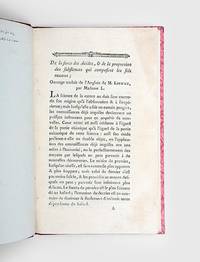
1791174569Paris: c.1791. A prime example of Madame Lavoisier's formidable analytic eye First edition scarce offprint issue of Madame Lavoisier's critical translation of the work of a prominent fellow of the Royal Society. In the UK institutional copies are recorded at UCL and in the Wellcome Collection. Marie-Anne Paulze Lavoisier 1758-1836 famously refuted the claims of the chemist Richard Kirwan 1733-1812 several times. In 1787 after he published his Essay on Phlogiston she brought out a similarly deprecatory translation complete with a preface which undermined his authority as an academic. Kirwan published Of the strength of acids and the proportion of ingredients in neutral salts in Dublin in 1791. In her translation Lavoisier's extensive annotations and critical apparatus focus on Kirwan's scientific and procedural errors. "II y a dans ces sortes d'expériences une cause d'erreurs qui paroit avoir échappé à M. Kirwan; c'est la grande quantité d'eau que l'acide carbonique est susceptible de dissoudre et qui échappe avec lui" "There is in these types of experiences a cause of errors which appears to have escaped Mr Kirwan: the large quantity of water which carbonic acid is likely to dissolve and which escapes with it" - p. 40. Marie-Anne married Antoine Lavoisier in 1771. She promoted their collaborative work to the international scientific community and used her command of languages to keep Antoine abreast of the latest developments. "Through her drawings translations interpretations of notes and skillful editing of Lavoisier's memoirs she made some important additions to the body of scientific knowledge. there are indications that she made some theoretical contributions" Ogilvie & Harvey. This translation was published in journal form in the Annales de Chimie which Antoine Lavoisier edited. Octavo 193 x 120 mm pp. 108. Woodcut headpieces and tables in the text. Recent red quarter morocco spine lettered in gilt marbled paper sides. Minimal wear minor foxing and creasing to contents: a very good copy indeed. Ogilvie & Harvey Biographical Dictionary of Women in Science II p. 753. unknown
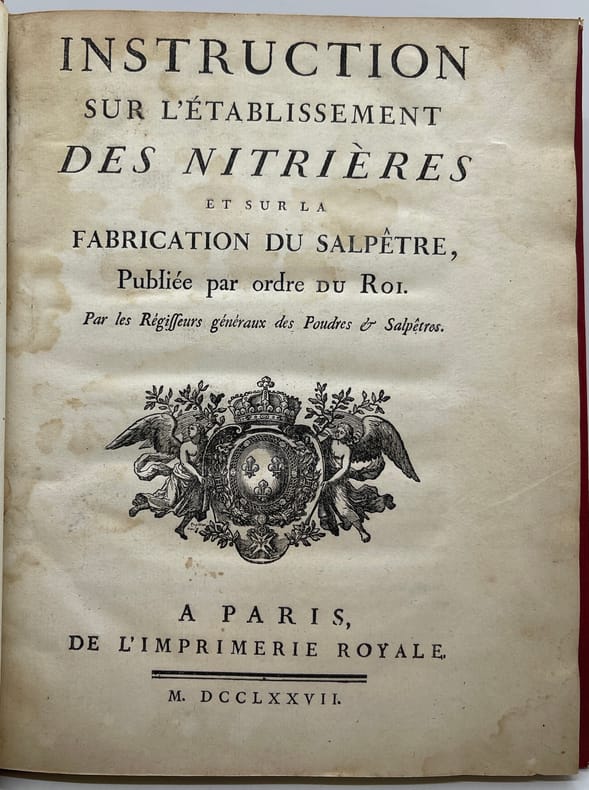
014818Antoine Lavoisier, Instruction sur l'établissement des nitrières et sur la fabrication du salpêtre, publiée par ordre du Roi. par les Régisseurs généraux des Poudres & Salpêtres. Paris, Imprimerie Royale, 1777. In-4, [4]-83p & 4 planches dépliantes. Edition originale de la plus grande rareté sur la pyrotechnie. Il s'agissait donc de décrire la construction de nitrières artificielles. L'ouvrage est complet de ses 4 planches dépliantes signées Pierre Claude Delagardette. On remarquera que l'ouvrage fut réédité en 1794 (Paris, Cuchet), en pleine révolution, quand la production de poudre à canon devint essentielle puisque la poudre était alors majoritairement importée. L'ouvrage avait pour intention de « rectifier les vices essentiel qui régnaient dans l'art de fabriquer le Salpêtre » (préface de l'édition de Cuchet). Dès 1794, le volume est considéré comme rare : « mais comme ce travail se faisait avec un certain mystère, il est douteux que l'ont ait atteint le but que l'on s'était proposé ; il est même douteux que cette instruction ait été répandue : nous sommes d'autant plus porté à le crois, qu'elle est très-rare ; elle n'existait même pas dans la Bibliothèque nationale il y a quelques mois » (ib.). L'ouvrage est toutefois présent dans quelques bibliothèques publiques (BnF, Bordeaux, Grenoble). Nous n'avons trouvé la trace de cet ouvrage que dans deux catalogues du XIXe siècle : M. M.., vente Besançon, 12 janvier 1835 et jours suivants, n°227. « v.f., fil., d.s.t. ». Eugène de C., vente Paris, 7 novembre 1808 et jours suivants, n°700. « cart. à dos de v. ». Il est possible que notre exemplaire soit ce dernier. Notre exemplaire est aussi passé par la librairie Raymond Clavreuil. Il porte aussi deux notes de classement de bibliothèques (l'une cachée par l'étiquette de Clavreuil) et la trace d'un ex-libris décollé. Cartonnage demi-veau rouge, plats papier. Mouillure angulaire (avant le cartonnage actuel). Très rare document.
178871724S. n. | Paris 1788 | 12.50 x 20 cm | relié
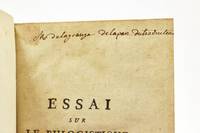
178871724Paris: S. n. 1788. Fine. S. n. Paris 1788 12.50 x 20 cm relié Essai sur le Phlogistique et sur la constitution des Acides Essay on Phlogistonn. p. Paris 1788 8vo 12.5 x 20 cm xij ; 344 pp.; 4 p. contemporary half sheep First edition and sole publication of the French translation and critical analysis under the direction of Madame Lavoisier of this text published in English the previous year under the title An Essay on Phlogiston and the Constitution of Acids. The work is made up of twelve sections all followed by critical notes by Louis-Bernard Guyton de Morveau Pierre Simon de Laplace & Gaspard Monge & Claude Louis Berthollet & Antoine François de Fourcroy. Contemporary half light brown sheep over marbled paper boards smooth leather spine decorated with gilt fillets and fleurons morocco leather title piece. Very skillfully restored joints. Interior in very good condition except for two marks left by bookmarks on pages 68-69 and 176-177. Rare autograph inscription by Marie-Anne Paulze Lavoisier to Joseph Louis de Lagrange prominent mathematician and loyal friend to Antoine Lavoisier. Valuable record of the leading role played by Marie-Anne Paulze Lavoisier in the chemical revolution at the dawn of the French Revolution. Phlogiston theory emerged at the end of the 17th century conceived by Johann Becker and developed by Georg Ernst Stahl postulating the existence of a flame element inherent in combustible bodies and released during combustion. This hypothesis was completely refuted by Lavoisier who revealed the role of oxygen in the combustion process thus inventing the theory of oxidation. Irritated by Lavoisier's skepticism with regard to phlogiston theory the eminent Irish chemist Richard Kirwan published this text titled Essay on Phlogiston. . The French chemists who rallied around Lavoisier decided to respond by translating An Essay on Phlogiston into French. Keiko Kawashima Madame Lavoisier et la traduction française de l'Essay on phlogiston de Kirwan in Revue d'histoire des sciences 2000. This text far from being a simple translation of Kirwan's work adopted the form of a manifesto in itself in which the greatest chemists of the day contested phlogiston theory dissecting its advocates' arguments one by one. The huge success of the French translation led Kirwan to attempt to refute the objections of Lavoisier and his collaborators. In 1789 he published a second edition of his work translating the French notes written by its detractors into English and adding his own refutations. He finally converted to the ideas of the anti-phlogisticians the founders of modern organic chemistry. Marie-Anne Pierrette Paulze Mme Lavoisier played a key role in the career of her husband who taught her chemistry at her request; she then became his assistant recording the experiments he carried out and their results. She very quickly took on a role that went beyond that of the devoted wife becoming a translator but also a writer: many of the notes in the Essai sur le phlogistique were written by her. At the height of her involvement it was she in her capacity as a skilled illustrator who drew all the plates in Traité élémentaire de chimie 1789 appending her signature Paulze Lavoisier Sculpsit on this occasion. This specimen includes a rare autograph inscription by the translator Mme Lavoisier to Joseph Louis de Lagrange 1736-1813 one of her husband's closest friends. It was Lavoisier who aroused the interest of Lagrange in the new science of chemistry. Together they participated in the development of a metric system that standardized weights and measures which came to light during the Revolution. Working for the revolutionary government Lagrange had more opportunities than his chemist friend who was executed as a victim of the Terror. When he learned that Lavoisier had been killed at the guillotine the mathematician declared: It took them only an instant to cut off Lavo S. n. hardcover