LAVOISIER, Antoine Laurent, and othersBiblio.com
414 résultats
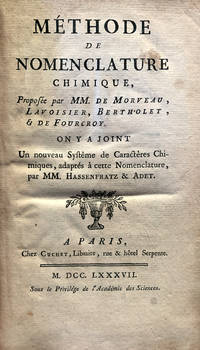
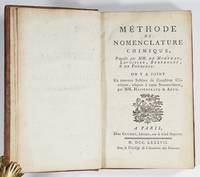
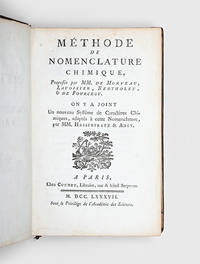
1787173027Paris: Chez Cuchet 1787. Modern chemistry therefore starts in 1787 First edition second issue of the work which introduced modern chemical terminology among the most fundamental scientific texts of the 18th century. The folding tables outline the first taxonomic system of chemical substances arranged according to their composition a system which proved immediately influential; even established figures like Priestley felt obliged to adopt the new terminology. The late 18th century witnessed considerable debates over the theory and practice of chemistry. The chief theoretical shift was the identification of oxygen in place of the hypothesized phlogiston which led many contemporaries to view the existing chemical terminology as outdated and confused. This move was largely driven by Lavoisier 1743-1791 and his fellow authors of the Méthode Louis Bernard Guyton de Morveau 1737-1816 Claude-Louis Berthollet 1748-1822 and Antoine-François de Fourcroy 1755-1809. In the Méthode they develop a systematic nomenclature largely derived from oxygen theory arguing that chemical substances should be named according to their constituents. Simple substances should receive simple names and compounds should receive complex names deriving from their constituents. "The new terms were soon translated and adapted into other languages and became the basis of the modern nomenclature of inorganic chemistry. In the purely pragmatic terms of the terminology used modern chemistry therefore starts in 1787" Crosland p. 411. There were two issues of the first edition: this second is identified by misnumbering pages 258-9 262-3 266-7 and 270-1. The first edition itself there were two in 1787 is identified by the woodcut on the title page depicting a cherub supervising distillation. Octavo 185 x 120 mm pp. 4 314. With 7 folding tables woodcut title page vignette head- and tailpieces. Contemporary mottled sheep spine with foliate decoration in gilt brown calf label lettered in gilt raised bands covers with single fillet border in blind marbled endpapers edges red pink silk bookmarker. Later pencil annotation to upper margin of p. 9. Light bumping and rubbing minor stripping to covers tail of front joint neatly repaired front inner hinge split but holding firm loss to lower outer corner of half-title inner margin of leaf G7 and outer margin of rear free endpaper none affecting text a couple of closed tears to initial folding table contents otherwise clean: a very good copy. Duveen & Klickstein 126; Norman 1291. Maurice Crosland "Chemistry and the chemical revolution" in The Ferment of Knowledge: Studies in the Historiography of Eighteenth-century Science 1980. hardcover
1787612Paris: Cuchet 1787. 1st. Full mottled calf with gilt tooling along the edges gilt spine compartments with floral ornaments and leather spine label. Contemporary binding with rubbing and wear along the spine and corners. Boards show mottling and fading with some scuffing. Pages exhibit foxing toning and occasional spotting consistent with age. Folding tables are intact and legible though with some creasing and edge wear. Features: Marbled edges; multiple large folding tables and engraved charts; decorative typographic ornaments. Overall good. <p data-start="251" data-end="727">Méthode de Nomenclature Chimique Paris: Cuchet 1787 is the groundbreaking work that introduced the modern system of chemical nomenclature marking a turning point in the history of science. Written collaboratively by Morveau Lavoisier Berthollet and Fourcroy—four of the most influential chemists of the 18th century—this treatise sought to replace centuries of inconsistent and confusing chemical terminology with a rational systematic method of naming substances.</p> <br /> <p data-start="729" data-end="1178">The work introduces a new nomenclature rooted in clarity precision and universality laying the foundation for the modern language of chemistry. Included are detailed explanations of the logic behind the naming system as well as extensive tables of elements and compounds that illustrate the method in practice. The treatise also contains supplementary sections by Hassenfratz and Adet who proposed a symbolic notation for chemical substances.</p> <br /> <p data-start="1180" data-end="1537">Lavishly produced the book features large folding tables and engraved charts including the famous “Tableau de la Nomenclature Chimique†which visually organizes the new classification of substances. These elements highlight both the pedagogical and scientific ambitions of the project: to unify chemists under a single coherent system of communication.</p> <br /> <p data-start="1539" data-end="1749">This volume is considered a cornerstone of the Chemical Revolution appearing just two years before Lavoisier’s Traité élémentaire de chimie 1789 and cementing his role as the father of modern chemistry.</p> . Cuchet unknown
thl53Paris: Cuchet 1787. First Edition First Issue of this important collaborative work which established the first systematic method of chemical nomenclature that is still in use today. “Originally suggested by Guyton de Morveau to eliminate the confused synonymy of chemistry and prefaced by a memoir of Lavoisier it emerged as a complete break with the past. In effect the scheme was based upon the new anti-phlogiston discoveries and theories…In a series of tables the ‘Nomenclature’ listed the elements substances non décomposées that is those bodies that had not been or perhaps could not be decomposed. Fifty-five in number these simple bodies included light and Lavoisier’s “matter of fire†now called “caloricâ€; the elementary gases: oxygen nitrogen azote and “inflammable air†now called hydrogen; carbon sulphur and phosphorus; the sixteen known metals; a long list of organic “radicals†i. e. accidifiable bases; and the as yet undecomposed alkaline earths and alkalis. Compounds were designated as chemists have done ever since so as to indicate their constituents." DSB VIII p. 80. Honeyman 1936. Neu 1791. Sparrow 126. 8vo. pp. 2 p.l. 256 241-256 273-314. with half-title. 6 folding engraved tables & 1 folding engraved plate. woodcut title vignette of a cherub supervising distillation. contemporary sprinkled calf gilt back small chip to head of spine short cracks in joints light dampstain to some leaves & first table stain on last leaf. thl53 Paris: Cuchet, 1787 unknown
178718453Paris: Chez Cuchet 1787. FIRST EDITION. With half-title 6 large folding copperplates and 1 large folding table title vignette woodcut headpiece above first text leaf pages 257-272 misnumbered. Contemporary tree calf spine label very small crack at top of spine and rear cover otherwise an excellent copy printed partially on blue paper from the library of Melchet Court Romsey and a small book label with the heraldic motto “virus in arduis†on the paste-down. First edition of one of the most important works in the history of modern chemistry. Lavoisier’s discoveries brought about a critical need to develop a new chemical nomenclature. Its importance was first recognized by Guyton de Morveau an adherent of the phlogiston theory. De Morveau was invited to join a group of the leading anti-phlogistonists to discuss the possibility of applying his nomenclature to Lavoisier’s chemistry and in the process was converted to Lavoisier’s doctrines. The result of this collaboration of Bertholet Fourcroy de Morveau Lavoisier and others is contained in this volume and marks the foundation of modern chemical nomenclature.<br /> <br /> Cole Chemical Literature 1700-1860 566C under Guyton de Morveau; Duveen 126; Duveen & Klickstein p. 127; Norman 1291; see Printing & the Mind of Man 238; Sparrow Milestones of Science 125. Chez Cuchet unknown
1787655401787. Paris: Chez Cuchet 1787 8° IV 314 pp. 6 gefalt. Kupfertafeln Ledereinbnand. d.Zt.; Falttabll fehlt; Rücken restauriert; feines Expl. FIRST EDITION first issue of one of the key books in the history of modern chemistry. This copy has all the features mentioned for the first issue such as the figurative title vignette and the misnumbered pages: 242/34 instead of 258/% 246/7 instead of 262/3 291 instead of 266/7 254/5 instead of 270/1. Unfortunately the table opposite page 100 is missing. Lavoisier's discoveries made a new and rational chemical nomenclature imperative. Initiated by Guyton de Morveau still an adherent of the phlogiston theory the project was taken up by Lavoisier who soon convinced Guyton of the truth of his system. They entered into collaboration with Berthollet and Fourcroy. The result of their combined efforts is contained in the present volume the most important milestone in the development of chemical nomenclature. The new nomenclature with only slight modifications is still the basis of the language of modern chemistry. The table of contents: 1 Mémoire Sur la nécessité de réformer & de nomenclature de la Chimie lu à l'Assemblée publique de l'Académie Royale des Sciences du 18 Avril 1787; Par M. Lavoisier pp. 1-25 This is the first appearance of this memoir in print. It was never published in the Mém. Acad. R. Sci. The contents are discussed in the introduction to this section. Lavosier revised the memoir and used it again for the "discours préliminaire" of this 'Traité Elementaire de Chemie. 2 Mémoire sur le développement des principes de la Nomenclature méthodique lu à l'Académie le 2 Mai 1787; Par M. de Morveau pp.26-70. 3 Appendice Contenant la nomenclature de quelques substances composées qui s ; combinent quelquefois à la manière des corps simples pp.70-74. 4 Mémoire Pour servir à l'explication du Tableau de Nomenclature. Par M. de Fourcroy pp.75-100. 5 Avertissement Sur les deux Synonimies pp.101-106. 6 Synonimie Ancienne & novelle par ordre alphabétique pp.107-143. 7 Dictionnaire Pour la nouvelle Nomenclature Chimique pp.144-237. 8 Rapport Sur la nouvelle Nomenclature pp.238-252. 8 Mémoire Sur de nouveaux Caractères à employer en Chimie. Par MM. Hassenfratz pppp.253-270. 9 IIe Mémoire Sur de nouveaux Caractères à employer en Chimie & l'arrangement que doivent avoir ces nouveaux Caractères afin de leur faire exprimer les rapports de quantité des substances simples contenues dans les mixtes. Par MM. Hassenfratz & Adet pp.271-287. As a complement to he new nomenclature Hassenfratz and Adet devised a system of symbols straight lines. Half -circles squares triangles lozenges and circles in different positions and combinations which as they intended should make possible an immediate understanding of chemical substances and their nature the world over. Ingenious though their methods seemed this sign language proved unsatisfactory and it has long been discarded. 10 Rapport Sur les nouveau Caractères chimiques pp.288-312. This memoir was never published in the Mém. Acad. R. Sci. H.F. Norman Lib. Cat. 1291. Duveen & Klickstein 126. Duveen p. 340. D.S.B. 8: 80. Cole 566. Bolton I. 58. Partington III. 372.VI. Smith Coll. p.209. Edelstein 1361. Milestones of Science 126. First issue not in Neville. Duveen-Klickstein 126 unknown
3382203995.Ghardcover. Good. Access codes and supplements are not guaranteed with used items. May be an ex-library book. hardcover
1021591513.Gpaperback. Good. Access codes and supplements are not guaranteed with used items. May be an ex-library book. paperback
1020112956.Ghardcover. Good. Access codes and supplements are not guaranteed with used items. May be an ex-library book. hardcover
1018718117.Gpaperback. Good. Access codes and supplements are not guaranteed with used items. May be an ex-library book. paperback
3382203987.Gpaperback. Good. Access codes and supplements are not guaranteed with used items. May be an ex-library book. paperback
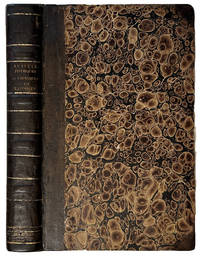
186225309Paris: Imprimerie Imperiale 1862. 6 volumes 4to 54 plates many folding and 2 double-p. tables; contemporary quarter brown morocco gilt-lettered direct on spine; ex-Northwestern University small labels on each spine perforated stamp on first leaf of text pocket at rear of each volume with withdrawn stamp; some wear to bindings; small tide-marks in the lower blank margins of most leaves also on some of the plates. The monumental collected edition of Lavoisier's works. "So many of the papers written by Lavoisier remained unpublished during his lifetime and can only be found in the Oeuvres particularly those of his earlier periods." Duveen & Klickstein pp. 377-456. Imprimerie Imperiale unknown
210972New York Johnson Reprint Corp. 1965. from the Paris Imprimerie Imperiale edition of 1864-1893 . Six volumes 8vo. c.3000pp. B/w frontis. folding charts folding engraved plates etc. An excellent set. A high quality facsimile marking the centenary of the original publication. New York, Johnson Reprint Corp. 1965. [ from the Paris, Imprimerie Imperiale edition of 1864-1893 ]. unknown
1288152892.Gpaperback. Good. Access codes and supplements are not guaranteed with used items. May be an ex-library book. paperback
034104119X.Gpaperback. Good. Access codes and supplements are not guaranteed with used items. May be an ex-library book. paperback
0341035084.Ghardcover. Good. Access codes and supplements are not guaranteed with used items. May be an ex-library book. hardcover
DADAX0341035084Wentworth Press 2018-08-08. hardcover. New. 6.14x1.81x9.21. Buy with confidence. Excellent Customer Service & Return policy. Wentworth Press hardcover
1021378046.Gpaperback. Good. Access codes and supplements are not guaranteed with used items. May be an ex-library book. paperback
1019687843.Ghardcover. Good. Access codes and supplements are not guaranteed with used items. May be an ex-library book. hardcover
1021356085.Gpaperback. Good. Access codes and supplements are not guaranteed with used items. May be an ex-library book. paperback
1801S14204Paris :: Deterville An IX 1801. 1801. 8vo. 197 x 122 mm xxx 2 443 pp. Three folding engraved plates. Speckled edges; paper flaws in K2 and O5 affecting text. Quarter-bound in 19th century half calf over brown marbled boards raised bands gilt-stamped title and gilt-rules on spine. Housed in a custom folding chemise and red quarter morocco and cloth slipcase raised bands gilt rules and gilt-stamped titles; light shelf wear. PROVENANCE: Robert Honeyman's copy. 261 Second edition second issue. "An entirely different issue of the usual 'Seconde edition.' Deterville has reprinted the entire book with the errata corrected in the text and the plates re-engraved by Tardieu l'aine Rue de Sorbonne No. 385. In the original edition the engraver had been de la Gardette who incidentally engraved Lavoisier's bookplate. The half-title with the titre de relais is present as before. The remark which appears at the end of the prior issue 'Le Privilege du Roi se trouve aux Memoires de l'Academie Royale del Sciences' is here omitted." Duveen & Klickstein. / This is Lavoisier's first major work. In this work on combustion and calcination which first appeared in 1774 Lavoisier first published his investigations into the nature and properties of gases in connection with numerous experiments and laid the basis of his antiphlogistic theory. Lavoisier gives a history of gases and a detailed account of his experiments. It was in this pioneer work that he broke ground that was new to him and asserted himself on an important question that was in controversy. The Opuscules one of Lavoisier's four major works resulted from his study on combustion and experiments with phosphorus and sulfur and the conversion of calces into metals. The work consists of a historical section and an introduction on gases; the second part describes his experiments dealing with the problems of combustion calcination and air fixation. / "Although Priestley isolated oxygen it was Lavoisier who discovered its real significance. He showed the true nature of the interchange of gases in the lungs and exploded Stahl's phlogiston theory." Garrison and Morton. / A native Parisian Lavoisier was one of the most important scientists of the 18th century. Because of his loyalty to the Ancien Regime Lavoisier fell into disfavor with the ruling National Assembly. He and his father were both arrested on 24 December 1793 tried on 8 May 1794 and executed by guillotine the same day. As the apocryphal story goes Lavoisier appealed at his trial for time to complete some scientific work at which the presiding judge replied "The Republic has no need of scientists." Authentic however is the remark attributed to Lagrange the day after Lavoisier's execution: "It took them only an instant to cut off that head and a hundred years may not produce another like it." / The half-title reads: "Cet ouvrage a l'exception des tables fut imprime pendant la detention du citoyen Lavoisier. Il ne faut donc pas etre surpris si l'edition n'en est pas belle ; on se rappelera sans peine qu'a cette epoque les matieres premieres manquoient pour l'impression. trans.: "This work with the exception of the tables was printed during the detention of Citizen Lavoisier. One should not be surprised if the edition is not beautiful; one will note without sorrow that this impression is without the errors of the first edition. ". PROVENANCE: From the celebrated Robert Honeyman IV library sold at auction by Sotheby Park Bernet & Co. May 12 1980 Part V Lot # 1933. REFERENCES: BM Readex Vol. 14 p. 998; Cole 770; DSB Vol. VIII pp. 66-91; Duveen p. 342; Duveen & Klickstein 123; Norman 1288 1st ed.; Partington III 372 V; Poggendorff I 1392. Deterville, An IX [1801]. hardcover
thl50Paris: Deterville 1801. Second i.e. Third Edition of Lavoisier’s first major work. It was originally intended to consist of a series of volumes but only this first was ever published. The first part contains an historical review of the experiments with gases of Lavoisier's predecessors while the second records Lavoisier’s own experiments that he had carried out in 1773. “These experiments confirmed Lavoisier's suspicions that air or some constituent of air played an important role in the processes of combustion and calcination.†DSB p. 74 “Remarkable for his versatility as scientist and public servant Lavoisier was first of all a chemist of genius justly remembered for his discovery of the role of oxygen in chemical reactions and as the chief architect of a reform of chemistry a reform so radical that he himself spoke of his early on as a “revolution†in that science.†Ibid. p. 66 Duveen p. 342. cfHoneyman 1933. See Printing and the Mind of Man 238. 8vo. pp. xxx 2 443. with half-title. 3 folding engraved plates. index. contemporary tree calf gilt back head of spine & corners damaged front joint partly cracked. thl50 Paris: Deterville, 1801 unknown
1801866Paris: Chez Deterville 1801. Second edition. <br /> <br /> A significant early collected work by Antoine-Laurent Lavoisier the founder of modern chemistry bringing together a series of his shorter but influential papers on physics and chemistry. Opuscules Physiques et Chimiques reflects the transitional moment in late 18th-century science when experimental chemistry began to replace older speculative systems. The volume includes studies on elastic fluids gases combustion fermentation and chemical decomposition illustrating Lavoisier’s role in redefining chemical processes through quantitative experimentation and precise observation.<br /> <br /> This 1801 second edition is particularly notable for its historical context: as stated in the prefatory note the work was printed during Lavoisier’s imprisonment amid the French Revolution shortly before his execution in 1794. As such the book stands not only as a scientific milestone but also as a poignant artifact of Enlightenment science disrupted by political upheaval. The inclusion of engraved folding plates depicting experimental apparatus underscores the practical and experimental nature of the work offering insight into early laboratory techniques that helped establish modern chemical methodology.<br /> <br /> Condition & Binding: Bound in contemporary full calf with an elaborately gilt-decorated spine and a central gilt armorial device on the boards likely institutional or academic possibly French reading “Collegium Lugdunense†or similar. Spine with gilt compartments and red morocco title label; some rubbing and wear to extremities including minor loss at head of spine. Boards show scuffing and surface wear but remain solid and attractive. Internally text is generally clean with light to moderate foxing and toning throughout. Overall- very good. Chez Deterville unknown
0282433171.Gpaperback. Good. Access codes and supplements are not guaranteed with used items. May be an ex-library book. paperback
1142419290.Gpaperback. Good. Access codes and supplements are not guaranteed with used items. May be an ex-library book. paperback
1144857937.Gpaperback. Good. Access codes and supplements are not guaranteed with used items. May be an ex-library book. paperback