74 résultats
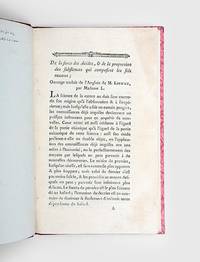
1791CLL-37Paris, de l'Imprimerie nationale, 1791 In-8 de (1) f., 48 pp., cartonnage à la Bradel de papier gris marbré, dos lisse, titre doré en long, tranches nues (reliure moderne).
179061775[Paris, Clouiser, 1790, in-8, de 32 pages, exemplaire broché, sous couverture de papier marbré, Rare plaquette. Critiquant à la fois les positions de Talleyrand et celles de Mirabeau, le célèbre chimiste, député suppléant du bailliage de Blois, membre de la Société de 1789, propose, en compagnie de ses amis modérés comme La Rochefoucauld, La Fayette ou Bailly, une limitation de l'émission des assignats. Premiers et derniers feuillets roussis. Couverture rigide
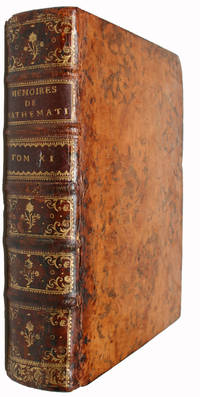
1768EBS100145In: Mémoires de Mathématique et de Physiques Présentés à l Académie Royale de Sciences par divers Savans & lûs dans ses Assemblées; Pp 341-366 in Volume 5 1768. 1st Edition. Hardcover. Very Good/No Jacket. FIRST EDITION JOURNAL ISSUE OF LAVOISIER'S FIRST CONTRIBUTION TO THE ACADEMY OF SCIENCES. "Lavoisier's earliest chemical investigation his study of gypsum was mineralogical in character; begun in the autumn of 1764 it was intended as the first paper in a series devoted to the analysis of mineral substances. 'I have tried to copy nature' Lavoisier wrote. 'Water this almost universal solvent. is the chief agent she employs; it is the one I have adopted in my work.'. Analysis convinced him that this gypsum was a neutral salt a compound of vitriolic sulfuric acid and a calcareous or chalky base. He further demonstrated that gypsum when transformed by strong heating into plaster of Paris gives off a vapor which he showed to be oure water making up about a quarter of the weight of gypsum. This first paper which in so many respects embodies the quantitative methods Lavoisier was to employ in his later work had in fact been anticipated by others." DSB. Other essays in the Mémoires include works by Chevalier Muller and Boucher. The entire volume is illustrated with 20 engraved folding plates. See Duveen and Klickstein p 14Paris: De L Imprimerie Royale 1768Large 4to Complete Volume 5 bound in cont. leather spine raised bands in compartments folding plates; Also chemical papers by Cadet 2 de Cortanvaux 2 Baumé 2 Bomare 1 plus others; VG. In: Mémoires de Mathématique et de Physiques Présentés à l Académie Royale de Sciences, par divers Savans & lûs dans ses hardcover
176844940Paris L'Imprimerie Royale 1768. 4to. Extract from "Mémoires fe Mathematique et de Physique Présentés à l'Academie des Sciences par divers Savans" Tome V. With tittlepage to vol. 5. Pp. 341-357. Clean and fine. <br/><br/><em>First appearance of Lavoisier's FIRST PUBLISHED CHEMICAL PAPER introducing quantitative methods in chemistry and in which he for the first time brought a hydrometer in use to measure the specific gravities of components of a chemical solutions. Lavoisier defended the originality of his approach in the following words: "It is to the art of combination that the knowledge of the specific gravities of fluids can bring most light. This aspect of chemistry is much less advanced than we thought we possess barely the rudiments of it." "This first paper which in so many respects embodies the quantitative methods Lavoisier was to employ in his later work had in fact been largely anticipated by others notably by Marggraf who had already discovered the composition of gypsum and shown that it contained water phlegm. Yet Lavoisier’s work was more through; and his paper his first contribution to the Academy of Sciences read to the Academy on 25 February 1765 appeared in 1768. The paper offered. - Lavoisier’s earliest chemical investigation his study of gypsum was mineralogical in character; begun in the autumn of 1764 it was intended as the first paper in a series devoted to the analysis of mineral substances. This systematic inventory was to be carried out not by the method of J. H. Pott "who exposed minerals to the action of fire" but by reactions in solution by the "wet way." "I have tried to copy nature" Lavoisier wrote. "Water this almost universal solvent "is the cheif agent she employs; it is also the one I have adopted in my work." Using a hydrometer he determined with the care the solubility of different samples of gypsum samples of selenite or lapis specularis some supplied by Guettard and Rouelle. He made similar measurements with calcined gypsumplaster of paris. Analysis convinced him that this gypsum was a neutral salt a compound of vitriolic sulfuric acid and a calcareous or chalky base. Not content with having shown by analysis the composition of the gypsum Lavoisier completed his proof by a synthesis following as he said the way that nature had formed the gypsum. He further demonstrated that gypsum when transformed by strong heating into plaster of Paris gives off a vapor which he showed to be pure water making up about a quarter of the weight of gypsum. Conversely when plaster of Paris is mixed with water and turns into a solid mass it avidly combines with water. Using the expression first coined by Rouelle he called this the "water of crystallization." DSB.Partington III pp. 378-79. - </em> unknown
176844940Paris, L'Imprimerie Royale, 1768. 4to. Extract from ""Mémoires fe Mathematique et de Physique, Présentés à l'Academie des Sciences par divers Savans"", Tome V. With tittlepage to vol. 5. Pp. 341-357. Clean and fine.
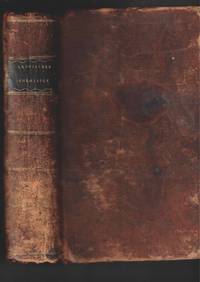
178990025Paris: Rue et Hôtel Serpente 1789. Fine. Opening run of the journal ""Annales de chimie"" vehicle of ""The New Chemistry"" founded and directed by Antoine de Lavoisier Rue et Hôtel Serpente Paris 1789-1792 12.8 x 19.6 cm Relié First edition highly sought after in the 19th century comprising 14 of the first 15 volumes published between 1789 and 1792 of the first series of the celebrated French scientific periodical Annales de chimie. Volume 10 missing. Contemporary full brown calf spines smooth with gilt fillets brown morocco lettering-piece and green morocco numbering-piece blind-ruled border to covers red speckled edges bookplate of P. H. Chavoix to front pastedown of each volume. Volumes 1 and 11 numbered in Roman rather than Arabic numerals. Overall discreet restorations corners rubbed occasional light foxing and browning some worming to bindings not affecting text head and tail of headcaps worn on volumes 7 13 14 and 15. The complete first series of the Annales de chimie published between 1789 and 1815 runs to 96 volumes. From 1793 to 1797 publication was suspended following the arrest of Antoine Lavoisier the journal's treasurer and in Édouard Grimaux's words its ""true director."" The opening run here contains nearly all the issues produced under the direction of and with contributions from the chemists Antoine de Lavoisier and Baron Philippe Frédéric de Dietrich. Both were condemned to the guillotine during the Reign of Terror in 1794 and 1793 respectively. This set is further illustrated with 12 scientific plates including two by the engraver Sellier as well as a map of the county of Bigorre. The majority of the articles and essays are first editions written by distinguished French and foreign chemists and physicists who helped disseminate ""The New Chemistry"": in order of appearance Louis-Bernard Guyton de Morveau Antoine de Lavoisier Gaspard Monge Claude-Louis Berthollet Anne-François Fourcroy Philippe-Frédéric de Dietrich Jean Henri Hassenfratz Pierre-Auguste Adet Jean-Antoine Chaptal Martin Heinrich Klaproth Johann Georg Albrecht Höpfner Christoph Girtanner Johann Christian Wiegleb Jacques-Anselme Dorthes Johann Friedrich Westrumb Armand Seguin Henry Cavendish William Austin Martin van Marum l'abbé René Just Haüy Peter Jacob Hjelm Jan Ingenhousz Isaac Milner Johan Gadolin James Watt Lorenz Florenz Friedrich von Crell Charles Blagden Jean Senebier Jean d'Arcet William Higgins Nicolas-Louis Vauquelin Nicolas Joseph Thiéry de Ménonville Dom Michel Rubin de Celis Jacques Louis Schurer Augustin-François de Silvestre l'abbé Claude Chappe Antoine Augustin Parmentier Nicolas Deyeux Bertrand Pelletier Charles-Augustin Coulomb Joseph Priestley Richard Kirwan Jean André de Luc Jean-François Clouet chevalier Marsilio Landriani Jean-Noël Hallé François Pierre Nicolas Gillet de Laumont Georges-Charles Bartholdi Alexandre Brongniart Jean-Michel Haussmann Henri Reboul François René Curaudau Thomas Henry Jean-Anthyme Margueron Nicolas Leblanc Johann Rudolph Deiman Pieter Nieuwland Pierre de Ribaucourt Pissis fils Jean-Baptiste Van Mons ou encore Louis François Antoine Arbogast. In 1816 the Annales de chimie was retitled Annales de chimie et de physique. In 1913 the journal split into two separate publications Annales de chimie and Annales de physique. The titles have undergone further changes up to the present day. A collection of 14 volumes from the opening run of the prestigious French scientific periodical Annales de chimie containing numerous essays and articles most in first edition published under the editorship of distinguished figures: Antoine de Lavoisier Louis-Bernard Guyton de Morveau Gaspard Monge Claude-Louis Berthollet Anne-François Fourcroy Philippe-Frédéric de Dietrich Jean Henri Hassenfratz and Pierre-Auguste Adet. Rue et Hôtel Serpente unknown
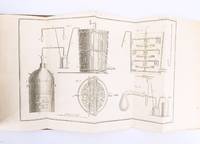
1791042651Paris: Fuchs 1791. First Edition. Hardcover Half Leather. Very Good Condition. Half contemporary leather over marbled boards. Worn at corners hinges slightly cracked stamp to title page. Tome 10 of the first series. 336pp folding plate at rear. Contents include: Investigations on the chemical history of the tepid springs of Buxton Refining of metal for clocks Chemical examination of skate liver etc. Size: Octavo 8vo. Quantity Available: 1. Shipped Weight: Under 1 kilo. Category: Science & Technology; Antiquarian & Rare. Inventory No: 042651. <br/><br/> Fuchs hardcover
1793042673Paris: Joseph de Boffe 1793. First Edition. Hardcover Half Leather. Very Good Condition. Volumes 17-20 1793-1797 of the crucial French scientific journal still published today. Half leather over marbled boards general wear at edges chipped and wear at corners and spine ends bindings tight and intact. Stamp on title pages browning to endpapers. Volume 19 with a dark dampstain all along the top margin not touching the text.<br /> <br /> 335pp two folding plates; 328pp 1 folding plate; 384pp; 396pp 1 folding plate.<br /> <br /> Size: Octavo 8vo. Quantity Available: 1. Shipped Weight: Under 1 kilo. Category: Science & Technology; Antiquarian & Rare. Inventory No: 042673. Joseph de Boffe hardcover
1791042651Paris: Fuchs 1791. First Edition. Hardcover Half Leather. Very Good Condition. Half contemporary leather over marbled boards. Worn at corners hinges slightly cracked stamp to title page. Tome 10 of the first series. 336pp folding plate at rear. Contents include: Investigations on the chemical history of the tepid springs of Buxton Refining of metal for clocks Chemical examination of skate liver etc. Size: Octavo 8vo. Quantity Available: 1. Shipped Weight: Under 1 kilo. Category: Science & Technology; Antiquarian & Rare. Inventory No: 042651. <br/><br/> Fuchs hardcover books
1793042673Paris: Joseph de Boffe 1793. First Edition. Hardcover Half Leather. Very Good Condition. Volumes 17-20 1793-1797 of the seminal French scientific journal still published today. Half leather over marbled boards general wear at edges chipped and wear at corners and spine ends bindings tight and intact. Stamp on title pages browning to endpapers. Volume 19 with a dark dampstain all along the top margin not touching the text. 335pp two folding plates; 328pp 1 folding plate; 384pp; 396pp 1 folding plate. Size: Octavo 8vo. Quantity Available: 1. Shipped Weight: Under 1 kilo. Category: Science & Technology; Antiquarian & Rare. Inventory No: 042673. <br/><br/> Joseph de Boffe hardcover books
178990025Rue et Hôtel Serpente | Paris 1789-1792 | 12.8 x 19.6 cm | Relié
1788374291788. Crells Chem. Annalen 1788/ 67. - Helmstädt Leipzig Müller 1788 8° pp.481-574 96 pp. 2 orig. Broschur. First German Edition of the report made by Lavoisier to the Académie on the French translation of Scheele's Chemische Abhandlung von der Luft und dem Feuer. "The review is a warm one with Lavoisier expressing a greater confidence in his own ideas because of the confirmation given them by Scheele's experiments. Scheele used phlogiston to explain his results. No record has been found as to the time when Lavoisier first read ths book. previously on August 8 1781 Bertholett and Lavoisier had already submitted a joint report on Dietrich's translation of Scheele's book which was printed for the first time in his Oeuvres IV 337-379." In the second article "Lavoisier proves that air fixe rally is a compound of carbon charcoal and oxygen; he details a good many of the experiments by which this fact was established. The work thus certainly forms a plank in the platform of his new theory. He was of the opinion that all acids contain oxygen that oxygen is in fact the acidifying principle in all acids and he therefore called air fixe carbonic acid. This view was confirm to him by the fact that a solution of the gas in water exhibits acid properties." Duveen & Klickstein Nr.61 63. Fierz-David Anhang II: Entdeckungsgeschichte der Elemente 6: Lavoisier erkannte das C in reinem Zustand im Diamant vorhandnen ist. unknown
1764000594Lipsiae Gleditsch 1764
1791174569Paris: c.1791. A prime example of Madame Lavoisier's formidable analytic eye First edition scarce offprint issue of Madame Lavoisier's critical translation of the work of a prominent fellow of the Royal Society. In the UK institutional copies are recorded at UCL and in the Wellcome Collection. Marie-Anne Paulze Lavoisier 1758-1836 famously refuted the claims of the chemist Richard Kirwan 1733-1812 several times. In 1787 after he published his Essay on Phlogiston she brought out a similarly deprecatory translation complete with a preface which undermined his authority as an academic. Kirwan published Of the strength of acids and the proportion of ingredients in neutral salts in Dublin in 1791. In her translation Lavoisier's extensive annotations and critical apparatus focus on Kirwan's scientific and procedural errors. "II y a dans ces sortes d'expériences une cause d'erreurs qui paroit avoir échappé à M. Kirwan; c'est la grande quantité d'eau que l'acide carbonique est susceptible de dissoudre et qui échappe avec lui" "There is in these types of experiences a cause of errors which appears to have escaped Mr Kirwan: the large quantity of water which carbonic acid is likely to dissolve and which escapes with it" - p. 40. Marie-Anne married Antoine Lavoisier in 1771. She promoted their collaborative work to the international scientific community and used her command of languages to keep Antoine abreast of the latest developments. "Through her drawings translations interpretations of notes and skillful editing of Lavoisier's memoirs she made some important additions to the body of scientific knowledge. there are indications that she made some theoretical contributions" Ogilvie & Harvey. This translation was published in journal form in the Annales de Chimie which Antoine Lavoisier edited. Octavo 193 x 120 mm pp. 108. Woodcut headpieces and tables in the text. Recent red quarter morocco spine lettered in gilt marbled paper sides. Minimal wear minor foxing and creasing to contents: a very good copy indeed. Ogilvie & Harvey Biographical Dictionary of Women in Science II p. 753. unknown
1777536Paris P. Fr. Didot 1777 Trois volumes petit in-8 plein veau raciné, dos à nerfs, caissons décorés, pièces de titre en maroquin noisette, pièces de tomaison en maroquin brun, filet doré sur les coupes, xxxii, 747, 660 et 510 pages, 10 planches dépliantes in fine. Tampon d'ex-libris en page de garde et en marge p. xvi. Bel exemplaire.
1790EBS100146Edinburgh: William Creech 1790. 1st Edition. Hardcover. Very Good/No Jacket. Robert Kerr 1755-1813 undertook this first English translation of Lavoisier's Traité elementaire de Chimie Paris 1789. Printing & the Mind of Man headlines the original edition as "A new epoch in chemistry." <br /> <br /> A more recent analysis pinpoints the importance of this book: "Lavoisier's most fundamental innovations transformed how one presents how one argues scientific knowledge and how as a result one develops and transmits it. The transformation of the terms and structures of scientific discussions had consequences beyond chemistry-consequences that Lavoisier himself did not foresee". W. C. Anderson Between the library & the laboratory John Hopkins 1984. <br /> <br /> BOOK DETAILS AND CONDITION: First Eng. Ed 8vo: 50 511 1 pp with 2 folding tables and 13 folding copper plates Duveen and Klickstein pp 180-182 Cont. leather w/some wear missing head and tail bands. Neville II p 24: Some alterations have been made in the tables in the appendix to accommodate the English reader: e.g. rules for converting French weights and measures are added and temperatures are given in degrees Fahrenheit. See A. Greenberg From Alchemy to Chemistry in Picture and Story John Wiley & Sons New York 2007 pp 309310316. Overall: VG.<br /> <br /> RARITY: Rare Book Hub shows eleven copies have sold in the last century.<br /> <br /> PROVENANCE: Signatures of three past owners in book: Alfred Brunton 1843; Henry Hallett and Charles Lucy. This book was also owned by Arthur Greenburg. Henry Hallett shared the 1936 Nobel Prize in physiology for discovery of the role of acetylcholine in neural transmission. Greenburg is a well known historian of chemistry. Edinburgh: William Creech hardcover
17997013Mathew Carey. Good with no dust jacket; Hardcover; No marks clean tight binding . owners names and date 1818 on FEP; full original leather; rubbed on all . egdes back cover professionally reattached; toned end sheets some foxing . on few pages; hinge paper crack but not hinges; privately printed; NOT . ex-library; hand made paper pages; original black and gilt spine label ;. 1799. Fourth Edition. Hardcover. Thirteen fold out plates of the modern lab equipment; appendix and tables by the Father of Chemistry; ; 592 pages . Mathew Carey hardcover
179625031Edinburgh: William Creech 1796. Third Edition. Full-Leather. Good. Octavo. 592pp 13 folding copper plates.Last few pages including the plates wavy from moisture mildly stained Small bookplate. Third Edinburgh edition. <br/><br/> William Creech hardcover
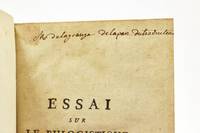
178871724Paris: S. n. 1788. Fine. S. n. Paris 1788 12.50 x 20 cm relié Essai sur le Phlogistique et sur la constitution des Acides Essay on Phlogistonn. p. Paris 1788 8vo 12.5 x 20 cm xij ; 344 pp.; 4 p. contemporary half sheep First edition and sole publication of the French translation and critical analysis under the direction of Madame Lavoisier of this text published in English the previous year under the title An Essay on Phlogiston and the Constitution of Acids. The work is made up of twelve sections all followed by critical notes by Louis-Bernard Guyton de Morveau Pierre Simon de Laplace & Gaspard Monge & Claude Louis Berthollet & Antoine François de Fourcroy. Contemporary half light brown sheep over marbled paper boards smooth leather spine decorated with gilt fillets and fleurons morocco leather title piece. Very skillfully restored joints. Interior in very good condition except for two marks left by bookmarks on pages 68-69 and 176-177. Rare autograph inscription by Marie-Anne Paulze Lavoisier to Joseph Louis de Lagrange prominent mathematician and loyal friend to Antoine Lavoisier. Valuable record of the leading role played by Marie-Anne Paulze Lavoisier in the chemical revolution at the dawn of the French Revolution. Phlogiston theory emerged at the end of the 17th century conceived by Johann Becker and developed by Georg Ernst Stahl postulating the existence of a flame element inherent in combustible bodies and released during combustion. This hypothesis was completely refuted by Lavoisier who revealed the role of oxygen in the combustion process thus inventing the theory of oxidation. Irritated by Lavoisier's skepticism with regard to phlogiston theory the eminent Irish chemist Richard Kirwan published this text titled Essay on Phlogiston. . The French chemists who rallied around Lavoisier decided to respond by translating An Essay on Phlogiston into French. Keiko Kawashima Madame Lavoisier et la traduction française de l'Essay on phlogiston de Kirwan in Revue d'histoire des sciences 2000. This text far from being a simple translation of Kirwan's work adopted the form of a manifesto in itself in which the greatest chemists of the day contested phlogiston theory dissecting its advocates' arguments one by one. The huge success of the French translation led Kirwan to attempt to refute the objections of Lavoisier and his collaborators. In 1789 he published a second edition of his work translating the French notes written by its detractors into English and adding his own refutations. He finally converted to the ideas of the anti-phlogisticians the founders of modern organic chemistry. Marie-Anne Pierrette Paulze Mme Lavoisier played a key role in the career of her husband who taught her chemistry at her request; she then became his assistant recording the experiments he carried out and their results. She very quickly took on a role that went beyond that of the devoted wife becoming a translator but also a writer: many of the notes in the Essai sur le phlogistique were written by her. At the height of her involvement it was she in her capacity as a skilled illustrator who drew all the plates in Traité élémentaire de chimie 1789 appending her signature Paulze Lavoisier Sculpsit on this occasion. This specimen includes a rare autograph inscription by the translator Mme Lavoisier to Joseph Louis de Lagrange 1736-1813 one of her husband's closest friends. It was Lavoisier who aroused the interest of Lagrange in the new science of chemistry. Together they participated in the development of a metric system that standardized weights and measures which came to light during the Revolution. Working for the revolutionary government Lagrange had more opportunities than his chemist friend who was executed as a victim of the Terror. When he learned that Lavoisier had been killed at the guillotine the mathematician declared: It took them only an instant to cut off Lavo S. n. hardcover
178871724S. n. | Paris 1788 | 12.50 x 20 cm | relié
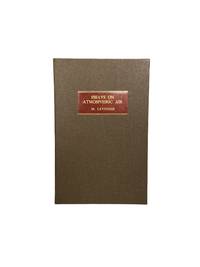
17833925London: Warrington Printed by W. Eyres for J. Johnston 1783. First English Language Edition. Octavo : pp. vii viii 2 141 3 List of Books lately published by J. Johnston : now custom clamshell box with red leather title panel lettered in gilt. DUVEEN 336<br /> <br /> Lacks covers and half title; toned foxed and brittle; title page detached; thereafter first gathering detached; chips and water stains. Antoine Lavoisier often referred to as the Father of Modern Chemistry and his wife Marie-Anne Pierrette Paulze Lavoisier later Countess von Rumford were eighteenth century French chemists responsible for overthrowing the "false doctrine of Phlogiston". Lavoisier relied on Paulze's translation of foreign works to keep abreast of current developments in chemistry. In the case of phlogiston it was Paulze's translation of Richard Kirwan's 'Essay on Phlogiston and the Constitution of Acids - with her own footnotes critiquing his errors - that convinced him the idea was incorrect ultimately leading to his studies of combustion and his discovery of oxygen gas. <br /> <br /> Lavoisier was a victim of The Terror of 1794 and guillotined in Paris. "It took but a moment to cut off his head; it will take a century to produce another like it" mourned his friend Lagrange the mathematician. The Autobiography of Science p.228.<br /> <br /> The collected essays show the development of Lavoisier's thinking and in the penultimate essay VIII the term "oxyginous principle" principe oxygin i.e. oxygen appears for the first time in chemistry p.98 This paper was first submitted to the Academie in 1777 and read in 1779. DUVEEN 49. Warrington, Printed by W. Eyres for J. Johnston unknown
1783EBS100454Warrington: Printed by W. Eyres for J. Johnson 1783. 1st Edition. Hardcover. Very Good/No Jacket. FIRST COLLECTED EDITION of this group of papers which Lavoisier published in the Mémoires of the Académie Royale des Sciences; there is no equivalent edition in French. <br /> <br /> The first paper is the first edition in English of his Expériences sur la respiration des animaux in which he asserted that respiration involved only the air éminement respirable i.e. oxygen and that the remainder of the air is purely passive entering and leaving the lungs unchanged. This began his first serious studies of respiration which were to culminate in 1785-1789 in his classic investigations on the subject see Fulton Selected readings in the history of physiology. <br /> <br /> Other papers are on combustion and on the analysis of acids including his paper read to the Académie in 1779 which contains the first appearance of the word oxygen in chemistry although the translator uses the usual term for time dephlogisticated air and Lavoisier's original definition of it. <br /> <br /> In the eighth essay pp. 96-118 of this important work Lavoisier proposes his theory that oxygen is an essential constituent of all acids and he remarks: Here therefore we have a new road opened in chemistry. p. 115. <br /> <br /> BOOK DETAILS AND CONDITION: 8vo xx 142 pp. Without half-title and advert leaf; Bound in recent half calf and marbled paper over boards; Early leaves foxed as usual. VG <br /> <br /> RARITY: A relatively rare book. Has sold five times at auction in the last century RBH. OCLC reports 32 copies in the worlds libraries / ESTC T63988 shows 30 copies. <br /> <br /> PROVENANCE: Ex-library Franklin Institute See Duveen and Klickstein pp 368-370. From the Arthur C. Greenberg History of Chemistry Library. <br /> <br /> REFERENCES: Blake p.258; Cole 761. Duveen p. 340. Neville II p. 17. Duveen & Klickstein 336. Warrington: Printed by W. Eyres, for J. Johnson hardcover
1776ABE-17454235012311776. 1st Edition. Hardcover. Fine. Essays Physical and Chemical. Translated with Notes and an Appendix by Thomas Henry. Volume the First ALL PUBLISHED London 1776 First Edition in English of Lavoisier`s first book 3 folding plates xxxiii 475pp Duveen and Klickstein p 118 8vo orig boards rebacked in mod. 1/4 calf See A. Greenberg From Alchemy to Chemistry in Picture and Story John Wiley & Sons New York 2007 p 307. hardcover
1784513931784. <p>Franklin Benjamin 1706-90; Antoine Lavoisier 1743-94 Jean-Sylvain Bailly 1736-93 et al. Exposé des expériences qui ont été faites pour l'examen du magnétisme animal lu à l'Académie des Sciences . . . 16pp. N.p. 1784. 212 x 141 mm. uncut. Original plain wrappers. Paper flaw in last leaf but fine otherwise.</p> <p> Early Octavo Edition issued in the same year as the official quarto edition printed by the Imprimerie Royale. OCLC records two octavo editions one with imprint reading "A Paris: Chez Moutard Imprimeur-Libraire de la Reine . . . M.DCC.LXXXIV" and the other simply dated "1784" with no place or publisher information as in our copy. The typesetting also differs between the two editions: The Moutard edition has 15 pages with blank page 16 while our edition has 16 printed pages. </p> <p> After the Franklin commission issued its official report on animal magnetism a shorter précis of its findings was read by Bailly before the Académie des Sciences on 4 September 1784; this was then published under the title Exposé des expériences . . . As noted above the Exposé was issued in both quarto and octavo format. Not in Duveen Bibliography of the Works of Antoine-Laurent Lavoisier which records only the Moutard edition. </p> . unknown
178644923Paris Moutard 1786. 4to. Contemp. full sprinckled calf with 5 raised bands on spine. Richly gilt compartments title-and tomelabels with gilt lettering. A small nich to leather at middle of front hinge. A small tear to rear hinge at upper compartment. "Mémoires fe Mathematique et de Physique Présentés à l'Academie des Sciences par divers Savans" Tome XI. 4198682 pp. Wide-margined fine and clean. <br/><br/><em>This collective work is the French Academy's monumental treatise on the chemistry and the production of Salpetre a topic of great importence for the war-industry in making gunpowder. The volume contains papers by Macquer Darcy Lavoisier Sage Baumé de la Rochefoucault Clouer and an anonymous report on experiments made in England CAVENDISH'S on the composition of nitric acid.papers by Cornette Thouvenel and Thouvenel Le Lorgna Gavinet and Chevrand de Beunie Romme Clouet and Lavoisier de Rochefoucault etc.Partington III p. 467 n."The Regie des Poudres et Salpetres had the monopoly of refining salpetre from 1775 until it was suppressed during the Revolution. Until his retirement in 1791 the leading light in it was Lavoisier who seems to have written its publications. - In 1775 the Academy offered a prize of 4000 livres for a process for procuring an abundant supply of salpetrethe announcement being written by Lavoisier. Altogether 66 papers were received and the prize was finally awarded in 1782 to the brothers Thouvenel who gave a full account of nitre plantations. The material was published in 1786 in one volume by the Academy. In it Lavoisier describes 'Experiences sur la décomposition du nitre par le charbon' said to have been made in 1784."Partington III pp. 466 ff."Peu de temps après que Lavoisier eut été nommé régisseur des poudres et salpêtres il suggéra à Turgot alors contrôleur général des finances l'idée de charger l'Académie des sciences de décerner un prix au meilleur mémoire sur la formation du salpêtre. 'Académie nomma une commission dont Lavoisier fut le rapporteur ; c'est lui qui examina tous les mémoires présentés au concours en fit l'analyse et quand l'Académie publia en 1786 un volume contenant l'histoire du prix du salpêtre et les mémoires présentés au concours c'est encore Lavoisier qui en fut le rédacteur. Ce volume fait partie du Recueil des mémoires de mathématiques et de physique présentés à l'Académie royale des sciences par divers savants et lus dans ses assemblées tome XI contenant le Recueil des mémoires sur la formation et la fabrication du salpêtre à Paris de l'imprimerie Moutard DCCLXXXVI. Sauf les mémoires des concurrents et un mémoire du duc de la Rochefoucault ce volume est tout entier de la main de Lavoisier. Il est formé de deux parties ; la première est intitulée : Histoire de ce qui s'est passé relativement au prix proposé sur la formation du salpêtre ; la seconde partie comprend les mémoires présentés au concours ainsi que des mémoires de Lavoisier et Clouet un mémoire sans signature mais qui appartient à Lavoisier le manuscrit autographe a été conservé le mémoire du duc de La Rochefoucault et les expériences de Lavoisier sur la décomposition du nitre par le charbon." </em> hardcover