MM.Lavoisier et De LaplaceLivre Rare Book
414 résultats
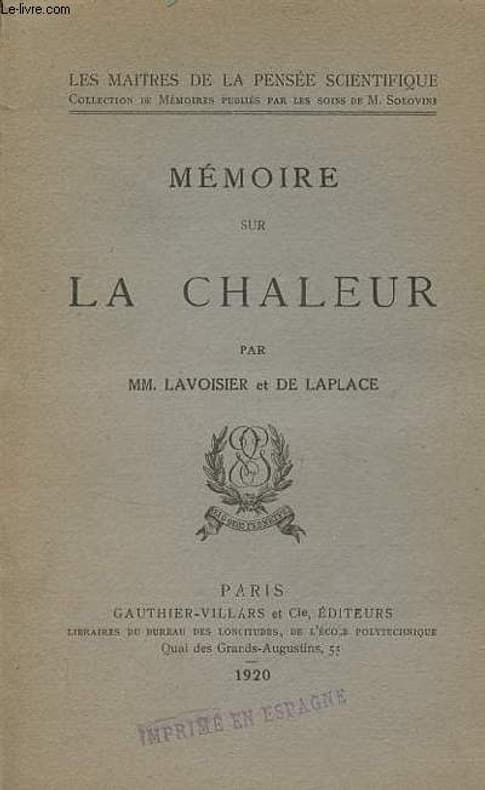
1920R160222006Gauthier-villars et cie. 1920. In-12. Broché. Etat d'usage, Couv. convenable, Dos satisfaisant, Papier jauni. 78 pages + 2 planches en noir et blanc - tampon sur le 1er plat.. . . . Classification Dewey : 500-SCIENCES DE LA NATURE ET MATHEMATIQUES
15 "leçons" en un volume in-4, cartonnage marbré à la Bradel, pièce de titre en long (rel. moderne), pagination séparée par leçon, (1) f., 4 p., 4 p., 4 p., 4 p., 4 p., 4 p., 4 p., 4 p., 4 p., (2) p., (2) p., 4 p., 2 p., 2 p., (2) p. Édition originale du recueil des quinze "cours révolutionnaires" organisés au sein de l'École polytechnique nouvellement crée, afin de propager auprès d’auditeurs venus de toute la France, les nouvelles méthodes de fabrication du salpêtre, de la poudre et des canons, fruit des recherches communes des signataires de ces cours. La rédaction est due à Guyton de Morveau. Contient deux séries de leçons. La première a pour titre de départ: "Cours révolutionnaire de la fabrication du salpêtre et de la poudre". La seconde: "Fabrication des canons de fer coulé". La première série compte neuf leçons, huit numérotées de 1 à 8, datées du 1er au 8 ventôse de l'an II [du 19 au 26 février 1794], suivies d'une dernière non numérotée, dite "supplémentaire" et datée du 19 ventôse de l'an II [9 mars 1794]. Si Lavoisier, emprisonné, ne put participer à ce travail, on y trouve sa marque à toutes les pages sans que son nom ne soit jamais cité. On y retrouve également ses trois co-auteurs de la 'Méthode de nomenclature chimique': Guyton de Morveau, Fourcroy et Berthollet. (Duveen, 'Bibliotheca Chimica', p. 486. Martin & Walter, 'Anonymes', 14623). Dos frotté. La page de titre est roussie et montée sur onglet, restauration à un coin de la page 1 avec de perte de trois mots reproduits à la plume.
3633515 "leçons" en un volume in-4, cartonnage marbré à la Bradel, pièce de titre en long (rel. moderne), pagination séparée par leçon, (1) f., 4 p., 4 p., 4 p., 4 p., 4 p., 4 p., 4 p., 4 p., 4 p., (2) p., (2) p., 4 p., 2 p., 2 p., (2) p. S.l.n.d. [Paris, Imprimerie du Comité de salut public, février-mars 1794].
178717876Paris, (Chardon für) Cuchet, 1787. 2 Bll., 314 S. mit Titelholzschnitt-Vignette. 6 mehrfach gefalt. Kupfertafeln und 1 mehrfach gefalt. Tabelle. 8°. HLdr. des 20. Jahrhunderts mit Rückenschild (leicht berieben und bestoßen). [5 Warenabbildungen]
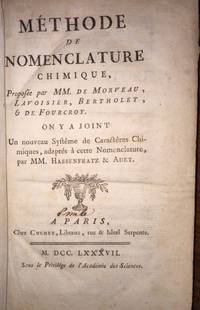
1787S9953Paris:: Chez Cuchet 1787. 1787. 8vo. iv 314 pp. Half-title woodcut title-page vignette headpiece tailpieces 6 folding tables of chemical symbols 1 folding plate; page 1 of the text trimmed at top margin and mounted on a stub foxed. Contemporary full mottled calf red leather spine label gilt-stamped spine; foot of spine chipped corners of read cover chewed. Ownership signature on title. Very good. FIRST EDITION second issue second printing with the flowered vase on the title-page previously a cherub and no colophon on page 314. Lavoisier's new terminology of chemistry was an important part of his reforms in the science and it has been in use with some modifications ever since its introduction. "The merits of the new nomenclature are even today more than evident since with only slight modification it is still the basis of the language of modern chemistry." Duveen & Klickstein pp. 119-126. Louis Guyton de Morveau was trained as a lawyer who taught himself the subject of chemistry. From 1776-1789 he taught public courses in chemistry at the Dihon Academy. He was professor of chemistry at the Ecole Polytechnique from 1794-1811 twice serving as its director. Blake/NLM p. 191 2nd printing; Cole Chemical literature 566; DSB Vol. V. pp. 600-604; Duveen Bibliotheca alchemica et chemical p. 340; Duveen & Klickstein 130; Gascoigne 7150.4; Partington A history of chemistry Vol. III p. 372; Poggendorf Vol. I col. 981; Wellcome III p. 185. Chez Cuchet, 1787. hardcover books
46368Cuchet - edition originale premier tirage In-8 iv-314pp. un grand tableau depliant 6 planches et tableaux depliants in-fine reliure demi-basane de l'epoque dos orne fers et filets dores piece de titre vert emeraude legeres usures aux coiffes ex-libris manuscrit Nb-0107 Publiee en Aout 1787 cette premiere edition regroupe et fait la synthese des differents memoires publies sur les nouvelles denominations chimiques et ses nouveaux symboles depuis 1780 habituellement attribuee a Lavoisier. unknown
1787S14078Paris :: Chez Cuchet 1787. 1787. 8vo. iv 314 pp. PAGINATION NOTE: pages 257-272 are mis-numbered 241-256 Duveen. Half-title woodcut title-page vignette headpiece tailpieces 6 folding tables of chemical symbols 1 folding plate; page 1 of the text trimmed at top margin and mounted on a stub foxed. Contemporary full mottled calf red leather spine label gilt-stamped spine; foot of spine mended with kozo patch upper joint cracked corners of read cover chewed. Ownership signature on title under the vignette. Very good. 264 FIRST EDITION second issue second printing with the flowered vase on the title-page previously a cherub and no colophon on page 314. Lavoisier's new terminology of chemistry was an important part of his reforms in the science and it has been in use with some modifications ever since its introduction. "The merits of the new nomenclature are even today more than evident since with only slight modification it is still the basis of the language of modern chemistry." Duveen & Klickstein pp. 119-126. Louis Guyton de Morveau was trained as a lawyer who taught himself the subject of chemistry. From 1776-1789 he taught public courses in chemistry at the Dihon Academy. He was professor of chemistry at the Ecole Polytechnique from 1794-1811 twice serving as its director. ALL AUTHORS: LAVOISIER Antoine Laurent 1743-1794 ; Louis Bernard GUYTON DE MORVEAU 1737-1816 ; Claude-Louis BERTHOLLET 1748-1822 ; Antoine-Francois de FOURCROY 1755-1809 ; Jean Henri HASSENFRATZ 1755-1827 ; Pierre-Auguste ADET 1763-1834. PROVENANCE: Emile on title. REFERENCES: Blake/NLM p. 191 2nd printing; Cole Chemical literature 566; DSB Vol. V. pp. 600-604; Duveen Bibliotheca Alchemica et Chemica p. 340; Duveen & Klickstein 130; Gascoigne 7150.4; Partington A history of chemistry Vol. III p. 372; Poggendorf Vol. I col. 981; Wellcome III p. 185. Chez Cuchet, 1787. hardcover
17781465Paris: De l'Imprimerie Royale 1778. 1st Edition. FIRST EDITION LAVOISIER'S OFFICIAL EASTER MEMOIR ON THE COMPOSITION OF AIR. <br /> <br /> In this work Lavoisier proposed that ordinary air is composed of two different gases one "highly respirable" that he named "oxygen" and the other later named nitrogen that was unable to support combustion or respiration. This work is commonly referred to as Lavoisier's "Easter Memoir" because he presented an earlier version to the Academy around Easter of 1775; as this is the 1778 revised version historians regard it as Lavoisier's "official" Easter Memoir Wikipedia. We offer the 1780 edition separately.<br /> <br /> In April 1778 "Lavoisier read for a second time the memoir in which he had originally demonstrated in April 1775 that mercury precipitate reduced without charcoal disengages not fixed air but the ‘air itself entire' or ‘the purest portion of the air'. He made some revisions in the text that have attracted widespread attention from historians" Holmes Lavoisier 137. <br /> <br /> In the time between 1775 and 1778 Lavoisier repeated some of performed some new experiments of his own and repeated some of Priestley's. In the 1778 ‘official' version Lavoisier "altered the language in which he had described that air calling it now ‘the most salubrious the most pure portion of the air' and air ‘in an eminently respirable state'. Fastening on to this last phrase he again referred to the air later in his memoir as ‘eminently respirable air'. At the same time he deleted references to it in the original version as ‘common air' and eliminated the experimental description that it reacted to the nitrous air test in the same manner as common air. <br /> <br /> "Historians have tended to treat with suspicion the textual changes Lavoisier made. The implication seems to be that he sought to represent himself as having clearly understood in 1775 that the air released from the mercury calx is a specific portion of the atmosphere when in fact he had then still not distinguished it unambiguously from ordinary air. If one couples this suspicion with acceptance of Priestley's charge that Lavoisier had obtained the idea for the experiment from him in the first place then one creates an image of Lavoisier as one who is known to have had an ‘occasional tendency to allow the work of others to pass as his own'. <br /> <br /> "There is however no solid evidence that in making these changes he was attempting to rewrite history. His motivation was probably simple. By the spring of 1778 when his new theoretical edifice had solidified the experiments on mercury calx would have come to appear to him as one of the decisive experimental foundations on which he had erected it. Yet when he looked back on the paper which reported these experiments from the vantage point he had since attained the descriptions of the air he had identified in it would have appeared confused ambiguous and inconsistent. <br /> <br /> "The embarrassment of allowing such flaws to remain in what he could now anticipate might someday be regarded as a classic paper is obvious. Since the paper had yet to appear in the Memoirs of the Academy chronically two to three years late in publication he had a convenient opportunity to avoid that outcome" Holmes. <br /> <br /> ALSO INCLUDED: An important paper by P. S. Laplace introducing the concept of the "Coriolis effect" fifty years before Coriolis. Euler had also written about the effect in 1749. "Recherches sur plusieurs points du système du monde" in Mémoires de l'Académie des Sciences Année 1775 pp. 75-182 1778. This is part one of a two part paper. CONDITION: Paris: De l'Imprimerie Royale. 4to 10.5 x 8.25. 11 folding engraved copperplates. Prior ownership name 'Bernardi' on front free endpaper. Contemporary full leather binding. Front joint between spine and boards cracking but solid. Handsome wide margins throughout. Slight toning throughout otherwise bright and very clean. Very good condition. De l'Imprimerie Royale hardcover
17801466Paris: Hotel de Thou rue des Poitevins 1780. LAVOISIER'S OFFICIAL EASTER MEMOIR ON THE COMPOSITION OF AIR. THIS IS THE 1780 edition. WE OFFER THE 1st 1778 EDITION SEPARATELY. <br /> <br /> In this work Lavoisier proposed that ordinary air is composed of two different gases one "highly respirable" that he named "oxygen" and the other later named nitrogen that was unable to support combustion or respiration. This work is commonly referred to as Lavoisier's "Easter Memoir" because he presented an earlier version to the Academy around Easter of 1775; as this is the 1778 revised version historians regard it as Lavoisier's "official" Easter Memoir Wikipedia. <br /> <br /> In April 1778 "Lavoisier read for a second time the memoir in which he had originally demonstrated in April 1775 that mercury precipitate reduced without charcoal disengages not fixed air but the ‘air itself entire' or ‘the purest portion of the air'. He made some revisions in the text that have attracted widespread attention from historians" Holmes Lavoisier 137. <br /> <br /> In the time between 1775 and 1778 Lavoisier repeated some of performed some new experiments of his own and repeated some of Priestley's. In the 1778 ‘official' version Lavoisier "altered the language in which he had described that air calling it now ‘the most salubrious the most pure portion of the air' and air ‘in an eminently respirable state'. Fastening on to this last phrase he again referred to the air later in his memoir as ‘eminently respirable air'. At the same time he deleted references to it in the original version as ‘common air' and eliminated the experimental description that it reacted to the nitrous air test in the same manner as common air. <br /> <br /> "Historians have tended to treat with suspicion the textual changes Lavoisier made. The implication seems to be that he sought to represent himself as having clearly understood in 1775 that the air released from the mercury calx is a specific portion of the atmosphere when in fact he had then still not distinguished it unambiguously from ordinary air. If one couples this suspicion with acceptance of Priestley's charge that Lavoisier had obtained the idea for the experiment from him in the first place then one creates an image of Lavoisier as one who is known to have had an ‘occasional tendency to allow the work of others to pass as his own'. <br /> <br /> "There is however no solid evidence that in making these changes he was attempting to rewrite history. His motivation was probably simple. By the spring of 1778 when his new theoretical edifice had solidified the experiments on mercury calx would have come to appear to him as one of the decisive experimental foundations on which he had erected it. Yet when he looked back on the paper which reported these experiments from the vantage point he had since attained the descriptions of the air he had identified in it would have appeared confused ambiguous and inconsistent. <br /> <br /> "The embarrassment of allowing such flaws to remain in what he could now anticipate might someday be regarded as a classic paper is obvious. Since the paper had yet to appear in the Memoirs of the Academy chronically two to three years late in publication he had a convenient opportunity to avoid that outcome" Holmes. CONDITION: Paris: Hotel de Thou rue des Poitevins. 8vo. 6.5 x 4. 12 folding engraved copperplates. Marbled endpapers. Contemporary full leather binding. Chipped in several places. Internally fine. Hotel de Thou, rue des Poitevins hardcover
a108438Paris. "An III de la Republique" publisher: "Chez Fugs Libraire au coin des rues de Hurpoix & Gille-Coeur." The landmark paper which set the foundation for modern chemistry appeared in the "Tome Premier" of 1789. The text of this volume is exactly the same as the 1789 edition of the Annales except for the titlepage publisher and date. Lavoisier paper is on pp.19-30 . The volume as a whole has 313p. and includes articles by Girtanner Klaproth M. Berthollet others. In French. Small octavo. Volume's original boards are gone but text block is strongly and securely bound text has no wear or tear and is almost entirely clean except for a very few spots of soiling; light foxing on initial and final pages. Text lightly evenly toned. There is an old red oval institute stamp on tp and a black ink number on tp. Blue marbled end papers original Our binder will put a plain paper cover on the book on request and free of charge or book can be purchased "as is" for customer to arrange for recovering. The book would make a beautiful volume in fine leather. Antoine Lavoisier was tragically guillotined in May of 1794 by the radical government during the French Revolution. Pictures of the book available on request. Essential article in history of Chemistry. . hardcover
1982007289Neale Watson Academic Publications Inc 1982. Hardcover. Near Fine/No Jacket. Octavo. No jacket. Dark blue cloth boards with blind stamp illustration on front and rose gold gilt lettering on spine. Previous owner name stamp on bottom edge of text block; some very mild scuffs on boards. Binding tight text clean and unmarked. Neale Watson Academic Publications, Inc hardcover
6206917819.Gpaperback. Good. Access codes and supplements are not guaranteed with used items. May be an ex-library book. paperback
2 livraisons réunies en un volume in-8, broché, couverture papier coquille moderne, 8 p. et 8 p. Edition originale des deux livraisons de cette feuille montagnarde radicale. Au nombre des "aristocrates conjurés" : "Lavoisier, Fermier-Général" figure dans la 2e livraison, p. 5. (Martin & Walter, "Anonymes", 8977).
63692Paris, 14 septembre 1793, l'an 2e de la République, , un billet de 180 x 130 mm, rédigé à l'encre brune, portant en-tête le cachet de minute notarial à l'emblème de la République et avec la devise "la loi le roi", , Intéressante pièce autographe du peintre Pierre-Joseph Redouté : elle témoigne de son activité de dessinateur scientifique et de ses relations avec deux des plus grands noms du monde des sciences et de la physique de la fin du XVIIIe siècle, Antoine Lavoisier (1743-1794) et Jean-Charles Borda (1733-1799), au sujet de l'élaboration du système métrique. En 1792, Redouté, qui passera à la postérité pour ses peintures de fleurs, est employé par l'Académie des sciences. Il signe ici une reconnaissance de paiement perçu de la part du très célèbre Lavoisier : "pour deux dessins que j'ai fait à Mr Borda relatifs aux opérations pour mesurer la longueur du pendule à seconde". Nous avons donc là une minute exceptionnelle, en lien avec l'une des dernières préoccupations de Lavoisier à la veille de son emprisonnement, le 24 novembre 1793, et de son exécution, le 8 mai 1794 : appelé par le gouvernement pour fixer les règles du nouveau système métrique, Lavoisier s'était adjoint l'aide du physicien et navigateur Jean-Charles Borda, rendu indispensable pour l'exactitude de ses opérations de pesage. L'importance de cette tâche était de taille : il s'agissait d'uniformiser le système des poids et des mesures dans l'ensemble de la France. Dans ces conditions, Lavoisier fut exceptionnellement autorisé, par délibération de la Commission le 28 frimaire An II (18 décembre 1793), à sortir de sa prison chaque matin accompagné d'un gendarme, pour continuer ses expériences. C'est Borda lui-même qui signa la délibération : "la présence permanente du citoyen Lavoisier, en raison de son talent particulier pour tout ce qui exige de la précision, est irremplaçable. Il est urgent que ce citoyen puisse être rendu aux travaux importants qu'il a toujours suivis avec autant de zèle que d'activité ". Bel état, en dépit d'un renfort marginal au revers et une petite déchirure de 2 cm, sans atteinte au texte. Couverture rigide
5538212pp, 1995, superbe catalogue très renseigné et illustré
In-8, broché, couverture imprimée, xv, 362 p. Edition originale. Une partie est consacrée aux "doléances sur certains impôts principaux" et aux fermiers généraux. Une "liste des fermiers généraux pour le bail commençant le 1er octobre 1774" figure en annexe (Lavoisier se trouve à la page 334).
9114P., Masson, 1892, un volume in 8 relié en demi-basane havane, dos orné de fers dorés (reliure de l'époque), 104pp., (2), figures dans le texte
29025In-8, broché, couverture imprimée, xv, 362 p. Paris, Perrin, 1911.
1890BL4107Paris:: Felix Alcan 1890. 1890. Series: Bibliotheque Scientifique Internationale LXIX. 8vo. xii 334 ads. 2 34 pp. Frontispiece; lightly foxed. Original blind and gilt-stamped maroon cloth; heavily rubbed silver-fish trainings. Good . "In 1889 to celebrate the centenary of the French Revolution Berthelot . . . was called upon to commemorate men of science. He prepared material for a lecture on Lavoisier and on the basis of this and Grimaux's study of 1888 he produced a book La revolution chimique Lavoisier. One detects special sympathy by the patriotic nineteenth-century French chemist for the eighteenth-century liberal who had also used his scientific knowledge to help his country. Berthelot's publication of extracts from the laboratory notebooks of Lavoisier which were in the possession of the Academy performed a valuable service to the history of science. Whatever criticisms may be leveled at Berthelot's earlier publications on the history of chemistry this study was an astonishing achievement" – DSB vol. II p. 64. Felix Alcan, 1890. hardcover books
199928105Tours Centre D'études De La Renaissance 1999 GRAND In-8 193 pp, illustrations en noir et en couleurs
Paris, Seghers, 1964, 16mo (cm. 16 x 13,5) brossura con copertina illustrata, pp. 203 con numerosi facsimile nel testo (Savants du Monde Entier) . Fioriture alla copertina.
1941BL4111Paris:: Gallimard 1941. 1941. Sm. 8vo. 259 pp. Later blue buckram. Good. Gallimard, (1941). hardcover books
1964RH1387Paris:: Editions Seghers 1964. 1964. Series: Savants du Monde Entier. Cover title: Antoine-Laurent de Lavoisier et le principe chimique. Sm. 8vo. 202 pp. Illus. Printed wrappers; creased covers. INSCRIBED by the author to Roger Hahn. Very good. Editions Seghers, (1964). unknown books
In-8, broché, couverture factice, 125 p., portrait en frontispice. Edition originale. Dans la collection 'Nobles vies, grandes oeuvres'.
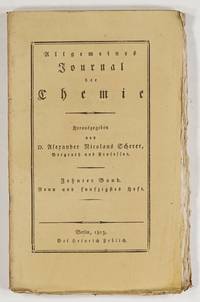
1803309551803. Allg. Journ. Chemie 10/59. - Berlin Heinrich Frölich 1803 8° pp.463-572 orig. Broschur; unbeschnittenes Exemplar in der sehr seltenen orig. Broschur. INCUNABULA OF MODERN PHYSIOLOGY - This is the first German translation of "Premier Mémoire sur la Transpiration des Animaux par Seguin et Lavoisier" Mémoires de l' Acad. des sc. p. Année 1790. Paris 1797 S.601-612" by Alexander Nicolau Scherer "It set a new standard of accuracy for metabolic studies and along with the "Premier Mémoire sur la Respiration des Animaux" 1789; it is one of the incunabula of modern physiology." - Duveen & KLickstein No.106 Not in Duveen und Klickstein only Italian and Spanish translation. unknown