1 803 résultats
1906504131906. <p>Einstein Albert 1879-1955. Über eine Methode zur Bestimmung des Verhältnisses der transversalen und longitudinalen Masse des Elektrons. In Annalen der Physik 21 1906. 583-586pp. Figs. Text-illust. 214 x 140 mm. Laid-in item: notecard with penciled notes probably in the hand of Lord Rayleigh. Red cloth gilt spine. Frontis portrait of P. Curie d. 1906. Whole volume: viii 1056pp. 9 plates 5 b/w silver photos 4 folding. Small cut on spine starting approximately two inches from the head and is about three inches in length -very thin- otherwise Very Good. </p> <br /> <br /> <p>First Edition Whole Volume. In his landmark 1905 paper on special relativity Einstein used the velocity-dependent concepts of transverse and longitudinal mass for the moving electron these terms have now been replaced with the concept of relativistic mass first defined by Lewis and Tolman in 1909. In the present paper Einstein proposed an experimental method for determining the ratio of the transverse to the longitudinal mass and invited experimentalists to verify his special theory of relativity. Einstein later abandoned velocity-dependent mass concepts stating in 1948 that "it is better to introduce no other mass concept than the rest mass" quoted in L. B. Okun "The concept of mass" Physics Today 1989: 31-36. Lavenda A New Perspective on Relativity pp. 7-8. </p> <br /> <br /> <p>Weil's Einstein Bibliography no. 14. <br> Boni's Einstein Checklist no. 14</p> <br /> <br /> <p> John William Strutt third Baron Rayleigh Lord Rayleigh 1842-1919 was a british mathematician and physicist; he was one of the very few members of higher nobility who won fame as an outstanding scientist. Rayleigh was born as the son of John James Strutt second Baron and his wife Clara Elizabeth La Touche eldest daughter of Captain Richard Vicars R.E. Lord Rayleigh was awarded the 1904 Nobel Prize in Physics "for his investigations of the densities of the most important gases for his discovery of argon in connection with these studies." Rayleigh provided the first theoretical treatment of the elastic scattering of light by particles much smaller than the light's wavelength now known as "Rayleigh scattering" - a process which notably explains why the sky is blue. He also made extensive contributions to fluid dynamics e.g. the Rayleigh number critereon for the stability of the Taylor-Couette flow etc. Rayleigh also formulated the circulation theory of aerodynamic lift. His derivation of the Rayleigh-Jeans law for classical black body radiation played an important role in the birth of quantum mechanics i.e. the Ultraviolet catastrophe. During the first World War he was president of the United Kingdom government's Advisory Committee for Aeronautics. Notable students of the 3rd Lord Rayleigh include J.J. Thomson 1856-1940 and Sir William Ramsay 1852-1916 who was awarded the Nobel Prize in Chemistry in 1904 "in recognition of his services in the discovery of the elements in air." In 1871 he married Evelyn Balfour sister of the future prime minister the Earl of Balfour and daughter of James Maitland Balfour and his wide Blanche the daughter of the second Marquis of Salisbury. They had three sons the eldest of whom Robert John Strutt 1875-1946 was to become Professor of Physics at Imperial College of Science and Technology London. Strutt inherited the title of fourth Baron Rayleigh after his father's death in 1919. nobelprize.org. </p> <br /> <br /> <br /> <p> Also in this volume: Einthoven Willem 1860-1927. Weitere mitteilungen ueber das saitengalvanometer. Analyse der saitengalvanometrischen kurven. Masse und spannung des quarzfadens und widerstand gegen die fadenbewengung. Erster teil. In Annalen der Physik ser. 4 21 1906. 483-514 pp. <br> Willem Einthoven 1860-1927 was a Dutch doctor and physiologist who won the Nobel Prize in Physiology or Medicine in 1924 "for his discovery of the mechanism of the electrocardiogram" nobelprize.org. </p> . unknown
192919299Berlin: Verlag der Akademia der Wissenschaften in Kommission bei Walter de Gruyter 1929. FIRST EDITION. Original printed orange wrappers; a fine copy unopened and bound into morocco-backed cloth boards spine labeled in gilt. First edition first issue in the rare author’s offprint form with a newly set title-page. One of Einstein’s last important scientific works this publication of the unified field theory caused quite a sensation. It was the first separate printing of one of a series of five papers published between 1925 and 1929 in which Einstein attempted to develop a unified field theory reconciling in a single formula the laws of electromagnetism and gravitation.<br /> <br /> Weil 165; Printing & the Mind of Man 418. Verlag der Akademia der Wissenschaften in Kommission bei Walter de Gruyter unknown
1923432881923. <p>Einstein Albert 1879-1955 and Paul Ehrenfest 1880-1933. Zur Quantentheorie des Strahlungsgleichgewichts. Offprint from Zeitschrift für Physik 19 1923. 301-306pp. Original printed self-wrappers. 230 x 157 mm. Light toning but very good.</p> <p>First Edition Offprint Issue. In 1916 after publishing his great work on general relativity Einstein returned to the question of blackbody radiation. In November 1916 he wrote to his friend Besso that "a splendid light has dawned on me about the absorption and emission of radiation" quoted in Pais p. 405 one that led him to a new derivation of Planck's radiation law and convinced him of the reality of light-quanta photons. After publishing these results in three papers culminating with the famous "Zur Quantentheorie der Strahlung" 1917 Einstein kept looking for "new ways in which the existence of photons might lead to observable derivations from the classical picture" Pais p. 413. He found none until 1923 when Arthur Compton and Peter Debye independently derived the relativistic kinematics for the scattering of a photon off an electron at rest. The work of Compton and Debye led Wolfgang Pauli to extend Einstein's work of 1917 to the case of radiation in equilibrium with free electrons see Pais p. 414n. "Pauli examined the requirements of detailed balance under Lorentz transformations and found that scattering of light by free electrons must include a term of a form which we would now call stimulated emission . . . Einstein and Ehrenfest then showed that Pauli's results could be obtained by an extension of Einstein's 1917 paper with the unnecessary specialization to discrete energy levels removed . . . The core of Einstein's argument is that the scattering process should be broken into two parts: the absorption of energy from radiation of frequency 1 and the emission of energy as radiation of frequency 2" Lewis p. 42. Lewis "Einstein's derivation of Planck's radiation law" American Journal of Physics 41 1973: 38-44. Pais Subtle is the Lord ch. 21. Weil Albert Einstein Bibliography 138.</p> . unknown
19212545920Madrid. 1921. Hardcover. Cubierta deslucida. Good. 24 cm. 79 p. Encuadernación en tapa dura artesanal con lomo en piel. Einstein Albert 1879-1955. Über die spezielle und die allgemeine Relativitätstheorie. Traducida de la 12ª ed. alemana por F. Lorente de Nó. Imp. de Suc. de S. Peláez. Relatividad Física . Cubierta deslucida. Física.530.12 530 hardcover
1982059692Harry N. Abrams Inc. 1982. 2nd Edition . Hardcover. Fine/Slipcase. 296 Pp. Beige Cloth Stamped In Silver And In Blind. Second Edition. The Deluxe Issue #57 Of 150 Copies Numbered Signed By Sam Francis And In Special Slipcase Of Thick Tsumugi Silk. Fine With A Few Faint And Tiny Spots Of Foxing Around Fore Edges Of Front And Rear Covers Of Book. Slipcase Shows Fading Of Blue Silk Around Both Ends. <br/> <br/> Harry N. Abrams, Inc. hardcover
19212827000Madrid.: S.n. 1921. Paperback. Good. 24 cm. 79 p. Encuadernación en tapa blanda artesanal. Einstein Albert 1879-1955. Über die spezielle und die allgemeine Relativitätstheorie. Traducida de la 12ª ed. alemana por F. Lorente de Nó. Imp. de Suc. de S. Peláez. Relatividad Física . Física.530.12 530 [S.n.]. paperback
1k7854Institut International de Coopèration Intellectuelle Paris 1933. 56 Seiten kartoniert etwas gebräunt und teils unaufgeschnitten. - Text in Englisch/Nr. 797 von 2000 numerrierten Exemplaren - unknown
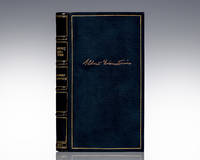
1931150006New York: The MacMillan Company 1931. First edition of this volume of Einstein's speeches and letters concerning his views on Zionism. Octavo bound in full morocco by the Harcourt Bindery with gilt titles and tooling to the spine in five compartments within raised gilt bands gilt ruling to the front and rear panel gilt signature to the front panel gilt inner dentelles stamp-signed by the Harcourt Bindery marbled endpapers all edges gilt. In fine condition. Translated and edited with an introduction by Leon Simon. An exceptional presentation. Einstein was a prominent supporter of both Labor Zionism and efforts to encourage Jewish-Arab cooperation. He supported the creation of a Jewish national homeland in the British mandate of Palestine but was opposed to the idea of a Jewish state "with borders an army and a measure of temporal power." In a letter to Jawaharlal Nehru dated June 13 1947 he asserted "Long before the emergence of Hitler I made the cause of Zionism mine because through it I saw a means of correcting a flagrant wrong.The Jewish people alone has for centuries been in the anomalous position of being victimized and hounded as a people though bereft of all the rights and protections which even the smallest people normally has.Zionism offered the means of ending this discrimination." Einstein's speeches lectures and letters concerning Zionism were first published in 1930 by The Soncino Press and eleven of these essays were later collected in The World as I See It published in 1933 which Einstein dedicated "to the Jews of Germany". The MacMillan Company unknown
1906003208Leipzig: J. A. Barth 1906. First Edition. Contemporary Red Cloth. Very Good. J. A. Barth Hardcover
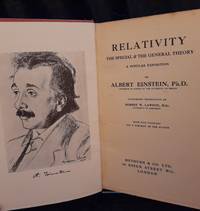
1920001806<p>London: Methuen & Co. Ltd 1920. 1st Edition . Hardcover. Good. First English Translation. 8vo xiii pp138 complete with b/w frontis portrait of the author and 8 pages of publisher's adverts to rear. hardcover no dust jacket. Publishers red cloth binding with blind-stamped titles to front board and black titles to spine gilt totally rubbed off in good condition with sunning to spine some shelf wear to top & tail of spine and bumping to tips of boards. Inside cracked in a couple of places with front board a little loose but binding still sound and solid with a little yellowing to pages a few discreet notes and sums to page 115-118 with the occasional mark to pages and some spotting to fore edge. Overall a good copy of this scarce 1st edition. <br /><br /></p> Methuen & Co. Ltd hardcover
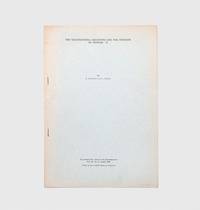
1940180281Princeton: Princeton University Press 1940. Elucidating the Einstein-Infeld-Hoffman equations First edition offprint issue of Einstein's last major contribution to the general theory of relativity. It formed part of his mathematical investigations into the structure of the theory which he spent the latter part of his life refining. "During the development of the general theory Einstein had intended to hold fast to the conservation of energy and momentum in the usual special relativistic sense as far as possible. At the same time he was driven by other considerations toward the idea that the laws should be generally covariant. These two desires proved mutually incompatible. The problem of the equation of motion of bodies is the following. The 1916 theory had a classical structure in the sense that there were both field equations the curvature of space-time is determined by the mass and motion of bodies in space-time and equation of motion of bodies the world line of small mass is a geodesic. Einstein showed that if matter is represented by a point singularity of the metric field these singularities are located on world lines that are geodesics of space time provided its metric satisfies the equation of general relativity" DSB IV p. 329. The first part of the paper was published in 1938. Large octavo pp. 10. Original wrappers wire-stitched as issued front cover printed in black. Wrappers gently toned: a near-fine copy. Boni 236.1; Weil 205. unknown
188748810Leipzig Barth 1887-91. 8vo. No wrappers. 4 papers. In: "Annalen der Physik und Chemie. Hrsg. von G. Wiedemann" Neue Folge Bd. XXX No. 4 XXXI No 6 XXXII No. 11 XLIV No. 11. - Pp. 545-704 a. 1 plate pp. 145-336 a. 1 plate pp. 337-528 a. 1 plate pp. 385-576 a. 1 plate. With titlepge to vol. XXX htitlepage to vol. XXXI titlepage to vol. XXXII and titlepage to vol. XLIV. Titlepages with a stamp and on verso. Planck's papers: pp. 562-582 pp. 189-203 pp. 462-503 and pp. 385-428. Clean copies. <br/><br/><em>First appearance of all 4 papers constituting Planck's seminal papers on entropy carrying the general title "On the principles of Increase of Entropy" in which he applied the second law of thermodynamics to chemical problems."His goal was as he said in the first paper of the series to carry further the "grand generalization" of Helmholtz Josiah Willard Gibbs and others: like the first principle of the mechanical heat theory the second the "Carnot-Clausius" principle applies not only to heat phenomena but to all kinds of physical and chemical phenomena; and because the second principle applies not only to reversible processes but also to irreversible or "natural" processes it applies to all processes whatsoever."Jungnickel and McCormach "Intellectual Mastery of Nature vol. 2 pp. 52 ff.What Einstein admired and called Planck's "first great scientific discovery" was the generality of its formulas which contain all that can be derived from pure thermodynamic principles. Einstein referred to the third paper in this series with the title "Gesetze des Eintritts beliebiger thermodynamischer und chemischer Reactionen"Akademie Nos. 8910 and 20. </em> unknown
1944182569London: The Jewish Agency for Palestine 1944. First separate edition of Einstein's appeal for Zionism. Einstein was one of the most prominent international supports of Zionism. He argues Palestine is the only place historically spiritually and culturally tied to the Jewish people. Whereas the Arabs with many homelands the Jews have nowhere else to go. Their claims are rooted not in conquest or nationalism but in justice and survival. The article was originally published in the Princeton Herald earlier that year. This publication prints the article alongside other speeches and letters by Einstein extracted from his 1930 About Zionism. Provenance: Jews' College Library London with their shelf mark to the front wrapper and their stamp to the front wrapper verso. Octavo. Original wrappers. Library markings see note a little creased and spotted. A good copy. unknown
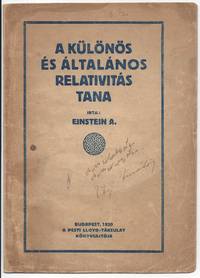
19201870Budapest: A Pesti Lloyd-Társulat Könyvsajtója 1920. First separate edition. Offprint of Természettudományi Közlöny. In publisher’s printed wrappers. Cover chipped at extremities. Restored rear panel replaced with cardboard similar to original. Old ownership inscriptions on front panel. Contemporary notes and underlines throughout in pen and pencil. Pages discolored due to the acidic paper. Overall in good condition. First separate edition. Offprint of Természettudományi Közlöny. In publisher’s printed wrappers. 2 19 1 p. <p><br /> First Hungarian edition of Einstein’s Über die spezielle und allgemeine Relativitätstheorie Braunschweig 1917 published as an extract.<br /> <p><p><br /> Offprint of Természettudományi Közlöny. One of the earliest Hungarian publications of Einstein’s works. <br /> <p>. A Pesti Lloyd-Társulat Könyvsajtója unknown
195521242781955. London: Victor Gollancz Ltd. 1955. offered with:BLACKETT Patrick Maynard Stuart. The Atom and the Charter. London and Hereford: the Hereford Times for 'Fabian Publications ltd in conjunction with Victor Gollancz Ltd'. September 1946. offered with:BLACKETT Patrick Maynard Stuart. The Atom and the Charter. London and Hereford: the Hereford Times for 'Fabian Publications Ltd in conjunction with Victor Gollancz Ltd'. September 1946.8vo. Publisher's blue cloth lettered in gilt to spine in yellow dust-jacket printed in red and black; pp. 22 2 blank; maps and tables in the text spine of jacket sunned a little spotting to back cover small closed tear to back flap hinge c. 10 mm lettering to spine rubbed small chip to upper joint; very good; contemporary Foyles label to pastedown 'P. M. S. Blackett' see below with Blackett's ownership inscription in blue ink to front free endpaper.First English edition with a preface by Einstein of this work arguing for nuclear disarmament translated by the gardener novelist and anarchist Edward Byams this copy from the library of Nobel Prize-winning physicist Patrick Blackett whose own work is discussed at length in the book.Jules Moch 1893-1985 worked as a French Resistance organiser during the war later became a senior minister in several post-war governments and was France's delegate to the UN Disarmament Committee for 1951-1960. It was this latter role that informed the principles he sets forth in Human Folly which argue for multilateral nuclear disarmament. Divided into two parts the first examines the destructive capacities of modern warfare before tracing the recent history of disarmament negotiations. Moch attempts to represent both Soviet and Western positions with fairness concluding that the divisions between the two are gradually narrowing. Though he does not regard the situation as entirely hopeless he presents it as one of pressing urgency. The preface by Albert Einstein one of Moch's most eminent supporters makes clear peace can only arise from political will: 'Those who do not believe in the possibility of the attainment of a lasting and assured peace or have not the courage to act accordingly are ripe for destruction' p. 8. Provenance: front free endpaper with the ownership inscription of Patrick Blackett 1897-1974 with his occasional underlining throughout and one word 'Target' in pencil to the top of p. 10. Blackett was awarded the 1948 Nobel Prize in Physics for his pioneering work in nuclear physics and cosmic radiation including experiments demonstrating nuclear transmutation and important early research into the positron. During the Second World War he headed Operational Research at the Admiralty where his statistical criticism of the RAF blanket bombing campaigns led to increasing ostracism from the military authority. His opposition to mass destruction later informed his belief that Britain should not develop nuclear weapons. Combined with his openly socialist views this attracted the attention of MI5 and led to his inclusion on George Orwell's list of alleged 'crypto-communists' contributing to his marginalisation by the post-war Labour government. Blackett's book The Military and Economic Consequences of Atomic Energy 1948 is discussed at length by Moch pp. 117-19. Written before the development of second-generation thermonuclear weapons Blackett had estimated that thousands of atomic bombs would be required to destroy the United States or the Soviet Union when at the time only a few dozen existed. As Moch observes on p. 121 however 'today a few dozen thermonuclear bombs would produce the same results'. It is particularly notable that Blackett has not annotated the passages explicitly discussing his work. This copy of Human Folly is offered with Blackett's pamphlet The Atom and the Charter which discusses the extent to which 'the advent of atomic bombs necessitates changes in the procedure for the application of sanctions under the Charter of the United Nations Organisation' issued by Victor Gollancz and the socialist Fabian Society on behalf of the Association of Scientific Workers a scientific trade union of which Blackett was president. hardcover
19403293321940. Black and white photographic print. 6 1/2 x 4 7/8 in. Fine. Black and white photographic print. 6 1/2 x 4 7/8 in. unknown
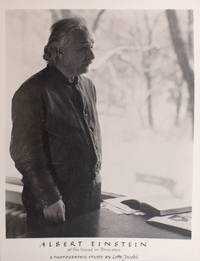
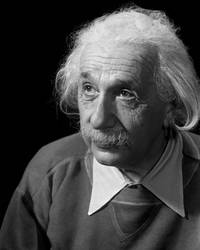
195032820558<p>In this portrait Sternberger shows Einstein dressed informally. Einstein was keenly aware of his public image and often attempted to show a cheerful visage. The common backgrounds of the two men helped the photographer to put Einstein in a relaxed state and to capture him in a more vulnerable pose.</p><p>Marcel Sternberger and Albert Einstein had known each other in Europe long before the two met again in Princeton New Jersey for this session. Before the men left Europe Einstein had furnished the preface to a book written by Sternberger.</p><p>After a warm welcome and lemonade the men settled in for the sitting. They discussed various topics including World War II and the state of American education. Although some photographs from the session show Einstein with a telltale twinkle in his eye here the great scientist appears fatigued. The seriousness of their conversation seems to have worn him down.</p><p>Still the conversation had its moments of levity. At one moment Sternberger asked Einstein to remove his suspenders. Einstein replied "I am going to lose my trousers! I can't." Einstein instead put on one of his trademark sweatshirts.</p><p>Here modern science's greatest mind is forever immortalized as only Sternberger could. He has found a depth of personality exceeding photographs produced without regard to the sitter's inner psychological state.</p><br /><p>Gelatin silver print 16 x 20 in. Archivally framed. Estate Edition a limited edition of 20 copies embossed and numbered.</p><br /><p><b>$1250 unframed; framed: $1650 </b></p>
1949140941039Evanston IL: The Library of Living Philosophers Inc 1949. First Edition. Near Fine/Very Good. First edition first printing. Bound in publisher's original dark blue cloth stamped in gilt. Near Fine with toning to pages offsetting to endsheets former owner name to front free endpaper and small sticker ghost to front paste down. In a Very Good dust jacket with fraying and chip at bottom spine end and short closed tear at head light edge wear toning and soiling to rear panel. The Library of Living Philosophers, Inc unknown
1947316757Emergency Committee of Atomic Scientists 1947. Paper Back. Very Good. Letterhead of Emergency Committee of Atomic Scientists on two sheets soliciting contributions to the Committee. Dated August 6 1947 the second anniversary of the Hiroshima bombing. An original typed letter with a facsimile Einstein signature in blue ink. Emergency Committee of Atomic Scientists unknown
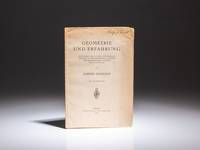
192117649Berlin: Verlag Von Julius Springer 1921. First Trade Edition. Wraps. Very good. The first trade edition of Geometrie Und Erfahrung Geometry and Experience by Albert Einstein from the collection of Einstein's English translator Dr. Wilfrid Perrett. Octavo 20pp. Publisher's original wraps bound with two staples. Light soiling and wear on wraps internally clean. Includes two illustrations advertisements on verso of rear flap. Staples showing rust some wear to edges of original wraps. Weil 115 Schlipp-Shields 143 This copy is signed by Wilfrid Perrett on the front cover. This work first appeared in the Sitzungsberichte der Preussischen Akademie der Wissenschaften accompanied by an "author's offprint" which was bound in orange wrappers. Weil 114. This work is the first separate trade edition. The recipient of this copy Dr. Wilfrid Perrett worked with Dr. George Barker Jeffery to translate many of Einstein's most notable works into English. Perrett was a "distinguished German scholar" and would "overlook the literary side of the work" while Jeffery would oversee the mathematical translations. The two worked together on Das Relativitätsprinzip On the Relativity Principle beginning in 1922 and numerous other works by Einstein over his career. Jammer 113-114. Verlag Von Julius Springer unknown
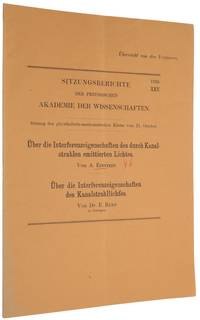
19266414Berlin: Akademie der Wissenschaften 1926. First edition. <p>First edition very rare author's presentation offprint extremely rare author's presentation offprint not to be confused with the much more common trade separate - see below from the library of the great German physicist Arnold Sommerfeld of the notorious Einstein/Rupp experiments which demonstrated the wave-theory of light contrary to Einstein's expectations.</p>. SCIENTIFIC FRAUD: THE EINSTEIN-RUPP EXPERIMENTS. <p>First edition extremely rare author's presentation offprint not to be confused with the much more common trade separate - see below from the library of the great German physicist Arnold Sommerfeld of the notorious Einstein/Rupp experiments. "In the fall of 1926 Albert Einstein published the outline of two experiments in the Proceedings of the Berlin Academy. They addressed one of the most urgent questions in physics at the time: the experiments were to show if the emission of light was a process that was extended in time or if instead light emission occurred in an instantaneous act. Of course the first possibility would confirm a traditional oscillator-and-wave-like view whereas the second possibility would cohere well with Einstein's own ideas on light quanta. It is quite surprising that these experiments are so unfamiliar today. Apart from addressing a central question and being proposed by no lesser figure than Einstein they also circulated at a crucial moment in the history of quantum theory. Still the experiments are not mentioned in any of the standard Einstein biographies and there is no substantial treatment of them in histories of the quantum theory . The likely cause for this lack of attention is at least as surprising: the experiments were-supposedly-conducted by Emil Rupp yet a decade later Rupp was exposed as a scientific fraudster; the results obtained by Rupp in close consultation with Einstein and published back-to-back with the latter's theoretical paper were in the end generally believed to have been fabrications" Van Dongen. As Walter Gerlach of Stern-Gerlach fame said in an interview with Thomas Kuhn in 1963 "Rupp in the late twenties early thirties was regarded as the most important and most competent physicist. He did incredible things. . Later it turned out that everything that he had ever published everything was forged. This had gone on for ten years ten years!" Nevertheless "these experiments played a substantial role in developments in 1926. Most importantly they confirmed a wave picture of light when many including Einstein himself initially expected a particle-like instantaneous picture of light emission to be confirmed. After all only a few years before Compton scattering had been shown and as little as a year before the Einstein-Rupp experiments Walther Bothe and Hans Geiger had done the experiments that dismissed the BKS theory. But the experiments of Einstein and Rupp also influenced events in other ways. For instance their initial interpretation was most likely of direct importance for Max Born when he proposed the probabilistic interpretation of the wave function. The experiments further played a role in the thinking of Werner Heisenberg as he formulated his uncertainty relations . these experiments deserve renewed attention and their current obscure status is not warranted by their historical importance" Van Dongen. OCLC locates only three copies two in Switzerland one in Germany but it is unclear which of these if any are author's presentation offprints. The presentation offprint was not present in the collection of Einstein's son Hans Albert Christie's 2006 but it was in Einstein's own collection of his offprints Christie's 2008.</p> <br /> <p>Provenance: Arnold Sommerfeld 1868-1951 his characteristic numbering '46' in red pencil on front cover. "The son of a physician Sommerfeld was educated at the University of Königsberg. After teaching briefly at the universities of Göttingen Clausthal and Aachen he was appointed professor of physics at the University of Münich in 1906. Sommerfeld should have retired in 1936 in favour of his pupil Werner Heisenberg. Opposition from the Nazi party to Heisenberg's appointment prolonged Sommerfeld's tenure and it was not in fact until late 1939 that he finally retired to be succeeded not by Heisenberg but by Wilhelm Müller a Nazi aerodynamicist without a single publication in physics to his credit. Although Sommerfeld and Heisenberg were not Jewish they were regarded by the Nazis as Jewish sympathizers. Sommerfeld however survived the war and returned to his Münich chair in 1945 continuing to work at physics until he died in a car accident in 1951" Oxford Reference. "Arnold Sommerfeld was one of the most distinguished representatives of the transition period between classical and modern theoretical physics. The work of his youth was still firmly anchored in the conceptions of the nineteenth century; but when in the first decennium of the century the flood of new discoveries experimental and theoretical broke the dams of tradition he became a leader of the new movement and in combining the two ways of thinking he exerted a powerful influence on the younger generation. This combination of a classical mind to whom clarity of conception and mathematical rigour are essential with the adventurous spirit of a pioneer are the roots of his scientific success while his exceptional gift of communicating his ideas by spoken and written word made him a great teacher" Max Born p. 275. </p> <br /> <p>"Born in 1898 Rupp began his career in the 1920s studying canal rays beams of positive ions and atoms formed between an anode and cathode the latter punctured with holes or "canals" in a gas discharge tube. When these rays shoot through the canals and into a vacuum chamber the ions rapidly lose and gain charge emitting visible light that becomes less intense at the other end of the canal.</p> <br /> <p>"In his first experiments in the mid-1920s Rupp measured the coherence length of light - the distance over which the light maintains a consistent phase - emitted by hydrogen and mercury atoms in the canal rays. He measured these lengths as 62 centimeters for hydrogen and 15.2 centimeters for mercury. These were blockbuster results: A moving hydrogen atom was expected to stay coherent over a much smaller distance.</p> <br /> <p>"What's more Rupp's extra-long hydrogen canal ray seemed like it could be used to test one of physics' biggest questions at the time: Is light a particle or a wave Einstein had devised experiments to test if light was emitted instantaneously or over time but he needed a light with an extra-long coherence length - and only Rupp had achieved it.</p> <br /> <p>"After reading Rupp's 1926 paper Einstein published his own "Proposal for an Experiment on the Nature of the Elementary Process of Radiation Emission" and reached out to Rupp directly to discuss a collaboration. But because Rupp's boss at Heidelberg University the physicist Philipp Lenard was "a fervent anti-relativist - and anti-Semite" writes van Dongen Einstein chose to forgo a visit to the institution and sent instructions for Rupp to do the experiments on his own.</p> <br /> <p>"There were red flags from the start. In one instance Rupp appeared to have altered the mirrors in his interferometer the instrument he used to study interference just so into an arrangement that would obtain desired outcomes. In another instance when Einstein corrected the settings Rupp reported using for another instrument Rupp chalked the mistake up to a typo. There were other 'alarming discrepancies' in Rupp's calculations van Dongen writes and Einstein's letters show that he pushed back on several occasions. Each time Rupp responded with new results that perfectly explained the oddities Einstein questioned.</p> <br /> <p>"Initially Einstein expected to find that light was emitted instantaneously. But as the collaboration stretched on he began to expect the experiments would confirm the alternative the 'classical' theory. 'One of the reasons for his changing position likely was that that outcome had inadvertently already been corroborated by Rupp' van Dongen writes.</p> <br /> <p>"When Rupp furnished Einstein with a final set of results supporting the classical emission picture Einstein facilitated their publication in the proceedings of the Prussian Academy of Sciences. They were published back-to-back with a paper by Einstein explaining the theory behind the experiments in which Einstein cited Rupp's work. Einstein even helped Rupp draft his paper's abstract.</p> <br /> <p>"The association with Einstein rocketed Rupp to scientific prominence and in 1928 he accepted a position in the research labs of German electronics company AEG 'a kind of counterpart to General Electric' writes MIT physicist Anthony French in his 1999 retrospective of Rupp's case.</p> <br /> <p>"However scientists had begun voicing skepticism about Rupp's canal ray work. Among them were British spectroscopist Robert d'Escourt Atkinson who doubted Rupp's extraordinary coherence lengths and a researcher named Harald Straub who tried and failed to replicate Rupp's measurements in 1930. Rupp came down hard on Straub with a rebuttal sending photographs that supposedly showed his interference fields and forcefully defending his work in the same journal where Straub published his. Straub wrote that he had nothing else to add and the matter appeared settled.</p> <br /> <p>"But Rupp's reputation was bruised in the episode and his letters from the time indicate that his funding at AEG was drying up. He published work on electron scattering then took up experiments with positrons producing them by pounding lithium with protons. In a 1934 paper Rupp claimed to have accelerated protons at potential differences of 500 kV. This was impossible for him to have done - he simply did not have the requisite accelerator in his lab.</p> <br /> <p>"In December 1934 two of Rupp's fellow scientists at AEG brought the glaring problem to the attention of the institute's director who launched an investigation and subsequently fired Rupp. In January 1935 Rupp published the retraction statement appended to his doctor's note claiming he had no knowledge of or control over the fabrications. And later that year experimentalists Walther Gerlach and Eduard Rüchardt published 'On the Coherence Length of Light emitted by Canal Rays' which essentially confirmed that Rupp's early canal ray work was also erroneous. Amid this public humiliation Rupp experienced a nervous breakdown and spent time in a sanatorium. He never worked in physics again.</p> <br /> <p>"Einstein however escaped from the episode unscathed. Historians like van Dongen think his credulousness was an honest mistake underpinned by his desire to see his theories confirmed by experiments. Rupp's work and life are now a footnote but following his downfall it appears that German scientists mentioned his name often. According to French 'for a number of years afterward the word 'geruppt' became an epithet among German physicists to describe questionable work'" Jooss. </p> <br /> <p>This author's presentation offprint is of extreme rarity and must be distinguished from other so-called 'offprints' of papers from the Berlin Sitzungsberichte many of which are commonly available on the market. The celebrated bookseller Ernst Weil 1919-1981 in the introduction to his Einstein bibliography wrote: "I have often been asked about the number of those offprints. It seems to be certain that there were few before 1914. They were given only to the author and mostly 'Überreicht vom Verfasser' Presented by the Author is printed on the wrapper. Later on I have no doubt many more offprints were made and also sold as such especially by the Berlin Academy." If the term 'offprint' means as we believe it should a separate printing of a journal article given only to the author for distribution to colleagues then 'offprints' were not commercially available. Although there is certainly some truth in Weil's remark in our view it requires clarification and explanation.</p> <br /> <p>Until about 1916 most of Einstein's papers were published in Annalen der Physik; from 1916 until he left Germany for the United States in 1933 most were published in the Berlin Sitzungsberichte. The Sitzungsberichte differed from other journals in which Einstein published in that it made separate printings of its papers commercially available. These separate printings have 'Sonderabdruck' printed on the front wrapper the usual German term for offprint but they are not offprints according to our definition. They were available to anyone; indeed a price list of these 'trade offprints' is printed on the rear wrapper. True author's presentation offprints can be distinguished from these trade separates by the presence of 'Überreicht vom Verfasser' on the front wrapper.</p> <br /> <p>In the period 1916 to 1919 or 1920 the Sitzungsberichte trade separates are themselves rare. After 1919 or 1920 however the trade separates become much more common although the author's presentation offprints are still very rare. The reason for this change is that it was only in 1919 that Einstein became famous among the general public.</p> <br /> <p>It might seem obvious that Einstein's fame dates from 1905 his 'annus mirabilis' in which he published his epoch-making papers on special relativity and the light quantum. However these works did not make him immediately well known even in the physics community - many physicists did not understand or accept his work and it was two or three years before his genius was fully accepted even by his colleagues. Einstein did not secure an academic position until 1908. Among the general public Einstein became well known only in late 1919 following the success of Eddington's expedition to observe the bending of light by the Sun which confirmed Einstein's general theory of relativity. This was front-page news and made Einstein universally famous. See Chapter 16 'The suddenly famous Doctor Einstein' in Pais Subtle is the Lord for an account of these events. Before 1919 the trade separates of Einstein's papers would probably only have been purchased by professional physicists; after 1919 everyone wanted a memento of the famous Dr. Einstein whether or not they understood anything of theoretical physics and the trade separates of his papers were printed and sold in far greater numbers than before to meet the demand. It is telling that when these post-1919 trade separates appear on the market they are often in mint condition - they were never read simply because their owners were unable to understand them.</p> <br /> <p>BRL 160; Weil 153. Born 'Arnold Johannes Wilhelm Sommerfeld 1868-1951' Obituary Notices of Fellows of the Royal Society 8 1952 pp. 275-296. French 'The strange case of Emil Rupp' Physics in Perspective 1 1999 pp. 3-21. Joosse 'December 1934: Emil Rupp's research which fooled even Einstein is exposed as fraud' APS News Nov. 14 2023. Van Dongen 'Communicating the Heisenberg uncertainty relations: Niels Bohr complementarity and the Einstein-Rupp experiments' Scientia Danica. Series M Mathematica et physica 1: One Hundred Years of the Bohr Atom Proceedings 2015 pp. 310-343.</p> <br/> <br/> 8vo 252 x 180 mm pp. 334-340; 341-351. Original printed wrappers portion of ink postmark stamp on lower cover just into text of publisher's advertisements light vertical crease for posting. Akademie der Wissenschaften unknown
1926043114London: Methuen & Co. 1926. 1st Edition 1st Printing. Hardcover. Fine/No Jacket. Viii 124 Pp. Green Cloth White Spine Lettering. First Printing In Secondary Binding With White Lettering The First Binding Was Lettered In Gilt. Book Used But Still Fine No Rubbing Lettering Complete And Entirely Strong. Spanish Owner's Name With His 1948 Receipt From H. K. Lewin For The Book Laid In Loosely. Lacking The Scarce Dust Jacket. <br/> <br/> Methuen & Co. hardcover
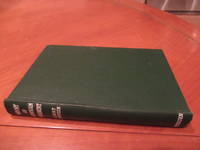
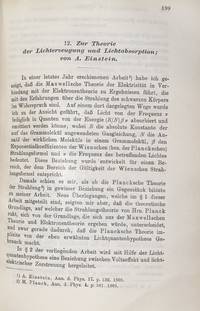
190632820369<p>Contemporary half dark green roan. Rubbed some chipping separation at upper joint. Library markings.</p><p>FIRST EDITION of "On the Theory of Light Production and Light Absorption" pp. 199-206. This classic in the history of physics is Einstein's second paper on the photoelectric effect. Einstein reconciles his and Planck's independent derivations of the blackbody formula E=hν. Planck's derivation of this formula ascribed it to a restriction on the energy changes possible when radiation is produced or absorbed by matter which implied no restriction on the energies of either matter or radiation. Einstein's 1905 derivation ascribed it to a restriction on the energy of radiation alone but in this paper he proposes the modern idea that the energies of both matter and radiation are quantized which led to his work on quantum specific heats.</p><p>and</p><p>FIRST EDITION of "The Principle of Conservation of Motion of the Center of Gravity and the Inertia of Energy" pp. 627-633. In this "ingenious thought experiment involving energy transport in a hollow cylinder Einstein returned to the relationship between inertial mass and energy giving more general arguments for their complete equivalence" Calaprice The Einstein Almanac. This is the first statement that the conservation of mass is a special case of the conservation of energy.</p><br /> Annalen der Physik
191229311Leipzig Barth 1912. 8vo. Orig. printed wrappers. Backstrip taped. Kept in a cloth-box. In: "Annalen der Physik IV Bd. 38" pp. 355-369 and pp. 443-458. The whole issue present= Bd. 38 Heft 2 pp.249-472. <br/><br/><em>Both papers in first edition and they are considered as the first appearance of a Nonlinear Field Equation for Gravitation. - "Einstein published two remarkable memoirs in 1912 which were efforts to construct a complete theory of gravitation incorporating the equivalence principle. In these memoirs Einstein supposed that the gravitational field can be characterized completely by one function the local speed of light analogous to the Newtonian description where only the gravitational potential appears. By an extraordinary argument he extended the potential equation of Newton.In his second Memoir in 1912 he used the equivalence principle to show the influence of a static gravitational field on electromagnetic and thermal processes." DSB IV p.320 ff. - Weil No. 47 and 48. </em> hardcover
193846954Baltimore Princeton University Press 1938 a.1940. Royal8vo. Bound in 2 full cloth gilt lettering to spines. In: Annals of Mathematics" Series 2 Vol. 39 and vol. 40. Entire volumes offered. The papers: pp. 65-100 a. pp. 455-464. Clean and fine.også on a generalization. pais p. 496 <br/><br/><em>First appearance of these two importent papers on the General theory of Relativity in which is shown that the equation of motion follows directly from the field equation that defined the geometry."Einstein's last importent contribution to general relativity deals again with the problem of motion. It is the work done with Leopold Indfeld and Banesh Hoffmann on the N-body problem of motion. In these papers the gravitational field is no longer treated as external. Instead it and the motion of its singular sources are treated simultaneously. A new approximation scheme is introduced in which the fields are no longer necessarily weak but in which the source velocities are small compared with the light velocity. These equations are widely used in analyses of planetary orbits in the solar system."Pais "Subtle is the Lord" pp. 290-91.Weil: 202 a. 205 both with an asterix denoting a major paper. - Boni: 236 a. 236.1. </em> hardcover