850 résultats
192539308Paris Gauthier-Villars et Cie 1925. Small8vo. Uncut in orig. printed wrappers. Portrait. 4562 pp. Publisher's Cat. 6 pp. 2 leaves with an insignificant small loss of upper right corner. A fine copy. <br/><br/><em>First French edition of the initials papers on Special Relativity. It is a translation of the 2 Einstein-papers which appeared in 1905 "Elektrodynamik bewegter Körper" and "Ist die Trägheit eines Körpers von seinem Energieinhalt abhängig ". Published in the series "Les Maitres de la Pensee scientifique". - Weil: 9 c - Schielpp-Schields: 189. - Boni-Laurence: 9 B and 10 B. </em> unknown
190438818Leipzig J.A. Barth 1904. Contemp. hcloth tears to hinges at upper part of spine. "Annalen der Physik. Vierte Folge. Band 14. Herausgegeben von Paul Drude". VIII1040 pp. and 3 plates. The Einstein paper: pp. 354-362. Internally clean and fine. The whole volume offered. <br/><br/><em>First edition of Einstein's fifth work. "It was in this last of his early series of papers before the announcement of the theory of relativity in 1905 that Einstein introduced a new theme. Einstein asked for the physical significance of the constant now known as Boltzmann's konstant 'k'.It was already well known from the theory of the ideal gas that 'k' was simply related to the gas constant 'R' and to Avogardo's number the number of molecules in a gram-molecular weight of any substance. Einstein showed that 'k' entered into still another basic equation of the statistical theory the expression for the mean square fluctuation of the energy about its average value. This meant that 'k' determines the thermal stability of a system.the paper contains the seeds of much of his later work.Walter Alicke. - Weil No 5. </em> hardcover
192928362Berlin Gruyter & Co. 1929. 4to. Orig. orange printed wrappers. Offprint/Sonderabdruck aus Sitzungsberichten.pp. 1-8. Fine fresh copy. <br/><br/><em>First edition in the rare Offprint still called "Abdruck" but having separate printed title and separate pagination. See Weil No. 165 where this is not mentioned.Weil No. 165 with an asterix denoting a major work. "The Unified Field-Theory is one of the last importent works by Einstein. This paper presents a new development which was immediate news; translations and abstracts of ite appeared at once besides numerous articles in general periodicals" W. Alicke.The early Offprints from "Sitzungsberichten." are called "Sonderabdruck" up to Weil No.165 including this. From Weil 166 they are called "Sonderausgabe.". - Before 161 up to 160 the Offprints do not have separate title and pagination the pagination follows the numbering in the periodical. From 166 the Offprint has both separate printed title and pagination. - So Weil Nos 161-165 is still "Abdruck" but with separate title and pagination. These facts are not mentioned in the bibliographies. </em> unknown
191746895Leipzig S. Hirzel 1917. Royal8vo. Bound in contemporary half calf with gilt lettering to spine and 5 raised bands with ornaments in gilt. In "Physikalische Zeitschrift" Bd. 18 1917. Spine and hinges with wear otherwise a fine and clean copy. Pp. 121-128. Entire volume: XI 1 604 pp. 14 plates. <br/><br/><em>The paper was first published in 1916 in Mitteilungen der Physikalischen Gesellschaft in Zürich but here for the first time in Physikalische Zeitschrift. All subsequent research on absorption and emission of radiation and the entire discovery of the maser later the laser was based on the research presented in the present paper. The paper is also notable for introducing the concept but not the name of the photon; Einstein argues that in the interaction of matter and radiation there must be in addition to the processes of absorption and spontaneous emission a third process of stimulated emission. If stimulated emission exists then he can derive the Planck distribution for blackbody radiation and without it the same argument implies the invalid Wien-distribution theory."In this paper he derived Planck's original quantum law from a different starting point he suggested that as well as spontaneous emission and absorption there could also take place the process of stimulated emission. In 1917 this seemed mainly of theoretical interest; forty years later it was utilized to provide the maser and laser of modern technology. In 1916 "Einstein came back once more to blackbody radiation and made further progress. In November 1916 he wrote to Besso: 'A splendid light has fallen on me about the absorption and emission of radiation'. His reasoning is divided into three papers two of which appeared in 1916 and the third one early in 1917 the two papers above - note that these are the two papers of Einstein on radiation theory cited by Weil as "principal works"; a third paper from 1916 is not. In these papers Einstein proposed a statistical theory of the interaction between atoms and photons gave a new demonstration of Planck's radiation theory and introduced the concept of 'stimulated emission' providing the basis for the discovery of masers and lasers " Bertolotti The History of the Laser."When Einstein returned to the radiation problem in 1916 the quantum theory had undergone a major change. Niels Bohr's papers had opened a new and fertile domain for the application of quantum concepts-the explanation of atomic structure and atomic spectra. In addition Bohr's work and its generalizations by Arnold Sommerfeld and others constituted a fresh approach to the foundations of the quantum theory of matter. Einstein's new work showed the influence of these ideas . He had found still another derivation of Planck's black-body radiation law an "astonishingly simple and general" one which he thought mightproperly be called "the derivation" 12 of this important law. It was based on statistical assumptions about the processes of absorption and emission of radiation and on Bohr's basic quantum hypothesis that atomic systems have a discrete set of possible stationary states. The proof turned on the requirement that absorption and emission of radiation both spontaneous and stimulated suffice to keep a gas of atoms in thermodynamic equilibrium. This paper introduced the concept of stimulated emission into the quantum theory and is therefore often described as the basis of laser physics. Einstein himself considered the most important contribution of this work to be not the new derivation of the distribution law but rather the arguments he presented for the directional character of energy quanta. DSB Weil No 91 with an asterix denoting major paper. </em> hardcover
191038842Leipzig J.A. Barth 1910. Contemp. hcalf. Spine gilt a fs scratches to spine. VIII1584 pp. and 6 plates. Einstein papers: pp. 1096: pp. 1105-1115; pp. 1275-1298. Fine and clean. The whole volume offered. <br/><br/><em>All three papers first edition. The purpose of "A theorem in probability and its application in the Theory of radiation" is to demonstrate that the failure of statistical mechanics with respect to the radiation law Rayleigh - Jeans law contradicted by experience cannot be removed by the conjecture that perhaps the individual statistical events should not follow the usual law of independence product of probabilities instead of assuming a certain interdependence between them. Lanczos. The second paper "Statistical investigation on of the motion of an oscillator in a radiation field" makes use of the results of the previous investigation. Einstein's aim is to demonstrate that the Rayleigh-jeans law of radiation contracdicted by the physical facts is an unavoidable consequence of statistics even if we avoid any kind of assumption which may be suspected of needing correction. Lanczos. The third paper "Theory of the opalescence of homogenous fluids and fluid mixtures near the critical state" is an importent investigation and one of the most difficult of all his papers to understand. The aim of the paper is to complement the work of Smoluchovski Ann. d. Physik25 1908 who gave a general explanation of the strong density fluctuations - and the opalescence thus generated - of two fluids near the critical state of mixture or a single fluid near the critical state of condensation on the basis of the kinetic theory of heat. he did notgive howeverthe quantitative details concerning the scattered light associated with this phenomenon. Lanczos. - Weil Nos 34 35 and 36 with an asterix denoting major work. </em> unknown
192033265-52Berlin E. S. Mittler for Julius Springer 1920. 15 1 pp. 8vo. Orig. wrappers. Berlin E. S. Mittler for Julius Springer 1920. First edition. Einstein discusses the concept of the aether in relation to his theory of relativity. This lecture examines the historical role of the aether in physics and its transformation under relativity. His conclusion is that relativity does not bring back the classical aether but introduces a new understanding of space as an active structured entity. The text of this speech delivered at Leiden University was also translated into French in 1921. The English translation appeared in Einstein's "Sidelights of Relativity" published at London in 1922. Einstein's manuscript is now kept in the Bibliotheca Bodmeriana Geneva. - Weil 111; Boni Russ and Laurence 115; Roller/Goodman I 354; Seelig 131; Schilpp-Shields 131. SCIENCE: PHYSICS ; Berlin, (E. S. Mittler for) Julius Springer unknown
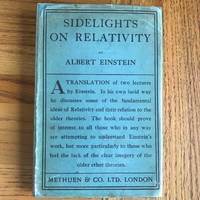
1924js21524London: Methuen and Co 1924. second edition. Hardcover. Very Good/Very Good. a lovely copy of the 2nd edition. the jacket is shelf worn with a little loss at the top of the spine and fraying at the bottom. there is a previous owner's signature and place name. the paper is possibly a little darkened but no real foxing to talk of. square and neat binding. appears very little used. Our orders are shipped using tracked courier delivery services. Methuen and Co hardcover
1922355490717346London: Methuen 1922. First Edition. Hard Cover. Dust Jacket. First UK Edition. Contains 2 Essays: "Ether and Relativity" and "Geometry and Experience". Translated by G.B. Jeffrey and W. Perrett. Publisher's original blue boards with gilt spine lettering. Foxing to the page block edges and slight fading to the edges of the boards otherwise a VG copy In the RARE FRAGILE D/W priced 3/6 net to the spine as called for. The D/W is in good condition with chipping at the head of the spine removing most of "SIDE" and at the base of the spine not affecting any lettering. At the edge of the rear flap a former owner has written in fountain pen: 13 6/- per week. It looks much better than it sounds. Rare. Methuen hardcover
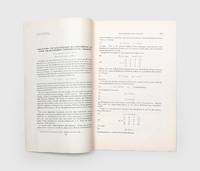
1944180331Princeton: Princeton University Press 1944. First edition offprint issue of the first of two papers on Einstein's penultimate approach by which he hoped to arrive at a unified field theory. "What Einstein and Bargmann proposed was an attempt at a nonlocal relativistic theory of gravitation. They investigated the properties of a new kind of mathematical object that they called 'bivectors'" Sauer p. 300. Octavo pp. 14. Original yellow wrappers front wrapper printed in black wire-stitched as issued. Wrappers a little soiled: a very good copy. Boni 248; Weil 213. Tilman Sauer "Einstein's Unified Field Theory Programme" The Cambridge Companion to Einstein 2014. unknown
1934180324Princeton: Princeton University Press 1934. First edition offprint issue of the fourth and final paper on Einstein and Mayer's semi-vectors in which they aimed to incorporate the Dirac equation into the general theory of relativity. This last article "was presented foremost as an exercise with exclusively mathematical appeal" Van Dongen p. 106. Large octavo pp. 7. Disbound from wrappers wire-stitched. Nicks and a handful of short closed tears to extremities: a very good copy. Boni 225; Weil 193. Jeroen van Dongen Einstein's Unification 2010. unknown
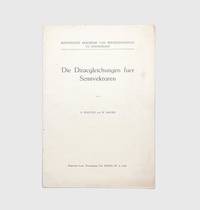
1933180322Amsterdam: Koninklijke Akademie van Wetenschappen 1933. First edition offprint issue of the second of Einstein and Mayer's four classic papers on semi-vectors in which they aimed to incorporate the Dirac equation into the general theory of relativity. "By introducing semi-vectors Einstein wanted to arrive at a mathematically simpler and more general formulation of spinors. The semi-vector generalization of the Dirac equation was thought to give a unified description of charged elementary particles in particular of the electron and proton. In their second semi-vector paper Einstein and Mayer were on the lookout for the most general Dirac system possible for the semivector" Van Dongen pp. 103-11. Large octavo pp. 20. Original cream wrappers front wrapper printed in black. Wire-stitching sometime removed front wrappers lightly soiled: a very good copy. Boni 222; Weil 191. Jeroen van Dongen Einstein's Unification 2010. unknown
1933180318Amsterdam: Koninklijke Akademie van Wetenschappen 1933. First edition offprint issue of the third of Einstein and Mayer's four classic papers on semi-vectors in which they aimed to incorporate the Dirac equation into the general theory of relativity. "By introducing semi-vectors Einstein wanted to arrive at a mathematically simpler and more general formulation of spinors. The semi-vector generalization of the Dirac equation was thought to give a unified description of charged elementary particles in particular of the electron and proton" Van Dongen pp. 103-5. Large octavo pp. 4. Original cream wrappers front wrapper printed in black wire-stitched as issued. Extremities gently creased short closed tears at spine ends occasional light foxing: a very good copy. Boni 223; Weil 192. Jeroen van Dongen Einstein's Unification 2010. unknown
191150604Leipzig J.A. Barth 1911. 8vo. In Contemporary half calf with gilt lettering to spine. In "Annalen der Physik. Vierte Folge. Band 34. Hrsg. von W.Wien und Max Planck.". The whole volume offered. A tear to lower part of spine and small stamp to title page otherwise fine. Einstein papers: pp. 165-169; pp. 170-174; pp.; 175-176; p. 590; pp. 591-592. Entire volume: VIII1032 pp. 6 plates. <br/><br/><em>First edition of all 5 papers. In "Relation between elastic behaviour and specific heat of solid bodies with monatomic molecules" Einstein comments Sutherlands importent paper in Philosophical Magazine from 1910. Sutherland made the importent remark that the infrared eigenfrequencies of solid bodies have their origin possibly in the elastic vibrations of these bodies. Einstein impressed by this remark adds that electrically charged ions are the sources of optical vibrations whreas elastic vibrations are caused by the mutual motion of the entire molecule. Hence he prefers to test the hypothesis of Sutherland by solid bodies which are composed of monatomic molecules."Lanczos. - Weil Nos 38 39 this with an asterix denoting major work40 1-2 and 41. </em> unknown
1908003221Leipzig: J. A. Barth 1908. First Edition. Contemporary Cloth. Very Good. J. A. Barth Hardcover
1906003218Leipzig: J. A. Barth 1906. Several small dents in cover edges. First Edition. Contemporary Cloth. Very Good. J. A. Barth Hardcover
19141199Braunschweig: Friedr. Vieweg & Sohn 1914. 1st Edition. FIRST EDITION FULL VOLUME OF THE FRANCK-HERTZ EXPERIMENT: THE FIRST ELECTRICAL MEASUREMENT TO CLEARLY SHOW THE QUANTUM NATURE OF ATOMS - PROOF OF THE QUANTIZED MODEL OF THE BOHR ATOM & OF PLANCK'S QUANTUM THEORY. Note that this volume includes both the first and second Franck-Hertz experiment. In the first they demonstrate that atoms can only absorb and be excited by specific amounts of energy; in the second experiment performed the same year they demonstrate that the frequency of the light emitted following the collision of electrons with mercury atoms corresponds precisely with the energy lost by the electrons in the collision. Franck and Hertz received the Nobel Prize for this work specifically "for their discovery of the laws governing the impact of an electron upon an atom" Nobel Prize Committee. <br /> <br /> Of equal import this volume also contains a paper by Einstein in which he uses the light quantum hypothesis to give new derivations of Planck's radiation law and Nernst's third law of thermodynamics. His "proofs introduced the quantum hypothesis" Calaprice The Einstein Almanac 40. <br /> <br /> In 1914 James Franck and Gustav Hertz were working together in the Physics Institute of Berlin and were "particularly interested in ionization i.e. in the process in which an electron is removed from an atom" The Harvest of a Century" p. 102-103. The experiment they devised now known commonly as the Franck-Hertz experiment is "a vivid illustration of the quantization of energy" that relied on methodology so simple "that it is now carried out regularly by undergraduates. They accelerated electrons through a low-pressure gas of mercury. When the electrons' energy reach the energy of a stationary state of mercury they gave up a quantum of energy to the mercury resulting in a stepwise shape to the curve of current through the apparatus. This demonstrated that atoms could absorb energy only in discrete amounts" Peacock The Quantum Revolution 40. <br /> <br /> "Franck and Hertz had not only shown for the first time that electrons lose their kinetic energy to mercury atoms in energy quanta but also that these energy quanta are equal to the energy of the light emitted by the same atoms if interpreted with Einstein's light-quantum hypothesis.This was the first experimental determination of Planck's constant not using blackbody radiation" Brandt 103. CONDITION & DETAILS: Braunschweig: Friedr. Vieweg & Sohn. 8vo. Unobtrusive stamp on front paste down and title page. In-text figures throughout. Tightly bound in leather over marbled paper boards; gilt-lettered and tooled at the slightly faded and spotted spine which looks worse in the image due to the bright light than it does to the eye. Unusually beautiful marbled paper edges. Bright and very clean throughout. Near fine. Friedr. Vieweg & Sohn hardcover
1955060140New York: Pantheon Books 1955. First Edition . Cloth. Very Good /Good. 86 Pp. Blue Cloth. First Edition. Book Very Good Dj First State Priced $4.00 Considerable Wear Chipping At Corners 2" Mostly Closed Tear Near Top Of Front Spine Edge No Marks. <br/> <br/> Pantheon Books hardcover
1949057965New York: The Library Of Living Philosophers 1949. 1st Edition 1st Printing. Hardcover. Near Fine/Very Good. Xvi 781 Pp. Blue Cloth Gilt. Stated First Edition. First Printing Of Einstein's Autobiography With Text In Both German And English; First Publication Of Major Essays On Einstein And An Important Discussion With Niels Bohr. Near Fine Book Gilt Bright No Marks. Dust Jacket Priced $8.50 Wear Browning Minute Losses At Edges Dust To Rear Panel. <br/> <br/> The Library Of Living Philosophers hardcover
1926043474London: Methuen & Co. 1926. 1st Edition 1st Printing. Hardcover. Near Fine/No Jacket. Viii 124 Pp. Green Cloth White Spine Lettering. First Printing In Secondary Binding With White Lettering The First Binding Was Lettered In Gilt. Book Used But Still Near Fine Very Slight Rubbing Lettering Complete With Some Wear Small Areas Of Lightening Of Color On Front Cover Darkening To Lower Corner Of Page "V" First Page Of Preface. No Marks. Lacking The Very Scarce Dust Jacket. <br/> <br/> Methuen & Co. hardcover
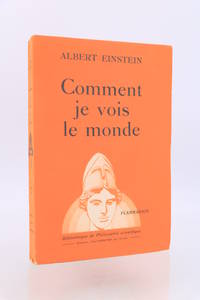
193491810Paris: Flammarion 1934. Fine. Flammarion Paris 1934 13 x 19.5 cm Broché First edition of the French translation one of 110 numbered copies on alfa paper the only deluxe paper issue after 10 on Holland and 20 on pur fil.A fine copy. Flammarion unknown
191049714Leipzig Barth 1910. 8vo. Bound in contemporary half cloth with gilt lettering to spine. In "Annalen der Physik" Bd. 33 1910. Entire volume offered. Library stamp to verso of title page light wear to extremities. Otherwise fine and clean. pp. 1096-1104 and pp. 1105-1115; Pp. 1275-1298 Entire volume: VIII 1584 pp. 6 plates. <br/><br/><em>First appearance of all three papers. The purpose of "A theorem in probability and its application in the Theory of radiation" is to demonstrate that the failure of statistical mechanics with respect to the radiation law Rayleigh - Jeans law contradicted by experience cannot be removed by the conjecture that perhaps the individual statistical events should not follow the usual law of independence product of probabilities instead of assuming a certain interdependence between them. Lanczos. The second paper "Statistical investigation on of the motion of an oscillator in a radiation field" makes use of the results of the previous investigation. Einstein's aim is to demonstrate that the Rayleigh-jeans law of radiation contracdicted by the physical facts is an unavoidable consequence of statistics even if we avoid any kind of assumption which may be suspected of needing correction. Lanczos. The third paper "Theory of the opalescence of homogenous fluids and fluid mixtures near the critical state" is an importent investigation and one of the most difficult of all his papers to understand. The aim of the paper is to complement the work of Smoluchovski Ann. d. Physik25 1908 who gave a general explanation of the strong density fluctuations - and the opalescence thus generated - of two fluids near the critical state of mixture or a single fluid near the critical state of condensation on the basis of the kinetic theory of heat. he did notgive howeverthe quantitative details concerning the scattered light associated with this phenomenon. Lanczos. - Weil Nos 34 35 and 36 with an asterix denoting major work.Weil No. 34 35 & 36. </em> hardcover
1920504910Toronto: The Ryerson Press 1920. Book. Very Good. Hardcover. Binding sturdy. Text clean. A well-preserved copy of the first Canadian edition with previous owner's inscription on front free end page. Modest stunning to spine cover else in very good condition indeed. The Ryerson Press Hardcover
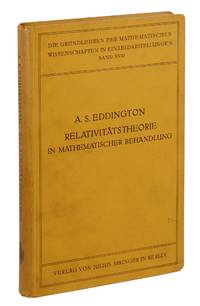
1925140945616Berlin: Verlag von Julius Springer 1925. First edition. First edition. xiv 377 1 4 pp. Bound in publisher's orangish yellow boards. Near Fine with light rubbing and soiling to boards tiny pen squiggle to front board. Contents bright and unmarked. An uncommon German-language physics text with an appendix by Einstein. Verlag von Julius Springer unknown
194938664The Library of Living Philosophers. Very Good in Very Good dust jacket. 1949. First Edition. Hardcover. First edition of Einstein's autobiography. Blue cloth. Bookplate to ffep. Glue darkening along hinges. Book is tight and square. Gilt unfaded. The clipped jacket shows wear along edges and shows general toning. ; The Library of Living Philosophers; Vol. 7; 8vo 8" - 9" tall . The Library of Living Philosophers hardcover
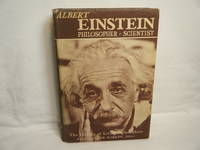
1968019130Crown Publishers. First Printing. No Statement Of Printing DJ Price Clipped But Exactly Same As First And Came With This Book Publisher's Address As 419 Fourth Avenue On Front And Rear Flaps.Clipped DJ in archival cover edge wear small chips. . Fine. Hardcover. 1st Edition. 1968. Crown Publishers hardcover