EINSTEIN ALBERTABAA

1 506 résultats
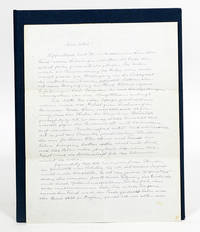
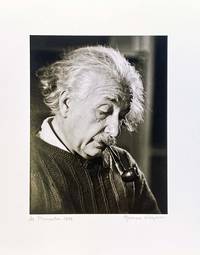
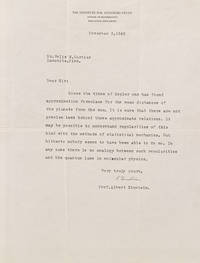
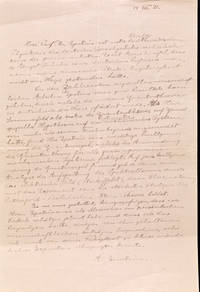
19432376Princeton NJ: np 1943. First edition. nb. Fine. EINSTEIN OFFERS STRONG AND PRESCIENT WORDS OF ENCOURAGEMENT TO THE LEADER OF THE NAACP IN THE FIGHT AGAINST RACISM AND SEGREGATION IN THE UNITED STATES. Background: Einstein's fight against racial discrimination in the United States: The imperative "to protect the rights of the individual. was Einstein's most fundamental political tenet. Individualism and freedom were necessary for creative art and science to flourish. Personally politically and professionally he was repulsed by any restraints. "That is why he remained outspoken about racial discrimination in America. As a Jew who had grown up in Germany Einstein was acutely sensitive to such discrimination. 'The more I feel an American the more this situation pains me' he wrote in an essay called 'The Negro Question' for the January 1946 issue of Pageant magazine. 'I can escape the feeling of complicity in it only by speaking out.'" Isaacson Albert Einstein 505. Even more directly in his 1946 commencement speech to Lincoln University the first degree-granting Historically Black College and University HBCU in the United States Einstein strongly denounced segregation as "an American tradition which is uncritically handed down from one generation to the next" noting that "There is separation of colored people from white people in the United States. That separation is not a disease of colored people. It is a disease of white people. I do not intend to be quiet about it." This remarkable letter - from 1943 -Â is one of the earliest examples of his interest in condemning racism in the United States. The letter: Dated 22 September 1943 and handwritten on his embossed Mercer Street Princeton letterhead Einstein writes in English to Walter F. White the enormously influential African-American civil rights leader who led the NAACP from 1929-1955 praising him for his work and revealing his own awareness of and frustrations with racism and prejudice in America. The text reads in full: Dear Mr. White: I have been quite impressed by the address you delivered some years ago at a meeting of the Princeton Branch of the National Association for the Advancement of Colored People. I know how hard it is to awaken the conscience even of good-hearted and well-meaning people when deep rooted prejudices are in the way. It is a great work indeed which you are doing relentlessly for the betterment of the living conditions of our Colored fellow-citizens for justice and for the accomplishment of national unity of the American people. With sincere respect and kind wishes Yours Albert Einstein ------------- On April 28 1940 White was the keynote speaker at "an inter-racial meeting sponsored by the Princeton branch of the National Association for the Advancement of Colored People" where his topic was "What Happens to Democracy When It Encounters the Color Line." Princeton Herald April 26 1940. At the time Princeton did not admit African Americans and the community was debating the question of whether or not to end segregation at the university. Princeton in fact did not admit its first African-American student until the fall of 1947. Einstein -Â writing in 1943 -Â notes that he heard White speak "some years ago". Something clearly must have deeply impressed Einstein about White's speech for him to write this thoughtful letter to White over three years after the event. Note: In addition to its content this apparently unpublished letter is also remarkable for being one of the very few letters Einstein hand-wrote in English during this period as German was still very much his preferred tongue. Princeton: September 22 1943. One page on Einstein's embossed Mercer Street Princeton letterhead 7.25x10 in visible handsomely matted and framed with a photograph of Einstein. Fine condition. np unknown books
19432376<p>Princeton NJ: np 1943. First edition. nb. Fine. EINSTEIN OFFERS STRONG AND PRESCIENT WORDS OF ENCOURAGEMENT TO THE LEADER OF THE NAACP IN THE FIGHT AGAINST RACIAL SEGREGATION AND DISCRIMINATION IN THE UNITED STATES. Background: Einstein's fight against racial discrimination in the United States:<br /><br />The imperative "to protect the rights of the individual. was Einstein's most fundamental political tenet. Individualism and freedom were necessary for creative art and science to flourish. Personally politically and professionally he was repulsed by any restraints. <br /><br />"That is why he remained outspoken about racial discrimination in America. As a Jew who had grown up in Germany Einstein was acutely sensitive to such discrimination. 'The more I feel an American the more this situation pains me' he wrote in an essay called 'The Negro Question' for the January 1946 issue of Pageant magazine. 'I can escape the feeling of complicity in it only by speaking out.'" Isaacson Albert Einstein 505. <br /><br />Even more directly in his 1946 commencement speech to Lincoln University the first degree-granting Historically Black College and University HBCU in the United States Einstein strongly denounced segregation as "an American tradition which is uncritically handed down from one generation to the next" noting that "There is separation of colored people from white people in the United States. That separation is not a disease of colored people. It is a disease of white people. I do not intend to be quiet about it." <br /><br />This remarkable letter - from 1943 - is one of the earliest examples of his interest in condemning racism in the United States. <br /><br />The letter:<br /><br />Dated 22 September 1943 and handwritten on his embossed Mercer Street Princeton letterhead Einstein writes in English to Walter F. White the enormously influential African-American civil rights leader who led the NAACP from 1929-1955 praising him for his work and revealing his own awareness of and frustrations with racism and prejudice in America. <br /><br />The text reads in full:<br /><br />Dear Mr. White:<br /><br />I have been quite impressed by the address you delivered some years ago at a meeting of the Princeton Branch of the National Association for the Advancement of Colored People. I know how hard it is to awaken the conscience even of good-hearted and well-meaning people when deep rooted prejudices are in the way. It is a great work indeed which you are doing relentlessly for the betterment of the living conditions of our Colored fellow-citizens for justice and for the accomplishment of national unity of the American people.<br /><br />With sincere respect and kind wishes<br /><br />Yours <br />Albert Einstein<br /><br />-------------<br /><br />On April 28 1940 White was the keynote speaker at "an inter-racial meeting sponsored by the Princeton branch of the National Association for the Advancement of Colored People" where his topic was "What Happens to Democracy When It Encounters the Color Line." Princeton Herald April 26 1940. At the time Princeton did not admit African Americans and the community was debating the question of whether or not to end segregation at the university. Princeton in fact did not admit its first African-American student until the fall of 1947. <br /><br />Einstein - writing in 1943 - notes that he heard White speak "some years ago". Something clearly must have deeply impressed Einstein about White's speech for him to write this thoughtful letter to White over three years after the event.<br /><br />Note: In addition to its content this apparently unpublished letter is also remarkable for being one of the very few letters Einstein hand-wrote in English during this period as German was still very much his preferred tongue. <br /><br />Princeton: September 22 1943. One page on Einstein's embossed Mercer Street Princeton letterhead 7.25x10 in visible handsomely matted and framed with a photograph of Einstein. Fine condition.</p> np
192625045<p><b>ALBERT EINSTEIN.</b>Autograph Correspondence Card Signed to Michele Besso May 1 1926 Berlin. In German. 1 p. 4¼ x 5⅞ in. </p><b>Complete Translation</b><p><i> 1 May 1926</i></p><p><i>Dear Michele</i></p><p><i> I read that paper</i><i>right away at the time but I don't think that anything more profound lies behind it. There is naturally a rough connection between a decrease in volume and energy and from here one can try to come nearer to the empirical phenomena by introducing further parameters. But this happens in such a way that neither rhyme nor reason can be made of it. It is very reminiscent of Traube. Using such apothecary's methods one cannot reveal any of God's secrets I think. Schrödinger did a couple of wonderful studies on quantum rules Ann d Physik.</i> <i>That has the scent of a deeper truth. Let it be explained to you.</i></p><p><i> I'm coming to Switzerland in July. End of July is LN meeting in Geneva.</i> <i>Then I'm going somewhere in the mountains with Tete. So I'll visit you or else we can meet.</i></p><p><i> Warm regards also to Anna and Vero your</i></p><p><i> Albert</i></p><p><b>Historical Background</b></p><p>Early in 1926 Michele Besso sent Einstein an early draft of a paper by Swiss chemist Gottfried Beck on quantum mechanics. Beck had initially submitted the paper to the Swiss scientific journal <i>Helvetica Chemica Acta</i> which rejected it as too speculative. On April 25 1926 Besso wrote to Einstein about Beck's paper. After discussing the details he writes "This surely is an amusing thing; I was surprised that you didn't write me anything about it. Here too reality is once again simpler than the theoretical conceptions would lead one to expect."</p><p>Three months later Einstein wrote to Besso regarding Beck's paper: "it is obviously particularly painful to use the quantum condition together with the equations of motion here because the validity of the latter appears to be irreconcilable with the validity of the former." Einstein was skeptical that Beck's equation "has any reality left within it in the face of quanta. I vigorously doubt it." However Einstein found the construction of the left side of the equation "surely contains a deeper truth." Einstein declared to Besso "I cannot make myself glue two things together like the left- and right-hand sides of this equation that have nothing to do with each other logico-mathematically."</p><p><b>Michele Besso</b> 1873-1955 was born in Zurich Switzerland into an Italian Jewish family. He was a close friend of Albert Einstein when they worked together at the Federal Polytechnic Institute in Zurich and at the patent office in Bern where Einstein helped Besso get a job. Besso met his future wife Anna Winteler through Einstein in June 1897. In 1898 their son Vero was born in Winterthur Switzerland. Einstein referred to Besso as "the best sounding board in Europe" for scientific ideas. Besso died in Geneva just over one month before Einstein died in Princeton New Jersey.</p><p><b>Johann Gottfried Beck</b> 1900-1992 received his Ph.D. in chemistry from the University of Bern in December 1925. He worked as an assistant to Heinrich Zangger at the Institute for Forensic Medicine at the University of Zurich.</p><p><b>Isidor Traube</b> 1860-1943 was born in Hanover the son of a wealthy German-Jewish merchant. He received his doctorate in organic chemistry in 1882. He founded capillary chemistry and conducted advanced research on liquids helping to define the concepts of surface tension and critical temperature. In 1882 he joined the faculty of Technische Hochshule in Berlin and became a professor of chemistry there in 1900. Unacceptable to National Socialists Traube was barred from his laboratory and he left Germany in 1934. Through the aid of British colleagues he was provided with a laboratory at the University of Edinburgh. During his long career he was a persistent and stubborn controversialist in opposition to various theories.</p><p><b>Erwin Schrödinger</b> 1887-1961 was born in Vienna Austria. He was a commissioned officer in the Austrian fortress artillery during World War I. After the war he advanced through the academic ranks to become a full professor in 1921 in Breslau now Wroclaw Poland. That year he moved to the University of Zurich and in 1927 to the Friedrich Wilhelm University in Berlin. He received the Nobel Prize in Physics in 1933 and left Germany as he opposed the Nazis. After brief positions in a number of places he settled in Dublin Ireland in 1940 where he remained until retiring in 1955. During his career Schrödinger developed a number of fundamentals of quantum theory including the wave equation. He also published many works in various fields of physics. Although Schrödinger was an atheist he believed his scientific work was an approach to the godhead in a metaphorical sense.</p><p><b>Eduard Einstein</b> 1910-1965 was born in Zürich Switzerland to Albert and Mileva Marić Einstein. In 1914 his parents separated and his mother returned to Zürich with Eduard and older brother Hans Albert who were both deeply affected. Eduard was interested in music art and poetry. Unlike his father Eduard was a good student. He had started to study medicine and psychiatry but in 1930 was diagnosed with schizophrenia. He was first institutionalized in 1932; it is not clear if his treatment particularly electroconvulsive therapy did more good than harm. Albert fondly referred to Eduard as "Tete" for <i>petit</i> and they corresponded regularly but never saw each other after a heart-breaking final visit in 1933. Marić and Eduard's Swiss citizenship undoubtedly saved Eduard from Aktion T4 the Nazi euthanasia program and perhaps both of them from the Holocaust. His mother cared for Eduard until her death in 1948 and Eduard thereafter lived mostly at a psychiatric clinic in Zurich where he died from a stroke in 1965.</p> books
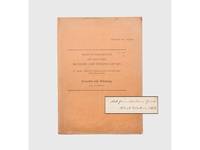
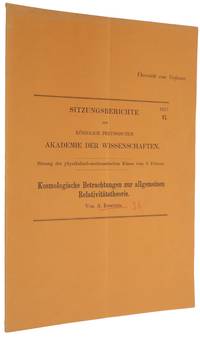
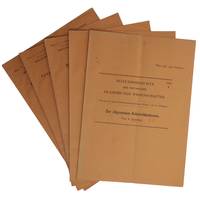
1921176803Berlin: Prussian Academy 1921. One of the scientist's most celebrated mathematical texts inscribed to a colleague First edition rare author's presentation offprint inscribed by Einstein shortly after publication to Professor Friedrich Fritz Behrend 1878-1939 of the Prussian Academy of Sciences where the lecture was first delivered. The paper includes Einstein's celebrated aphorism: "As far as the laws of mathematics refer to reality they are not certain; and as far as they are certain they do not refer to reality." This copy is inscribed in ink on the first page "Mit freundlichen Gruss Albert Einstein. 1. III 21" with a portion of the original address label laid in postmarked 2 March 1921. Einstein and Behrend corresponded in the early 1920s; their relationship was close enough for Behrend to ask Einstein to act as guarantor on a loan in December 1924 a request Einstein politely declined Collected Papers letters 568 and 596. The presentation offprint is distinguished from the trade issue by the printed statement "Überreicht vom Verfasser" on the front cover. Einstein delivered this lecture on the foundations and applications of geometry to the Prussian Academy on 27 January 1921 the year he received the Nobel Prize in Physics. In what DSB describes as a "particularly beautiful lecture" he set out his mature views on the geometrization of physics and relativity the distinction between pure and applied geometry and the priority of empirical over a priori claims. The paper stands as his most considered response to Poincaré's challenge that the universe's geometry could never be proved and it later came to be regarded by logical empiricists as a paradigm-defining text. Quarto 8 pages pp. 123-30. Original orange printed wrappers. With portion of original address label laid in inscribed "Herrn Prof Dr Fritz Behrend Preuss. Akademie der Wissenschaften Unter der Linden 38". Housed in a black quarter morocco solander box with chemise by the Chelsea Bindery. Light central crease from folding partial postmark to rear where address label once affixed: a very good copy. Weil 114. The Collected Papers of Albert Einstein Vol. 14: The Berlin Years Writings & Correspondence April 1923 - May 1925 2015; Thomas Ryckman The Reign of Relativity: Philosophy in Physics 1915-1925 2005. unknown
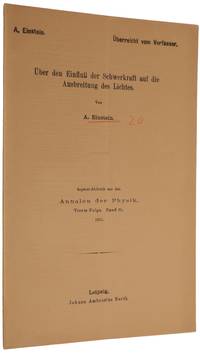
19116407Leipzig: Johann Ambrosius Barth 1911. First edition. <p>First edition an extremely rare author's presentation offprint with 'Überreicht vom Verfasser' - Presented by the Author from the library of the eminent German physicist Arnold Sommerfeld of Einstein's "first paper completely devoted to general relativity" Brandt Harvest of a Century. In this groundbreaking work Einstein applied the equivalence principle - the idea that acceleration and gravitation are physically indistinguishable - to predict two profound effects of gravity on light: the gravitational redshift and the bending of light by massive bodies. These predictions would later be spectacularly confirmed notably in the 1919 solar eclipse observations cementing Einstein's reputation worldwide.</p>. <p>GRAVITATIONAL RED-SHIFT AND THE BENDING OF LIGHT</p> . <p>First edition extremely rare author's presentation offprint with 'Überreicht vom Verfasser' Presented by the Author stamped on front wrapper from the library of the great German physicist Arnold Sommerfeld of Einstein's "first paper completely devoted to general relativity" Brandt p. 105. This epochal paper applies the equivalence principle that acceleration and gravitation are equivalent in their physical effects to demonstrate two effects of gravity on light: the gravitational bending of light and the gravitational redshift. "In 1911 Einstein proceeded to revise and improve his earlier presentation in 1907 making the principle of equivalence the central feature of his treatment. Einstein now included an elegant proof based on a cyclic process reminiscent of thermodynamics that the gravitational mass of a body as well as its inertial mass is increased by the amount E/c2 when the body absorbs energy E c being the speed of light" Collected Papers p. xxix. Einstein applies this result to show first that if light of frequency ν travels a distance d against a gravitational field which would exert an acceleration g on a gravitating body its frequency is reduced by Δν = νgd/c2 - this is the gravitational redshift. And second Einstein deduced the deflection of a light ray moving in the gravitational field of a spherical body - he finds that the light suffers a deflection toward the source given by 2Gm/dc2 where d is the distance of closest approach to the body of mass m and G is the gravitational constant. "The paper ends with a plea to the astronomers: 'It is urgently desirable that astronomers concern themselves with the question brought up here even if the foregoing considerations might seem insufficiently founded or even adventurous'" Pais p. 200. The bending of light was famously observed by Eddington and his team during a solar eclipse in 1919; the gravitational redshift was more difficult to measure but Einstein's prediction was confirmed by Pound & Rebka at Harvard in 1960 using a laboratory experiment not astronomical observations. "Thus in 1911 we discern the first glimpses of the new Einstein program: to derive the equivalence principle from a new theory of gravitation. This cannot be achieved within the framework of what he called the ordinary relativity theory the special theory. Therefore one must look for a new theory not only of gravitation but also of relativity. Another point made in this paper likewise bears on that new program. 'Of course one cannot replace an arbitrary gravitational field by a state of motion without gravitational field as little as one can transform to rest by means of a relativity transformation all points of an arbitrarily moving medium.' This statement would continue to be true in the ultimate general theory of relativity" Pais pp. 195-196. OCLC lists three copies: King's College London; Württembergische Landesbibliothek; Swiss National Library. RBH list only two other copies both sold by Christie's: the Plotnick copy in 2002 and that in Einstein's own collection of his offprints in 2008.</p> <br /> <p>Provenance: Arnold Sommerfeld 1868-1951 his characteristic numbering in red pencil '20' on front cover. "The son of a physician Sommerfeld was educated at the University of Königsberg. After teaching briefly at the universities of Göttingen Clausthal and Aachen he was appointed professor of physics at the University of Münich in 1906. Sommerfeld should have retired in 1936 in favour of his pupil Werner Heisenberg. Opposition from the Nazi party to Heisenberg's appointment prolonged Sommerfeld's tenure and it was not in fact until late 1939 that he finally retired to be succeeded not by Heisenberg but by Wilhelm Müller a Nazi aerodynamicist without a single publication in physics to his credit. Although Sommerfeld and Heisenberg were not Jewish they were regarded by the Nazis as Jewish sympathizers. Sommerfeld however survived the war and returned to his Münich chair in 1945 continuing to work at physics until he died in a car accident in 1951" Oxford Reference. "Arnold Sommerfeld was one of the most distinguished representatives of the transition period between classical and modern theoretical physics. The work of his youth was still firmly anchored in the conceptions of the nineteenth century; but when in the first decennium of the century the flood of new discoveries experimental and theoretical broke the dams of tradition he became a leader of the new movement and in combining the two ways of thinking he exerted a powerful influence on the younger generation. This combination of a classical mind to whom clarity of conception and mathematical rigour are essential with the adventurous spirit of a pioneer are the roots of his scientific success while his exceptional gift of communicating his ideas by spoken and written word made him a great teacher" Max Born p. 275. </p> <br /> <p>"In 1907 still working at the patent office in Bern Einstein began to study the laws of physics in reference frames with an accelerated relative motion. When he completed this work in 1915 he called it the General Theory of Relativity. At various occasions Einstein recalled his starting point in this project. It struck him that a man falling from the top of a roof he said did not feel his own weight. In the reference frame of the building it is the weight or gravitational force which make the man fall but in a reference frame moving with the man there is another force exactly counteracting the weight so that there is no net force. In that frame the man stays at rest. Einstein realized that acceleration and gravitation are equivalent to each other. That was later called the equivalence principle. If he would be able to extend his theory of relativity to accelerated reference frames he would be able to do for the theory of gravitation what he had done for electrodynamics with special relativity. He gave a first glimpse at his new topic in a review article on special relativity written in 1907 'Über das Relativitätprinzip und die aus demselben gezogenen Folgerungen' Jahrbuch der Radioaktivität und Elektronik Bd. 4 pp. 411-62" Brandt p. 105.</p> <br /> <p>"A few months before the Solvay Congress Einstein had returned to the questions concerning gravitation and accelerated frames of reference that he first raised in his 1907 review article on relativity. These subjects had gone unmentioned in his papers for four years and hardly ever appear in his correspondence during that time. But in June 1911 Einstein completed a short paper 'On the Influence of Gravitation on the Propagation of Light.' This was only a month after his letter to Besso announcing that he was abandoning his efforts to create a new theory of radiation. It looks as though his renunciation of that quest set him free to focus his attention once more on gravitation" Collected Papers p. xxix. </p> <br /> <p>"It is characteristic for Einstein that in the same paper he proposed a way to verify his predictions experimentally . From his formula for the gravitational redshift he computed that the frequency of a spectral line emitted by an atom on the surface of the sun would be reduced by two parts in a million when that light reached the earth. Thus a line spectrum originating from the sun is shifted to lower frequencies and therefore to longer wavelengths compared to a spectrum emitted in the laboratory. This redshift is difficult to measure because the surface of the sun is a nasty environment with high pressure storms and magnetic fields all influencing spectral lines. But with modern techniques it has been well established even in the laboratory with radiation climbing against the earth's gravitation for only a few meters.</p> <br /> <p>"Einstein also computed the bending of light by gravitation. If the light of a star passes near the surface of the sun and is then observed by an astronomer on the earth the star appears to be in a slightly different position because the light was attracted by the sun and thus the ray was bent on its way from star to the earth. Einstein found a bending angle of 0.83 seconds of an arc. This number was too small by a factor of two but nobody knew because the effect had not been measured. However Einstein himself realized that his theory had to be refined. For a homogeneous gravitational field a field that is constant everywhere he could replace gravitation by a single transformation to an accelerated coordinate system. For a more complicated field like that of the sun or that of all stars the transformation would have to be different for every point in space. That seemed a formidable problem" Brandt p. 106. The correct calculation of light bending was made only in 1915 when Einstein had the final version of general relativity.</p> <br /> <p>"His 1911 paper was specifically prompted by his new realization that it should be possible to observe the gravitational bending of light . One had to observe a star whose light would travel close by the sun on its way to the observer. This could be done during a total eclipse of the sun .</p> <br /> <p>"Einstein took the initiative in consulting experimental colleagues about the possibilities for checking these results. In August 1911 he began corresponding with W.H. Julius of Utrecht about the gravitational redshift among other matters. At about the same time he raised with Erwin Freundlich at Berlin the question of observing the deflecting of starlight by the gravitational field of the sun a subject on which he corresponded with George Ellery Hale at the Mount Wilson Observatory two years later. There would however be no reliable results on either of these subjects for years to come. But whether or not there were experimental results to help in guiding his work generalizing relativity and creating a new theory of gravitation became the problem that absorbed his attention for the next few years. 'I am just now lecturing on the foundations of that poor dead mechanics which is so beautiful' he wrote to Zangger a month after the Solvay Congress. 'What will its successor look like With that question I torment myself ceaselessly'" Collected Papers pp. xxix-xxx.</p> <br /> <p>"English interest in the bending of light developed soon after copies of Einstein's general relativity papers were sent from Holland by de Sitter to Arthur Stanley Eddington at Cambridge . a subsequent report by Eddington . stressed the importance of the deflection of light. In March 1917 the Astronomer Royal Sir Frank Watson Dyson drew attention to the excellence of the star configuration on May 29 1919 another eclipse date for measuring the alleged deflection . Two expeditions were mounted one to Sobral in Brazil led by Andrew Crommelin from the Greenwich Observatory and one to Principe Island off the coast of Spanish Guinea led by Eddington. Before departing Eddington wrote 'The present eclipse expeditions may for the first time demonstrate the weight of light i.e. the Newton value; or they may confirm Einstein's weird theory of non-Euclidean space which predicted twice the Newton value; or they may lead to a result of yet more far-reaching consequences - no deflection' . The expeditions returned. Data analysis began. According to a preliminary report by Eddington to the meeting of the British Association held in Bournemouth on September 9-13 the bending of light lay between 0.87 and double that value. Word reached Lorentz. Lorentz cabled Einstein . Then came November 6 1919 the day on which Einstein was canonized . the setting a joint meeting of the Royal Society and the Royal Astronomical Society resembled a Congregation of Rites. Dyson acted as postulator ably assisted by Crommelin and Eddington as advocate-procurators. Dyson speaking first concluded his remarks with the statement 'After a careful study of the plates I am prepared to say that they confirm Einstein's prediction. A very definite result has been obtained that light is deflected in accordance with Einstein's law of gravitation'" Pais pp. 304-305.</p> <br /> <p>The gravitational bending of light has recently found a new application - the search for extra-solar planets. ". the 'most curious effect' of the bending of starlight by the gravity of intervening foreground stars - now commonly referred to as 'gravitational microlensing' - has become one of the successfully applied techniques to detect planets orbiting stars other than the Sun while being quite unlike any other . Gravitational microlensing favours a range of orbital separations that covers planets whose orbital periods are too long to allow detection by other indirect techniques but which are still too close to their host star to be detected by means of their emitted or reflected light. Rather than being limited to the Solar neighbourhood a unique opportunity is provided for inferring a census of planets orbiting stars belonging to two distinct populations within the Milky Way with a sensitivity not only reaching down to Earth mass but even below with ground-based observations. The capabilities of gravitational microlensing extend even to obtaining evidence of a planet orbiting a star in another galaxy" Dominik.</p> <br /> <p>BRL 39; Parkinson p. 471; Weil 43. The Collected Papers of Albert Einstein vol. 3 The Swiss Years: Writings 1909-1911 Princeton: Princeton University Press 1994. Born 'Arnold Johannes Wilhelm Sommerfeld 1868-1951' Obituary Notices of Fellows of the Royal Society 8 1952 pp. 275-296. Brandt The Harvest of a Century Oxford: Oxford University Press 2009. Dominik 'Studying planet populations with Einstein's blip' Philosophical Transactions of the Royal Society A: Mathematical Physical and Engineering Sciences vol. 368 no. 1924 2010. Pais Subtle is the Lord Oxford: Clarendon Press 1982.</p> <br/> <br/> 8vo 222 x 144 mm pp. 1 blank 898-908. Original printed orange wrappers light vertical crease for posting. Johann Ambrosius Barth unknown
19371984Princeton: np 1937. First Edition. Very Good. AN EXTRAORDINARY LETTER BY EINSTEIN TO HIS SON OFFERING LIFE ADVICE AND DISCUSSING FREUD SHAKESPEARE AND SCHILLER. Addressed to his son Eduard "Tetel" Einstein and signed "Papa" the letter written in ink on both sides of one sheet reads in full translated from the original German: 

Dear Tetel

 I hope by now you've received Freud's lectures from Vienna. I've read most of them myself in the past. They really made me admire the Author but they didn't convince me that his theories were correct. 

I must admit however that based on my personal experiences my conviction about those theories is weakening -- I feel now that he was onto something at least in regards to the main theses. I would have written to you sooner but work is keeping me very busy. Even though they say that the work of a single person will not have much of an impact in the big picture it does not diminish the passion in which we pursue our interests and that is a good thing. 

 Although personal illusions may bring warmth and joy into one's life when young they don't last a lifetime. Life would be bleak if the work and the passion for discovery did not exist. In my free time I am currently reading Schiller's poems which I have neglected since my youth. 

They feel a bit pompous but at the same time they are enthralling in their choice of words and grammar. I am really happy that I picked them up again. 

I would have liked to send you another book on the top of the Freud but didn't know which one to send -- especially because I don't get a lot of German writings anymore.

 When I have some extra free time after finishing Schiller I really want to start reading Shakespeare everything from him I can get my hands on. If you like to read it too perhaps we could discuss it at some later time
 

 Albert is a real delight -- he has been traveling up and down the country for the past 6 weeks and will have seen and experienced many interesting things. I really hope he has followed my advice and kept a journal but I am not holding high hopes. When it comes to talking and writing he seems to be chronically constipated. With my warmest regards

 Papa Einstein's life advice underscoring one of his core beliefs: Einstein often stated that his main goal in life was the quest for truth no matter how difficult and painstaking the quest. He advises Eduard in this letter that it is the pursuit and the work in attaining the goal that brings satisfaction and sustains one throughout life even if "the work of a single person will not have much of an impact in the big picture". This he notes is critical to understand after the illusions of youth have succumbed to reality. Einstein Eduard and Freud: Eduard Einstein nicknamed "Tete" or "Tetel" born in 1910 was the second son of Albert and his first wife Mileva. From an early age he became enamored with the teachings of Freud even hanging a picture of famous psychiatrist on his bedroom wall. By the age of twenty he was diagnosed with schizophrenia and consequently was institutionalized several times throughout his life. Einstein's views of Freud's teachings were somewhat more nuanced than those of his son. Initially Einstein did not show much interest in Freud's theories and after their first meeting in 1927 Freud famously remarked "He understands as much about psychology as I do about physics." Over the years however Einstein began studying Freud's works. After corresponding with Freud somewhat regularly throughout the 1930s and even collaborating with him on a project sponsored by the League of Nations "Why War" 1932 Einstein began to move from a deep skepticism to - as indicated in this letter - a growing acceptance. By 1936 - just before this letter was written - Einstein sent birthday greetings to Freud acknowledging: "Until recently I could only apprehend the speculative power of your train of thought together with its enormous influence on the Weltanschauung of the present era without being in a position to form a definite opinion about the amount of truth it contains. Not long ago however I had the opportunity of hearing about a few instances not very important in themselves which in my judgment exclude any other interpretation than that provided by the theory of repression. I was delighted to come across them since it is always delightful when a great and beautiful conception proves to be consonant with reality." 
In this letter to Eduard Einstein admits to Eduard that he now believes Freud "was onto something at least in regards to the main theses." Einstein Shakespeare Schiller: Einstein's fondness for music is well-known but not as much has been recorded about his literary tastes. It is not surprising and has been previously documented that Einstein had a fondness for the great German poet Schiller but we can find no other references to Shakespeare by Einstein in any other letters or manuscripts. His words to Eduard "I really want to start reading Shakespeare everything from him I can get my hands on" imply that Einstein has recently "discovered" Shakespeare and is excited at the discovery. 
Note: Although the letter is not dated we can assume that it was written late November - December in 1937 when Einstein's son Albert was visiting the United States a trip he refers to in the letter. Princeton: November - December 1937. One 8.5x11 inch leaf written on both sides. In German. Usual folds otherwise fine. A LONG REMARKABLE AND REVEALING LETTER UNITING THE INTELLECTUAL GIANTS EINSTEIN FREUD AND SHAKESPEARE AND SHARING ONE OF HIS CORE BELIEFS WITH HIS SON. np unknown books
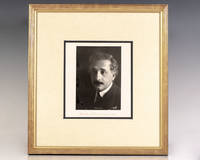
19231413011923. Extremely rare original photograph boldly signed "Albert Einstein Jerusalem 1923" during his only trip to Palestine in 1923. Einstein's return voyage from his tour of Japan and China took him via the Red Sea and Suez Canal which allowed him to accept the invitation of Arthur Ruppin the director of the Palestine office of the Zionist Organization in Jaffa to visit the region for twelve days. Einstein arrived in Port Said on February 1 1923 and from there he traveled to Jerusalem Tel Aviv Jaffa and Haifa. The photographer Zvi Oron began his career in Warsaw and the United States before opening a studio in Tel Aviv in 1919. In 1930 he moved to Jerusalem and opened a studio of Jaffa Street working in the service of press clients and the British Government. He was well regarded for his candid images that captured daily life in the British Mandate. The Zionist archive holds over 1300 of his negatives. Double matted and framed the entire piece measures 19.75 inches by 15.5 inches. An exceptional piece. This is the only signed photograph known from his time in Palestine. Albert Einstein developed the general theory of relativity one of the two pillars of modern physics alongside quantum mechanics. Einstein's work is also known for its influence on the philosophy of science. Einstein is best known in popular culture for his mass–energy equivalence formula E = mc2 which has been dubbed "the world's most famous equation". He received the 1921 Nobel Prize in Physics for his "services to theoretical physics" in particular his discovery of the law of the photoelectric effect a pivotal step in the evolution of quantum theory David Bodanis. unknown
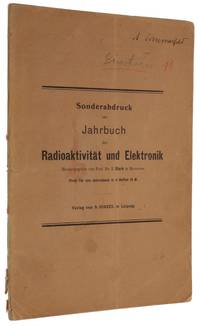
19076410Leipzig: S. Hirzel 1907. First edition. <p>First edition an extremely rare offprint from the library of the renowned German physicist Arnold Sommerfeld of one of the most important transitional papers in Einstein's scientific career. In this landmark work Einstein first articulated the equivalence principle - the insight that uniform acceleration and gravitation are physically indistinguishable</p> <p>- a profound realization he later described as "the happiest thought of my life." This concept became the foundation of general relativity marking a pivotal departure from special relativity and setting Einstein on the path toward a relativistic theory of gravitation.</p>. <p>THE EQUIVALENCE PRINCIPLE 'THE HAPPIEST THOUGHT OF MY LIFE'</p> . <p>First edition extremely rare author's presentation offprint with 'Überreicht vom Verfasser' Presented by the Author stamped on front wrapper from the library of the great German physicist Arnold Sommerfeld of this crucially important transitional paper in which Einstein introduced the equivalence principle that uniform acceleration and gravitation are equivalent in their physical effects which launched him on his path to general relativity. "Einstein's efforts to incorporate gravitation into the theory of relativity led him in 1907 to formulate a new formal principle later named the principle of equivalence. He stressed that when gravitational effects are taken into account it is impossible to maintain the privileged role that inertial frames of reference still have in the original relativity theory. He concluded that if gravitation is to be included it is necessary to extend the relativity principle. The search for a group of transformations wider than the Lorentz group under which the laws of physics remain invariant when gravitation is included lasted from 1907 until the end of 1915 leading finally to what Einstein considered his greatest achievement the general theory of relativity" Collected Papers 2 p. xxix. "On p. 443 are probably the first explicit statements both of the equivalence of inertial and gravitational mass and of the equation for mass in terms of energy E = mc2 now regarded as the theoretical basis for the release of atomic energy" Weil. In 1905 "Einstein said that all energy of whatever sort has mass. It took even him two years more to come to the stupendous realization that the reverse must also hold: that all mass of whatever sort must have energy. . With mass and energy thus wholly equivalent Einstein was able in 1907 in a long and mainly expository paper published in the Jahrbuch der Radioactivität the offered paper to write his famous equation E = mc2 . In presenting his equation in 1907 Einstein spoke of it as the most important consequence of his theory of relativity" Hoffmann Albert Einstein p. 81. "Of greatest importance is the last part of the paper which generalizes the principle of relativity from uniformly moving systems to uniformly 'accelerated' systems. . He introduces the principle of equivalence which claims that the problem of a uniform and stationary gravitational field on the one hand and the system moving with a constant acceleration without any gravitation on the other hand are physically indistinguishable situations. This principle put him in a position to find out what effect gravitation has on an arbitrary physical phenomenon because all he had to do was to observe that phenomenon from an accelerated reference system. He thus obtains the speeding up of clocks in a field of increased gravitational potential which must lead to a universal red shift of the spectral lines coming from the Sun and likewise to a bending of light rays near to the limb of the Sun. Furthermore this hypothesis at once makes it clear why inertial mass and gravitational mass must be under all circumstances strictly proportional to one another. . Hence the principle of the energy value of inertial mass must be extended to the gravitational mass" Lanczos The Einstein Decade p. 153. Later Einstein wrote that when he was working on this paper "There occurred to me the happiest thought of my life in the following form. The gravitational field has only a relative existence in a way similar to the electric field generated by magnetoelectric induction. Because for an observer falling freely from the roof of a house there exists - at least in his immediate surroundings - no gravitational field" Einstein's emphasis Pais Subtle is the Lord p. 178. Although Einstein submitted the paper on 4 December 1907; it was published in the January 22 issue of the Jahrbuch. This is one of Einstein's rarest major papers in offprint form. RBH lists three copies: Plotnick Christie's 2002; Einstein's own collection of his offprints Christie's 2008; and Richard Green Christie's 2008. OCLC lists 6 copies worldwide Morgan; Princeton; Stanford; Trinity College Cambridge; Queen's University Kingston ON; Thomas Fisher. This copy was presented by Einstein to one of the leading physicists of the time surely hoping to make himself known in the scientific world when he was still a technical expert in the Swiss Patent Office.</p> <br /> <p>Provenance: Arnold Sommerfeld 1868-1951 his signature and characteristic numbering in red pencil '11' on front cover. "The son of a physician Sommerfeld was educated at the University of Königsberg. After teaching briefly at the universities of Göttingen Clausthal and Aachen he was appointed professor of physics at the University of Münich in 1906. Sommerfeld should have retired in 1936 in favour of his pupil Werner Heisenberg. Opposition from the Nazi party to Heisenberg's appointment prolonged Sommerfeld's tenure and it was not in fact until late 1939 that he finally retired to be succeeded not by Heisenberg but by Wilhelm Müller a Nazi aerodynamicist without a single publication in physics to his credit. Although Sommerfeld and Heisenberg were not Jewish they were regarded by the Nazis as Jewish sympathizers. Sommerfeld however survived the war and returned to his Münich chair in 1945 continuing to work at physics until he died in a car accident in 1951" Oxford Reference. "Arnold Sommerfeld was one of the most distinguished representatives of the transition period between classical and modern theoretical physics. The work of his youth was still firmly anchored in the conceptions of the nineteenth century; but when in the first decennium of the century the flood of new discoveries experimental and theoretical broke the dams of tradition he became a leader of the new movement and in combining the two ways of thinking he exerted a powerful influence on the younger generation. This combination of a classical mind to whom clarity of conception and mathematical rigour are essential with the adventurous spirit of a pioneer are the roots of his scientific success while his exceptional gift of communicating his ideas by spoken and written word made him a great teacher" Max Born p. 275. </p> <br /> <p>"His first important paper on relativity theory after 1905 is the 1907 review. This article was written at the request of Johannes Stark the editor of the Jahrbuch. On September 25 1907 Einstein had accepted this invitation. On November 1 Einstein further wrote to Stark: 'I am now ready with the first part of the work for your Jahrbuch. I am working zealously on the second part in my unfortunately scarce spare time.' Since this second part contains the remarks on gravitation it seems probable that Einstein's 'happiest thought' came to him sometime in November 1907. We certainly know where he was when he had this idea. In his Kyoto lecture he told the story: 'I was sitting in a chair in the patent office at Bern when all of a sudden a thought occurred to me. 'If a person falls freely he will not feel his own weight!' I was startled. This simple thought made a deep impression on me. It impelled me toward a theory of gravitation' .</p> <br /> <p>"Three main issues are raised in Section V of the Jahrbuch article. </p> <br /> <p>The Equivalence Principle. 'Is it conceivable that the principle of relativity also holds for systems which are accelerated relative to each other' That is Einstein's starting question. Then he gives the standard argument. A reference frame Σ1 is accelerated in the x direction with a constant acceleration γ. A second frame Σ2 is at rest in a homogeneous gravitational field which imparts an acceleration -γ in the x direction to all objects. 'In the present state of experience we have no reason to assume that . Σ1 and Σ2 are distinct in any respect and in what follows we shall therefore assume the complete physical equivalence of a gravitational field and the corresponding acceleration of the reference frame. This assumption extends the principle of relativity to the case of uniformly accelerated motion of the reference frame . he began by applying his new postulate to the Maxwell equations always for uniform acceleration. He did not raise the question of the further extension to nonuniform acceleration until 1912 the year he first referred to his hypothesis as the 'equivalence principle.'</p> <br /> <p>The Gravitational Red Shift. Many textbooks on relativity ascribe to Einstein the method of calculating the red shift by means of the Doppler effect of light falling from the top to the bottom of an upwardly accelerating elevator. That is indeed the derivation he gave in 1911. However he was already aware of the red shift in 1907. The derivation he gave at that time is less general more tortured and yet oddly more sophisticated. It deserves particular mention because it contains the germ of two ideas that were to become cornerstones of his final theory: the existence of local Lorenz frames and the constancy of the velocity of light for infinitesimally small paths .</p> <br /> <p>Maxwell's Equations; Bending of Light; Gravitational Energy = mc2. Indomitably Einstein goes on. He tackles the Maxwell equations next. He concludes that Maxwell's equations have the same form in a uniformly accelerated reference frame as in a non-accelerated frame but with a modified velocity of light. 'It follows that the light rays . are bent by the gravitational field.' Second he examines the energy conservation law in the accelerated frame and finds 'a very notable result . In a gravitational field one must associate with every energy E an additional position-dependent energy which equals the position-dependent energy of a 'ponderable' mass of magnitude E/mc2. The law E = mc2 therefore holds not only for inertial but also for gravitational mass' .</p> <br /> <p>"This review does not have the perfection of the 1905 paper on special relativity. The approximations are clumsy and mask the generality of the conclusions. Einstein was the first to say so in 1911. The conclusion about the bending of light is qualitatively correct quantitatively wrong - though in 1907 not yet logically wrong. Einstein was the first to realize this in 1915. Despite all this I admire this article at least as much as the perfect relativity paper on 1905 not as much for its details as for its courage" Pais pp. 179-182.</p> <br /> <p>"In 1920 Einstein recalled how he first arrived at the ideas behind the equivalence principle: </p> <br /> <p>'While I was occupied in 1907 with a comprehensive survey of the special theory for the 'Yearbook for Radioactivity and Electronics' I also had to attempt to modify Newton's theory of gravitation in such a way that its laws fitted into the theory. Attempts along these lines showed the feasibility of this enterprise but did not satisfy me because they had to be based on physical hypotheses that were not well-founded. Then there came to me the most fortunate thought of my life in the following form: </p> <br /> <p>'Like the electric field generated by electromagnetic induction . the gravitational field only has a relative existence. Because for an observer freely falling from the roof of a house during his fall there exists-at least in his immediate neighborhood-no gravitation field. Indeed if the observer lets go of any objects relative to him they remain in a state of rest or uniform motion independently of their particular chemical or physical composition note by AE: air resistance is naturally ignored in this argument. The observer is thus justified in interpreting his state as being at rest. </p> <br /> <p>'Through these considerations the unusually extraordinary experimental law that all bodies fall with equal acceleration in the same gravitational field immediately obtains a deep physical significance. For if there were just one single thing that fell differently from the others in the gravitational field then with its help the observer could recognize that he was falling in a gravitational field. If such a thing does not exist-which experiment has shown with great precision-then there is no objective basis for the observer to regard himself as falling in a gravitational field. Rather he has the right to regard his state as one of rest and with respect to a gravitational field his neighborhood as field free. The experimental fact of the material-independence of the acceleration due to gravity is thus a powerful argument for the extension of the relativity postulate to coordinate systems in non-uniform relative motion with respect to each other . The generalization of the relativity principle thus indicates a speculative path towards the investigation of the properties of the gravitational field.' </p> <br /> <p>"Einstein alludes here to his initial attempts to set up a special-relativistic theory of gravitation but gives no details. In 1933 he gave the fullest account of how he 'arrived at the equivalence principle by a detour Umweg' through such attempts. After mentioning his doubts after 1905 about the privileged dynamical role of inertial systems and his early fascination by Mach's idea that the acceleration of a body is not absolute but relative to the rest of the bodies in the universe he turns to the events of 1907:</p> <br /> <p>'I first came a step closer to the solution of the problem when I attempted to treat the law of gravitation within the framework of special relativity. Like most authors at the time I attempted to establish a field law for gravitation since the introduction of an unmediated action at a distance was no longer possible at least in any sort of natural way on account of the abolition of the concept of absolute simultaneity. </p> <br /> <p>'The simplest thing naturally was to preserve the Laplacian scalar gravitational potential and to supplement Poisson's equation in the obvious way by a term involving time derivatives so that the special theory of relativity was satisfactorily taken into account. The equation of motion of a particle also had to be modified to accord with the special theory. The way to do so was less uniquely prescribed since the inertial mass of a body might well depend on its gravitational potential. This was even to be expected on the basis of the law of the inertia of energy. </p> <br /> <p>'However such investigations led to a result that made me highly suspicious. For according to classical mechanics the vertical acceleration of a body in a vertical gravitational field is independent of the horizontal component of its velocity. This is connected with the fact that the vertical acceleration of a mechanical system or rather of its center of mass in such a gravitational field turns out to be independent of its internal kinetic energy. According to the theory I was pursuing however such an independence of the gravitational acceleration from the horizontal velocity or from the internal energy of a system did not occur.</p> <br /> <p>'This did not accord with an old fact of experience that all bodies experience the same acceleration in a gravitational field. This law which can also be formulated as the law of equality of inertial and gravitational mass now appeared to me in its deep significance. I was most highly amazed by it and guessed that in it must lie the key to the deeper under- standing of inertia and gravitation.' </p> <br /> <p>"Turning from later reminiscences let us see how Einstein presented his approach to gravitation in 1907:</p> <br /> <p>'Up to now we have only applied the principle of relativity i.e. the presupposition that the laws of nature are independent of the state of motion of the reference system to acceleration-free reference systems. Is it conceivable that the principle of relativity also holds for systems that are accelerated relative to each other </p> <br /> <p>'This is not the place for an exhaustive treatment of this question. Since however it is bound to occur to anyone who has followed the previous applications of the relativity principle I shall not avoid taking a position on the question here. Consider two systems in motion Σ1 and Σ2. Let Σ1 be accelerated in the direction of its X -axis and let γ be the magnitude constant in time of this acceleration. Let Σ2 be at rest but in a homogeneous gravitational field that imparts an acceleration -γ in the direction of the X -axis to all objects. As far as we know the laws of physics with respect to Σ1do not differ from those with respect to Σ2; this is due to the circumstance that all bodies in a gravitational field are equally accelerated. So we have no basis in the current state of our experience for the assumption that the systems Σ1and Σ2differ from each other in any respect; and therefore in what follows shall assume the complete physical equivalence of a gravitational field and the corresponding acceleration of a reference system. </p> <br /> <p>'This assumption extends the principle of relativity to the case of uniformly-accelerated translational motion of the reference system. The heuristic value of this assumption lies in the circumstance that it allows the replacement of a homogeneous gravitational field by a uniformly accelerated reference system which to a certain extent is amenable to theoretical treatment.' </p> <br /> <p>"Some further comments on this equivalence in his next paper on gravitation in 1911 are illuminating. He notes that in both systems objects subject to no other forces fall with constant acceleration:</p> <br /> <p>'For the accelerated system K′ corresponding to the 1907 Σ1 this follows directly from the Galileian principle of inertia; for the system K at rest in a homogeneous gravitational field corresponding to the 1907 Σ2 however it follows from the experimental fact that in such a field all bodies are equally strongly uniformly accelerated. This experience of the equal falling of all bodies in a gravitational field is the most universal with which the observation of nature has provided us; in spite of that this law has not found any place in the foundations of our physical picture of the world . From this standpoint one can as little speak of the absolute acceleration of a reference system as one can of the absolute velocity of a system according to the usual special theory of relativity. Naturally one cannot replace an arbitrary gravitational field by a state of motion of the system without a gravitational field; just as little as one can trans- form all points of an arbitrarily moving medium to rest by a relativity transformation. From this standpoint the equal falling of all bodies in a gravitational field is obvious. </p> <br /> <p>'As long as we confine ourselves to purely mechanical processes within the realm of validity of Newtonian mechanics we are certain of the equivalence of the systems K and K′. Our point of view will only have a deeper significance however if the systems K and K′ are equivalent with respect to all physical processes i.e. if the laws of nature with respect to K agree completely with those with respect to K′. By assuming this we obtain a principle that if it really is correct possesses a great heuristic significance. For by means of theoretical consideration of processes that take place relative to a uniformly accelerated reference system we obtain conclusions about the course of processes in a homogeneous gravitational field.'</p> <br /> <p>"With hindsight one can see that Einstein's attempt to find the best way to implement mathematically the physical insights about gravitation incorporated in the equivalence principle was hampered significantly by the absence of the appropriate mathematical concepts. His insight as he put is a few years later that gravitation and inertia are "essentially the same" wesensgleich cries out for implementation by their incorporation into a single inertio-gravitational field represented mathematically by a non-flat affine connection on a four-dimensional manifold. But the concept of such a connection was only developed after and largely in response to the formulation of the general theory. So Einstein had to make do with what was available: Riemannian geometry and the tensor calculus as developed by the turn of the century i.e. based on the concept of the metric tensor without a geometrical interpretation of the covariant derivative" Stachel pp. 83-86.</p> <br /> <p>BRL 20; Stanitz 94; Weil 21. Born 'Arnold Johannes Wilhelm Sommerfeld 1868-1951' Obituary Notices of Fellows of the Royal Society 8 1952 pp. 275-296. Stachel 'The first two acts' pp. 81-112 in: Gravitation in the Twilight of Classical Physics. The Promise of Mathematics Renn & Schemmel eds. 2007.</p> <br/> <br/> 8vo 231 x 157 mm pp. 411-462. Original printed wrappers upper cover a bit soiled lower part of spine worn light vertical crease for posting faint ink stain to page 418 spine strip with wear and tear. S. Hirzel unknown
19302349np: np 1930. First edition. Fine. EINSTEIN ON THE CONCEPT OF PEACE: A POWERFUL AUTOGRAPH STATEMENT IN EXCEPTIONALLY LARGE FORMAT. 
. Translated from the original German:<br /> <br /> "No person has the moral right to call himself a Christian or Jew so long as he is prepared to engage in systematic murder at the command of an authority or allow himself to be used in any way in the service of war or the preparation for it."<br /> <br /> Starting in 1925 the French Academy began sending large 11.5x16.5 sheets to important scientists writers and intellectuals asking them to write on the sheet a statement on the concept of peace for possible inclusion in an anthology. The World League for Peace later released a limited edition of prints from the submissions under the title Pax Mundi: livre d'or de la paix. This is Einstein's unique manuscript submission. <br /> <br /> A highly unusual format with exceptionally large Einstein signature 2.25 in / 6 cm of an important Einstein statement consistent with his life-long dedication to pacifism. <br /> <br /> c.1925-1930. One large folio page 11.5 x 16.5 inches. In German. Fine condition. np unknown books
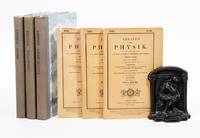
19052895<p>Leipzig: Johann Ambrosius Barth 1905. First edition. original wrappers. Very Good. FIRST PRINTINGS WITH EXTREMELY RARE ORIGINAL WRAPPERS of Einstein's revolutionary papers of 1905 including the first edition of the initial paper on special relativity; three of the most important papers in the history of science. Beautiful clean copies without any institutional stamps. In the first paper "On a Heuristic Viewpoint Concerning the Production and Transformation of Light" published in March "Einstein postulated that light is composed of individual quanta later called photons that in addition to wavelike behaviour demonstrate certain properties unique to particles. In a single stroke he thus revolutionized the theory of light and provided an explanation for among other phenomena the emission of electrons from some solids when struck by light called the photoelectric effect" Britannica. It was for this paper on the photoelectric effect that Einstein was granted the Nobel Prize in physics in 1921. The next paper "On the Motion-Required by the Molecular Kinetic Theory of Heat-of Small Particles Suspended in a Stationary Liquid" published in May provided a theoretical explanation of Brownian motion. It is generally regarded as the first proof that molecules exist.<br /><br />Although the first two papers were of astonishing originality and importance it was the third paper introducing what would be later known as Einstein's special theory of relativity that would make him famous. "Toward the end of June it was all written up and on June 30 receipt of the manuscript was recorded at the editorial office of Annalen in Berlin. The thirty-page article published three months later was titled 'On the Electrodynamics of Moving Bodies'. It was a treatise beyond compare and without precedent one of the greatest scientific achievements in content and one of the most brilliant in style. Of course there were later additions some from Einstein himself and some from others but these were mere addenda to a theory which had appeared before all the world ready and complete valid for all time" Folsing Albert Einstein. Einstein's theory with the premise that "if for all frames of reference the speed of light is constant and if all natural laws are the same then both time and motion are found to be relative to the observer" "involved a complete rethinking of the entire conceptual tradition of modern physics from its beginning" Britannica; Folsing. Weil 6. Weil 8. Weil 9. Grolier/Horblit 26b.<br /><br />Zur Elektrodynamik bewegter Korper in Annalen der Physik Vierte Folge Volume 17 part 10 pp. 891-921; WITH: Über einen die Erzeugung und Verwandlung des Lichtes betreffenden heuristischen Gesichtspunkt ibid part 6 pp. 132-148. WITH: Über die von der molekularkinetischen Theorie der Warme geforderte Bewegung von in ruhenden Flussigkeiten suspendierten Teilchen ibid part 8 pp. 549-560. Leipzig: Johann Ambrosius Barth 1905. Octavo three issues in original wrappers rebacked; three custom boxes. <br /><br />Note: The issues are slightly trimmed indicating that it is likely they were originally bound with the wrappers and then re-assembled. With general title page volume half-title and index included in part 6. Some chipping to exceedingly rare and brittle original wrappers; otherwise fine. Extremely rare in such outstanding condition.</p> Johann Ambrosius Barth
193313747Los Angeles 1933. Signed by the photographer Aaron Tycko of Los Angeles. Prominently signed “Albert Einstein. 1933†below image. Rarely seen photograph of the famous scientist taken during his last visit to Southern California in January 1933 the month Hitler took power in his native Germany. During the five-month trip Einstein 1879-1955 spent most of his time at the Mount Wilson Observatory and the California Institute of Technology where he was offered a position. Later that year he renounced his German citizenship and accepted a professorship at the Institute for Advanced Studies in Princeton New Jersey.<br /> <br /> Tycko 1893-1975 was based in Los Angeles and often photographed Einstein along with other Hollywood icons of the early twentieth century including Irving Berlin. At the time this photograph was taken Tycko also shot a well-known photograph of Einstein with his wife Elsa. Interestingly Tycko is mention in Einstein’s FBI files because a Hollywood informant reported that the photographer believed Einstein was a communist. This informant contended that Tycko thought Einstein was “the brain that was setting up Hollywood in the 1930’s for the big Communist push . . . He was one of the most dangerous and powerful figures in what has become the Communist movement.†<br /> <br /> Jerome The Einstein File: J. Edgar Hoover’s Secret War Against the World’s Most Famous Scientist. unknown
1954195551954. in German black ink. Signed “A. Einsteinâ€. A poem written by Einstein to his colleague and collaborator Ernst Straus and his son Daniel.<br /> <br /> “Dear Strausse both!<br /> <br /> My best wishes and greetings in poetic form.<br /> <br /> It brings even more happiness<br /> If it has been anticipated for so long<br /> also in one’s circle of friends<br /> the event is doubly appreciated. <br /> <br /> This is what I wish:<br /> Let Daniel be like his father<br /> thoroughly intelligent and not less joyous<br /> so few humans are like that.<br /> <br /> Many - alas - are born<br /> few are chosen<br /> to bring light and joy.<br /> Let such gift be his drive.<br /> <br /> Yours A. Einsteinâ€<br /> <br /> In German “Strauss†means bunch bouquet etc. or ostrich and “Strausse†is plural.<br /> <br /> Ernst G. Straus 1922-1983 was a mathematician who helped found the theories of Euclidean Ramsey theory and of the arithmetic properties of analytic functions. He was Einstein’s assistant and collaborator both at Princeton and afterwards when he moved to become a professor of mathematics at UCLA. His son Daniel is a professor of chemistry at Cal State San Jose. unknown
1949343971949. <blockquote><p>On scientists and military work: “The majority of really good scientists in this country have withdrawn from military work…The young ones who cannot lean upon a standing of their own have generally given in to the almost irresistible pressure. One cannot expect it to be any different.""</p><p> </p><p>Einstein and other scientists faced the harsh reality of the product of their work after the war and the bombing of Japan; Here Einstein in a way grapples with his own role</p></blockquote><p> </p><blockquote><p>On the timeless nature of fighting for what you believe: “The truth appears foolish to the insane.Lost people are content to find themselves in agreement with the masses.""</p></blockquote><p><img class=""alignnone wp-image-34606 size-post-window"" src=""https://cdn.raabcollection.com/wp-content/uploads/20251001204256/Einstein_Letter_11-1-1600x897.jpg"" alt="""" width=""1600"" height=""897"" /></p><p>Although Albert Einstein’s participation in the production of the atomic bomb was limited the public perceived his role as crucial and he was in fact the face of the project to many. The reasons were that although he did not work on the Manhattan Project the US effort to build the bomb his famous equation E=mc2 provided the theoretical basis for understanding the immense energy released in nuclear fission which is the process that powers the bomb. And his 1939 letter to President Roosevelt co-signed by Leo Szilárd alerted the US government to the potential of nuclear weapons and prompted the start of research that eventually led to the Manhattan Project. Feeding the public perceptions of his responsibility were publications like The Smyth Report a history of the development of the bomb published the day after the bombing of Nagasaki which ascribed great historical weight to Einstein’s 1939 letter to President Franklin D. Roosevelt in catalyzing the development of the bomb. In 1946 Time magazine published the famous cover featuring Einstein’s portrait backgrounded by an enormous mushroom cloud emblazoned with “E=mc2†and the accompanying article by Whittaker Chambers referred to him as “the father of the bomb†a title which resonated in the popular imagination. A March 1947 Newsweek cover featured Einstein above the headline “Godfather of the Atomic Bombâ€. Einstein was hounded by the association throughout the rest of his life culminating in his November 1954 admission to Linus Pauling “I made one great mistake in my life when I signed the letter to President Roosevelt recommending that atom bombs be made….â€</p><p>Albert Einstein was known for his dedication to morality which he said was “of the highest importance†as well as beliefs that stemmed from morality like pacifism anti-militarism and loyalty to the facts taught by science. He viewed morality as fundamentally human and believed that ethical behavior should form a basis for both individual well-being and the collective good of humanity. Thus for Einstein the pursuit of morality was the most vital human endeavor essential for bringing beauty and dignity to life and ensuring the survival and thriving of the human race. He shared these beliefs with Dr. Herbert Jehle.</p><p>Dr. Jehle was a pioneering theoretical physicist whose work spanned quantum field theory biophysics and astrophysics. He was a student and friend of Einstein in the 1920s in Germany; and a disciple and friend of Dietrich Bonhoeffer. At Princeton in 1947 he provided Richard Feynman with the spark which would lead to his path integral formulation. Einstein had left for the United States in 1933 the same year that Jehle received his doctorate from the Technische Hochschule Berlin. In the same year Dietrich Bonhoeffer Jehle's friend and mentor stepped down from his professorship at Berlin in protest of the Nazi ascent to power. In 1940 Jehle refused to assist in the German armament and atomic project and was interned in concentration camps. Escaping in 1941 with the help of Quaker and Christian relief organizations Jehle made his way to the United States where he took a position at Harvard University until leaving for Princeton in 1947. At Princeton Jehle's pacifist beliefs coincided with Einstein's own and they reconnected bonding over shared views of social responsibility and ethics in science and playing music together regularly Einstein on violin Jehle on the piano.</p><p>Jehle was also the editor of the Society for Social Responsibility in Science newsletter of which Einstein was a member. Jehle additionally submitted articles to other science publications. During the 1950s Jehle collaborated with Linus Pauling on DNA research as well as advocating with Pauling for peace. In the early 1960s Jehle worked as a consultant to Marshall Nirenberg at the NIH on DNA-coding for which Nirenberg also won a Nobel Prize for in 1968.</p><p>Jehle's 1949 article ""For a Universal Morality"" asserted that ""participation in war preparations posed a challenge to man's conscience under any circumstances. and urged that scientists refuse to participate in war work under any government democratic or totalitarian"" see Nathan & Norden Einstein on Peace p 514. The editor of the Bulletin Eugene Rabinowitch rejected the article in a letter to Einstein to which Einstein replied advocating Jehle's position praising Jehle for not being “deterred by taboos†and then sent this letter to Jehle.</p><p>It is interesting to think how time and war had affected Einstein's thinking. Where his letter did much to advance the nuclear militarization and as a scientist he felt a need to intervene here is advocating the opposite.</p><p><strong>Autograph letter signed</strong> on paper watermarked <em>""Whiting Mutual Bond Rag Content""</em>Princeton 1949 to Herbert Jehle endorsing the article by Jehle that had been submitted to the Bulletin of Atomic Scientists on the topics of science and morality and cautioning Jehle on the complications of his position in the post-war world. <em>“I have read your article several times and find that it agrees exactly with my thinking. In accordance with your wishes I am sending your paper with my recommendation to the Bulletin of Atomic Scientists in the hope that they will publish it.</em></p><p><em>“I doubt however that the effect will correspond with the good intentions of the article. The truth appears foolish to the insane. He suspects disloyal intent and revolts against the thought that the 'foreigner' considers himself a better judge of what Americans should do. There are after all few who think and feel in a supra-national manner. Lost people are content to find themselves in agreement with the masses.</em></p><p><em>“The majority of really good scientists in this country have withdrawn from military work more so than it was ever the case in Germany. The young ones who cannot lean upon a standing of their own have generally given in to the almost irresistible pressure. One cannot expect it to be any different since few are born to be martyrs - if no mass movement drives them in that direction. I see the real justification of your approach in the attempt to help generate such a mass movement.</em></p><p><em>“The predicament in which we are is in a certain sense timeless. The public institutions necessarily represent a rather low moral level as do the men who stand behind these institutions. The individual is at the mercy of these institutions the standards of which he must recognize to be low if he is conscientious and not completely without ideas. He is thus forced into some compromise since he sees that that kind of necessarily imperfect institution cannot be dispensed with.</em></p><p><em>“If those who see the light do not stand honestly and courageously for the good the world will get deeper and deeper into the morass. In expressing my joy that you have acted in this way and continue to do so I remain with friendly greetings. Yours A. Einstein.â€</em></p><p>With: <strong>Autograph statement</strong> as a PS from Einstein in German with Jehle's autograph English translation beneath and annotations above transcribing his recommendation for Jehle which Einstein sent to the editor of the Bulletin. <em>“I am sending you this book article. It comes from a younger physicist who is courageous enough to simply say what is evident without being deterred by taboos. I hope that his note can be published in the Bulletin.â€</em></p><p>An important letter reflecting Einstein's post-war advocacy for morality and peace and assessments of the place of scientists in the moral sphere as well as realistic observations on and understanding of world politics.</p><p>We obtained this letter directly from the Jehle family.</p><p><img class=""alignnone wp-image-25018 size-post-window"" src=""https://cdn.raabcollection.com/wp-content/uploads/20231204144051/Folder-site-11-1600x1327.jpg"" alt="""" width=""1600"" height=""1327"" /></p> unknown
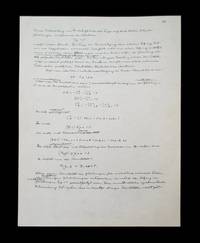
194069509n.p. 1940. n.p.: 1940.<br> <br> Full Description:<br> <br> EINSTEIN Albert. Autograph Manuscript in Pen. n.p. n.d ca: 1940.<br> <br> Autograph manuscript in German in Einstein's hand. Manuscript is on the "Unified Field Theory" and is a draft from his published article "A Generalization of the Relativistic Theory of Gravitation." One quarto page 11 x 8 1/2 inches; 280 x 217 mm. Manuscript in black ink on recto verso blank. With 31 lines of manuscript text in German including over 180 words and eleven equations. Because this is a working document there are numerous revisions on the page. He strikes through and makes additions in eight places. At the top right corner the page is numbered "6" in his hand. Leaf is very lightly toned but generally about fine. It is quite rare to find manuscripts of Einstein works that has been published. Housed in a full morocco clamshell.<br> <br> "A Generalization of the Relativistic Theory of Gravitation" was an article written by Einstein in German and translated into English for publication by his assistant E.G. Straus in approximately 1945. The article was long and so it was divided in two parts. The present leaf comes from Part II and the translated text is on pages 735-736 of the published article.<br> <br> "The published translation appears to follow this original manuscript very closely and without alteration. In this section of his paper Einstein is discussing the field equations for the Hamiltonian operator which plays a central role in the equations of motion for General Relativity and is defined in terms of the metric tensor and its conjugate momenta; and in this particular page of the paper Einstein is here considering the implications of embracing a stronger form of the field equations." University Archives<br> <br> During the course of World War II Einstein came to the conclusion that the General Theory of Relativity was the proper basis for the development of Unified Field Theory; and using this framework he explored the implications of using new and complex forms of number within Unified Field Theory. The publication of this article marked the beginning of Einstein's final approach to Unified Field Theory an approach which Einstein pursued until the end of his life. University Archives .<br> <br> HBS 69509.<br> <br> $45000. n.p. unknown
19802611New York: np 1980. First edition. Clamshell box. Fine. EXTREMELY RARE COMPLETE SUITE OF SEVEN LARGE SILVER PRINTS FROM EINSTEIN'S FAMOUS PHOTO SHOOT AT PRINCETON WITH ROMAN VISHNIAC. Each print is signed by Vishniac and dated "At Princeton 1942" in his hand below the image and numbered on the back. "One day Vishniac decided to visit Albert Einstein at Princeton to offer greetings from mutual friends in Berlin. Uninvited he hoped Einstein would pose for a portrait but Einstein had little interest. Vishniac recalled:<br /> <br /> It was a singular experience. An idea had suddenly come to him and the room was filled with the movement of the great man's thought. I waited several minutes and then when I saw that he did not intend to say anything more to me and that he was off in a world of his own I started taking pictures.<br /> <br /> Einstein later admitted that a Vishniac photograph taken that day was his favorite portrait" Encyclopedia of Twentieth-Century Photography. <br /> <br /> Vishniac provided details about this portolfio in a letter to an original recipient the letter is not included here explaining:<br /> <br /> The size of the edition's limitation is uncertain due to my age and only spare time to make them. The most expensive portfolios - Ansel Adams Kertesz - are limited in large numbers I can never measure up - 999 1001 and similar. <br /> <br /> The originality of Portfolio "Einstein" consists of its special character. It is made not to get images but the feeling that you are present during the creativity by the Great Man. All pictures are made with "hidden camera" method.<br /> <br /> The value of this portfolio is great and can hardly be estimated today. <br /> <br /> Princeton/New York: 1942 negatives; 1980 silver prints. Elephant folio clamshell box approx. 17x21 in. housing seven silver prints. Image size: approx. 10.25 x 13.25 in.; with matte 16x20 in. A few minor blemishes to box. Photos in fine condition. RARE. np unknown
19176411Berlin: W. de Gruyter 1917. First edition. <p>First edition an extremely rare author's presentation offprint from the library of the eminent German physicist Arnold Sommerfeld of the groundbreaking paper that "laid the foundations of modern theories of the universe" O'Raifeartaigh. In this seminal work Einstein first applied the principles of general relativity to cosmology introducing the cosmological constant to allow for a static universe - a pivotal conceptual innovation that shaped modern theoretical physics. "There is little doubt that Einstein's 1917 paper 'Cosmological Considerations in the General Theory of Relativity' constituted a key milestone in 20th-century physics" ibid. This presentation offprint - issued in very limited numbers for private distribution by Einstein himself - is vastly scarcer than the commercially available separate printings which appear more regularly on the market.</p>. <p>LAID THE FOUNDATIONS OF MODERN THEORIES OF THE UNIVERSE</p> . <p>First edition extremely rare author's presentation offprint not to be confused with the more common trade separate - see below from the library of the great German physicist Arnold Sommerfeld of Einstein's 'cosmological constant' paper which "laid the foundations of modern theories of the universe" O'Raifeartaigh. "There is little doubt that Einstein's 1917 paper 'Cosmological Considerations in the General Theory of Relativity' constituted a key milestone in 20th century physics. As the first relativistic model of the universe the paper later known as 'Einstein's Static Universe' or the 'Einstein World' set the foundations of modern theoretical cosmology" O'Raifeartaigh et al. "It is generally agreed that the seeds of a revolution in theoretical cosmology were planted when Einstein completed his general theory of relativity in the fall of 1915. On 25 November he read to the Prussian Academy of Sciences the final communication which contained a consistent set of gravitational equations. One and a half years later in a paper announced on 8 February 1917 Einstein took the revolutionary step of exploring the consequences of his new theory for no less than the entire universe" Kragh p. 8. "The consequence of Einstein's version of Mach's principle is that at infinity the components of the metric tensor should degenerate: for an isotropic field the spatial components become zero whereas the timelike component goes to infinity. It turned out to be impossible to realize these conditions for centrally symmetric static fields. Einstein's way out was to postulate a universe that is spatially finite closed and static with a uniform mass distribution a universe in which no boundary conditions are needed. In order to do so however Einstein had to modify his field equations to include what became known as the 'cosmological constant'" Papers 6 p. xx. Max Born said of Einstein's conception "This suggestion of a finite but unbounded space is one of the greatest ideas about the nature of the worlds which has ever been conceived . It solved the mysterious fact why the system of stars did not disperse and thin out which it would do if space were infinite; it gave a physical meaning to Mach's principle which postulated that the law of inertia should not be regarded as a property of empty space but as an effect of the total system of stars; and it opened the way to the concept of the expanding universe" quoted in Clark p. 270. The 'Einstein world' described a static universe but in 1929 Edwin Hubble demonstrated that the universe is not static but expanding. Soon after Einstein rejected his cosmological constant as unnecessary and compromising the simplicity of his field equations. Nevertheless recent discoveries regarding dark matter and dark energy suggest that the cosmological constant may have a role to play in the explanation of the fact that the expansion of the universe appears to be accelerating. OCLC lists copies of this offprint at American Philosophical Society Burndy Huntington and University of Florida but it is unclear if any of these are author's presentation offprints rather than trade separates. We have been unable to locate any other presentation offprint on RBH - it was not present in the collection of Einstein's son Hans Albert Christie's 2006 nor in Einstein's own collection Christie's 2008. RBH lists only four copies of the trade separate in the last 75 years the last sold at Bonham's in 2022 for $15300.</p> <br /> <p>Provenance: Arnold Sommerfeld 1868-1951 his characteristic numbering '36' in red pencil on front wrapper. "The son of a physician Sommerfeld was educated at the University of Königsberg. After teaching briefly at the universities of Göttingen Clausthal and Aachen he was appointed professor of physics at the University of Münich in 1906. Sommerfeld should have retired in 1936 in favour of his pupil Werner Heisenberg. Opposition from the Nazi party to Heisenberg's appointment prolonged Sommerfeld's tenure and it was not in fact until late 1939 that he finally retired to be succeeded not by Heisenberg but by Wilhelm Müller a Nazi aerodynamicist without a single publication in physics to his credit. Although Sommerfeld and Heisenberg were not Jewish they were regarded by the Nazis as Jewish sympathizers. Sommerfeld however survived the war and returned to his Münich chair in 1945 continuing to work at physics until he died in a car accident in 1951" Oxford Reference. "Arnold Sommerfeld was one of the most distinguished representatives of the transition period between classical and modern theoretical physics. The work of his youth was still firmly anchored in the conceptions of the nineteenth century; but when in the first decennium of the century the flood of new discoveries experimental and theoretical broke the dams of tradition he became a leader of the new movement and in combining the two ways of thinking he exerted a powerful influence on the younger generation. This combination of a classical mind to whom clarity of conception and mathematical rigour are essential with the adventurous spirit of a pioneer are the roots of his scientific success while his exceptional gift of communicating his ideas by spoken and written word made him a great teacher" Max Born p. 275. </p> <br /> <p>"The new relativistic theory of the universe had conceptual roots far back in time especially in problems discussed by Newton in a famous correspondence with the Reverend Richard Bentley in 1692-93 first published as Four letters from Sir Isaac Newton to Doctor Bentley . London 1756. Newton considered the universe as an infinite container with an infinite number of stars but in that case it seemed impossible to define the gravitational force acting upon a body in a definite way. Later scientists sought to resolve the dilemma by keeping to Newton's idea of an infinite space but including a modification of his law of gravitation. In the mid-1890s two German theoreticians Carl von Neumann and Hugo Seeliger suggested independently that the amount of matter in the spatially infinite universe was finite. Although this led to a well-defined gravitational force it also led to a universe which would seem to collapse under the influence of gravitation as realized by Newton. To avoid this consequence Neumann and Seeliger proposed to change Newton's law of gravitation .</p> <br /> <p>"When Einstein attacked the cosmological problem he was much aware of the Newtonian anomaly and earlier attempts to solve it such as that of Neumann and Seeliger. He wrote: 'I shall conduct the reader over the road that I have myself travelled rather a rough and winding road because otherwise I cannot hope that he will take much interest in the result at the end of the journey. The conclusion I shall arrive at is that the field equations of gravitation which I have championed hitherto still need a slight modification so that on the basis of the general theory of relativity those fundamental difficulties may be avoided . which confronted the Newtonian theory.'</p> <br /> <p>"That the road to the cosmological theory had been rough and winding an intellectual tour de force was also what Einstein wrote to his friend the Dutch physicist Paul Ehrenfest. In early February 1917 Einstein told him that the work had exposed him 'to the danger of being confined in a madhouse.' The conceptual problem which Einstein faced was essentially the same as that Newton had struggled with namely to formulate boundary conditions for an infinite space. In December 1916 he argued in a letter to his friend Michele Besso that a homogeneous symmetrical distribution of matter throughout all of infinite space would not be sufficient to produce the stable universe that both he and Besso presupposed. 'Only the closedness of the universe can get rid of this dilemma' he wrote and added that his new idea was 'one of great scientific significance and not a product of my imagination.' Einstein's solution was to circumvent the problem which he could do by conceiving the universe as a spatially closed continuum in accordance with his general theory of relativity: 'If it were possible to regard the universe as a continuum which is finite closed with respect to its spatial dimension we should have no need at all of any such boundary conditions. We shall proceed to show that both the general postulate of relativity and the fact of the small stellar velocities are compatible with the hypothesis of a spatially finite universe; though certainly in order to carry through this idea we need a generalizing modification of the field equations of gravitation.' Einstein thus assumed the universe to be a spatially closed continuum 'spherical' in four dimensions. This model is also referred to as Einstein's 'cylinder' world: with two of the spatial dimensions suppressed the model universe can be pictured as a cylinder where the radius represents the space and the axis the time coordinate. Einstein was also and naturally so guided by the available empirical evidence. This suggested that the universe was indeed spatially finite that it was static and that it contained a finite amount of matter .</p> <br /> <p>"Apart from being influenced by the existing discussion of Newtonian cosmology Einstein was also motivated by the ideas of the famous Austrian physicist and philosopher Ernst Mach. According to Mach's principle proposed in the 1880s the laws of mechanics including the law of inertia should be seen as purely relational namely relative to the universe as a whole. Einstein's version of the principle was rather different; he tended to understand it in the sense that the space-time metric is determined by the masses of the universe and thus that the local dynamics is conditioned by the universe at large. In general Mach's principle is interpreted as the assumption that local inertial frames are determined by some average of the motion of the distant celestial objects. Originally Einstein believed that his relativistic theory of cosmology embodied Mach's principle but in his later years he concluded that the principle could not be harmonized with the general theory of relativity" Kragh pp. 7-9.</p> <br /> <p>"Only a year before publishing the present work Einstein had finally completed his great masterwork a new theory of gravity space and time known as the general theory of relativity. From a scientific point of view it is hardly surprising that Einstein quickly turned his attention to cosmology. A fundamental tenet of the general theory was that the geometric structure of a region of spacetime is not an independent self-determined entity but is determined by mass-energy. In modern notation that idea is expressed as the field equations</p> <br /> <p>Gμν = −κTμν 1</p> <br /> <p>where Gμν is a four-dimensional tensor that describes the geometry of a region of spacetime and Tμνis a four-dimensional tensor that describes the flux of mass-energy within that region the quantity κ is a constant known as the Einstein constant. Once Einstein had completed the theory it was natural for him to ask if general relativity could deliver a consistent model of all of spacetime-a plausible model of the universe as a whole. As he remarked in a letter to the Dutch astronomer Willem de Sitter 'For me though it was a burning question whether the relativity concept can be followed through to the finish or whether it leads to contradictions.'</p> <br /> <p>"Einstein soon found that assuming a universe with a static distribution of matter evidence to the contrary did not emerge until 1929 it was no easy task to obtain a satisfactory solution to the field equations for the case of the universe as a whole. The main difficulty was his insistence that a model of the cosmos should reflect both the principle of relativity which demanded that all frames of reference be equivalent and an assumption he later named Mach's principle-that the inertia of a body is determined entirely by the presence of other masses in the universe.</p> <br /> <p>"The outcome of those deliberations was Einstein's 'Cosmological considerations' paper of 1917. His ingenious breakthrough was to postulate that we inhabit a universe of closed spatial geometry. Relativity could deliver a satisfactory model of the known universe if it was assumed that the cosmos had the geometry of a three-dimensional sphere-unbounded spatially yet finite in content. However the Einstein universe came at a price. In his analysis Einstein found that a nonzero solution to the field equations could be obtained only if a new term was introduced to the equations according to:</p> <br /> <p>Gμν λgμν = −κTμν. 2</p> <br /> <p>To some the new term λgμν known as the 'cosmological constant' term marred the symmetry and simplicity of the original field equations. However general relativity certainly permitted the term; indeed Einstein had noted the possibility of such an extension to the field equations in his original exposition of 1916. Now the cosmological constant found an important application because it allowed a model of the universe that was consistent with Einstein's views on the relativity of inertia .</p> <br /> <p>"Einstein's analysis culminated in a simple relation between the cosmological constant λ the mean density of matter Ï and the radius of the cosmos R according to</p> <br /> <p>λ = κÏ/2= 1/R2. 3</p> <br /> <p>"One puzzling aspect of Einstein's 'Cosmological considerations' paper is that he made no attempt to estimate the size of his model universe from equation 3. After all even a rough approximation of the mean density of matter in the universe could have given some estimate of the cosmic radius R. Instead he merely declared at the end of the paper that the model was logically consistent: 'At any rate this view is logically consistent and from the standpoint of the general theory of relativity lies nearest at hand; whether from the standpoint of present astronomical knowledge it is tenable will not here be discussed' .</p> <br /> <p>"A second puzzle associated with the 'Cosmological considerations' paper is Einstein's failure to consider the stability of his model universe. After all the quantity Ï in equation 3 represented a mean value for the density of matter in the universe; one could expect a variation in that parameter from time to time which raises the question of the stability of the model against such perturbations. Indeed it was later shown that the Einstein universe is highly unstable against perturbations in matter density a slight increase in density would trigger an inexorable contraction while a slight decrease would result in a runaway expansion .</p> <br /> <p>"In 1929 American astronomer Edwin Hubble published the first evidence of a linear relation between the redshifts of the spiral nebulae and their radial distance. Many theorists viewed Hubble's results as evidence of a non-static universe and proposed a variety of relativistic time-varying models of the cosmos. Einstein himself lost little time in abandoning his static cosmology at that point. In the early 1930s he published two distinct models of the expanding universe one of positive spatial curvature and one of Euclidean geometry. In each case he also abandoned the cosmological constant stating that the term was both unsatisfactory it gave an unstable solution and redundant relativity could describe expanding models of the universe without the term .</p> <br /> <p>"Some years later the Russian scientist George Gamow reported in his memoirs that Einstein once described the cosmological constant as his 'biggest blunder' . It is intriguing to think that Einstein might have predicted the expansion of the universe many years before Hubble's observations had he not introduced the cosmological constant. However it must be remembered that Einstein's task in 1917 was to investigate whether relativity could describe the known universe that is a universe that was assumed to be static. If Einstein did make the 'biggest blunder' comment he may have been referring to his failure to notice the instability of his model" O'Raifeartaigh.</p> <br /> <p>"In the latter third of the twentieth century the situation in cosmology began to change dramatically. Theoretical cosmology became more and more closely associated with elementary particle theory and observational cosmology began to accumulate more and more data limiting the possibilities for and influencing the construction of cosmological models. The cosmological constant has had a dramatic rebirth with the accumulating observation evidence that rather than slowing down as current theories had predicted the expansion of the universe is actually accelerating with cosmic time. By an appropriate choice of sign and value for λ cosmological models with this property are easily constructed. The problem is to give a physical explanation for such a choice of λ. One favored explanation as of 2007 is that the λ-term in the field equations is actually the stress-energy-momentum tensor for 'dark energy' a hitherto unobserved component pervading the entire universe. If this explanation stands the test of time it may also turn out that the 'cosmological constant' is not constant but varies with cosmological time!" DSB.</p> <br /> <p>"Today the term cosmological constant has made a dramatic return to the field equations due to the observation of an acceleration in the expansion of the cosmos. It might therefore be argued that Einstein's real blunder was to abandon the term in the 1930s. However such a view is once again somewhat retrospective because evidence of an accelerated expansion was not known to him.</p> <br /> <p>"In recent years the Einstein universe has once more become a topic of interest in theoretical cosmology. In attempts to avoid the well-known problem of a big bang singularity some theorists have become interested in the possibility of a universe that inflates from a static Einstein universe a scenario known as the emergent universe. Whether the emergent universe will offer a plausible consistent description of the early universe is not yet known. But it is intriguing to think that like the cosmological constant the Einstein universe might yet make a dramatic comeback" O'Raifeartaigh.</p> <br /> <p>This author's presentation offprint is of extreme rarity and must be distinguished from other so-called 'offprints' of papers from the Berlin Sitzungsberichte many of which are commonly available on the market. The celebrated bookseller Ernst Weil 1919-1981 in the introduction to his Einstein bibliography wrote: "I have often been asked about the number of those offprints. It seems to be certain that there were few before 1914. They were given only to the author and mostly 'Ãœberreicht vom Verfasser' Presented by the Author is printed on the wrapper. Later on I have no doubt many more offprints were made and also sold as such especially by the Berlin Academy." If the term 'offprint' means as we believe it should a separate printing of a journal article given only to the author for distribution to colleagues then 'offprints' were not commercially available. Although there is certainly some truth in Weil's remark in our view it requires clarification and explanation.</p> <br /> <p>Until about 1916 most of Einstein's papers were published in Annalen der Physik; from 1916 until he left Germany for the United States in 1933 most were published in the Berlin Sitzungsberichte. The Sitzungsberichte differed from other journals in which Einstein published in that it made separate printings of its papers commercially available. These separate printings have 'Sonderabdruck' printed on the front wrapper the usual German term for offprint but they are not offprints according to our definition. They were available to anyone; indeed a price list of these 'trade offprints' is printed on the rear wrapper. True author's presentation offprints can be distinguished from these trade offprints by the presence of 'Ãœberreicht vom Verfasser' on the front wrapper as in the present offprint.</p> <br /> <p>In the period 1916 to 1919 or 1920 the Sitzungsberichte trade offprints are themselves rare: for example RBH list only three 'offprints' of Einstein's famous 1917 Sitzungsberichte paper 'Kosmologische Betrachtungen zur allgemeinen Relativitätstheorie' the auction records do not distinguish between trade and author's presentation offprints. After 1919 or 1920 however the trade offprints become much more common although the author's presentation offprints are still very rare. The reason for this change is that it was only in 1919 that Einstein became famous among the general public.</p> <br /> <p>It might seem obvious that Einstein's fame dates from 1905 his 'annus mirabilis' in which he published his epoch-making papers on special relativity and the light quantum. However these works did not make him immediately well known even in the physics community - many physicists did not understand or accept his work and it was two or three years before his genius was fully accepted even by his colleagues. Among the general public Einstein became well known only in late 1919 following the success of Eddington's expedition to observe the bending of light by the Sun which confirmed Einstein's general theory of relativity. This was front-page news and made Einstein universally famous. See Chapter 16 'The suddenly famous Doctor Einstein' in Pais Subtle is the Lord for an account of these events. Before 1919 the trade offprints of Einstein's papers would probably only have been purchased by professional physicists; after 1919 everyone wanted a memento of the famous Dr. Einstein whether or not they understood anything of theoretical physics and the trade offprints of his papers were printed and sold in far greater numbers than before to meet the demand. It is telling that when these post-1919 trade offprints appear on the market they are often in mint condition - they were never read simply because their owners were unable to understand them.</p> <br /> <p>In our view Einstein's author's presentation offprints are rare from any journal and any period though of course some are rarer than others. Before 1919 or 1920 the Sitzungsberichte trade offprints are also rare although not are rare as the author's presentation offprints; after 1919 or 1920 the trade offprints are much more common.</p> <br /> <p>BRL 96; Weil 92. Clark Einstein: The Life and Times 1971. Kragh Cosmology and Controversy 1996. O'Raifeartaigh O'Keeffe Nahm & Mitton 'Einstein's 1917 Static Model of the Universe: A Centennial Review' The European Physical Journal H 42 2017 pp. 431-74. O'Raifeartaigh 'Albert Einstein and the origins of modern cosmology' Physics Today 3 February 2017 .</p> <br/> <br/> 8vo 252 x 180mm pp. 142-152 1 blank. Original printed orange wrappers light vertical crease for posting small piece of paper adhered to rear wrapper. W. de Gruyter unknown
1905786Leipzig: Barth 1905. First Edition. 8vo 222 x 159mm pp. 1 viii 1022. In German the first appearance anywhere of three seminal papers by Einstein each addressing a distinct problem and each now recognized as foundational for a major branch of twentieth-century physics. Original cloth publisher’s binding complete with half-title and index with light rubbing to the spine tips still near fine and exceptionally well preserved for this volume and unusually without institutional stamps or other markings. Half morocco case.<br /> <br /> The most consequential volume in the history of modern physics: a single 1905 journal containing three papers by Albert Einstein that simultaneously founded quantum theory proved the existence of atoms and overthrew Newton's conception of space and time. This is the year physics broke open. While offprints individual issues and extracted copies of one or another of these texts appear with some frequency complete and unrestored copies of the bound annual volume in contemporary cloth remain scarce and this copy is in unusually fine condition. As a unit Band 17 documents in real time the consolidation of a new theoretical framework that would reshape the subsequent development of physics. PMM 293 371 408. Dibner 167. The first paper "Über einen die Erzeugung und Verwandlung des Lichtes betreffenden heuristischen Gesichtspunkt" On a Heuristic Viewpoint Concerning the Production and Transformation of Light March 1905 pp. 132–148 introduces the light quantum hypothesis and provides the first satisfactory explanation of the photoelectric effect. By treating radiation in specific circumstances as consisting of localized energy quanta rather than as a continuously distributed wave Einstein resolved the empirical failure of classical electrodynamics to account for the frequency dependence of photoelectron energies. This conceptual move directly anticipates and influences later developments in quantum theory from the formalization of the photon concept in quantum electrodynamics to the probabilistic interpretation of radiation–matter interactions in quantum field theory. It is for this work rather than for relativity that Einstein received the 1921 Nobel Prize in Physics underscoring its centrality to the emerging quantum paradigm.<br /> <br /> The second paper "Über die von der molekularkinetischen Theorie der Wärme geforderte Bewegung von in ruhenden Flüssigkeiten suspendierten Teilchen" On the Motion of Small Particles Suspended in a Stationary Liquid as Demanded by the Molecular-Kinetic Theory of Heat May 1905 pp. 549–560 furnishes a quantitative theory of Brownian motion linking observable stochastic trajectories of suspended particles to underlying molecular collisions. By deriving explicit relations between mean squared displacement time viscosity and particle size Einstein showed how microscopic randomness could be described statistically and used to infer Avogadro’s number and molecular dimensions. The experimental confirmation of these predictions provided decisive evidence for the atomic hypothesis and helped to secure statistical mechanics as a fundamental framework in physics. This work underlies later advances in the theory of stochastic processes diffusion and fluctuation phenomena with ramifications from critical phenomena and noise in electronic devices to modern treatments of random walks and Langevin dynamics.<br /> <br /> The third paper "Zur Elektrodynamik bewegter Körper" On the Electrodynamics of Moving Bodies September 1905 pp. 891–921 formulates the Special Theory of Relativity reconciling Maxwell’s equations with the principle that the laws of physics take the same form in all inertial frames. By abandoning absolute simultaneity and treating space and time as components of a single relativistic structure Einstein derived time dilation length contraction and the relativity of simultaneity as necessary consequences of his postulates. A short follow-up note later in 1905 "Ist die Trägheit eines Körpers von seinem Energieinhalt abhängig" Does the Inertia of a Body Depend Upon Its Energy Content established the mass–energy relation E = mc² providing the bridge between kinematics and energetics in the relativistic regime. Together these contributions supplied the conceptual and mathematical apparatus for later developments in relativistic field theory including Minkowski’s spacetime formulation the construction of relativistic quantum mechanics and quantum field theory and ultimately the General Theory of Relativity and modern cosmology.<br /> <br /> Considered collectively the three 1905 papers in this volume inaugurate quantum theory provide decisive empirical and theoretical support for the molecular-kinetic view of matter and reconfigure the classical concepts of space time and motion. They set the stage for the principal theoretical revolutions of twentieth-century physics: the matrix and wave formulations of quantum mechanics quantum electrodynamics and later gauge field theories relativistic quantum field theory and the geometric theory of gravitation. As a complete contemporary issue of "Annalen der Physik" Band 17 this volume thus embodies not only three individual breakthroughs but also the point of departure for much of modern physical theory exerting an enduring influence on the trajectory of both fundamental physics and its technological applications. Barth unknown
19421265881942. Signed. EINSTEIN Albert. Typed letter signed. Princeton November 3 1942. One sheet measuring 8-1/2 by 11 inches typing on recto only; matted and framed with a portrait of Einstein entire piece measures 21 by 17 inches. $38000.An exceptional typed letter signed by Einstein on precursors like Johannes Kepler's work to his Special and General Theories of Relativity beautifully framed.The letter on letterhead from the Institute for Advanced Study in Princeton reads in full: ""November 3 1942. Mr. Felix W. Cartier. Laconite Minn. Dear Sir: Since the times of Kepler one has found approximation formulaes for the mean distances of the planets from the sun. It is sure that there are not precise laws behind those approximate relations. It may be possible to understand the irregularities of this kind with the methods of statistical mechanics. But hitherto nobody seems to have been able to do so. In any case there is no analogy between such regularities and the quantum laws in molecular physics. Very truly yours signed A. Einstein. Prof. Albert Einstein.""Early in the 17th century Johannes Kepler 1571-1630 discovered that planets orbit the sun in ellipses rather than perfect circles. This great discovery paved the way for Isaac Newton's laws of gravity and for Albert Einstein's general and special theories of relativity. Previous to Einstein's time people believed in real distances and absolute time and showed that instruments could not objectively measure the distances between planets. Einstein's theories which hypothesized that light and space curve near a massive object revolutionized scientific thought and gave man an exciting new perspective of his universe.Einstein's letter reflects on some of the most important scientific revelations in the history of physics and astronomy. Kepler defined three laws of planetary motion; however the one specifically referred to in this letter is that all planets move about the Sun in elliptical orbits having the Sun as one of the foci. If the Universe then consisted only of two point massesthe Sun and a planetthe orbit of that planet would make a perfect closed ellipse that returned the world to its starting location with each trip around the Sun. But in a Universe governed by Newtonian gravity with a plethora of massive bodies in our Solar System that ellipse will precess or rotate slightly in its orbit.In the mid-1800s orbital deviations of Uranus from its predicted motions led to the discovery of Neptune as the outermost world's gravitational influence accounted for the excess motion. But in the inner Solar System the nearest planet to the Sun Mercury was experiencing a similar problem. With detailed accurate observations going back to the late 1500s thanks to astronomer Tycho Brahe we could measure how Mercury's perihelion its closest orbital point to the Sun was advancing. The number we came up with was 5600"" per century just over 1.5 degrees over a 100 year period. But of that 5025"" came from the precession of Earth's equinoxes a well-known phenomenon while 532"" was due to Newtonian gravity.But 5025"" plus 532"" comes up short by a small but significant amount. Attempts at explanationincluding the existence of an unknown inner planet interior to Mercuryall failed. But after Einstein's special theory of relativity came out in 1905 mathematician Henri Poincare showed that the phenomena of length contraction and time dilation contributed a fraction between 15-25% of the needed amount towards the solution dependent on the error. That plus Minkowski's formalization of space and time as not separate entities but as a single structure bound together by their union spacetime led Einstein to develop the general theory of relativity. On November 25 1915 he presented his results computing the spectacular figure that the contribution of the extra curvature of space predicted an additional precession of 43"" per century exactly the right figure needed to explain this observation sending shockwaves through the astronomy and physics communities. Less than two months after this Karl Schwarzschild found an exact solution predicting the existence of black holes. The deflection of starlight and gravitational redshifts/blueshifts were realized as possible tests and finally the solar eclipse of 1919 validated general relativity as superseding Newtonian gravity. Expected fold lines. An incredible letter scarce in its important content. unknown
193160051931. First edition. <p>An important group of photographs documenting Einstein's visit to Caltech. The main purpose of the visit was to discuss Edwin Hubble's observations made in 1929 with the 100-inch telescope at the Mount Wilson Observatory which showed that light from distant nebulae galaxies was red-shifted indicating that the universe was expanding. Einstein had believed that the universe is static and had introduced his 'cosmological constant' into his equations of general relativity to allow for a static solution. When Einstein met Hubble at the Mount Wilson Observatory in January and February 1931 he was visibly moved with Hubble's discovery and reportedly said with tears in his eyes that "It was the most beautiful and satisfying interpretation of astronomical science." In light of the new evidence Einstein published a paper two months later renouncing the concept of a cosmological constant whose invention Einstein denounced as "the greatest blunder of my life."</p>. 'the greatest blunder of my life'. <p>An important group of photographs documenting Einstein's second visit to America and his first to the California Institute of Technology which began at the end of December 1930. The main purpose of the visit was to discuss Edwin Hubble's observations made in 1929 with the 100-inch telescope at the Mount Wilson Observatory then the largest telescope in the world which showed that light from distant nebulae galaxies was red-shifted indicating that the universe was expanding. Einstein had believed that the universe is static and had introduced his 'cosmological constant' into his equations of general relativity to allow for a static solution. When Einstein met Hubble at the Mount Wilson Observatory in January and February 1931 he was visibly moved with Hubble's discovery and reportedly said with tears in his eyes that "It was the most beautiful and satisfying interpretation of astronomical science." In light of the new evidence Einstein published a paper two months later renouncing the concept of a cosmological constant whose invention Einstein denounced as "the greatest blunder of my life." Einstein was accompanied on his visit by Walther Mayer 1887-1948 who had been appointed as his mathematical assistant in 1929. Mayer and Einstein worked together on several approaches towards a unified field theory. "On the way over Einstein and his mathematical calculator Walther Mayer holed up working on revisions to his unified field theory in an upper-deck suite with a sailor guarding the door" Isaacson p. 368. Two of the photographs are of Einstein at Mount Wilson one with Mayer and the observatory's director Walter Adams 1876-1956 who had confirmed Einstein's prediction of the gravitational red-shift although his observations were later shown to be faulty; the other with Mayer and solar physicist Charles St. John 1857-1935 who had assisted Hubble with his red-shift observations. Another photograph shows Einstein between fellow Nobel Laureates Albert Michelson 1852-1931 and Robert Millikan 1868-1953 Caltech's "chairman of the executive council" effectively its president. Together with Edward Morley Michelson had in 1887 carried out the famous Michelson-Morley experiment which failed to detect evidence of the existence of the luminiferous ether; this provided crucial evidence for the early acceptance of special relativity. On this trip Einstein "paid tribute to the aging Michelson carefully praising his famous experiments that detected no ether drift without explicitly saying that they were a basis for his special theory of relativity" Isaacson p. 372. </p> <br /> <p>"In the early 1930s Einstein came to California specifically to consult with scientists at the California Institute of Technology. Few members of the general public understood the nature of his visits but they idolized him all the same. From the moment his boat docked in San Diego on December 31 1930 the reception accorded him by Californians was one part show business one part hero worship and one part genuine affection. Groups of children dressed in blue and white middies serenaded him and thrust wreaths of flowers into his hands two bands struck up tunes and in Los Angeles a theatrical group the Yale Puppeteers opened a play called Mr. Noah in which the ark landed on Mt. Wilson instead of on Mt. Ararat .</p> <br /> <p>"As early as 1913 Einstein was looking for experimental verification for the correctness of his theory of general relativity and he had been in correspondence with Caltech's George Ellery Hale asking him to make an astronomical measurement. He was anxious to know if Hale could detect the influence of the sun's gravitation field upon a light ray. Hale replied that in order to try he needed a solar eclipse. The experiment was finally carried out in 1919 by two British expedition teams and again in 1922 by an American team of astronomers - and it did confirm the theory of general relativity.</p> <br /> <p>"There were cosmological implications in this theory and they attracted a lot of attention in the 1920s and 1930s - nowhere more than at Caltech. Millikan had been urging Einstein to visit the campus for some time and in the fall of 1930 he agreed to spend the winter quarter in Pasadena. Not only would he be able to discuss his theory and its interpretation with distinguished scientists; he would also be meeting old friends again - Richard Tolman the cosmologist; Paul Epstein the theoretical physicist; and Theodore von Karman the aerodynamicist .</p> <br /> <p>"The new Athenaeum at Caltech was the setting for many dinners to honor Einstein. At the first on January 15 1931 the guests included the physicist and Nobel Laureate A. A. Michelson and 200 members of the California Institute Associates. Several weeks later a second dinner was held at which all the astronomers from the Institute and the Mt. Wilson Observatory were present. Edwin Hubble was there as was Charles E. St. John who verified the third prediction of the theory of general relativity the gravitational red-shift. Colleagues came from Berkeley including Tolman's close friend and co-author G. N. Lewis who wrote to say he was coming with a friend - though not without some mildly humorous trepidation. As he put it in his letter to Tolman: 'I have just accepted an invitation from Oppenheimer to drive me down. Do you think I should take out accident insurance'</p> <br /> <p>"Einstein was not without a sense of humor himself. At a farewell luncheon in his honor on February 24 1931 which was sponsored by the Pasadena Chamber of Commerce he said: "I want to thank the extraordinary group of scholars in the fields of physics and astronomy who have afforded me glimpses of their work. They have conducted me not only into the world of atoms and crystals but also to the surface of the sun and into the outermost depths of space. There I saw worlds which are flying away from us with incomprehensible rapidity in spite of the fact that their inhabitants do not know us well enough to justify any such action'" Goodstein.</p> <br /> <p>"Millikan was a physicist who had won the Nobel Prize in 1923 for having 'verified experimentally Einstein's all-important photoelectric equation.' He likewise verified Einstein's interpretation of Brownian motion. So it was understandable that as he was building Caltech into one of the world's pre-eminent scientific institutions he worked diligently to bring Einstein there.</p> <br /> <p>"Despite al they had in common Millikan and Einstein were different enough in their personal outlooks that they were destined to have an awkward relationship. Millikan was so conservative scientifically that he resisted Einstein's interpretation of the photoelectric effect and his dismissal of the ether even after they were apparently verified by his own experiments. And he was even more conservative politically. A robust and athletic son of an Iowa preacher he had a penchant for patriotic militarism that was as pronounced as Einstein's aversion to it" Isaacson p. 373. </p> <br /> <p>"To physics posterity Viennese mathematician Walther Mayer is mostly known as 'Einstein's calculator'. He had apparently been called that at the California Institute of Technology in Pasadena which Einstein and Mayer visited together in the winter of 1930/31. It is true that in order to advance in his studies to construct a unified field theory Einstein relied on the expertise of mathematicians. With his unified field theory Einstein attempted to formally join his own theory of general relativity with Maxwell's electromagnetism.</p> <br /> <p>"When Einstein was looking for a new mathematics assistant in 1929 Mayer was hired on the recommendation of eminent mathematician Richard von Mises. Like Einstein von Mises at that time held a professorship in Berlin. Walther Mayer then served as private lecturer at the University of Vienna finishing the second volume of a very well received textbook series on differential geometry which he co-authored with fellow Viennese mathematician Adalbert Duschek. Subsequently Mayer and Einstein worked together on several approaches towards a unified field theory consisting of 1 the analysis of solutions to Einstein's so-called distant teleparallelism approach 2 the invention of a variant of the Kaluza-Klein theory in which not space-time but attached vector spaces are 5-dimensional and finally 3 the construction of a formalism they referred to as "semi-vectors" for interpreting Dirac-spinors in simpler classical field-theoretical terms and reformulating the Dirac equation accordingly. Their joint work was published in 7 papers over a period of roughly four years 1930-1934 .</p> <br /> <p>"While being humbly appreciative of the vital improvement that Einstein brought to his career Mayer was at the same time also quite unhappy about his role as Einstein's 'appendage'. Einstein however was aware of and respected this sentiment of Mayer's: When he bargained his Princeton position with Abraham Flexner a founding director of Princeton's Institute for Advanced Study he insisted on an independent professorship for Mayer as well. After some back and forth this was indeed granted at the last minute. However the question of Mayer's legitimacy as an independent professor at Princeton surfaced again after their arrival. Feeling unwelcomed and not sufficiently supported by Einstein Mayer finally ended their collaboration after just one further joint paper in 1934. He felt that his career would be advanced best if from now on he would focus entirely on his own studies in pure mathematics. In the end Mayer was able to retain his tenure at Princeton for the rest of his life but he subsequently appeared to have wished to no longer be associated with work on unified field theory. On the outside Einstein and Mayer remained in friendly contact while Einstein found new collaborators. The ones immediately succeeding Walther Mayer at Princeton were Boris Podolsky and Nathan Rosen" Lessel.</p> <br /> <p>The photographs are accompanied by a number of letters from Mayer to his brother Arthur in Austria discussing Einstein's work Hitler and the Nazis. Mayer was Jewish and it was only through Einstein's intervention that he was given the title of professor at the University of Vienna. Mayer immediately took a leave of absence from this position to continue his collaboration with Einstein when he had returned to Berlin.</p> <br /> <p>At a press conference on his arrival in New York Einstein was asked "'What do you think of Adolf Hitler' Einstein replied 'He is living on the empty stomach of Germany. As soon as economic conditions improve he will no longer be important'" Isaacson p. 369. "On the day he left New York Einstein revised slightly one of the statements he had made on his arrival. Asked again about Hitler he declared that if the Nazis were ever able to gain control he would consider leaving Germany" ibid. p. 371. In April 1933 Einstein discovered that the new German government had passed laws barring Jews from holding any official positions including teaching at universities. He left Germany in summer 1933 and took up a position at the Institute for Advanced Study in Princeton despite Millikan's efforts to lure him to Caltech. He remained at the Institute until his death in 1955.</p> <br /> <p>Goodstein 'Albert Einstein in California' Engineering and Science May-June 1979 pp. 17-19 - Isaacson Einstein. His Life and Universe 2007. Lessel 'Walther Mayer - more than 'Einstein's calculator'' - ;/span></p> <br/> <br/> . unknown
19211206201921. Signed. EINSTEIN Albert. Autograph letter signed. No place August 14 1921. Single sheet of cream lined paper measuring 7-1/2 by 11 inches; p. 1. $35000.Rare heartfelt autograph letter of recommendation written and signed by Einstein in German enthusiastically recommending his friend and colleague physicist Prof. Dr. Paul Epstein for an academic position.The autograph letter dated ""14 VIII 21"" written entirely in Einstein's hand reads translated from the original German: ""Prof. Dr. Epstein is certainly one of the most prominent living theoretical physicists of the German-speaking world. Without a doubt he would have been appointed to a German professorship a long time ago had his Russian nationality not stood in the way. Among Epstein's numerous original scientific papers two findings which advanced the modern quantum theory in crucial ways should be noted. After Mr. Sommerfeld as the first physicist who on the basis of special hypotheses had applied the quantum theory to a certain mechanical system of more than one degree of freedom Mr. Epstein discovered an important generalization of the quantum principle which established the application of the quantum theory for all quasi-periodic mechanical systems. Based on that general application of the quantum principle he then provided an analysis of the splitting of spectral lines in the electrical field Stark effect the accordance of which with the experiment provides one of the strongest supports for the Rutherford-Bohr atomic theory. I would like to add that I have also come to appreciate Mr. Epstein in personal interactions as a human being and that I had the pleasure of attending several scientific lectures given by him which enabled me to convince myself of his competence in delivering clearly understandable oral exposition. / A. Einstein.""Einstein and Epstein were friends and longtime correspondents who shared an interest in physics Judaism and the founding of Israel. Paul Epstein was a Russian-American mathematical physicist. He remains best known for his contributions to the development of quantum mechanics. Indeed he was one of a select group that included Lorentz Einstein Minkowski Thomson Rutherford Sommerfeld Röntgen von Laue Bohr de Broglie Ehrenfest and Schwarzschild. Born in Warsaw then part of Imperial Russia Epstein was brought up solidly middle class. He later stated that his mother recognized his potential at the age of four and predicted his future as a mathematician. Epstein studied mathematics and physics for his entire university career eventually earning a degree from the Imperial University of Moscow. He then went on to earn a Ph.D. at the Technical University of Munich in 1914 concentrating on a problem in the theory of diffraction of electromagnetic waves. However the outbreak of World War I rendered Epstein an enemy alien in Germany. Sommerfeld intervened on his behalf and he was allowed to stay as a private citizen and continue his research. In 1916 Epstein published an important paper explaining the Stark Effect using the Bohr-Sommerfeld quantum theory. After the war Epstein went to Leiden and worked as an assistant for Lorentz and Ehrenfest. In 1921the year this letter was writtenEpstein was recruited by Robert Millikan to join the physicists at the California Institute of Technology. Epstein accepted the position and stayed there for the rest of his career publishing extensively on quantum theory. Epstein was something of polymath and worked in numerous areas outside of quantum theory including work on air resistance the settling of gasses the theory of vibration and the absorption of sound. He was an avid supported of Freudian psychoanalysis including as one of the founding members of the Psychoanalytic Study Group that later merged with the Los Angeles Institute for Psychoanalysis. Epstein was also notably anti-communist and worried about the threat of nationalism.The areas of study mentioned in Einstein's letter of recommendation all came together to help form the science behind atomic and hydrogen bombs though neither Einstein nor Epstein anticipated quite where the science was headed in 1921. The letter mentions the Stark effect which is the shifting and splitting of spectral lines of atoms and molecules due to the presence of an external electric field. It is analogous to the Zeeman effect in which a magnetic field is the influence. The Rutherford-Bohr model presented in 1913 is a system consisting of a small dense nucleus surrounded by orbiting electronssomewhat like the Solar System but with electrostatic forces instead of gravity. The Bohr model came to be recognized as a relatively primitive model of the hydrogen atom compared to the valence shell atom model. However because of its simplicity and the correct results it generates for certain systems it is still commonly used to introduce students to quantum mechanics.Overall this letter provides valuable insight into the scientific world during the height of Einstein's international career right when he first began traveling abroad and meeting fellow scientists internationally. The letter reflects Einstein's importance in the community and is a testament to Epstein's ability as a physicist. Original mailing creases. Fine condition. unknown
19532270<p>Princeton NJ: np 1953. First edition. custom folder. Very Good. TOWARDS THE END OF HIS LIFE EINSTEIN WRITES TO ONE OF HIS FRIENDS FROM THE PATENT OFFICE CONCERNING ONE OF THE CENTRAL STRUGGLES OF HIS SCIENTIFIC LIFE.<br /><br />COMMENTING ON THE WORK OF DIRAC EINSTEIN ADMITS THAT ALTHOUGH HE "CAN'T TAKE A STATISTICAL FOUNDATION OF PHYSICS SERIOUSLY" HE FINDS IT "DIFFICULT TO MOVE BEYOND IT". Background:<br /><br />Einstein's struggle with accepting a strictly statistical quantum theory has been one of the most discussed and debated topics of twentieth-century physics. When introduced to the statistically-based quantum mechanics of Heisenberg Born and Jordan in 1926 Einstein famously wrote to Max Born that "Quantum mechanics is certainly imposing. But an inner voice tells me that it is not yet the real thing. The theory says a lot but does not really bring us any closer to the secret of the 'old one.' I at any rare am convinced that He is not playing at dice." Einstein letter to Born from 4 December 1926.<br /><br />From the onset "Einstein regarded the quantum theory as descriptively incomplete. What he meant was that in typical cases the probabilistic assertions provided by the theory for an individual quantum system do not exhaust all the relevant and true physical assertions about the system. Put briefly according to Einstein the typical statistical story told by quantum theory is not the whole story." Arthur Fine "What is Einstein's Statistical Interpretation or Is It Einstein for Whom Bell's Theorem Tolls". <br /><br />Einstein's discomfort with the new theory haunted him for the next three decades and his challenges to the theory were the cause of some of the most fertile and defining moments of modern science notably the celebrated "Bohr-Einstein debates" begun at the Fifth Solvay Conference 1927 and his monumentally influential "EPR" paper of 1935 "Can Quantum-Mechanical Description of Physical Reality Be Considered Complete" written with Boris Podolsky and Nathan Rosen.<br /><br />As late as 1949 in his "Reply to Criticisms" published in Albert Einstein: Philosopher-Scientist Einstein notes that Born and Wolfgang Pauli in their contributions to the volume "deprecate the fact that I reject the basic idea of contemporary statistical quantum theory insofar as I do not believe that this fundamental concept will provide a useful basis for the whole of physics" and spends the majority of the essay explaining his position and distinguishing between his acceptance of the model for "ensembles of systems" while still rejecting it for an "individual physical system".<br /><br />The letter:<br /><br />Dated September 12 1953 and written to his old colleague at the patent office in Bern Joseph Sauter the letter translated from the original German reads in full:<br /><br />Dear Mr. Sauter<br /><br />If I am able to I will gladly assist Mr. Keberle.<br /><br />I have heard of you often from my old friend Besso and I have also received a manuscript which deals critically with handwritten Dirac's presentation of the statistical approach to quantum theory. I have not been able to judge it myself because it is simply impossible for me to take a statistical foundation of physics seriously. But I have to admit that it is difficult to move beyond it.<br /><br />Yours sincerely <br /><br />signed A. Einstein.<br />Albert Einstein.<br /><br />The recipient Joseph Sauter worked with Einstein at the Bern Patent office during the years he was developing the ideas for his revolutionary papers of 1905. "Among his colleagues at the Patent Office Einstein discovered one with similar scientific interests-Dr. Josef Sauter a French-Swiss who had also studied at the Polytechnic and who had been Professor Weber's chief assistant for a while. Sauter like Einstein tried to fill the gaps in the Polytechnic's syllabus by private study so that Einstein was able to discuss with him Maxwell's thermodynamics and Helmholtz's and Hertz's theoretical concepts. The two also discussed Einstein's publications on thermodynamics with the result that Sauter discovered a mistake in them which Einstein accepted 'without being the least upset.' Fifty years later Einstein recalled 'that I had a lot of discussions with Sauter about. my thermal-statistical papers'. At least as important as his help with the 'rewriting and amending' were Sauter's connections with scientific circles in Bern to which he soon introduced his new colleague." Albrecht Fölsing Albert Einstein. <br /><br />Edouard Keberle mentioned in the first line by Einstein was a Bulgarian physicist who at the time of the letter had just left the Institute of Theoretical Physics in Bern over a publication dispute. Not long after this letter - in early 1954 - Keberle accepted a post at the Midwest Research Institute in Kansas City. It is unclear if Einstein helped him in any way to get this position.<br /><br />Michele Besso - also mentioned in this letter - was Einstein's close lifelong friend.<br /><br />What prompts Einstein to declare that "it is simply impossible for me to take a statistical foundation of physics seriously" is the mention of a manuscript on the work of Paul Dirac. Philosophically Dirac was almost the opposite of Einstein - he had no interest in probing the interpretations of quantum theory wryly noting in his paper "The Inadequacies of Quantum Field Theory" that "The interpretation of quantum mechanics has been dealt with by many authors and I do not want to discuss it here. I want to deal with more fundamental things."<br /><br />It is revealing in this letter that although Einstein re-states his objection to a statistical basis of quantum theory he has doubts about his position admitting - less than two years before his death - that he still has difficulty moving beyond it. <br /><br />Typed Letter Signed. Princeton NJ: September 12 1953. One 8.5x11 inch sheet with Einstein's embossed Mercer Street address at top. Custom silk presentation folder. With original mailing envelope with postmarks. A few small smudges usual folds; fine condition.<br /><br />ONE OF EINSTEIN'S FINAL STATEMENTS ON ONE OF THE CENTRAL TENETS OF HIS SCIENTIFIC PHILOSOPHY.</p> np
1949179026Evanston Illinois: The Library of Living Philosophers Inc. 1949. A superb survival First edition signed limited issue number 555 of 760 copies signed and dated by Einstein. The book and slipcase are in fine condition and they are housed in the elusive original cardboard packaging which is numbered to match the limitation. This is the first copy that we have handled in its original packaging. Issued on his 70th birthday this handsomely produced volume includes the first appearance in print of Einstein's autobiography specially written for the book and itself an important scientific contribution. In addition to the autobiographical notes in which Einstein famously describes the awakening of his scientific curiosity when shown a compass as a child the book presents a series of essays on Einstein's work and achievements by 25 of his contemporaries including Niels Bohr Max Born Kurt Gödel and Wolfgang Pauli. Several of these have become seminal papers in their own right: "Bohr's account of his discussion with Einstein has been called 'one of the great masterpieces of modern scientific reporting'" Jammer p. 136 and Gödel's "appears to be the only published piece by him that deals with philosophical issues not directly concerned with mathematics" Feferman p. 199. A bibliography of Einstein's writings is also included. This copy is accompanied by correspondence between a former owner George Pratt of Portland Oregon and the Open Court Publishing Company who issued the Library of Living Philosophers series from 1959 onwards. Pratt's name is written in ink on the cardboard packaging. Primarily dated between 1974 and 1975 the typed letters mostly supplied in photocopy detail Pratt's successful verification of Einstein's signature. They include testimony from R. F. Gehner a representative of the George Banta Publishing Company printer of the series in which Gehner recounts personally delivering 760 copies of Philosopher-Scientist to Einstein and observing him sign them. A portion of the original glassine jacket is also present in the envelope. Octavo. Portrait frontispiece after Yousuf Karsh and plate facsimile of Einstein's handwriting and portrait in his studio with the editor. Original brown morocco-grain cloth over bevelled boards spine lettered and ruled in gilt gilt facsimile of Einstein's signature to front board top edge gilt others untrimmed. With original brown card slipcase and the original cardboard packaging the latter annotated "no. 555". Housed in a brown quarter morocco solander box by the Chelsea Bindery. All in fine condition. Weil Appendix p. 41. Solomon Feferman introductory note to Gödel's Collected Works vol. 2 1990; Max Jammer The Philosophy of Quantum Mechanics 1974. hardcover
1938146188Cambridge: Cambridge University Press 1938. First edition of this classic work which traces the development of ideas in physics. Octavo original blue cloth. Presentation copy inscribed by the author in the year of publication on the second free endpaper "For David Stern Albert Einstein 1938." Fine in a near dust jacket with a few small closed tears. Trade editions signed by Einstein are scarce. Upon publication The Saturday Review of Literature praised Evolution of Physics as "masterly Einstein and Infelds book should do much to spread an understanding and appreciation one of the great dramas in the evolution of human thought." Cambridge University Press hardcover
19532270Princeton NJ: np 1953. First edition. custom folder. Very Good. TOWARDS THE END OF HIS LIFE EINSTEIN WRITES TO ONE OF HIS FRIENDS FROM THE PATENT OFFICE CONCERNING ONE OF THE CENTRAL STRUGGLES OF HIS SCIENTIFIC LIFE. COMMENTING ON THE WORK OF DIRAC EINSTEIN ADMITS THAT ALTHOUGH HE "CAN'T TAKE A STATISTICAL FOUNDATION OF PHYSICS SERIOUSLY" HE FINDS IT "DIFFICULT TO MOVE BEYOND IT". Background: Einstein's struggle with accepting a strictly statistical quantum theory has been one of the most discussed and debated topics of twentieth-century physics. When introduced to the statistically-based quantum mechanics of Heisenberg Born and Jordan in 1926 Einstein famously wrote to Max Born that "Quantum mechanics is certainly imposing. But an inner voice tells me that it is not yet the real thing. The theory says a lot but does not really bring us any closer to the secret of the 'old one.' I at any rare am convinced that He is not playing at dice." Einstein letter to Born from 4 December 1926. From the onset "Einstein regarded the quantum theory as descriptively incomplete. What he meant was that in typical cases the probabilistic assertions provided by the theory for an individual quantum system do not exhaust all the relevant and true physical assertions about the system. Put briefly according to Einstein the typical statistical story told by quantum theory is not the whole story." Arthur Fine "What is Einstein's Statistical Interpretation or Is It Einstein for Whom Bell's Theorem Tolls". Einstein's discomfort with the new theory haunted him for the next three decades and his challenges to the theory were the cause of some of the most fertile and defining moments of modern science notably the celebrated "Bohr-Einstein debates" begun at the Fifth Solvay Conference 1927 and his monumentally influential "EPR" paper of 1935 "Can Quantum-Mechanical Description of Physical Reality Be Considered Complete" written with Boris Podolsky and Nathan Rosen. As late as 1949 in his "Reply to Criticisms" published in Albert Einstein: Philosopher-Scientist Einstein notes that Born and Wolfgang Pauli in their contributions to the volume "deprecate the fact that I reject the basic idea of contemporary statistical quantum theory insofar as I do not believe that this fundamental concept will provide a useful basis for the whole of physics" and spends the majority of the essay explaining his position and distinguishing between his acceptance of the model for "ensembles of systems" while still rejecting it for an "individual physical system". The letter: Dated September 12 1953 and written to his old colleague at the patent office in Bern Joseph Sauter the letter translated from the original German reads in full: Dear Mr. Sauter If I am able to I will gladly assist Mr. Keberle. I have heard of you often from my old friend Besso and I have also received a manuscript which deals critically with handwritten Dirac's presentation of the statistical approach to quantum theory. I have not been able to judge it myself because it is simply impossible for me to take a statistical foundation of physics seriously. But I have to admit that it is difficult to move beyond it. Yours sincerely signed A. Einstein. Albert Einstein. The recipient Joseph Sauter worked with Einstein at the Bern Patent office during the years he was developing the ideas for his revolutionary papers of 1905. "Among his colleagues at the Patent Office Einstein discovered one with similar scientific interests-Dr. Josef Sauter a French-Swiss who had also studied at the Polytechnic and who had been Professor Weber's chief assistant for a while. Sauter like Einstein tried to fill the gaps in the Polytechnic's syllabus by private study so that Einstein was able to discuss with him Maxwell's thermodynamics and Helmholtz's and Hertz's theoretical concepts. The two also discussed Einstein's publications on thermodynamics with the result that Sauter discovered a mistake in them which Einstein accepted 'without being the least upset.' Fifty years later Einstein recalled 'that I had a lot of discussions with Sauter about. my thermal-statistical papers'. At least as important as his help with the 'rewriting and amending' were Sauter's connections with scientific circles in Bern to which he soon introduced his new colleague." Albrecht Fölsing Albert Einstein. Edouard Keberle mentioned in the first line by Einstein was a Bulgarian physicist who at the time of the letter had just left the Institute of Theoretical Physics in Bern over a publication dispute. Not long after this letter - in early 1954 - Keberle accepted a post at the Midwest Research Institute in Kansas City. It is unclear if Einstein helped him in any way to get this position. Michele Besso - also mentioned in this letter - was Einstein's close lifelong friend. What prompts Einstein to declare that "it is simply impossible for me to take a statistical foundation of physics seriously" is the mention of a manuscript on the work of Paul Dirac. Philosophically Dirac was almost the opposite of Einstein - he had no interest in probing the interpretations of quantum theory wryly noting in his paper "The Inadequacies of Quantum Field Theory" that "The interpretation of quantum mechanics has been dealt with by many authors and I do not want to discuss it here. I want to deal with more fundamental things." It is revealing in this letter that although Einstein re-states his objection to a statistical basis of quantum theory he has doubts about his position admitting - less than two years before his death - that he still has difficulty moving beyond it. Typed Letter Signed. Princeton NJ: September 12 1953. One 8.5x11 inch sheet with Einstein's embossed Mercer Street address at top. Custom silk presentation folder. With original mailing envelope with postmarks. A few small smudges usual folds; fine condition. ONE OF EINSTEIN'S FINAL STATEMENTS ON ONE OF THE CENTRAL TENETS OF HIS SCIENTIFIC PHILOSOPHY. np unknown books
19236416Berlin: Akademie der Wissenschaften 1923. First edition. <p>First edition extremely rare author's presentation offprints "Überreicht vom Verfasser" from the library of the great German physicist Arnold Sommerfeld of Einstein's most important early publications on unified field theory. Einstein's work on unified field theory was inspired by James Clerk Maxwell's success in finding a unified theory of electricity and magnetism one of the greatest achievements of nineteenth-century physics. Einstein's contributions in this area represent about a quarter of his entire research output and half his scientific production after 1920. Such presentation offprints were issued in very small numbers unlike the commercially available separate printings which are common on the market.</p>. UNIFIED FIELD THEORY. <p>First edition extremely rare author's presentation offprints "Überreicht vom Verfasser" not to be confused with the much more common trade separates - see below from the library of the great German physicist Arnold Sommerfeld of Einstein's most important early publications on unified field theory. Einstein's work on unified field theory was inspired by James Clerk Maxwell's success in finding a unified theory of electricity and magnetism one of the greatest achievements of nineteenth-century physics which showed that light was a form of electromagnetic wave and made possible modern inventions such as radio television and the telephone. Einstein's contributions in this area represent about a quarter of his entire research output and half his scientific production after 1920. Although he was ultimately unsuccessful a similar vision was realized in the decades after his death in the construction of the 'standard model' a unified theory of electromagnetism with the weak and strong nuclear forces which were unknown in Einstein's time and efforts to incorporate gravity into the model continue to this day. 'Zur allgemeinen Relativitätstheorie' written on board ship during his return journey from Japan "gives us insight into the workings of Einstein's mind as it searched for a unified theory of gravitation and electromagnetism a search that would dominate his thinking for the rest of his life" Collected Papers 13 p. lxxvii. 'Einheitliche Feldtheorie von Gravitation und Elektrizität' was the first paper to use the term 'Unified Field Theory' in its title. In its opening paragraph Einstein wrote: "After incessant search during the last two years I now believe I have found the true solution" Pais Subtle is the Lord p. 343. The half-dozen papers Einstein had already written on unified field theory were reactions to the ideas of others such as Eddington Kaluza and Weyl; it was in this paper that Einstein put forward the first original approach of his own. "His theory rested in major part on the following arithmetical coincidence. In one of the customary ways of describing electromagnetism 6 field quantities are used. The metrical tensor of general relativity has a certain symmetry. Remove that symmetry and it will automatically contain not 10 but 16 field quantities. Use 10 combinations of these for gravitation and there will be 6 left over - just the number of field quantities with which to represent electromagnetism" Hoffmann Einstein p. 225. In 1928 Einstein embarked upon a new approach to a unified field theory involving what he called 'distant parallelism.' This was introduced in 'Riemann-Geometrie mit Aufrechterhaltung des Begriffes des Fernparallelismus' and 'Neue Möglichkeit für eine einheitliche Feldtheorie von Gravitation und Elektrizität.' By early 1929 he had solved the main problems involved in writing down field equations for his unified theory and presented his solution in 'Zur einheitlichen Feldtheorie'. "Einstein did propose in this last paper a set of field equations but added that 'further investigations will have to show whether these will give an interpretation of the physical qualities of space'. His attempt to derive his equations from a variational principle had to be withdrawn. Nevertheless in 1929 he had 'hardly any doubt' that he was on the right track" Pais p. 346. "Within three days the first printing of the journal offprint i.e. the commercial separate-a thousand copies-sold out and another thousand copies were soon printed. Soon thereafter Nature's News and Views section published a more accessible account of the work including a quote by Einstein: 'Now but only now we know that the force which moves electrons in their ellipses about the nuclei of atoms is the same force which moves our earth in its annual course about the sun and is the same force which brings to us the rays of light and heat which make life possible upon this planet.' With Einstein's 50th birthday approaching his new idea rapidly caught fire at least in the popular press. The New York Times published almost a dozen articles that year about distant parallelism rivaling its coverage of the 1919 eclipse results" Halpern. "In this frenzied unscientific atmosphere Einstein's new theory was hailed in the press as an outstanding scientific advance. Yet Einstein had stated in his article that it was still tentative; and soon he found he had to abandon it" Hoffman p. 226. Only paper III was present in the collection of presentation offprints of Einstein's son Hans Albert Christie's 2006 and in Einstein's own collection Christie's 2008; and no other copies of any of the offprints with "Überreicht vom Verfasser" can be identified on RBH. Similarly although several copies of each offprint can be found in institutional collections it is unclear how many are presentation offprints as the library records do not mention "Überreicht vom Verfasser".</p> <br /> <p>Provenance: Arnold Sommerfeld 1868-1951 his ink stamp on the front cover of III-V and characteristic numbering in red pencil on each - 40 45 47 48 49. "The son of a physician Sommerfeld was educated at the University of Königsberg. After teaching briefly at the universities of Göttingen Clausthal and Aachen he was appointed professor of physics at the University of Münich in 1906. Sommerfeld should have retired in 1936 in favour of his pupil Werner Heisenberg. Opposition from the Nazi party to Heisenberg's appointment prolonged Sommerfeld's tenure and it was not in fact until late 1939 that he finally retired to be succeeded not by Heisenberg but by Wilhelm Müller a Nazi aerodynamicist without a single publication in physics to his credit. Although Sommerfeld and Heisenberg were not Jewish they were regarded by the Nazis as Jewish sympathizers. Sommerfeld however survived the war and returned to his Münich chair in 1945 continuing to work at physics until he died in a car accident in 1951" Oxford Reference. "Arnold Sommerfeld was one of the most distinguished representatives of the transition period between classical and modern theoretical physics. The work of his youth was still firmly anchored in the conceptions of the nineteenth century; but when in the first decennium of the century the flood of new discoveries experimental and theoretical broke the dams of tradition he became a leader of the new movement and in combining the two ways of thinking he exerted a powerful influence on the younger generation. This combination of a classical mind to whom clarity of conception and mathematical rigour are essential with the adventurous spirit of a pioneer are the roots of his scientific success while his exceptional gift of communicating his ideas by spoken and written word made him a great teacher" Max Born p. 275. </p> <br /> <p>"Einstein's early work on the unification program after the completion of the theory of general relativity was by and large a reaction to approaches advanced by others. This is the case for the first geometrization of the electromagnetic field proposed in 1918 by Hermann Weyl; for the first exploration of a five-dimensional theory suggested by Theodor Kaluza in 1919; and for the first attempt to base a unified field theory on the concept of the affine connection rather than on the metric field as advanced by Arthur Eddington in 1921" Sauer pp. 289-90.</p> <br /> <p>Weyl 1885-1955 had introduced a new geometrical object into the theory that he called a "length connection" and he used it to establish a link between the geometrical structure given by the length connection and the electromagnetic field. Einstein was initially enthusiastic about Weyl's idea calling it "a first-class stroke of genius" but quickly found a serious objection to it showing that it implied that the wavelength of light emitted by a radiating atom would depend on the prehistory of that atom contrary to observation. Nevertheless in March 1921 Einstein elaborated on Weyl's theory in his paper 'Uber eine naheliegende Ergänzung des Fundamentes der allgemeinen Relativitätstheorie.'</p> <br /> <p>Another idea to which Einstein responded was put forward as early as 1919 by Theodor Kaluza 1885-1954 at the time Privatdozent in mathematics at the University of Königsberg; he introduced the concept of a fifth dimension to the underlying space-time manifold of general relativity and attempted to represent the electromagnetic field in terms of the additional components of the metric tensor. Einstein showed that for the equation of motion of an electron Kaluza's theory predicted that the influence of the gravitational field was larger by many orders of magnitude than any reasonable physical interpretation would allow for. Nevertheless Einstein later encouraged Kaluza to publish his idea and Einstein and Jakob Grommer 1879-1933 published a response to it in 1923 'Beweis der Nichtexistenz eines überall regulären zentrisch symmetrischen Feldes nach der Feld-Theorie von Kaluza'.</p> <br /> <p>A third approach toward a unified field theory was advanced most notably by Eddington 1882-1944 in the early twenties and was also taken up by Einstein. The idea was to base the theory on the concept of an affine connection as the fundamental mathematical quantity rather than on the metric tensor. The associated Ricci curvature of spacetime is not then in general a symmetric tensor and Eddington suggested that the anti-symmetric part of the curvature could be identified with the electromagnetic field the symmetric part being the usual metric. Eddington did not however provide the field equations that would determine the affine connection a problem Einstein addressed in 'Zur allgemeinen Relativitätstheorie' paper I. Einstein identified the symmetrized part of the Ricci tensor with the 'natural' metric of the theory and like Eddington he linked the antisymmetrized Ricci tensor to the electromagnetic field. Einstein's criticism of Eddington's approach focused on Eddington's failure to provide field equations that determine all forty connection coefficients and the derivation of such field equations became the focal point of the published paper. Lastly Einstein explicitly introduced a scale factor λ that mediates between the scale of the 'natural' metric defined by the Ricci tensor and that of the physical metric. </p> <br /> <p>"With Einstein's response to Weyl Kaluza and Eddington in the early twenties we find him reacting to approaches that had been advanced by others . The first original approach put forward by Einstein himself was published in a paper of 1925 paper II in which also the term 'unified field theory' appeared for the first time in a title. In that paper he explored a metric-affine approach i.e. he took both a metric tensor field and a linear affine connection at the same time as fundamental variables. Both connection and metric were assumed to be asymmetric. Parallel transport then again defines a Ricci tensor and a Riemann curvature scalar and Einstein defined tentative field equations in terms of a variational principle taking the Riemann scalar as a Lagrangian just as in standard general relativity. As regards the interpretation of the mathematical objects he tried to associate the gravitational and electromagnetic fields with the symmetric and anti-symmetric parts of the metric field. In his attempt to recover the known cases he could show that the metric was symmetric for the purely gravitational case and the usual compatibility condition for the Levi-Civita connection can be recovered. Maxwell's equations could be recovered in the limit of weak gravitational fields but only in a slightly different form that is not entirely equivalent to the original equations.</p> <br /> <p>"The basic problem of this approach seems to have been that Einstein did not know how to go on from here. Dealing with both an asymmetric metric tensor and an asymmetric connection opened up a vast field of possibilities inherent in the mathematical framework and many familiar results of the theory of Riemannian geometry no longer held. In particular verifying the existence of non-singular spherically symmetric charge distributions posed a formidable challenge. It was also unclear how to explicitly investigate the non-vacuum case beyond the first order approximation of weak gravitational fields. Einstein did not pursue this approach any longer in print but he did take it up once more twenty years later as his final approach toward a unified field theory working on it until his death" Sauer pp. 293-5.</p> <br /> <p>"At some point in May 1928 while convalescing at home in Berlin Einstein had an idea for what he thought was 'an entirely new way of realizing the general theory of relativity and that may be groundbreaking.' Key to this new approach was the notion of a field of mutually orthogonal normal vectors defined on the space-time manifold. This was a so-called n-Bein-Feld or in more modern terminology for n = 4 a field of tetrads. Such a theory admits the definition of a natural notion of distant parallelism by identifying vectors on this orthonormal frame field. Two vectors at distant points of the manifold are parallel by definition if they are represented by the same vector of the orthonormal frames at the respective points. The manifold also carries a Riemannian metric which can be expressed in terms of the tetrad field. Since the tetrad field determines the metric field but not the other way around the tetrads provide more degrees of freedom which Einstein hoped could be put to use to provide a representation of the electromagnetic field. </p> <br /> <p>"At Einstein's request on 7 June 1928 Max Planck presented a brief note on this 'Riemannian Geometry Retaining the Concept of Distant Parallelism' paper III to the Prussian Academy for publication in its Proceedings. Since Einstein was not sure at the time whether the notion of Fernparallelismus that is distant parallelism or teleparallelism and its associated geometric concepts were known in the mathematical literature he asked Planck to inquire among his mathematician colleagues whether any of this was known before submitting the paper for publication. Planck did not find the occasion to do as requested but nevertheless submitted the paper. </p> <br /> <p>"Only a week later Einstein realized how to put the geometry of distant parallelism to use for his project of a unified theory of both the gravitational and the electromagnetic fields. The idea was to postulate a variational principle for an invariant action integral that depended on the tetrad field as the dynamical variable. </p> <br /> <p>"From this perspective the problem presented itself as a fairly well-defined mathematical problem but posed difficulties of interpretation in terms of physical concepts. From the mathematical side the required invariance of the variational integral created a clearly defined problem. One needed to identify all possible invariants that can be constructed from the tetrads as well as a combination of these invariants that would be suitable as a Lagrangian for the variational integral. Second variation with respect to the tetrad field would produce differential equations that had to be associated with the known field equations of gravitation and electromagnetism in certain limiting cases. Third solutions for the differential equations had to be found. Finally Einstein later would become interested in finding identities that would be satisfied by the tetrads by virtue of general covariance or that might be postulated to derive field equations. As far as the physical interpretation was concerned the metric field would take on its old role as in the general theory namely corresponding to the gravitational field. But the electromagnetic field also had to be identified with quantities occurring in the geometric framework. </p> <br /> <p>"As a first step Einstein identified the relevant possible invariants to be constructed from the tetrads. He also realized that in addition to the possibility of constructing a metric-compatible Levi-Civita connection from the metric as well as the associated notion of parallel transport the tetrad field allowed the definition of another connection with its notion of parallelism. In contrast to the Levi-Civita connection the teleparallel connection is asymmetric and describes a geometry that has vanishing Riemann curvature. Instead it is characterized by the nonvanishing of a tensorial quantity constructed from the teleparallel connection that is now known as the torsion tensor. Taking the mathematical expression of torsion a third-rank tensor Einstein tentatively identified its contraction with the electromagnetic four-potential. And settling on what seemed to be the simplest invariant to be taken as a basis for a tentative field theory Einstein succeeded in deriving to first approximation in the field components both the gravitational field equations of general relativity as well as an equivalent version of the Maxwell equations. </p> <br /> <p>"Again a brief note on this work was presented by Planck to the Academy on 14 June 1928 and was published in July under the title 'New Possibility for a Unified Field Theory of Gravitation and Electricity' paper IV. These two notes mark the beginning of a search for a unified field theory in this teleparallel framework that would preoccupy Einstein for the next two or three years .</p> <br /> <p>"The new approach to unified field theory opened the possibility of finding solutions to long-standing problems and work along these lines continued with intense phases of calculation and collaboration partly done when Einstein withdrew from public life and spent extended periods of time in secluded residences in Scharbeutz and Gatow or later in Caputh. However in mid-December 1928 difficulties in working out the consequences of the new differential equations had piled up to such a point that Einstein reconsidered the basis of their derivation by means of Hamilton's principle. On 13 December he wrote to his collaborator Chaim Herman Müntz that he had a 'simple bold idea that will throw Hamilton's principle overboard'. Instead of trying to recover the Maxwell equations in some acceptable limit he would now 'put the cart before the horse' and 'choose the field equations in such a way that I can be certain that they will lead to the Maxwell equations'. But yet again things turned out to be more difficult and for a few days in late December he reverted to the 'old Hamilton method once again'. But over the New Year's break on another retreat in Gatow Einstein gave up again on the variational approach and derived field equations based instead on some identities. On 27 December he wrote to Müntz: 'EUREKA!' convinced that he had found a solution that was 'so splendid nothing nicer could be imagined'. </p> <br /> <p>"The new progress was written up in a brief paper completed by 5 January 1929. Einstein was exhausted but happy about this new paper 'lying finished in front of me compressed into seven pages under the title 'Unified Field Theory'.' To his son Eduard he wrote on the same day that he was 'very happy' because he had 'more or less completed my life's work'. The paper was submitted on 10 January 1929 for publication in the Prussian Academy's Proceedings and appeared under the somewhat less assertive title 'On Unified Field Theory' paper V. </p> <br /> <p>"When published the paper made a big splash in the press and received much public attention. A press release appeared in the New York Times on 11 January and reports followed on 12 January in the German and international press. The paper was reprinted in a record number of copies and Einstein wrote a popular exposition English translations of which appeared in the London Times and the New York Times as well as in the Observatory. In Britain Nature contacted Einstein for a copy in order to report on it a request that Einstein diverted to Eddington. The latter informed Einstein a little later about the craze that his latest publication had stirred in London where 'one of our great Department Stores in London Selfridges has pasted up in its window your paper six pages pasted up side-by-side so that passers-by can read it all through. Large crowds gather round to read it!'. </p> <br /> <p>"The paper is indeed a rather technical brief note as Einstein soon pointed out and 'no occasion for anybody to be excited about it' as there will be 'only a few mathematicians who will be inclined to read it'. In a letter to Karl Kerkhof he admitted that he himself might carry some responsibility for the excitement since he 'may have alluded to it in speaking with one or another of my friends'. Among them was Hans Reichenbach who reported on the new approach in a column in the Vossische Zeitung before Einstein's printed paper was actually issued and thereby caused a deep rift between them. In any case it soon became clear that the brief paper would not be the last word on the theory. Already the published version carried an addendum in which Einstein indicated a simpler way of looking at things" Collected Papers 16 pp. lxiv-lxix.</p> <br /> <p>"Einstein soon was to learn that the mathematical concept of distant parallelism was by no means new and had already been explored by mathematicians notably by Roland Weitzenböck and Élie Cartan. While immediately acknowledging the priority of others as far as the mathematics was concerned Einstein nevertheless held high hopes for his idea of formulating a unified field theory within this structure. For him the critical question was to find a field equation for the components of the dynamical tetrad fields. Each field of tetrads defines a metric tensor field. But the converse is not true since the metric tensor components can only fix ten of the sixteen components of a tetrad. The additional six degrees of freedom are just what would be needed so he thought to accommodate the six degrees of freedom of the Maxwell field in a unified description of gravitation and electromagnetism. </p> <br /> <p>"The story of the distant parallelism approach can be told largely as a story of attempts to find and justify a uniquely determined set of field equations for the tetrad components with the demand that solutions of those field equations be given a sensible physical interpretation. The distant parallelism approach in this respect shows a number of marked similarities with Einstein's search for general relativistic field equations of gravitation in the years 1912-15. In 1912 it had been the introduction of the metric tensor into the theory that had started Einstein's research and existing mathematical theorems had to be adapted to the theory. In 1928 it was the tetrad fields that allowed the investigation of a non-Euclidean geometry of vanishing curvature and similarly Einstein was made aware of existing mathematical results by mathematician colleagues. In both cases Einstein's research quickly focussed on finding a set of field equations for the dynamical variables and in both cases it was difficult to satisfy all heuristic requirements. In response to these difficulties Einstein changed back and forth between two different and complementary strategies each starting from one particular set of heuristic postulates. In both episodes Einstein at one point settled on a set of field equations that was justified more by physical considerations rather than by mathematical soundness. In both cases Einstein continued to work out consequences of the field equations as well as continued to find a satisfactory mathematical justification for these equations. And finally the demise of both theories came about by a combination of realizing more and more shortcomings of the theory and by discovering that an alternative approach promised to be more successful. However while in 1915 the more successful theory that Einstein substituted for his earlier so-called Entwurf theory was the final version of general relativity the successor approach to the distant parallelism episode turned out to be yet another attempt at a unified field theory" Sauer pp. 296-7.</p> <br /> <p>These author's presentation offprints are of extreme rarity and must be distinguished from other so-called 'offprints' of papers from the Berlin Sitzungsberichte many of which are commonly available on the market. The celebrated bookseller Ernst Weil 1919-1981 in the introduction to his Einstein bibliography wrote: "I have often been asked about the number of those offprints. It seems to be certain that there were few before 1914. They were given only to the author and mostly 'Überreicht vom Verfasser' Presented by the Author is printed on the wrapper. Later on I have no doubt many more offprints were made and also sold as such especially by the Berlin Academy." If the term 'offprint' means as we believe it should a separate printing of a journal article given only to the author for distribution to colleagues then 'offprints' were not commercially available. Although there is certainly some truth in Weil's remark in our view it requires clarification and explanation.</p> <br /> <p>Until about 1916 most of Einstein's papers were published in Annalen der Physik; from 1916 until he left Germany for the United States in 1933 most were published in the Berlin Sitzungsberichte. The Sitzungsberichte differed from other journals in which Einstein published in that it made separate printings of its papers commercially available. These separate printings have 'Sonderabdruck' printed on the front wrapper the usual German term for offprint but they are not offprints according to our definition. They were available to anyone; indeed a price list of these 'trade offprints' is printed on the rear wrapper. True author's presentation offprints can be distinguished from these trade separates by the presence of 'Überreicht vom Verfasser' on the front wrapper.</p> <br /> <p>In the period 1916 to 1919 or 1920 the Sitzungsberichte trade separates are themselves rare. After 1919 or 1920 however the trade separates become much more common although the author's presentation offprints are still very rare. The reason for this change is that it was only in 1919 that Einstein became famous among the general public.</p> <br /> <p>It might seem obvious that Einstein's fame dates from 1905 his 'annus mirabilis' in which he published his epoch-making papers on special relativity and the light quantum. However these works did not make him immediately well known even in the physics community - many physicists did not understand or accept his work and it was two or three years before his genius was fully accepted even by his colleagues. Einstein did not secure an academic position until 1908. Among the general public Einstein became well known only in late 1919 following the success of Eddington's expedition to observe the bending of light by the Sun which confirmed Einstein's general theory of relativity. This was front-page news and made Einstein universally famous. See Chapter 16 'The suddenly famous Doctor Einstein' in Pais Subtle is the Lord for an account of these events. Before 1919 the trade separates of Einstein's papers would probably only have been purchased by professional physicists; after 1919 everyone wanted a memento of the famous Dr. Einstein whether or not they understood anything of theoretical physics and the trade separates of his papers were printed and sold in far greater numbers than before to meet the demand. It is telling that when these post-1919 trade separates appear on the market they are often in mint condition - they were never read simply because their owners were unable to understand them.</p> <br /> <p>I. BRL 140; Weil 131. II. BRL 155; Weil 147. III. BRL 174; Weil 161. IV. BRL 175; Weil 162. V. BRL 183; Weil 165 cf. PMM 416. Born 'Arnold Johannes Wilhelm Sommerfeld 1868-1951' Obituary Notices of Fellows of the Royal Society 8 1952 pp. 275-296. Halpern 'Albert Einstein celebrity physicist' Physics Today 1 April 2019 pp. 38-45. Sauer 'Einstein's unified field theory program' Chapter 9 in: The Cambridge Companion to Einstein Janssen & Lehner eds. 2014.</p> <br/> <br/> 8vo 252 x 180 mm pp. 334-340; 341-351. Original printed wrappers portion of ink postmark stamp on lower cover just into text of publisher's advertisements light vertical crease for posting. Akademie der Wissenschaften unknown