1 803 résultats
19151200Braunschweig: Friedr. Vieweg & Sohn 1915. 1st Edition. FIRST EDITION FULL BOUND VOLUME OF THE EINSTEIN-DE HAAS EFFECT -- an experimental observation that illustrates the relationship between magnetism and angular momentum and in which a change in the magnetic moment causes the rotation of a free body. In this 1915 paper Albert Einstein and Wander de Haas report that changing the magnetization of a suspended iron rod by applying an external magnetic field leads to mechanical rotation of the rod - a result that still stands as a textbook illustration of the relationship between magnetism and angular momentum. Papers by Planck The Quantum Hypothesis for Molecules with Multiple Degrees of Freedom von Laue Warburg Siegbahn and Born are also present. <br /> <br /> Einstein had long contemplated Ampère's 1820 conjecture that magnetism is caused by the microscopic circular motions of electric charges. In light of this Einstein and de Haas devised an experiment to test not just Ampère's hypothesis but also "Lorentz's theory that the rotating particles are electrons. The aim of the experiment was to measure the torque generated by a reversal of the magnetization of an iron cylinder" Calaprice Einstein Almanac 52. <br /> <br /> In the experiment Einstein and de Haas designed "a magnetic material was suspended with the aid of a thin string inside a magnetic field coil. When the magnetic field was increased by the application of an electric current through the field coil the magnetic material is magnetized. In order to keep the total magnetic moment of the magnetic material constant the latter rotates. This classical Einstein-de Haas effect demonstrates that the spin angular momentum is of the same nature as the angular momentum of rotating bodies as conceived in classical mechanics" Ganzhorn Nature Communications 7 11443 2016. <br /> <br /> Einstein spoke enthusiastically of the experimental results he and de Haas has achieved stating that they had "given firm proof of the existence of Ampère's molecular currents" Pais Subtle is the Lord 245. <br /> <br /> ALSO INCLUDED: Papers by Planck "Die Quantenhypotese für Molekeln mit mehreren Freiheitsgraden" and "Bemerkung über die Entropiekonstante zweiatomiger Gase" as well as a paper by von Laue "Die Einsteinischen Energieschwankungen" CONDITION & DETAILS: Braunschweig: Friedr. Vieweg & Sohn. 8vo. Unobtrusive stamp on front paste down and title page. In-text figures throughout. Tightly bound in leather over marbled paper boards; gilt-lettered and tooled at the slightly faded spine. Unusually beautiful marbled paper edges. Bright and very clean throughout. Near fine. Friedr. Vieweg & Sohn hardcover
192232430Berlin: Sitzungsberichten der Preussischen Akademie der Wissenschaften 1922. First Thus. First Thus. Einstein Albert 1879-1955. Zur Theorie der Lichtfortpflanzung in dispergierenden Medien. Complete. Quarto. Offprint from Sitzungsberichten der Preussischen Akademie der Wissenschaften. Berlin: 1922. First edition in very fine condition. This superb offprint is a separate printing of the Prussian Academy's session reports here with independent pagination. A small number of such off prints were presented to the author by the publisher as voucher copies. References: Schilpp-Shields 162; Weil 120. This paper gives evidence that Einsteins ideas on the photon were not able to contradict classical theory. "Since after 1917 Einstein firmly believed that light-quanta were here to stay it is not surprising that he would look for new ways in which the existence of photons might lead to observable deviation from the classical picture. In this he did not succeed. At one point in 1921 he thought he had found a new quantum criterion but it soon turned out to be a false lead as demonstrated in this paper". An excellent example. "The early Offprints from "Sitzungsberichten." are called "Sonderabdruck" up to Weil No.165 including this. From Weil 166 they are called "Sonderausgabe.". - Before 161 up to 160 the Offprints do not have separate title and pagination the pagination follows the numbering in the periodical. From 166 the Offprint has both separate printed title and pagination. - So Weil Nos 161-165 is still "Abdruck" but with separate title and pagination. Sitzungsberichten der Preussischen Akademie der Wissenschaften unknown
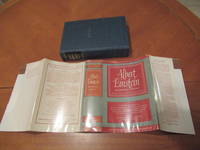
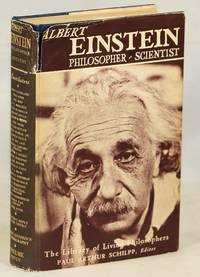
1951053640New York: Tudor Publishing Company 1951. 2nd Edition 1st Printing. Hardcover. Near Fine/Very Good DJ. Xvi 781 Pp. Blue Cloth Gilt. Second Edition With Bibliography Brought Up To 1951. Contains Einstein's Autobiography With Text In Both German And English; And Major Essays On Einstein Including An Important Discussion With Niels Bohr. Book Is Near Fine Gilt Brilliant Hinges Tight Touch Of Rubbing At Corners No Marks Or Bookplates. Dj With Light Usage Bright And Clean <br/> <br/> Tudor Publishing Company hardcover
191438840Braunschweig Vieweg & Sohn 1914. Later full cloth. A stamp to the general titlepage. IX1072;414 pp. textillustrations. "Verhandlungen der Deutschen Physikalischen Gesellschaft im Jahre 1914. Sechzehnter Jahrgang. Hrsg. von Karl Scheel." Einstein paper pp. 820-828. Internally clean and fine. The whole volume offered <br/><br/><em>First edition. In this paper "Contributions to quantum theory" two considerations are given which are interrelated by a common goal inasmuch as it is attempted to derive two of the most importent achievementss of quantum theory viz. Planck's radiation law and Nernst's third law of thermodynamics in a new manner. The proofs do not involve Boltzmann's equation and are thus based enterely on macroscopic thermodynamics. They do introduce however the quantum hupothesis. Einstein points out that the alleged 'proofs' which try to derive the theorem of Nernst from the mere fact that the heat capacity of all substances goes to zero at absolute zero temterature are not genuine. Cornelius Lanczos.- Weil No 67. </em> hardcover
190347072Leipzig Johann Ambrosius Barth 1903. Contemp. hcloth. Handwritten paperlabel on spine. In: "Annalen der Physik. Vierte Folge. Band 11. Herausgegeben von Paul Drude.". VIII1144pp. and 6 plates. Entire volume offered. The Einstein paper: pp. 170-187. Faint signs of dampstains in outer margins on a few leaves. <br/><br/><em>First edition of Einsteins fourth paper. In his paper from 1902 Einstein "says in his introduction that nobody has yet succeeded in deriving the conditions of thermal equilibrium and of the second law of thermodynamics from probability considerations although Maxwell and Boltzmann came near to it. Willard Gibbs is not mentioned. In fact Einstein's paper was written in ignorance of Gibbs paper published 1901. In the present paper Einstein builds the theory on another basis not used by Gibbs namely on the consideration of a single system in course of time later called "Zeit-Gesamtheit" time assembly and proves that this is equivalent to a certain virtual assembly of many systems Gibb's micro-canonical assembly.Einstein at once proceeded to apply his theorems to a case of utmost importance namely to systems of a size suited for demonstrating the reality of molecules and the correctness of the kinetic theory of matter."Walter Alicke. First edition of Einsteins fourth paper. In his paper from 1902 Einstein "says in his introduction that nobody has yet succeeded in deriving the conditions of thermal equilibrium and of the second law of thermodynamics from probability considerations although Maxwell and Boltzmann came near to it. Willard Gibbs is not mentioned. In fact Einstein's paper was written in ignorance of Gibbs paper published 1901. In the present paper Einstein builds the theory on another basis not used by Gibbs namely on the consideration of a single system in course of time later called "Zeit-Gesamtheit" time assembly and proves that this is equivalent to a certain virtual assembly of many systems Gibb's micro-canonical assembly.Einstein at once proceeded to apply his theorems to a case of utmost importance namely to systems of a size suited for demonstrating the reality of molecules and the correctness of the kinetic theory of matter."Walter Alicke. - Weil No. 4 - Boni No 4. </em> hardcover
190249501Leipzig J. A. Barth 1902. 8vo. Bound in contemporary half calf with five raised bands and gilt lettering to spine. In ""Annalen der Physik. Vierte Folge. Band 9.". Entire volume offered. <br/><br/><em>First edition of Einstein's third paper in which he deals with the definitions of temperature and entropy for thermal equilibrium conditions and with the equipartition theorem.The volume contains 2 papers by Max Planck originally published in "Jubelband für H.A. Lorentz" und Jubelband für J. Bosscha: "Ueber die von einem elliptisch schwingenden Ion emitterte und absorbierte Energie;" und "Ueber die Verteilung der Energie zwischen Aether und Materie;" pp. 619-628 und pp. 629-641.Weil No 3. </em> hardcover
191238839Leipzig J.A. Barth 1912. Bound in two contemp. hcalf richly gilt spine and one later full cloth. A library stamp on the first volume. "Annalen der Physik. Vierte Folge. Band 37 und 38. Hrsg. von W. Wien und M. Planck." VIII1048;VIII1064 pp. 58 plates. Einstein papers: pp. 832-38 vol.37 pp. 881-84 Nachtrag vol. 38; pp. 443-458 vol. 38; p. 888 vol. 38; pp. 1059-1064 vol. 38; Planck: pp. 642-656. Internally fine and clean. Both volumes offered. <br/><br/><em>All papers first edition. In the first paper "Thermodynamical derivation of the photochemical equivalence" Einstein calls "the law of photochemical equivalence" the statement that the decomposition of one gram equivalent of any substance by a photochemical proces demands the radiation energy of 'Nhv' where N=the Avogadro number. In this paper he demonstrates how this law is deducible by purely thermodynamical arguments if certain olausible assumotions are made. Lanzos. - The second paper "Concerning the theory of a static gravitational field" states that the 'equivalence hypothesis' permits us to come to very definite conclusions about the behaviour of a static gravitational field. - The next Einstein paper gives an answer to J. Stark as Stark claimed priority to the photochemical equivalence law. - In the last paper "Relativity and Gravitation. Reply to a remark of M. Abraham" Einstein elaborates his answer to the critique of M. Abraham. - Weil Nos 46 1-2 a. 48. - Planck Akademie No 95. </em> hardcover
190646956Leipzig Johann Ambrosius Barth 1906. No wrappers. Extracted from "Annalen der Physik" Vierte Folge. Bd. 20. Pp. 199-206. Clean and fine. <br/><br/><em>First printing of one of the papers for which Einstein was awarded the Nobel Prize in 1921. It was for the papers "Ueber einen die Erzeugung und Verwandlung des Lichtes betreffenden heuristischen Gesichtspunkt" of 1905 and "Zur Theorie der Lichterzeugung. Theory of light emission and absorption the offered item that Einstein received the prize: "for his services to theoretical physics and especially for his discoveryof the law of the photoelectrical effect" - his reward was not based on relativity."The quantum theory has affected virtually every branch of physics. Its earliest and one of its most significant developments was Einstein's application of the theory to what is known as the 'photo-electrical effect'.Einstein explained this effext by suggesting that the classical view that light is emitted in the form of continous waves must be abandoned. The photo-electrical effect could be explained only as an example of quantum action where the waves of light or X-rays are emitted in minute particles or bullets. It is he size of the bullet the wave-lenght of the radiation which determines the number of electrons ejected. It was for this and not for the theory of relativity that Einstein was awarded the Nobel Prize in 1921. Einstein's two fundamental papers on this subject are "Ueber einem Erzeugung." 1905 and Zur Theorie der Lichterzeugung the paper offered here" PMM the note to 391.Weil: 12 with an asterix denoting a major paper - Boni:12. </em> unknown
192338826Berlin Verlag der Akademie der Wissenschaften 1923. 4to. Uncut and partly unopened in orig. wrappers to issue XXVIII-XXIV of "Sitzungsberichte der Preussischen Akademie der Wissenschaften". Wrappers with nicks and tears especilly frontwrapper with marginal loss. Die Energieschwankungen.pp. 350-354. - Bemerkung zu Quantenstatistik.pp. 355-58.- Bietet die Feldtheorie.pp. 359-364. - Zur Theorie der von glühende.pp. 334-348. <br/><br/><em>All four papers first edition. - Planck: Akademie both :145. - Eionstein: Weil No 137. </em> unknown
1918005931Leipzig: Johann Ambrosius Barth 1918. Contemporary half cloth boards. Joints repaired slightly worn; book plate; ink stamp on front flyleaf and title. First Edition. About Very Good. Johann Ambrosius Barth hardcover
1949000017063Evanston Illinois: The Library of Living Philosophers Inc 1949. First edition. Hardcover. Very Good/Very Good. Large 8vo. 4 v-xvi 1 2-781 3 pp. Blue cloth with gold lettering on the front board and spine; brown topstain. Price of $8.50 on the front flap of the dust jacket. Illustrated with a frontispiece portrait of Einstein. Edited by Paul Arthur Schilpp. Volume seven of the Library of Living Philosophers. Boni 512. Contains Einstein's autobiography a bibliography of his work twenty-five scholar's discussions of Einstein's work and achievements with Einstein's replies to these various scholars. Includes essays by Bohr Born Reichenbach Pauli and the well-known essay by Godel in which he argues based upon his solutions to the field equations of general relativity in 1949 that Parmenides was right in that change is an illusion based upon our conceptual framework and our sensory perceptions. A fascinating study of the scientist who so profoundly shaped the twentieth century. A small soil spot on the bottom textblock and two small dog-ears; jacket with a closed tear on its spine panel and light edge wear. The Library of Living Philosophers, Inc hardcover
a97179Braunschweig 1914 first edition. Vieweg. Vol XVI of Berichte der Deutschen Physikalishchen. hardcover very thick octavo. 3/4 dark brown cloth with brown/black marbled boards. Gilt spine lettering. Illustrations. 1072p. plus 414p. Halbonatliches Literaturverszeichnis. Includes: EINSTEIN landmark article pp. 820-828. Other article in same volume by A.Euken J. Franck G. Hertz andothers. Owner stamps on titlepage end of text and on end papers - no other marks. Very nice condition: Near Fine end papers slightly toned. Text Fine. . hardcover
192132432Berlin: Julius Springer 1921. First Edition. First Edition. Einstein Albert. GEOMETRIE UND ERFAHRUNG. Geometry and Experience PP.121-131. Julius Springer Berlin 1921. Erweiterte Fassung des Festvortrages gehalten an der Preussischen Akademie der Wissenschaften zu Berlin am 27. Januar 1921. 8VO. 20PP. With 2 text illustrations. Original printed cream wrapper. First Edition. Weil 115. HBS52699. At 1921 at the Prussian Acedemy's commemorative session honoring Frederick the Great founder of the Academy Einstein delivered this lecture in which he summed up his views on the geometrization of physics and relativity and the relation of mathematics to the external world. Here he gave his famous answer to the puzzling question of why mathematics should be so well adapted to describing the external world: "Insofar as the Laws of Mathematics refer to the external world they are not certain; and insofar as they are certain they do not refer to reality" D.B.S. Vol. 4 p. 330. A fine copy. This is a mature work of Einstein published when he was 42 years old and in the year he received the Nobel Prize in Physics. Julius Springer unknown
192118099New York: Henry Holt and Company 1921. THIRD EDITION. With frontispiece portrait Einstein dated 1920. Blue cloth small tear at top of spine corners slightly worn no dust wrapper; front hinge a bit loose otherwise a very clean copy. From the library of Martin J. Klein professor of the history of science at Yale and the first recipient of the Abraham Pais Prize for the History of Physics. This copy was given to Klein as a gift from his summer program NEH class of 1986 and is signed by 13 of his students. Third edition though the only change is the date on the title page of one of Einstein’s most renowned works intended for readers with a general scientific and philosophical background. Part I treats the special theory of relativity part II the general theory and part III considers the universe as a whole.<br /> <br /> Not in Weil or Boni. Henry Holt and Company unknown
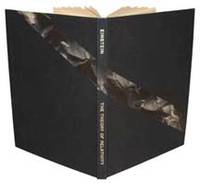
2005CNAP071San Francisco: The Arion Press 2005. Hardcover. New. 10-1/2 by 8 inches eighty pages. Printed by letterpress from lead-alloy type cast in the Mackenzie & Harris typefoundry the formulas were set by hand as was the display type while the prose was composed and cast in Monotype. The types are Modern for the text with special characters as needed for mathematical symbols; Egyptian for the interspersed annotations printed in blue; and Lining Gothic for display. The paper is Schiller a German mouldmade sheet. A pixelated portrait of Einstein is the frontispiece. This image is based on a photograph taken about 1910 rendered as a coarse halftone for reference then handset in units of six-point type: three sizes of solid squares and one centered dot. Over 4000 pieces of type make up the picture. The portrait is printed in gray as is the famous equation: E=mc2 which appears on the flyleaves. The binding is dark blue cloth over boards with a band of tie-dyed Thai paper to create an unusual spatial effect spanning the cover diagonally. The titling on the spine is stamped in silver foil. The edition is limited to 400 numbered copies for sale. One of the great achievements in science Albert Einstein's Theory of Relativity was set forth in two papers published in the Leipzig physics journal Annalen der Physik in 1905. The German text was translated into English in 1923 by W. Perrett and G. B. Jeffrey and this is the version with some later corrections that is presented in this book. <br /> <br /> The Einstein papers are annotated by Richard Muller who has also provided a foreword and afterword. The foreword gives a general overview of the problems Einstein addressed against the background of nineteenth-century physics. The afterword carries the story from the miraculous year of 1905 when Einstein was only twenty-six through the effects of the theory on twentieth-century science. Muller conjectures on the progress of physics had Einstein not appeared and considers his career as a whole its last thirty-five years devoted mainly to an unsuccessful attempt to create a unified field theory. <br /> <br /> ___POSTAGE: International customers please note that additional postage may apply as the standard does not always cover costs; please inquire for details.<br /> <br /> ___Swan's Fine Books is pleased to be a member of the ABAA ILAB and IOBA and we stand behind every book we sell. Please contact us with any questions you may have we are here to help. The Arion Press hardcover
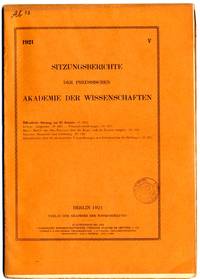
1921395921921. S.ber. Akad. Wiss. Berl. 1921/ 5. - Berlin 1921 8° pp.103-166 orig. Broschur; unaufgeschnittenes frisches Exemplar. The quite rare first edition and first appearance in print rarely found in this fine condition unopened and in original wrappers! During the early years of the second decade of this century Einstein was also concerned to clarify misconceptions about the theory of relativity and to present his views on natural sciences on a less abstract level. Among the efforts in this direction his particular beautiful lecture on "Geometry and Experience" stands out. At the Prussian Academy's commemorative session honouring Frederick the Great founder of the Academy Einstein delivered this lecture in which he summed up his views on the geometrization of physics and relativity and the relation of mathematics to the external world. Here he gave his famous answer to the puzzling question of why mathematics should be so well adapted to describing the external world: "Insofar as the Laws of Mathematics refer to the external world they are not certain; and insofar as they are certain they do not refer to reality. The lecture was extended to book form. cf. W.Alicke. Weil No.114; Schlipp-Shields No.148 unknown
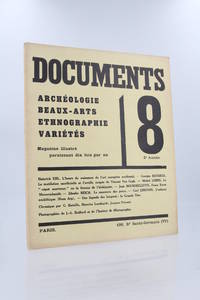
193080796Paris: Calmann Lévy 1930. Fine. Calmann Lévy Paris 1930 22 x 27.50 cm broché First edition of this issue of the important journal dealing notably with archaeology fine arts and ethnography with Georges Bataille and Carl Einstein as principal editors. Very handsome copy. Contributions by Heinrich Ehl: ""L'heure de naissance de l'art européen occidental"" Georges Bataille ""La mutilation sacrificielle et l'oreille coupée de Vincent Van Gogh"" Michel Leiris: ""Le ""caput mortuum"" ou la femme de l'alchimiste"" Jean Bourdeillette: ""Franz Xaver Messerschmidt"" Zdenko Reich: ""Le massacre des porcs"" Carl Einstein: ""L'enfance néoloithique Hans Arp"" Jacques Prévert Maurice Leenhardt. Issue illustrated with photographs by Jacques-André Boiffard Calmann Lévy unknown
a94390Lipezig 1917. first edition. 4to. hardcover. Volume 18 of Physikalische Zeitschrift volume 18 at pp. 121-128. One of Einstein's great achievements in quantum mechanics. 3/4 black cloth and marbled boards gilt spine lettering. Ex-university library with no spine numbers but a bookplate and pocket. Cover board edges rounded at tips. Text clean and binding secure; no other owner marks. no hinges cracked. . hardcover
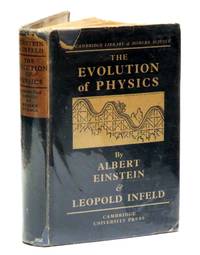
19383393Great Britain: Cambridge University Press 1938. First Edition. Blue cloth over boards. Very good with a few edge smudges previousl bookseller inventory number in pencil otherwise a clean firm edition/G protected by mylar which has been taped to inside flaps thumb print size chip at top edge tide mark on spine and some edgewear. 5" x 7.5" pp. vi 3 4-319. This book was first intended as an opportunity for Einstein to financially aid his friend Infeld. Though it soon became a joy for him to share physics in near layman's words as if the reader were seated before him in a classroom. "The theory of relativity deduces from its fundamental assumption an answer again of a quantitative character: all energy resists change of motion; all energy behaves like matter." p 207. Cambridge University Press unknown
H4005Berlin Akademie der Wissenschaften 1922 In: Sitzungsberichte der Königl.Preuss. Akademie der Wissenschaften Band 1922/2. 4to. S.18-22; S.448-449. Weitere Berichte von: Laue v. und Gordon W.: Ein Verfahren zur Bestimmung der Wärmeleitfähigkeit bei Glühtemperaturen. S.118-126. Laue von: Die Bedeutung des Nullkegels in der allgemeinen Relativitätstheorie. S.127-136 Planck Max: Über die freie Energie von Gasmolekülen mit beliebiger Geschwindigkeitsverteilung. S.63-71 u.a. Halbleinenband der Zeit leicht berieben Bibl.-Nr.am Rücken Original-Broschur miteingebunden unaufgeschnitten gutes Exemplar. unknown
B34915-SCCambridge University Press. Collectible - Good. Great Britain: Cambridge at the Univ Press 1938. 1st UK 1st issue with gold lettering on spine and both endpapers present. Hardcover 12mo 319 pgs. Medium blue cloth gold gilt on spine. B/w plates and illustrations. Near very good book in a fair dust jacket. Corners and spine ends lightly bumped and worn. Contents clean and binding sound. Bookplate to front endpaper with writing in Latin name of Andrzei Falkiewicz written in and Alberto H R Ball Rectore at bottom edge. Jacket is edgeworn chipped and torn. Rear panel and spine are toned. Orig price 8s 6d on front flap. stem science physics Inquire if you need further information. Cambridge University Press hardcover
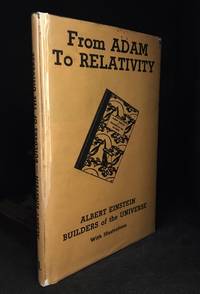
129894Los Angeles: U.S. Library Association Inc. 1932 1st edition. Hardcover 96pp. Near fine in very good dust jacket. Blue and white patterned cloth in a printed yellow dust jacket. Illustrations. The dust jacket is price-clipped and has minor edgewear. This is as nice a copy as you will ever see. From ADAM to RELATIVITY. The construction of the world and how its ideas have changed told by the great thinkers in their own words with illustrations. Science. U.S. Library Association, Inc. Hardcover
190238799Leipzig Ambrosius Barth 1902. Contemp. hcloth. First hinge broken. = "Annalen der Physik. Vierte Folge. Band 9." VIII1344 pp. and 5 plates. The Einstein Paper: pp. 417-435. Internally clean and fine. The whole volume offered. <br/><br/><em>First edition of Einstein's third paper. - Weil No 3. - The volume contains 2 papers by Max Planck originally published in "Jubelband für H.A. Lorentz" und Jubelband für J. Bosscha: "Ueber die von einem elliptisch schwingenden Ion emitterte und absorbierte Energie;" und "Ueber die Verteilung der Energie zwischen Aether und Materie;" pp. 619-628 und pp. 629-641. </em> hardcover
190947376Braunschweig Friedrich Vieweg und Sohn 1909. 8vo. Bound in contemporary half calf with gilt lettering to spine. In "Verhandlungen der Deutsche Physikalische Gesellschaft" 11 Jahrgang 1909. Reprinted same year in "Physikalische Zeitschrift 10". Bound with "Berichte der Deutschen Physikalischen Gesellschaft" 7 Jahrgang 1909. Capitals and hindges with wear. Internally very fine and clean. Pp. 482-500. Entire volume: 2 749 3 VII 450 pp. <br/><br/><em>First printing of Einstein's famous lecture in which he anticipated the discovery of black-body radiation and famously stated that: "the next phase in the development of theoretical physics will bring us a theory of light which may be regarded as a sort of fusion of the undulatory and emission theories of light" The present paper Pp. 482-3. He furthermore stated that the electromagnetic fields that constitute light will no longer appear to be states of a hypothetical medium but rather independent entities emitted by the sources of light exactly as in the Newtonian emission theory of light. The paper was delivered as a lecture before the 81st assembly of the 'Gesellschaft Deutscher Naturforscher' in Salzburg on 21st September 1909.The occasion was important for Einstein since he for years had been working in scientific exile. Among those who attended Einstein's lecture were some of the world's foremost physicists such as; Max von Laue Max Born Arnold Sommerfeld. All published papers of their own in the present volume. Weil No. 30. </em> unknown
191450425Leipzig: Johann Ambrosius Barth 1914. 1 Einstein Albert 1879-1955 and A.driaan D.aniël Fokker 1887-1972. Die Nordströmsche Gravitationstheorie vom Standpunkt des absoluten Differentialkalküls. In Annalen der Physik 44 10: 321-328. 2 Born Max 1882-1970. Zur Raumgitter theorie des Diamanten. In Annalen der Physik 44 12: 605-642. 3 Schrödinger Erwin Rudolf Josef Alexander 1887-1961. Zur Dynamik elastisch gekoppelter Punktesysteme. In Annalen der Physik 44 14: 916-934. Leipzig: Johann Ambrosius Barth 1914. </p> <br /> <br /> <p>Whole volume: viii 1272 pp. 22 plates Numbered Taf. I-XXII. Taf. I-IX: b/w/ silver photos; Taf. XI w/ one b/w silver photo; Taf. XII is folding and XIII XIV are b/w silver photos; Taf. XV and XVI are large folding tables; Taf. XVII XVIII XIX b/w/ silv.photos; and Taf.XX--XXII are photographs of X-ray images. Figs. Text-illust. 210 x 140 mm. Red cloth gilt lettering on spine. Very good. Along the margin of p. 802 written in pencil are the words: "Mallock R.S. 1910" probably written in Lord Rayleigh's hand most likely in reference to the title "The dampening of sound by frothy liquids" by A. Mallock in Proc. R.S. Lond ser. A vol. 84: 391-94. London 1911. </p> <br /> <br /> <p> A.D. Fokker 1887-1972 was a Dutch physicist and cousin to aeronautical engineer Anthony Fokker 1890-1939. He was musically inclined having invented the 31EDO pipe organ. He earned his doctorate in 1913 continuing his studies with Albert Einstein Ernest Rutheford 1871-1937 and William Bragg 1862-1942. In his 1913 thesis he derived the Fokker-Planck equation with Max Planck 1858-1947. Fokker made contributions to special relativity and general relativity particularly the effects of the curvature of space-time formally called "geodetic precession". Wikipedia.</p> . Johann Ambrosius Barth unknown