Einstein, AlbertBiblio.com
850 résultats
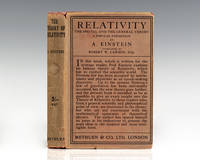
1920131697London: Methuen and Co 1920. First edition of the scientist's ground breaking work. Octavo original red cloth frontispiece of the author and with five diagrams. Near fine in the rare original dust jacket with loss of section of rear panel and flap. Tape repairs to verso. Translated by Robert W. Lawson. Scarce in the original dust jacket. Housed in a custom half morocco clamshell box by the Harcourt Bindery. It can hardly be disputed that the theories put forth in this book are among the most important in the history of modern science. "The imprint of Einstein's work on the different areas of physical science is so large and varied" writes Gerald Holton in a recent assessment "that a scientist who tries to trace it would be hard put to know where to start" Simmons The Scientific 100. Methuen and Co hardcover
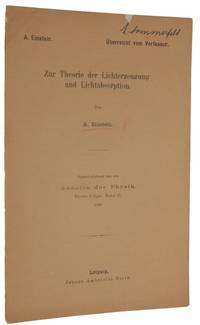
19066413Leipzig: Johann Ambrosius Barth 1906. First edition. <p>First edition a very rare author's presentation offprint with 'Überreicht vom Verfasser' from the library of the eminent German physicist Arnold Sommerfeld of this important sequel to Einstein's revolutionary 1905 paper introducing the light-quantum hypothesis</p> <p>- the foundation of quantum theory. In this follow- up work Einstein further develops the implications of his light-quantum hypothesis arguing that Max Planck's black-body radiation law implicitly relies on the same assumption: that light itself consists of discrete quanta of energy.</p>. <p>EINSTEIN ON HIS LIGHT-QUANTUM HYPOTHESIS</p> . <p>First edition very rare author's presentation offprint "Überreicht vom Verfasser" from the library of the great German physicist Arnold Sommerfeld of this brilliant follow-up to Einstein's landmark 1905 paper on the photoelectric effect for which he was awarded the 1921 Nobel Prize in physics. "Thomas Kuhn has argued that it is not to Planck in 1900 but to Einstein in 1905 that we owe the origins of quantum theory" Cassidy. In the 1905 paper 'On a heuristic point of view concerning the production and transformation of light' Einstein had explained the photoelectric effect-the emission of electrons from a metal when irradiated by light-by making the revolutionary proposal that light rather than consisting of continuous waves was instead made up of discrete particles of energy "light quanta" which transferred their entire payload of energy to an electron on impact. In the 1905 paper Einstein made use of Planck's formula for blackbody radiation which had introduced the concept of energy quantization. "In a companion paper published in 1906 offered here Einstein exposed appeal to the quantum as fundamentally counter to the ethos of classical physics: 'the theoretical bases on which Planck's radiation theory rests are different from those of Maxwell's theory'. Planck had not initially intended to quantify light-radiation itself but Einstein demonstrated that his own 'light-quantum hypothesis' was implicit in Planck's earlier work" Honner p. 31. "At first Einstein believed that the light-quantum hypothesis was merely 'heuristic': light behaved only as if it consisted of discontinuous quanta . In his 1906 paper Einstein used his statistical mechanics to demonstrate that when light interacts with matter Planck's entire formula can arise only from the existence of light quanta-not from waves" Cassidy. As Einstein stated when he published the 1905 paper "Planck's theory of radiation seemed to me in a certain respect the antithesis of my own. New considerations which are presented in section 1 of this paper demonstrated to me however that the theoretical bases on which Planck's radiation theory rests are different from those of Maxwell's theory and of electron theory. The difference furthermore is precisely that Planck's theory implicitly makes use of the light-quantum hypothesis" p. 199 of the present paper translation from Kuhn p. 182. Later in the paper p. 203 Einstein is forced to make the following assumption: "Although Maxwell's theory is not applicable to elementary resonators the average energy of such a resonator in a radiation field is the same as that which one would compute from Maxwell's theory". "That statement marks the emergence of the basic paradox of the old quantum theory. The theory has recourse to both Maxwell's equations and those of classical mechanics but its further formulation is incompatible with one or both of those classical theories. Other physicists were to exploit the resulting inconsistency as an argument against any form of quantum discontinuity and Einstein himself was deeply disturbed by it . But neither he nor anyone else was successful in finding a classical resolution of the quantum paradox. When two decades later Bohr and others found a way to resolve it Einstein was unable to accept their fundamentally non-classical interpretation" Kuhn pp. 184-185. RBH lists 4 other copies: in the offprint collections of Einstein himself Christie's June 17 2008 lot 100 Richard Green Christie's June 17 2008 lot 101 Hans Albert Einstein Christie's June 14 2006 lot 264 and Harvey Plotnick Christie's October 4 2002 lot 105. This copy was presented by Einstein to one of the leading physicists of the time surely hoping to make himself known in the scientific world when he was still a technical expert in the Swiss Patent Office.</p> <br /> <p>Provenance: Arnold Sommerfeld 1868-1951 his signature and characteristic numbering in red pencil '8' on front cover. "The son of a physician Sommerfeld was educated at the University of Königsberg. After teaching briefly at the universities of Göttingen Clausthal and Aachen he was appointed professor of physics at the University of Münich in 1906. Sommerfeld should have retired in 1936 in favour of his pupil Werner Heisenberg. Opposition from the Nazi party to Heisenberg's appointment prolonged Sommerfeld's tenure and it was not in fact until late 1939 that he finally retired to be succeeded not by Heisenberg but by Wilhelm Müller a Nazi aerodynamicist without a single publication in physics to his credit. Although Sommerfeld and Heisenberg were not Jewish they were regarded by the Nazis as Jewish sympathizers. Sommerfeld however survived the war and returned to his Münich chair in 1945 continuing to work at physics until he died in a car accident in 1951" Oxford Reference. "Arnold Sommerfeld was one of the most distinguished representatives of the transition period between classical and modern theoretical physics. The work of his youth was still firmly anchored in the conceptions of the nineteenth century; but when in the first decennium of the century the flood of new discoveries experimental and theoretical broke the dams of tradition he became a leader of the new movement and in combining the two ways of thinking he exerted a powerful influence on the younger generation. This combination of a classical mind to whom clarity of conception and mathematical rigour are essential with the adventurous spirit of a pioneer are the roots of his scientific success while his exceptional gift of communicating his ideas by spoken and written word made him a great teacher" Max Born p. 275. </p> <br /> <p>"Einstein started to study black-body radiation well before 1905. Mach's Wärmelehre which Einstein read in 1897 or shortly thereafter contains two chapters on thermal radiation culminating in a discussion of Kirchhoff's work. Kirchhoff showed that the energy emission spectrum of a perfectly black body defined as one absorbing all incident radiation at a given temperature is a universal function of the temperature and wavelength. He inferred that equilibrium thermal radiation in a cavity with walls maintained at a certain temperature behaves like radiation emitted by a black body at the same temperature. </p> <br /> <p>"H. F. Weber Einstein's physics professor at the ETH attempted to determine the universal black-body radiation function. He made measurements of the energy spectrum and proposed an empirical formula for the distribution function . anticipating Wien's formulation of the displacement law for black-body radiation. Weber described his work in a course at the ETH given during the winter semester of 1898-1899 for which Einstein registered. </p> <br /> <p>"By March 1899 Einstein had started to think seriously about the problem of radiation. In the spring of 1901 he was closely following Planck's work on black-body radiation. Originally Planck had hoped to explain irreversibility by studying electromagnetic radiation but came to recognize that this could not be done without introducing statistical elements into the argument. In a series of papers published between 1897 and 1900 Planck utilized Maxwell's electrodynamics to develop a theory of thermal radiation in interaction with one or more identical charged harmonic oscillators within a cavity. He was only able to account for the irreversible approach to thermal equilibrium by employing methods analogous to those Boltzmann used in kinetic theory. Planck introduced the notion of 'natural' that is maximally disordered radiation which he defined in analogy with Boltzmann's definition of molecular chaos . </p> <br /> <p>"Planck calculated the average energy of an oscillator by making assumptions about the entropy of the oscillators that enabled him to derive Wien's law for the blackbody spectrum which originally seemed well supported by the experimental evidence. But by the turn of the century new observations showed systematic deviations from Wien's law for large values of temperature. </p> <br /> <p>"Planck in 1900 presented a new energy density distribution formula that agreed closely with observations over the entire spectrum . this expression now known as Planck's law or Planck's formula involves a new constant h later called Planck's constant. To derive this formula Planck calculated the entropy of the oscillators using what Einstein later called 'the Boltzmann principle': S = k log W where S is the entropy of a macroscopic state of the system the probability of which is W and k is 'Boltzmann's constant'. Following Boltzmann Planck took W proportional to the number of 'complexions' or possible microconfigurations of the system corresponding to its state. He calculated this number by dividing the total energy of the state into a finite number of elements of equal magnitude and counting the number of possible ways of distributing these energy elements among the individual oscillators. If the size of the energy elements is set equal to hv where v is the frequency of the oscillators an expression for the entropy of an oscillator results that leads to Planck's formula .</p> <br /> <p>"In the 1905 paper Einstein showed that the expression for the volume dependence of the entropy of radiation at a given frequency is similar in form to that of the entropy of an ideal gas. He concluded that 'monochromatic radiation of low density behaves thermodynamically as though it consisted of quanta of energy which are independent of one another' . Einstein opened the paper by pointing out the 'fundamental formal distinction' between current theories of matter in which the energy of a body is represented as a sum over a finite number of degrees of freedom and Maxwell's theory in which the energy is a continuous spatial function having an infinite number of degrees of freedom. He suggested that the inability of Maxwell's theory to give an adequate account of radiation might be remedied by a theory in which radiant energy is distributed discontinuously in space. Einstein formulated 'the light quantum hypothesis' that the energy of a light ray emitted from a point is not continuously distributed over an ever increasing space but consists of a finite number of energy quanta which are localized at points in space which move without dividing and which can only be produced and absorbed as complete units . Einstein asserted that Planck's derivation implicitly assumes quantization of the energies of charged oscillators" Papers pp. 134-142.</p> <br /> <p>"In 1905 Einstein could not make sense of Planck's derivation of Planck's law. In fact he seems to have deliberately avoided any reference to Planck's law in his reasoning . The following year Einstein ceased to avoid Planck's law as he discovered a new way to justify Planck's formal steps toward this law. If a resonator of frequency ν can only emit or absorb full light quanta Einstein reasoned then its energy can only be an integral multiple of hν and Planck's characterization of the complexions for a set of resonators receives a dynamical justification. The only remaining difficulty is that Planck's derivation of the relation between the average energy of a resonator and the spectral density of radiation becomes void. Einstein expressed the need of a new derivation based on some quantized dynamics for the interaction between matter and radiation. Ten years elapsed however before he filled the gap" Janssen & Lehner p. 126. </p> <br /> <p>In the final section of this paper Einstein gives a new application of his 'heuristic principle' to the explanation of the 'Volta effect' - that when two different metals are placed in contact a potential difference between them is observed.</p> <br /> <p>BRL 12; Weil 12. Shields "Writings of Albert Einstein" in Albert Einstein: Philosopher-Scientist 1948 pp. 689-758 no. 13; also included in Shields' "Chronological list of principal works" on p. 757. The Cambridge Companion to Einstein Janssen & Lehner eds. 2014. The Collected Papers of Albert Einstein Vol. 2: The Swiss Years: Writings 1900-1909. Born 'Arnold Johannes Wilhelm Sommerfeld 1868-1951' Obituary Notices of Fellows of the Royal Society 8 1952 pp. 275-296.</p> <br /> <p>Cassidy "Einstein on the Photoelectric Effect." Einstein: Image and Impact. American Institute of Physics n.d. Honner The Description of Nature 1988. Kuhn Black-Body Theory and the Quantum Discontinuity 1894-1912 1978. Pais Subtle is the Lord 1982.</p> <br/> <br/> 8vo 222 x 144 mm pp. 199-206. Original printed wrappers small chip from upper edge of front wrapper. Johann Ambrosius Barth unknown
1930110352New York: Albert & Charles Boni 1930. First edition of this Einstein biography written by Rudolf Kayser a German literary historian and husband to Albert Einstein's stepdaughter Ilse under the pseudonym Anton Reiser. Octavo original cloth frontispiece of Einstein. Signed and dated by Einstein on the front free endpaper in the year of publication "Albert Einstein New York 1930." In near fine condition. Housed in a custom half morocco clamshell box. Albert Einstein developed the general theory of relativity one of the two pillars of modern physics alongside quantum mechanics. Einstein's work is also known for its influence on the philosophy of science. Einstein is best known in popular culture for his mass–energy equivalence formula E = mc2 which has been dubbed "the world's most famous equation". He received the 1921 Nobel Prize in Physics for his "services to theoretical physics" in particular his discovery of the law of the photoelectric effect a pivotal step in the evolution of quantum theory David Bodanis. Albert & Charles Boni hardcover
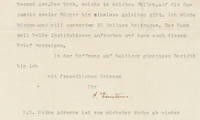
19413262211/9/41. <blockquote><p>A generous demonstration by Einstein of his loyalty to friends and belief in the importance of music</p></blockquote><p>Dr. Theodor Rosenheim was a physician at the famed Medical University Clinic of the Charité in Germany in the 1880s. He was primarily concerned with the physiology and pathology of the digestive tract. He published an early textbook on the “Pathologie und Therapie der Krankheiten des Verdauungsapparatesâ€. Rosenheim was one of the first in Germany to describe and publish on ulcerative colitis. He was intensively involved in the technical development of esophagoscopy and gastroscopy which at that time were only possible with rigid instruments. The Rosenheim line which was named after him described the largest diagonal diameter of the gastric percussion figure.</p><p>Rosenheim was appointed professor extraordinarius at Berlin University in 1921. He also founded a polyclinic and a private sanatorium for stomach and intestinal patients. He was well respected in Berlin and his private practice developed successfully with a large circle of patients including Albert Einstein.</p><p>Theodor’s wife was Hedwig Rosenheim and their daughter Kate was a hero of the Holocaust. She helped several thousand children from Jewish families to escape from Germany. She personally accompanied the legendary Kindertransporte to England among other places. She travelled to the USA in 1936 to negotiate directly with the aid organizations there. She then returned to Germany to actively continue the aid campaigns. Theodor died in 1939. Käte Rosenheim was able to flee Berlin together with her 72-year-old mother Hedwig Rosenheim on January 23 1941. They reached Havana Cuba via France Spain and Portugal. From there they were able to continue to New York where they arrived on April 1 1941.</p><p>Albert Einstein was an accomplished violinist and music lover who was inspired by music in his scientific work. He often said that he would have been a musician if he hadn't pursued science. Another music lover was Hedwig Rosenheim. She had escaped Germany without her possessions especially her precious musical instruments. Upon arrival in the United States she contacted the old family friend Albert Einstein hoping he could help her get a flute either for herself or another escapee one who may have agreed to look for her. Einstein was sympathetic and rose to the occasion. He even contributed some of his personal funds to secure the flute.</p><p><strong>Typed letter signed</strong> his vacation house in Knollwood at Saranac Lake N.Y. September 11 1941 to his old friend Mrs. Hedwig Rosenheim in New York City.<em> “ The matter of i.e. the quest for the flute shall not fail. First one should know what the committee is giving out – or loaning. Second there is the Hebrew Free Loan Society 108 Second Ave. New York which in such cases provides interest-free loans in exchange for the backing of two guarantors. I will serve as a guarantor and contribute 20 dollars on top of that. The man should visit both institutions and can show this letter. In the hope of receiving a positive report soon I remain with warm greetings your A. Einstein.â€</em> <em>“PS. Starting next week my address will again be in Princeton.â€</em> The committee he referred may have been the American Jewish Joint Distribution Committee though there were others as well.</p><p>It shows a lot about Einstein - his generosity his continued concern for old friends who had escaped from Germany and love for music - that he volunteered to make a personal financial contribution to obtaining the flute.</p><p><img class=""alignnone wp-image-25018 size-post-window"" src=""https://cdn.raabcollection.com/wp-content/uploads/20231204144051/Folder-site-11-1600x1327.jpg"" alt="""" width=""1600"" height=""1327"" /></p> unknown
1952720911952. Rare original black and white silver gelatin photograph of Albert Einstein. Signed "A Einstein 52." Full-length group portrait showing Albert Einstein standing with Hadassah National President Rebecca Beldner Shulman and others at his Princeton home in June of 1952 during a celebration marking the commencement of building of the Hadassah-Hebrew University Medical Center in Jerusalem. The photograph measures 8 inches by 9.5 inches. Double matted and framed. The entire piece measures 19 inches by 20.5 inches. An exceptional piece. Albert Einstein developed the general theory of relativity one of the two pillars of modern physics alongside quantum mechanics. Einstein's work is also known for its influence on the philosophy of science. Einstein is best known in popular culture for his mass–energy equivalence formula E = mc2 which has been dubbed "the world's most famous equation". He received the 1921 Nobel Prize in Physics for his "services to theoretical physics" in particular his discovery of the law of the photoelectric effect a pivotal step in the evolution of quantum theory David Bodanis. unknown
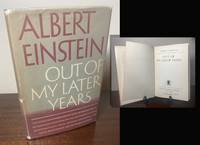
195033985New York: The Philosophical Library 1950. 1st Edition. 1st Edition. First Edition. Nicely Signed in fountain pen in black ink on the Title page and dated 1953.<br /> Original black cloth with gilt stamping on spine and front with Einstein's signature. A very good grey and maroon unclipped dustwrapper with some browning at the edges and some minor imperfections."1" at the base of the copyright page present<br /> Custom brown slipcase with E=MC2 embossed. <br /> <br /> Collects 60 essays some of which are published for the first time and on a wide variety of topics: science of course but also many societal issues such as education religion race relations war and peace and the Jewish people. An extremely nice copy. Weil p.42. <br /> <br /> Rare and desirable signed. The Philosophical Library unknown
19162364Braunschweig: Druck und Verlag von Friedr Vieweg and Son 1916. First edition. Original wrappers. Very Good. FIRST PRINTING IN ORIGINAL WRAPPERS OF ONE OF EINSTEIN'S MAJOR WORKS: HIS FIRST PAPER ON THE DERIVATION OF PLANK'S LAW AND PROVIDING THE THEORETICAL BASIS FOR THE LASER. "Einstein commended the 'unparalleled boldness' of Planck's derivation of 1900 meaning not only the problem itself but also the fact that it was based on assumptions that were not entirely free of contradictions. Einstein now succeeded in the first of two papers in eliminating that flaw. More interesting than the derivation itself was the general character of his methods. Einstein proceeded from Niels Bohr's basic--and by then well tested--assumption that the electrons within an atom occupy a number of discrete energy states and are able through emission or absorption of radiation to pass from one of those states to another. Added to this was an assumption of thermodynamic equilibrium between radiation field and atom as well as a consideration of the 'classical' limiting case at high temperatures--and there was Planck's formula. This brief argument. also covers emission stimulated by the radiation field; thus the formulas already by implication contain the theory of the laser though it was to take nearly half a century to be realized" Folsing Albert Einstein 389. Weil 85.<br /> <br /> The "implication" containing the theory of the laser was more fully developed in his companion paper "On the Quantum Theory of Radiation" published a few weeks later. In the first paper Einstein wrestled with the concept that the atomic emission of radiation could be a directed process; in the second paper he convincingly demonstrates that this is indeed the case.<br /> <br /> IN: Verhandl. D. Deutch. Phys. Ges. Vol 18 pp. 318-323. Braunschweig: Druck und Verlag von Friedr. Vieweg and Son 1916. Octavo original wrappers; housed in custom half leather chemise. One thread literally resewn on wrappers a little creasing and soiling. A beautiful copy. RARE IN ORIGINAL WRAPPERS. Druck und Verlag von Friedr Vieweg and Son unknown
1950001681New York: Philosophical Library 1950. 1st Edition . Cloth. Near Fine/Very Good. 8vo - over 7¾ - 9¾" tall. First edition of Einstein's book of essays and speeches. 8 vo. 282 pp. Full cloth. Signed by him on the title page: "A. Einstein. 51." Near fine with a little rubbing to the spine extremities in a very good price-clipped jacket. The jacket's spine is toned else near fine without tears or any loss. No ownership marks. Interior clean. Very rare with Einstein's signature. Accompanied by a letter and certificate of authenticity. <br/> <br/> Philosophical Library hardcover
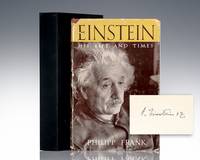
1947147192New York: Alfred A. Knopf 1947. First edition of this classic work by Frank a famed contemporary of Einstein. Octavo original cloth. Signed by the subject in the year of publication on the front free endpaper "A. Einstein 47." Translated from a German manuscript by George Rosen. Edited and Revised by Shuichi Kusaka. Housed in a custom half morocco slipcase. Rare and desirable signed by Einstein. Much has been written about Albert Einstein technical and biographical but very little remains as valuable as this unique hybrid of a book written by Einstein's colleague and contemporary. Both rich in personal insights and grounded in a deep knowledge of twentieth-century science Phillip Frank's biography anchors the reader with a lucid overview of physics and draws an intimate portrait of the Nobel Prize–winner. Very good in a very good dust jacket name to the front pastedown side edges. Alfred A. Knopf hardcover
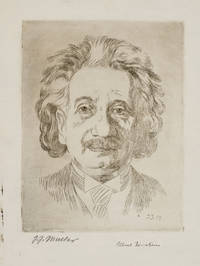
1933H-217<p>A stunning portrait etching of one of the greatest human minds signed by both the artist J J Muller and Albert Einstein.</p><p>The sketch is signed in ink by Einstein and by the artist J. J. Muller in pencil n.p. 1933. Plate 195 x 150mm; sheet 253 x 200mm.</p><p>A true collector's copy of a beautiful signed portrait.</p>
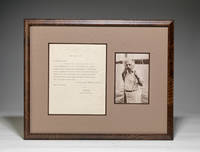
19461206241946. Signed. EINSTEIN Albert. Typed letter signed. Princeton April 3 1946. Single sheet of gray letterhead measuring 8-1/2 by 11 inches; p. 1. Matted and framed with a portrait entire piece measures 19 by 15-1/2 inches. $9500.Original typed letter signed by Albert Einstein thanking his friend Dr. Isadore Held for his birthday wishes as well as for sending a new book that Einstein found both ""extraordinarily enlightening"" and humorous. Text in German.The letter typed on Einstein's personal letterhead with his name and Princeton address blindstamped at the top reads in full translation: ""3 April 1946. Dear Mr. Held: I would like to express my sincere thanks for your birthday wishes and for the sending of the last work of this wonderful contemporary. I have already read quite a bit and find that it is extraordinarily enlightening. His penetration into the mentality of far-off times and attitudes toward thinking is most remarkable and his humor no less. With fond greetings to you and your dear wife. Yours signed Albert Einstein."" This letter was written to Austrian-American medical Dr. Isadore Held who was friends with Einstein since at least 1938. Held and Einstein shared numerous interests particularly related to Jewish humanitarian relief and Israel. At Held's death Einstein wrote to his widow that ""True goodness emanated from this man who alleviated the harshness of human relations and who understood and forgave all weaknesses As a role model for his fellow men he was the best that a human being can be."" Einstein was not a huge fan of birthdays though he happily acknowledged well wishes from friends. Just before turning 65 Einstein crankily said to a New York Times interviewer: ""What is there to celebrate Birthdays are automatic things. Anyway birthdays are for children."" In a 1954 letter to physicist Hans Mühsam Einstein described his birthday as ""a natural disaster a shower of paper full of flattery under which one is drowned."" Einstein was generally quite shy and did not like to be the center of attention particularly from strangers obsessed with his accomplishments and fame. However well-meaning letters and small gifts like the book given by Held were always welcomed and graciously accepted by Einstein. Original mailing creases and a few pinpoint holes along top edge possibly from stapling. About-fine condition. unknown
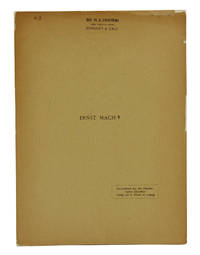
1916140941831Leipzig Germany: S. Hirzel 1916. First separate edition. First separate edition. 4 pp. Illustrated with portrait of August Mach from photograph. Publisher's original printed wrappers. Very Good with some small chips to fragile wrappers faint crease to top of front wrap contents toned with age. This copy belonged to Hans Albert Einstein Albert Einstein’s oldest son with his inkstamp at top of front wrapper; likely a presentation copy from his father. Neatly written at top of front wrapper is "43" and date "14.III.16." OCLC/WorldCat locates four copies two at the University of Toronto one at the Smithsonian Institution and one at the American Philosophical Society. Weil 89.<br /> <br /> <p>Very rare author's offprint stating "Uberreicht vom Verfasser" of the eulogy by Albert Einstein for fellow physicist Ernst Mach as first published in Physikalischen Zeitschrift. A noted scientist in his own right Mach is best known for the concept of "Mach's principle" which asserts that an entity's inertial mass is determined by all the other masses in the universe. Einstein in fact coined the phrase "Mach's principle" and his application of it had major ramifications for the development of his theory of general relativity Einstein in 1918 labeling it one of the "three pillars" of general relativity. S. Hirzel unknown
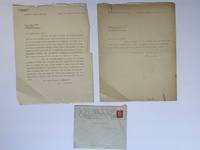
19311403337Potsdam Germany 1931. Two letters by Albert Einstein. The first is a single-paged autograph letter signed by Albert Einstein with one horizontal fold and one vertical fold. In Very Good condition . Measuring 22.5 x 28.5 cm. Letter accompanied with mailing envelope both with matching paper-clip rust stain. Letter with some light wear along edges small staining to lower corner.<br /> <br> <br /> <br> <br /> Addressed to G. W. Meyer and dated 8 Oktober 31 in Potsdam the Letter reads in full: "Sehr geehrter Herr! Indem ich Ihnen für die Uebersendung des Buches von Henry George bestens danke sende ich Ihnen anliegend die gewünschte Meinungsäusserung mit der Bitte um Weiterleitung an Mrs. Evans. Mit ausgezeichneter Hochachtung" and signed in ink "A. Einstein". He thanks Meyer for serving as an intermediary in getting a book to him and for forwarding the enclosed letter.<br /> <br> <br /> <br> <br /> The second letter is a typed copy of Einstein's previously enclosed letter presumably made by Meyer before he passed the original on to Evans.<br /> <br> <br /> <br> <br /> Addressed to R. W. Evans and dated 8.10.1931 in Potsdam the letter discusses Henry George's economic theory of poverty and land nationalization compares it to Franz Oppenheimer's work and proposes questions to be asked. Presumably he was sent a copy of Henry George's Progress and Poverty. First published in 1879 it sparked the Progressive Era discussing the paradox of increasing inequality and poverty amid economic and technological progress as well as the economic value of land.<br /> <br> <br /> <br> <br /> Consignment. Shelved Case 3. The Letter reads in full: "Sehr geehrte Mrs. Evans!<br /> Ich habe das Buch von Henry George zum grössten<br /> Teil mit ausserordentlichem Interesse gelesen und glaube dass es in der Hauptsache einen unanfechtbaren Standpunkt vertritt insbesondere was die Ursache der Armut betrifft. Nie in diesem Buch vertretenen Ansichten stimmen soweit ich es beurteilen kann vollkommen mit den Resultaten des zeitgenössischen Professors Franz Oppenheimer überein der sie offenbar selbständig herausgefunden hat. Nicht einverstanden bin ich mit der Theorie des Zinses.<br /> Mit dem vorgeschlagenen Heilmittel der Verstaatlichung des Bodens und der Bodenschätzung scheint mir allerdings mehr ein Problem als eine Lösung gegeben zu sein. Soll z. Beispiel ein Boden Eigentum der Gemeinschaft das darauf hingestellte Haus aber Privateigentum sein Jedenfalls ist es schon von höchster Wichtigkeit dass das Wesen des Uebels klar aufgezeigt ist. Schon darum wäre es wichtig wenn das Buch die ihm gebührende Beachtung fände.<br /> Mit ausgezeichneter Hochachtung<br /> gez. A. Einstein." 1403337. Shelved Dupont Bookstore. unknown
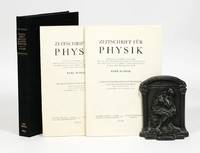
19242905Berlin: Julius Springer 1924. First edition. original wrappers. Very Good. FIRST EDITION IN ORIGINAL WRAPPERS of the presentation of "Bose-Einstein statistics." “In 1924 Bose found a way to derive Planck’s equation for black body radiation using a statistical approach based entirely on the idea that light is made up of tiny particles photons. This echoed the statistical mechanics approach of Ludwig Boltzmann to the behaviour of gases but using a different statistical rule; it derives black body radiation entirely in quantum terms without using the idea of electromagnetic radiation at all. Bose wrote a paper about his discovery and sent it to Albert Einstein who immediately saw its significance translated it into German and arranged for its publication in the prestigious Zeitschrift für Physik. Einstein developed the idea to apply to other kinds of particle not just to a ‘gas’ of photons which is why this approach is usually referred to as ‘Bose-Einstein statistics’. Paul Dirac coined the name ‘bosons’ for particles which obey Bose-Einstein statistics" Gribbin Q is for Quantum.<br /> <br /> Particle Physics: One Hundred Years of Discoveries: “Discovery of new statistical counting rules for light quanta and a new derivation of Planck’s radiation law. Known as Bose-Einstein quantum statistics for particles with integer spins.â€<br /> <br /> WITH a follow-up paper by Bose: "Wärmegleichgewicht im Strahlungsfeld bei Anwesenheit von Materie": "Bose's first paper in 'Zeitschrift für Physik' was followed by another that was also translated by Einstein and published during 1924. In it Bose provided a general statistical treatment of emission and absorption processes for electromagnetic radiation in equilibrium with matter. This paper was accompanied by a note by Einstein expressing serious doubts about the method. In January 1925 Bose wrote to Einstein from Paris that he was working on a paper he felt would remove these doubts. But it seems never to have been completed" DSB.<br /> <br /> Plancks Gesetz und Lichtquantenhypothese. IN: Zeitschrift für Physik Vol 26 No. 3 August 1924 pp. 178-81. Berlin: Julius Springer 1924. “Wärmegleichgewicht†Vol 27 No. 5/6 September 1924 pp. 384-93. Octavo original wrappers. “Planks Gesetz†with small closed tear at rear wrapper edge; otherwise fine condition; “Wärmegleichgewicht†with small chip to base of front wrapper. SCARCE in original wrappers. Julius Springer unknown
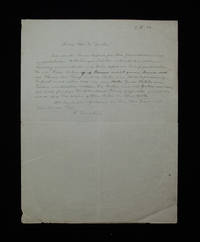
192468960Berlin 1924. Berlin: 1924.<br> <br> Full Description:<br> <br> EINSTEIN Albert. Autograph Letter Signed. Berlin: 9. IX September 1924.<br> <br> Autograph letter signed "A. Einstein" to Mr. Zeisler. One quarto page 11 x 8 1/2 inches; 280 x 217 mm. Manuscript letter on recto verso blank. With one horizontal center crease and one vertical center crease as expected in a letter. A few other light creases. Some minor chipping along edges. A closed split along horizontal crease not affecting manuscript. Overall very good.<br> <br> This letter with text in German is addressed to "Herr Dr. Zeisler" Sigmund Zeisler an German-Jewish U.S. attorney born in Austria. He was known for his defense of radicals in Chicago in the 1880s also known as the Haymarket Affair. His wife was the famous concert pianist Fannie Bloomfield Zeisler. Some unproven sources have said that Zeisler was Einstein's lawyer but regardless it is known that he and Einstein were good friends and had much correspondence over the years. According to "The Collected Papers of Albert Einstein" published by Princeton University Einstein was in correspondence during the 1920s with Zeisler regarding various American investments. According to a letter from Zeisler to Einstein on October 15 1921 "Zeisler had invested $4300 in American shares on Einstein's behalf in October 1921. He subsequently informed Einstein of the accumulated interest." Einstein wrote another letter in April of 1924 asking Zeisler to transfer American investments to his daughter and soon to be son-in-law as a dowery. Zeisler was to ensure the interest was paid on an annual basis to his daughter. In this present letter just six months later Einstein is thanking Zeisler for doing "many good things" and stating that he looks forward to seeing him again in Berlin.<br> <br> Translated by an outside party:<br> <br> "9. IX. 24. Dear Dr Zeisler Many thanks for your friendly and clearly stateed letter. Of course I agree with the offer. I immediately wrote the letter. Since I don;t know the exact address I an sending you the letter and ask that you forward it. It pleases me that we shall see each other again in Berlin. You have done many good things for which I thank you. I know that you have done these things gladly since you are a good person. Regards to you your wife and to your sons. A. Einstein."<br> <br> HBS 68960.<br> <br> $7500. Berlin unknown
19321864np: np 1932. First edition. nb. UNPUBLISHED CANDID PHOTOGRAPHS OF EINSTEIN AND LETTERS BY WILLIAM HUBBARD OFFERING AN INTIMATE VIEW OF THE SCIENTIST ON VACATION. On March 2 1932 at the height of his career and world fame Albert Einstein and his wife Elsa set off on a vacation to their German homeland departing from Los Angeles on the M. S. San Francisco. Another passenger aboard the ship was the renowned music scholar William Lines Hubbard. Famous in his own right Hubbard was the music critic for the Chicago Tribune and author of a definitive 11-volume work on the history of opera published 1908. Accompanying Hubbard was his companion Julia Reid their cabins adjacent to that of the Einstein's. As was the practice during this era Hubbard kept detailed journals and letters of his travel experiences. <br /> <br /> This collection from the estate of Hubbard contains the following items: <br /> <br /> 1. Three unpublished small black-and-white and sepia photographs. The first photograph 4.5" x 2.5" pictures Einstein his wife Elsa the Ship's Captain Hubbard the tall figure and three other of the ship's passengers dated 3/14/32. The second photograph 3.5" x 3.25" is an outstanding full front image of Einstein his wife Elsa and the ship's Captain. The final photograph 4.5" x 2.5" is a full frontal image of Einstein and his wife Elsa both seated in deck chairs with the ship's Captain standing behind. <br /> <br /> 2. Typed letter dated March 22 1932 written while sailing through the South Atlantic. Six pages typed front and back on two pieces folded of the ship's original stationary approx. 7.5x11 in. Excerpts on Einstein include: <br /> <br /> Of our Six Passengers two are Prof. Einstein and wife. They are proving very delightful companions-- sincere unaffected and jolly. At first they were very reserved and merely bowed and smiled and "Guten-Morgan-ed" when entering and leaving the dining room but when they had become rested and saw that none of the rest of us planned to intrude they came forward and have been very genial. She is a great talker but talks interestingly. He walks deck smoking his stubby black pipe or whistling cheerily his gray hair blowing in the breeze. Each forenoon and sometimes in the afternoon he goes to the piano and plays for half hour or so. Plays in that satisfying manner peculiar to a man to whom music is a comfort and who thinks musically. It is in no wise brilliant playing but it is throughly enjoyable to hear. The rest of the time he sits in his steamer chair or in his cabin reading or thinking. On the 14th he had his 53rd birthday and the Capt had ordered from La Libertad Salvador where we had taken cargo the day before large bunches of easter and tiger lilies which in the morning were on the Einstein table together with a birthday cake the ship's cook had made and countless cards and letters which friends had sent. It was all a complete surprise to them both and their happiness was childlike in its spontaneity and sincerity. It was heart warming to watch them. <br /> <br /> They seem to appreciate being left to themselves and not being lionized. It is the third time they have come through the canal on these boards an they enjoy it to the full. <br /> <br /> 3. Typed letter dated April 1 1932 written while entering the English Channel. Seven pages on two approx. 8.5x11in sheets folded of the ship's original stationary. Excerpts on Einstein include:<br /> <br /> We had good fun watching for crocodiles along the banks as we came up the cut and Prof Einstein was especially gleeful when he discovered one.<br /> <br /> Professor Einstein loves the roung sic weather and has reveled in it. He and the Mme are proving very delightful fellow passengers. She is very chatty but chats interestingly and he struts up and down deck smoking his stubby pipe or whistling like a jolly kid his white hair blowing in the breeze. <br /> <br /> We have some talks occasionally and he yesterday when he saw the copy of Living Philosophies which I had given me sic before I left San Diego and in which his article is the first took the book and autographed his picture and wrote in remembrance of the happy days on board the San Francisco. I don't think I told you of his birthday which occurred on the 14 of March the day before we reached the Canal. The Capt came to know if it and when the Einsteins came to their table at breakfast they found it decorated with three huge vases of Easter and Tiger lilies which the Capt had secured in La Libertad. The cook had made a gorgeously decorated Torte-- one of the filled and frosted German cakes-- and there were letters and telegrams from friends which had been sent in the Capt's care. It was a complete surprise to the Einsteins and they were like two happy kiddies. It was gladdening to watch their simple and keen enjoyment. Later we had pieces of the Torte which were a bit of muchness for breakfast but which of course we ate.<br /> <br /> 4. Typed letter dated April 24 1932 written in Merano Italy. Six pages on five 5.5x7in sheets. While recalling a cargo transfer on the M. S. San Fransisco Hubbard writes: <br /> <br /> The Einsteins were especially enthusiastic and we had a great fun over the boss of the unloading. He was a huge and tremendously rotund gent wearing a soft felt hat and a short overcoat the buttons of which seemed fated to "bust off" at any moment. His chief employment seemed to be running about from side to side of the dock into the warehouse and out again clambering onboard and then clambering off and all the time shouting orders at the top of his voice and gesticulating wildly. Einstein had been reading the "Living Philosophies" which I had loaned him and was especially curious concerning Mencken and how he happened to be included in the great ones in the book. I gave him an outline of Mr. M's greatness and assured him that the book cold sic well largely on account of M being included. All of which amused the Einsteins greatly. So when this wild boss hove into sight that morning and began his excited directing Mrs E said "there is Mister Mencken" and thus he remained so long as we were in Rotterdam.<br /> <br /> The Einsteins were starting early the next morning for Berlin so they went about 9 pm to the custom house and had their 16 packages bundles and gifts examined. Frau Professor had a funny story to tell of their experience with the 150 pound bag of coffee that had been presented them in Salvador.<br /> <br /> 5. An official passenger list from the M. S. San Francisco printed on the ship's original stationary 4.75" x 8.25" dated March 2 1932. With "Professor Albert Einstein" and "Mrs. Albert Einstein" shown under the list of cabin passengers going from Los Angeles to Bremen. <br /> <br /> 6. A postcard depicting Hubbard's profile in black and white 3.45" x 5.45". <br /> <br /> All items in very good condition letters with wear and soiling at folds and housed in a custom cloth presentation folder. <br /> <br /> RARE FIRST-HAND TESTIMONY REVEALING THE PERSONALITY OF EINSTEIN IN RELAXED AND INFORMAL MOMENTS. np unknown
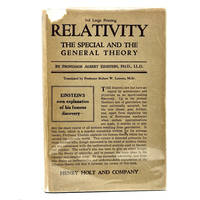
19215136166150><p><strong>EINSTEIN Albert.</strong> <em>Relativity: The Special and the General Theory.</em></p><p>New York: Henry Holt and Company 1921. "3rd Large Printing." Octavo. Original blue cloth lettered in gilt on the front board. Portrait frontispiece of Einstein. Original publisher's dust jacket printed in black on tan paper. Cloth exceptionally clean and bright for this title the gilt lettering sharp; minor wear at extremities. Dust jacket with a moderate chip at the crown of the spine extending slightly into the upper panel smaller chips and short closed tears along edges and general toning consistent with age. Near Fine in Very Good- jacket.</p><p>Einstein's celebrated non-technical exposition of his revolutionary theory written to explain the principles of relativity to an educated general audience. First published in German in 1916 and translated into English by Robert W. Lawson in 1920 the work quickly became the most widely read introduction to modern physics in the early twentieth century and played a major role in disseminating Einstein's ideas beyond the scientific community.</p><p>Copies of the early Holt printings rarely survive in their original jackets which were printed on thin paper and typically discarded or heavily worn through use. The present example a 1921 "3rd Large Printing" represents an unusually early survival in dust jacket. At the time of cataloguing only one earlier jacketed printing appears to be offered on the market making this among the earliest obtainable examples of Einstein's landmark work in its original publisher's jacket. The survival of the jacket combined with the remarkably clean cloth makes this a particularly desirable example of one of the foundational popular works of twentieth-century science.</p> Henry Holt and Company hardcover
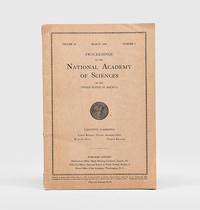
1932180272Easton Pennsylvania: Mack Printing Company 1932. Einstein revises his "biggest blunder" First edition journal issue of the paper in which Einstein rejected his 1917 cosmological constant and acknowledged the expansion of the universe. Drawing on Hubble's law Einstein and de Sitter proposed that the constant should be set equal to zero thereby offering a new model of the universe. "In 1917 Einstein had shown how to construct a universe that was static by introducing a 'cosmological constant' into his equations. This matched well with the idea current before Hubble's 1924 measurement of the distances to the nebulae of a small and static 'universe' that was confined to the stars of the Milky Way galaxy. Einstein's idea of a static universe suspended between gravity pulling inward and the cosmological constant making the universe expand was ruled out by Hubble's data" Kirshner pp. 9-12. In Einstein and de Sitter's revised model "the galaxies receded forever but the recession rate declines to zero as time approaches infinity. Some sources indicate that this is the first attempt to describe our universe rather than a mathematical abstraction of universes possible under general relativity. Shortly after Einstein formally renounced his cosmological constant and according to George Gamow called it 'the biggest blunder of my life'" Wenner. Einstein and de Sitter 1872-1934 were close collaborators in the 1920s at Leiden where de Sitter was chair of astronomy and Einstein was a visiting professor. De Sitter is also known for the concepts of De Sitter space and the De Sitter universe. Large octavo. Original brown wrappers covers printed in black. Short closed tears to spine a little loss to ends corners gently creased: a very good copy. Boni 214; Weil 184; Wenner p. 256. Robert P. Kirshner "Hubble's Diagram and Cosmic Expansion" Proceedings of the National Academy of Sciences of the United States of America vol. 101 no. 1 December 2003. unknown
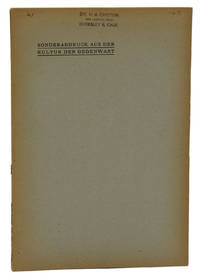
1925140941837Berlin: No Publisher 1925. Revised edition. 783-797 pp. Publisher's original printed wrappers. About Very Good with thin tear along front wrap fold near head a little chipping to wraps at spine front wrap hinge fragile contents toned with age. This copy belonged to Hans Albert Einstein Albert Einstein’s oldest son with his inkstamp at top of front wrapper; likely a presentation copy from his father. Neatly written at top of front wrapper are "41" and 163."<br /> <br /> <p>Very rare author's offprint from Die Kulture der Gegenwart of an essay on relativity theory which was first published in 1914 revised to incorporate Einstein's later research. OCLC/WorldCat locates no physical copies. Weil 71. [No Publisher] unknown
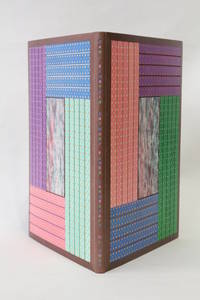
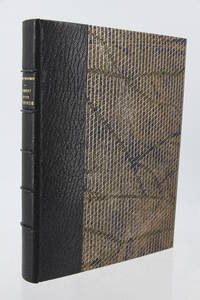
193067602Paris: Edition de la Galerie Simon 1930. Fine. Edition de la Galerie Simon Paris 1930 19 x 25 cm relié Entwurf einer Landschaft Sketch of a Landscape Édition de la Galerie Simon Paris 1930 19 x 25 cm full calf First edition one of 90 numbered copies on Holland paper signed by Carl Einstein and Gaston-Louis Roux on the justification page the only issue with 10 copies on Japan paper and 10 on Chapelle paper. With five full page black lithographs by Gaston-Louis Roux one of which on the frontispiece. Binding in full brown-pink box spine with blue pink and green title in ser significant inlaid decoration on the boards four bands of five strips of pink purple green and blue calf arranged around a central piece of rectangular multi-colored marbled box endpapers in flesh-side pink suede wrappers and spine preserved all edges gilt dust jacket in half brown-pink box spine with blue pink and green title in ser slip case lined with brown-pink box binding signed by Georges Leroux and dated 1994. Carl Einstein is an anarchist writer art historian friend of George Grosz Georges Braque and Pablo Picasso collaborator of Jean Renoir lived through the wars and revolutions that shook Europe during the first part of the twentieth century. He volunteer during the Spanish civil revolution in 1936 and went to Barcelona to fight in the ranks of the Confédération nationale du tra vail National Labor Confederation before joining the Groupe international de la Colonne Durruti Durruti Column International Group. Of Jewish faith he committed suicide in 1940 to avoid failing into the hands of the Nazis. Magnificent copy perfectly set in a full inlaid box binding signed by Georges Leroux one of the greatest binders of the second part of the 20th century. Edition de la Galerie Simon hardcover
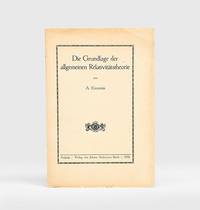
1916188045Leipzig: Johann Ambrosius Barth 1916. The foundation of general relativity First separate edition first issue of the work presenting the finalized version of general relativity. The Grundlage was also published in the Annalen der Physik in 1916 but Weil clarifies that the separate publication is now accepted as the earliest published edition of the paper. Einstein had almost finalized the general theory of relativity in 1913. However an error led him to contend that his equations could not be covariant - that they could not be applied without a system of spacetime co-ordinates devised by humans and therefore contextually specific. His first attempt at an overall presentation of the theory as delivered in 1914 was based on this assumption. By 1915 his subsequent reflections had driven him to reapply covariance and in November he published several papers outlining covariant field equations of general relativity. The present work adapts the comprehensive perspective of the 1914 paper with the revised mathematics of the 1915 equations to present "the first systematic exposition of general relativity" Janssen p. 1. Tilman Sauer notes that "in essence Einstein's general theory of relativity of 1916 remains today's accepted theory of the gravitational field" p. 24. This copy includes all the necessary first issue points: the imprint "Druck von Metzger & Wittig in Leipzig. 314" on the title page verso; Ziehen's Die Psychologie as the last title listed in the publisher's advertisement on the rear wrapper; and the imprint "Metzger & Wittig Leipzig" on the rear wrapper. Octavo. Device to title page formulae in the text. Original tan vertically ribbed wrappers printed in black. Light creasing and foxing to otherwise bright wrappers title page remargined at head not affecting text contents crisp: a near-fine copy. Norman 696; Printing and the Mind of Man 408; Weil 80a. Michael Janssen "Einstein's First Systematic Exposition of General Relativity" 2004; Tilman Sauer "Albert Einstein's 1916 Review Article on General Relativity" in Ivor Grattan-Guiness ed. Landmark Writings in Western Mathematics 1640-1940 2004. unknown
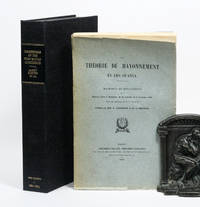
19122508Paris: Gauthier-Villars 1912. First edition. Original wrappers custom box. Very Good. RARE FIRST EDITION IN ORIGINAL WRAPPERS OF THE REPORTS FROM THE HISTORIC FIRST SOLVAY CONFERENCE "THE FIRST INTERNATIONAL CONFERENCE IN PHYSICS EVER ORGANIZED" AND A CRITICAL MOMENT IN THE BIRTH OF QUANTUM PHYSICS. In the short time that followed Planck's hypothesis of the universal constant that would bear his name the greatest minds in physics were largely at a loss about how to deal with the bizarre theoretical results that followed let alone the experimental results which confirmed them!. Much of the focus at the time was on black-body radiation including work by Planck himself as well as Lorentz Rayleigh and Jeans. However shortly before the first Solvay conference a young Einstein had also started investigating the related question of materials' specific heat. Kuhn. "The purpose of the first Solvay Conference was thus two-fold: first there was the need to examine whether classical theories molecular-kinetic theory and electrodynamics could in some undiscovered ways provide an explanation of the problem of black-body radiation and of the specific heat of polyatomic substances at low temperatures; secondly to consider phenomena in which the theory of quanta could be successfully used." Mehra.<br /> <br /> Underlying these questions was the more fundamental mystery of how to interpret the existence of the Planck constant. There were two camps both of which were represented at the conference. Planck's took the constant to indicate some fundamental constraint on the radiative processes of emission and absorption. For example "Sommerfeld introduced a version of the quantum hypothesis which he considered to be compatible with classical electrodynamics. He postulated that in 'every purely molecular process' a quantized quantity of action is exchanged." Staumann. Einstein's camp on the other hand took the quantum of action to represent the physicality of a perhaps pseudo-corpuscular theory of energy exchange - his photons of light.<br /> <br /> Although the debates that followed the lectures included in the proceedings did not rise to the famous heated exchange that Einstein would have with Bohr at the 1927 Solvay conference we do see some of the young Einstein's hotheadedness as he opens the debate following Planck's plenary lecture: "What I find strange about the way Mr. Planck applies Boltzmann's equation is that he introduces a state probability W without giving this quantity a physical definition. If one proceeds in such a way then to begin with Boltzmann's equation does not have a physical meaning." As translated by Straumann.<br /> <br /> It would take another 14 years for quantum mechanics to be fully formalized but the first Solvay conference represents a pivotal point in quantum history:<br /> <br /> "During 1911 the situation changed quickly. Articles that applied the quantum to other topics then outnumbered those on blackbody radiation for the first time and some were backed by impressive experimental evidence. In part because of that evidence physicists like Planck and Lorentz who had previously taken the constant h to be characteristic only of the radiation problem began to consider additional areas in which others had earlier staked quantum claims." Kuhn.<br /> <br /> Albert Einstein and the Solvay Conference:<br /> <br /> Among the most renown scientists of the day - including Ernest Rutherford Marie Curie and Max Planck - Einstein made quite an impression. At age 32 he was the second youngest participant in the conference. The youngest was British physicist Frederick Lindemann later to become scientific adviser to Winston Churchill.<br /> <br /> Although "Einstein had already published so many masterpieces none had actually been put to the test and his theories were looked on rather as tours de force than as definitive additions to knowledge. But his pre-eminence among the twelve greatest theoretical physicists of the day was clear to any unprejudiced observer." Frederick Lindemann quoted in Brian.<br /> <br /> References: Headline quote from the Solvay Institute website. Kuhn T. 1978 Black Body Theory and the Quantum Discontinuity 1894-1912. University of Chicago Press. Mehra J. 1975 The Solvay Conferences on Physics: Aspects of the Development of Physics Since 1911. Straumann N. 2011. On the first Solvay Congress in 1911. The European Physical Journal H 363 379-399. Denis Brian Einstein: A Life p.82.<br /> <br /> Paris: Gauthier-Villars 1912. Octavo original wrappers; custom box. Splits to top and bottom joint of upper wrapper two creases to front wrapper. Text in fine condition largely unopened. <br /> <br /> FIRST PRINTINGS IN ORIGINAL WRAPPERS ARE EXTREMELY SCARCE. Gauthier-Villars unknown
193481265Paris: Flammarion 1934. Fine. Flammarion Paris 1934 12 x 19 cm relié Comment je vois le Monde The World as I See It Paris 1934 12x19cm bound. First edition of the French translation published a year before the English translation one of 10 numbered copies on Hollande most limited deluxe issue. Dark gray half morocco binding spine with five raised bands patterned paper boards gray paper endpapers and pastedowns covers and spine preserved slightly wrinkled and with small tears top edge gilt over untrimmed edges binding signed P. Goy & C. Vilaine. A few foxing spots to endpapers and to some leaves on the untrimmed edges bookplate on pastedown. A very rare untrimmed copy of this fundamental text by the brilliant scientist. Flammarion hardcover
192749047Berlin: Ernst Wasmuth A.-G 1927. First edition. Good- to fine condition. 176/330. 41 1pp. 42 plates with printed tissue guards. Original quarter vellum over brown paper-covered boards with gilt vignette on cover gilt lettering on spine. Title page with publisher's device and black double frame. Cover design by Lucian Zabel. With an introduction on Russian culture the tradition of ballet and theater set and costume design by Carl Einstein. Many of the plates with dates ranging from 1910 to 1923 including motifs created during the war. The motifs of the plates range from close-up figure drawings to simple folk costumes elaborate gowns for members of the Court mystical figures and various set designs.<br /> <br /> Illustrated with forty-two plates nineteen of them fully or partially colored by hand or pochoir some heightened in gilt or silver three b/w one sepia-toned lithograph and nineteen plates reproduced in high quality offset printing. The title page calls for forty-two plates and six illustrations in the text. Our copy is illustrated with seven tipped-in color offset reproductions and one b/w lithograph as endpiece on page seventeen.<br /> <br /> In addition the work is extra-illustrated with five color offset reproductions: one full-page embossed color plate with extensive hand-applied gilt overlay facing page seven Le Roi a full-page embossed color offset reproduction with extensive silver overlay facing plate one Phedre Thesee dated 1923 and three full page color offset reproductions facing plates fifteen L'Amazone with black overprinting twenty-five Scheherazade embossed and heightened in silver and Lampe d'Aladin multicolor overprint and thirty-six La Sultane embossed and overprinted in gilt facing the same image though with greater detail.<br /> <br /> The copies listed in OCLC vary in publication dates all calling for 42 plates and six in-text illustrations. Auction records call for 1925. One auction record for the 1925 edition calls for the lithograph line drawing in the text. Our copy contains two plates dated 1922 in addition to others dated 1917. We've been unable to find any bibliographic record that describes seven in-text illustrations or the five additional illustrations facing four of the plates and the first page of the text as described.<br /> <br /> Text in German. Binding with light wear along edges but vellum smudged and variously discolored. Block lightly starting at a few plates 11 15 19 27 30 42. A couples of tissue guards for plates loose but present. Binding in overall good- plates in very good to fine condition. Leon Bakst 1866-1924 was a Russian painter costume and set designer. Bakst studied art at the St. Petersburg Academy of Arts and was a member of the Sergei Diaghilev circle. In 1893 he moved to Paris for four years studying at the Academy Julian. He founded the magazine 'Mir Iskusstva World of Art' with his friends Alexander Benois Sergei Diaghilev and Valentin Serov. Bakst is best known for his work in set and costume design for the Ballet Russes. Ernst Wasmuth A.-G unknown
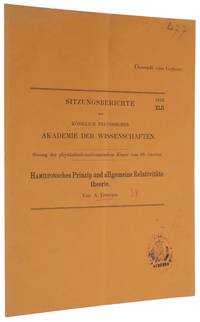
19166409Berlin: Königlichen Akademie der Wissenschaften 1916. First edition. <p>First editions extremely rare author's presentation offprint not to be confused with the much more common trade separate - see below from the library of the great German physicist Arnold Sommerfeld of Einstein's derivation of the field equations of gravitation from a variational principle. This was the first time Einstein had derived the field equations of gravitation in arbitrary coordinates - in his celebrated 1915 papers he derived the equations in generally-covariant form but only in special 'unimodular' coordinates.</p>. THE GRAVITATIONAL EQUATIONS FROM A VARIATIONAL PRINCIPLE. <p>First editions extremely rare author's presentation offprint not to be confused with the much more common trade separate - see below from the library of the great German physicist Arnold Sommerfeld of Einstein's derivation of the field equations of gravitation from a variational principle. This was the first time Einstein had derived the field equations of gravitation in arbitrary coordinates - in his celebrated 1915 papers he derived the equations in generally-covariant form but only in special 'unimodular' coordinates. In the early 19th century William Rowan Hamilton 1805-65 showed that Newton's equations of motion for a classical mechanical system were equivalent to the statement that the 'action' of the system now called the Lagrangian has a stationary value generally a minimum. A first variational approach to the gravitational field equations of general relativity was unsuccessfully sketched by Einstein and Marcel Grossmann in 1913-1914 and subsequently by Einstein himself in 1914 the so-called Entwurf Theory. But Einstein's 1914 theory was invalidated by a misconception related to the physically unjustified requirement of restricting the covariance of the gravitational field equations and by some mathematical errors in a crucial proof in the theory. Between March and May 1915 the Italian mathematician Tullio Levi-Civita 1873-1941 in his private correspondence with Einstein singled out the mathematical flaws of the Entwurf theory setting Einstein back on the path of general covariance which eventually brought him in November 1915 to the correct formulation of the gravitational field equations. Also in November 1915 the great German mathematician David Hilbert 1862-1943 published an article in which he correctly showed that Einstein's gravitational field equations could be obtained from a variational principle at least in the presence of an electromagnetic field. Five days later independently of Hilbert Einstein obtained in the present paper the same results thus obtaining the definitive variational formulation of the field equations. Einstein considered his approach to be more general than Hilbert's as Hilbert had made some hypotheses about matter which Einstein dispensed with Einstein also refused to accept the electromagnetic origin of matter which Hilbert had assumed. In the course of this paper Einstein also proved a special case of Emmy Noether's second theorem on the relation between symmetry and conservation laws which she published in full generality two years later. The only author's presentation offprint listed on RBH is that is the collection of Einstein's son Hans Albert Christie's 2006; it was not in Einstein's own collection of his offprints Christie's 2008.</p> <br /> <p>Provenance: Arnold Sommerfeld 1868-1951 his characteristic numbering in red pencil '34' on front cover; Institut für Theoretische Physik Munich ink stamp on upper cover. "The son of a physician Sommerfeld was educated at the University of Königsberg. After teaching briefly at the universities of Göttingen Clausthal and Aachen he was appointed professor of physics at the University of Münich in 1906. Sommerfeld should have retired in 1936 in favour of his pupil Werner Heisenberg. Opposition from the Nazi party to Heisenberg's appointment prolonged Sommerfeld's tenure and it was not in fact until late 1939 that he finally retired to be succeeded not by Heisenberg but by Wilhelm Müller a Nazi aerodynamicist without a single publication in physics to his credit. Although Sommerfeld and Heisenberg were not Jewish they were regarded by the Nazis as Jewish sympathizers. Sommerfeld however survived the war and returned to his Münich chair in 1945 continuing to work at physics until he died in a car accident in 1951" Oxford Reference. "Arnold Sommerfeld was one of the most distinguished representatives of the transition period between classical and modern theoretical physics. The work of his youth was still firmly anchored in the conceptions of the nineteenth century; but when in the first decennium of the century the flood of new discoveries experimental and theoretical broke the dams of tradition he became a leader of the new movement and in combining the two ways of thinking he exerted a powerful influence on the younger generation. This combination of a classical mind to whom clarity of conception and mathematical rigour are essential with the adventurous spirit of a pioneer are the roots of his scientific success while his exceptional gift of communicating his ideas by spoken and written word made him a great teacher" Max Born p. 275. </p> <br /> <p>"Einstein's first paper on a metric theory of gravity co-authored with his mathematician friend Marcel Grossmann was published as a separatum in early 1913 and was reprinted the following year in Zeitschrift für Mathematik und Physik. Most of the formalism of general relativity as we know it today was already in place in this Einstein-Grossmann theory. Still missing were the generally-covariant Einstein field equations .</p> <br /> <p>"In the fall of 1915 Einstein came to the painful realization that the 'Entwurf' field equations are untenable. Casting about for new field equations he fortuitously found his way back to equations of broad covariance that he had reluctantly abandoned three years earlier . on November 4 1915 presented the rediscovered old equations to the Berlin Academy. He returned a week later with an important modification and two weeks after that with a further modification .</p> <br /> <p>"When it was all over Einstein commented with typical self-deprecation: 'unfortunately I have immortalized my final errors in the academy-papers;' and 'it's convenient with that fellow Einstein every year he retracts what he wrote the year before.' What excused Einstein's rushing into print was that he knew that the formidable Göttingen mathematician David Hilbert was hot on his trail. Nevertheless these hastily written communications to the Berlin Academy proved hard to follow even for Einstein's staunchest supporters such as the Leyden theorists H. A. Lorentz and Paul Ehrenfest . Ehrenfest's queries undoubtedly helped Einstein organize the material of November 1915 for an authoritative exposition of the new theory .</p> <br /> <p>"In March 1916 Einstein sent his new review article 'Die Grundlage der Relativitätstheorie' to Wilhelm Wien editor of the Annalen . In this paper the field equations and energy-momentum conservation are not developed in generally-covariant form but only in special coordinates. Einstein had found the Einstein field equation in terms of these coordinates in November 1915. This part of the review paper is basically a sanitized version of the argument that had led Einstein to these equations in the first place .</p> <br /> <p>"As he was writing his review article he was already considering redoing the discussion of the field equations and energy-momentum conservation in arbitrary coordinates. In November 1916 he published such a generally-covariant account in the Berlin Sitzungsberichte the offered paper. This paper is undoubtedly much more satisfactory mathematically than the corresponding part of the review article but it does not offer any insight into how Einstein actually found his theory.</p> <br /> <p>Reading the offered paper without having read the November 1915 papers and the 1916 review article one easily comes away with the impression that Einstein hit upon the Einstein field equations simply by picking the mathematically most obvious candidate for the gravitational part of the Lagrangian for the metric field namely the Riemann curvature scalar. This is essentially how Einstein himself came to remember his discovery of general relativity. He routinely trotted out this version of events to justify the purely mathematical speculation he resorted to in his work on unified field theory.</p> <br /> <p>"In this paper he derived the generally-covariant field equations from an action principle with the Riemann curvature scalar as the Lagrangian . The present paper fills two important gaps in the review article. First Einstein derived the generally-covariant version of the Bianchi identities which in conjunction with the field equations imply energy-momentum conservation . Second Einstein showed that the identities guaranteeing energy-momentum conservation are a direct consequence of the covariance of the action functional. Einstein had thus in a mathematically impeccable way found a special case of one of Noether's theorems published two years later.</p> <br /> <p>"From a purely mathematical point of view the discussion of the field equations and energy-momentum conservation in the present paper is far more elegant than in the review article. This more elegant treatment however obscures the way in which Einstein found the Einstein field equations. It makes it look as if it was a matter ofpicking the most obvious candidate for the Lagrangian the Riemann curvature scalar at which point everything else fell into place. Ironically this is exactly what Einstein in his later years came to believe himself in part no doubt because it made his successful search for the field equations of general relativity look so similar to his fruitless search for a unified field theory. The clumsier discussion in unimodular coordinates in the review article however may serve as a reminder that-whatever he believed said or wrote about it later on-Einstein only discovered the mathematical high road to the Einstein field equations after he had already found these equations at the end of a poorly paved road through physics. Serving as road signs were Newton's gravitational theory Maxwell's electrodynamics and such key results of special relativity as the law of energy-momentum conservation. Considerations of mathematical elegance played only a subsidiary role" Janssen.</p> <br /> <p>This author's presentation offprint is of extreme rarity and must be distinguished from other so-called 'offprints' of papers from the Berlin Sitzungsberichte many of which are commonly available on the market. The celebrated bookseller Ernst Weil 1919-1981 in the introduction to his Einstein bibliography wrote: "I have often been asked about the number of those offprints. It seems to be certain that there were few before 1914. They were given only to the author and mostly 'Überreicht vom Verfasser' Presented by the Author is printed on the wrapper. Later on I have no doubt many more offprints were made and also sold as such especially by the Berlin Academy." If the term 'offprint' means as we believe it should a separate printing of a journal article given only to the author for distribution to colleagues then 'offprints' were not commercially available. Although there is certainly some truth in Weil's remark in our view it requires clarification and explanation.</p> <br /> <p>Until about 1916 most of Einstein's papers were published in Annalen der Physik; from 1916 until he left Germany for the United States in 1933 most were published in the Berlin Sitzungsberichte. The Sitzungsberichte differed from other journals in which Einstein published in that it made separate printings of its papers commercially available. These separate printings have 'Sonderabdruck' printed on the front wrapper the usual German term for offprint but they are not offprints according to our definition. They were available to anyone; indeed a price list of these 'trade offprints' is printed on the rear wrapper. True author's presentation offprints can be distinguished from these trade separates by the presence of 'Überreicht vom Verfasser' on the front wrapper.</p> <br /> <p>In the period 1916 to 1919 or 1920 the Sitzungsberichte trade separates are themselves rare. After 1919 or 1920 however the trade separates become much more common although the author's presentation offprints are still very rare. The reason for this change is that it was only in 1919 that Einstein became famous among the general public.</p> <br /> <p>It might seem obvious that Einstein's fame dates from 1905 his 'annus mirabilis' in which he published his epoch-making papers on special relativity and the light quantum. However these works did not make him immediately well known even in the physics community - many physicists did not understand or accept his work and it was two or three years before his genius was fully accepted even by his colleagues. Einstein did not secure an academic position until 1908. Among the general public Einstein became well known only in late 1919 following the success of Eddington's expedition to observe the bending of light by the Sun which confirmed Einstein's general theory of relativity. This was front-page news and made Einstein universally famous. See Chapter 16 'The suddenly famous Doctor Einstein' in Pais Subtle is the Lord for an account of these events. Before 1919 the trade separates of Einstein's papers would probably only have been purchased by professional physicists; after 1919 everyone wanted a memento of the famous Dr. Einstein whether or not they understood anything of theoretical physics and the trade separates of his papers were printed and sold in far greater numbers than before to meet the demand. It is telling that when these post-1919 trade separates appear on the market they are often in mint condition - they were never read simply because their owners were unable to understand them.</p> <br /> <p>BRL 90; Weil 88. Born 'Arnold Johannes Wilhelm Sommerfeld 1868-1951' Obituary Notices of Fellows of the Royal Society 8 1952 pp. 275-296. Janssen 'Einstein's First Systematic Exposition of General Relativity' 2004 .</p> <br/> <br/> 8vo 252 x 180 mm pp. 1111-1116. Original orange printed wrappers light vertical crease for posting. Königlichen Akademie der Wissenschaften unknown