187 résultats
1921302276Leipzig Felix Meiner 1921. 1921. First edition. 8vo. Foreword by Raymund Schmidt. Articles by Oskar Kraus Friedrich Lepsius Paul F. Lincke Joseph Petzoldt. Text pages numbered 334-500. Original stiff green wrappers printed in black. Very good. Cover title: Zur Relativitatstheorie. Kraus' article entitled: "Fiktion und Hypothese in der Einsteinschen Relativitatstheorie.". 1st Edition. Soft cover. Very Good/No Jacket. Leipzig, Felix Meiner, 1921. paperback books
1930433061930. Offprint from Mathematische Annalen 102 1930. 685-697pp. Original printed self-wrappers. 233 x 157 mm. Very good apart from small split in lower spine. Weil Albert Einstein Bibliography 171. unknown books
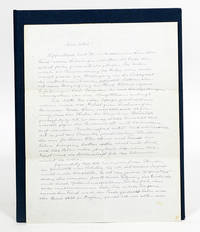
19371984Princeton: np 1937. First Edition. Very Good. AN EXTRAORDINARY LETTER BY EINSTEIN TO HIS SON OFFERING LIFE ADVICE AND DISCUSSING FREUD SHAKESPEARE AND SCHILLER. Addressed to his son Eduard "Tetel" Einstein and signed "Papa" the letter written in ink on both sides of one sheet reads in full translated from the original German: 

Dear Tetel

 I hope by now you've received Freud's lectures from Vienna. I've read most of them myself in the past. They really made me admire the Author but they didn't convince me that his theories were correct. 

I must admit however that based on my personal experiences my conviction about those theories is weakening -- I feel now that he was onto something at least in regards to the main theses. I would have written to you sooner but work is keeping me very busy. Even though they say that the work of a single person will not have much of an impact in the big picture it does not diminish the passion in which we pursue our interests and that is a good thing. 

 Although personal illusions may bring warmth and joy into one's life when young they don't last a lifetime. Life would be bleak if the work and the passion for discovery did not exist. In my free time I am currently reading Schiller's poems which I have neglected since my youth. 

They feel a bit pompous but at the same time they are enthralling in their choice of words and grammar. I am really happy that I picked them up again. 

I would have liked to send you another book on the top of the Freud but didn't know which one to send -- especially because I don't get a lot of German writings anymore.

 When I have some extra free time after finishing Schiller I really want to start reading Shakespeare everything from him I can get my hands on. If you like to read it too perhaps we could discuss it at some later time
 

 Albert is a real delight -- he has been traveling up and down the country for the past 6 weeks and will have seen and experienced many interesting things. I really hope he has followed my advice and kept a journal but I am not holding high hopes. When it comes to talking and writing he seems to be chronically constipated. With my warmest regards

 Papa Einstein's life advice underscoring one of his core beliefs: Einstein often stated that his main goal in life was the quest for truth no matter how difficult and painstaking the quest. He advises Eduard in this letter that it is the pursuit and the work in attaining the goal that brings satisfaction and sustains one throughout life even if "the work of a single person will not have much of an impact in the big picture". This he notes is critical to understand after the illusions of youth have succumbed to reality. Einstein Eduard and Freud: Eduard Einstein nicknamed "Tete" or "Tetel" born in 1910 was the second son of Albert and his first wife Mileva. From an early age he became enamored with the teachings of Freud even hanging a picture of famous psychiatrist on his bedroom wall. By the age of twenty he was diagnosed with schizophrenia and consequently was institutionalized several times throughout his life. Einstein's views of Freud's teachings were somewhat more nuanced than those of his son. Initially Einstein did not show much interest in Freud's theories and after their first meeting in 1927 Freud famously remarked "He understands as much about psychology as I do about physics." Over the years however Einstein began studying Freud's works. After corresponding with Freud somewhat regularly throughout the 1930s and even collaborating with him on a project sponsored by the League of Nations "Why War" 1932 Einstein began to move from a deep skepticism to - as indicated in this letter - a growing acceptance. By 1936 - just before this letter was written - Einstein sent birthday greetings to Freud acknowledging: "Until recently I could only apprehend the speculative power of your train of thought together with its enormous influence on the Weltanschauung of the present era without being in a position to form a definite opinion about the amount of truth it contains. Not long ago however I had the opportunity of hearing about a few instances not very important in themselves which in my judgment exclude any other interpretation than that provided by the theory of repression. I was delighted to come across them since it is always delightful when a great and beautiful conception proves to be consonant with reality." 
In this letter to Eduard Einstein admits to Eduard that he now believes Freud "was onto something at least in regards to the main theses." Einstein Shakespeare Schiller: Einstein's fondness for music is well-known but not as much has been recorded about his literary tastes. It is not surprising and has been previously documented that Einstein had a fondness for the great German poet Schiller but we can find no other references to Shakespeare by Einstein in any other letters or manuscripts. His words to Eduard "I really want to start reading Shakespeare everything from him I can get my hands on" imply that Einstein has recently "discovered" Shakespeare and is excited at the discovery. 
Note: Although the letter is not dated we can assume that it was written late November - December in 1937 when Einstein's son Albert was visiting the United States a trip he refers to in the letter. Princeton: November - December 1937. One 8.5x11 inch leaf written on both sides. In German. Usual folds otherwise fine. A LONG REMARKABLE AND REVEALING LETTER UNITING THE INTELLECTUAL GIANTS EINSTEIN FREUD AND SHAKESPEARE AND SHARING ONE OF HIS CORE BELIEFS WITH HIS SON. np unknown books
19432376Princeton NJ: np 1943. First edition. nb. Fine. EINSTEIN OFFERS STRONG AND PRESCIENT WORDS OF ENCOURAGEMENT TO THE LEADER OF THE NAACP IN THE FIGHT AGAINST RACISM AND SEGREGATION IN THE UNITED STATES. Background: Einstein's fight against racial discrimination in the United States: The imperative "to protect the rights of the individual. was Einstein's most fundamental political tenet. Individualism and freedom were necessary for creative art and science to flourish. Personally politically and professionally he was repulsed by any restraints. "That is why he remained outspoken about racial discrimination in America. As a Jew who had grown up in Germany Einstein was acutely sensitive to such discrimination. 'The more I feel an American the more this situation pains me' he wrote in an essay called 'The Negro Question' for the January 1946 issue of Pageant magazine. 'I can escape the feeling of complicity in it only by speaking out.'" Isaacson Albert Einstein 505. Even more directly in his 1946 commencement speech to Lincoln University the first degree-granting Historically Black College and University HBCU in the United States Einstein strongly denounced segregation as "an American tradition which is uncritically handed down from one generation to the next" noting that "There is separation of colored people from white people in the United States. That separation is not a disease of colored people. It is a disease of white people. I do not intend to be quiet about it." This remarkable letter - from 1943 -Â is one of the earliest examples of his interest in condemning racism in the United States. The letter: Dated 22 September 1943 and handwritten on his embossed Mercer Street Princeton letterhead Einstein writes in English to Walter F. White the enormously influential African-American civil rights leader who led the NAACP from 1929-1955 praising him for his work and revealing his own awareness of and frustrations with racism and prejudice in America. The text reads in full: Dear Mr. White: I have been quite impressed by the address you delivered some years ago at a meeting of the Princeton Branch of the National Association for the Advancement of Colored People. I know how hard it is to awaken the conscience even of good-hearted and well-meaning people when deep rooted prejudices are in the way. It is a great work indeed which you are doing relentlessly for the betterment of the living conditions of our Colored fellow-citizens for justice and for the accomplishment of national unity of the American people. With sincere respect and kind wishes Yours Albert Einstein ------------- On April 28 1940 White was the keynote speaker at "an inter-racial meeting sponsored by the Princeton branch of the National Association for the Advancement of Colored People" where his topic was "What Happens to Democracy When It Encounters the Color Line." Princeton Herald April 26 1940. At the time Princeton did not admit African Americans and the community was debating the question of whether or not to end segregation at the university. Princeton in fact did not admit its first African-American student until the fall of 1947. Einstein -Â writing in 1943 -Â notes that he heard White speak "some years ago". Something clearly must have deeply impressed Einstein about White's speech for him to write this thoughtful letter to White over three years after the event. Note: In addition to its content this apparently unpublished letter is also remarkable for being one of the very few letters Einstein hand-wrote in English during this period as German was still very much his preferred tongue. Princeton: September 22 1943. One page on Einstein's embossed Mercer Street Princeton letterhead 7.25x10 in visible handsomely matted and framed with a photograph of Einstein. Fine condition. np unknown books
19302349np: np 1930. First edition. Fine. EINSTEIN ON THE CONCEPT OF PEACE: A POWERFUL AUTOGRAPH STATEMENT IN EXCEPTIONALLY LARGE FORMAT. 
. Translated from the original German:<br /> <br /> "No person has the moral right to call himself a Christian or Jew so long as he is prepared to engage in systematic murder at the command of an authority or allow himself to be used in any way in the service of war or the preparation for it."<br /> <br /> Starting in 1925 the French Academy began sending large 11.5x16.5 sheets to important scientists writers and intellectuals asking them to write on the sheet a statement on the concept of peace for possible inclusion in an anthology. The World League for Peace later released a limited edition of prints from the submissions under the title Pax Mundi: livre d'or de la paix. This is Einstein's unique manuscript submission. <br /> <br /> A highly unusual format with exceptionally large Einstein signature 2.25 in / 6 cm of an important Einstein statement consistent with his life-long dedication to pacifism. <br /> <br /> c.1925-1930. One large folio page 11.5 x 16.5 inches. In German. Fine condition. np unknown books
1923433171923. Offprint from Sitzungsberichte der preussischen Akademie der Wissenschaften 1923. Single sheet pp. 76-77. 265 x 184 mm. A few marginal chips and tiny tears but very good. First edition offprint issue. The second of the four short papers Einstein published in 1923 on Eddington's program for a unified field theory. Weil Albert Einstein Bibliography 131n. unknown books
1907432971907. <p>Einstein Albert 1879-1955. Berichtigung zu meiner Arbeit: "Die Plancksche Theorie der Strahlung etc." Offprint from Annalen der Physik 22 1907. Single sheet p. 800. Unbound as issued. 223 x 145 mm. Lower corner lightly creased but very good.</p> <p>First Edition Rare Offprint Issue. Einstein's important correction to his paper on specific heats "Die Plancksche Theorie der Strahlung und die Theorie der spezifischen Wärme" 1907; see Weil 15 which "made clear for the first time that quantum concepts have a far more general applicability" Pais p. 394. "Einstein initially believed that his oscillating lattice points in a three-dimensional crystal lattice were electrically charged ions. A few months later he published a correction to his paper in which he observed that this was an unnecessary assumption . . . Einstein's correction freed the quantum rules in passing one might say from any specific dependence on electromagnetism" Pais p. 396. Pais Subtle is the Lord pp. 394-396. Weil 15n.</p> . unknown books
1911432921911. <p>Einstein Albert 1879-1955. Berichtigung zu meiner Arbeit: "Eine neue Bestimmung der Moleküldimensionen." Offprint from Annalen der Physik 34 1911. 591-592pp. 224 x 146 mm. Original printed wrappers a little chipped splint in lower spine. Light toning but very good.</p> <p>First Edition Offprint Issue. Einstein's correction to his formula for the viscosity coefficient = 1 a key equation in his 1905 doctoral thesis in which he had presented a new theoretical method for determining molecular radii and Avogadro's number. In 1910 Jacques Bacelin a pupil of French physicist Jean-Baptiste Perrin obtained experimental results indicating a possible error in Einstein's formula. "That prompted Einstein after an unsuccessful attempt to find an error to ask his student and collaborator Ludwig Hopf to check his calculations and arguments . . . Hopf did find an error in the dissertation namely in the derivatives of some velocity components and obtained for a corrected coefficient 2.5 . . .In early 1911 Einstein submitted his correction for publication and recalculated Avogadro's number. He obtained a value of 6.56 x 10²³ per mole a value that is close to those derived from kinetic theory and Planck's black-body radiation theory" Duplantier pp. 216-217. Duplantier "Brownian motion ‘diverse and undulating'" in Einstein 1905-2005: Poincaré Seminar 2005 pp. 201-293. Pais Subtle is the Lord p. 92. Weil Albert Einstein Bibliography 41.</p> . unknown books
1923374081923. Offprint from S. preuss. Akad. Wiss. Weil 137. unknown books
1923433151923. Offprint from Sitzungsberichte der preussischen Akademie der Wissenschaften 1923. 359-364pp. 254 x 184 mm. Original printed wrappers. Very good. First Edition offprint issue. Weil Albert Einstein Bibliography 137. unknown books
1931207020New York: Covici-Friede 1931. First edition. Jacket worn and with some loss tape repair on spine. 8vo. Cloth; dust jacklet. Contains Einstein's famous essay on science and religion and other essays on Judaism pacifism and other related topics. <br/><br/> Covici-Friede hardcover books
1941433111941. Offprint from Universidad Nacional de Tucuman Revista Serie A 2 1941. 11-15pp. 270 x 179 mm. Original printed wrappers. Very good. "Address to joint meeting of the American Physics Society and the American Association of Physics Teachers Princeton Dec. 29 1941 under the title: 'Solutions of finite mass of the gravitational equations'" Weil. Weil Albert Einstein Bibliography 208. unknown books
19142124Berlin: Königlichen Akademie der Wissenschaften 1914. FIRST EDITION OFFPRINT. Original wrappers. Fine. FIRST EDITION COMMERCIAL OFFPRINT ISSUE of Einstein's important 1914 paper on the development of general relativity. "In summer 1914 Einstein felt that the new theory general relativity should be presented in a comprehensive review. He also felt that a mathematical derivation of the field equations that would determine them uniquely was still missing. "Both tasks are addressed in a long paper presented in October 1914 to the Prussian Academy for publication in its Sitzungsberichte. It is entitled 'The formal foundation of the general theory of relativity'; here for the first time Einstein gave the new theory of relativity the epithet 'general' in lieu of the more cautious 'generalized' that he had used for the Entwurf" Landmark Writings in Western Mathematics 1640-1940. "According to John Norton 'How Einstein Found His Field Equations' this major review article was intended to convey the full content of the 1913 'Entwurf' theory: 'The principal novelty lies in the mathematical formulation of the theory. Drawing on earlier work with Marcel Grossman Einstein formulated his gravitational field equations using a variation principle. Using this richer mathematical structure Einstein offered a proof purporting to demonstrate that his theory had the maximum covariance compatible with the hole argument; that is covariance under 'justified' transformation between the 'adapted coordinate systems' he had introduced with Grossman'" Calaprice The Einstein Almanac. Offprint from: Sitzungsberichte der Königlich Preussischen Akademie der Wissenschaften XLI 19 November 1914 pp. 1030-1085. Berlin: Königlichen Akademie der Wissenschaften 1914. Octavo original wrappers; custom box. Neat early ownership name on front wrapper. Only the slightest wear; a fine copy. Rare. Königlichen Akademie der Wissenschaften unknown books
1916140940031Leipzig: Verlag von Johann Ambrosius Barth 1916. First Edition. Near Fine. First edition. Annalen der Physik Band 48 No. 7. total pp. 769-880 with Einstein's paper "Die Grundlage der allgemeinen Relativitätstheorie" on pp. 769-822. "Druck von Metzger & Wittig in Leipzig" to foot of pp. 880. Finely bound without wraps opens directly to p. 769 in marbled boards with brown leather spine lettered in gilt with contents lightly toned else Fine. Also contains papers by Otto Stern W. Wein R. Hirsch and H. Lussem. Text in German. The first printing of Einstein's General Theory of Relativity and a continuation of his ideas of first set forth in a 1905 paper on special relativity. General relativity refines Newton's laws of gravity describing it as a geometric property of space and time applying it to the universe. Verlag von Johann Ambrosius Barth unknown books
193037421Berlin: Akad. der Wiss 1930. Offprint from S. preuss. Akad. Wiss. Weil 169. Akad. der Wiss unknown books
1916432941916. <p>Einstein Albert 1879-1955. Ein einfaches Experiment zum Nachweis der Ampèreschen Molekularströme. Offprint from Verhandlung der Deutschen Physikalischen Gesellschaft 18 1916. 173-177pp. 230 x 157 mm. Original printed wrappers. Fine copy.</p> <p>First Edition Offprint Issue. In 1915 Einstein and Dutch physicist Wander Johannes de Haas conducted gyromagnetic experiments leading to the discovery of the Einstein-de Haas effect which corresponds to the mechanical rotation induced in a ferromagnetic cylinder suspended inside a coil when an impulse of electric current is sent through the coil. Einstein was very enthusiastic about the experimental results stating that he and de Haas had "given firm proof of the existence of Ampère's molecular currents" quoted in Pais Subtle is the Lord pp. 245-246. After his collaboration with de Haas ended Einstein published the present paper on the Einstein-de Haas effect proposing a new experimental method for determining gyromagnetism. The Einstein-de Haas effect is now known to reveal a relationship between magnetism angular momentum and electron spin; however this was not understood at the time as electron spin was not discovered until the 1920s. Weil Albert Einstein Bibliography 82.</p> . unknown books
1921433071921. Offprint from "Der Festschrift der Kaiser Wilhelm Gesellschaft zur Förderung der Wissenschaften zu ihrem 10jährigen Jubiläum" Berlin: Julius Springer 1921. 50-52pp. 260 x 175 mm. Original printed wrappers a little chipped. Very good. First separate edition. Title translation: A simple application of Newton's law of gravitation to globular clusters. Weil Albert Einstein Bibliography 117. unknown books
190638892Leipzig 1906. Einstein Albert 1879-1955. 1 Eine neue Bestimmung der Molekuldimensionen. In Ann. d. Physik 4th series 19 1906: 289-306. 2 Zur Theorie der Brownschen Bewegung. In ibid.:371-381. Whole volume 8vo. viii 1080pp. 5 plates. 213 x 143 mm. Original cloth spine faded split in upper half of spine inner hinge cracking. Very good. <p>1 First Edition in Journal Form Revised of Einstein's doctoral thesis ranked by his biographer as being on the same level as his 1905 papers on relativity the light quanta and Brownian motion. In his thesis Einstein presented a new theoretical method for determining molecular radii and Avogadro's number the number of atoms or molecules needed to make up a mass equal to a substance's atomic or molecular weight in grams. The thesis appeared in print in the spring of 1905; in the journal version published at the beginning of 1906 Einstein added a brief appendix containing an improved value of Avogadro's number.</p> <p>Einstein's biographer Abraham Pais wrote of Einstein's thesis as follows: </p> <p>"It is not sufficiently realized that Einstein's thesis is one of his most fundamental papers. Histories and biographies invariably refer to 1905 as the miraculous year because of his article on relativity the light-quantum and Brownian motion. In my opinion the thesis is on a par with the Brownian motion article. In fact in some-not all-respects his results on Brownian motion are by-products of his thesis work emphasis ours. This goes a long way toward explaining why the paper on Brownian motion was received by the Annalen der Physik on May 11 1905 only eleven days after the thesis had been completed.</p> <p>"Three weeks after the thesis was accepted this same journal received a copy of the thesis for publication. It was published only after Einstein supplied a brief addendum in January 1906. . . . As a result of these various delays the thesis appeared as a paper in the Annalen der Physik only after the Brownian motion article had come out in the same journal. This may have helped create the impression in some quarters that the relation between diffusion and viscosity-a very important equation due to Einstein and Sutherland-was first obtained in Einstein's paper on Brownian motion. Actually it first appeared in his thesis . . . ." </p> <p>"Quite apart from the fundamental nature of some results obtained in the thesis there is another reason why this paper is of uncommon interest: it has had more widespread practical applications than any other paper Einstein ever wrote . . . . The thesis dealing with bulk rheological properties of particle suspensions contains results which have an extraordinarily wide range of applications. They are relevant to the construction industry the motion of sand particles in cement mixes to the dairy industry the motion of casein micelles in cow's milk and to ecology the motion of aerosol particles in clouds to mention but a few scattered examples. Einstein might have enjoyed hearing this since he was quite fond of applying physics to practical situations" Pais Subtle is the Lord pp. 89-90. </p> <p>Pais notes that during the period 1970-1974 the 1906 journal version of Einstein's thesis was cited four times more often than his 1916 paper on general relativity and eight times more often than his 1905 paper on light quanta.</p> <p>2 First Edition of Einstein's second paper on Brownian motion containing two further methods for finding Avogadro's number. This was the first of his papers on the subject to include the term "Brownian motion" in the title. Pais pp. 95 98.</p> . unknown books
193137425Berlin: Akad. Wiss 1931. <p>Einstein Albert 1879-1955 and Walther Mayer 1887-1948. 1 Einheitliche Theorie von Gravitation und Electrizität. Offprint from Sitzungsberichten der preussischen Akademie der Wissenschaften 1931. 19pp. 2 Einheitliche Theorie von Gravitation und Elektrizität. Zweite Abhandlung. Offprint from Sitzungsberichten der preussischen Akademie der Wissenschaften 1932. 10pp. Together 2 offprints. 258 x 185 mm. Original printed wrappers no. 1 lightly creased vertically. Fine copies.</p> <p>First Editions Offprint Issues. Einstein made several attempts at a five-dimensional unified field theory including this two-part collaboration with mathematician Walther Mayer "in which a new unified field theory was proposed one based on a four-dimensional space-time continuum with a five-dimensional tangent space attached at each point" Pais Subtle is the Lord p. 492. This two-part paper is included on Shields's list of Einstein's most significant papers; see Albert Einstein Philosopher-Scientist 1949 p. 758. Shields 251; 261. Weil 182; 185.</p> . Akad. Wiss unknown books
199433034Oxford: Clarendon Press 1994. Clarendon Press unknown books
2003047275New York: George Braziller Publishers in Association with the Edmond J. Safra Philanthropic Foundation 2003. Revised Edition. 174p. with full facsimile of the 1912 manuscript and English translation original stiff printed wrappers quarto format. George Braziller, Publishers in Association with the Edmond J. Safra Philanthropic Foundation unknown books
16970EINSTEIN Albert. Relativity: The Special and General Theory. New York: Henry Holt & Company 1921. First Edition third printing. 1921 on title page making it the second printing of this edition and the third overall. Publisher's original blue cloth no dust jacket. Octavo 168 pages. Relativity: The Special and the General Theory began as a short paper and was eventually published as a book written with the aim of giving "an exact insight into the theory of relativity to those readers who from a general scientific and philosophical point of view are interested in the theory but who are not conversant with the mathematical apparatus of theoretical physics."- from the Preface. It is divided into 3 parts the first dealing with special relativity the second dealing with general relativity and the third dealing with considerations on the universe as a whole. It is unique both for giving special insight into one of the greatest minds of the 20th century and for providing a remarkably concise explanation of relativity. In very good to near fine condition with only very slight mottling to cloth cover and very minor foxing to outer bottom page edges. Absolutely clean and tight inside. unknown books
191667998EinsteinÃs Theory of Relativity in Original Wrappers EINSTEIN Albert. Die Grundlage der allgemeinen Relativit‰tstheorie. Sonderdruck aus den Annalen der Physik Band 49 1916. Leipzig: Verlag von Johann Ambrosius Barth 1916. First separate printing with significant additions and revisions to the edition printed in the Annalen der Physik. With printerÃs imprint ìDruck von Metzger & Witting in Leipzigî on the verso of the title and the shorter imprint ìMetzger & Witting Leipzigî on the back wrapper. Octavo 9 1/2 x 6 3/8 inches; 240 x 160 mm. 64 pp. Original tan printed wrappers. Some light browning around the edges of the wrappers. Overall an excellent copy with none of the spine erosion or soiling usually found with this fragile item. ìThe authorized version of EinsteinÃs general theory of relativity. The theoryÃs impact upon twentieth-century science and thought can hardly be overstatedî Norman Library 695 describing the first printing. ìThis separate edition is printed on good strong paper the wrappers are of strong material too.and it is described now as ëthe original editionà of this classic paperî Weil. Grolier/Horblit 26c describing the first printing. Norman Library 696. Printing and the Mind of Man 408. Weil 80a. HBS 67998. $7500 Verlag von Johann Ambrosius Barth unknown books
35418NY: Bonanza. 8vo pp. 377. Based on Mein Weltbild edited by Carl Seellig and other sources. Donor's presentation on flyleaf. A nice copy in lightly scuffed dj. Bonanza unknown books
19052103Leipzig: Johann Ambrosius Barth 1905. First edition. Contemporary morocco over marbled boards. Very Good. FIRST PRINTING of Albert Einstein's groundbreaking 1905 paper the introduction and derivation of the most famous equation in modern physics: E=mc2. "A few months after first publishing the theory of relativity Einstein discovered something that particularly intrigued him; the relation between inertial mass and energy. He wrote to Conrad Habicht during the summer of 1905: 'One more consequence of the paper on electrodynamics has also occurred to me. The principle of relativity in conjunction with Maxwell's equations requires that mass be a direct measure of the energy contained in a body; light carries mass with it. A noticeable decrease of mass should occur in the case of radium. The argument is amusing and seductive but for all I know the Lord might be laughing over it and leading me around by the nose'" Stachel Einstein's Miraculous Year. Einstein continued to work late into the summer on this "amusing and seductive" problem before proving the mass-energy relationship that would become known throughout the world as the simple and elegant E=mc2. Received by Annalen der Physik on September 27 Einstein's derivation and proof of his most famous equation was a dramatic contribution to his annus mirabilis of 1905. Weil 10. Note: In this paper and others until 1912 Einstein used the symbol "L" for energy in his equations and wrote the formula in the form: Mass= L/c2. In: Annalen der Physik Vierte Folge Volume 18 part 13 pages 639-41. Leipzig: Barth 1905. Octavo contemporary half-morocco over marbled boards. The whole volume 18 offered complete with volume halt-title title and contents. Some scuffing to spine of binding; text exceptionally fine. A rare copy in a contemporary binding with no institutional stamps. Johann Ambrosius Barth unknown books