EINSTEIN ALBERTBiblio.com
1 803 résultats
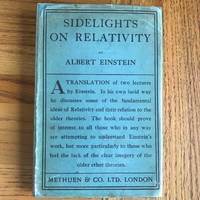
1922355490717346London: Methuen 1922. First Edition. Hard Cover. Dust Jacket. First UK Edition. Contains 2 Essays: "Ether and Relativity" and "Geometry and Experience". Translated by G.B. Jeffrey and W. Perrett. Publisher's original blue boards with gilt spine lettering. Foxing to the page block edges and slight fading to the edges of the boards otherwise a VG copy In the RARE FRAGILE D/W priced 3/6 net to the spine as called for. The D/W is in good condition with chipping at the head of the spine removing most of "SIDE" and at the base of the spine not affecting any lettering. At the edge of the rear flap a former owner has written in fountain pen: 13 6/- per week. It looks much better than it sounds. Rare. Methuen hardcover
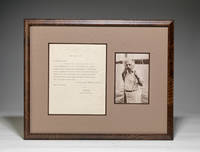
19461206241946. Signed. EINSTEIN Albert. Typed letter signed. Princeton April 3 1946. Single sheet of gray letterhead measuring 8-1/2 by 11 inches; p. 1. Matted and framed with a portrait entire piece measures 19 by 15-1/2 inches. $9500.Original typed letter signed by Albert Einstein thanking his friend Dr. Isadore Held for his birthday wishes as well as for sending a new book that Einstein found both ""extraordinarily enlightening"" and humorous. Text in German.The letter typed on Einstein's personal letterhead with his name and Princeton address blindstamped at the top reads in full translation: ""3 April 1946. Dear Mr. Held: I would like to express my sincere thanks for your birthday wishes and for the sending of the last work of this wonderful contemporary. I have already read quite a bit and find that it is extraordinarily enlightening. His penetration into the mentality of far-off times and attitudes toward thinking is most remarkable and his humor no less. With fond greetings to you and your dear wife. Yours signed Albert Einstein."" This letter was written to Austrian-American medical Dr. Isadore Held who was friends with Einstein since at least 1938. Held and Einstein shared numerous interests particularly related to Jewish humanitarian relief and Israel. At Held's death Einstein wrote to his widow that ""True goodness emanated from this man who alleviated the harshness of human relations and who understood and forgave all weaknesses As a role model for his fellow men he was the best that a human being can be."" Einstein was not a huge fan of birthdays though he happily acknowledged well wishes from friends. Just before turning 65 Einstein crankily said to a New York Times interviewer: ""What is there to celebrate Birthdays are automatic things. Anyway birthdays are for children."" In a 1954 letter to physicist Hans Mühsam Einstein described his birthday as ""a natural disaster a shower of paper full of flattery under which one is drowned."" Einstein was generally quite shy and did not like to be the center of attention particularly from strangers obsessed with his accomplishments and fame. However well-meaning letters and small gifts like the book given by Held were always welcomed and graciously accepted by Einstein. Original mailing creases and a few pinpoint holes along top edge possibly from stapling. About-fine condition. unknown
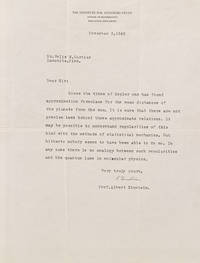
19421265881942. Signed. EINSTEIN Albert. Typed letter signed. Princeton November 3 1942. One sheet measuring 8-1/2 by 11 inches typing on recto only; matted and framed with a portrait of Einstein entire piece measures 21 by 17 inches. $38000.An exceptional typed letter signed by Einstein on precursors like Johannes Kepler's work to his Special and General Theories of Relativity beautifully framed.The letter on letterhead from the Institute for Advanced Study in Princeton reads in full: ""November 3 1942. Mr. Felix W. Cartier. Laconite Minn. Dear Sir: Since the times of Kepler one has found approximation formulaes for the mean distances of the planets from the sun. It is sure that there are not precise laws behind those approximate relations. It may be possible to understand the irregularities of this kind with the methods of statistical mechanics. But hitherto nobody seems to have been able to do so. In any case there is no analogy between such regularities and the quantum laws in molecular physics. Very truly yours signed A. Einstein. Prof. Albert Einstein.""Early in the 17th century Johannes Kepler 1571-1630 discovered that planets orbit the sun in ellipses rather than perfect circles. This great discovery paved the way for Isaac Newton's laws of gravity and for Albert Einstein's general and special theories of relativity. Previous to Einstein's time people believed in real distances and absolute time and showed that instruments could not objectively measure the distances between planets. Einstein's theories which hypothesized that light and space curve near a massive object revolutionized scientific thought and gave man an exciting new perspective of his universe.Einstein's letter reflects on some of the most important scientific revelations in the history of physics and astronomy. Kepler defined three laws of planetary motion; however the one specifically referred to in this letter is that all planets move about the Sun in elliptical orbits having the Sun as one of the foci. If the Universe then consisted only of two point massesthe Sun and a planetthe orbit of that planet would make a perfect closed ellipse that returned the world to its starting location with each trip around the Sun. But in a Universe governed by Newtonian gravity with a plethora of massive bodies in our Solar System that ellipse will precess or rotate slightly in its orbit.In the mid-1800s orbital deviations of Uranus from its predicted motions led to the discovery of Neptune as the outermost world's gravitational influence accounted for the excess motion. But in the inner Solar System the nearest planet to the Sun Mercury was experiencing a similar problem. With detailed accurate observations going back to the late 1500s thanks to astronomer Tycho Brahe we could measure how Mercury's perihelion its closest orbital point to the Sun was advancing. The number we came up with was 5600"" per century just over 1.5 degrees over a 100 year period. But of that 5025"" came from the precession of Earth's equinoxes a well-known phenomenon while 532"" was due to Newtonian gravity.But 5025"" plus 532"" comes up short by a small but significant amount. Attempts at explanationincluding the existence of an unknown inner planet interior to Mercuryall failed. But after Einstein's special theory of relativity came out in 1905 mathematician Henri Poincare showed that the phenomena of length contraction and time dilation contributed a fraction between 15-25% of the needed amount towards the solution dependent on the error. That plus Minkowski's formalization of space and time as not separate entities but as a single structure bound together by their union spacetime led Einstein to develop the general theory of relativity. On November 25 1915 he presented his results computing the spectacular figure that the contribution of the extra curvature of space predicted an additional precession of 43"" per century exactly the right figure needed to explain this observation sending shockwaves through the astronomy and physics communities. Less than two months after this Karl Schwarzschild found an exact solution predicting the existence of black holes. The deflection of starlight and gravitational redshifts/blueshifts were realized as possible tests and finally the solar eclipse of 1919 validated general relativity as superseding Newtonian gravity. Expected fold lines. An incredible letter scarce in its important content. unknown
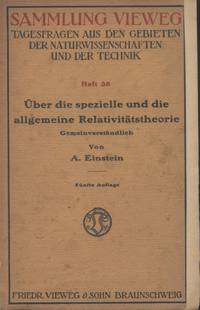
1920108736Friedr. Vieweg und Sohn in Braunschweig 1920. Paperback. <b>Livre en anglais</b>. Couverture souple. Mit 3 Figuren. Fünfte Auflage. Sammlung Vieweg. Heft 38. Broché. 83 pages. Papier bruni. Couverture légèrement défraîchie. Découpure de quelques millimètres sur la longueur des plats. <i>ref. 108736</i> Friedr. Vieweg und Sohn in Braunschweig paperback
192917857Berlin: Verlag Der Akademie der Wissenschaften 1929. An important offprint first edition. With mathematical formulas in text. Small folio in the original orange off-print paper wrappers printed in black on both covers. 8 pp. Very fine nearly as new. A RARE AND IMPORTANT OFFPRINT. EINHEITLICHEN FELDTHEORIE which means "A Coherent Theory of the Electro-Magnetic Field" and is the title of a five-page paper of highest mathematical formulae which Relativist Albert Einstein worked on for ten years. His report is a purely mathematical extension of the general theory of relativity to include gravitational and electromagnetic phenomena.<br> His relativity theory which he phrased within only three printed pages made time & space the creator of matter. When this paper on the Unified Field Theory was published it was a headline story in the newspapers. Few if any people understood the complex mathematics but many were fascinated by the thought that Einstein had possibly came up with a new theory expanding on "General Relativity" and unifying the fundamental forces of nature. It is considered Einstein's last important scientific work Weil #165.<br> "In 1928 Einstein embarked on a new approach to a unified field theory. involving what he called 'distant parallelism'. By early 1929 he had solved the main problems involved in writing down field equations for his unified field theory. On the day of official publication of the third of a formidably technical series of nine articles on the theory. excited headlines appeared in foreign newspapers throughout the world. In this frenzied unscientific atmosphere Einstein's new theory was hailed in the press as an outstanding scientific advance. Yet Einstein had stated in his article that this was still tentative; and soon he found he had to abandon it" Hoffmann/Dukas ''Albert Einstein: Creator and Rebel'' 1972 pp. 225-226 Verlag Der Akademie der Wissenschaften unknown
191450425Leipzig: Johann Ambrosius Barth 1914. 1 Einstein Albert 1879-1955 and A.driaan D.aniël Fokker 1887-1972. Die Nordströmsche Gravitationstheorie vom Standpunkt des absoluten Differentialkalküls. In Annalen der Physik 44 10: 321-328. 2 Born Max 1882-1970. Zur Raumgitter theorie des Diamanten. In Annalen der Physik 44 12: 605-642. 3 Schrödinger Erwin Rudolf Josef Alexander 1887-1961. Zur Dynamik elastisch gekoppelter Punktesysteme. In Annalen der Physik 44 14: 916-934. Leipzig: Johann Ambrosius Barth 1914. </p> <br /> <br /> <p>Whole volume: viii 1272 pp. 22 plates Numbered Taf. I-XXII. Taf. I-IX: b/w/ silver photos; Taf. XI w/ one b/w silver photo; Taf. XII is folding and XIII XIV are b/w silver photos; Taf. XV and XVI are large folding tables; Taf. XVII XVIII XIX b/w/ silv.photos; and Taf.XX--XXII are photographs of X-ray images. Figs. Text-illust. 210 x 140 mm. Red cloth gilt lettering on spine. Very good. Along the margin of p. 802 written in pencil are the words: "Mallock R.S. 1910" probably written in Lord Rayleigh's hand most likely in reference to the title "The dampening of sound by frothy liquids" by A. Mallock in Proc. R.S. Lond ser. A vol. 84: 391-94. London 1911. </p> <br /> <br /> <p> A.D. Fokker 1887-1972 was a Dutch physicist and cousin to aeronautical engineer Anthony Fokker 1890-1939. He was musically inclined having invented the 31EDO pipe organ. He earned his doctorate in 1913 continuing his studies with Albert Einstein Ernest Rutheford 1871-1937 and William Bragg 1862-1942. In his 1913 thesis he derived the Fokker-Planck equation with Max Planck 1858-1947. Fokker made contributions to special relativity and general relativity particularly the effects of the curvature of space-time formally called "geodetic precession". Wikipedia.</p> . Johann Ambrosius Barth unknown
19962081502111806519Iwanamishoten 1996. Soft Cover. Fine. Volume: 1 Iwanamishoten paperback
DADAX1476667918McFarland 2016-09-20. Illustrated. paperback. New. 7.00x0.57x10.00. Buy with confidence. Excellent Customer Service & Return policy. McFarland paperback
19782111902152907861Kodansha 1978. Soft Cover. Fine. Size: B6 size Kodansha paperback
2006AME_9789812565228World Scientific Publishing 2006. 1. Hardcover. New/New. World Scientific Publishing hardcover
1918005931Leipzig: Johann Ambrosius Barth 1918. Contemporary half cloth boards. Joints repaired slightly worn; book plate; ink stamp on front flyleaf and title. First Edition. About Very Good. Johann Ambrosius Barth hardcover
H1017Leipzig J. A. Barth 1906 S. 371-381. Halbleinenband der Zeit mit goldgeprägtem Rückentitel gr. 8°. Vorderdeckel etwas berieben.2 St. a. Titel. Text sauber und frisch. bedeutender Botaniker und Nachfolger Dryanders als Bibliothekar Joseph Banks' ist noch heute durch seine Entdeckung der sog. Brownschen Bewegung auch Brownschen Molekularbewegung Brownian Movement im Jahr 1827 bekannt. Bei Beobachtungen mit dem Mikroskop fiel ihm die unregelmäßige Zitterbewegung von auf der Wasserfläche dahintreibenden Blütenstaubpartikeln auf. Brown konnte keine Erklärung dafür finden. Es war Albert Einstein der 1905 herausfand dass sie durch Zusammenstöße mit unter dem Mikroskop nicht sichtbaren Atomen und Molekülen herrührt. Einstein veröffentlichte seine Beobachtung in den Abhandlungen "Über die von der molekularkinetischen Theorie der Wärme geforderte Bewegung von in ruhenden Flüssigkeiten suspendierten Teilchen" Annalen der Physik 4. Folge Bd. 17 1905 und – hier vorliegend - "Zur Theorie der Brownschen Bewegung" dass. Bd. 19 1906. Die erfolgreiche Erklärung der brownschen Bewegung gilt als Meilenstein auf dem Weg zum wissenschaftlichen Nachweis der Existenz der Moleküle und damit der Atome. Robert Brown 1773-1858 zählte zu den bedeutendsten Botanikern der ersten Hälfte des 19. Jahrhunderts. Nach dem Studium der Medizin und Botanik in Edinburgh wurde er zunächst als Militärarzt im Norden Irlands tätig. 1798 machte er die Bekanntschaft von Joseph Banks – ein Treffen das entscheidend für sein ganzes weiteres Leben sein sollte. Banks bot ihm eine Stelle als Naturwissenschaftler auf Flinders Expedition zur Erforschung der australischen Küsten an. Brown nahm an und arbeitete in der Folge eng mit dem Pflanzenmaler Ferdinand Bauer zusammen. Als Flinders aufgrund des untragbaren Zustandes des Expeditionsschiffs "Investigator" gezwungen war die Reise vorzeitig abzubrechen blieben Brown und Bauer in Port Jackson zurück um ihre Forschungen bis zur Rückkehr Flinders' fortzuführen. Brown ging in der Folge nach Van Diemens-Land Tasmanien Bauer auf die Norfolk-Insel. 1805 traf man sich in Sydney wieder und trat die Heimreise an. Kurz nach seiner Rückkehr wurde Brown zum Bibliothekar der Linnéan Society. 1810 nach dem Tod Dryanders übernahm er dessen Stelle in der Bibliothek Banks'. Letzterer gab Brown testamentarisch das Recht auf lebenslange Nutzung seiner Sammlungen und seiner Bibliothek. Als man diese 1827 ins British Museum verlegte wurde Brown zum Bibliothekar und Kurator der dortigen botanischen Abteilung. Nach Banks' Tod gab Brown seine Stellung als Bibliothekar der Linnéan Society auf und fungierte von 1849 bis 1853 als deren Präsident. Bereits 1839 hatte man ihm für seine Forschungen über den pflanzlichen Befruchtungsprozess die Copley-Medaille verliehen. unknown
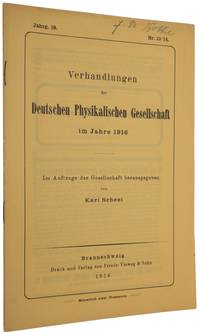
19166164Braunschweig: Druck und Verlag von Friedr. Vieweg and Son 1916. First edition. <p>First edition complete journal issue in original printed wrappers inscribed by Einstein to fellow Nobel Laureate Walther Bothe. "This work represents a major step forward in quantum theory" Calaprice p. 297. It introduced the concept of stimulated emission of radiation the theoretical basis for the laser; it also contained a new derivation of Planck's radiation law which provided as a by-product a justification of the frequency rule forming the basis of Bohr's theory of atomic spectra.</p>. DISCOVERY OF STIMULATED EMISSION OF RADIATION<br /> THE PRINCIPLE OF THE LASER<br /> INSCRIBED BY EINSTEIN TO A FELLOW NOBEL LAUREATE. <p>First edition complete journal issue in original printed wrappers inscribed by Einstein to fellow Nobel Laureate Walther Bothe. "This work represents a major step forward in quantum theory" Calaprice p. 297. It introduced the concept of stimulated emission of radiation the theoretical basis for the laser; it also contained a new derivation of Planck's radiation law which provided as a by-product a justification of the frequency rule forming the basis of Bohr's theory of atomic spectra. "According to Albert Einstein when more atoms occupy a higher energy state than a lower one under normal temperature equilibrium it is possible to force atoms to return to an unexcited state by stimulating them with the same energy as would be emitted naturally" Britannica. This is 'stimulated emission.' "To claim that Einstein almost invented the laser would be an exaggeration but the laser's underlying mechanism stimulated emission of radiation was a creation of his radiation theory" Kleppner pp. 32-33. "During the summer of 1916 less than a year after he had completed the general theory of relativity Einstein made a new major contribution to the quantum theory. The two papers he wrote then deal with the quantum theory of radiation by arguments that do not depend on the classical electromagnetic theory as had all earlier treatments of Planck's radiation law . When Einstein returned to the radiation problem in 1916 the quantum theory had undergone a major change. Niels Bohr's papers had opened a new and fertile domain for the application of quantum concepts - the explanation of atomic structure and atomic spectra. In addition Bohr's work and its generalizations by Arnold Sommerfeld and others constituted a fresh approach to the foundations of the quantum theory of matter" DSB. In this paper "Einstein considers a system of atoms in equilibrium with an external radiation field. An atom can change its internal energy state by absorbing or emitting radiation. Einstein introduces three basic assumptions about these exchanges of energy between matter and field. First the probability of absorption of radiation is proportional to the radiation density. Second there are two kinds of emission processes: one - spontaneous - following a law like that of radioactive decay; the other - stimulated - induced by the radiation field and with probability proportional to the radiation density. Third at equilibrium the atoms are distributed among their internal states according to the Boltzmann distribution law. From these assumptions Planck's law follows in a simple way. Einstein was very pleased with his derivation which he characterized in a letter to Besso: 'An amazingly simple derivation of Planck's formula I should like to say the derivation.' As a bonus from his derivation Einstein found that the energy difference between two internal energy states of the atom had to be equal to hv with v the frequency of the radiation absorbed or emitted in transitions between these two states thus confirming one of the postulates of Niels Bohr's theory of spectra" Papers 6 xxiii-xxiv. "Einstein meant the second part of this study a proof of the oriented character of the emission process to be his most essential contribution to quantum radiation theory this second paper was published later in 1916 as 'Zür Quantentheorie der Strahlung'. Instead Bohr gave more importance to the new deduction of the blackbody law; for this deduction reinforced the basic assumptions of his atomic theory and completed them with a statistical description of radiation processes" Darrigol p. 120. </p> <br /> <p>Provenance: Inscribed by Einstein on front wrapper "für. Dr Bothe" i.e. Walther Bothe 1891-1957. "In 1929 in collaboration with W. Kolhörster Bothe introduced a new method for the study of cosmic and ultraviolet rays by passing them through suitably arranged Geiger counters and by this method demonstrated the presence of penetrating charged particles in the rays and defined the paths of individual rays. For his discovery of the 'method of coincidence' and the discoveries subsequently made by it which laid the foundations of nuclear spectroscopy Bothe was awarded jointly with Max Born the Nobel Prize in Physics 1954" .</p> <br /> <p>While Einstein commended Planck's epoch-making derivation of his radiation law in 1900 which ushered in the quantum era he had also noted its limitations. Einstein also saw inconsistencies in Planck's derivation of his law. For Einstein this inconsistency was no reason to reject Planck's quantum theory but it was a reason to study the foundations of traditional radiation theory and if needed revise them. </p> <br /> <p>"As Einstein had noted in 1906 Planck's derivation of the Rayleigh-Jeans law</p> <br /> <p>uν = 8πν2/c3 kT</p> <br /> <p>between average resonator energy uν and radiation spectrum ν only applied to classical resonators T is the temperature k is Boltzmann's constant. A new quantum-theoretical picture of the interaction between matter and radiation was needed. Einstein found it in the summer of 1916 after the completion of his general theory of gravitation left him more time for quantum meditation.</p> <br /> <p>"The new picture presumably emerged from a combination of three elements: Einstein's derivation of the law of photochemical equivalence his analogy between quantum states and chemical species and Niels Bohr's theory of atomic spectra. According to Bohr atoms and molecules can only exist in a series of quantum states S0 S1 . . . Sn . . . with well-defined energies E0 E1 . . . En . . . Their interaction with radiation occurs through quantum jumps with characteristic values of the frequency of the emitted or absorbed radiation. Regarding the quantum states as chemical species and remembering his photochemical reasoning Einstein knew that he could derive Wien's law by balancing the absorption process Sn hν → Sn1 with the emission process Sn1 → Sn hν and by making the probability of the first reaction proportional to the density of radiation at frequency ν. Something in this reasoning needed to be altered in order to get Planck's law instead of Wien's. </p> <br /> <p>"At this point Einstein appealed to an analogy between classical and quantum theory. According to classical theory an oscillating dipole spontaneously emits radiation whether or not radiation is initially present in its surroundings. When external radiation encounters this dipole it may either be absorbed if the phase of the incoming wave agrees with that of the oscillator or it may be amplified in the contrary case. In the quantum theory of radiation Einstein similarly admitted the existence of three kinds of processes: spontaneous emission Ausstrahlung absorption negative Einstrahlung and stimulated emission positive Einstrahlung. The modern terminology is Bohr's. For the probability per time unit of the respective sorts of quantum jump Einstein assumed the forms</p> <br /> <p>Anm ÏνBnm ÏνBmn</p> <br /> <p>where n is the upper quantum state m the lower one and Ïν is the density of radiation at the frequency ν.</p> <br /> <p>"Einstein did not say much on the nature of the probabilities he thus introduced. He only commented that his theory had the weakness to leave to chance the instant and direction of the spontaneous emission of light. He also noted the similarity between spontaneous emission and radioactive decay. Undoubtedly he would have preferred a theory in which the emission and absorption probabilities were deduced from an underlying deterministic theory. He nonetheless expressed his 'full trust in the present way of reasoning'. The probabilistic description of the interaction was a natural counterpart of the discrete character of quantum states: if a quantum system evolves mostly through quantum jumps then the probability of a quantum jump obviously is the main quantity of physical interest. Instead of speculating on the precise timing and fine structure of the jumps Einstein proceeded to show what could be done by means of the new probability coefficients.</p> <br /> <p>"At thermal equilibrium Einstein reasoned statistical mechanics requires the number of atoms in a quantum state n to be proportional to exp−En /kT. The kinetic equilibrium between the atoms and surrounding radiation further requires that the number of quantum jumps from m to n should be equal to the number of reverse jumps:</p> <br /> <p>ÏνBnm exp−Em /kT = ÏνBnm Anm exp−En /kT.</p> <br /> <p>In the high temperature limit for which Ïν → ∞ this condition gives</p> <br /> <p>Bnm = Bmn.</p> <br /> <p>Therefore the equilibrium value uν of the density Ïν is given by</p> <br /> <p>uνexpEn − Em/kT - 1 = Anm / Bnm.</p> <br /> <p>According to a thermodynamic theorem by Wien uν/ν3 must be a function of ν/T only. Hence En − Em must be proportional to ν. Einstein thus derived Bohr's strange frequency rule ΔE = hν with complete generality and without recourse to any of the empirical laws of spectra. He then required the expression of uν to agree with the Rayleigh-Jeans law in the low-frequency limit. The outcome was Planck's law as well as the relation</p> <br /> <p>Anm / Bnm = 8Ï€hν3/c3</p> <br /> <p>between Einstein's two probability coefficients .</p> <br /> <p>"Einstein's new theory of radiation is now remembered for the introduction of stimulated emission which famously permitted the conception of masers and lasers. For Einstein and for his contemporaries the importance of these memoirs lay elsewhere. First Einstein filled an important gap in the derivation of Planck's law by means of a simple statistical description of radiation processes. Second he corroborated two basic assumptions of Bohr's atomic theory: the existence of stationary states and the frequency rule. In this regard it should be emphasized that before Einstein's and Sommerfeld's contributions of 1916 Bohr believed that his frequency rule only applied to strictly periodic systems. For instance he regarded the Zeeman effect as a violation of this rule. Einstein's new considerations established its complete generality" Darrigol in Cambridge Companion to Einstein pp. 134-136.</p> <br /> <p>"The implication of Einstein's theory of stimulated emission was that if one arranges for a large number of atoms to be in identical excited states a stray photon of the right energy can stimulate one atom to emit another photon which stimulates another. and all the atoms release their excess energy in a sudden cascade. What's more the photon released by stimulated emission will be in phase - coherent - with the one that stimulated it and so all the light produced in the cascade will be coherent.</p> <br /> <p>"In 1955 American physicist Charles Townes of Columbia University in New York an expert in molecular spectroscopy and his co-workers showed how stimulated emission could be used to make a device for generating or amplifying microwaves which they called a maser microwave amplified stimulated emission of radiation. Three years later Townes and Arthur Schawlow explained how to extend the idea to visible and infrared frequencies to make an 'optical maser' - in effect the laser.</p> <br /> <p>"They proposed using ordinary incoherent light to pump atoms into an excited state setting up the 'population inversion' in which the atoms are primed to return to their ground state by emitting photons. And their design used an optical cavity - basically two mirrors between which photons would bounce - to trap the emitted photons while they stimulated more emission. The device they explained would generate 'extremely monochromatic single-wavelength and coherent light'. Theodore Maiman of the Hughes Research Laboratories in Malibu California described such a device using a ruby crystal already used for masers as the lasing medium in 1960" 'A century ago Einstein sparked the notion of the laser' Physics World History Blog 31 August 2017.</p> <br /> <p>Weil 85. Calaprice An Einstein Encyclopedia 2015. Darrigol From c-numbers to q-numbers 1992. Kleppner 'Rereading Einstein on radiation' Physics Today 58 2005 pp. 30-33. Pais Subtle is the Lord 1982.</p> <br/> <br/> 8vo 228 x 154 mm pp. 315-332. Original printed wrappers. A fine copy. Druck und Verlag von Friedr. Vieweg and Son unknown
H4012Berlin Akademie der Wissenschaften 1932 In: Sitzungsberichte der Königl.Preuss. Akademie der Wissenschaften Band 1932. 4to. S.130-137 und 522-550. Weiters: Hahn Otto: Radioaktivität und ihre Bedeutung für Fragen der Geochemie. S.2-17. Schrödinger Erwin: Diracsches Elektron im Schwerefeld I. S.105-129. Weiteres von Planck Halbleinenband der Zeit leicht berieben Bibl.-Nr.am Rücken Original-Broschur miteingebunden unaufgeschnitten gutes Exemplar. unknown
191250338Leipzig: Johann Ambrosius Barth 1912. Einstein Albert 1879-1955. 1 Lichtgeschwindigkeit und Statik des Gravitationsfeldes pp. 355-369. Weil 47 Boni 43. 2 Zur Theorie des statischen Gravitationsfeldes pp. 443-458. Weil 48 Boni 44. 3 Nachtrag zu meiner Arbeit: "Thermodynamische Begrundung des photochemischen Aquivalentgesetzes" pp. 881-885. Weil 46 Boni 42. 4 Antwort auf eine Bemerkung von J. Stark: "Uber eine Anwedung des Planckschen Elementargesetzes" pp. 888. Weil 49 Boni 45. 5 Relativitat und Gravitation. Erwiderung auf eine Bemerkung des Hrn. A. Einstein pp. 1059-1064. Weil 50 Boni 46. In Annalen der Physik 38 1912. Red cloth with gilt lettering on the spine. Whole volume: 1064 pp. 8 plates. Text-figs. 210 x 130 mm. Very good copy. <br /> <br /> <p>Approximate English translations of titles with brief explanations of referenced paper if available:<br> 1 "The speed of light and the statics of the gravitational field." "Further exploring his studies of gravitation based on the equivalence principle Einstein sees with growing clarity that gravitation is intimitely linked with the problem of the measurement of space and time" p. 292. Calaprice Kennefick & Shulmann. An Einstein Encyclopedia. 2015.;<br> 2 "On the theory of the static gravitational field." "Einstein more closely analyzes the equations of motion stated in no. 1 above concluding that those equations cannot be reconciled with the given field equations for c . . . because the principle of "action equals reaction" is violated. p. 290. Calaprice Kennefick & Shulmann. An Einstein Encyclopedia. 2015.;<br> 3 "Addendum to my work: 'Thermodynamic justification of the photochemical equivalent law' "; <br> 4 "Answer to my remark by J. Stark: "On an application of Planck's elementary law' ";<br> 5 "Relativity and gravitation. Response to a remark by Mr. A Einstein".</p> <br /> <br /> <p>Weil's Einstein Bibliography nos. 47 48 46 49 and 50. <br> Boni's Einstein Checklist nos. 43 44 42 45 and 46. </p> . Johann Ambrosius Barth unknown
H4007Berlin Akademie der Wissenschaften 1924-1925 In: Sitzungsberichte der Königl.Preuss. Akademie der Wissenschaften 2 Bände 1924 und 1925. 4to. S.261-267; S.3-25; S.414-419. Anbei u.a.: Schrödinger E.: Über die statistische Entropiedefinition beim idealen Gas. S.434-441; Planck Max: Zur Frage der Quantelung einatomiger Gase. S.49-56. Halbleinenband der Zeit leicht berieben Bibl.-Nr.am Rücken Original-Broschur miteingebunden unaufgeschnitten gutes Exemplar. unknown
H4001Berlin Akademie der Wissenschaften 1919 In: Sitzungsberichte der Königl.Preuss. Akademie der Wissenschaften Band 1919/1. 4to. S.349-356; S.433.438. Halbleinenband der Zeit leicht berieben Bibl.-Nr.am Rücken Original-Broschur miteingebunden unaufgeschnitten gutes Exemplar. unknown
50414<p>1 First Edition journal issue. The brilliant follow-up to Einstein's landmark 1905 paper on the photoelectric effect. In the 1905 paper Einstein had explained the photoelectric effect-the emission of electrons from a metal when irradiated by light-by making the revolutionary proposal that light rather than consisting of continuous waves was instead made up of discrete particles of energy "light quanta" which transferred their entire payload of energy to an electron on impact. In the 1905 paper Einstein made use of Planck's mathematical formula for blackbody radiation which had introduced the concept of energy quanta but he was only able to derive part of the formula. In his 1906 paper Einstein "used his statistical mechanics to demonstrate that when light interacts with matter Planck's entire formula can arise only from the existence of light quanta-not from waves" Cassidy; emphasis ours. Einstein had realized as he stated in the present paper that "'Planck's theory makes implicit use of the . . . light-quantum hypothesis' . . . his acceptance of Planck's formula albeit as a hypothesis led to a major advance in his own work" Pais Subtle is the Lord p. 378. In 1921 Einstein was awarded the Nobel Prize in physics for his work on the photoelectric effect. Cassidy David "Einstein on the Photoelectric Effect." Einstein: Image and Impact. American Institute of Physics n.d. Web. Accessed 09 July 2014. Shields "Writings of Albert Einstein" in Albert Einstein: Philosopher-Scientist 1948 pp. 689-758 no. 13; also included in Shields' "Chronological list of principal works" on p. 757. Weil Albert Einstein: A Bibliography no. 12.</p> <p> 2 First Edition journal issue of Einstein's second paper on the inertia of energy following his 1905 paper "Ist die Trägheit eines Körpers von seinem Energieinhalt abhängig" Is the inertia of a body dependent on its energy content. In the present paper Einstein presented another argument in support of the proposition that a body's energy depends on its energy content. "About a year after he first introduced the inertia of energy Einstein published a paper entitled "The Principle of the Conservation of the Center of Gravity and the Inertia of Energy" in which he showed that E = mc2 is necessary and sufficient to ensure that the center-of-mass theorem holds for systems in which 'not only mechanical but also electromagnetic processes take place' . . . As Einstein acknowledges his paper is similar to Poincaré's contribution to the Lorentz Festschrift 1900. Einstein showed that in order to avoid the kind of violations of the center-of-mass theorem discussed by Poincaré one has to assume that energy has inertia" Janssen pp. 39-40. Janssen "The Trouton experiment E = mc2 and a slice of Minkowski space-time" in Revisiting the Foundations of Relativistic Physics: Festschrift in Honor of John Stachel 2003 pp. 27-54. Weil Albert Einstein Bibliography 13. </p> . unknown
H4009Berlin Akademie der Wissenschaften 1931 In: Sitzungsberichte der Königl.Preuss. Akademie der Wissenschaften Band 1931. 4to. S.235-237 258-265 und A. 541-561. Weiters: Schrödinger Erwin: Zur Quantendynamik des Elektrons. S.63-72: Planck Max: Über die Grenzschicht verdünnter Elektrolyte Zweite Mitteilung. S.113-122; Schrödinger Erwin: Über die Umkehrung der Naturgesetze. S.144-153. Halbleinenband der Zeit leicht berieben Bibl.-Nr.am Rücken Original-Broschur miteingebunden unaufgeschnitten gutes Exemplar. unknown
H4006Berlin Akademie der Wissenschaften 1923 In: Sitzungsberichte der Königl.Preuss. Akademie der Wissenschaften Band 1923/2. 4to. S.32-38; S. 76-77; S.137-140; S. 359-364. Halbleinenband der Zeit leicht berieben Bibl.-Nr.am Rücken Original-Broschur miteingebunden unaufgeschnitten gutes Exemplar. unknown
H4011Berlin Akademie der Wissenschaften 1929 In: Sitzungsberichte der Königl.Preuss. Akademie der Wissenschaften Band 1929. 4to. S.2-7; 156-162 Anbei: Schrödinger Erwin: Verwaschene Eigenwertspektra. S.668-684. Hahn Otto: Die radioaktiven Substanzen im dienste chemischer und physikalisch-chemischer Forschung. S.535-542. Halbleinenband der Zeit leicht berieben Bibl.-Nr.am Rücken Original-Broschur miteingebunden unaufgeschnitten gutes Exemplar. unknown
H4005Berlin Akademie der Wissenschaften 1922 In: Sitzungsberichte der Königl.Preuss. Akademie der Wissenschaften Band 1922/2. 4to. S.18-22; S.448-449. Weitere Berichte von: Laue v. und Gordon W.: Ein Verfahren zur Bestimmung der Wärmeleitfähigkeit bei Glühtemperaturen. S.118-126. Laue von: Die Bedeutung des Nullkegels in der allgemeinen Relativitätstheorie. S.127-136 Planck Max: Über die freie Energie von Gasmolekülen mit beliebiger Geschwindigkeitsverteilung. S.63-71 u.a. Halbleinenband der Zeit leicht berieben Bibl.-Nr.am Rücken Original-Broschur miteingebunden unaufgeschnitten gutes Exemplar. unknown
H4000Berlin Akademie der Wissenschaften 1918 In: Sitzungsberichte der Königl.Preuss. Akademie der Wissenschaften Band 1918/1. 4to. S.154-167; S.270-272 S.448-461. Weitere Berichte von: Born M.; u.a. Halbleinenband der Zeit leicht berieben Bibl.-Nr.am Rücken Original-Broschur miteingebunden unaufgeschnitten gutes Exemplar. unknown
193869317-A-65099Amsterdam: D.B. Centen 1938. Linnen gebonden. Met prospectus van het boek gevouwen a-4. 319 pp. ills. -Schutbladen verkleurd wat roestvlekken op de snee onderstrepingen in potlood verder in goede staat. D.B. Centen unknown
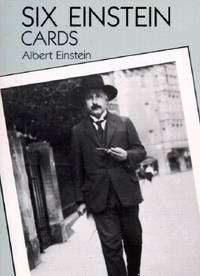
0486277127New. Brand new and still unused unknown