1 803 résultats
2004x-0691121249Princeton Univ Pr 2004. Paperback. New. 1st edition. 472 pages. 9.75x7.25x0.80 inches. Princeton Univ Pr paperback
1918003007Saint Louis: The Laryngoscope Press 1918. First Thus . Hardcover. Very Good. 8vo - over 7¾" - 9¾. 14 128 28 plates viii 3 plates 21 plates 3 comprised of Part I - a new edition of Collector's Marks by Fagan 1883 Part II-Supplement to Fagan's Book Part III-New Contributions. Red pebbled cloth gilt titles to front cover edges and spine extremities rubbed; an un-numbered copy of a limited edition of 300 copies. Book plate of Annie Cowdray 1st Viscountess Cowdray on ffep 8vo - over 7¾" - 9¾ <br/> <br/> The Laryngoscope Press hardcover
191874743The Laryngoscope Press. Very Good. 1918. Hardcover. FREE UPGRADE to Courier/Priority Shipping Upon Request - IN STOCK AND IMMEDIATELY AVAILABLE FOR SHIPMENT - AS NEW THE TEXT BLOCK IS PRISTINE CLEAN UNMARKED AND IN EXCELLENT CONDITION - - 14 128 56 viii 88 pp. 48 ills. 4to. -- with a bonus offer-- . The Laryngoscope Press hardcover
19185296Saint Louis: Laryngoscope Press 1918. 1st. Very Good corners bumped mild spine fading. Octavo. Red cloth boards with gilt lettering; without dust jacket as issued. #95 of an edition limited to 300 copies. This volume was produced to make available again Louis Fagan's 'Collectors' Marks' updated by the authors. Includes as Part I Fagan's Collectors' Marks; Part II Supplement to Fagan's Books and Part III New Contributions; Index. This study of collectors' "marks" is as important alike to the historian of art as it is to the collector. Laryngoscope Press unknown
1938143h5663USA: Crowell 1938. Magazine. Illus. by Reid Robert O. Cover Art; Sawyers Martha; Beall C.C.; McLeod Ronald; Biggs Geoffrey; Cooper Mario; Roth Ben; Lichty George; Timmins Harry L.; Coe RolandBorgstedt Douglas; Keate Jeff; Green George Hamilton; Gentry Thurston; Hilton Ned. Good. Magazine. First Edition. Folio - over 12 - 15" tall. Feature article by Albert Einstein entitled "Why Do They Hate The Jews" offers his views on the subject and includes a large black and white profile photo of the man himself. Additional features include: Local Ghost Makes Good - Jesse James Makes Restitution in Pineville; Coach Ralph Furey explains why football stars are not born article with several photos of football stars of the day; Speak No Evil short story; Hangin' Crazy Benny short story; Uncertain Wings short story; Via All Oceans short story; You Liked a Parade short story; None But The Brave part 5 of 6; Murder for Christmas - part 3 of 10 of this serial by Agatha Christie; Great cover art by Robert O. Reid features young lovely eyeing the dessert table; and more. 70 pages. Unmarked with average wear. Binding intact. Moderate evidence of moisture exposure. A sound vintage copy of this exceptional issue. Boni Russ & Laurence 396. . Crowell Paperback
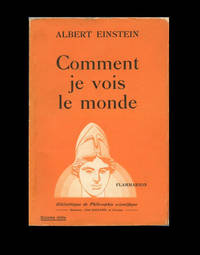
19341564Paris: Paul Gaultier de l'Institut 1934. 1st Edition. Paul Gaultier de l'Institut. 13 x 19.5cm. 258pp. Handsome illustrated cover. How I see the World. Judaism Politics and Pacifism in Germany 1933. Translated from the German by Colonel Cros. Content: Comment je vois le Monde - Politique et Pacifisme - Allemagne - Le Judaisme - Science. Minor wear at edges and spine Bright and clean inside and out. Very good condition. Paul Gaultier, de l'Institut unknown
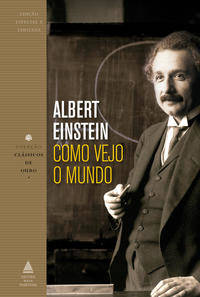
9788520936740NOVA FRONTEIRA. new. Albert Einstein um dos mais memorveis cientistas do mundo. Sua genialidade foi unnime e seu nome colocado no mesmo plano que o de Descartes Galileu ou Newton. Em Como vejo o mundo conhecemos o lado espirituoso intensamente perceptivo e preocupado com a humanidade desse f�sico extraordinrio. Einstein acreditava na possibilidade de um mundo pac�fico e na misso da cincia de servir ao bem-estar humano. Com textos escritos entre 1930 e 1935 o livro aborda temas como o desarmamento o respeito s minorias e a relao da cincia com a religiosidade mantendo uma atualidade impressionante. NOVA FRONTEIRA unknown
9786556408248NOVA FRONTEIRA. new. Albert Einstein � um dos mais memor�veis cientistas do mun�do. Sua genialidade foi un�nime e seu nome colo�cado no mesmo patamar que o de Descartes Galileu ou Newton. Em Como vejo o mundo conhecemos o lado espirituoso intensamente per�cep�tivo e preocupado com a humanidade desse f�sico extraordin�rio. A partir de textos escritos entre 1930 e 1935 entre cartas notas artigos ensaios discursos e entrevistas a obra expe grandes questes sobre as quais Einstein desejava se explicar publicamente o pacifismo a defesa do juda�smo a relao entre religio e cincia a cultura moral bem como educao e sua admirao por algumas grandes personalidades como George B. Shaw e Bertrand Russell. Tamb�m so abordados problemas cient�ficos importantes como a teoria da relatividade geral e restrita. Em uma prosa acess�vel e envolvente Como vejo o mundo oferece uma oportunidade nica de mergulhar na mente brilhante desse cien�tista multifacetado e apreciar sua perspectiva singular sobre a ma�ravilha do conhecimento e a infinita complexidade do universo. NOVA FRONTEIRA unknown
0520266528.Ghardcover. Good. Access codes and supplements are not guaranteed with used items. May be an ex-library book. hardcover
2012Q-0520266528University of California Press 2012-04-26. Hardcover. New. New. In shrink wrap. Looks like an interesting title! University of California Press hardcover
2012x-0520266528Univ of California Pr 2012. Hardcover. New. 1st edition. 240 pages. 10.00x6.50x1.00 inches. Univ of California Pr hardcover
2012DADAX0520266528University of California Press 2012-04-26. First Edition. hardcover. New. 6.00x0.83x9.00. Buy with confidence. Excellent Customer Service & Return policy. University of California Press hardcover
1946858Lancaster: American Physical Society 1946. 1st Edition. FIRST EDITION IN ORIGINAL WRAPS OF SIGNIFICANT CORRECTIONS & ADDITIONS BY EINSTEIN & STRAUS TO AN IMPORTANT PAPER; AS WELL A PAPER BY CHANDRASEKHAR ON THE ORIGIN OF THE SOLAR SYSTEM. <br /> <br /> In 1945 Albert Einstein and Ernst G. Straus introduced their Swiss cheese model of the universe in a paper entitled "The Influence of the Expansion of Space on the Gravitation Fields Surrounding the Individual Stars". Weil 216. The following year they published "Corrections and Additional Remarks to Our Paper" the 1945 paper the paper offered here. <br /> <br /> In early 1945 Einstein returned to long held cosmological questions as he sought to try to understand whether the expansion of the universe caused the solar system to expand as well — or more specifically the influence of the expansion of space on the gravitational field in the neighborhood of a star. Working with Straus the two began studying the effect of inhomogeneities in an expanding model. <br /> <br /> "By the spring of 1945 Einstein and Straus had found a new type of possible universe using Einstein's equations. It described a universe which looked largely like one of the simple expanding universes of Friedmann and Lemaître containing material like galaxies which exerted no pressure. But it has spherical regions removed from it like bubbles in a Swiss cheese. Each empty hole then had a mass placed at its centre. The mass was equal in magnitude to what had been excavated to create the hole. This was a step towards a more realistic universe in which the matter was not smoothly spread with the same density everywhere but gathered up into lumps like galaxies which were spread about in empty space. Barrow The Book of Universes 106-107. <br /> <br /> ALSO INCLUDED: S. Chandrasekhar's "On a New Theory of Weizsäcker on the Origin of the Solar System". In 1945 C. F. v. Weizsäcker proposed a new theory of the origin of the solar system which appeared to merit consideration. Weizsäcker argued "that there would be turbulence in the solar nebula which would give rise to the formation of eddies having angular motion opposite to that of the rotation of the nebula" Abhyankar The Origin BASI 26 339. Weizsäcker's "principal idea was to regard the formation of a planetary system around a star as a possible last stage in the formation of the star itself" Chandrasekhar 1946 94. He believed that "the protoplanets were supposed to have formed at the sites of the ball bearing eddies and the merger of the protoplanets in the same orbit produced the known planets" Abhyankar 343. In the paper offered here the Indian American astrophysicist S. Chandrasekhar challenged Weizsäcker's theory and showed "that there will be a wide spectrum of turbulence with smaller eddies within the larger ones and there would be no regular pattern as suggested by Weizsäcker. Further the life time of the eddies will be too short for the formation of the planets" ibid. In other words Chandrasekhar's work "indicated that the regular pattern of vortices originally postulated by Weizsäcker could not occur but instead must be replaced by a range of eddy sizes" Brush A History of Modern Planetary Physics 14. Chandrasekhar's work led to the abandonment of Weizsäcker's theories. <br /> <br /> INCLUDED: Nobel Prize winner Percy Williams Bridgman's "Recent Work in the Field of High Pressures" pp. 1-94 an important review of work done in the field of high pressure physics between Bridgman's seminal 1930 work and 1946 the year he won the prize and R. Samuel's "The Dissociation Spectra of Covalent Polyatomic Molecules" pp. 103-148. CONDITION & DETAILS: Lancaster: American Physical Society. Complete issue in original wraps. 4to. 10.5 x 8 inches; 263 x 200mm. Very slight wear at the edges of the wraps and head and foot of the spine; small closed tear see images. Bright and clean throughout. Very good condition. American Physical Society paperback
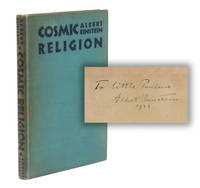
1931021909New York: Covici Friede 1931. First Edition. hardcover. Some pencil markings in text title page and endpapers darkened not really affecting Einstein's inscription; covers a little soiled. Good to Very Good and quite scarce. With a long biographical note and an appreciation by George Bernard Shaw. Subjects include Disarmament Pacifism the Jewish Homeland and more. This copy INSCRIBED and SIGNED by the author with his scarcer full signature on the front endpaper: "To little Pauline/Albert Einstein/1933." An uncommon title to find signed by the man of the century. With a letter of authenticity from James Spence if you need that kind of security blanket. <br/><br/> Covici Friede hardcover
1258001470.Ghardcover. Good. Access codes and supplements are not guaranteed with used items. May be an ex-library book. hardcover
1258113112.Gpaperback. Good. Access codes and supplements are not guaranteed with used items. May be an ex-library book. paperback
0993840124.Gpaperback. Good. Access codes and supplements are not guaranteed with used items. May be an ex-library book. paperback
1934180324Princeton: Princeton University Press 1934. First edition offprint issue of the fourth and final paper on Einstein and Mayer's semi-vectors in which they aimed to incorporate the Dirac equation into the general theory of relativity. This last article "was presented foremost as an exercise with exclusively mathematical appeal" Van Dongen p. 106. Large octavo pp. 7. Disbound from wrappers wire-stitched. Nicks and a handful of short closed tears to extremities: a very good copy. Boni 225; Weil 193. Jeroen van Dongen Einstein's Unification 2010. unknown
190639057Leipzig Johann Ambrosius Barth 1906. Bound in a fine recent hmorocco. Gilt lettering on spine. "Annalen der Physik" Bd. 20 Heft 8 pp. 433-640. The Einstein paper pp. 627-633. <br/><br/><em>First edition of this paper in the periodical form in which Einstein shows that the conservation of mass is a special application of his energy principle E= Mc2 - "Einstein considers a weightless horizontal cylinder filled with electromagnetic radiation and closed to the external world. A certain amount of radiating energy E moves from the left end of the cylinder to the right end transferring a certain amount of momentum due to radiation pressure to the left end which translates the cylinder to the left. When the radiation arrives at the right end the motion stops. We now imagine that a practically massless body absorbs this radiation moves back to the left and deposits it to its original state. Then the body moves back to right end into its original position. Now a complete cycle has taken place the system is back in its original state but the center of mass has moved by a certain amount to the left. This process can be repeated any number of times with the result that a body all by itself without any external forces can change its centre of mass by an arbitrary amount in contradiction to all physical evidence. This conclusion is avoided if we assume that the energy E is associated with the mass M=E/c2 in which case the centre of mass remains permanently at rest in agreement with our ecpectations." Cornelius Lanczos. - Weil: 13. </em> unknown
1015511376.Ghardcover. Good. Access codes and supplements are not guaranteed with used items. May be an ex-library book. hardcover
191514657Leipzig and Berlin: B.G. Teubner 1915. With frontispiece portrait of Minkowski and text figures. Boards spine and corners frayed and cracking. Sammelband containing the original papers on the special and general theories of relativity with a foreword by O. Blumenthal. It is in Minkowski's famous paper Raum und Zeit Space and time that he proposes the concept of time as the fourth dimension and initiates a mathematical study that became the basis of the later development of the theory. Included here is the re-issue of that work by Einstein and Lorentz with notes by A. Sommerfeld published after Minkowski's untimely death along with other papers by the two scientists whose works led to the abandonment of space and time as separate entities. <br /> <br /> Weil 59; see Printing & the Mind of Man 401. B.G. Teubner unknown
20181567230107Triton Museum of Art/ Grand Central Press 2018. Hardcover. Good. Pages can have notes/highlighting. Spine may show signs of wear. ~ ThriftBooks: Read More Spend Less.Dust jacket in acceptable condition. SIGNED and inscribed by the author. Shelf and handling wear to cover and binding with general signs of previous use. Cut to dust jacket. Secure packaging for safe delivery.Dust jacket quality is not guaranteed. Triton Museum of Art/ Grand Central Press hardcover
1941433111941. Offprint from Universidad Nacional de Tucuman Revista Serie A 2 1941. 11-15pp. 270 x 179 mm. Original printed wrappers. Very good. "Address to joint meeting of the American Physics Society and the American Association of Physics Teachers Princeton Dec. 29 1941 under the title: 'Solutions of finite mass of the gravitational equations'" Weil. Weil Albert Einstein Bibliography 208. unknown
194146476Tucuman Argentina 1941. Royal8vo. Orig. printed wrappers. Offprint from "Revista. Universidad Nacional de Tucuman" Series A Matematicas y Fisica Teorica Vol. 2 Diciembre de 1941 Nos 1 y 2. Pp. 11-15. Fine and clean. This copy has belonged to Abraham Pais 1918-2000 - the famous Einstein scholar theoretical physicist and Einsteins collegue at Princeton - and having his name on top of the frontwrapper "A Pais" <br/><br/><em>First edition of a scarce paper in the offprint version. The paper "represents the basis of the one written by the same author in collaboration with Wolfgang Pauli in 1943 in which by following analogous lines the proof of the non-existence of regular particle-type solutions was generalized to the case of cilyndrical geometries in Kaluza-Klein theory Einstein & Pauli 1943. Besides other generalizations were subsequently presented. The non-existence of such solutions in classical unified field theory was undoubtedly an important criterion leading Einstein's investigations."Galvagno and Giribet."In his search for a unified field theory that could undercut quantum mechanics Einstein considered five-dimensional classical Kaluza-Klein theory. He studied this theory most intensively during the years 1938-1943. One of his primary objectives was finding a non-singular particle solution. In the full theory this search got frustrated and in the x5-independent theory Einstein together with Pauli argued it would be impossible to find these structures." Jeroen van Dongen.Weil: 208. - Boni: 243. </em> unknown
194146477Tucuman Argentina 1941. Royal8vo. Orig. printed wrappers. Offprint from "Revista. Universidad Nacional de Tucuman" Series A Matematicas y Fisica Teorica Vol. 2 Diciembre de 1941 Nos 1 y 2. Pp. 11-15. Fine and clean. <br/><br/><em>First edition of a scarce paper in the offprint version. The paper "represents the basis of the one written by the same author in collaboration with Wolfgang Pauli in 1943 in which by following analogous lines the proof of the non-existence of regular particle-type solutions was generalized to the case of cilyndrical geometries in Kaluza-Klein theory Einstein & Pauli 1943. Besides other generalizations were subsequently presented. The non-existence of such solutions in classical unified field theory was undoubtedly an important criterion leading Einstein's investigations."Galvagno and Giribet."In his search for a unified field theory that could undercut quantum mechanics Einstein considered five-dimensional classical Kaluza-Klein theory. He studied this theory most intensively during the years 1938-1943. One of his primary objectives was finding a non-singular particle solution. In the full theory this search got frustrated and in the x5-independent theory Einstein together with Pauli argued it would be impossible to find these structures." Jeroen van Dongen.Weil: 208. - Boni: 243. </em> unknown