1 803 résultats
a94389Leipzig 1918. Hirzel. 4to hardcover. Both articles contained in one full year of Physikalische Zeitschrift vol XIX 1918. Hahn and Meitner article p. 208-218. Schroedinger article p. 218-220. Einstein and others are also in this volume. Ex-university library but no spine number just bookplate and pocket. Text clean and hinges not cracked binding secure but some pages are toned. Cover board edges worn. Good. Pictures available on request. . hardcover
19821iiCd0019Stuttgart Germany/ Deutschland: B.G. Teubner Verlagsgesellschaft 1982. Book. Like New. Hardcover Canvas. 8vo or 8° Medium Octavo: 7¾" x 9¾" tall. 159 pp. Clean fresh copy with very light shelf wear crisp pages and clean text. No dj. Text in German. B.G. Teubner Verlagsgesellschaft Hardcover
192320260506001New York: Dodd Mead and Company 1923. Hardcover. Good. 23 cm. Dodd Mead and Company Published 1923. Hardcover viii 216 pp.; 23 cm; First Edition dated 1923 on title page with no additional printings; with seven diagrams; printed at the University Press Aberdeen. In Good condition lacking the dust jacket. Blue cloth-covered boards with the original printed paper label on the spine bearing the title and authors. Mild to moderate shelf wear with some color loss along the edges and soiling and toning to the spine cloth. The paper spine label has chipping along the right edge with loss to the upper right corner. A few razor-thin cracks to the binding but the text block remains very solid in the boards. Pages mildly toned with heavier toning to the endpapers and pastedowns. Otherwise unmarked.The first English-language collection of original memoirs on the special and general theory of relativity. Translated by W. Perrett and G. B. Jeffery from the German collection "Des Relativitätsprinzip" Teubner 4th ed. 1922 with notes by A. Sommerfeld. Gathers key papers in the development of modern physics including Einstein's "On the Electrodynamics of Moving Bodies" 1905 Minkowski's "Space and Time" 1908 Einstein's "The Foundation of the General Theory of Relativity" 1916 and Weyl's "Gravitation and Electricity" along with contributions by Lorentz on Michelson's interference experiment and electromagnetic phenomena.Contents: Michelson's Interference Experiment by H. A. Lorentz; Electromagnetic Phenomena in a System Moving with Any Velocity Less Than That of Light by H. A. Lorentz; On the Electrodynamics of Moving Bodies by A. Einstein; Does the Inertia of a Body Depend Upon Its Energy-Content by A. Einstein; Space and Time by H. Minkowski; On the Influence of Gravitation on the Propagation of Light by A. Einstein; The Foundation of the General Theory of Relativity by A. Einstein; Hamilton's Principle and the General Theory of Relativity by A. Einstein; Cosmological Considerations on the General Theory of Relativity by A. Einstein; Do Gravitational Fields Play an Essential Part in the Structure of the Elementary Particles of Matter by A. Einstein; Gravitation and Electricity by H. Weyl. Dodd, Mead and Company hardcover
2008Q-0385315937Dial Press Trade Paperback 2008-04-08. Paperback. New. In shrink wrap. Looks like an interesting title! Dial Press Trade Paperback paperback
126956Burlington: Lutheran Literary Board 1923. Hardcover 84pp. Very good no dust jacket. Light brown cloth with embossed title and decoration in gilt. Notes index errata slip. There is a previous owner's stamp. Based on the work of Albert Einstein. Science Gravitation Science Theory of Relativity. Lutheran Literary Board Hardcover
4860746-nnew. unknown
4860746like new. unknown
193080796Paris: Calmann Lévy 1930. Fine. Calmann Lévy Paris 1930 22 x 27.50 cm broché First edition of this issue of the important journal dealing notably with archaeology fine arts and ethnography with Georges Bataille and Carl Einstein as principal editors. Very handsome copy. Contributions by Heinrich Ehl: ""L'heure de naissance de l'art européen occidental"" Georges Bataille ""La mutilation sacrificielle et l'oreille coupée de Vincent Van Gogh"" Michel Leiris: ""Le ""caput mortuum"" ou la femme de l'alchimiste"" Jean Bourdeillette: ""Franz Xaver Messerschmidt"" Zdenko Reich: ""Le massacre des porcs"" Carl Einstein: ""L'enfance néoloithique Hans Arp"" Jacques Prévert Maurice Leenhardt. Issue illustrated with photographs by Jacques-André Boiffard Calmann Lévy unknown
193081582Paris: Calmann Lévy 1930. Fine. Calmann Lévy Paris 1930 22 x 27.50 cm broché First edition of this issue of this important journal dealing notably with archaeology fine arts and ethnography and whose principal editors were Georges Bataille and Carl Einstein. A small tear at the foot of the spine a slight tear without loss at the foot of pages 21-22. Contributions by Heinrich Ehl: ""L'heure de naissance de l'art européen occidental"" Georges Bataille ""La mutilation sacrificielle et l'oreille coupée de Vincent Van Gogh"" Michel Leiris: ""Le ""caput mortuum"" ou la femme de l'alchimiste"" Jean Bourdeillette: ""Franz Xaver Messerschmidt"" Zdenko Reich: ""Le massacre des porcs"" Carl Einstein: ""L'enfance néoloithique Hans Arp"" Jacques Prévert Maurice Leenhardt. Issue illustrated with photographs by Jacques-André Boiffard. Calmann Lévy unknown
1953019091University of California Press Berkeley / Los Angeles. First Printing. Clipped DJ in archival cover edge wear. . Fine. Hardcover. 1st Edition. 1953. University of California Press, Berkeley / Los Angeles hardcover
2013110056Folio Society 2013. Hardcover. New. 9x6x1. Brand new 2013 Folio Society hardcover in slipcase as issued. oversized and overweight.D25 Please email for photos. Folio Society hardcover
1953biblio37528<p>University of California Berkeley 1953. XXVII496 pages. Fine Hardcover in VeryGood DJ. DarkRed cloth Bookplate with spine title. No Wear. Clean Unmarked throughout Excellent binding and hinges. The DJ got light edge wear. 9.5"x6.25"x1.6". be46009.</p> University of California hardcover
1968689Berkeley and Los Angeles: University of California Press 1968. Second Revised Edition Thus. Publisher's Blue Cloth Gilt Detailing. Near Fine/Very Good. A Near Fine Book in a Very Good or Better Dust Jacket Unclipped $15.00. Book is lightly shelf worn and sunned to extremities. Text block is a bit toned and soiled especially to top edge. Text is unmarked. Binding is tight and square. Dust Jacket is lightly shelf worn to extremities. Jacket is generally and variously toned from sunning. A few marks and scuffs present. Hardcover. Octavo. xxviii 5 6-496pp. . University of California Press unknown
Q-0520004507University of California Press 1962-08-01. Paperback. New. In shrink wrap. Looks like an interesting title! University of California Press paperback
1953040592Berkeley and Los Angeles CA: University of California Press 1953. Book. Near Fine. Original Cloth. First Thus. 8vo - over 7¾" - 9¾" tall. Dark mauve cloth paper title label mounted on upper spine panel. Slight binding lean text block edges a bit toned by age. Dust jacket a bit toned along spine panel with 1" closed tear at head of front joint light shelf wear now in mylar. xxvii496 pp. Einstein's foreword in German with facing-page translation into English. University of California Press Hardcover
1953048358BERKELEY CA.: UNIVERSITY OF CALIFORNIA PRESS. SMALL CHIP TO THE DJ CLEAN UNMARKED COPY! . VG. Hardcover. First Edition. 1953. UNIVERSITY OF CALIFORNIA PRESS hardcover
192249429Berlin Julius Springer 1922-24. 8vo. 4 contemporary half cloth binding: two in uniform half green cloth and two en uniform grey/blue half cloth. In "Zeitschrift für Physik" Bd. 10 11 16 & 21. Entire volumes offered. All volumes with stamp to title page and front free end paper otherwise a fine and clean set. Friedmann: Bd. 10: Pp. 377-386; Bd. 21: P.p. 326-332. Einstein: Bd. 11:P. 326; Bd. 16: P. 228. <br/><br/><em>First printing of these four landmark paper in which Friedman "introduced into cosmology two concepts of revolutionary importance the age og the world and the creation of the world" Kragh Cosmology and Controversy. "In his paper of 1922 Friedmann offered a complete analysis of the solutions of Einstein's cosmological field equations that went beyond the earlier solutions of Einstein and de Sitter as it also included nonstatic solutions. Friedmann did so clearly and explicitly: "The purpose of this note" he wrote "is firstly to show that the cylindrical Einsteinand spherical de Sitter worlds are special cases of more general assumptions and secondly to demonstrate the possibility of a world in which the curvature of space is independent of the three spatial coordinates but does on time".Ibid.In 'Über die Krümmung des Raumes' Friedman derived the non-stationary solutions to Einstein's field equations. Einstein quickly responded in a short comment 'Bemerkung' in which he expressed his suspicion of such a model of the Universe and apparently pointed out an error in Friedman's calculations. However Friedman now wrote a letter to Einstein in which he enclosed his full calculations. Shortly after this Einstein submitted a short notice Notiz in which he admitted that he himself had performed a calculation error and that Friedman's solutions which shed new light on the matter were valid. Friedman's expanding universe model was corroborated by Edwin Hubble's red-shift observations in 1929. In 'Über die Möglichkeit einer Welt mit konstanter negativer Krümmung des Raumes' Friedman derived the Friedman-equations and demonstrated that he had command of all three Friedman-models describing positive zero and negative curvature respectively nearly a decade before the independent discoveries of the same models by Lemaître Robertson and Walker. "Friedmann made a valuable contribution to Einstein's general theory of relativity. As always his interest was not limited simply to familiarizing himself with this new field of science but led to his own remarkable investigations. Friedmann's work on the theory of relativity dealt with one of its most difficult questions the cosmological problem. In his paper "Über die Krümmung des Raumes" 1922 he outlined the fundamental ideas of his cosmology: the supposition concerning the homogeneity of the distribution of matter in space and the consequent homogence of "world" time for which at any moment in time the metrics of space will be identical at all points and in all directions. This theory is especially important because it leads to a sufficiently correct explanation of the fundamental phenomenon known as the "red shift." This solution of the Einstein field equations obtained from the above propositions is the model for any homogeneous and isotropic cosmological theory. It is interesting to note that Einstein thought that the cosmological solution to the equations of a field had to be static and had to lead to a closed model of the universe. Friedmann discarded both conditions and arrived at an independent solution. Einstein welcomed Friedmann's results because they showed the dispensability of the ad hoc cosmological term Einstein had been forced to introduce into the basic field equation of general relativity". DSB. Weil 122 & 130. </em> hardcover
192234667Berlin Julius Springer 1922-24. 8vo. In: "Zeitschrift für Physik" Vol. 10 pp. 377 ff.Vol.11 pp.326 vol.16 pp.228 vol.21 pp.326-332. The entire four volumes offered here. Contemporary half cloth bindings. <br/><br/><em>Two landmark papers in the history of cosmology: All first editions. In 'Über die Krümmung des Raumes' Friedman derived the non-stationary solutions to Einstein's field equations. Einstein quickly responded in a short comment 'Bemerkung' in which he expressed his suspicion of such a model of the Universe and apparently pointed out an error in Friedman's calculations. However Friedman now wrote a letter to Einstein in which he enclosed his full calculations. Shortly after this Einstein submitted a short notice Notiz in which he admitted that he himself had performed a calculation error and that Friedman's solutions which shed new light on the matter were valid. Friedman's expanding universe model was corroborated by Edwin Hubble's red-shift observations in 1929. In 'Über die Möglichkeit einer Welt mit konstanter negativer Krümmung des Raumes' Friedman derived the Friedman-equations and demonstrated that he had command of all three Friedman-models describing positive zero and negative curvature respectively nearly a decade before the independent discoveries of the same models by Lemaître Robertson and Walker. </em> hardcover
1916140945574Berlin: Verlag von Julius Springer 1916. First edition. First edition. 64 pp. Bound in publisher's wraps. Very Good with slightly toned wraps tiny stain to back wrap slightly bumped corners bookplate on verso of front wrap. <p>An early German language work on Einstein's theory of gravitation with a foreword by the man himself. Freundlich's first book. Verlag von Julius Springer unknown
192425388London:: Methuen 1924. Second edition revised and enlarged. publisher's cloth in dust jacket. . Very good or better in a jacket with an L-shaped closed split at the bottom of the jacket spine a label had been removed from the bottom of the spine which has skinned a few of the letters in the imprint; also there is some splitting along folds. An uncommon book in jacket. . 8vo. With a Preface by Albert Einstein. Methuen, hardcover
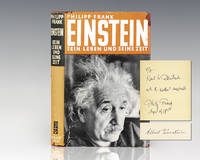
1949133215Munchen: Paul List Verlag 1949. First German edition of this classic work by Frank a famed contemporary of Einstein. Octavo original cloth. Signed by Albert Einstein on the slip to the title page and inscribed by the author on the front free endpaper "To Karl W. Deutsch with the author's compliments Philipp Frank August 10 1950." Philipp Frank was a physicist mathematician and also a philosopher during the first half of the 20th century. He was a logical-positivist and a member of the Vienna Circle. He was influenced by Mach and was one of the Machists criticised by Lenin in Materialism and Empirio-criticism. He studied physics at the University of Vienna and graduated in 1907 with a thesis in theoretical physics under the supervision of Ludwig Boltzmann. Albert Einstein recommended him as his successor for a professorship at the German Charles-Ferdinand University of Prague a position which he held from 1912 until 1938. Very good in a good dust jacket. Much has been written about Albert Einstein technical and biographical but very little remains as valuable as this unique hybrid of a book written by Einstein's colleague and contemporary. Both rich in personal insights and grounded in a deep knowledge of twentieth-century science Phillip Frank's biography anchors the reader with a lucid overview of physics and draws an intimate portrait of the Nobel Prize–winner. Paul List Verlag hardcover
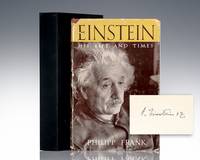
1947147192New York: Alfred A. Knopf 1947. First edition of this classic work by Frank a famed contemporary of Einstein. Octavo original cloth. Signed by the subject in the year of publication on the front free endpaper "A. Einstein 47." Translated from a German manuscript by George Rosen. Edited and Revised by Shuichi Kusaka. Housed in a custom half morocco slipcase. Rare and desirable signed by Einstein. Much has been written about Albert Einstein technical and biographical but very little remains as valuable as this unique hybrid of a book written by Einstein's colleague and contemporary. Both rich in personal insights and grounded in a deep knowledge of twentieth-century science Phillip Frank's biography anchors the reader with a lucid overview of physics and draws an intimate portrait of the Nobel Prize–winner. Very good in a very good dust jacket name to the front pastedown side edges. Alfred A. Knopf hardcover
19141199Braunschweig: Friedr. Vieweg & Sohn 1914. 1st Edition. FIRST EDITION FULL VOLUME OF THE FRANCK-HERTZ EXPERIMENT: THE FIRST ELECTRICAL MEASUREMENT TO CLEARLY SHOW THE QUANTUM NATURE OF ATOMS - PROOF OF THE QUANTIZED MODEL OF THE BOHR ATOM & OF PLANCK'S QUANTUM THEORY. Note that this volume includes both the first and second Franck-Hertz experiment. In the first they demonstrate that atoms can only absorb and be excited by specific amounts of energy; in the second experiment performed the same year they demonstrate that the frequency of the light emitted following the collision of electrons with mercury atoms corresponds precisely with the energy lost by the electrons in the collision. Franck and Hertz received the Nobel Prize for this work specifically "for their discovery of the laws governing the impact of an electron upon an atom" Nobel Prize Committee. <br /> <br /> Of equal import this volume also contains a paper by Einstein in which he uses the light quantum hypothesis to give new derivations of Planck's radiation law and Nernst's third law of thermodynamics. His "proofs introduced the quantum hypothesis" Calaprice The Einstein Almanac 40. <br /> <br /> In 1914 James Franck and Gustav Hertz were working together in the Physics Institute of Berlin and were "particularly interested in ionization i.e. in the process in which an electron is removed from an atom" The Harvest of a Century" p. 102-103. The experiment they devised now known commonly as the Franck-Hertz experiment is "a vivid illustration of the quantization of energy" that relied on methodology so simple "that it is now carried out regularly by undergraduates. They accelerated electrons through a low-pressure gas of mercury. When the electrons' energy reach the energy of a stationary state of mercury they gave up a quantum of energy to the mercury resulting in a stepwise shape to the curve of current through the apparatus. This demonstrated that atoms could absorb energy only in discrete amounts" Peacock The Quantum Revolution 40. <br /> <br /> "Franck and Hertz had not only shown for the first time that electrons lose their kinetic energy to mercury atoms in energy quanta but also that these energy quanta are equal to the energy of the light emitted by the same atoms if interpreted with Einstein's light-quantum hypothesis.This was the first experimental determination of Planck's constant not using blackbody radiation" Brandt 103. CONDITION & DETAILS: Braunschweig: Friedr. Vieweg & Sohn. 8vo. Unobtrusive stamp on front paste down and title page. In-text figures throughout. Tightly bound in leather over marbled paper boards; gilt-lettered and tooled at the slightly faded and spotted spine which looks worse in the image due to the bright light than it does to the eye. Unusually beautiful marbled paper edges. Bright and very clean throughout. Near fine. Friedr. Vieweg & Sohn hardcover
1925032126Physica / Nederlaandsch Tijdscrift Voor Natuurkunde 1925. 1st Edition 1st Printing. Soft cover. Very Good. Double Issue Nov-Dec 1925. Einstein Article Is In German. Einstein Temporarily Abandons The Search For A Unified Theory. Original Grey Card Covers Printed In Black Small "Lorentz" Printed On Label On Spine. Lightly Used Some Loss Of Paper On Spine Corner Crease On Front Cover Beginning To Split. <br/> <br/> Physica / Nederlaandsch Tijdscrift Voor Natuurkunde paperback
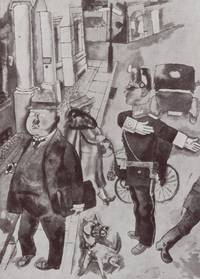
192639022Berlin: Das Kunstarchiv Verlag 1926. First edition. Softcover. g. Quarto. 36pp. Original printed wrappers. Catalog published on the occasion of an exhibition of paintings and drawings by George Grosz held during the Spring of 1926 in Berlin at the Galerie Alfred Flechtheim. This catalog features 24 duo-tone and b/w photographic reproductions. Includes a poem by Gottfried Benn and four essay on the artist and his work by Carl Einstein Marc Neven Max Herrmann and Florent Fels. Some age-wear and moderate soiling on wrappers. Upper corners bumped thus slightly affecting pages throughout. Text in German gothic script with one of the four essays in French. Wrappers in overall good- to good interior in good to very good condition. Alfred Flechtheim 1878-1937 was a German art dealer art collector journalist and publisher. Flechtheim appeared in the art world shortly after 1900 with a collection of paintings by Vincent van Gogh and Paul Cézanne; French Avant garde early works of Pablo Picasso Georges Braque and André Derain; paintings of Wassily Kandinsky Maurice de Vlaminck Alexej von Jawlensky Gabriele Münter and the Rhein Expressionists Heinrich Campendonk August Macke Heinrich Nauen de and Paul Adolf Seehaus de. Flechtheim opened his first gallery in Düsseldorf in 1913 followed by galleries in Berlin Frankfurt Cologne and Vienna. Flechtheim served in the German Army during World War I but not at the front. His art business collapsed during the war but he re-opened in Düsseldorf in 1919. In 1921 he founded "Der Querschnitt" the Cross Section a cultural magazine. Legendary glamorous parties in Flechtheim's gallery overflowed with the glitterati of the new Berlin: movie stars titans of finance prizefighters and artists of every stripe. As Hitler rose to power in the late 1920s and early 1930s Flechtheim became a bête noire because of the art he espoused and championed. In 1933 Sturmabteilung men broke up an auction of Flechtheim's paintings. The Nazis aryanized Flechtheim's gallery as they would many other Jewish businesses and turned it over to Flechtheim's business manager Alex Vömel. After the war former party member Vömel said he didn't even remember who Flechtheim was. The Nazis seized and sold off Flechtheim's private collection as well as the contents of his gallery. Emigration and Death Six months after the Nazis came to power in 1933 Flechtheim penniless fled to Paris and tried to find work with his former business partner Daniel-Henry Kahnweiler. Flechtheim subsequently organized exhibits in London of the paintings of exiled German artists. In London Flechtheim slipped on a patch of ice was taken to a hospital punctured his leg on a rusty nail in his hospital bed developed septicemia leading to amputation of his leg and died. Das Kunstarchiv Verlag unknown