187 résultats
192021022503New York: Henry Holt 1920. First Edition. Cloth. Good . First US edition first printing octavo size 182 pp. The name "Albert Einstein" 1879-1955 immediately conjures up in the mind of almost everyone the image a brilliant scientist whose research and findings are comprehensible to only a few. He would be awarded the Nobel Prize in Physics in 1921 the year after this book was published and his work led to ideas such as spacetime length contraction neutron stars and black holes - along with many other scientific concepts still being explored today. <br/><br/>Einstein published works on "special relativity" as early as 1905 and by 1916 would publish the final form of "general relativity". The two would come together in this work "Relativity The Special and General Theory" first published in London by Methuen in 1920 and in the same year in the US by Henry Holt. In addition to the sections on "The Special Theory of Relativity" and "The General Theory of Relativity" is included a special part "Considerations on the Universe as a Whole" which according to the translator's note was "written specially for this translation" p. ix. <br/><br/>___DESCRIPTION: Bound in full navy blue cloth over boards gilt lettering on the front blind-debossed ruled borders on the front frontispiece a half-tone reproduction of an etching of Einstein in 1920 by Hermann Struck a German-Jewish artist well known for his etchings; octavo size 8 3/8" by 5 5/8" pagination: i-iv v-xiii blank xiv 1-168. <br/><br/>___CONDITION: A bit better than good the boards mostly clean with a few light specks straight corners with minimal rubbing a strong square text block with solid hinges the interior clean and entirely free of prior owner markings; rubbing with slight fraying of the cloth at the head and tail of the spine gilt lettering on the spine has rubbed off leaving debossed lettering the aforementioned light rubbing to the corners an old dampstain at the top fore-edge corner from the front free endpaper through p. 2 a few upper corners bent only the outer quarter-inch by a prior owner offsetting from an old clipping on pp. 16 and 17 and uniform light toning throughout. <br/><br/>___CITATIONS: Printing and the Mind of Man no. 408; online American National Biography and a bit from Wiki. <br/><br/>___POSTAGE: International customers please note that additional postage may apply as the standard does not always cover costs; please inquire for details.<br/><br/>___Swan's Fine Books is pleased to be a member of the ABAA ILAB and IOBA and we stand behind every book we sell. Please contact us with any questions you may have we are here to help. Henry Holt unknown books
1908140937838Leipzig: Johann Ambrosius Barth 1908. First Edition. Very Good. First edition scarce author's offprint ''Uberreicht von den Verfassern'' essentially a presentation copy of the article for the authors' use. One of a small unspecified number perhaps 25-50 of copies thus also printed in the journal Annalen der Physik Vierte Folge Band 26; very few survive. 532-540 pp. Original cream-colored wrappers. In German. Very Good with chips in brittle front and back double-sided wraps tear along entire back wrap repaired with clear tape on verso; contents fine. No foxing. The first separate publication of the paper "On the Fundamental Electromagnetic Equations for Moving Bodies" by Einstein then still a patent clerk and Laub. Johann Ambrosius Barth unknown books
19482327Princeton NJ: np 1948. framed. Fine. ONE OF THE MOST CELEBRATED IMAGES OF EINSTEIN SIGNED BY MASTER PHOTOGRAPHER YOUSUF KARSH. On February 11 1948 Yousuf Karsh perhaps the most accomplished portrait photographer of his generation visited The Institute for Advanced Study in Princeton to fulfill a dream of his: to photograph Albert Einstein. As he later explained: "Among the tasks that life as a photographer had set me a portrait of Albert Einstein had always seemed a 'must' - not only because this greatest refugee of our century has been accounted by all the world as the most outstanding scientist since Newton but because his face in all its rough grandeur invited and challenged the camera." Karsh: Beyond the Camera David Travis ed. "At Princeton's Institute for Advanced Study I found Einstein a simple kindly almost childlike man too great for any of the postures of eminence. One did not have to understand his science to feel the power of his mind or the force of his personality" official Karsh website. "Awed before this unique intellect I yet ventured to ask Einstein his views on human immortality. He mused for a moment and then replied 'What I believe of immortality There are two kinds. The first lives in the imagination of people and is thus an illusion. There is a relative immortality which may conserve the memory of an individual for some generations. But there is only one true immortality on a cosmic scale ant that is the immortality of the cosmos itself. There is no other.' "He spoke of these ultimate mysteries as calmly as he might a student's question about mathematics - with such an air of quiet confidence indeed that I found his answer profoundly disturbing to one who held other views. Knowing him to be an accomplished violinist I turned the conversation and asked if there were any connection between music and mathematics. 'In art he said 'and in the higher ranges of science there is a feeling of harmony which underlies all endeavour. There is no true greatness in art or science without that sense of harmony. He who lacks it can never be more than a great technician in either field.' "Was he optimistic about the future harmony of mankind itself He appeared to ponder deeply and remarked in graver tones: 'Optimistic No. But if mankind fails to find a harmonious solution than there will be disaster on a dimension beyond anyone's imagination.' To what source should we look for the hope of the world's future 'To ourselves' said Einstein. He spoke sadly yet serenely as one who had looked into the universe far past mankind's small affairs. In this humor my camera caught him. the portrait of a man who had traveled beyond hope or despair." Yousuf Karsh Regarding Heroes. Opening quote from: Colin Naylor ed. Contemporary Photographers. Silver print. Photo taken Princeton 1948. Printed later. Signed by Karsh in full beneath the image on photographer's mount. With Karsh's original calling "card" - a 4x10 inch cardboard slip - included. Image: 8x9 inches. Framed to an overall size of 12x15 inches. Fine condition. np unknown books
198742951Princeton: Princeton University Press 1987. First American Edition. Large thick octavo 26cm.; publisher's cloth in black photo-illustrated dust jacket; lxvi2433pp.; 10 leaves of illus. printed on rectos and versos. Some wear to top jacket extremities else Very Good and sound. Inscribed and signed by Stachel on front free endpaper. Princeton University Press unknown books
1922R5312Berlin: Slovo 1922. Third edition. Paperback. Good. Original wraps; pp. 152 with frontispiece portrait of the author and his preface to the Russian edition. Front cover and endpaper detached but present; cheap paper tanned along the edges and a bit brittle. <br/><br/> Slovo paperback books
1938180902007New York: Simon and Schuster 1938. First Edition. Hardcover. Very Good. First edition first printing. Previous owner signature of Albert K. Chapman to front free end paper. Chapman served as the president of the Eastman Kodak Company from 1952-1960 then as chairman until he retired in 1967.Publisher's navy blue cloth binding stamped in gilt. Near Fine with a small scuff to front cover. In a Very Good dust jacket with price intact moderate rubbing and edge wear and a slightly toned spine panel. Simon and Schuster hardcover books
19321864np: np 1932. First edition. nb. UNPUBLISHED CANDID PHOTOGRAPHS OF EINSTEIN AND LETTERS BY WILLIAM HUBBARD OFFERING AN INTIMATE VIEW OF THE SCIENTIST ON VACATION. On March 2 1932 at the height of his career and world fame Albert Einstein and his wife Elsa set off on a vacation to their German homeland departing from Los Angeles on the M. S. San Francisco. Another passenger aboard the ship was the renowned music scholar William Lines Hubbard. Famous in his own right Hubbard was the music critic for the Chicago Tribune and author of a definitive 11-volume work on the history of opera published 1908. Accompanying Hubbard was his companion Julia Reid their cabins adjacent to that of the Einstein's. As was the practice during this era Hubbard kept detailed journals and letters of his travel experiences. This collection from the estate of Hubbard contains the following items:
 1. Three unpublished small black-and-white and sepia photographs. The first photograph 4.5" x 2.5" pictures Einstein his wife Elsa the Ship's Captain Hubbard the tall figure and three other of the ship's passengers dated 3/14/32. The second photograph 3.5" x 3.25" is an outstanding full front image of Einstein his wife Elsa and the ship's Captain. The final photograph 4.5" x 2.5" is a full frontal image of Einstein and his wife Elsa both seated in deck chairs with the ship's Captain standing behind.
 2. Typed letter dated March 22 1932 written while sailing through the South Atlantic. Six pages typed front and back on two pieces folded of the ship's original stationary approx. 7.5x11 in. Excerpts on Einstein include:

 Of our Six Passengers two are Prof. Einstein and wife. They are proving very delightful companions-- sincere unaffected and jolly. At first they were very reserved and merely bowed and smiled and "Guten-Morgan-ed" when entering and leaving the dining room but when they had become rested and saw that none of the rest of us planned to intrude they came forward and have been very genial. She is a great talker but talks interestingly. He walks deck smoking his stubby black pipe or whistling cheerily his gray hair blowing in the breeze. Each forenoon and sometimes in the afternoon he goes to the piano and plays for half hour or so. Plays in that satisfying manner peculiar to a man to whom music is a comfort and who thinks musically. It is in no wise brilliant playing but it is throughly enjoyable to hear. The rest of the time he sits in his steamer chair or in his cabin reading or thinking. On the 14th he had his 53rd birthday and the Capt had ordered from La Libertad Salvador where we had taken cargo the day before large bunches of easter and tiger lilies which in the morning were on the Einstein table together with a birthday cake the ship's cook had made and countless cards and letters which friends had sent. It was all a complete surprise to them both and their happiness was childlike in its spontaneity and sincerity. It was heart warming to watch them. They seem to appreciate being left to themselves and not being lionized. It is the third time they have come through the canal on these boards an they enjoy it to the full.
 3. Typed letter dated April 1 1932 written while entering the English Channel. Seven pages on two approx. 8.5x11in sheets folded of the ship's original stationary. Excerpts on Einstein include: 

We had good fun watching for crocodiles along the banks as we came up the cut and Prof Einstein was especially gleeful when he discovered one. Professor Einstein loves the roung sic weather and has reveled in it. He and the Mme are proving very delightful fellow passengers. She is very chatty but chats interestingly and he struts up and down deck smoking his stubby pipe or whistling like a jolly kid his white hair blowing in the breeze. We have some talks occasionally and he yesterday when he saw the copy of Living Philosophies which I had given me sic before I left San Diego and in which his article is the first took the book and autographed his picture and wrote in remembrance of the happy days on board the San Francisco. I don't think I told you of his birthday which occurred on the 14 of March the day before we reached the Canal. The Capt came to know if it and when the Einsteins came to their table at breakfast they found it decorated with three huge vases of Easter and Tiger lilies which the Capt had secured in La Libertad. The cook had made a gorgeously decorated Torte-- one of the filled and frosted German cakes-- and there were letters and telegrams from friends which had been sent in the Capt's care. It was a complete surprise to the Einsteins and they were like two happy kiddies. It was gladdening to watch their simple and keen enjoyment. Later we had pieces of the Torte which were a bit of muchness for breakfast but which of course we ate. 
4. Typed letter dated April 24 1932 written in Merano Italy. Six pages on five 5.5x7in sheets. 

While recalling a cargo transfer on the M. S. San Fransisco Hubbard writes: The Einsteins were especially enthusiastic and we had a great fun over the boss of the unloading. He was a huge and tremendously rotund gent wearing a soft felt hat and a short overcoat the buttons of which seemed fated to "bust off" at any moment. His chief employment seemed to be running about from side to side of the dock into the warehouse and out again clambering onboard and then clambering off and all the time shouting orders at the top of his voice and gesticulating wildly. Einstein had been reading the "Living Philosophies" which I had loaned him and was especially curious concerning Mencken and how he happened to be included in the great ones in the book. I gave him an outline of Mr. M's greatness and assured him that the book cold sic well largely on account of M being included. All of which amused the Einsteins greatly. So when this wild boss hove into sight that morning and began his excited directing Mrs E said "there is Mister Mencken" and thus he remained so long as we were in Rotterdam. The Einsteins were starting early the next morning for Berlin so they went about 9 pm to the custom house and had their 16 packages bundles and gifts examined. Frau Professor had a funny story to tell of their experience with the 150 pound bag of coffee that had been presented them in Salvador. 


5. An official passenger list from the M. S. San Francisco printed on the ship's original stationary 4.75" x 8.25" dated March 2 1932. With "Professor Albert Einstein" and "Mrs. Albert Einstein" shown under the list of cabin passengers going from Los Angeles to Bremen.


 6. A postcard depicting Hubbard's profile in black and white 3.45" x 5.45".

 All items in very good condition letters with wear and soiling at folds and housed in a custom cloth presentation folder. RARE FIRST-HAND TESTIMONY REVEALING THE PERSONALITY OF EINSTEIN IN RELAXED AND INFORMAL MOMENTS. np unknown books
1923958901923. Etch bust of Albert Einstein done by well-known artist Hermann Struck. Signed by both Einstein and Struck numbered 49/150. In fine condition. Double matted and framed the entire piece measures 12.25 inches by 15 inches. An exceptional piece. Hermann Struck was a German Jewish artist known for his etchings. In 1908 Struck published "Die Kunst des Radierens" "The Art of Etching" which became a seminal work on the subject. His students included Marc Chagall Lovis Corinth Jacob Steinhardt Lesser Ury and Max Liebermann. Struck did commissioned portraits of Albert Einstein Ibsen Nietzsche Freud Herzl Oscar Wilde among others. unknown books
19981322768Princeton: Princeton University Press 1998. First Edition. Softcover. Quarto; VG- Paperback; White spine with Black text; Covers have some edgewear some shelfwear covers bowing towards fore edge red marks on spine otherwise clean; Textblock has bending to top corner of page 713 otherwise clean; 714 pp; English Translation. 1322768. FP New Rockville Stock. Princeton University Press unknown books
19472187Princeton NJ: Halsman 1947. Photograph. Fine. ONE OF THE MOST FAMOUS IMAGES OF EINSTEIN. Philippe Halsman's now iconic 1947 photograph of Einstein has become not only one of the most celebrated images of Einstein but one of the most recognizable images of the twentieth century. It was used to a 1966 US postage stamp of Einstein and was featured on the cover of Time Magazine honoring Einstein as the "Person of the Century".

 The photographer Halsman in his book Philippe Halsman: A Retrospective explained the circumstances of the photo: I admired Albert Einstein more than anyone I ever photographed not only as the genius who single-handedly had changed the foundation of modern physics but even more as a rare and idealistic human being.
 Personally I owed him an immense debt of gratitude. After the fall of France it was through his personal intervention that my name was added to the list of artists and scientists who in danger of being captured by the Nazis were given emergency visas to the United States.
 After my miraculous rescue I went to Princeton to thank Einstein and I remember vividly my first impression. Instead of a frail scientist I saw a deep-chested man with a resonant voice and a hearty laugh.
 The question of how to capture the essence of such a man in a portrait filled me with apprehension. Finally in 1947 I had the courage to bring on one of my visits my Halsman camera and a few floodlights. After tea I asked for permission to set up my lights in Einstein's study. The professor sat down and started peacefully working on his mathematical calculations. I took a few pictures. Ordinarily Einstein did not like photographers whom he called Lichtaffen light monkeys. But he cooperated because I was his guest and after all he had helped save me.
 Suddenly looking into my camera he started talking. He spoke about his despair that his formula E=mc2 and his letter to President Roosevelt had made the atomic bomb possible that his scientific search had resulted in the death of so many human beings. "Have you read" he asked "that powerful voices in the United States are demanding that the bomb be dropped on Russia now before the Russians have time to perfect their own" With my entire being I felt how much this infinitely good and compassionate man was suffering from the knowledge that he had helped to put in the hands of politicians a monstrous weapon of devastation and death.
 He grew silent. His eyes had a look of immense sadness. There was a question and a reproach in them.
 The spell of this moment almost paralyzed me. Then with an effort I released the shutter of my camera. Einstein looked up and I asked him "So you don't believe that there will ever be peace"
 "No" he answered. "As long as there will be man there will be wars." Silver prints of this photograph have been printed in different sizes over the years. This photograph is an official Halsman silver print with his copyright hand-stamp on the verso measuring approximately 10x13 inches. Princeton NJ. Silver print. Taken 1947; printed 1970s. Image: 13x10 inches 33x25.4 cm. Archivally matted and framed under UV-protecting museum glass to an overall size of 18.5x22 inches. A stunning piece in fine condition. Halsman unknown books
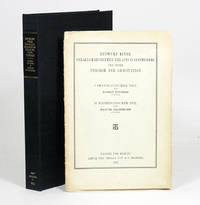
19132064Leipzig and Berlin: Teubner 1913. First edition. Original wrappers. Very Good. FIRST EDITION COMMERCIAL OFFPRINT ISSUE of Einstein's breakthrough work on general relativity: the famous "Entwurf" paper. "In this book Einstein and Grossman investigated curved space and curved time as they relate to a theory of gravity. They presented virtually all the elements of the general theory of relativity with the exception of one striking omission: gravitational field equations that were not generally covariant. Einstein soon reconciled himself to this lack of general covariance through the 'hole argument' which sought to establish that generally covariant gravitational field equations would be physically uninteresting. Einstein did not adopt the gravitational field equations until late in 1915 in his final formulations of the general theory. Here Einstein contributed the physics and Grossman the mathematics" Calaprice The Einstein Almanac 40. Weil 59a. Offprint from Zeitschrift für Mathematik und Physik volume 62. Leipzig and Berlin: Teubner 1913. Octavo original wrappers; custom box. Pencil notation on title. Small chips at spine ends. An outstanding copy without any of the cover-foxing so common with this issue. Teubner unknown books
19132139Zürich: Zürcher & Furrer 1913. First edition offprint. Original wrappers. Very Good. EXTREMELY RARE AUTHOR'S OFFPRINT "Überreicht von den Verfassern" IN ORIGINAL WRAPPERS OF THE FIRST PRINTING OF EINSTEIN AND GROSSMANN'S FURTHER DEVELOPMENT OF THE CRITICAL "ENTWURF" THEORY OF 1913. "Einstein returned from Prague to Zurich in the summer of 1912. He had by then already formulated the fundamental physical principles of the general relativity theory of gravitation and was now searching for their mathematical structure. At the E.T.H. the Swiss Federal Institute of Technology in Zurich where he now returned as professor of theoretical physics Einstein met again his old fiend and former fellow student Marcel Grossmann who was now a professor of mathematics and his colleague. With Grossmann and under his guidance Einstein studied the mathematical literature especially the theory of invariants and the absolute differential calculus of Chirstoffel Ricci Levi-Civita and others. Einstein developed the mathematical structure of his theory jointly with Grossmann and in his celebrated paper on the general theory of relativity in 1916 he acknowledged the help which his friend had given him. It was Grossmann's help which had Einstein said 'spared me not only the study of the relevant mathematical literature but who Grossmann also assisted me in searching for the field equations of gravitation.' This study of mathematical literature and the search for the proper mathematical tools led to several joint papers with Grossmann during Einstein's all too brief stay in Zurich. These papers contained the first attempts toward a generalized theory of relativity using new mathematical tools and gave full expression to Einstein's earlier physical insights" Jagdish The Golden Age of Theoretical Physics. The first of Einstein's papers to present his collaborative work with Grossmann the famous "Entwurf" paper appeared in the summer of 1913; the present paper based on a lecture given on September 9 1913 to the 96th annual meeting of the Swiss Society for Natural Sciences in Frauenfeld provides further details on the new generalized theory of relativity. The published paper contains more mathematics than in the given lecture. Weil 57. OFFPRINT FROM: Vierteljahrsschrift der Naturforschenden Gesellschaft vol. 58 pp. 284-290 Einstein; pp. 291-297 Grossmann. Zürich: Zürcher & Furrer 1913. Octavo original wrappers; custom box. Mild dampstaining to extreme top outer margin away from the text; crease down the center of issue. SCARCE. Zürcher & Furrer unknown books
19171127481917. Rare large etching of Albert Einstein done by well-known artist Erich Buttner. Signed by both Einstein and Buttner. In fine condition. Double matted and framed the entire piece measures 12.25 inches by 15 inches. An exceptional piece. In the 1920s he created a series of portraits of his friends and fellow artists including Lovis Corinth George Grosz Arno Holz and Heinrich Zille. He produced a very fine book of exlibris bookplates in Berlin 1921. This book contains the exlibris of Albert Einstein 1917 probably Einstein's only bookplate. The etching measures 12.5 inches by 9.5 inches. Double matted and framed. The entire piece measures 18.75 inches by 15.75 inches. Hermann Struck was a German Jewish artist known for his etchings. In 1908 Struck published "Die Kunst des Radierens" "The Art of Etching" which became a seminal work on the subject. His students included Marc Chagall Lovis Corinth Jacob Steinhardt Lesser Ury and Max Liebermann. Struck did commissioned portraits of Albert Einstein Ibsen Nietzsche Freud Herzl Oscar Wilde among others. unknown books
19561326923Princeton NJ: Princeton University Press 1956. Fifth Edition. Hardcover. 10mo; pp 166; G/Fair; dark beige spine with brown text; fifth edition including the Relativistic Theory of the Non-Symmetric Field; last edition corrected by Einstein before his death; dust jacket has noticeable sun darkening to exterior; few chips to edges; cloth shows lightly sunned exterior; strong boards; text block has only light foxing to exterior edges; interior clean; illustrated;. 1326923. FP New Rockville Stock. Princeton University Press hardcover books
1913WRCLIT84021Leipzig & Berlin: B.G. Teubner 1913. 289pp. Printed green cloth. Ink name and bookplate on pastedown front free endsheet brittle and detached cloth a bit faded and lightly soiled but a very good copy. First edition in this format of three essays by Lorentz two by Einstein and one by Minkowski with a foreword by Otto Blumenthal. Einstein's two essays "Zur Elektrodynamik bewegter Korper" and "Ist die Tragheit eines Korpers von seinem Enerheinhalt abhangig" were first published in 1905 in ANNALEN DER PHYSIK the first being Einstein's first publication on special relativity. Minkowski's essay "Raum und Zeit" was first published in 1909 see PMM 401. B.G. Teubner hardcover books
200040663NY:: George Braziller. As New. 2000. Hardcover. 0807614173 . Black and white illustrations. A facsimile edition. As new in like slipcase. Still in original shrinkwrap. ; 192 pages . George Braziller, hardcover books
1988S8998Princeton:: Princeton University Press 1988. 1988. 8vo. 166 pp. Printed wrappers. Fine. Fifth edition. ISBN: 069102352 Princeton University Press, (1988). unknown books
194994288NY:: Philosophical Library. Very Good in Very Good dust jacket. 1949. Hardcover. Translated from the German by Alan Harris. First edition thus. Very good in a very good dust jacket. ; 112 pages . Philosophical Library, hardcover books
194926768New York: Philosophical Library 1949. FIRST ABRIDGED EDITION. Originally published in 1933 by Covici-Friede. A fine copy in a fine dust jacket. <br/><br/> Philosophical Library unknown books
1979BL1593New York:: Center for Physics; American Institute of Physics 1979. 1979. Second revised edition. Oblong 8vo. 77 pp. Figs. Printed wrappers; corners creased. Burndy bookplate. Very good. ISBN: 0883182483 Center for Physics; American Institute of Physics, (1979). unknown books
1979BL1592Austin:: University of Texas Press 1979. 1979. Series: The Library Chronicle New Series no. 12. Thin 8vo. 107 pp. Printed wrappers. Four lectures by Loyd S. Swenson C.P. Snow Howard Stein Ilya Prigogine. University of Texas Press, 1979. unknown books
1988S4425In:: American Scientist Vol. 76 No. 2 March-April 1988. 1988. 277 x 211 mm. 4to. 154-158 pp. 4 figs. Pictorial wrappers Einstein and Chaplin. Fine. American Scientist, Vol. 76, No. 2, March-April 1988. unknown books
1994S11423New York:: Warner Books 1994. 1994. Small 8vo. 179 pp. Printed wrappers. Fine. ISBN: 0446670111 Warner Books, (1994). unknown books
193240505Los Angeles: Los ANgeles University of International Relations 1932. First Edition. Quarto 26cm. Pictorial card wrappers; 96pp. Mild external soil; Very Good or better. Includes a translation of Dr. Einstein's 1932 address "World Disarmament" delivered at the World Affairs Dinner in Pasadena February 1 1932. Other contributions Ken Nakazawa and N. Wing Mah on the Sino-Japanese Controversy Bernard Mollenhauer et al. Los ANgeles University of International Relations unknown books
1925321321Buenos Aires: Imprenta y Casa Editora Coni 1925. First Edition. 14 pp. Plate with halftone photograph portrait of Albert Einstein by Witcomb. 8vo. Original printed wrappers. Minor browning at wrapper edges. First Edition. 14 pp. Plate with halftone photograph portrait of Albert Einstein by Witcomb. 8vo. From the Library of Einstein's Eldest Son. This scarce commemorative booklet issued on the occasion of Einstein's visit to the University of Buenos Aires contains a biography and bibliography of Einstein together with a list of Einstein's activities while in Argentina during 1925. This example with provenance to Hans Albert Einstein Albert Einstein's oldest son with his inkstamp at top of front wrapper. OCLC locates only three copies Princeton University the National Library of Israel and Hebrew University in Israel. Imprenta y Casa Editora Coni unknown books