187 résultats
1938165146Paris 1938. paperback. Pp. 5-19 IN: Zeitschrift fur Freie Deutsche Forschung. Jahrgang 1 Nummer 1. Herausgegeben von der Freien Deutschen Hochschule in Paris. 168p. printed wrappers. Paris Juli 1938.<br/><br/> First number of this scarce short-lived exile publication featuring German & Austrian writers and scholars. Fine.<br/><br/> unknown books
19132139Zürich: Zürcher & Furrer 1913. First edition offprint. Original wrappers. Very Good. EXTREMELY RARE AUTHOR'S OFFPRINT "Überreicht von den Verfassern" IN ORIGINAL WRAPPERS OF THE FIRST PRINTING OF EINSTEIN AND GROSSMANN'S FURTHER DEVELOPMENT OF THE CRITICAL "ENTWURF" THEORY OF 1913. "Einstein returned from Prague to Zurich in the summer of 1912. He had by then already formulated the fundamental physical principles of the general relativity theory of gravitation and was now searching for their mathematical structure. At the E.T.H. the Swiss Federal Institute of Technology in Zurich where he now returned as professor of theoretical physics Einstein met again his old fiend and former fellow student Marcel Grossmann who was now a professor of mathematics and his colleague. With Grossmann and under his guidance Einstein studied the mathematical literature especially the theory of invariants and the absolute differential calculus of Chirstoffel Ricci Levi-Civita and others. Einstein developed the mathematical structure of his theory jointly with Grossmann and in his celebrated paper on the general theory of relativity in 1916 he acknowledged the help which his friend had given him. It was Grossmann's help which had Einstein said 'spared me not only the study of the relevant mathematical literature but who Grossmann also assisted me in searching for the field equations of gravitation.' This study of mathematical literature and the search for the proper mathematical tools led to several joint papers with Grossmann during Einstein's all too brief stay in Zurich. These papers contained the first attempts toward a generalized theory of relativity using new mathematical tools and gave full expression to Einstein's earlier physical insights" Jagdish The Golden Age of Theoretical Physics. The first of Einstein's papers to present his collaborative work with Grossmann the famous "Entwurf" paper appeared in the summer of 1913; the present paper based on a lecture given on September 9 1913 to the 96th annual meeting of the Swiss Society for Natural Sciences in Frauenfeld provides further details on the new generalized theory of relativity. The published paper contains more mathematics than in the given lecture. Weil 57. OFFPRINT FROM: Vierteljahrsschrift der Naturforschenden Gesellschaft vol. 58 pp. 284-290 Einstein; pp. 291-297 Grossmann. Zürich: Zürcher & Furrer 1913. Octavo original wrappers; custom box. Mild dampstaining to extreme top outer margin away from the text; crease down the center of issue. SCARCE. Zürcher & Furrer unknown books
19482327Princeton NJ: np 1948. framed. Fine. ONE OF THE MOST CELEBRATED IMAGES OF EINSTEIN SIGNED BY MASTER PHOTOGRAPHER YOUSUF KARSH. On February 11 1948 Yousuf Karsh perhaps the most accomplished portrait photographer of his generation visited The Institute for Advanced Study in Princeton to fulfill a dream of his: to photograph Albert Einstein. As he later explained: "Among the tasks that life as a photographer had set me a portrait of Albert Einstein had always seemed a 'must' - not only because this greatest refugee of our century has been accounted by all the world as the most outstanding scientist since Newton but because his face in all its rough grandeur invited and challenged the camera." Karsh: Beyond the Camera David Travis ed. "At Princeton's Institute for Advanced Study I found Einstein a simple kindly almost childlike man too great for any of the postures of eminence. One did not have to understand his science to feel the power of his mind or the force of his personality" official Karsh website. "Awed before this unique intellect I yet ventured to ask Einstein his views on human immortality. He mused for a moment and then replied 'What I believe of immortality There are two kinds. The first lives in the imagination of people and is thus an illusion. There is a relative immortality which may conserve the memory of an individual for some generations. But there is only one true immortality on a cosmic scale ant that is the immortality of the cosmos itself. There is no other.' "He spoke of these ultimate mysteries as calmly as he might a student's question about mathematics - with such an air of quiet confidence indeed that I found his answer profoundly disturbing to one who held other views. Knowing him to be an accomplished violinist I turned the conversation and asked if there were any connection between music and mathematics. 'In art he said 'and in the higher ranges of science there is a feeling of harmony which underlies all endeavour. There is no true greatness in art or science without that sense of harmony. He who lacks it can never be more than a great technician in either field.' "Was he optimistic about the future harmony of mankind itself He appeared to ponder deeply and remarked in graver tones: 'Optimistic No. But if mankind fails to find a harmonious solution than there will be disaster on a dimension beyond anyone's imagination.' To what source should we look for the hope of the world's future 'To ourselves' said Einstein. He spoke sadly yet serenely as one who had looked into the universe far past mankind's small affairs. In this humor my camera caught him. the portrait of a man who had traveled beyond hope or despair." Yousuf Karsh Regarding Heroes. Opening quote from: Colin Naylor ed. Contemporary Photographers. Silver print. Photo taken Princeton 1948. Printed later. Signed by Karsh in full beneath the image on photographer's mount. With Karsh's original calling "card" - a 4x10 inch cardboard slip - included. Image: 8x9 inches. Framed to an overall size of 12x15 inches. Fine condition. np unknown books
1933316570Paris: Institut International de Cooperation Intellectuelle. Societe des Nations 1933. One of 3000 copies on Chataignier paper. 62 1 1 blank 1 imprint. Printed in Dijon by Darantière. 1 vols. 8vo. Printed wrappers. Loose in binding spine toned and scuffed internally clean. Very good. One of 3000 copies on Chataignier paper. 62 1 1 blank 1 imprint. Printed in Dijon by Darantière. 1 vols. 8vo. Published simultaneously in French English and German. Institut International de Cooperation Intellectuelle. Societe des Nations unknown books
195286694NY:: Dover Publications. Good. 1952. Paperback. With notes by A. Sommerfield. Translated from the German by W. Perrett and G. B. Jeffery. With seven diagrams. First edition thus paperback. Covers are age darkened with a few corner creases else good in printed wraps.; 216 pages . Dover Publications, paperback books
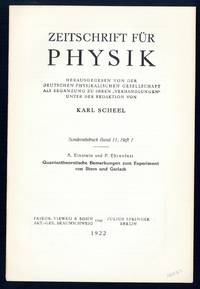
1922432871922. <p>Einstein Albert 1879-1955 and Paul Ehrenfest 1880-1933. Quantentheoretische Bemerkungen zum Experiment von Stern und Gerlach. Offprint from Zeitschrift für Physik 11 1922. 31-34pp. 229 x 155 mm. Original printed self-wrappers. Light toning but fine otherwise. </p> <p>First Edition Offprint Issue. In 1922 the physicists Otto Stern and Walther Gerlach conducted a now-classic experiment in which a beam of silver atoms was streamed through an inharmonious magnetic field in order to observe the atoms' deflection patterns. Rather than a random and continuous distribution as predicted by classical theory the atoms passing through the field were deflected up or down by a specific amount demonstrating that they had intrinsically quantum properties. The Stern-Gerlach experiment corroborated the Bohr-Sommerfeld model of the atom and strongly influenced later developments in 20th century physics. However the experiment also created some serious difficulties for quantum physicists in the period before the rise of the "new" quantum mechanics. </p> <p>Einstein and Ehrenfest addressed one of these difficulties—connected with space quantization—in their joint paper in which </p> <p>"they dealt in particular with the problem of how the orbits of the atom would obtain their discrete directions which they exhibit while passing through the inhomogeneous magnetic field. Under the assumption that the mechanism causing the orientation was provided by the interaction with the radiation field Einstein and Ehrenfest estimated that for a field strength of 10000 G a change in the direction of the orbit would take place in roughly 1011 s; this long time interval would be reduced in the presence of heat radiation at room temperature . . . to about 109 s. How could they asked the experimental situation be explained which implied that the discrete orientations of the orbits in silver atoms were obtained in less than 10-4 s. In order to deal with this evident puzzle Einstein and Ehrenfest proposed two alternatives: first that the silver atoms were always in the states of spatial quantization; second the orientations of the electron orbits arose from an interaction of the atoms with the radiation field which involved much smaller reaction times . . . However they found that both alternatives created considerable difficulties in the understanding of the atomic processes . . . Thus Einstein and Ehrenfest concluded: 'The difficulties mentioned above show how unsatisfactory are both interpretations of the results found by Stern and Gerlach'" Mehra & Rechenberg The Historical Development of Quantum Theory 1 pp. 443-444. </p> <p>Pais Subtle is the Lord p. 328. Weil Albert Einstein Bibliography 121.</p> . unknown books
1920DOV18320New York: Henry Holt and Company 1920. Hardcover. Good. 8vo. Publisher's navy blue cloth. The 1921 on title-page making this the 3rd printing. First was 1920. Portrait of Einstein by Hermann Struck from 1920 as frontispiece with facsimile Einstein signature beneath image. Top of spine worn with light chipping to spine ends corners bumped. Internally a very solid copy. Old Brentanos bookplate. <br/><br/> Henry Holt and Company hardcover books
1931147457New York: Peter Smith 1931. Reprint of 1920 Henry Holt edition. Hardcover. Tight binding but with rubbing to covers. Several pencil notations within text from former owner Robert Palter noted Newtonian and professor of science. Ex-lib. stamp inside front cover. Midnight cloth/boards with gilt lettering. 168 pp. with no illus. Translated by Robert Lawson. With a charming preface by Einstein a bit of biographical information and numerous mathematical equations throughout the text. Peter Smith hardcover books
192021022503New York: Henry Holt 1920. First Edition. Cloth. Good . First US edition first printing octavo size 182 pp. The name "Albert Einstein" 1879-1955 immediately conjures up in the mind of almost everyone the image a brilliant scientist whose research and findings are comprehensible to only a few. He would be awarded the Nobel Prize in Physics in 1921 the year after this book was published and his work led to ideas such as spacetime length contraction neutron stars and black holes - along with many other scientific concepts still being explored today. <br/><br/>Einstein published works on "special relativity" as early as 1905 and by 1916 would publish the final form of "general relativity". The two would come together in this work "Relativity The Special and General Theory" first published in London by Methuen in 1920 and in the same year in the US by Henry Holt. In addition to the sections on "The Special Theory of Relativity" and "The General Theory of Relativity" is included a special part "Considerations on the Universe as a Whole" which according to the translator's note was "written specially for this translation" p. ix. <br/><br/>___DESCRIPTION: Bound in full navy blue cloth over boards gilt lettering on the front blind-debossed ruled borders on the front frontispiece a half-tone reproduction of an etching of Einstein in 1920 by Hermann Struck a German-Jewish artist well known for his etchings; octavo size 8 3/8" by 5 5/8" pagination: i-iv v-xiii blank xiv 1-168. <br/><br/>___CONDITION: A bit better than good the boards mostly clean with a few light specks straight corners with minimal rubbing a strong square text block with solid hinges the interior clean and entirely free of prior owner markings; rubbing with slight fraying of the cloth at the head and tail of the spine gilt lettering on the spine has rubbed off leaving debossed lettering the aforementioned light rubbing to the corners an old dampstain at the top fore-edge corner from the front free endpaper through p. 2 a few upper corners bent only the outer quarter-inch by a prior owner offsetting from an old clipping on pp. 16 and 17 and uniform light toning throughout. <br/><br/>___CITATIONS: Printing and the Mind of Man no. 408; online American National Biography and a bit from Wiki. <br/><br/>___POSTAGE: International customers please note that additional postage may apply as the standard does not always cover costs; please inquire for details.<br/><br/>___Swan's Fine Books is pleased to be a member of the ABAA ILAB and IOBA and we stand behind every book we sell. Please contact us with any questions you may have we are here to help. Henry Holt unknown books
192010340London: Methuen & Co. LTD 1920. First Edition. Cloth. Near fine. First English edition of Albert Einstein's Special & General Theory of Relativity in publisher's scarce dust jacket. Octavo xiii 3 138pp. 8pp ads. Red cloth title in gilt on spine stamped on cover. "First Published in 1920" statement on copyright page. A few leaves are unopened along the top edge. Light even toning throughout. Front hinge starting to separate but text block stable. Previous ownership inscription on front endpaper. Housed in custom brown leather clamshell lined in tan cloth title in gilt on spine. In publisher's original dust jacket expert restoration to spine and hinges remnants of tape repair to spine exceptionally scarce. First published in German in 1916 this copy is the first English translation of Relativity with the aim of giving "an exact insight into the theory of relativity to those readers who from a general scientific and philosophical point of view are interested in the theory but who are not conversant with the mathematical apparatus of theoretical physics." - Albert Einstein. The first American edition was published later the same year. Methuen & Co. LTD unknown books
1928374171928. Weil 161. Offprint from S. preuss. Akad. Wiss. unknown books
193010508Boston: Houghton Mifflin 1930. First Edition. Cloth. Near fine/good. First edition of Roosevelt: His Mind in Action by Lewis Einstein in scarce dust jacket. Octavo vii 5 259pp. Maroon buckram cloth title printed on label affixed to cover and spine. Some leaves unopened. Uncut outer edge. No additional printings mentioned on copyright page. Previous ownership inscription on front free endpaper. In publisher's scarce dust jacket $3.00 retail price on front flap long closed tear to front cover large chipping to spine and back panel archival repair to verso bright illustrations. A rare find in the publisher's dust jacket. Houghton Mifflin unknown books
1962121258Düsseldorf Germany: Galerie Vomel 1962. Softcover. VG. White paper wraps. Unpaginated with 8 pp. and 4 bw plates. Text in German. Includes a bw photo of the artist a list of works in the exhibition held January - February 1962 and a brief essay. Galerie Vomel unknown books
1975172601New York: Harry N. Abrams 1975. First edition. Oblong hardcover. First printing. 260 pages. Text by Peter Selz essay by Susan Einstein and with some poems inspired by Francis' artworks. Includes 185 illustrations with 45 in color. A tight close to near fine copy with some faint foxing in a near fine dust jacket. A nice copy of what remains one of the better monographs on Francis. Harry N. Abrams unknown books
1982178607New York: H.N. Abrams 1982. revised. Hardcover. VG/VG. Off-white cloth boards stamped design on front cover blue spine lettering; glossy color illustrated dust jacket with red lettering bw illustrated end pages 296 pp profusely illustrated with 217 illustrations including 82 in full color. Contents include:Sam Francis / Peter Selz -- Plates -- A selection of poems written about the artist -- The prints of Sam Francis: Lithographs and silkscreens / Susan Einstein -- Monotypes and other recent prints / Jan Butterfield. Also includes bibliographical references pages 288-292 and index and essays by Susan Einstein and Jan Butterfield. H.N. Abrams hardcover books
1982015731New York: Abrams 1982. Book. Near fine condition. Hardcover. Revised edition. Quarto 4to. 296 pages of text. Original hardcover binding with a small bump to the top of the spine; otherwise almost new condition. Unclipped dustjacket with minimal shelfwear and minor sunning to the spine; protected in archival mylar. Contains 217 illustrations including 82 plates in full color. The text is clean and unmarked. First published in 1975 this full-scale book on Francis is enlarged and brought up to date. First printing of the Revised Edition. Abrams Hardcover books
1920374021920. Weil 110. Offprint from S. preuss. Akad. Wiss. unknown books
195133824London: Cassell 1951. 391 pp. Some browning and foxing. Cassell unknown books
1932433001932. Offprint from Sitzungsberichte der Preussischen Akademie der Wissenschaften 32 1932. 31pp. 256 x 183 mm. Original printed wrappers a little chipped and darkened small splits in spine. Very good. First edition offprint issue. Einstein's work on semivectors "was stimulated by Ehrenfest's insistence on a better understanding of the relation between single-valued and double-valued representations of the Lorentz group . . . Einstein and Mayer went on to relate semivectors to the Dirac equation and to generalize the formalism to general relativity" Pais Subtle is the Lord pp. 451-452. Weil Albert Einstein Bibliography 186. unknown books
193237427Berlin: Akad. Wiss 1932. Akad. Wiss unknown books
198335229NY: Dover 1983. 8vo pp. 56. Paper wraps. Cover very slightly soiled o/w a nice tight copy. Two addresses: Ether and the theory of relativity 1920 and Geometry and experience 1921. Dover unknown books
19191857Berlin: Königlich Akademie der Wissenschaften 1919. First Edition. Fine. FIRST EDITION IN ORIGINAL WRAPPERS of one of Einstein's major papers on the modification of general relativity and the beginning of his unified field theory. "As so often the case in relativity the story of quantum gravity begins with Einstein himself. Soon after the final formulation of general relativity he pointed out the need for a quantum modification of the theory. In "Do Gravitational Fields Play an Essential Role in the Structure of the Elementary Particles of Matter" he began to speculate whether gravitation plays a role in the atomistic structure of matter: There are reasons for thinking that the elementary formations which go to make up the atom are held together by gravitational forces. The above reflections show the possibility of a theoretical construction of matter out of the gravitational field and the electromagnetic field alone. "In order to construct such a model of an 'elementary particle' Einstein shows that it is necessary to modify the original gravitational field equations. The major interest of this paper is that his attention now shifted from possible quantum modifications of general relativity to the search for a unified theory of the electromagnetic and gravitational fields on the basis of which he hoped to explain the structure of matter. Quantum effects are to be derived from such a theory rather than postulated ad hoc. Einstein remained committed to this approach for the rest of his life: the search for a 'natural' mathematical extension of the general theory in the hope that such a theory would somehow explain the quantization of matter and energy" Iyer and Bhawal Black Holes Gravitational Radiation and the Universe. IN: Sitzungsberichte der Preussischen Akademie der Wissenschaften Vol XX pp. 349-356. Berlin: Akademie der Wissenschafter 1919. Octavo original wrappers; custom box. A tiny bit of edgewear. A FINE COPY. Königlich Akademie der Wissenschaften unknown books
50102pamphlet. 11 pages p 1105-1115 FROM: Annalen der Physik fourth series vol. 33. Modern wrappers. Leipzig 1910.<br/><br/> unknown books
19162364Braunschweig: Druck und Verlag von Friedr Vieweg and Son 1916. First edition. Original wrappers. Very Good. FIRST PRINTING IN ORIGINAL WRAPPERS OF ONE OF EINSTEIN'S MAJOR WORKS: HIS FIRST PAPER ON THE DERIVATION OF PLANK'S LAW AND PROVIDING THE THEORETICAL BASIS FOR THE LASER. "Einstein commended the 'unparalleled boldness' of Planck's derivation of 1900 meaning not only the problem itself but also the fact that it was based on assumptions that were not entirely free of contradictions. Einstein now succeeded in the first of two papers in eliminating that flaw. More interesting than the derivation itself was the general character of his methods. Einstein proceeded from Niels Bohr's basic--and by then well tested--assumption that the electrons within an atom occupy a number of discrete energy states and are able through emission or absorption of radiation to pass from one of those states to another. Added to this was an assumption of thermodynamic equilibrium between radiation field and atom as well as a consideration of the 'classical' limiting case at high temperatures--and there was Planck's formula. This brief argument. also covers emission stimulated by the radiation field; thus the formulas already by implication contain the theory of the laser though it was to take nearly half a century to be realized" Folsing Albert Einstein 389. Weil 85. The "implication" containing the theory of the laser was more fully developed in his companion paper "On the Quantum Theory of Radiation" published a few weeks later. In the first paper Einstein wrestled with the concept that the atomic emission of radiation could be a directed process; in the second paper he convincingly demonstrates that this is indeed the case. IN: Verhandl. D. Deutch. Phys. Ges. Vol 18 pp. 318-323. Braunschweig: Druck und Verlag von Friedr. Vieweg and Son 1916. Octavo original wrappers; housed in custom half leather chemise. One thread literally resewn on wrappers a little creasing and soiling. A beautiful copy. RARE IN ORIGINAL WRAPPERS. Druck und Verlag von Friedr Vieweg and Son unknown books