1 803 résultats
19222081002109000573SPRINGER-VERLAG 1922. Soft Cover. Fine. Number of pages: 15 SPRINGER-VERLAG paperback
19201433Berlin: Julius Springer 1920. 1st Edition. FIRST EDITION IN ORIGINAL WRAPPERS OF EINSTEIN'S LEIDEN LECTURE EXPLAINING AT LENGTH HIS THEORY OF THE ETHER ALONG WITH THOSE OF LORENTZ & MAXWELL. Very good condition. "Einstein's lecture at the University of Leiden on the occasion of his appointment as a visiting professor summarized his current views on the ether and retrospectively looked at the development of his opinions on the physical properties of space" Calaprice The Einstein Almanac 86. <br /> <br /> In this lecture Einstein recanted his earlier denial of the ether writing: "Recapitulating we may say that according to the general theory of relativity space is endowed with physical qualities; in this sense therefore there exists an ether. According to the general theory of relativity space without ether is unthinkable; for in such space there not only would be no propagation of light but also no possibility of existence for standards of space and time measuring-rods and clocks nor therefore any space-time intervals in the physical sense. But this ether may not be thought of as endowed with the quality characteristic of ponderable media as consisting of parts which may be tracked through time. The idea of motion may not be applied to it" Einstein Ather 1920. <br /> <br /> In this lecture Einstein also sought "to reconcile his theory of relativity with his mentor's Lorentz's cherished concept of the aether. Einstein stressed that special relativity took away the last mechanical property of Lorentz's aether: immobility. However he continued that special relativity does not necessarily rule out the aether because the latter can be used to give physical reality to acceleration and rotation. This concept was fully elaborated within general relativity in which physical properties which are partially determined by matter are attributed to space but no substance or state of motion can be attributed to that "aether" aether = curved space-time" Wikipedia. CONDITION & DETAIL: Berlin Julius Springer 1920. Complete in original cream colored wrappers. 8vo. 22 x 15cm. 15pp. Slight toning. Very good condition. <br /> <br /> ITEM: Ather und Relativitätstheorie. Rede gehalten am 5. Mai 1920 an der Reichs-Universität zu Leiden. Julius Springer unknown
1930433061930. Offprint from Mathematische Annalen 102 1930. 685-697pp. Original printed self-wrappers. 233 x 157 mm. Very good apart from small split in lower spine. Weil Albert Einstein Bibliography 171. unknown
3421027307.Ghardcover. Good. Access codes and supplements are not guaranteed with used items. May be an ex-library book. hardcover
19794445103<p>24cm by 18cm 89pp white dustjacket lightly soiled unmarked.</p> Open Court Publishing Company hardcover
1999Q-0812691792Open Court 1999-01-06. Paperback. New. In shrink wrap. Looks like an interesting title! Open Court paperback
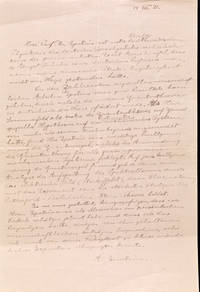
19211206201921. Signed. EINSTEIN Albert. Autograph letter signed. No place August 14 1921. Single sheet of cream lined paper measuring 7-1/2 by 11 inches; p. 1. $35000.Rare heartfelt autograph letter of recommendation written and signed by Einstein in German enthusiastically recommending his friend and colleague physicist Prof. Dr. Paul Epstein for an academic position.The autograph letter dated ""14 VIII 21"" written entirely in Einstein's hand reads translated from the original German: ""Prof. Dr. Epstein is certainly one of the most prominent living theoretical physicists of the German-speaking world. Without a doubt he would have been appointed to a German professorship a long time ago had his Russian nationality not stood in the way. Among Epstein's numerous original scientific papers two findings which advanced the modern quantum theory in crucial ways should be noted. After Mr. Sommerfeld as the first physicist who on the basis of special hypotheses had applied the quantum theory to a certain mechanical system of more than one degree of freedom Mr. Epstein discovered an important generalization of the quantum principle which established the application of the quantum theory for all quasi-periodic mechanical systems. Based on that general application of the quantum principle he then provided an analysis of the splitting of spectral lines in the electrical field Stark effect the accordance of which with the experiment provides one of the strongest supports for the Rutherford-Bohr atomic theory. I would like to add that I have also come to appreciate Mr. Epstein in personal interactions as a human being and that I had the pleasure of attending several scientific lectures given by him which enabled me to convince myself of his competence in delivering clearly understandable oral exposition. / A. Einstein.""Einstein and Epstein were friends and longtime correspondents who shared an interest in physics Judaism and the founding of Israel. Paul Epstein was a Russian-American mathematical physicist. He remains best known for his contributions to the development of quantum mechanics. Indeed he was one of a select group that included Lorentz Einstein Minkowski Thomson Rutherford Sommerfeld Röntgen von Laue Bohr de Broglie Ehrenfest and Schwarzschild. Born in Warsaw then part of Imperial Russia Epstein was brought up solidly middle class. He later stated that his mother recognized his potential at the age of four and predicted his future as a mathematician. Epstein studied mathematics and physics for his entire university career eventually earning a degree from the Imperial University of Moscow. He then went on to earn a Ph.D. at the Technical University of Munich in 1914 concentrating on a problem in the theory of diffraction of electromagnetic waves. However the outbreak of World War I rendered Epstein an enemy alien in Germany. Sommerfeld intervened on his behalf and he was allowed to stay as a private citizen and continue his research. In 1916 Epstein published an important paper explaining the Stark Effect using the Bohr-Sommerfeld quantum theory. After the war Epstein went to Leiden and worked as an assistant for Lorentz and Ehrenfest. In 1921the year this letter was writtenEpstein was recruited by Robert Millikan to join the physicists at the California Institute of Technology. Epstein accepted the position and stayed there for the rest of his career publishing extensively on quantum theory. Epstein was something of polymath and worked in numerous areas outside of quantum theory including work on air resistance the settling of gasses the theory of vibration and the absorption of sound. He was an avid supported of Freudian psychoanalysis including as one of the founding members of the Psychoanalytic Study Group that later merged with the Los Angeles Institute for Psychoanalysis. Epstein was also notably anti-communist and worried about the threat of nationalism.The areas of study mentioned in Einstein's letter of recommendation all came together to help form the science behind atomic and hydrogen bombs though neither Einstein nor Epstein anticipated quite where the science was headed in 1921. The letter mentions the Stark effect which is the shifting and splitting of spectral lines of atoms and molecules due to the presence of an external electric field. It is analogous to the Zeeman effect in which a magnetic field is the influence. The Rutherford-Bohr model presented in 1913 is a system consisting of a small dense nucleus surrounded by orbiting electronssomewhat like the Solar System but with electrostatic forces instead of gravity. The Bohr model came to be recognized as a relatively primitive model of the hydrogen atom compared to the valence shell atom model. However because of its simplicity and the correct results it generates for certain systems it is still commonly used to introduce students to quantum mechanics.Overall this letter provides valuable insight into the scientific world during the height of Einstein's international career right when he first began traveling abroad and meeting fellow scientists internationally. The letter reflects Einstein's importance in the community and is a testament to Epstein's ability as a physicist. Original mailing creases. Fine condition. unknown
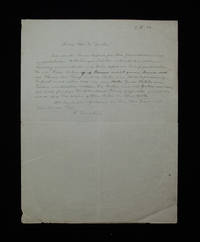
192468960Berlin 1924. Berlin: 1924.<br> <br> Full Description:<br> <br> EINSTEIN Albert. Autograph Letter Signed. Berlin: 9. IX September 1924.<br> <br> Autograph letter signed "A. Einstein" to Mr. Zeisler. One quarto page 11 x 8 1/2 inches; 280 x 217 mm. Manuscript letter on recto verso blank. With one horizontal center crease and one vertical center crease as expected in a letter. A few other light creases. Some minor chipping along edges. A closed split along horizontal crease not affecting manuscript. Overall very good.<br> <br> This letter with text in German is addressed to "Herr Dr. Zeisler" Sigmund Zeisler an German-Jewish U.S. attorney born in Austria. He was known for his defense of radicals in Chicago in the 1880s also known as the Haymarket Affair. His wife was the famous concert pianist Fannie Bloomfield Zeisler. Some unproven sources have said that Zeisler was Einstein's lawyer but regardless it is known that he and Einstein were good friends and had much correspondence over the years. According to "The Collected Papers of Albert Einstein" published by Princeton University Einstein was in correspondence during the 1920s with Zeisler regarding various American investments. According to a letter from Zeisler to Einstein on October 15 1921 "Zeisler had invested $4300 in American shares on Einstein's behalf in October 1921. He subsequently informed Einstein of the accumulated interest." Einstein wrote another letter in April of 1924 asking Zeisler to transfer American investments to his daughter and soon to be son-in-law as a dowery. Zeisler was to ensure the interest was paid on an annual basis to his daughter. In this present letter just six months later Einstein is thanking Zeisler for doing "many good things" and stating that he looks forward to seeing him again in Berlin.<br> <br> Translated by an outside party:<br> <br> "9. IX. 24. Dear Dr Zeisler Many thanks for your friendly and clearly stateed letter. Of course I agree with the offer. I immediately wrote the letter. Since I don;t know the exact address I an sending you the letter and ask that you forward it. It pleases me that we shall see each other again in Berlin. You have done many good things for which I thank you. I know that you have done these things gladly since you are a good person. Regards to you your wife and to your sons. A. Einstein."<br> <br> HBS 68960.<br> <br> $7500. Berlin unknown
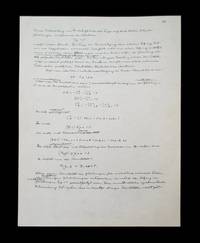
194069509n.p. 1940. n.p.: 1940.<br> <br> Full Description:<br> <br> EINSTEIN Albert. Autograph Manuscript in Pen. n.p. n.d ca: 1940.<br> <br> Autograph manuscript in German in Einstein's hand. Manuscript is on the "Unified Field Theory" and is a draft from his published article "A Generalization of the Relativistic Theory of Gravitation." One quarto page 11 x 8 1/2 inches; 280 x 217 mm. Manuscript in black ink on recto verso blank. With 31 lines of manuscript text in German including over 180 words and eleven equations. Because this is a working document there are numerous revisions on the page. He strikes through and makes additions in eight places. At the top right corner the page is numbered "6" in his hand. Leaf is very lightly toned but generally about fine. It is quite rare to find manuscripts of Einstein works that has been published. Housed in a full morocco clamshell.<br> <br> "A Generalization of the Relativistic Theory of Gravitation" was an article written by Einstein in German and translated into English for publication by his assistant E.G. Straus in approximately 1945. The article was long and so it was divided in two parts. The present leaf comes from Part II and the translated text is on pages 735-736 of the published article.<br> <br> "The published translation appears to follow this original manuscript very closely and without alteration. In this section of his paper Einstein is discussing the field equations for the Hamiltonian operator which plays a central role in the equations of motion for General Relativity and is defined in terms of the metric tensor and its conjugate momenta; and in this particular page of the paper Einstein is here considering the implications of embracing a stronger form of the field equations." University Archives<br> <br> During the course of World War II Einstein came to the conclusion that the General Theory of Relativity was the proper basis for the development of Unified Field Theory; and using this framework he explored the implications of using new and complex forms of number within Unified Field Theory. The publication of this article marked the beginning of Einstein's final approach to Unified Field Theory an approach which Einstein pursued until the end of his life. University Archives .<br> <br> HBS 69509.<br> <br> $45000. n.p. unknown
19432376<p>Princeton NJ: np 1943. First edition. nb. Fine. EINSTEIN OFFERS STRONG AND PRESCIENT WORDS OF ENCOURAGEMENT TO THE LEADER OF THE NAACP IN THE FIGHT AGAINST RACIAL SEGREGATION AND DISCRIMINATION IN THE UNITED STATES. Background: Einstein's fight against racial discrimination in the United States:<br /><br />The imperative "to protect the rights of the individual. was Einstein's most fundamental political tenet. Individualism and freedom were necessary for creative art and science to flourish. Personally politically and professionally he was repulsed by any restraints. <br /><br />"That is why he remained outspoken about racial discrimination in America. As a Jew who had grown up in Germany Einstein was acutely sensitive to such discrimination. 'The more I feel an American the more this situation pains me' he wrote in an essay called 'The Negro Question' for the January 1946 issue of Pageant magazine. 'I can escape the feeling of complicity in it only by speaking out.'" Isaacson Albert Einstein 505. <br /><br />Even more directly in his 1946 commencement speech to Lincoln University the first degree-granting Historically Black College and University HBCU in the United States Einstein strongly denounced segregation as "an American tradition which is uncritically handed down from one generation to the next" noting that "There is separation of colored people from white people in the United States. That separation is not a disease of colored people. It is a disease of white people. I do not intend to be quiet about it." <br /><br />This remarkable letter - from 1943 - is one of the earliest examples of his interest in condemning racism in the United States. <br /><br />The letter:<br /><br />Dated 22 September 1943 and handwritten on his embossed Mercer Street Princeton letterhead Einstein writes in English to Walter F. White the enormously influential African-American civil rights leader who led the NAACP from 1929-1955 praising him for his work and revealing his own awareness of and frustrations with racism and prejudice in America. <br /><br />The text reads in full:<br /><br />Dear Mr. White:<br /><br />I have been quite impressed by the address you delivered some years ago at a meeting of the Princeton Branch of the National Association for the Advancement of Colored People. I know how hard it is to awaken the conscience even of good-hearted and well-meaning people when deep rooted prejudices are in the way. It is a great work indeed which you are doing relentlessly for the betterment of the living conditions of our Colored fellow-citizens for justice and for the accomplishment of national unity of the American people.<br /><br />With sincere respect and kind wishes<br /><br />Yours <br />Albert Einstein<br /><br />-------------<br /><br />On April 28 1940 White was the keynote speaker at "an inter-racial meeting sponsored by the Princeton branch of the National Association for the Advancement of Colored People" where his topic was "What Happens to Democracy When It Encounters the Color Line." Princeton Herald April 26 1940. At the time Princeton did not admit African Americans and the community was debating the question of whether or not to end segregation at the university. Princeton in fact did not admit its first African-American student until the fall of 1947. <br /><br />Einstein - writing in 1943 - notes that he heard White speak "some years ago". Something clearly must have deeply impressed Einstein about White's speech for him to write this thoughtful letter to White over three years after the event.<br /><br />Note: In addition to its content this apparently unpublished letter is also remarkable for being one of the very few letters Einstein hand-wrote in English during this period as German was still very much his preferred tongue. <br /><br />Princeton: September 22 1943. One page on Einstein's embossed Mercer Street Princeton letterhead 7.25x10 in visible handsomely matted and framed with a photograph of Einstein. Fine condition.</p> np
V09C-04523Random House Value Publishing. Used - Very Good. Very Good condition. Very Good dust jacket. A copy that may have a few cosmetic defects. May also contain light spine creasing or a few markings such as an owner’s name short gifter’s inscription or light stamp. Random House Value Publishing unknown
U07B-08863Random House Value Publishing. Used - Good. Good condition. Good dust jacket. A copy that has been read but remains intact. May contain markings such as bookplates stamps limited notes and highlighting or a few light stains. Random House Value Publishing unknown
1989Q-0517675773Random House Value Publishing 1989-01-13. Hardcover. New. New. In shrink wrap. Looks like an interesting title! Random House Value Publishing hardcover
2007Q-0061144649HarperCollins 2007-09-25. Hardcover. New. New. In shrink wrap. Looks like an interesting title! HarperCollins hardcover
13884Frankfurt Insel Verlag 1963. 62 S. Pbd. Insel-Bücherei Nr. 801 unknown
EDZZ0740Berlin-Wilmersdorf Vlg. der Wochenschrift Die Aktion 1917. 99 S. 7 S. Verlagsanz. Mit 1 Portr. von Max Oppenheimer. = Aktions-Bücher der Aeternisten Bd. 5. Orig.-Pappband unt. Kapital mit 3 cm Fehlstelle. Raabe/Hannich-B. 65.1. Das Erstlingswerk Einsteins war zuvor 1912 erschienen als erste Buchpublikation der Aktion mit dem Untertitel ""Die Dilettanten des Wunders"". Berlin-Wilmersdorf, Vlg. der Wochenschrift Die Aktion 1917. unknown
3966371146.Gpaperback. Good. Access codes and supplements are not guaranteed with used items. May be an ex-library book. paperback
0266793762.Ghardcover. Good. Access codes and supplements are not guaranteed with used items. May be an ex-library book. hardcover
a106117Braunschweig 1914 first edition. Vieweg. Vol XVI of Berichte der Deutschen Physikalishchen. Original binding. hardcover thick octavo. 3/4 darkbrown cloth with matching dark brown papercovered boards. Gilt spine lettering. Illustrations. 1072p. Among many other important papers this volume includes: EINSTEIN "Beitrage zur Quantentheorie " pp. 820-828 VG. no owner marks; light foxing on end papers; just very light cover wear; hinges not cracked. Clean solid excellent condition! Pictures available on request. . hardcover
a97179Braunschweig 1914 first edition. Vieweg. Vol XVI of Berichte der Deutschen Physikalishchen. hardcover very thick octavo. 3/4 dark brown cloth with brown/black marbled boards. Gilt spine lettering. Illustrations. 1072p. plus 414p. Halbonatliches Literaturverszeichnis. Includes: EINSTEIN landmark article pp. 820-828. Other article in same volume by A.Euken J. Franck G. Hertz andothers. Owner stamps on titlepage end of text and on end papers - no other marks. Very nice condition: Near Fine end papers slightly toned. Text Fine. . hardcover
191448163Braunschweig Vieweg & Sohn 1914. No wrappers. "Verhandlungen der Deutschen Physikalischen Gesellschaft im Jahre 1914. Hrsg. von Karl Scheel." 16. Jahrgang Nr. 16. Pp. 765- 834. Entire issue offered. With the general titlepage to 16. Jahrg. Titlepage stamped at foot. Einstein paper pp. 820-828. <br/><br/><em>First edition. In this paper "Contributions to quantum theory" two considerations are given which are interrelated by a common goal inasmuch as it is attempted to derive two of the most importent achievementss of quantum theory viz. Planck's radiation law and Nernst's third law of thermodynamics in a new manner. The proofs do not involve Boltzmann's equation and are thus based enterely on macroscopic thermodynamics. They do introduce however the quantum hupothesis. Einstein points out that the alleged 'proofs' which try to derive the theorem of Nernst from the mere fact that the heat capacity of all substances goes to zero at absolute zero temterature are not genuine. Cornelius Lanczos.Weil No 67. </em> unknown
191438840Braunschweig Vieweg & Sohn 1914. Later full cloth. A stamp to the general titlepage. IX1072;414 pp. textillustrations. "Verhandlungen der Deutschen Physikalischen Gesellschaft im Jahre 1914. Sechzehnter Jahrgang. Hrsg. von Karl Scheel." Einstein paper pp. 820-828. Internally clean and fine. The whole volume offered <br/><br/><em>First edition. In this paper "Contributions to quantum theory" two considerations are given which are interrelated by a common goal inasmuch as it is attempted to derive two of the most importent achievementss of quantum theory viz. Planck's radiation law and Nernst's third law of thermodynamics in a new manner. The proofs do not involve Boltzmann's equation and are thus based enterely on macroscopic thermodynamics. They do introduce however the quantum hupothesis. Einstein points out that the alleged 'proofs' which try to derive the theorem of Nernst from the mere fact that the heat capacity of all substances goes to zero at absolute zero temterature are not genuine. Cornelius Lanczos.- Weil No 67. </em> hardcover
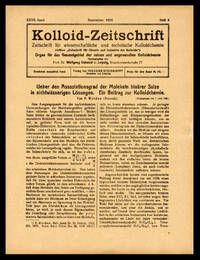
192014561920. 1st Edition. First edition in original wraps of Einstein's review of a paper by Nobel Prize winner Walter Rudolf Hess entitled Theory of the Viscosity of Heterogeneous Systems. CONDITION: The journal was published in three sections. All three are here all bright clean and in near fine condition. paperback
191150315Leipzig: Johann Ambrosius Barth 1911. <p>Einstein Albert 1879-1955. 1 Bemerkung zu dem Gesetz von Eötvös. In Annalen der Physik 34 1: 165-169 pp. 1910. Weil 38 Boni 35. 2 Eine beziehung zwischen dem elastischen Verhalten und der spezifischen Wärme bei festen Körpen mit einatomigem Molekül. In Annalen der Physik 34 1: 170-174 pp. 1910. Weil 39 Boni 36. 3 Bemerkungen zu den P. Hertzschen Arbeiten: "Über die mechanischen Grundlagen der Thermodynamik." In Annalen der Physik 34 1: 175-176 pp. 1910. Weil 40 Boni 37. 4 Bemerkung zu meiner Arbeit: "Eine Beziehung zwischen dem elastischen Verhalten . . ." In Annalen der Physik 34 3: p. 590. Weil 40. 5 Berichtigung zu meiner Arbeit: "Eine neue Bestimmung der Moleküldimensionen." In Annalen der Physik 34 3: p. 591. Weil 41. Leipzig: Johann Ambrosius Barth 1911. </p> <p>Whole volume: viii 1032 pp. 6 plates 5 folding 1 b/w/ silver photograph. Figs. Text-illust. 210 x 140 mm. Red cloth with gilt lettering on spine. First Edition. Pages are a little toned as are plates 5 and 6 otherwise Very Good. </p> <br /> <br /> <p> Approximate English translations of titles:<br> 1 "Remarks on the law of Eötvös." 2 "A connection between the elastic conduct and the specific heat of solid bodies with monatomic molecule." 3 "Remarks on P. Hertz' work: 'On the mechanical foundations of thermodynamics.'" </p> <br /> <br /> <p> Eövtös' findings served as part of the basis of Albert Einstein's General Theory of Relativity in which the principle of equivalence acts as the keystone no. 1 above. "Einstein adds a comment on p.590 of the same journal no. 2 above. To supplement Sutherland's observation that infared eigenfrequencies of solid bodies possibly originate in the elastic vibrations of these bodies Einstein adds that electrically charged ions are the source of optical vibrations while the mututal motions of the entire molecule cause elastic vibrations." Calaprice Alice et al. An Einstein Encyclopedia. 2015. p. 291.</p> <br /> <br /> <p> Weil's Einstein Bibliography nos. 38 39 40 and 41.<br> Boni's Einstein Checklist nos. 35 36 and 37. </p> . Johann Ambrosius Barth unknown
1911003225Leipzig: J. A. Barth 1911. title continued "Uber der mechanischen Grundlagen der Thermodynamik" pp. 175-76 and Bemerkung zu meiner Arbeit: "Eine Beziehung zxischen dem elastischen verhalten" p. 590 and Berichtigung zu meiner Arbeit: Enie neue Bestimmung der Molkuldimensionen" pp. 591-92. In Annalen der Physik Vierte Folge Band 34. Contemporary three-quarter cloth marbled boards. Short scratch in spine; small stain on rear cover; three nicks in outer edge of rear cover. First Edition. About Very Good. J. A. Barth hardcover