Einstein AlbertABAA

187 résultats
1949125016Evanston: Library of Living Philosophers 1949. Signed limited edition of Einstein's singular autobiography. Octavo original brown cloth top edge gilt original glassine and slipcase. One of 760 numbered copies signed and dated "Albert Einstein '49" this is number 458. Fine in the rare original glassine which is in near fine condition and in the original slipcase which is in fine condition. Housed in the original publisher's cardboard. An absolute pristine example which has been stored in the original cardboard box since publication. Edited by Paul Arthur Schilpp. Frontispiece portrait of Einstein by Yousuf Karsh. Rare and desirable in this condition particularly scarce in the original glassine and original box. Written by the man considered the "Person of the Century" by Time magazine this is not a glimpse into Einstein's personal life but an extension and elaboration into his thinking on science. Two of the great theories of the physical world were created in the early 20th century: the theory of relativity and quantum mechanics. Einstein created the theory of relativity and was also one of the founders of quantum theory. Here Einstein describes the failure of classical mechanics and the rise of the electromagnetic field the theory of relativity and of the quanta. "The greatest physicist of the 20th century" PMM 408. Library of Living Philosophers hardcover books
1949110472Evanston: Library of Living Philosophers 1949. Signed limited first edition number 711 of 760 copies signed and dated "Albert Einstein '49." Octavo original brown cloth top edge gilt. The book is in fine condition in the rare original dust jacket which is in very good condition. Edited by Paul Arthur Schilpp. Frontispiece portrait of Einstein by Yousef Karsh. Rare and desirable in this condition. Written by the man considered the "Person of the Century" by Time magazine this is not a glimpse into Einstein's personal life but an extension and elaboration into his thinking on science. Two of the great theories of the physical world were created in the early 20th century: the theory of relativity and quantum mechanics. Einstein created the theory of relativity and was also one of the founders of quantum theory. Here Einstein describes the failure of classical mechanics and the rise of the electromagnetic field the theory of relativity and of the quanta. "The greatest physicist of the 20th century" PMM 408. Library of Living Philosophers hardcover books
19472187Princeton NJ: Halsman 1947. Photograph. Fine. ONE OF THE MOST FAMOUS IMAGES OF EINSTEIN. Philippe Halsman's now iconic 1947 photograph of Einstein has become not only one of the most celebrated images of Einstein but one of the most recognizable images of the twentieth century. It was used to a 1966 US postage stamp of Einstein and was featured on the cover of Time Magazine honoring Einstein as the "Person of the Century".

 The photographer Halsman in his book Philippe Halsman: A Retrospective explained the circumstances of the photo: I admired Albert Einstein more than anyone I ever photographed not only as the genius who single-handedly had changed the foundation of modern physics but even more as a rare and idealistic human being.
 Personally I owed him an immense debt of gratitude. After the fall of France it was through his personal intervention that my name was added to the list of artists and scientists who in danger of being captured by the Nazis were given emergency visas to the United States.
 After my miraculous rescue I went to Princeton to thank Einstein and I remember vividly my first impression. Instead of a frail scientist I saw a deep-chested man with a resonant voice and a hearty laugh.
 The question of how to capture the essence of such a man in a portrait filled me with apprehension. Finally in 1947 I had the courage to bring on one of my visits my Halsman camera and a few floodlights. After tea I asked for permission to set up my lights in Einstein's study. The professor sat down and started peacefully working on his mathematical calculations. I took a few pictures. Ordinarily Einstein did not like photographers whom he called Lichtaffen light monkeys. But he cooperated because I was his guest and after all he had helped save me.
 Suddenly looking into my camera he started talking. He spoke about his despair that his formula E=mc2 and his letter to President Roosevelt had made the atomic bomb possible that his scientific search had resulted in the death of so many human beings. "Have you read" he asked "that powerful voices in the United States are demanding that the bomb be dropped on Russia now before the Russians have time to perfect their own" With my entire being I felt how much this infinitely good and compassionate man was suffering from the knowledge that he had helped to put in the hands of politicians a monstrous weapon of devastation and death.
 He grew silent. His eyes had a look of immense sadness. There was a question and a reproach in them.
 The spell of this moment almost paralyzed me. Then with an effort I released the shutter of my camera. Einstein looked up and I asked him "So you don't believe that there will ever be peace"
 "No" he answered. "As long as there will be man there will be wars." Silver prints of this photograph have been printed in different sizes over the years. This photograph is an official Halsman silver print with his copyright hand-stamp on the verso measuring approximately 10x13 inches. Princeton NJ. Silver print. Taken 1947; printed 1970s. Image: 13x10 inches 33x25.4 cm. Archivally matted and framed under UV-protecting museum glass to an overall size of 18.5x22 inches. A stunning piece in fine condition. Halsman unknown books
1927374151927. Offprint from S. preuss. Akad. Wiss. Weil 155. unknown books
1927433031927. Offprint from Sitzungsberichte der preussischen Akademie der Wissenschaften 1927. 235-245pp. 255 x 183 mm. Original printed wrappers. Fine. On the problem of motion in general relativity theory; a follow-up to his and Grommer's paper of the same title published earlier in 1927. Weil Albert Einstein Bibliography 160. unknown books
1921302276Leipzig Felix Meiner 1921. 1921. First edition. 8vo. Foreword by Raymund Schmidt. Articles by Oskar Kraus Friedrich Lepsius Paul F. Lincke Joseph Petzoldt. Text pages numbered 334-500. Original stiff green wrappers printed in black. Very good. Cover title: Zur Relativitatstheorie. Kraus' article entitled: "Fiktion und Hypothese in der Einsteinschen Relativitatstheorie.". 1st Edition. Soft cover. Very Good/No Jacket. Leipzig, Felix Meiner, 1921. paperback books
1930433061930. Offprint from Mathematische Annalen 102 1930. 685-697pp. Original printed self-wrappers. 233 x 157 mm. Very good apart from small split in lower spine. Weil Albert Einstein Bibliography 171. unknown books
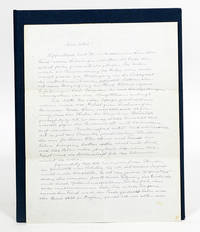
19371984Princeton: np 1937. First Edition. Very Good. AN EXTRAORDINARY LETTER BY EINSTEIN TO HIS SON OFFERING LIFE ADVICE AND DISCUSSING FREUD SHAKESPEARE AND SCHILLER. Addressed to his son Eduard "Tetel" Einstein and signed "Papa" the letter written in ink on both sides of one sheet reads in full translated from the original German: 

Dear Tetel

 I hope by now you've received Freud's lectures from Vienna. I've read most of them myself in the past. They really made me admire the Author but they didn't convince me that his theories were correct. 

I must admit however that based on my personal experiences my conviction about those theories is weakening -- I feel now that he was onto something at least in regards to the main theses. I would have written to you sooner but work is keeping me very busy. Even though they say that the work of a single person will not have much of an impact in the big picture it does not diminish the passion in which we pursue our interests and that is a good thing. 

 Although personal illusions may bring warmth and joy into one's life when young they don't last a lifetime. Life would be bleak if the work and the passion for discovery did not exist. In my free time I am currently reading Schiller's poems which I have neglected since my youth. 

They feel a bit pompous but at the same time they are enthralling in their choice of words and grammar. I am really happy that I picked them up again. 

I would have liked to send you another book on the top of the Freud but didn't know which one to send -- especially because I don't get a lot of German writings anymore.

 When I have some extra free time after finishing Schiller I really want to start reading Shakespeare everything from him I can get my hands on. If you like to read it too perhaps we could discuss it at some later time
 

 Albert is a real delight -- he has been traveling up and down the country for the past 6 weeks and will have seen and experienced many interesting things. I really hope he has followed my advice and kept a journal but I am not holding high hopes. When it comes to talking and writing he seems to be chronically constipated. With my warmest regards

 Papa Einstein's life advice underscoring one of his core beliefs: Einstein often stated that his main goal in life was the quest for truth no matter how difficult and painstaking the quest. He advises Eduard in this letter that it is the pursuit and the work in attaining the goal that brings satisfaction and sustains one throughout life even if "the work of a single person will not have much of an impact in the big picture". This he notes is critical to understand after the illusions of youth have succumbed to reality. Einstein Eduard and Freud: Eduard Einstein nicknamed "Tete" or "Tetel" born in 1910 was the second son of Albert and his first wife Mileva. From an early age he became enamored with the teachings of Freud even hanging a picture of famous psychiatrist on his bedroom wall. By the age of twenty he was diagnosed with schizophrenia and consequently was institutionalized several times throughout his life. Einstein's views of Freud's teachings were somewhat more nuanced than those of his son. Initially Einstein did not show much interest in Freud's theories and after their first meeting in 1927 Freud famously remarked "He understands as much about psychology as I do about physics." Over the years however Einstein began studying Freud's works. After corresponding with Freud somewhat regularly throughout the 1930s and even collaborating with him on a project sponsored by the League of Nations "Why War" 1932 Einstein began to move from a deep skepticism to - as indicated in this letter - a growing acceptance. By 1936 - just before this letter was written - Einstein sent birthday greetings to Freud acknowledging: "Until recently I could only apprehend the speculative power of your train of thought together with its enormous influence on the Weltanschauung of the present era without being in a position to form a definite opinion about the amount of truth it contains. Not long ago however I had the opportunity of hearing about a few instances not very important in themselves which in my judgment exclude any other interpretation than that provided by the theory of repression. I was delighted to come across them since it is always delightful when a great and beautiful conception proves to be consonant with reality." 
In this letter to Eduard Einstein admits to Eduard that he now believes Freud "was onto something at least in regards to the main theses." Einstein Shakespeare Schiller: Einstein's fondness for music is well-known but not as much has been recorded about his literary tastes. It is not surprising and has been previously documented that Einstein had a fondness for the great German poet Schiller but we can find no other references to Shakespeare by Einstein in any other letters or manuscripts. His words to Eduard "I really want to start reading Shakespeare everything from him I can get my hands on" imply that Einstein has recently "discovered" Shakespeare and is excited at the discovery. 
Note: Although the letter is not dated we can assume that it was written late November - December in 1937 when Einstein's son Albert was visiting the United States a trip he refers to in the letter. Princeton: November - December 1937. One 8.5x11 inch leaf written on both sides. In German. Usual folds otherwise fine. A LONG REMARKABLE AND REVEALING LETTER UNITING THE INTELLECTUAL GIANTS EINSTEIN FREUD AND SHAKESPEARE AND SHARING ONE OF HIS CORE BELIEFS WITH HIS SON. np unknown books
19432376Princeton NJ: np 1943. First edition. nb. Fine. EINSTEIN OFFERS STRONG AND PRESCIENT WORDS OF ENCOURAGEMENT TO THE LEADER OF THE NAACP IN THE FIGHT AGAINST RACISM AND SEGREGATION IN THE UNITED STATES. Background: Einstein's fight against racial discrimination in the United States: The imperative "to protect the rights of the individual. was Einstein's most fundamental political tenet. Individualism and freedom were necessary for creative art and science to flourish. Personally politically and professionally he was repulsed by any restraints. "That is why he remained outspoken about racial discrimination in America. As a Jew who had grown up in Germany Einstein was acutely sensitive to such discrimination. 'The more I feel an American the more this situation pains me' he wrote in an essay called 'The Negro Question' for the January 1946 issue of Pageant magazine. 'I can escape the feeling of complicity in it only by speaking out.'" Isaacson Albert Einstein 505. Even more directly in his 1946 commencement speech to Lincoln University the first degree-granting Historically Black College and University HBCU in the United States Einstein strongly denounced segregation as "an American tradition which is uncritically handed down from one generation to the next" noting that "There is separation of colored people from white people in the United States. That separation is not a disease of colored people. It is a disease of white people. I do not intend to be quiet about it." This remarkable letter - from 1943 -Â is one of the earliest examples of his interest in condemning racism in the United States. The letter: Dated 22 September 1943 and handwritten on his embossed Mercer Street Princeton letterhead Einstein writes in English to Walter F. White the enormously influential African-American civil rights leader who led the NAACP from 1929-1955 praising him for his work and revealing his own awareness of and frustrations with racism and prejudice in America. The text reads in full: Dear Mr. White: I have been quite impressed by the address you delivered some years ago at a meeting of the Princeton Branch of the National Association for the Advancement of Colored People. I know how hard it is to awaken the conscience even of good-hearted and well-meaning people when deep rooted prejudices are in the way. It is a great work indeed which you are doing relentlessly for the betterment of the living conditions of our Colored fellow-citizens for justice and for the accomplishment of national unity of the American people. With sincere respect and kind wishes Yours Albert Einstein ------------- On April 28 1940 White was the keynote speaker at "an inter-racial meeting sponsored by the Princeton branch of the National Association for the Advancement of Colored People" where his topic was "What Happens to Democracy When It Encounters the Color Line." Princeton Herald April 26 1940. At the time Princeton did not admit African Americans and the community was debating the question of whether or not to end segregation at the university. Princeton in fact did not admit its first African-American student until the fall of 1947. Einstein -Â writing in 1943 -Â notes that he heard White speak "some years ago". Something clearly must have deeply impressed Einstein about White's speech for him to write this thoughtful letter to White over three years after the event. Note: In addition to its content this apparently unpublished letter is also remarkable for being one of the very few letters Einstein hand-wrote in English during this period as German was still very much his preferred tongue. Princeton: September 22 1943. One page on Einstein's embossed Mercer Street Princeton letterhead 7.25x10 in visible handsomely matted and framed with a photograph of Einstein. Fine condition. np unknown books
19302349np: np 1930. First edition. Fine. EINSTEIN ON THE CONCEPT OF PEACE: A POWERFUL AUTOGRAPH STATEMENT IN EXCEPTIONALLY LARGE FORMAT. 
. Translated from the original German:<br /> <br /> "No person has the moral right to call himself a Christian or Jew so long as he is prepared to engage in systematic murder at the command of an authority or allow himself to be used in any way in the service of war or the preparation for it."<br /> <br /> Starting in 1925 the French Academy began sending large 11.5x16.5 sheets to important scientists writers and intellectuals asking them to write on the sheet a statement on the concept of peace for possible inclusion in an anthology. The World League for Peace later released a limited edition of prints from the submissions under the title Pax Mundi: livre d'or de la paix. This is Einstein's unique manuscript submission. <br /> <br /> A highly unusual format with exceptionally large Einstein signature 2.25 in / 6 cm of an important Einstein statement consistent with his life-long dedication to pacifism. <br /> <br /> c.1925-1930. One large folio page 11.5 x 16.5 inches. In German. Fine condition. np unknown books
19271324467Paris: The Sign of the Pegasus 1927. First Edition. Hardcover. 16 31 pages; 150 pages; VG; bound in gilt decorated burgundy cloth rebacked with original boards and spine preserved; top edge of text block gilt; mild rubbing and wear; with 150 photographs plus a folded color frontispiece; shelved above front case. 1324467. Shelved Dupont Bookstore. The Sign of the Pegasus hardcover books
1923433171923. Offprint from Sitzungsberichte der preussischen Akademie der Wissenschaften 1923. Single sheet pp. 76-77. 265 x 184 mm. A few marginal chips and tiny tears but very good. First edition offprint issue. The second of the four short papers Einstein published in 1923 on Eddington's program for a unified field theory. Weil Albert Einstein Bibliography 131n. unknown books
1907432971907. <p>Einstein Albert 1879-1955. Berichtigung zu meiner Arbeit: "Die Plancksche Theorie der Strahlung etc." Offprint from Annalen der Physik 22 1907. Single sheet p. 800. Unbound as issued. 223 x 145 mm. Lower corner lightly creased but very good.</p> <p>First Edition Rare Offprint Issue. Einstein's important correction to his paper on specific heats "Die Plancksche Theorie der Strahlung und die Theorie der spezifischen Wärme" 1907; see Weil 15 which "made clear for the first time that quantum concepts have a far more general applicability" Pais p. 394. "Einstein initially believed that his oscillating lattice points in a three-dimensional crystal lattice were electrically charged ions. A few months later he published a correction to his paper in which he observed that this was an unnecessary assumption . . . Einstein's correction freed the quantum rules in passing one might say from any specific dependence on electromagnetism" Pais p. 396. Pais Subtle is the Lord pp. 394-396. Weil 15n.</p> . unknown books
1911432921911. <p>Einstein Albert 1879-1955. Berichtigung zu meiner Arbeit: "Eine neue Bestimmung der Moleküldimensionen." Offprint from Annalen der Physik 34 1911. 591-592pp. 224 x 146 mm. Original printed wrappers a little chipped splint in lower spine. Light toning but very good.</p> <p>First Edition Offprint Issue. Einstein's correction to his formula for the viscosity coefficient = 1 a key equation in his 1905 doctoral thesis in which he had presented a new theoretical method for determining molecular radii and Avogadro's number. In 1910 Jacques Bacelin a pupil of French physicist Jean-Baptiste Perrin obtained experimental results indicating a possible error in Einstein's formula. "That prompted Einstein after an unsuccessful attempt to find an error to ask his student and collaborator Ludwig Hopf to check his calculations and arguments . . . Hopf did find an error in the dissertation namely in the derivatives of some velocity components and obtained for a corrected coefficient 2.5 . . .In early 1911 Einstein submitted his correction for publication and recalculated Avogadro's number. He obtained a value of 6.56 x 10²³ per mole a value that is close to those derived from kinetic theory and Planck's black-body radiation theory" Duplantier pp. 216-217. Duplantier "Brownian motion ‘diverse and undulating'" in Einstein 1905-2005: Poincaré Seminar 2005 pp. 201-293. Pais Subtle is the Lord p. 92. Weil Albert Einstein Bibliography 41.</p> . unknown books
1923374081923. Offprint from S. preuss. Akad. Wiss. Weil 137. unknown books
1923433151923. Offprint from Sitzungsberichte der preussischen Akademie der Wissenschaften 1923. 359-364pp. 254 x 184 mm. Original printed wrappers. Very good. First Edition offprint issue. Weil Albert Einstein Bibliography 137. unknown books
19781288091Sauk City: Arkham House 1978. First Edition. Hardcover. Octavo; VG/VG; green illustrated spine black text; jacket has little to no wear unclipped and has protective mylar cover; boards strong and clean; textblock have light age toning; interior pages clean; pp 202. shelve front counter. 1288091. Shelved Dupont Bookstore. Arkham House hardcover books
1918134657Saint Louis: Laryngoscope Press 1918. Hardcover. good ex-library with expected marks plus perforation stamp on title page pg 1 of the reprint and all plates. binding cracked in center but still holding. wear to exterior with cloth fraying at corners and spine ends. bumped corners. Red cloth. 128 pp bw plates and appendix. Number 231 of 300 copies. Reprint of the 1883 "Fagan's Collectors' Marks" with 668 marks plus an appendix of 205 additional marks. Of interest to collectors and art historians interested in European collectors collections and provenance. Laryngoscope Press hardcover books
1931207020New York: Covici-Friede 1931. First edition. Jacket worn and with some loss tape repair on spine. 8vo. Cloth; dust jacklet. Contains Einstein's famous essay on science and religion and other essays on Judaism pacifism and other related topics. <br/><br/> Covici-Friede hardcover books
19312240New York: Covici Friede 1931. 1st. Cloth. Collectible; Very Good. 1931 1st edition. Clean and VG in its original blue cloth. 12mo 109 pgs. Light offsetting at the gutters tasteful former owner bookplate to front pastedown. <br/><br/> Covici, Friede hardcover books
1913WRCLIT84021Leipzig & Berlin: B.G. Teubner 1913. 289pp. Printed green cloth. Ink name and bookplate on pastedown front free endsheet brittle and detached cloth a bit faded and lightly soiled but a very good copy. First edition in this format of three essays by Lorentz two by Einstein and one by Minkowski with a foreword by Otto Blumenthal. Einstein's two essays "Zur Elektrodynamik bewegter Korper" and "Ist die Tragheit eines Korpers von seinem Enerheinhalt abhangig" were first published in 1905 in ANNALEN DER PHYSIK the first being Einstein's first publication on special relativity. Minkowski's essay "Raum und Zeit" was first published in 1909 see PMM 401. B.G. Teubner hardcover books
2018185442California: Triton Museum of Art/ Grand Central Press 2018. Hardcover. VG/VG. Color illustrated boards with black lettering on a clear dust jacket; 287 pp; profusely illustrated throughout in bw and color. Published on the occasion of the exhibition David Einstein : a 50-year retrospective 1968-2018 presented by Triton Museum of Art in Santa Clara California from February 17 through April 22 2018. Contents include: Foreword -- Introduction : letting go and the possibilities of abstract expressionism -- David Einstein : a narrative chronology / biography by Mark B. Johnson -- Transcendent abstractions : color echoes and other works / Preston Metcalf -- Form color and process : the evolution of a mark maker / Judith Cook -- A mark maker in life and art : the early years / Roy Kotynek and John Cohassey -- The spiritual journey of a master mark maker / Stephanie Learmonth -- Gesture as language / Sienna Brown -- Reflecting on light echo #21-color veil / Scott A. Shields -- Prelude to the desert : the earth & sky series / Amy B. Scott -- Color veils and the shaping of David Einstein's painting / Ori Z. Soltes -- Selected works : 1968-2016. Triton Museum of Art/ Grand Central Press hardcover books
1941433111941. Offprint from Universidad Nacional de Tucuman Revista Serie A 2 1941. 11-15pp. 270 x 179 mm. Original printed wrappers. Very good. "Address to joint meeting of the American Physics Society and the American Association of Physics Teachers Princeton Dec. 29 1941 under the title: 'Solutions of finite mass of the gravitational equations'" Weil. Weil Albert Einstein Bibliography 208. unknown books
19142124Berlin: Königlichen Akademie der Wissenschaften 1914. FIRST EDITION OFFPRINT. Original wrappers. Fine. FIRST EDITION COMMERCIAL OFFPRINT ISSUE of Einstein's important 1914 paper on the development of general relativity. "In summer 1914 Einstein felt that the new theory general relativity should be presented in a comprehensive review. He also felt that a mathematical derivation of the field equations that would determine them uniquely was still missing. "Both tasks are addressed in a long paper presented in October 1914 to the Prussian Academy for publication in its Sitzungsberichte. It is entitled 'The formal foundation of the general theory of relativity'; here for the first time Einstein gave the new theory of relativity the epithet 'general' in lieu of the more cautious 'generalized' that he had used for the Entwurf" Landmark Writings in Western Mathematics 1640-1940. "According to John Norton 'How Einstein Found His Field Equations' this major review article was intended to convey the full content of the 1913 'Entwurf' theory: 'The principal novelty lies in the mathematical formulation of the theory. Drawing on earlier work with Marcel Grossman Einstein formulated his gravitational field equations using a variation principle. Using this richer mathematical structure Einstein offered a proof purporting to demonstrate that his theory had the maximum covariance compatible with the hole argument; that is covariance under 'justified' transformation between the 'adapted coordinate systems' he had introduced with Grossman'" Calaprice The Einstein Almanac. Offprint from: Sitzungsberichte der Königlich Preussischen Akademie der Wissenschaften XLI 19 November 1914 pp. 1030-1085. Berlin: Königlichen Akademie der Wissenschaften 1914. Octavo original wrappers; custom box. Neat early ownership name on front wrapper. Only the slightest wear; a fine copy. Rare. Königlichen Akademie der Wissenschaften unknown books
1916140940031Leipzig: Verlag von Johann Ambrosius Barth 1916. First Edition. Near Fine. First edition. Annalen der Physik Band 48 No. 7. total pp. 769-880 with Einstein's paper "Die Grundlage der allgemeinen Relativitätstheorie" on pp. 769-822. "Druck von Metzger & Wittig in Leipzig" to foot of pp. 880. Finely bound without wraps opens directly to p. 769 in marbled boards with brown leather spine lettered in gilt with contents lightly toned else Fine. Also contains papers by Otto Stern W. Wein R. Hirsch and H. Lussem. Text in German. The first printing of Einstein's General Theory of Relativity and a continuation of his ideas of first set forth in a 1905 paper on special relativity. General relativity refines Newton's laws of gravity describing it as a geometric property of space and time applying it to the universe. Verlag von Johann Ambrosius Barth unknown books