Albert EinsteinBiblio.com
1 803 résultats
6378555261Princeton University Press . Hardback. New. Princeton University Press hardcover
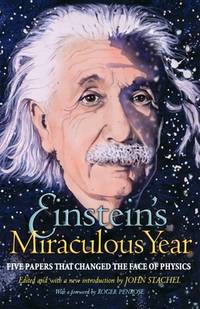
19981-0691059381Princeton Univ Dept of Art & 1998. Hardcover. New. illustrated edition. 198 pages. 8.75x6.00x0.75 inches. Princeton Univ Dept of Art & hardcover
2004Q-0807615323George Braziller Inc 2004-05-17. Paperback. New. In shrink wrap. Looks like an interesting title! George Braziller Inc paperback
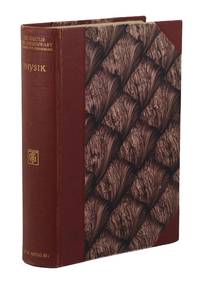
1915140945614Leipzig & Berlin: B.G. Teubner 1915. First edition. First edition. iv viii 762 8 pp. Bound in publisher's three quarter maroon cloth with marbled paper sides gilt spine lettering. Near Fine with rubbing along edges; a few marks to prelims text otherwise free of markings; hint of foxing to edges. Bookplate on paste down. <p>A German-language physics review with the first book publication of two articles by Albert Einstein as well as work by a number of famous physicists of the early 20th century. B.G. Teubner unknown
0156004178.Gpaperback. Good. Access codes and supplements are not guaranteed with used items. May be an ex-library book. paperback
2002Q-0838826512Educators Publishing Service Inc 2002-01-01. Paperback. New. New. In shrink wrap. Looks like an interesting title! Educators Publishing Service, Inc paperback
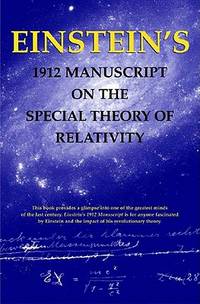
2009Q-0486470113Dover Publications 2009-05-21. Paperback. New. New. In shrink wrap. Looks like an interesting title! Dover Publications paperback
1998Q-0691059381Princeton University Press 1998-03-30. Hardcover. New. New. In shrink wrap. Looks like an interesting title! Princeton University Press hardcover
2005Q-0691122288Princeton University Press 2005-04-17. Paperback. New. New. In shrink wrap. Looks like an interesting title! Princeton University Press paperback
1996Q-0807614173George Braziller 1996-01-01. Hardcover. New. In shrink wrap. Looks like an interesting title! George Braziller hardcover
0156004127.Gpaperback. Good. Access codes and supplements are not guaranteed with used items. May be an ex-library book. paperback
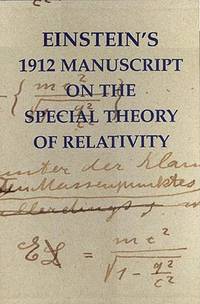
19960010399New York: George Braziller 1996. Hardcover. As New/issued without dj. Folio 192 pages clothbound in publisher's slipcase shrinkwrapped unopened <br/><br/>A highly detailed and accurate facsimile of the earliest surviving autograph manuscript published by George Braziller in association with the Jacob E. Safra Philanthropic Foundation and the Israel Museum. An English translation is provided for each page. Introduction by Hanoch Gutfreund. OP in hardcover original list price $195. George Braziller hardcover
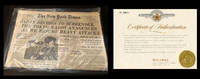
19311435New York: New York Times 1931. 1st Edition. First edition of the October 19th 1931 issue of the New York Times complete with "Certificate of Authentication" by the Historic Newspaper Archives. The certificate is #379912; it is signed and includes the seal of the archive. <br /> <br /> Einstein was asked to contribute to the New York Times' "World Mourns the Death of Edison; Body to Lie in State in Laboratory.". CONDITION: Historic Newspaper Archives see above has placed the issue in archival plastic and then into an Archive snap close bag. see photo By any measure this complete issue appears in very good condition. New York Times unknown
SONG0807614173Brand: George Braziller Inc 0000-00-00. First Edition. hardcover. Used: Good. 10.50x1.25x15.75. Buy with confidence. Excellent Customer Service & Return policy. Brand: George Braziller Inc hardcover
DADAX0807614173Brand: George Braziller Inc 0000-00-00. First Edition. hardcover. New. 10.50x1.25x15.75. Buy with confidence. Excellent Customer Service & Return policy. Brand: George Braziller Inc hardcover
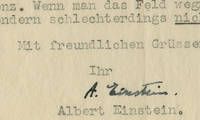
184029/9/54. <blockquote><p>The fullest summation we have seen by Einstein comparing relativity to Newtonian concepts of space and time</p></blockquote><p>Immanuel Kant took both Euclidean geometry and the Newtonian laws of motion to be synthetic a priori principles which from Kant’s point of view function as necessary presuppositions for applying our fundamental concepts of space time matter and motion to our sensible experience of the natural world meaning they are fixed necessary conditions. This idea rested on the absolute nature of space and time the work of Newton and the relationship between geometry and physics.</p><p>In 1905 while a young patent clerk and physicist in Bern Switzerland Albert Einstein obtained his doctorate and published a paper that explained his newly developed Special Theory of Relativity. This unlocked many mysteries of the universe and introduced the world to ""e=mc2"" equating mass and the speed of light with energy. It established that time and space are not fixed and in fact change to maintain a constant speed of light regardless of the relative motions of sources and observers. Just 10 years later in 1915 Einstein published his General Theory of Relativity which described the universe as a four-dimensional continuum with time added as the fourth dimension where gravitational effects are explained by the warping of space-time. In this theory Einstein incorporated gravity as a geometric property of space-time.</p><p>The impact of Einstein's work between 1905 and 1915 challenged many principles of physics that had been accepted for centuries. In 1921 he won the Nobel Prize for his work. Time Magazine named him the Person of the Century for the 20th century for his discoveries in relativity and space-time. Einstein is the most important scientist since Isaac Newton and probably the most famous in history.</p><p>Space and time were considered relativistic more subjective and not the fixed a priori notions that had long permeated the mathematical and scientific worlds.</p><p>Max Fischler was a California scientist who was interested in the implications of this distinction: were space and time now to be studied together in this context only or were the nature of space and the nature of time different</p><p>In special relativity what appears simultaneous to one person might not to another - they are relative. You cannot separate space and time; they occur subjectively and semi-dependently but are not tied to the content of that space.</p><p>With General Relativity space-time remains but matter warps it. It's a field like the sheet of a trampoline but reacts to matter. One needs all four dimensions of space-time and without them the others don't exist. You need matter for space.</p><p>On September 5 1954 he wrote to Einstein: "".Can anything in your theory of Relativity be said to throw new light on the nature of space and time themselves Or must we rest satisfied with the purely new logical treatment of these conceptions In other words does the new view of space and time as space-time carry any new meaning ontologically beyond the purely mathematical and logical relationship between the two. Or to put it differently: When Minkowski in his famous words said 'Space by itself and time by itself must not sink into the mere shadows and only a kind of union of the two can preserve an independent existence' did he not attach some new real meaning to the 'spacetime' which the old independent notions of space and time could not convey If so in what does this new meaning consist.""</p><p>Four days later Einstein replied in this letter:</p><p><strong>Typed letter signed</strong> in German on his personal blind embossed letterhead Princeton September 9 1954 to Max Fishler. <em>""The expression cited in the second paragraph only signifies the wish for logical clarity in the formal expressions. De facto the justification for concepts lies in their ability to comprehend the empirically given.</em></p><p><em>""In classical mechanics space and time were completed existences which had to be presupposed as real a priori in order to give meaning to the laws of motion. It was a reality in the same sense as the reality of matter; even governing the latter. In this sense Kant was entirely wrong.</em></p><p><em>""The case was the same as regards the Special Theory of Relativity only that an objective separation of space and time was abandoned in the sense that there could no longer be any objective simultaneity. Here too the four dimensional space is a reality independently of the physical content of space.</em></p><p><em>""Regarding the General Theory of Relativity however this is principally different. What we call ""space"" is here only an extension of a Field dimensionality hence no longer independent of the content of space. It is real in the same sense as matter but has no real existence independently of matter. When the field is taken away there does not remain any space but just nothing.â€</em></p><p>Letters of Einstein directly relating to relativity are increasingly uncommon and this is one of the finest such letters we have had.</p> unknown
1979311182Cambridge: Harvard University Press 1979. hardcover. fine/fine. Edited by A.P. French. Illustrated throughout with black and white photographs and diagrams. xx 332 pages. Tall 8vo red cloth d.w. Cambridge: Harvard University Press 1979. A fine copy in a fine dust wrapper.<br/> <br/> Harvard University Press unknown
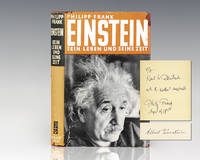
1949133215Munchen: Paul List Verlag 1949. First German edition of this classic work by Frank a famed contemporary of Einstein. Octavo original cloth. Signed by Albert Einstein on the slip to the title page and inscribed by the author on the front free endpaper "To Karl W. Deutsch with the author's compliments Philipp Frank August 10 1950." Philipp Frank was a physicist mathematician and also a philosopher during the first half of the 20th century. He was a logical-positivist and a member of the Vienna Circle. He was influenced by Mach and was one of the Machists criticised by Lenin in Materialism and Empirio-criticism. He studied physics at the University of Vienna and graduated in 1907 with a thesis in theoretical physics under the supervision of Ludwig Boltzmann. Albert Einstein recommended him as his successor for a professorship at the German Charles-Ferdinand University of Prague a position which he held from 1912 until 1938. Very good in a good dust jacket. Much has been written about Albert Einstein technical and biographical but very little remains as valuable as this unique hybrid of a book written by Einstein's colleague and contemporary. Both rich in personal insights and grounded in a deep knowledge of twentieth-century science Phillip Frank's biography anchors the reader with a lucid overview of physics and draws an intimate portrait of the Nobel Prize–winner. Paul List Verlag hardcover
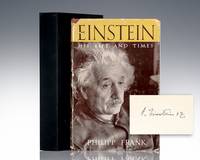
1947147192New York: Alfred A. Knopf 1947. First edition of this classic work by Frank a famed contemporary of Einstein. Octavo original cloth. Signed by the subject in the year of publication on the front free endpaper "A. Einstein 47." Translated from a German manuscript by George Rosen. Edited and Revised by Shuichi Kusaka. Housed in a custom half morocco slipcase. Rare and desirable signed by Einstein. Much has been written about Albert Einstein technical and biographical but very little remains as valuable as this unique hybrid of a book written by Einstein's colleague and contemporary. Both rich in personal insights and grounded in a deep knowledge of twentieth-century science Phillip Frank's biography anchors the reader with a lucid overview of physics and draws an intimate portrait of the Nobel Prize–winner. Very good in a very good dust jacket name to the front pastedown side edges. Alfred A. Knopf hardcover
2007021222New York London Toronto Sydney: Simon & Schuster 2007. FIRST EDITION first printing. Original two toned hardcover. Jacket is not price clipped. No previous owner's names not exlibrary. Overall an EXCELLENT book in an EXCELLENT bordart protected dust jacket. First Edition. Hard Cover. Near Fine/Near Fine. 8vo - over 7¾" - 9¾" tall. Hardcover. Simon & Schuster Hardcover
083882661X.Gpaperback. Good. Access codes and supplements are not guaranteed with used items. May be an ex-library book. paperback
192478904London: Methuen & Company 1924. First edition of this classic account of Born's analysis and interpretation of Einstein's theory of relativity. Octavo original cloth frontispiece of Einstein. Signed by Max Born on the verso of the frontispiece. Translated by Henry L. Brose. Very good in a very good dust jacket. Housed in a custom half morocco clamshell box. First editions are uncommon signed examples rare. Einstein's Theory of Relativity is a book in which one great mind explains the work of another great mind in terms comprehensible to the layman is a significant achievement. This is such a book. Max Born was awarded the Nobel Prize in 1954 and was one of the world's great physicists: in this work he analyzes and interprets the theory of Einsteinian relativity. The result is undoubtedly the most lucid and insightful of all the books that have been written to explain the revolutionary theory that marked the end of the classical and the beginning of the modern era of physics. Born follows a quasi-historical method of presentation. The book begins with a review of the classical physics covering such topics as origins of space and time measurements geometric axioms Ptolemaic and Copernican astronomy concepts of equilibrium and force laws of motion inertia mass momentum and energy Newtonian world system absolute space and absolute time gravitation celestial mechanics centrifugal forces and absolute space laws of optics the corpuscular and undulatory theories speed of light wave theory Doppler effect convection of light by matter electrodynamics including magnetic induction electromagnetic theory of light electromagnetic ether electromagnetic laws of moving bodies electromagnetic mass and the contraction hypothesis. Born then takes up his exposition of Einstein's special and general theories of relativity discussing the concept of simultaneity kinematics Einstein's mechanics and dynamics relativity of arbitrary motions the principle of equivalence the geometry of curved surfaces and the space-time continuum among other topics. Born then points out some predictions of the theory of relativity and its implications for cosmology and indicates what is being sought in the unified field theory. This work steers a middle course between vague popularizations and complex scientific presentations. This is a careful discussion of principles stated in thoroughly acceptable scientific form yet in a manner that makes it possible for the reader who has no scientific training to understand it. Only high school algebra has been used in explaining the nature of classical physics and relativity and simple experiments and diagrams are used to illustrate each step. The layman and the beginning student in physics will find this an immensely valuable and usable introduction to relativity. Methuen & Company hardcover
20091-8427034148Martinez Roca S A Ediciones 2009. Paperback. New. 574 pages. Spanish language. 6.69x1.61x9.61 inches. Martinez Roca S A Ediciones paperback
1976233935University Park Press 1976 hardback book and dust jacket in very gooD condition.name stamped on top page edges. 1st Edition. Hardcover. Very Good/Fair. University Park Press hardcover
1976233662University Park Press 1976 hardback book and dust jacket in very good to near fine conditionname stamped on page edges3 sideslight edgewear to dj. 1st Edition. Hardcover. Very Good/Very Good. University Park Press hardcover