850 résultats
1906003208Leipzig: J. A. Barth 1906. First Edition. Contemporary Red Cloth. Very Good. J. A. Barth Hardcover
190838837Leipzig Hirzel 1908. 4to. Contemp. hcalf. Spine gilt. Corners and spine ends with light wear. "Physikalische Zeitschrift. Herausgegeben von E. Riecke und H.Th. Simon. Neunter Jahrgang". XIX928 pp. textillustrations and 8 plates. Einstein paper: pp. 216-217. Internally clean and fine. The whole volume offered. <br/><br/><em>First edition. The volume contains also importent papers by Otto Hahn Lise Meitner Max Planck. </em> unknown
190638892Leipzig 1906. Einstein Albert 1879-1955. 1 Eine neue Bestimmung der Molekuldimensionen. In Ann. d. Physik 4th series 19 1906: 289-306. 2 Zur Theorie der Brownschen Bewegung. In ibid.:371-381. Whole volume 8vo. viii 1080pp. 5 plates. 213 x 143 mm. Original cloth spine faded split in upper half of spine inner hinge cracking. Very good. <p>1 First Edition in Journal Form Revised of Einstein's doctoral thesis ranked by his biographer as being on the same level as his 1905 papers on relativity the light quanta and Brownian motion. In his thesis Einstein presented a new theoretical method for determining molecular radii and Avogadro's number the number of atoms or molecules needed to make up a mass equal to a substance's atomic or molecular weight in grams. The thesis appeared in print in the spring of 1905; in the journal version published at the beginning of 1906 Einstein added a brief appendix containing an improved value of Avogadro's number.</p> <p>Einstein's biographer Abraham Pais wrote of Einstein's thesis as follows: </p> <p>"It is not sufficiently realized that Einstein's thesis is one of his most fundamental papers. Histories and biographies invariably refer to 1905 as the miraculous year because of his article on relativity the light-quantum and Brownian motion. In my opinion the thesis is on a par with the Brownian motion article. In fact in some-not all-respects his results on Brownian motion are by-products of his thesis work emphasis ours. This goes a long way toward explaining why the paper on Brownian motion was received by the Annalen der Physik on May 11 1905 only eleven days after the thesis had been completed.</p> <p>"Three weeks after the thesis was accepted this same journal received a copy of the thesis for publication. It was published only after Einstein supplied a brief addendum in January 1906. . . . As a result of these various delays the thesis appeared as a paper in the Annalen der Physik only after the Brownian motion article had come out in the same journal. This may have helped create the impression in some quarters that the relation between diffusion and viscosity-a very important equation due to Einstein and Sutherland-was first obtained in Einstein's paper on Brownian motion. Actually it first appeared in his thesis . . . ." </p> <p>"Quite apart from the fundamental nature of some results obtained in the thesis there is another reason why this paper is of uncommon interest: it has had more widespread practical applications than any other paper Einstein ever wrote . . . . The thesis dealing with bulk rheological properties of particle suspensions contains results which have an extraordinarily wide range of applications. They are relevant to the construction industry the motion of sand particles in cement mixes to the dairy industry the motion of casein micelles in cow's milk and to ecology the motion of aerosol particles in clouds to mention but a few scattered examples. Einstein might have enjoyed hearing this since he was quite fond of applying physics to practical situations" Pais Subtle is the Lord pp. 89-90. </p> <p>Pais notes that during the period 1970-1974 the 1906 journal version of Einstein's thesis was cited four times more often than his 1916 paper on general relativity and eight times more often than his 1905 paper on light quanta.</p> <p>2 First Edition of Einstein's second paper on Brownian motion containing two further methods for finding Avogadro's number. This was the first of his papers on the subject to include the term "Brownian motion" in the title. Pais pp. 95 98.</p> . unknown
192146469Berlin Julius Springer 1921. Lex8vo. Orig. printed wrappers. Offprint/Sonderdruck from "Der Festschrift der Kaiser Wilhelm Gesellschaft zur Förderung der Wissenschaften zu ihrem 10jährigen Jubiläum". Pp. 50-52. A small tear to right margin 1 cm otherwise fine and clean. At foot frontwrapper "Nicht im Handel". <br/><br/><em>First edition the offprint issue of this pioneerwork in globular cluster physics."In his paper on M13 Einstein 1921 concluded that the non-luminous mass contributes no higher order of magnitude to the total mass than does the luminous mass.To my knowledge this has been Einstein's only contact with globular clusters. As in other issues his claim still holds."Tom Richtler.Weil:117 - Boni:123. </em> unknown
191629308Braunschweig Vieweg & Sohn 1916. 8vo. Fine later boards the orig. printed frontwrapper from the Journal pasted on frontcover. Extract from "Verhandlungen d. deutschen Physikalischen Gesellschaft.18. Jahrgang. Nr. 6/7". pp. 173-177 and 1 textillustr. <br/><br/><em>First edition. - Weil No. 82. </em> hardcover
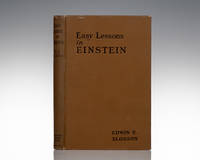
1921148232New York: Harcourt Brace and Company 1921. First edition of this popular science book that made Albert Einstein’s theory of relativity accessible to general readers. Octavo original cloth frontispiece with black and white illustrations. In very good condition name to the title page. Easy Lessons in Einstein 1920 by Edwin E. Slosson is an early and influential work of science communication that seeks to explain Albert Einstein’s theory of relativity in accessible terms for a general audience. Written at a time when Einstein’s ideas were gaining international attention but remained largely misunderstood by the public Slosson's book demystifies complex scientific concepts such as space-time the constancy of the speed of light and the relativity of motion using analogies and clear language rather than technical mathematics. As a chemist and science writer Slosson played a key role in making cutting-edge scientific developments comprehensible to non-specialists. The book reflects both the growing public fascination with modern physics in the early 20th century and the importance of translating theoretical science into broader cultural understanding. Harcourt, Brace and Company hardcover
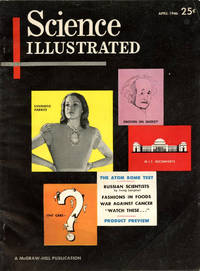
19461576McGraw-Hill 1946. 1st Edition. IN ORIGINAL WRAPPERS THE FIRST PUBLICATION BY EINSTEIN OF THE FAMILIAR EQUATION E=mc2 IN THAT SPECIFIC FORM. Eight months after Hiroshima the editors of Science Illustrated turned to Albert Einstein to explain "the form of the energy that destroyed Hiroshima;" "to explain in his own words what takes place in the operation of his law" Science Illustrated 1 1 pp. 17 April 1946. The editors believed that given the deployment of two nuclear weapons "average citizens" wanted at least a layman's understanding of the mathematical law that enabled atomic explosions so that they were better able to understand the destruction the bombs unleashed ibid.<br /> <br /> <br /> <br /> The mathematical equation or law in question was one Einstein published in 1905 in his Theory of Special Relativity but the form in which it was then written was longer and more complex. In the paper offered here Einstein presents the equation we all now know a shorter more understandable derivation of his equation based upon the law of the conservation of momentum the pressure of radiation and the aberration of light: E = mc2. In layman's terms Einstein also explains the equivalence of mass and energy and discusses the profound ‘urgent' implications of his principle ibid.<br /> <br /> <br /> <br /> In this article Einstein writes: "‘What takes place can be illustrated with the help of our rich man. The atom M is a rich miser who during his life gives away no money energy. But in his will he bequeaths his fortune to his sons M' and M'' on condition that they give to the community a small amount less than one thousandth of the whole estate energy or mass. The sons together have somewhat less than the father had the mass sum M' M'' is somewhat smaller than the mass M of the radioactive atom. But the part given to the community though relatively small is still so enormously large considered as kinetic energy that it brings with it a great threat of evil. Averting that threat has become the most urgent problem of our time" ibid. CONDITION & DETAILS: Complete issue bound in its original wrappers. 4to. pp. 1-128. Very slighy scuffing to the front wrap. There are no address labels. Bright and very clean throughout. McGraw-Hill unknown
19412142520/12/1941. <p>Brigitte Kaufmann was born in Germany but when the Nazis came to power in 1933 she fled to Paris. In France Kaufmann worked as an actress under the name of Brigitte Châtel and translated documents. She met her future husband Alfred Alexander-Katz in Paris and they married in 1939; the following day her husband was taken to an internment camp. He was given the choice of being interned in a labor camp or joining the Foreign Legion and chose the latter. Alexander was then sent to Clermont in Vichy France and the family relocated there.</p><p>Dr. Walter Rudlin was a social science professor at Sarah Lawrence College in New York and actively involved in anti-fascist activities. He was the author of “The Growth of Fascism in Great Britainâ€. In September 1942 he left his position and joined the U.S. Board of Economic Welfare whose chair was Vice President Henry Wallace. His wife Eryl was interested in bringing Jews in Europe out of harm’s way and she knew the Alexander-Katz family.</p><p>So Eryl sought to get Brigitte and her family safely out of Europe to Mexico and sought Einstein’s help. On March 12 1941 Einstein responded noting that Brigitte is his relative. “Thank you very much for your letter of March 11th. I am very gratified indeed to learn that our mutual friends Fred and Brigitte Alexander-Katz have some prospect to receive a visa into Mexico. I am certainly willing to vouch for their reliability and integrity both personal and political. I have known Mrs. Brigitte Alexander-Katz - whose family is related to mine - since she was a little girl. Her husband a very able engineer will certainly be useful to any country which receives him. If you will send me the address of the proper Mexican authority I shall gladly send any letter of recommendation desired.†This was a warm letter indeed expressing true concern and friendship for the Alexander-Katz family.</p><p>On April 3 1941 Einstein again wrote Rudlin noting “Enclosed I am sending you the requested letters in the hope that they may be successful.†But there were delays and no visa so Rudlin wrote Einstein seven months later asking him to take the matter up with the Mexican government.</p><p><strong>Typed letter signed</strong> on his blind-embossed letterhead Princeton December 20 1941 to Mrs. Eryl Rudlin saying that he expects the visa to be granted but does not feel he ought to approach the Mexican government directly. <em>“The Mexican authorities know that I am interested in the case of the Alexander-Katz family; they have kept me informed about the whole development of the matter. I have no doubt that admission to Mexico will be granted as it has been granted to hundreds of people in the same situation. I can give Mr. Alexander-Katz a recommendation but it is out of the question that I ask the Minister of Education to send him an official invitation. I have already done what could be done without intrusion.â€</em></p><p>Despite what he writes here to calm Mrs. Rudlin Einstein might have exerted some gentle pressure on Mexico by contacting the Mexican ambassador to the U.S. Gilberto Bosques; or the Alexander-Katz visas may have already being granted at that moment. The Einstein Archives is silent on this subject. But soon after Einstein soon wrote this letter in 1942 a telegram to the young Alexander-Katz family arrived stating that Einstein and Rudolph Uhlman a lawyer in New York had secured visas through Ambassador Bosques for them to escape to Veracruz Mexico aboard the ship San Thomé.</p><p>In Mexico Brigitte she became a noted author actress director and translator. She became the first woman in Mexico to produce and direct television programs. Speaking five languages she also worked as a translator for UNESCO and Amnesty International. Her daughter Susana and granddaughter Sophie also became actors.</p> unknown
1989SONG0306413787Springer 1989-01-01. 1989. hardcover. Used: Good. 7.00x1.00x10.25. Buy with confidence. Excellent Customer Service & Return policy. Springer hardcover
1989DADAX0306413787Springer 1989-01-01. 1989. hardcover. New. 7.00x1.00x10.25. Buy with confidence. Excellent Customer Service & Return policy. Springer hardcover
1983DADAX3795763843Eulenburg 1983-09-01. paperback. New. 5.50x1.57x7.75. Buy with confidence. Excellent Customer Service & Return policy. Eulenburg paperback
1983x-3795763843Schott & Co Ltd 1983. Paperback. New. 658 pages. 7.64x5.67x1.73 inches. Schott & Co Ltd paperback
1922139418Paris: Les Éditions G. Crès & Cie 1922. 32p. 48 b&w plates text in French pencil notes denoting country/region of origin of the artworks first edition in worn 10x7 inch paper boards with inkstains rough chipping to spine else good condition. Questo Volume è Apparso Nello Serie Orbis Pictus. Les Éditions G. Crès & Cie unknown
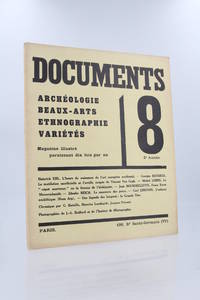
193080796Paris: Calmann Lévy 1930. Fine. Calmann Lévy Paris 1930 22 x 27.50 cm broché First edition of this issue of the important journal dealing notably with archaeology fine arts and ethnography with Georges Bataille and Carl Einstein as principal editors. Very handsome copy. Contributions by Heinrich Ehl: ""L'heure de naissance de l'art européen occidental"" Georges Bataille ""La mutilation sacrificielle et l'oreille coupée de Vincent Van Gogh"" Michel Leiris: ""Le ""caput mortuum"" ou la femme de l'alchimiste"" Jean Bourdeillette: ""Franz Xaver Messerschmidt"" Zdenko Reich: ""Le massacre des porcs"" Carl Einstein: ""L'enfance néoloithique Hans Arp"" Jacques Prévert Maurice Leenhardt. Issue illustrated with photographs by Jacques-André Boiffard Calmann Lévy unknown
193081582Paris: Calmann Lévy 1930. Fine. Calmann Lévy Paris 1930 22 x 27.50 cm broché First edition of this issue of this important journal dealing notably with archaeology fine arts and ethnography and whose principal editors were Georges Bataille and Carl Einstein. A small tear at the foot of the spine a slight tear without loss at the foot of pages 21-22. Contributions by Heinrich Ehl: ""L'heure de naissance de l'art européen occidental"" Georges Bataille ""La mutilation sacrificielle et l'oreille coupée de Vincent Van Gogh"" Michel Leiris: ""Le ""caput mortuum"" ou la femme de l'alchimiste"" Jean Bourdeillette: ""Franz Xaver Messerschmidt"" Zdenko Reich: ""Le massacre des porcs"" Carl Einstein: ""L'enfance néoloithique Hans Arp"" Jacques Prévert Maurice Leenhardt. Issue illustrated with photographs by Jacques-André Boiffard. Calmann Lévy unknown
192638843Berlin Julius Springer 1926. 4to. Contemp. hcloth. Some wear to binding. "Die Naturwisenschaften. Hrsg. von Arnold Berliner. Vierzehnter Jahrgang". XXVIII128644 pp. Einstein papers: pp. 223-224 and 300-301. Bohr paper pp. 1-10. The whole volume offred. <br/><br/><em>All 3 papers in first edition. - Weil Nos 150;154. </em> hardcover
192643839Berlin Julius Springer 1926. Lex8vo. In "Die Naturwissenschaften" Vierzehnter Jahrgang 1926. Entire volume offered bound in a nice contemporary half calf with five raised band and gilt lettering to spine. Minor wear to capitals otherwise a very fine and clean copy. Einstein: Pp. 223-24; Pp. 300-1; Bohr: Pp. 1-10. Entire volume: XXVIII 1286 72 pp. <br/><br/><em>First edition of all three papers. In the first paper Einstein explains the causes behind Baer's law: Due to the rotation of the earth erosion occurs mostly on the right banks of rivers in the Nothern Hemisphere while in the Southern Hemisphere erosion occurs primarily on the left banks. Weil Nos 150;154 </em> unknown
1992BN255921J.B. Metzler Part of Springer Nature - Springer-Verlag GmbH 1992. 1992. Die Romantik in der Musik <br/><br/>Die Romantik in der Musik Alfred Einstein J.B. Metzler, Part of Springer Nature - Springer-Verlag GmbH unknown
19503214Vaduz 1950. Gr.-8°. Ln. Varia unknown
191426027AB1914. Berlin Arthur Tetzlaff 1914. 8°. 4 230 2 Seiten. Hardcover / Library Binding. Bibliotheksbindung. Ehemaliges Exemplar der Harvard College Library. Mit dem Besitzvermerk von Prof. Gerald Holton. Die private Bibliotheksbindung mit mehreren Defekten. Vorsatzblatt lose und stark angerändert. Mit zahlreichen handschriftlichen Annotationen Holton's im Beitrag von Joseph Petzoldt: "Die Relativitätstheorie der Physik". Holton verweist in einem Absatz auf eine Peinlichkeit in Petzoldt's Aeusserung und merkt dazu an: "Embarrassing no wonder AE refused P invite to join Blackmore H. J. T. Blackmore and K. Hentschel" / Former copy of Harvard College Library with ownership-stamp of Nobel Laureate Prof. Gerald Holton. Several annotations in pencil by Holton in Joseph Petzoldt's contribution on the "Theory of Relativity of Physics". Holton notes for instance: "Embarrassing no wonder AE refused P invite to join Blackmore H. J. T. Blackmore and K. Hentschel" Zeitschrift für positivistische Philosophie. 2. Band. hardcover
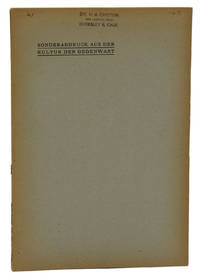
1925140941837Berlin: No Publisher 1925. Revised edition. 783-797 pp. Publisher's original printed wrappers. About Very Good with thin tear along front wrap fold near head a little chipping to wraps at spine front wrap hinge fragile contents toned with age. This copy belonged to Hans Albert Einstein Albert Einstein’s oldest son with his inkstamp at top of front wrapper; likely a presentation copy from his father. Neatly written at top of front wrapper are "41" and 163."<br /> <br /> <p>Very rare author's offprint from Die Kulture der Gegenwart of an essay on relativity theory which was first published in 1914 revised to incorporate Einstein's later research. OCLC/WorldCat locates no physical copies. Weil 71. [No Publisher] unknown
1907003219Leipzig: J. A. Barth 1907. In Annalen der Physik Vierte Folge Band 22. First Edition. Contemporary Cloth. Very Good. J. A. Barth Hardcover
190738828Berlin J.A. Barth 1907. Contemp. hcloth. Light wear to top of spine. "Annalen der Physik. Vierte Folge. Band 22" Engraved portrait of Pierre Curie. VIII1016 pp. and 4 plates. Einstein papers. pp. 180-190 pp. 569-572 and p.800. Internally clean and fine. The whole volume offered. <br/><br/><em>All papers in first edition. "From 1905 through 1909 Einstein published five major papers on the hypothesis of energy quanta its theoretical implications and its use in the explanation of various phenomena. Among these papers we have his importent paper "Die Plancksche." and in his second paper from 1906d he asserted that Planck's derivation implicitly assumes quantification of the enrgies of charged oscillators. Now in the paper offered he returned to this question showing that if the structure function in phase space he had introduced earlier is assumed to restrict the oscillators to orbits with energies that are integral mulætiples of 'hv' then the average oscillator energy in a canonical ensemble yealds Planck's law when substituted in eg. The works contains the first systematic introduction of probability factors in the mathematics of Quantum Theory.The second paper represents Einstein's third stage in dealing with brownian motion. He had previous explained the zigzag motion of suspended particles and looked as this penomenon from a more general angle. In the present investigation he extends his reults to all macroscopic parameters by giving a general principle for the calculation of theit fluctuations. Weil: nos 15 1-2 with an asterix a. 16. </em> hardcover
190747020Berlin J.A. Barth 1907. 8vo. 2 issues to both the original printed yellow wrappers. No backstrip. Wrappers loose. In: "Annalen der Physik. Vierte Folge. Band 22" No. 1. and No. 4. Pp. 1-208 1 fold. plate a. 1 portrait P. Curie a. pp. 609-800 1 plate. Entire issues offered. Einsteins paper: pp. 180-190 and p. 800. Astamp to verso of plates and a few leaves. THE PRINTED WRAPPERS LOOSE. <br/><br/><em>First printing of a major paper in Quantum Theory introducing the first systematic introduction of probability factors in Quantum Theory."From 1905 through 1909 Einstein published five major papers on the hypothesis of energy quanta its theoretical implications and its use in the explanation of various phenomena. Among these papers we have his importent paper "Die Plancksche." and in his second paper from 1906d he asserted that Planck's derivation implicitly assumes quantification of the enrgies of charged oscillators. Now in the paper offered he returned to this question showing that if the structure function in phase space he had introduced earlier is assumed to restrict the oscillators to orbits with energies that are integral mulætiples of 'hv' then the average oscillator energy in a canonical ensemble yealds Planck's law when substituted in eg. The works contains the first systematic introduction of probability factors in the mathematics of Quantum Theory." Weil: nos 15 1-2 with an asterix denoting a major paper. - Boni: 15. </em> unknown
191450425Leipzig: Johann Ambrosius Barth 1914. 1 Einstein Albert 1879-1955 and A.driaan D.aniël Fokker 1887-1972. Die Nordströmsche Gravitationstheorie vom Standpunkt des absoluten Differentialkalküls. In Annalen der Physik 44 10: 321-328. 2 Born Max 1882-1970. Zur Raumgitter theorie des Diamanten. In Annalen der Physik 44 12: 605-642. 3 Schrödinger Erwin Rudolf Josef Alexander 1887-1961. Zur Dynamik elastisch gekoppelter Punktesysteme. In Annalen der Physik 44 14: 916-934. Leipzig: Johann Ambrosius Barth 1914. </p> <br /> <br /> <p>Whole volume: viii 1272 pp. 22 plates Numbered Taf. I-XXII. Taf. I-IX: b/w/ silver photos; Taf. XI w/ one b/w silver photo; Taf. XII is folding and XIII XIV are b/w silver photos; Taf. XV and XVI are large folding tables; Taf. XVII XVIII XIX b/w/ silv.photos; and Taf.XX--XXII are photographs of X-ray images. Figs. Text-illust. 210 x 140 mm. Red cloth gilt lettering on spine. Very good. Along the margin of p. 802 written in pencil are the words: "Mallock R.S. 1910" probably written in Lord Rayleigh's hand most likely in reference to the title "The dampening of sound by frothy liquids" by A. Mallock in Proc. R.S. Lond ser. A vol. 84: 391-94. London 1911. </p> <br /> <br /> <p> A.D. Fokker 1887-1972 was a Dutch physicist and cousin to aeronautical engineer Anthony Fokker 1890-1939. He was musically inclined having invented the 31EDO pipe organ. He earned his doctorate in 1913 continuing his studies with Albert Einstein Ernest Rutheford 1871-1937 and William Bragg 1862-1942. In his 1913 thesis he derived the Fokker-Planck equation with Max Planck 1858-1947. Fokker made contributions to special relativity and general relativity particularly the effects of the curvature of space-time formally called "geodetic precession". Wikipedia.</p> . Johann Ambrosius Barth unknown