2 944 résultats
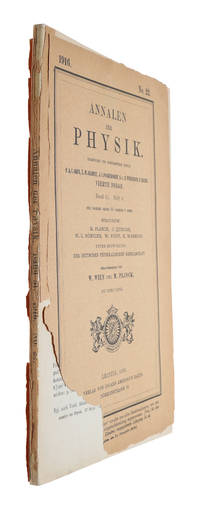
191638829Leipzig, J.A. Barth, 1916. Orig. printed wrappers. Frontwrapper lacking lower left coener. ""Annalenn der Physik. Vierte Folge. Band 51. 6. Heft."" (=1916 No. 22), pp. 577-684 and 3 plates. Einstein's paper: pp. 639-42. Internally clean and fine.
191650341Leipzig: Johann Ambrosius Barth 1916. Einstein Albert 1879-1955. Über Friedrich Kottlers Abhandlung "Über Einsteins Äquivalenzhypothese und die Gravitation." In Annalen der Physik 51 638-642 pp. Red cloth with gilt lettering on the spine. Whole volume: 883 pp. 4 plates. Figs. Text-illust. 210 x 130 mm. A very good copy.<br /> <br /> <p>Weil's Einstein Bibliography no. 81. <br> <br /> Boni's Einstein Checklist no. 79. </p> . Johann Ambrosius Barth unknown
191638829Leipzig J.A. Barth 1916. Orig. printed wrappers. Frontwrapper lacking lower left coener. "Annalenn der Physik. Vierte Folge. Band 51. 6. Heft." =1916 No. 22 pp. 577-684 and 3 plates. Einstein's paper: pp. 639-42. Internally clean and fine. <br/><br/><em>First edition. Weil No 81. </em> unknown
191049714Leipzig, Barth, 1910. 8vo. Bound in contemporary half cloth with gilt lettering to spine. In ""Annalen der Physik"", Bd. 33, 1910. Entire volume offered. Library stamp to verso of title page, light wear to extremities. Otherwise fine and clean. pp. 1096-1104 and pp. 1105-1115"" Pp. 1275-1298 [Entire volume: VIII, 1584 pp. + 6 plates.].
191029307(Leipzig, Barth, 1910). 8vo. Extracted from ""Annalen der Physik IV, Bd. 33"" pp. 1096-1104 and pp. 1105-1115. Fine and clean. Supplied with a facsimile wrapper from the offprint to the first paper.
191038842Leipzig, J.A. Barth, 1910. Contemp. hcalf. Spine gilt, a fs scratches to spine. VIII,1584 pp. and 6 plates. Einstein papers: pp. 1096: pp. 1105-1115" pp. 1275-1298. Fine and clean. The whole volume offered.
191050336Leipzig: Johann Ambrosius Barth 1910. <p>Einstein Albert 1879-1955. 1 Uber einen Satz der Wahrscheinlichkeitsrechnung und seine Anwendung in der Strahlungstheorie with L. Hopf. pp. 1096-1104. Weil 34 Boni 29. 2 Statistiche Untersuchung der Bewegung eines Resonators in einem Strahlungsfeld with L. Hopf. pp. 1105-1115. Weil 35 Boni 30. 3 Theorie der Opaleszens von homogenen Flüssigkeiten und Flüssigkeitsgemischen in der Nähe des kritischen Zustandes. pp. 1275-1298. Weil 36. In Annalen der Physik und Chemie 33. Red cloth with gilt lettering on the spine. Whole volume: viii 1584 pp. 6 plates. Text-figs. 210 x 130 mm. Very good copy. </p> <br /> <br /> <p>Approximate English translations of titles and brief explanations of papers:<br> <br /> <br /> 1 "On a theorem of probability calculus and its application in the radiation theory." "Einstein and Hopf wrote this paper to show that the failure of statistical mechanics vis-a-vis the radiation law cannot be ameliorated by proposing that individual statistical events in the emission of light from different points on the surface of a luminous body are not actually independent but instead are interdependent with each other. Even if one assumes a failure to be statistically independent one derives the same usual form of the radiation law as Fourier sum." p. 290. Calaprice Kennefick & Shulmann. An Einstein Encyclopedia. 2015.</p> <br /> <br /> <p>2 "Statistical investigation of the movement of a resonator in a radiation field." With: L. Hopf. "The authors make use of the results in no. 1 above demonstrating that the Rayleigh-Jeans law of radiation is an unavoidable consequence of statistics even if we avoid assumptions that we may think need correction. In other words we cannot blame statistics for a faulty result." p. 290. Calaprice Kennefick & Shulmann. An Einstein Encyclopedia. 2015. </p> <br /> <br /> <p>3 "Theory of the opalescence of homogenous liquids and liquid mixtures near the critical state"."Einstein explains the optical effects that occur near the critical point of a fluid at which liquid gas phases can coexist and of a binary mixture of liquids that can also explain the blue color of the sky. It adds to earlier stuidies that provided evidence for the atomistic constitution of matter and is one of the most difficult papers to understand." p. 290. Calaprice Kennefick & Shulmann. An Einstein Encyclopedia. 2015. </p> <br /> <br /> <p>"October 1910. E. completes a paper on critical opalescence his last major work in classical statistical physics." Pais Subtle is the Lord. 523. </p> <br /> <br /> <p>Weil's Einstein Bibliography nos. 34 35 and 36 respectively.</p> <br /> <p>Boni's Einstein Checklist nos. 29 30 and 31 respectively. </p> . Johann Ambrosius Barth unknown
191038842Leipzig J.A. Barth 1910. Contemp. hcalf. Spine gilt a fs scratches to spine. VIII1584 pp. and 6 plates. Einstein papers: pp. 1096: pp. 1105-1115; pp. 1275-1298. Fine and clean. The whole volume offered. <br/><br/><em>All three papers first edition. The purpose of "A theorem in probability and its application in the Theory of radiation" is to demonstrate that the failure of statistical mechanics with respect to the radiation law Rayleigh - Jeans law contradicted by experience cannot be removed by the conjecture that perhaps the individual statistical events should not follow the usual law of independence product of probabilities instead of assuming a certain interdependence between them. Lanczos. The second paper "Statistical investigation on of the motion of an oscillator in a radiation field" makes use of the results of the previous investigation. Einstein's aim is to demonstrate that the Rayleigh-jeans law of radiation contracdicted by the physical facts is an unavoidable consequence of statistics even if we avoid any kind of assumption which may be suspected of needing correction. Lanczos. The third paper "Theory of the opalescence of homogenous fluids and fluid mixtures near the critical state" is an importent investigation and one of the most difficult of all his papers to understand. The aim of the paper is to complement the work of Smoluchovski Ann. d. Physik25 1908 who gave a general explanation of the strong density fluctuations - and the opalescence thus generated - of two fluids near the critical state of mixture or a single fluid near the critical state of condensation on the basis of the kinetic theory of heat. he did notgive howeverthe quantitative details concerning the scattered light associated with this phenomenon. Lanczos. - Weil Nos 34 35 and 36 with an asterix denoting major work. </em> unknown
191049714Leipzig Barth 1910. 8vo. Bound in contemporary half cloth with gilt lettering to spine. In "Annalen der Physik" Bd. 33 1910. Entire volume offered. Library stamp to verso of title page light wear to extremities. Otherwise fine and clean. pp. 1096-1104 and pp. 1105-1115; Pp. 1275-1298 Entire volume: VIII 1584 pp. 6 plates. <br/><br/><em>First appearance of all three papers. The purpose of "A theorem in probability and its application in the Theory of radiation" is to demonstrate that the failure of statistical mechanics with respect to the radiation law Rayleigh - Jeans law contradicted by experience cannot be removed by the conjecture that perhaps the individual statistical events should not follow the usual law of independence product of probabilities instead of assuming a certain interdependence between them. Lanczos. The second paper "Statistical investigation on of the motion of an oscillator in a radiation field" makes use of the results of the previous investigation. Einstein's aim is to demonstrate that the Rayleigh-jeans law of radiation contracdicted by the physical facts is an unavoidable consequence of statistics even if we avoid any kind of assumption which may be suspected of needing correction. Lanczos. The third paper "Theory of the opalescence of homogenous fluids and fluid mixtures near the critical state" is an importent investigation and one of the most difficult of all his papers to understand. The aim of the paper is to complement the work of Smoluchovski Ann. d. Physik25 1908 who gave a general explanation of the strong density fluctuations - and the opalescence thus generated - of two fluids near the critical state of mixture or a single fluid near the critical state of condensation on the basis of the kinetic theory of heat. he did notgive howeverthe quantitative details concerning the scattered light associated with this phenomenon. Lanczos. - Weil Nos 34 35 and 36 with an asterix denoting major work.Weil No. 34 35 & 36. </em> hardcover
191029307Leipzig Barth 1910. 8vo. Extracted from "Annalen der Physik IV Bd. 33" pp. 1096-1104 and pp. 1105-1115. Fine and clean. Supplied with a facsimile wrapper from the offprint to the first paper. <br/><br/><em>Both works in first edition. - Weil No. 34 and 35. </em> unknown
190650324Leipzig, Ambrosius Barth, 1906. 8vo. In contemporary halv calf with four raised bands and gilt lettering to spine. In ""Annalen der Physik"", Vierte Folge, Band 21. Entire volume offered. Stamp to title page. Wear to extremities. Internally fine and clean. Pp. 583-86. [Entire volume: 1055, VIII pp.].
190638833Leipzig, J. A. Barth, 1906. Contemp. hcloth. Light wear to edges. A small tear at upper part of fronthinge. ""Annalen der Physik. Vierte Folge. Band 21. Hrsg. von W.Wien und M. Planck"". VIII,1056 pp.and 9 plates. Einstein paper: pp. 583-86. Internally clean and fine. The whole volume offered.
H4004Berlin Akademie der Wissenschaften 1921 In: Sitzungsberichte der Königl.Preuss. Akademie der Wissenschaften Band 1921/1. 4to. S.261-265. Weitere Berichte von: Laue Halbleinenband der Zeit leicht berieben Bibl.-Nr.am Rücken Original-Broschur miteingebunden unaufgeschnitten gutes Exemplar. unknown
1906432891906. <p>Einstein Albert 1879-1955. Über eine Methode zur Bestimmung des Verhältnisses der transversalen und longitudinalen Masse des Elektrons. Offprint from Annalen der Physik 21 1906. 583-586pp. 223 x 145 mm. Original printed wrappers chipped spine splitting minor spotting. Light toning but very good.</p> <p>First Edition Rare Offprint Issue. In his landmark 1905 paper on special relativity Einstein used the velocity-dependent concepts of transverse and longitudinal mass for the moving electron these terms have now been replaced with the concept of relativistic mass first defined by Lewis and Tolman in 1909. In the present paper Einstein proposed an experimental method for determining the ratio of the transverse to the longitudinal mass and invited experimentalists to verify his special theory of relativity. Einstein later abandoned velocity-dependent mass concepts stating in 1948 that "it is better to introduce no other mass concept than the 'rest mass' m" quoted in L. B. Okun "The concept of mass" Physics Today 1989: 31-36. Lavenda A New Perspective on Relativity pp. 7-8. Weil Albert Einstein Bibliography 14. </p> . unknown
190650324Leipzig Ambrosius Barth 1906. 8vo. In contemporary halv calf with four raised bands and gilt lettering to spine. In "Annalen der Physik" Vierte Folge Band 21. Entire volume offered. Stamp to title page. Wear to extremities. Internally fine and clean. Pp. 583-86. Entire volume: 1055 VIII pp. <br/><br/><em>First printing of Einstein's paper on a method for the determination of the transversal and longitudinal mass of the electron. This eventually caused a major breakthrough in Weil no. 14 </em> hardcover
190638833Leipzig J. A. Barth 1906. Contemp. hcloth. Light wear to edges. A small tear at upper part of fronthinge. "Annalen der Physik. Vierte Folge. Band 21. Hrsg. von W.Wien und M. Planck". VIII1056 pp.and 9 plates. Einstein paper: pp. 583-86. Internally clean and fine. The whole volume offered. <br/><br/><em>First edition. Einsten describes in this paper "Method for the determination of the ratio of the transversal to the longitudinal mass of the electron" an apparatus which would make it possible to determine with great accuracy the law according to which the mass of the electron changes with the velocity. - Weil No 14. </em> hardcover
192132433Berlin: Akad. Wiss. Berl. 1921 Berichte 51-53 1921. First Edition. Soft cover. First Edition. Soft cover. ALBERT EINSTEIN. Über eine naheliegende Ergänzung des Fundamentes der allgemeinen Relativitätstheorie Berlin 1921 8vo. 26.5 x 18.5 cms Akad. Wiss. Berl. 1921 Berichte 51-53 pp.261-264. Original printed wrappers. NEAR MINT CONDITION. A fine fresh example small pencil mark to upper wrapper of THIS RARE PAPER!! - ."Although Einstein could not accept Weyl's theory as a physical theory he cherished "its courageous mathematical construction" and thought intensively about its conceptual foundation. This becomes clear from his paper "On a complement at hand of the bases of general relativity" of 1921. In it he raised the question whether it would be possible to generate a geometry just from the conformal invariance of Equation without use of the conception "distance" i.e. without using rulers and clocks. He then embarked on conformal invariants and tensors of gauge-weight 0 and gave the one formed from the square of Weyl's conformal curvature tensor" Hubert F.M. Goenner On the History of Unified Field Theories. Reference: Weil N. 116; Schlipp-Shields No.145. Akad. Wiss. Berl., 1921, Berichte 51-53 unknown
1921433161921. Offprint from Sitzungsberichte der preussischen Akademie der Wissenschaften 1921. Single sheet pp. 882-883. 256 x 184 mm. Minor marginal tears one corner chipped but very good. First ediiton offprint issue. "Since after 1917 Einstein firmly believed that light-quanta were here to stay it is not surprising that he would look for new ways in which the existence of photons might lead to observable devations from the classical picture. In this he did not succeed. At one point in 1921 he thought he had found a new quantum criterion published in the present paper but it soon turned out to be a false lead" Pais Subtle is the Lord pp. 412-413. Weil Albert Einstein Bibliography 118. unknown
190750595Leibzig, Johann Ambrosius Barth, 1907. 8vo. In contemporary full cloth with gilt lettering to spine. In ""Annalen der Physik"", Vierte Folge, Band 23. Entire volume offered. Ex-libris pasted on to top right corner of pasted down front free end-paper. Light rubbing to extremities, a very fine and clean copy (not an ex-library copy). Pp.371-384. [Entire volume: VIII, 1000 pp. + 4 plates].
190747457Leibzig, Johann Ambrosius Barth, 1907. 8vo. Contemp. hcalf. Spine gilt. Title-and tomelabels with gilt lettering. Slightly rubbed. In ""Annalen der Physik"", Vierte Folge, Band 23. VIII,1000 pp. a. 4 plates. (The entire volume offered). Einstein's paper: pp.371-384. A small stamp on titlepage (Gmelin.Institut.). Internally clean and fine.
190753408Leibzig, Johann Ambrosius Barth, 1907. 8vo. Contemp. hcalf. Spine gilt and with gilt lettering. Slightly rubbed and light wear to spineends. In ""Annalen der Physik"", Vierte Folge, Band 23. VIII,1000 pp. a. 4 plates. (The entire volume offered). Einstein's paper: pp.371-384. Stamps on titlepage (Allgemeine Electricitäts-Gesellschaft a. AEG Forschungsinstitut). Internally clean.
190750595Leibzig Johann Ambrosius Barth 1907. 8vo. In contemporary full cloth with gilt lettering to spine. In "Annalen der Physik" Vierte Folge Band 23. Entire volume offered. Ex-libris pasted on to top right corner of pasted down front free end-paper. Light rubbing to extremities a very fine and clean copy not an ex-library copy. Pp.371-384. Entire volume: VIII 1000 pp. 4 plates. <br/><br/><em>First edition of the first explicit statement of Einstein's landmark energy-mass equation E=mc2.Nearly all descriptions of Einstein's scientific work state that the mass-energy equivalence E=mc2 was first formulated in Einstein's 1907 review paper 'Über das Relativitätsprinzip und die aus demselben gezogenen.' published in 'Jahrbuch der Radioaktivität und Elektronik' see Weil no. 21 and Dictionary of Scientific Biography vol. 4 pp.323 for examples. However in his paper 'Über die von Relativitätsprincip geforderte Trägheit der Energie' the offered paper which predates the former mentioned by six months Einstein gave a clear statement of the mass-energy equivalence E=mc2. See Lanczos: The Einstein Decade pp.149-150 and 153 as well as Volume 2 of 'The Collected Papers of Albert Einstein' pp. 428.Einstein's first paper regarding the relation E=mc2 is his fourth 1905 paper 'Ist die Trägheit eines Körpers von seinem Energieinhalt abhängig'. In this short paper Einstein showed that a body releasing the energy E in the form of radiation will have its mass decreased by E/c2 and concluded that the mass of a body is a measure of its energy content e.g. that all energy has mass. The next time Einstein returns to the subject is in his 1906 paper 'Das Prinzip von der Erhaltung der Schwerpunkts Bewegung und die Trägheit der Energie.'. Here Einstein concluded that one must either ascribe the inertial mass E/c2 to any form of energy E or else give up the fundamental law mechanics regarding conservation of the motion of the center of gravity. Then finally in the 1907 paper 'Über die von Relativitätsprincip geforderte Trägheit der Energie.' the offered paper Einstein makes the decisive step of assuming that all mass has energy. On page 382 Einstein considers the total energy of a moving mass point as the sum of its kinetic energy and its rest energy. In classical mechanics it is most convenient to set the second term to zero but in relativistic mechanics one obtains the simplest expression by setting the rest energy equal to mc2. Einstein then continues to show that this stipulation cannot lead to a contradiction in any relativistic argument. In a footnote on page 382 Einstein states for the first time the equation E=mc2 and mentions that this equation is the expression of the principle of the equivalence of mass and energy - see Volume 2 of 'The Collected Papers of Albert Einstein' pp. 428.The volume contains another paper by Einstein "Bemerkungen zu der Notiz von Hrn. Paul Ehrenfest: "Die Translation deformierbarer Elektronen und der Flächensatz"" pp.206-208. - Weil No. 18.Collected Works Doc. 45. Weil 19. Boni 19. </em> hardcover
190753408Leibzig Johann Ambrosius Barth 1907. 8vo. Contemp. hcalf. Spine gilt and with gilt lettering. Slightly rubbed and light wear to spineends. In "Annalen der Physik" Vierte Folge Band 23. VIII1000 pp. a. 4 plates. The entire volume offered. Einstein's paper: pp.371-384. Stamps on titlepage Allgemeine Electricitäts-Gesellschaft a. AEG Forschungsinstitut. Internally clean. <br/><br/><em>First edition of the first explicit statement of Einstein's energy-mass equation E=mc2.Nearly all descriptions of Einstein's scientific work state that the mass-energy equivalence E=mc2 was first formulated in Einstein's 1907 review paper 'Über das Relativitätsprinzip und die aus demselben gezogenen.' published in 'Jahrbuch der Radioaktivität und Elektronik' see Weil no. 21 and Dictionary of Scientific Biography vol. 4 pp.323 for examples. However in his paper 'Über die von Relativitätsprincip geforderte Trägheit der Energie' the offered paper which predates the former mentioned by six months Einstein gave a clear statement of the mass-energy equivalence E=mc2. See Lanczos: The Einstein Decade pp.149-150 and 153 as well as Volume 2 of 'The Collected Papers of Albert Einstein' pp. 428.Einstein's first paper regarding the relation E=mc2 is his fourth 1905 paper 'Ist die Trägheit eines Körpers von seinem Energieinhalt abhängig'. In this short paper Einstein showed that a body releasing the energy E in the form of radiation will have its mass decreased by E/c2 and concluded that the mass of a body is a measure of its energy content e.g. that all energy has mass. The next time Einstein returns to the subject is in his 1906 paper 'Das Prinzip von der Erhaltung der Schwerpunkts Bewegung und die Trägheit der Energie.'. Here Einstein concluded that one must either ascribe the inertial mass E/c2 to any form of energy E or else give up the fundamental law mechanics regarding conservation of the motion of the center of gravity. Then finally in the 1907 paper 'Über die von Relativitätsprincip geforderte Trägheit der Energie.' the offered paper Einstein makes the decisive step of assuming that all mass has energy. On page 382 Einstein considers the total energy of a moving mass point as the sum of its kinetic energy and its rest energy. In classical mechanics it is most convenient to set the second term to zero but in relativistic mechanics one obtains the simplest expression by setting the rest energy equal to mc2. Einstein then continues to show that this stipulation cannot lead to a contradiction in any relativistic argument. In a footnote on page 382 Einstein states for the first time the equation E=mc2 and mentions that this equation is the expression of the principle of the equivalence of mass and energy - see Volume 2 of 'The Collected Papers of Albert Einstein' pp. 428.The volume contains another paper by Einstein "Bemerkungen zu der Notiz von Hrn. Paul Ehrenfest: "Die Translation deformierbarer Elektronen und der Flächensatz"" pp.206-208. - Weil No. 18. Further with 2 importent papers by Max v. Laue.Collected Works Doc. 45. Weil 19. Boni 19. </em> unknown
190747457Leibzig Johann Ambrosius Barth 1907. 8vo. Contemp. hcalf. Spine gilt. Title-and tomelabels with gilt lettering. Slightly rubbed. In "Annalen der Physik" Vierte Folge Band 23. VIII1000 pp. a. 4 plates. The entire volume offered. Einstein's paper: pp.371-384. A small stamp on titlepage Gmelin.Institut. Internally clean and fine. <br/><br/><em>First edition of the first explicit statement of Einstein's energy-mass equation E=mc2.Nearly all descriptions of Einstein's scientific work state that the mass-energy equivalence E=mc2 was first formulated in Einstein's 1907 review paper 'Über das Relativitätsprinzip und die aus demselben gezogenen.' published in 'Jahrbuch der Radioaktivität und Elektronik' see Weil no. 21 and Dictionary of Scientific Biography vol. 4 pp.323 for examples. However in his paper 'Über die von Relativitätsprincip geforderte Trägheit der Energie' the offered paper which predates the former mentioned by six months Einstein gave a clear statement of the mass-energy equivalence E=mc2. See Lanczos: The Einstein Decade pp.149-150 and 153 as well as Volume 2 of 'The Collected Papers of Albert Einstein' pp. 428.Einstein's first paper regarding the relation E=mc2 is his fourth 1905 paper 'Ist die Trägheit eines Körpers von seinem Energieinhalt abhängig'. In this short paper Einstein showed that a body releasing the energy E in the form of radiation will have its mass decreased by E/c2 and concluded that the mass of a body is a measure of its energy content e.g. that all energy has mass. The next time Einstein returns to the subject is in his 1906 paper 'Das Prinzip von der Erhaltung der Schwerpunkts Bewegung und die Trägheit der Energie.'. Here Einstein concluded that one must either ascribe the inertial mass E/c2 to any form of energy E or else give up the fundamental law mechanics regarding conservation of the motion of the center of gravity. Then finally in the 1907 paper 'Über die von Relativitätsprincip geforderte Trägheit der Energie.' the offered paper Einstein makes the decisive step of assuming that all mass has energy. On page 382 Einstein considers the total energy of a moving mass point as the sum of its kinetic energy and its rest energy. In classical mechanics it is most convenient to set the second term to zero but in relativistic mechanics one obtains the simplest expression by setting the rest energy equal to mc2. Einstein then continues to show that this stipulation cannot lead to a contradiction in any relativistic argument. In a footnote on page 382 Einstein states for the first time the equation E=mc2 and mentions that this equation is the expression of the principle of the equivalence of mass and energy - see Volume 2 of 'The Collected Papers of Albert Einstein' pp. 428.The volume contains another paper by Einstein "Bemerkungen zu der Notiz von Hrn. Paul Ehrenfest: "Die Translation deformierbarer Elektronen und der Flächensatz"" pp.206-208. - Weil No. 18.Collected Works Doc. 45. Weil 19. Boni 19. </em> unknown
191722780Braunschweig, Fridr. Vieweg. & Sohn, 1917. (""Heft 38 sammlung Vieweg""), 8vo. Orig. printed wrappers. Title page with ink note and owners name. Some underlinings in ink. IV,70 pp.