850 résultats
1914003232Leipzig: J. A. Barth 1914. Contemporary cloth-backed marbled boards. Nick in spine; ink stamp on front pastedown. First Edition. Very Good. J. A. Barth hardcover
1931209587Berlin: Propyläen-Verlag 1931. Hardcover. VG: Wear to the edges and corners. Rubbing to the spine. Rubbing to the end pages. Stains to the inside corners of the end pages with no text or image affected. Some foxing to the margins of the pages and plates. Majority clean body pages and solid binding. A green casebound book with a blue fabric spine. There is gilt text and design on the spine. There is a gilt design on the front cover. Black textblocks. 660 pages; 60 plates total profusely illustrated with a good number of color tipped-in plates on heavy black pages with protective rice paper the remainders are black-and-white plates on heavy black paper. Text is in German. Contents are as follows: Henri Matisse -- Georges Rouault -- Henri Rousseau -- Andre Derain -- Amedeo Modigliani -- Roger de la Fresnaye -- Pablo Picasso -- Georges Braque -- Juan Gris -- Fernand Leger -- Andre Masson -- Joan Miro -- Gaston-Louis Roux -- Robert Delaunay -- Umberto Boccioni -- Gino Severini -- Carlo carra -- Giorgio de Chirico -- Emil Nolde -- Die Brucke -- Erich Heckel -- Max Pechstine -- Karl Schmidt-Rottluff -- Ernst Ludwig Kirchner -- Paula Modersohn-Becker -- Carl Hofer -- Lyonel Feininger -- Oskar Kokoschka -- George Grosz -- Max Beckmann -- Otto Dix -- Marc Chagall -- Konstruktivisten -- Franz Marc -- Wassilij Kandinsky -- Paul Klee -- GFranzosen Spanier Italiener -- Deutsche Russen Hollander Ungarn Plastik. Propyläen-Verlag hardcover
1926210542Berlin: Propylaen-Verlag 1926. Hardcover. VG. High quality rebinding and interior is clean and unmarked. Quarto. Hardcover. Rebound in green cloth with gilt titles. 576 pages illustrations some color. French text. Text is in German. Contents are as follows: Henri Matisse -- Georges Rouault -- Henri Rousseau -- Andre Derain -- Amedeo Modigliani -- Roger de la Fresnaye -- Pablo Picasso -- Georges Braque -- Juan Gris -- Fernand Leger -- Andre Masson -- Joan Miro -- Gaston-Louis Roux -- Robert Delaunay -- Umberto Boccioni -- Gino Severini -- Carlo carra -- Giorgio de Chirico -- Emil Nolde -- Die Brucke -- Erich Heckel -- Max Pechstine -- Karl Schmidt-Rottluff -- Ernst Ludwig Kirchner -- Paula Modersohn-Becker -- Carl Hofer -- Lyonel Feininger -- Oskar Kokoschka -- George Grosz -- Max Beckmann -- Otto Dix -- Marc Chagall -- Konstruktivisten -- Franz Marc -- Wassilij Kandinsky -- Paul Klee -- GFranzosen Spanier Italiener -- Deutsche Russen Hollander Ungarn Plastik. Propylaen-Verlag hardcover
193028365Berlin Gruyter X Co. 1930. 4to. Orig. orange printed wrappers. Offprint/Sonderausgabe aus Sitzungsberichten. pp. 1-13. <br/><br/><em>First edition in the rare Offprint having separate printed title and separate pagination. See Weil No. 170 where this is not mentioned.The early Offprints from "Sitzungsberichten." are called "Sonderabdruck" up to Weil No.165 including this. From Weil 166 they are called "Sonderausgabe.". - Before 161 up to 160 the Offprints do not have separate title and pagination the pagination follows the numbering in the periodical. From 166 the Offprint has both separate printed title and pagination. - So Weil Nos 161-165 is still "Abdruck" but with separate title and pagination. These facts are not mentioned in the bibliographies. </em> unknown
193028367Berlin Gruyter & Co. 1930. 4to. Orig. printed orange wrappers. Offprint/Sonderausgabe aus Sitzungsberichten.pp. 1-8. Fine fresh copy. <br/><br/><em>First edition in the scarce Offprint with its separate printed title and separate pagination. See Weil No. 169 where this is not mentioned.The early Offprints from "Sitzungsberichten." are called "Sonderabdruck" up to Weil No.165 including this. From Weil 166 they are called "Sonderausgabe.". - Before 161 up to 160 the Offprints do not have separate title and pagination the pagination follows the numbering in the periodical. From 166 the Offprint has both separate printed title and pagination. - So Weil Nos 161-165 is still "Abdruck" but with separate title and pagination. These facts are not mentioned in the bibliographies. </em> unknown
193037421Berlin: Akad. der Wiss 1930. Offprint from S. preuss. Akad. Wiss. Weil 169. Akad. der Wiss unknown
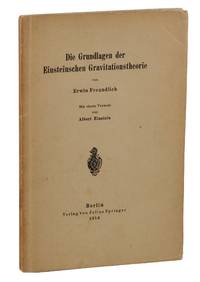
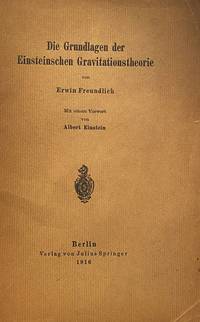
191632820373<p>Original wrappers. Very good.</p><p>FIRST EDITION. This work on Albert Einstein's theory of gravitation contains a foreword by Einstein. Freundlich is best known for his attempts to experimentally test the general theory of relativity using astronomical observations based on the gravitational redshift.<br /><br />Freundlich worked as an assistant at the University Observatory in Berlin at the time he published this work. In 1920 he moved to the Astrophysical Observatory in Potsdam where he was director from 1921-33</p><br /> Springer paperback
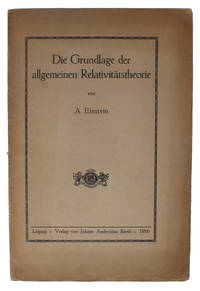
1916ABE-1748062254979Verlag von Johann Ambrosius Barth 1916 Pamphlet finely bound in Dark green quarter leather over marbled boards. Signed twice in ink either by Einstein or a decent forger. Signature faded. First separate edition for the first time with the introduction which did not appear in the "Annalen." - "The theory of relativity has turned astrophysics upside down even the entire scientific world view" Carter/Muir Books That Change the World p. 727. "This separate edition is printed on good strong paper the wrappers are of strong material too 163 x 243 and it is described now as 'the original edition' of this classic paper ." Weil. - Cover slightly browned with a few edge chips top and foredge. Minor repairs to rear cover. Carter/Muir Books That Change the World 408 in "Annals of Physics"; Boni 78; Weil 80a; Laurence 78; Norman 696; Horblitt 26c. Signed by Authors. 1st Edition. Hardcover. Very Good. Verlag von Johann Ambrosius Barth hardcover
191619266Leipzig: J.A Barth 1916. FIRST SEPARATE EDITION. Original printed wrappers on rippled paper; wrappers and interior soiled and spotted mostly likely with minor water damage. From the library of Einstein protege Dr. Kurt Eisenmann with his siganture and stamps. First separate printing of Einstein’s classic paper. Not an offprint from the Annalen der Physik as is often thought but a completely new setting of type with significant and important additions and revisions including an introduction published here for the first time which was not in the journal issue. <br /> <br /> Printing & the Mind of Man 408; Weil 80a. J.A Barth unknown
1916188045Leipzig: Johann Ambrosius Barth 1916. The foundation of general relativity First separate edition first issue of the work presenting the finalized version of general relativity. The Grundlage was also published in the Annalen der Physik in 1916 but Weil clarifies that the separate publication is now accepted as the earliest published edition of the paper. Einstein had almost finalized the general theory of relativity in 1913. However an error led him to contend that his equations could not be covariant - that they could not be applied without a system of spacetime co-ordinates devised by humans and therefore contextually specific. His first attempt at an overall presentation of the theory as delivered in 1914 was based on this assumption. By 1915 his subsequent reflections had driven him to reapply covariance and in November he published several papers outlining covariant field equations of general relativity. The present work adapts the comprehensive perspective of the 1914 paper with the revised mathematics of the 1915 equations to present "the first systematic exposition of general relativity" Janssen p. 1. Tilman Sauer notes that "in essence Einstein's general theory of relativity of 1916 remains today's accepted theory of the gravitational field" p. 24. This copy includes all the necessary first issue points: the imprint "Druck von Metzger & Wittig in Leipzig. 314" on the title page verso; Ziehen's Die Psychologie as the last title listed in the publisher's advertisement on the rear wrapper; and the imprint "Metzger & Wittig Leipzig" on the rear wrapper. Octavo. Device to title page formulae in the text. Original tan vertically ribbed wrappers printed in black. Light creasing and foxing to otherwise bright wrappers title page remargined at head not affecting text contents crisp: a near-fine copy. Norman 696; Printing and the Mind of Man 408; Weil 80a. Michael Janssen "Einstein's First Systematic Exposition of General Relativity" 2004; Tilman Sauer "Albert Einstein's 1916 Review Article on General Relativity" in Ivor Grattan-Guiness ed. Landmark Writings in Western Mathematics 1640-1940 2004. unknown
191660254Leipzig Ambrosius Barth 1916. 8vo. Uncut in the original printed wrappers. Light discolouration to margins of wrappers. Inner hinges with professional repairs. Small stamp exlibris to lower part of title-page. Previous owner's name Erik Broekmeyer in contemporary hand to upper outer corner of title-page. A fine copy. 64 pp. <br/><br/><em>First issue of the first edition in book form being not an offprint of the"Annalen der Physik" journal issue as often stated but a separate edition of the paper completely re-set and with significant changes and additions including for the first time in print the "Einleitung" and the "Inhalt".The first issue is distinguished from the later reprints by the printing of "Sonderdruck aus dem "Annalen der Physik" Band 49 1916" and "Druck von Metzger & Wittig in Leipzig. 314" to the verso of the title-page and "Metzger & Wittig Leipzig" to the foot of the back wrapper. Furthermore "This separate edition is printed on good strong paper the wrappers are of strong material too and it is described now as 'the original edition' of this classic paper" Weil. Einstein's seminal "General Theory of Relativity" has had an immense impact on all science philosophy and man's view of the world in general. Few other books of the 20th century can be said to have so basically altered the way that we view the world and our place in it. Determining space and time as being interwoven into a single continuum known as "space-time" and determining that there is no absolute space-time coordinate system - i.e. that there are no absolute positions in time and pace - established the fact that events that occur at the same time for one observer could occur at different times for another i.e. all positions in space and time are relative. This general theory of relativity here presented in its full exposition for the first time in book form is now a basic foundation for scientific thought."The theory of relativity has transformed astrophysics and indeed the whole scientific outlook." PMM."Whereas Special Relativity had brought under one set of laws the electromagnetic world of Maxwell and Newtonian mechanics as far as they applied to bodies in uniform relative motion The General Theory did the same thing for bodies with the accelerated relative motion epitomized in the acceleration of gravity. But first it had been necessary for Einstein to develop the true nature of gravity from his principle of equivalence.Basically he proposed that gravity was a function of matter itself and that its effects were transmitted between contiguous portions of space-time. Where matter exists so does energy; the greater the mass of matter involved the greater the effect of the energy which can be transmitted. In addition gravity affected light. exactly as it affected material particles. Thus the universe which Newton had seen and for which he had constructed his apparently impeccable mechanical laws was not the real universe. Einstein's paper gave not only a correct picture of the universe but also a fresh set of mechanical laws by which its details could be described" R.W. Clark. "This paper was the first comprehensive overview of the final version of Einstein's general theory of relativity after several expositions of preliminary versions and latest revisions of the theory in November 1915. It includes a self-contained exposition of the elements of the tensor calculus that are needed for the theory. T. Sauer in Landmark Writings in Western Mathematics. PMM: 408. Horblit 26 c. Weil 80.Boni: 781 Schilpp-Schields: 86. </em> unknown
1916140945574Berlin: Verlag von Julius Springer 1916. First edition. First edition. 64 pp. Bound in publisher's wraps. Very Good with slightly toned wraps tiny stain to back wrap slightly bumped corners bookplate on verso of front wrap. <p>An early German language work on Einstein's theory of gravitation with a foreword by the man himself. Freundlich's first book. Verlag von Julius Springer unknown
19142124Berlin: Königlichen Akademie der Wissenschaften 1914. FIRST EDITION OFFPRINT. Original wrappers. Fine. FIRST EDITION COMMERCIAL OFFPRINT ISSUE of Einstein's important 1914 paper on the development of general relativity. "In summer 1914 Einstein felt that the new theory general relativity should be presented in a comprehensive review. He also felt that a mathematical derivation of the field equations that would determine them uniquely was still missing. "Both tasks are addressed in a long paper presented in October 1914 to the Prussian Academy for publication in its Sitzungsberichte. It is entitled 'The formal foundation of the general theory of relativity'; here for the first time Einstein gave the new theory of relativity the epithet 'general' in lieu of the more cautious 'generalized' that he had used for the Entwurf" Landmark Writings in Western Mathematics 1640-1940. "According to John Norton 'How Einstein Found His Field Equations' this major review article was intended to convey the full content of the 1913 'Entwurf' theory: 'The principal novelty lies in the mathematical formulation of the theory. Drawing on earlier work with Marcel Grossman Einstein formulated his gravitational field equations using a variation principle. Using this richer mathematical structure Einstein offered a proof purporting to demonstrate that his theory had the maximum covariance compatible with the hole argument; that is covariance under 'justified' transformation between the 'adapted coordinate systems' he had introduced with Grossman'" Calaprice The Einstein Almanac. Offprint from: Sitzungsberichte der Königlich Preussischen Akademie der Wissenschaften XLI 19 November 1914 pp. 1030-1085. Berlin: Königlichen Akademie der Wissenschaften 1914. Octavo original wrappers; custom box. Neat early ownership name on front wrapper. Only the slightest wear; a fine copy. Rare. Königlichen Akademie der Wissenschaften unknown
1909662931909. Physik. Zschr. 10. - Leipzig Verlag von S. Hirzel 1909 4° XXII 2 1040 pp. mit Textabbildungen und 26 Tafeln Halbleinenband d.Zt.; St.a.Tit. feines Expl. A LANDMARK W. PAULI FIRST EDITION "of this extensive paper given as lecture before the 81st assembly of the "Gesellschaft Deutscher Naturforscher" in Salzburg on 21st September 1909. He spoke on "The Development of Our View of the Nature and Constitution of Radiation" a topic that embraced both relativity and quanta. Among those who attended Einstein's lecture were some of the world's foremost physicists. In Einstein's austere opinion his address regarded strictly as a work of science was of little importance since as he writes to a co-worker it contained nothing new. Einstein was being overmodest. Besides to many in Einstein's audience and it should be born in mind that it was the year after Minkowski's stirring introduction of the concept of the fourth dimension this Lecture came as a revelation. The occasion was important for Einstein too. He had been working for years in a sort of scientific exile and his curiosity as to what great scientists were like in face-to-face discussion was at least as great as their curiosity about him. His confidence in himself was certainly not harmed when he found that he was able to hold his own easily in their company. Moreover at this congress Einstein first met Planck. In addition he made new'lasting friendships leading to a voluminous scientific correspondence. Amongst those attending the congress were Max von Laue Max Born. Arnold Sommerfeld Hasnohrl. Ladenburg. Max von Laue was to be the first to publish in 1911 the first text-book on relativity theory. All of them are present in this issue with scientific papers of their own." Walter Alicke Weil No. 30; Schilpp-Shields No. 30; Hoffmann Einstein p. 93; Alicke Nr. 34 unknown
192338826Berlin Verlag der Akademie der Wissenschaften 1923. 4to. Uncut and partly unopened in orig. wrappers to issue XXVIII-XXIV of "Sitzungsberichte der Preussischen Akademie der Wissenschaften". Wrappers with nicks and tears especilly frontwrapper with marginal loss. Die Energieschwankungen.pp. 350-354. - Bemerkung zu Quantenstatistik.pp. 355-58.- Bietet die Feldtheorie.pp. 359-364. - Zur Theorie der von glühende.pp. 334-348. <br/><br/><em>All four papers first edition. - Planck: Akademie both :145. - Eionstein: Weil No 137. </em> unknown
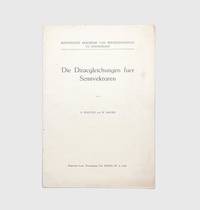
1933180322Amsterdam: Koninklijke Akademie van Wetenschappen 1933. First edition offprint issue of the second of Einstein and Mayer's four classic papers on semi-vectors in which they aimed to incorporate the Dirac equation into the general theory of relativity. "By introducing semi-vectors Einstein wanted to arrive at a mathematically simpler and more general formulation of spinors. The semi-vector generalization of the Dirac equation was thought to give a unified description of charged elementary particles in particular of the electron and proton. In their second semi-vector paper Einstein and Mayer were on the lookout for the most general Dirac system possible for the semivector" Van Dongen pp. 103-11. Large octavo pp. 20. Original cream wrappers front wrapper printed in black. Wire-stitching sometime removed front wrappers lightly soiled: a very good copy. Boni 222; Weil 191. Jeroen van Dongen Einstein's Unification 2010. unknown
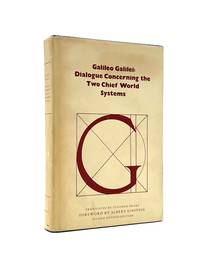
1968689Berkeley and Los Angeles: University of California Press 1968. Second Revised Edition Thus. Publisher's Blue Cloth Gilt Detailing. Near Fine/Very Good. A Near Fine Book in a Very Good or Better Dust Jacket Unclipped $15.00. Book is lightly shelf worn and sunned to extremities. Text block is a bit toned and soiled especially to top edge. Text is unmarked. Binding is tight and square. Dust Jacket is lightly shelf worn to extremities. Jacket is generally and variously toned from sunning. A few marks and scuffs present. Hardcover. Octavo. xxviii 5 6-496pp. . University of California Press unknown
1953040592Berkeley and Los Angeles CA: University of California Press 1953. Book. Near Fine. Original Cloth. First Thus. 8vo - over 7¾" - 9¾" tall. Dark mauve cloth paper title label mounted on upper spine panel. Slight binding lean text block edges a bit toned by age. Dust jacket a bit toned along spine panel with 1" closed tear at head of front joint light shelf wear now in mylar. xxvii496 pp. Einstein's foreword in German with facing-page translation into English. University of California Press Hardcover
1953048358BERKELEY CA.: UNIVERSITY OF CALIFORNIA PRESS. SMALL CHIP TO THE DJ CLEAN UNMARKED COPY! . VG. Hardcover. First Edition. 1953. UNIVERSITY OF CALIFORNIA PRESS hardcover
1953019091University of California Press Berkeley / Los Angeles. First Printing. Clipped DJ in archival cover edge wear. . Fine. Hardcover. 1st Edition. 1953. University of California Press, Berkeley / Los Angeles hardcover
1953biblio37528<p>University of California Berkeley 1953. XXVII496 pages. Fine Hardcover in VeryGood DJ. DarkRed cloth Bookplate with spine title. No Wear. Clean Unmarked throughout Excellent binding and hinges. The DJ got light edge wear. 9.5"x6.25"x1.6". be46009.</p> University of California hardcover
1939240København: J.H. Schultz Forlag 1939. Hardcover. Very Good. Half bound leather and marbled paper boards. Boards rubbed and discolored spine faded. Small tear at bottom edge of half title and title page. Small yellow stain at top corner of page 287 and the following page. J.H. Schultz Forlag hardcover
1941433111941. Offprint from Universidad Nacional de Tucuman Revista Serie A 2 1941. 11-15pp. 270 x 179 mm. Original printed wrappers. Very good. "Address to joint meeting of the American Physics Society and the American Association of Physics Teachers Princeton Dec. 29 1941 under the title: 'Solutions of finite mass of the gravitational equations'" Weil. Weil Albert Einstein Bibliography 208. unknown
194146476Tucuman Argentina 1941. Royal8vo. Orig. printed wrappers. Offprint from "Revista. Universidad Nacional de Tucuman" Series A Matematicas y Fisica Teorica Vol. 2 Diciembre de 1941 Nos 1 y 2. Pp. 11-15. Fine and clean. This copy has belonged to Abraham Pais 1918-2000 - the famous Einstein scholar theoretical physicist and Einsteins collegue at Princeton - and having his name on top of the frontwrapper "A Pais" <br/><br/><em>First edition of a scarce paper in the offprint version. The paper "represents the basis of the one written by the same author in collaboration with Wolfgang Pauli in 1943 in which by following analogous lines the proof of the non-existence of regular particle-type solutions was generalized to the case of cilyndrical geometries in Kaluza-Klein theory Einstein & Pauli 1943. Besides other generalizations were subsequently presented. The non-existence of such solutions in classical unified field theory was undoubtedly an important criterion leading Einstein's investigations."Galvagno and Giribet."In his search for a unified field theory that could undercut quantum mechanics Einstein considered five-dimensional classical Kaluza-Klein theory. He studied this theory most intensively during the years 1938-1943. One of his primary objectives was finding a non-singular particle solution. In the full theory this search got frustrated and in the x5-independent theory Einstein together with Pauli argued it would be impossible to find these structures." Jeroen van Dongen.Weil: 208. - Boni: 243. </em> unknown
194146477Tucuman Argentina 1941. Royal8vo. Orig. printed wrappers. Offprint from "Revista. Universidad Nacional de Tucuman" Series A Matematicas y Fisica Teorica Vol. 2 Diciembre de 1941 Nos 1 y 2. Pp. 11-15. Fine and clean. <br/><br/><em>First edition of a scarce paper in the offprint version. The paper "represents the basis of the one written by the same author in collaboration with Wolfgang Pauli in 1943 in which by following analogous lines the proof of the non-existence of regular particle-type solutions was generalized to the case of cilyndrical geometries in Kaluza-Klein theory Einstein & Pauli 1943. Besides other generalizations were subsequently presented. The non-existence of such solutions in classical unified field theory was undoubtedly an important criterion leading Einstein's investigations."Galvagno and Giribet."In his search for a unified field theory that could undercut quantum mechanics Einstein considered five-dimensional classical Kaluza-Klein theory. He studied this theory most intensively during the years 1938-1943. One of his primary objectives was finding a non-singular particle solution. In the full theory this search got frustrated and in the x5-independent theory Einstein together with Pauli argued it would be impossible to find these structures." Jeroen van Dongen.Weil: 208. - Boni: 243. </em> unknown