335 résultats
1987C0718OECD OCDE 1987. Softcover. Neuf. Broché 23x16cm 399 pages. . Livre à l'état neuf n'a jamais été lu. . Pour l'UE envoi depuis la France sans frais ou taxe douanière ou TVA. OECD, OCDE paperback
Z1-T-013-01028Organization for Economic. Used - Good. Ships from UK in 48 hours or less usually same day. Your purchase helps support Sri Lankan Children's Charity 'The Rainbow Centre'. Ex-library so some stamps and wear and may have sticker on cover but in good overall condition. 100% money back guarantee. We are a world class secondhand bookstore based in Hertfordshire United Kingdom and specialize in high quality textbooks across an enormous variety of subjects. We aim to provide a vast range of textbooks rare and collectible books at a great price. Our donations to The Rainbow Centre have helped provide an education and a safe haven to hundreds of children who live in appalling conditions. We provide a 100% money back guarantee and are dedicated to providing our customers with the highest standards of service in the bookselling industry. Organization for Economic unknown
1968Rad0001London: Pergamon Press Ltd. 1968. First Edition. Hardcover. Very Good./Very Good. 1623 p. over two volumes. Cloth. Charts graphs illustrations. With an Index of contributors at the end of Volume II. Pergamon Press, Ltd. hardcover
15306At foot of final page: '1204 WT. 39620. number of copies: 22500 date of publication i.e. July 1955: 7/55 printer: D & G Ltd.'. 39pp. small 4to. Stud-bound in brown card printed wraps. In good condition lightly aged and worn with crease to front cover to which the enamel badge is also attached beside the ownership signature of 'E J Sayer' Downing Street secretary Elizabeth Sayer later Cooper. First page dated in pencil '8th Sept' and pencil note in text of the 'permitted dose' of radiation. At head of front cover: 'ESTACIDVOL Code 5-96-0' and at foot: 'RESTRICTED The information given in this document is not to be communicated either directly or indirectly to the Press or to any person not authorised to receive it.' Printed inside the front cover: 'The accompanying notes have been prepared for your guidance. Additional information is contained in the Home Office Civil Defence Training Manuals which may be obtained on loan through your Instructor.' Divided into the main sections: Civil Defence Organisation; Fire Fighting; High Explosive Missiles; Atomic Warfare; Biological Warfare; Chemical Warfare; Protective Measures. Also present is a full-page 'Civil Defence Report Form'. The first section begins: 'Civil Defence is the responsibility of the Central Government and needs the assistance of Local Authorities Industry and public bodies of many kinds. It includes all measures short of actual combat necessary to mitigate the effects of enemy attack.' The 'Atomic Warfare' section is divided into four subsections: Features of Atomic Explosion; Delayed Radiation Risks; Radiation Sickness; Individual Dosimeter. The enamel badge is roughly 2.5 x 2cm and features red and blue enamel on brass. It consists of a crown topping a circle the latter having an image of a lion surrounded by a blue border with 'I.C.D.S.' The pamphlet is scarce: no copy on OCLC WorldCat and the only copy on COPAC at the Imperial War Museum. At foot of final page: '(1204) WT. 39620. [number of copies:] 22,500 [date of publication, i.e. July 1955:] 7/55 [printer:] D & paperback
0306407310.Ghardcover. Good. Access codes and supplements are not guaranteed with used items. May be an ex-library book. hardcover
1992H-140-969Nova Science Pub Inc 1992. Hardcover. Very Good. Edition 1992. Ammareal gives back up to 15% of this item's net price to charity organizations. Nova Science Pub Inc hardcover
1560720239.Ghardcover. Good. Access codes and supplements are not guaranteed with used items. May be an ex-library book. hardcover
6246Livermore CA: Lawrence Radiation Lab n.d. good. 1 photo color photo approx. 19-3/4" x 15" mounted on board approx. 24-1/4" x 20" Lawrence Radiation Lab unknown
196411228Livermore CA: Lawrence Radiation Laboratory c. 1964. Presumed first iteration thus. Photograph. good. 1 photo color photo approx. 20" x 16" mounted on board 24" x 20" some soiling to board and some wear along edges. Peaceful nuclear explosions PNEs are nuclear explosions conducted for non-military purposes such as activities related to economic development including the creation of canals. During the 1960s and 1970s both the United States and the Soviet Union conducted a number of PNEs. Six of the explosions by the Soviet Union are considered to have been of an applied nature not just tests. Subsequently the United States and the Soviet Union halted their programs. Definitions and limits are covered in the Peaceful Nuclear Explosions Treaty of 1976. In the PNE Treaty the signatories agreed: not to carry out any individual nuclear explosions having a yield exceeding 150 kilotons; not to carry out any group explosion consisting of a number of individual explosions having an aggregate yield exceeding 1500 kilotons; and not to carry out any group explosion having an aggregate yield exceeding 150 kilotons unless the individual explosions in the group could be identified and measured by agreed verification procedures. The parties also reaffirmed their obligations to comply fully with the Limited Test Ban Treaty of 1963. The parties reserve the right to carry out nuclear explosions for peaceful purposes in the territory of another country if requested to do so but only in full compliance with the yield limitations and other provisions of the PNE Treaty and in accord with the Non-Proliferation Treaty. The Comprehensive Nuclear-Test-Ban Treaty of 1996 prohibits all nuclear explosions regardless of whether they are for peaceful purposes or not. Project Gasbuggy was an underground nuclear detonation carried out by the United States Atomic Energy Commission on December 10 1967 in rural northern New Mexico. It was part of Operation Plowshare a program designed to find peaceful uses for nuclear explosions. Gasbuggy was carried out by the Lawrence Radiation Laboratory and the El Paso Natural Gas Company with funding from the Atomic Energy Commission. Its purpose was to determine if nuclear explosions could be useful in fracturing rock formations for natural gas extraction. The site lying in the Carson National Forest is approximately 34 km 21 mi southwest of Dulce New Mexico and 87 km 54 mi east of Farmington and was chosen because natural gas deposits were known to be held in sandstone beneath Leandro Canyon. A 29 kt 120 TJ device was placed at a depth of 1288 m 4227 ft underground then the well was backfilled before the device was detonated; a crowd had gathered to watch the detonation from atop a nearby butte. The detonation took place after a couple of delays the last one caused by a breakdown of the explosive refrigeration system. The detonation produced a rubble chimney that was 24 m 80 ft wide and 102 m 335 ft high above the blast center. After an initial surface cleanup effort the site sat idle for over a decade. A later surface cleanup effort primarily tackled leftover toxic materials. In 1978 a marker monument was installed at the Surface Ground Zero SGZ point that provided basic explanation of the historic test. Below the main plaque lies another which indicates that no drilling or digging is allowed without government permission. The site is publicly accessible via the Carson National Forest F.S. 357 dirt road/Indian J10 that leads into the Carson National Forest. Following the Project Gasbuggy test two subsequent nuclear explosion fracturing experiments were conducted in western Colorado in an effort to refine the technique. They were Project Rulison in 1969 and Project Rio Blanco in 1973. In both cases the gas radioactivity was still seen as too high and in the last case the triple-blast rubble chimney structures disappointed the design engineers. Soon after that test the ~ 15-year Project Plowshare program funding dried up. These early fracturing tests were later superseded by hydraulic fracturing fracking technologies. Lawrence Radiation Laboratory unknown
19642091202133001949Chiku ma shobo 1964. Soft Cover. Fine. Number of books: 1 Chiku ma shobo paperback
196982559Sandia Base Albuquerque New Mexico: Defense Atomic Support Agency Field Command Nuclear Training Directorate 1969. Presumed First Edition First printing thus. Wraps. Good. Three-hole punched and stapled at left side. iv 22 pages. Illustrated front cover. Illustrations. Cover has some wear. The Table of Contents has an introduction and sections on: Pershing Organization Characteristics Pershing Missile Ground Support Equipment Trajectory Theory Flight Sequence and Summary. The fifteen illustrations are: Pershing 1a System Missile Structures Battery Control Central Erector-Launcher and M757 Tractor Programer-Test Station and Power Station Vehicle Radio Terminal Set AN/TRC-80 Missile Section Containers Pershing Trajectory First-Stage Ignition Coast Period First-State Separation and Second-Stage Ignition Thrust Termination and Warhead Separation Case Venting Warhead Reentry and Detonation. In order to improve Pershing's performance in the quick reaction alert role Pershing 1a was developed. Ground support equipment was designed for maximum tactical and strategic mobility electronic computation of firing data and automatic test and checkout equipment. The Pershing 1a also had a specially designed communications set that allowed extremely reliable communications over great distances 99.9-percent reliability at 160 kilometers. This publication was intended for home study and reference by students attending the Nuclear Weapons Maintenance Course Army Weapons Division Nuclear Training Directorate Field Command. An understanding of the facts herein was deemed essential for the proper comprehension of classroom instruction in these courses. 1964 a series of operational tests and follow-on tests were performed to determine Pershing reliability. The Secretary of Defense then requested that the Army define the modifications required to make Pershing suitable for the Quick Reaction Alert QRA role. The Pershing 1a development program was approved in 1965 the original Pershing renamed to Pershing 1 and Martin Marietta received the Pershing 1a production contract in 1967. Project SWAP replaced all the Pershing equipment in Germany by mid-1970 and the first units quickly achieved QRA status. Secretary of Defense Robert McNamara directed that the U.S. Air Force's MGM-13 Mace missile would be replaced by the Pershing 1a in 1965. Pershing 1a was a Quick Reaction Alert system and so had faster vehicles launch times and newer electronics. The total number of launchers increased from 8 to 36 per battalion. Production of the Pershing 1a missile ended in 1975 and reopened in 1977 to replace missiles expended in training. Pershing 1a was further improved in 1971 with the Pershing Missile and Power Station Development Program. A total of 754 MGM-31A missiles were built. Defense Atomic Support Agency, Field Command, Nuclear Training Directorate paperback
197464132Portland OR: Portland General Electric Company 1974-1979. Two vols. hick 4to. 11.25 x 11.75 x 3.25 in. Approx. 1200 leaves sections variously numbered. w/ thumb tab sections printed affixed at fore-edges w/ over 100 maps many large folding most colour folding charts graphs diagrams; large folding site map in vol. 2. Original green vinyl 3-ring binders black lettering stamped on front covers & spines occasional interior age toning shelfwear rubbing still a VG set from the library of Dr. Clive F. “Rick†Kienle 1942-2025 geologist and specialist in aerial photo mapping . First edition of this very scarce original safety analyses reports for Portland General Electric’s pair of nuclear power plants to have been constructed at Pebble Springs in Gilliam County Oregon as part of a group with the proposed Trojan Nuclear Power plant licensed to run beginning in 1976 at 1100 Megawatts. These nuclear power plants had been proposed and begun development soon after construction began at the Trojan Nuclear Power Plant and by 1979 over $ 250 million had been spent by the State of Oregon and PGE on development costs. The two reactors would have been located 3 miles southeast of the Columbia River would have consisted of a Nuclear Steam System for each plant with a Reactor Coolant System supplied by Babcock & Wilcox square lattice reactor cores and abundant auxiliary systems. These reports include a myriad of updates carried out during the regulatory review of the project and the preliminary development work but after passage in 1980 of Ballot Measure 7 by Oregon voters no nuclear power plants could be considered for construction unless there was a Federal high-level waste repository and approval by Oregon voters. Several nuclear power plants had been proposed and received geotechnical studies in the Pacific Northwest following up the Trojan Nuclear Power Plant constructed upon the site of the former Trojan Powder Co. plant site as well as adjacent properties beginning in 1967. Pitched to PGE as a means to solve the exploding power usage demand in the fast-growing Portland OR area in the Mid-20th-Century by Admiral Lewis Strauss of the Atomic Energy Commission PGE and 13 other utilities began planning in 1967 and construction began July 30 1968. PGE chose to build a pressurized water reactor plant and the enormous plant and huge construction cost were projected at the time to be cheaper than coal-fired power plants to supplement the massive hydropower presence in the PNW. Oregon Governor Tom McCall established the first Nuclear Siting Task Force of the Nuclear Development Coordinating Committee in 1969 in order to approve location of nuclear power plants consistent with Oregon’s environmental protections as well as comply with the forthcoming Clean Air Act passed in 1970. Should be noted that the original Pebble Springs site is now the location of a massive 99 Megawatt Wind Farm. Worldcat locates 4 copies of similar reports divided into more volumes - Multnomah County PSU UO WA State Lib; See: Timeline of Oregon’s Energy History Oregon Department of Energy 2026; McTeague Renewable Energy Not Nuclear is the Oregon Way Oregon Capital Chronicle March 26 2026. Portland General Electric Company, unknown
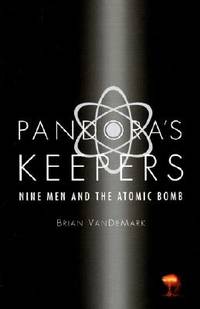
2003002858New York NY U.S.A.: Little Brown & Company 2003. 399pp. Development of atomic bomb. Book was removed from stores. Clean. 1st Printing. Hard Cover. As New/As New. 8vo - over 7¾" - 9¾" tall. Little Brown & Company hardcover
198706450Washington D.C.: U.S. Department of Energy 1987. First Edition. Paperback. Good/No dust jacket. 11.0 x 8.7 x 0.8 inches. Report providing information concerning the Soviet designed water-cooled water-moderated energy reactor the VVER. Contains technical schematics and details in English on the operation of soviet energy reactors. Very rare text in Good condition. Red plain wrap The covers look great with only light edge wear and a split repaired at the bottom of the front hinge. Hint of wrinkling to front cover. A few small specs and faint staining to top edge of text block. The binding is tight. The interior pages are clean and unmarked. Electronic delivery tracking will be issued free of charge. U.S. Department of Energy paperback
a1026701952 first edition. US Atmospheric Nuclear Weapons Tests. DNA 6019F. 216p. some photo illus and charts. 4to wraps. LIght non-circulating depository library stamps on cover no pocket no spine numbers no bookplate Text clean; VG. . paperback
a1026671951 first edition. US Atmospheric Nuclear Weapons Tests. DNA 6022F. 4to wraps.180P. LIght non-circulating depository library stamps on cover no pocket no spine numbers no bookplate Text clean; VG. . paperback
a1026711951 first edition. US Atmospheric Nuclear Weapons Tests. DNA 6023F. 188p. some photo illus and charts. 4to wraps. LIght non-circulating depository library stamps on cover no pocket no spine numbers no bookplate Text clean; VG. . paperback
1958705885PN. New. 1958. Soft Cover. Date is original print. This is a reprint edition. . PN paperback
1958705886PN. New. 1958. Soft Cover. Date is original print. This is a reprint edition. . PN paperback
1958705913PN. New. 1958. Soft Cover. Date is original print. This is a reprint edition. . PN paperback
1958705979PN. New. 1958. Soft Cover. Date is original print. This is a reprint edition. . PN paperback
198234288Washington DC Defense Nuclear Agency 1982 paperback. United States Atmospheric Nuclear Weapons Tests Nuclear Test Personnel Review. -- This report describes the activities of 1000 military and civilian personnel during 19 bomb tests 15 above ground at the Nevada Test Site in 1958. Radiation exposures are on tables and include also journalists and contractors. Map included. -- Softcover 240 pages 8.5x11inches. Condition: very good cover little soiled. Defense Nuclear Agency paperback
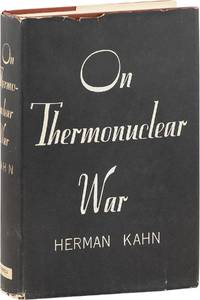
196085542Princeton New Jersey: Princeton University Press 1960. First Edition. Octavo. 24cm. Publisher's terracotta cloth titled and ruled in black and gilt to spine. Dustjacket. xx; 651pp. Very light wear and bumping to spine ends and extremities strong and bright; internally clean and fresh; in a grey dustjacket with some minor edgewear and shallow chipping to the spine ends and edges a hint of toning to the spine panel and some light soiling and wear to the white rear panel. A very good handsome copy indeed.<br /> <br /> Kahn's deeply influential analysis of the spectre of thermonuclear war partly intended as a counterpoint to von Neumann's apocalyptic concept of MAD or Mutually Assured Destruction. Kahn posits the strategic possibility of a 'winnable' nuclear conflict questions the solidity of a peace structure based on thermonuclear threat and makes the highly controversial for the time suggestion that the spectre of thermonuclear conflict itself isn't actually that terrifying and that the spectre of it is really what most people get worked up about. Kahn is an analytical strategist his conclusions are based in a zone in which emotion only plays the smallest part and upon publication the book elicited some powerful reactions from readers uncomfortable with the potential at the time inevitable deaths of millions being presented in the form of graphs and calm inexorable strategic detachment. Hubert Humphrey's contemporary review of the work stated "New thoughts particularly those which contradict current assumptions are always painful for the human mind to contemplate. On Thermonuclear War is filled with such thoughts."<br /> <br /> Perhaps as inevitable antidote to the grimly sardonic nature of his analysis Kahn's work earned him a place in the eternal halls of pop culture being the impromptu scriptwriter for the character of General Buck Turgidson in "Dr. Strangelove" and with popular understanding of his theories featuring prominently in fiction from Tom Clancy to "Wargames." Kahn is also credited with the coining of the phrases "Megadeath" as a unit of fatality and "Wargasm" describing the focus of the military personnel he worked with both of which have seeped into common usage. Kahn's borderline crude delivery combining horrifying statistics with jokes about how women will come to love their two-headed babies was deliberately jarring and intended to be equally disruptive to those locked in fearful uninformed paralysis and those working towards the wargasm. The reception of his book was one of the catalyzing elements that led Kahn to be a co-founder of The Hudson Institute after his work at RAND reached its inevitable close. Regardless of how divisive Kahn was both in theory and delivery "On Thermonuclear War" ranks as one of the most important 20th century works of strategic analysis right down to the title being an updated and expanded nod to von Clausewitz's "On War. Princeton University Press unknown
9264010319.Gpaperback. Good. Access codes and supplements are not guaranteed with used items. May be an ex-library book. paperback
19891561037407GE 1989. 14th Edition. Softcover. New . New Condition minimal wear from storage. Looks great. Multiple copies available this title. Quantity Available: 4. Shipped Weight: Under 1 kilo. Category: Education; Pictures of this item not already displayed here available upon request. Inventory No: 1561037407. . GE paperback