[Académie de la Dombes]Livre Rare Book
Daniel PiconLivre Rare Book
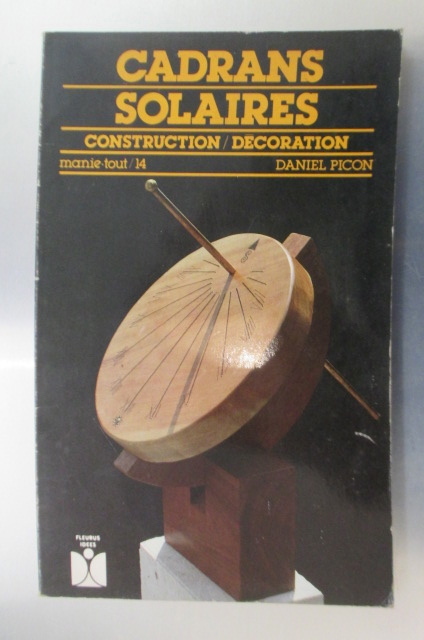
CADRANS SOLAIRES. Construction / Décoration
1988SCI050C115GAR1988 / 78 pages. Broché. Editions Fleurus.
Librairie du Levant · Bayonne, France10,00 €
54 résultats
1989LFA-126748980N° 9 de la Revue de l'Académie de la Dombes "DOMBES" : 40 pages, format 210 x 295 mm, illustrée, brochée, publié en 1989 (traces d'humidité)
1989LFA-126721604N° 17 (1er semestre 1989) : 80 pages, format 210 x 295 mm, illustré, broché, bon état
202403403Paris, Massin, s.d. ; in-4, 64 pp., cartonnage de l'éditeur. Avec jaquette.
201224865Paris, Massin, s.d. ; in-4, 64 pp., cartonnage de l'éditeur. Avec jaquette.
201224723Paris, Massin, s.d. ; in-4, 64 pp., cartonnage de l'éditeur. Avec jaquette.
201224722Paris, Massin, s.d. ; in-4, 64 pp., cartonnage de l'éditeur. Avec jaquette.
201110342, Edittions du queyras, 2003 ; in-4, 176 pp., cartonnage d'éditeur avec jaquette.
1999LFA-126717171N° 4 (1999 - 4e trimestre) : 119 pages, format 185 x 240 mm, illustré, broché, Centre Alpin et Rhodanien d'Ethnologie, bon état
1744D4448France 1744. Hardcover. Very Good. Manuscript book on paper in French. c.1744. 8vo 166 x 106mm. 8 355pp. written in brown ink in a clear humanist script with some calligraphic aspects between framed pages in a single column of approximately 28 lines headings in Roman majuscules. With 89 full-page diagrams and technical illustrations of sundial construction and usage and other supporting images three are on plates and two of which are folding at rear. Contemporary mottled calf spine gilt in compartments labeled Gnomonique on gilt red morocco lettering piece marbled endpapers & edges; edges uniformly toned occasional stains; expertly rebacked preserving the original spine somewhat worn. Full contents listed on first 6 pages for this expertly executed and comprehensive compendium on the sundial. The objective of this manual is to enable the 18th century audience to understand the operating principle of sundials by describing the construction and manipulation of different forms of sundials including the planet-sundial moon-clock celestial houses-clock polar-clock ancient Babylonian and Jewish clocks as well as the construction of quadrants and astronomical tables. The suns position in the sky has always been an obvious means to keep track of time. The use of shadows of sticks cast by the sun were a natural means of indicating the time of day by the direction of the shadow and the time of year by its length. Although town squares began constructing clocks beginning somewhere in the 14th century sundials remained in the picture well into the 18th century. Mechanical clocks were expensive and could be found only in the most noble of homes. They were also more of a curiosity at first; most people still used their sundials or just estimated the time of day by the height of the sun in the sky. In 1777 when the French General Lafayette wanted to express his admiration for his ally and friend General George Washington during the American Revolution he chose a silver Explorer sundial as his gift. But by the close of the 18th century clocks and watches began to supersede sundials. They had one huge advantage- they worked all day long and were not dependent on weather. However they were also notoriously unreliable- telling time only approximately within an hour and needing to be reset frequently of course with the help of a sundial. Although the work of this study is anonymous an ownership entry at the foot of the title helps to date the work: Hic est Thorridon Rectoris Laurentii Moussault 1744. This wide-ranging study of the sundial appears at a time when the mechanical clock was on its way into popular fashion. A unique scholarly work that may well be one of the last close studies of such an ancient and important time-telling tool. <br/><br/> hardcover
2011LFA-126721767Une revue de 64 pages, format 210 x 297 mm, brochée couverture couleurs, illustrée, n° 13, bon état
1990LFA-126719504XCIe année - 3e Trimestre 1990 : 152 pages, format 185 x 230 mm, broché, illustré, bon état
2002LFA-126712175Un ouvrage de 132pages, format 195 x 240 mm, illustré, broché couverture couleurs, publié en 2002, C.N.R.S. Editions, bon état
19217broché - 15x21 - 62pp - ACS - SANS DATE
112440aafGenova, Sagep, 1981, gr. in-8vo, 274 S., (petit tache sur feuille de garde), envoi de l’auteur, cartonnage original.
1988SCI050C115GAR1988 / 78 pages. Broché. Editions Fleurus.
198453262AB[Rockenhausen], Knut Deutschle / Kaiserslautern, Heimatstelle Pfalz, (1984). 8° (20x21), 136 S., mit zahlr. fotograf Aufnahmen, graph. Darst., Faksimiles, ill OPbd, minimal berieben, fest sauber und gepflegt, [= Uhren der Pfalz; 1 : herausgegeben von der Uhrenstube Rockenhausen / Beiträge zur pfälzischen Volkskunde; 1],
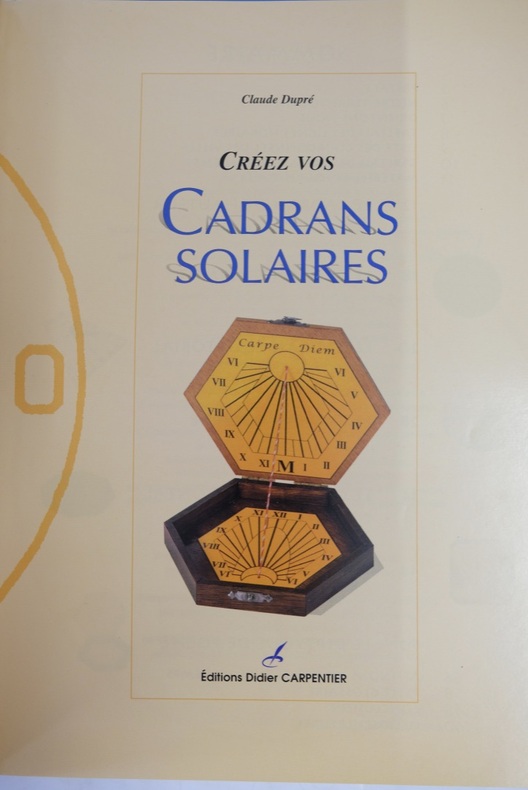
1998SCI621M1998, Didier Carpentier. In-4, relié, 61pp. Nombreuses illustrations
15823Paris, La Renaissance du Livre, 1927, 1 br., couverture illustrée., déchirure au dos. in-8 de 226 pp. ;
118565aafPayot, Lausanne, 1987, gr. in-8vo, 120 p., ill. brochure originale illustrée.
134086aafPayot, Lausanne, 1987, gr. in-8vo, 120 p., ill. envoi ms. par l’auteur sur faux-titre pour Fr. Deppieraz, brochure originale illustrée.
français In-8 de x-(2)-460 pp. + 5 pl. depl. h.t.; basane mouchetée muette (reliure de l'époque ou lég. postérieure). L'illustration comprend 10 figures gravées. 2 infimes manques de cuir à la reliure. Bel exemplaire.
19978806Cnrs 1997 Edition de 1993 In-8 broché, couvertures illustrées, 223 pp, 109 cadrans solaires de Paris, classés par arrondt; nombreuses Illustrations en noir.
1993203998Couverture souple. Broché. 223 pages.
673CNRS , bon état , 1997 , 223 p , 23 x 19 cm ,
198729688ABSigmaringen, Jan Thorbecke Verlag, 1987. 4° (24x17)), 144 S., mit 50 teils farb Abb. im Tafelteil, Oln mit OU 2., durchgesehene Aufl. nahezu ungelesen, schönes gepflegtes Exemplar,