Bennett, Dwight (D B Newton)Biblio.com

11 838 résultats
197722362Garden City: Doubleday & Company. Fine in Fine dust jacket. 1977. First Edition; First Printing. Hardcover. 0385121512 . Signed by Bennett on the title page. ; 8vo 8" - 9" tall; 180 pages; Signed by Author . Doubleday & Company hardcover
2021x-0367785595Routledge 2021. Paperback. New. reprint edition. 351 pages. 9.00x6.00x0.75 inches. Routledge paperback
2019__1138064432Routledge 2019. Hardcover. New. 320 pages. 9.25x6.25x1.00 inches. Routledge hardcover
1926031221Boston: Christopher Publishing House 1926. Book. Very Good. Hardcover. 1st Edition. 8vo - over 7¾ - 9¾" tall. First printing no additional printings listed. 58 pp. Moderate wear to the extremities. Otherwise fine. The dust jacket is stained rubbed and edgeworn. In Brodart archival dust jacket protector. Christopher Publishing House Hardcover
8420031798.Gpaperback. Good. Access codes and supplements are not guaranteed with used items. May be an ex-library book. paperback
2022__1470652455Alfred Pub Co 2022. Paperback. New. 999 pages. 12.48x9.65x0.79 inches. Alfred Pub Co paperback
2022__1470652412Alfred Pub Co 2022. Paperback. New. 999 pages. 12.17x9.41x1.22 inches. Alfred Pub Co paperback
1016998538.Ghardcover. Good. Access codes and supplements are not guaranteed with used items. May be an ex-library book. hardcover
1949Alibris.00422681949. Trade paperback. Good. some cover wear crease on front cover inscription on title page 5-inch tear on page 19/20 transparent tape on pages 22-23 26-27 near spine keeping pages from becoming disbound small edge tears on page 25/26. 48 p. Includes illustrations. paperback
026691215X.Ghardcover. Good. Access codes and supplements are not guaranteed with used items. May be an ex-library book. hardcover
1360562354.Gpaperback. Good. Access codes and supplements are not guaranteed with used items. May be an ex-library book. paperback
1017454221.Ghardcover. Good. Access codes and supplements are not guaranteed with used items. May be an ex-library book. hardcover
1163836729.Ghardcover. Good. Access codes and supplements are not guaranteed with used items. May be an ex-library book. hardcover
0548524629.Ghardcover. Good. Access codes and supplements are not guaranteed with used items. May be an ex-library book. hardcover
1951012062Washington: Government Printing Office 1951. Quarter-inch piece torn from spine top. On the title page: "Federal Security Agency Public Health Service National Institutes of Health. First Edition. Original Printed Wrappers. Very Good. Government Printing Office Paperback
978658671\'9789BAZAR DO TEMPO. new. Os golpes de Estado t�m marcado a hist��ria da Ǹpoca moderna aos dias atuais como mostra o fil��sofo Newton Bignotto neste novo livro um instigante panorama das teorias que ao longo do tempo investigaram a natureza e o significado dos atos radicais que interrompem o curso normal do poder pol�tico regido por leis ou costumes consolidados. Mais uma vez a anǭlise de Bignotto autor de O Brasil �� procura da democracia 2020 recorre �� hist��ria das ideias para tentar compreender fen�menos contempor�neos e iluminar o entendimento sobre quest��es pol�ticas fundamentais. Como ele bem observa a no��o de golpe de Estado Ǹ hoje t�o popular quanto mal compreendida. Este percurso hist��rico filos��fico e pol�tico tem em foco diversos autores situados em suas Ǹpocas e em face dos acontecimentos que os motivaram a escrever mostrando como a leitura desses argumentos nos permite estabelecer diǭlogos e reflex��es desde o nosso tempo. O golpe de Estado Ǹ afinal uma ideia � e n�o apenas � �� espreita. BAZAR DO TEMPO unknown
9786585984157-11-124942BAZAR DO TEMPO. New. BAZAR DO TEMPO unknown
1968EB-PB-10-1004<p>Doctor Sex by Bill Newton</p> PEC Books 1133 paperback
0952827719.Gpaperback. Good. Access codes and supplements are not guaranteed with used items. May be an ex-library book. paperback
2019x-3030055590Springer Verlag 2019. Hardcover. New. 416 pages. 9.25x6.10x1.06 inches. Springer Verlag hardcover
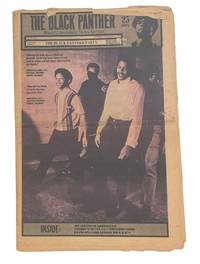
1969232101969. Black Panther PartyBlack Radicalism Newton Huey P. The Black Panther Vol. IV no. 4 issued December 27 1969 a vital organ of the Party disseminating coverage of police violence legal defense political education prison solidarity and community survival work in the immediate aftermath of the killings of Fred Hampton and Mark Clark. Rather than isolating those killings as a single event the issue contextualizes their deaths among wider U.S. racial repression providing investigative reporting along with chapter listings speeches and local programming demonstrating how the organization moved information across local branches and a national readership. The result is a concentrated record of Black Panther Party print strategy at the end of 1969 when the paper served both as a news organ and as an instrument of coordination.<br /> The Black Panther. Vol. IV No. 4. San Francisco CA: The Black Panther Party December 27 1969. Folio newsprint issue. Masthead reads "Black Community News Service" priced at 25 cents and marked "Published Weekly." The cover carries a large photograph beneath quotations from political prisoners in Denver with interior contents announced as "No Justice in Amerikka" "Statement to the P.R.G. of S.V. from Eldridge Cleaver" and "David Hilliard Speaks on B.S.U.'s." Interior pages shown here include "L.A. Pigs Condemn Peoples' Office" "Bill Green on the Condemning of L.A. Panther Office" "Political Prisoner Speaks to GIs" "Breakfast for School Children Programs" a substantial "List of Chapters and Branches of the Black Panther Party" "Speech by Charles Garry at Benefit in his behalf Dec. 19 1969" "Seize the Time" "What is There to Investigate" "Lived a Revolutionary Died a Revolutionary" on Mark Clark "Black Representatives Investigate Government Conspiracy" "Huey's Appeal" Part 16 "Pig An International Language" Eldridge Cleaver's statement at the Embassy of the P.R.G. of South Vietnam and David Hilliard's "Farewell and Criticism of Earl." The issue directly addresses the killings of Hampton and Clark and the Party's insistence that those deaths be understood as the direct result of state surveillance and persecution in response organized Black political resistance. Cleaver's statement extends that political frame outward into an international anti imperial context.<br /> Published only weeks after Hampton and Clark were executed by the Chicago Police in a raid coordinated wit the FBI this issue preserves the Party's response of mourning investigation and mobilization while continuing to publicize its community outreach breakfast programs campus activity chapter structure and legal advocacy. Overall good to very good with minor marginal losses not affecting text moderate toning small chips and short edge tears and handling wear consistent with circulated newsprint of this age. The combination of Hampton and Clark coverage Cleaver's statement and the printed national branch list makes this issue a precise record of how the Black Panther Party used its newspaper to connect local violence national organization and international politics within a single weekly publication. unknown
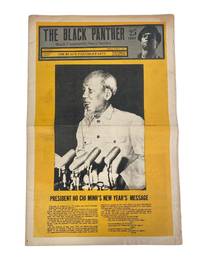
1969232001969. Black Panther PartyBlack Radicalism Newton Huey P. ed. The Black Panther March 3 1969 issue of the Black radical newspaper a periodical linking international antiwar solidarity prisoner defense labor boycott campaigns branch reporting and local documentation of police violence. Rather than concentrating on a single event this issue shows the paper functioning across several fronts at once: the cover prints "President Ho Chi Minh's New Year's Message" interior pages announce a "Free Huey Birthday Rally in Kansas City" advocate a "California Wine Boycott" carry branch news under "San Diego Branch Reports" and frame police abuse through "Pig Harassment" and "Harassment of Blacks in Sacramento White Front Store." The result is a clear record of how Black Panther print culture operated in early 1969 as an instrument of coordination instruction agitation and ideological alignment within the wider Black Power movement.<br /> The Black Panther. Vol. II No. 24. San Francisco CA: The Black Panther Party Monday March 3 1969. Large newspaper format with pagination visible through page 7 in the supplied photographs. Front page features a large photographic portrait of Ho Chi Minh above a printed text block beginning "Following is President Ho Chi Minh's New Year's message" paired with the line "For Independence for Freedom Let's fight so the Yanks quit and the puppets topple." Other visible contents include "The Genius of Huey Newton" "Editorial. Nation Celebrates Huey's Birthday" "Message from Huey" "Honoring Brother Malcolm" "Berkeley Benefit Rally" "Cultural Nationalism" "Puppet Hayakawa V.S. Bootlicker Willie Brown" "Black Man Stands Off 5" "Workers Continue Strike in Defiance of Tyranny" "Washington / Moscow Collaboration Intensified" and "Black Women and the Revolution." The photographed interior also preserves period advertisements and graphics including a "Gramma Books" advertisement for "Complete Marxist Works" and a hand-captioned rally image reading "A Sold Session at the Harambee."<br /> Issued weeks after Richard Nixon's inauguration and during the intensification of both the Vietnam War and the national campaign to free Huey P. Newton this number places the Panthers' local and national work within an openly international revolutionary frame. Its juxtaposition of Ho Chi Minh farmworker boycott coverage campus confrontation Sacramento police harassment and women's political writing shows the newspaper organizing readers across anti-imperial labor educational and community defense struggles rather than addressing them as separate subjects. Folded as issued with horizontal center crease light to moderate toning. Overall very good condition. A strong single issue for documenting the Black Panther Party's newspaper as an operational organ of movement politics in early 1969. unknown
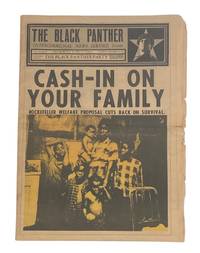
1971232081971. Black Panther PartyBlack Radicalism Newton Huey P. The Black Panther December 11 1971 issue the organ by which the Black Panther Party reported on race and class struggle including welfare policy police violenceand public health. Rather than isolating these matters as separate news issues the paper presents them as interlocking struggles. Front page attacks the Rockefeller welfare proposal under the headline "Cash In On Your Family" while interior coverage follows the death of Mark Allen in police custody raids and prosecutions tied to narcotics policing the continuing trial of Huey P. Newton and the operation of the Mark Clark People's Free Medical Clinic. The newspaper was a central tool used by the group to circulate political analysis mobilize support document repression and publicize aid programs.<br /> The Black Panther. Vol. VII No. 36. Saturday December 11 1971. San Francisco CA. Newspaper. The masthead reads The Black Panther Intercommunal News Service priced at 25 cents with copyright credited to "Huey P. Newton" and publication identified as "Published Weekly by The Black Panther Party." Front page headline "Cash In On Your Family" with subhead "Rockefeller Welfare Proposal Cuts Back On Survival"; "The Hanging Of Mark Allen"; "L.A.P.D. Annual Pre-Holiday Assault"; "Coke Raids"; "Another Vet Wounded At 'Home'" alongside a large notice for "The Third Trial Of Huey P. Newton Servant Of The People Has Begun"; pages 7-8 "From The People"; and page 9 "'Brotherly Love' Can Kill You" an article on the Mark Clark People's Free Medical Clinic in Philadelphia. The issue is illustrated throughout with halftone photographs of families damaged buildings bullet-marked walls defendants and community members and clinic-related imagery all reinforcing the paper's documentary and agitational function.<br /> By December 1971 The Black Panther had become one of the central print organs of the Black Power era operating as an important communications structure through which the Party could disseminate information on policing welfare restructuring imprisonment and medical care as intersecting fronts of the same political ideology. The issue presents failures of state power through coroners police courts and narcotics enforcement and the community response of legal mobilization political education and free health service. Minor losses at the margins not affecting text; wear and toning consistent with circulated newsprint of this age; overall very good condition. A strong single-issue example of the Black Panther Party's use of print to coordinate analysis publicity and community defense across multiple fronts of struggle. unknown
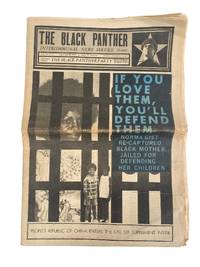
1971232041971. Black Panther PartyBlack Radicalism Newton Huey P. The Black Panther November 29 1971 issue a vital organ of the Black Panther Party for political communication across prison defense campaigns anti-police brutality reporting Black military dissent community mobilization and international political education. The cover story on Norma Gist a Black mother jailed after defending her children from racist violence in Idabel Oklahoma is paired with interior coverage of Frank Nubin Black GI organizing at Fort Hood the imprisonment of Hugo Pinell racist electoral intimidation in Houston and a rear-page "Survival Week" broadside for Chicago events featuring Bobby Seale Bob Rush and Charles Koen. Rather than functioning only as a news weekly this issue shows the Party press coordinating solidarity across local cases prison activism military resistance electoral struggle and survival-program organizing while also linking domestic Black liberation politics to global realignment through the front-page notice on the People's Republic of China entering the United Nations.<br /> The Black Panther. Vol. VII No. 14. San Francisco CA: The Black Panther Party Monday November 29 1971. Supplement present. Front page printed in black and blue with large headline "If You Love Them You'll Defend Them" over an image of Norma Gist and her children behind prison bars; masthead reads "The Black Panther Intercommunal News Service" priced at 25 cents with copyright credited to Huey P. Newton. Visible interior contents include "A Potentially Dangerous Man" on Brother Frank Nubin; "We Won't Have a Nier City Council Man" on violence directed at Ovide Duncantell in Houston; "Black GIs Battle on the Home Front" concerning Fort Hood hearings on racism in military justice and promotion; and the two-page article "The Black Panther Party and Hugo Pinell" accompanied by San Quentin imagery and text on prison repression and collective resistance. The final illustrated page is a Chicago "Survival Week" announcement calling for a student strike for survival and a December 4 rally with named speakers Bobby Seale Bob Rush and Charles Koen plus notice of food distribution through the People's Free Medical Center.<br /> By late 1971 Black Panther newspapers had become one of the Party's central mechanisms for binding dispersed campaigns into a readable political structure converting local incidents into shared movement knowledge and directing readers toward defense work rallies and survival programs. This issue makes that process visible in unusually concentrated form: state violence against Black families military racism prison radicalization and community organizing appear not as separate stories but as linked fronts in the same political field while the China supplement places that field within the Party's wider internationalist frame. Closed tears and chipping to front page and folds; handling wear and toning consistent inner pages complete. Overall good condition. A strong single issue for tracing how Black Panther print culture carried information discipline and mobilization across multiple sites of struggle in late 1971. unknown
140945081Oakland & San Francisco: The Black Panther Party 1980. First edition. An extensive collection of 237 numbers in 234 issues Volume 2 Numbers 15-17 are printed in a single volume and Volume 6 Numbers 13 and 14 are as well. Intermittent run spanning from the first volume to the final volume the 20th. Newspaper changed title to The Black Panther Intercommunal News Service on March 13 1971.<p>Contents: Volume 1 Number 6; Vol. 2 Nos. 1-3 5-7 15-17 18 19 21; Vol. 3 Nos. 1 3 6 7 9-12 16 17 19-21 26 27 29 29 sic 31; Vol. 4 Nos. 3 3 sic 4 7 8 8 sic 9 12-15 17 18 18 but 19 20 21 22 22 sic 27 28 28 sic 29; Vol. 5 Nos. 4 12 13 15-18 20-25 27 30; Vol. 6 Nos. 1-6 10 11 13-14 16 18 21 23-30; Vol. 7 Nos. 1 3 8 17 19-27 29 30; Vol. 8 Nos. 1-25 28-30; Vol. 9 Nos. 1 3-8 10 12-15; Vol.10 Nos. 15 18 23 25 27 28 30; Vol. 11 Nos. 12 14 15 21 23 26 29; Vol. 12 Nos. 1 7 12 15 16 30; Vol. 13 Nos. 2 7 11 12 19 20 21 29 30; Vol. 14 Nos. 4 8 11-13 15 17 18 28; Vol. 15 Nos. 3 10-15 26-30 30 sic; Vol.16 Nos. 4 5 8-11 13 18 27-30; Vol. 17 No. 29; Vol. 18 Nos. 1 3-9 11 16-19 22-26 28 29 29 sic; Vols. 19 Nos. 3 5-7 7 sic 8 9; Vol. 20 Nos. 1 3; Extra Saturday October 5th 1968 Unnumbered. <p>A well-preserved and very substantial run of the Black Panther Party's official newspaper with the issues representing a large swath of the paper's content circulation and overall aesthetic. In terms of content Huey Newton was acknowledged as the chief theoretician of the Party and its newspaper though in terms of generating mass-appeal much of the credit goes to Emory Douglas: "Douglas's work on the Black Panther newspaper and for the party was fearless in content and style. He was the party's Revolutionary Artist graphic designer illustrator political cartoonist and the master craftsman of its visual identity. His distinctive illustrations styles cartooning skills and resourceful collage and image recycling made the paper as explosive visually as it was verbally.Part of Douglas's genius was that he used the visually seductive methods of advertising and subverted them into weapons of the revolution. His images served two purposes: to illustrate conditions that made revolution a reasonable response and to construct a visual mythology of power for people who felt powerless and victimized" Durant Sam ed. Black Panther: The Revolutionary Art of Emory Douglas pp.95-96.<p>Contains an over-arching glimpse of the art layout production and content of the newspaper as well as the rise and fall of the Black Panther Party with issues ranging from the earliest days through 1980. Visually stunning and innovative in its design and layout they tell the story of the Black Panthers' struggle fighting racism and institutional violence and oppression. A key publication responsible for shaping African American revolutionary thought in the twentieth century; runs this extensive are very uncommon in commerce. The Black Panther Party unknown