Newton, JohnBiblio.com
14 résultats
167194BRWN1103London: William Fisher 1671. Hardback recent full-calf. Several blank pages to front and rear. 13cm x 8cm. Unpaginated. Binding a little rubbed and worn. Neat annotations to front free end-paper and to top margin of title page. Scarce. 94000. Hard Cover. Good. William Fisher Hardcover
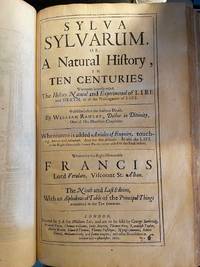
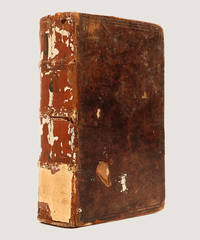
167096655London: William Lee 1670. Ninth edition. Hardcover. Very Good. The Ninth and Last Edition" published in 1670. This edition debuted Francis Bacon"s utopian novel "New Atlantis" tucked away toward the end of the book. Also included for the first time "The History of Natural and Experimental of Life and Death or of the Prolongation of Life." Includes also "an Alphabetical Table of the Principal Things contained in the Ten Centuries." Rebound calf with five raised bands on spine and title in gilt. Very good condition. Light rubbing to edges and one two-inch strip of heavier rubbing along spine. Some leather shedding at this place. Binding is solid. Engraved portrait is present and in fine condition as is the engraved pictorial title on facing page. Some pages have light spotting but the spotting doesn't obscure the text or dominate the page in any way. Most pages are clear and unspotted. The paper is very lightly tanned. It has a crinkle as the pages are turned which is very nice. Overall an excellent copy. From the library of noted California mathematician Charles Greenhall with his ownership signature penciled on the first endpage. On the second endpage there are two inked signatures that look of an era as the book: I Newton and B. Newton. Isaac Newton's signature looks different from this one. Sticker on end pastedown page: Henry Nuss Bookbinder Dallas Texas. 4to. <br/><br/> William Lee hardcover
1654GT1003London: George Hurlock 1654. 1st Edition . Hardback. Vg. 12mo. 8 420pp diagrams 2 folding plates p326 and p387: ill. 12.5cms. Original full calf binding with raised bands. Original owners bookplate Charles Kirk Builder Sleaford. The binding is loose but a rare item in complete state albeit worn. The Kirk family were well known in Sleaford for many generations and the bookplate may have been added at a later date. He possibly inherited the book from his predecessors. Printed by R&W Leybourn for George Hurlock. <br/> <br/> George Hurlock hardcover
169314641Ienae i.e. Jena; Heinr. Chirstoph. Crokeri i.e. Heinrich Christoph Cr�cker d. 1727 1693. 1693. The stated fourth edition and the first recorded edition published in Germany. Octavo pp. 30 864 sig. 8 27 31 A-Z8 2A-2Z8 3A-3H8 with engraved frontispiece plus four folding engraved diagrammatic plates numerous tables within text. Title-page printed in black and red printer's device to centre. Contemporary mottled sheep spine on three bands triple fillet borders in blind to boards; all edges speckled red. Ownership inscription of 'Gottlieb Schuyl' to front paste-down partially obliterated numerous other numerical marks of ownership in ink to the same; inscription to half-title dated 1778 'Pro Coirtu Hradistiensi // Fruim Minor Reformator. // Provicie Hungarie poe // uatoris' i.e. 'For the council of Hradcany minor reformer of the province of Hungary poet of the poets'. Scuffs and gouge to boards brown paint and historic paper shelf label to spine. Lacks preliminary and final blanks text-block and plates collated and complete; loss to third plate affecting one quarter of area see photo; light foxing and some intermittent heavier toning commensurate with the famously poor quality of German paper of the seventeenth century throughout. A fair copy. Newton published this edited and revised edition of the German Bernhardus Varenius' 1622-1650 textbook on the mathematics of geography and navigation for his students at Cambridge in 1672 making this Newton's first publication mere months before the publication of the Opticks. While the English editions were much reprinted in Cambridge and then London this first German edition is scarce outside of continental Europe. Published while Newton was Luasian Professor of Mathematics of Cambridge 1669-1702 Newton's version became the standard text on the subject for over a century. This edition reproduces Newton's Latin text with copies of the plates seen in the earlier Elsevier edition of 1650. While Newton's works were read and received within Germany from their first publication this is the first of his works published in Germany. USTC 2647283. VD17 39:115486D. USTC locates copies multiple copies in Germany one in Norway at Trondheim and three unconfirmed copies without shelf-marks in Sweden; WorldCat locates two in France one in the U. S. University of Connecticut and one in Slovenia; in the UK we locate one copy only at Trinity College Cambridge. Ienae [i.e. Jena]; Heinr. Chirstoph. Crokeri [i.e. Heinrich Christoph Cr�cker (d. 1727)], 1693. hardcover
168118283Cantabrigiæ: Ex Officina Joann. Hayes Sumptibus Henrici Dickinson 1681 1681. Second English edition; the first was published in 1672 also by Hayes. ESTC R9979; Wing V107; Honeyman Sale Catalogue 3029. Edges and hinges repaired; prelims a little foxed; a very good copy. 8vo contemporary panelled calf rebacked raised bands. Five folding plates. Title-page printed in red and black. The celebrated treatise on scientific and comparative geography by the German geographer Bernhardus Varenius 1622-1650 first published in Amsterdam in 1650. It became the standard textbook on the subject for a century. Isaac Newton edited and revised this edition for his students at Cambridge; it was Newton's first published work. Small bookplate of Johann Lawrence on the front paste-down. Cantabrigiæ: Ex Officina Joann. Hayes, Sumptibus Henrici Dickinson, 1681 unknown
168118283Cantabrigiæ: Ex Officina Joann. Hayes Sumptibus Henrici Dickinson 1681 1681. Second English edition; the first was published in 1672 also by Hayes. ESTC R9979; Wing V107; Honeyman Sale Catalogue 3029. Edges and hinges repaired; prelims a little foxed; a very good copy. 8vo contemporary panelled calf rebacked raised bands. Five folding plates. Title-page printed in red and black. ¶ The celebrated treatise on scientific and comparative geography by the German geographer Bernhardus Varenius 1622-1650 first published in Amsterdam in 1650. It became the standard textbook on the subject for a century. Isaac Newton edited and revised this edition for his students at Cambridge; it was Newton's first published work. <br/><br/> Cantabrigiæ: Ex Officina Joann. Hayes, Sumptibus Henrici Dickinson, 1681 unknown books
169745644Leipzig, Grosse & Gleditsch, 1697. 4to. No wrappers. In: ""Acta Eruditorum Anno MDCXCVII"", No V, May-issue. Pp. 193-240 (entire issue offered). With titlepage to the volume 1697. Leibniz: pp. 201-205. Johann Bernoulli: pp. 206-211. Jacob Bernoulli: pp. 211-214. Newton: pp. 223-224. As usual, some leaves with browning.
169745644Leipzig Grosse & Gleditsch 1697. 4to. No wrappers. In: "Acta Eruditorum Anno MDCXCVII" No V May-issue. Pp. 193-240 entire issue offered. With titlepage to the volume 1697. Leibniz: pp. 201-205. Johann Bernoulli: pp. 206-211. Jacob Bernoulli: pp. 211-214. Newton: pp. 223-224. As usual some leaves with browning. <br/><br/><em>First appearance of the famous issue of Acta Eruditorum in which the 4 solutions by the 4 most eminent mathematicians at the time were printed together. There were in all 5 solutions to the posed problem and Newton's solution was first printed in the Philosophical Transactions January 1697 and reprinted here. The solution proposed by L'Hopital not printed here was not published until 1988.The brachistochrone problem was posed by Johann Bernoulli in Acta Eruditorum in June 1696. He introduced the problem as follows: "I Johann Bernoulli address the most brilliant mathematicians in the world. Nothing is more attractive to intelligent people than an honest challenging problem whose possible solution will bestow fame and remain as a lasting monument. Following the example set by Pascal Fermat etc. I hope to gain the gratitude of the whole scientific community by placing before the finest mathematicians of our time a problem which will test their methods and the strength of their intellect. If someone communicates to me the solution of the proposed problem I shall publicly declare him worthy of praise." Johann Bernoulli and Leibniz deliberately tempted Newton with this problem. It is not surprising given the dispute over the calculus that Johann Bernoulli had included these words in his challenge:- ."there are fewer who are likely to solve our excellent problems aye fewer even among the very mathematicians who boast that they. have wonderfully extended its bounds by means of the golden theorems which they thought were known to no one but which in fact had long previously been published by others."According to Newton's biographer Conduitt he solved the problem in an evening after returning home from the Royal Mint. Newton: . "in the midst of the hurry of the great recoinage did not come home till four in the afternoon from the Tower very much tired but did not sleep till he had solved it which was by four in the morning."Newton send his solution to his friend Charles Montague and Montague published anonymously in the Transactions. Newton's solution presented here in the Acta is also anonymous. The episode did not please Newton as he later wrote: "I do not love to be dunned pestered and teased by foreigners about mathematical things ." After the competition Johann Bernoulli said ". my elder brother made up the fourth of these after Leibniz himself and Newton that the three great nations Germany England and France each one of their own to unite with myself in such a beautiful search all finding the same truth."Struik Edt. "A Source Book in Mathematics 1200-1800 pp. 391 ff. </em> unknown
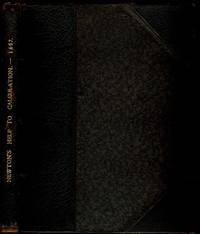
1657MS0005<p>1004 pages with tables and title within ruled boarder. Small quarto 7 1/2" x 5 3/4" bound in 20th century half green morocco with gilt lettering to spine over marbled boards. Thomash & Williams N33; Wing N1060 First edition.<br /><br />John Newton remained loyal to the king during the protectorate and supported himself by his eminent skill in mathematics and astronomy. At the Restoration he obtained the degree of D.D. and was in 1661 made king's chaplain and rector of Ross in Herefordshire where he died on 25 Dec. 1678. He was appointed canon of Hereford in 1673 and held the rectory of Upminster in Essex from 1662. He was the author of several works on arithmetic and astronomy designed to facilitate the use of decimal notation and logarithmic methods. He was also an advocate of educational reform in grammar schools; he protested against the narrowness of the system which taught Latin and nothing else to boys ignorant of their mother tongue; and complained that hardly any grammar-school masters were competent to teach arithmetic geometry and astronomy. With the object of supplying the means of teaching a wider and more practical curriculum he wrote school-books on these subjects and also on logic and rhetoric.</p><p>The following is a list of his works in chronological order; they are all in English: 1. <em>'Institutio Mathematica.' Decimal tables of natural sines tangents and secants and of logarithms; solution of plane and spherical triangles; with applications to astronomy dialling and navigation</em> 1654. 2. <em>'Astronomia Britannica' so called because decimals are used and the calculations are made for the meridian of London.</em> In two books dedicated to the Earl of Warwick who was an admiral of the fleet 1657. This and the foregoing work were printed by William Leybourn q. v. 3. <em>'Help to Calculation</em>' 1657. 4. <em>'Sixteenpence in the Pound' an interest table</em> 1657. 5.<em> 'Trigonometria Britannica'</em> in two books one of them from the Latin of Henry Gellibrand 1658. 6. <em>'Chiliades centum Logarithmorum</em>' 1659. 7.<em> 'Geometrical Trigonometry' </em>1659. 8. <em>'Mathematical Elements</em>' three parts 1660. 9.<em> 'A Perpetual Diary or Almanac</em>' 1662. 10. <em>'Description of Use of Carpenter's Rule</em>' 1667. 11. <em>'Ephemerides of Interest and Rate of Money at 6 per cent.'</em> 1667. 12.<em> 'Chiliades centum Logarithmorum et Tabula partium Proportionalium'</em> 1667. 13. <em>'The Scale of Interest: or the Use of Decimal Fractions and Table of Logarithms' composed and published for the use of an English mathematical and grammar school to be set up at Ross in Herefordshire</em> 1668. This book contains two dedications one to the Archbishop of Canterbury and the Bishops of London and Hereford the other to Lord Scudamore and other property owners about Ross. <em>His views on grammar-school education are expounded in a preface of thirty-six pages</em>. 14. <em>'School Pastime for Young Children</em>' dedicated to Thomas Foley 1669 contains a preface of eighteen pages on the education of infants. 15. <em>'Art of Practical Gauging</em>' 1669. 16. <em>'Introduction to the Art of Logic'</em> 1671 dedicated to Henry Milberne. 17.<em> 'Introduction to the Art of Rhetoric'</em> 1671. 18. <em>'The Art of Natural Arithmetic</em>' 1671. 19. '<em>The English Academy or a brief Introduction to the Seven Liberal Arts</em>' 1677. 20. <em>'Introduction to Geography</em>' 1678. 21. <em>'Cosmography</em>' 1679. 22. <em>'Introduction to Astronomy.</em>' The present work published by Joseph Moxon for sale in his instrument shop is designed to aid in the conversion from sexagesimal to decimal numbers so that problems in astronomy navigation etc. can more easily be solved using the standard logarithmic tables. After a short introduction the majority of the volume is taken up by the tables.<br /><br /><strong>Condition:</strong><br /><br />Points and spine ends rubbed ink stamp to title verso else very good.</p> Printed by Joseph Moxon hardcover
1679323256London: Thomas Passinger 1679. hardcover. Illustrated with 14 folding plates. Rubricated title. 16 512 14 pages. Small thick 8vo contemporary blind-ruled calf re-backed in brown leather with red spine label well-rubbed. London: Thomas Passinger 1679. First edition. A very good copy of this unusual book with some light foxing throughout. From the library of Harrison D. Horblitt with his bookplate. --Wing N-1055.<br/> <br/> Early English pedagogical treatise on mathematics. John Newton 1622-1678 was a mathematics teacher and rector of the mathematics school at Ross Herefordshire. Designed as a practical guide on the instruction of mathematics the work includes sections on surveying geometry and astronomy and geography as well as tables to determine area and other calculations. The preface stresses the need for mathematics as part of general education.<br/> <br/> Thomas Passinger unknown
1679241546London: Passinger 1679. hardcover. very good. 14 folding plates. Rubricated title small 8vo contemporary blindruled calf rebacked. London: Thomas Passinger 1679. First Edition. A very good copy.<br/><br/> John Newton 1622-1678 was a mathematics teacher and rector of the mathematuics school at Ross Herefordshire. His Work includes sections on surveying measuring solids astronomy and geography. The preface stresses the need for mathematics as part of general education. From the library of Harrison D. Horblitt with his bookplate. Wing N-1055.<br/><br/> Passinger unknown books
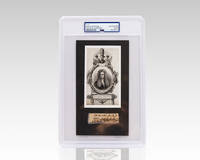
1700151722ca. 1700-1708. Autograph manuscript fragment on the Newton family lineage. England undated. A single leaf bearing autograph text in the hand of Sir Isaac Newton on both sides. 2.25 x 0.75 inches approx. 5.7 x 1.9 cm. Transcription recto: "Of the older family I am . whom I take to be my . of William Newton baptized 1541 whom ." Transcription verso: "for had by a . was next heir at law . infants and to that purpose . of her daughter with his ." A working genealogical note in Newton's hand evidently drawn from a longer document in which he traces a line of descent through one William Newton baptized 1541. The verso references questions of heirship and minor children suggesting the fragment formed part of Newton's private inquiry into the legal and lineal standing of the Newton family. Newton's documented genealogy situates him within the rural gentry of early modern England. He was born at Woolsthorpe Manor Lincolnshire to Isaac Newton a yeoman farmer who died before his son's birth and Hannah Ayscough daughter of a local clergyman. The paternal line can be traced to his grandfather Robert Newton also of Woolsthorpe indicating a family of modest landholding status. The maternal Ayscough line connected Newton to the educated clerical class a milieu that may have shaped his early intellectual formation. The present fragment though brief offers direct testimony of Newton's own engagement with the question of his ancestry and joins the small body of surviving manuscript material in which he records personal and familial concerns rather than scientific or theological matters. Condition: In good condition; minor wear consistent with age. The fragment has been archivally encapsulated by PSA/DNA together with a portrait of Newton and the corresponding authentication with the verso of the autograph remaining visible for examination. Authentication: PSA/DNA. Sir Isaac Newton 1642–1727 widely regarded as one of the most influential scientists in history established the foundational principles of classical mechanics in his Philosophiæ Naturalis Principia Mathematica wherein he articulated the three laws of motion and formulated the law of universal gravitation including the inverse-square relationship governing gravitational force. In addition to these achievements Newton independently developed the mathematical framework of calculus providing essential tools for the advancement of physics and mathematics. His extensive investigations into light and optics grounded in original experimentation significantly advanced contemporary understanding of the nature of light and color. Rejecting the long-standing authority of Aristotelian philosophy Newton instead championed an empirical experiment-based approach to scientific inquiry thereby helping to define the methodological foundations of modern science. unknown
16932188Oxford: Oxford University Press 1693. First collected edition. Contemporary calf. Very Good. SCARCE FIRST EDITION OF THE COLLECTED WORKS of one of Newton's most important precursors John Wallis Savilian Professor 1649-1703 containing the first printed appearance of Newton's ideas on fluxions. A staunch promoter of English mathematicians Wallis repeatedly urged Newton to publish his theories before others laid claim to he work for the sake of "your Reputation & that of the nation" Gjertsen Newton Handbook 605. While Newton resisted for many years in 1693 Wallis published several letters from Newton in Vol. II of his Opera thereby introducing the concept of fluxional notation-pricked and dotted letters. In the preface to Vol. I 1695 Wallis refers briefly to Newton's claim to the discovery of Fluxions while Vol II 1693 has the first full account of Newton's invention of calculus. The third volume of Wallis's Opera contains previously unpublished correspondence between Newton and Leibniz the most important items of which are Newton's Epistola prior and Epistola posterior. "These two lengthy letters were sent to Leibniz in 1676 to acquaint him with the main lines of Newton's mathematical development. Epistola prior beginning with the binomial theorem went on to describe Newton's work on series. The second letter also contains much discussion on infinite series. It is best known however for Newton's reference to powerful and general methods he had developed for the drawing of tangents the determination of maxima and minima and the quadrature of curves. These he added he preferred to conceal within a quite insoluble anagram. A second and even longer anagram concealed Newton's claim to be able to solve fluxional equations. The solutions to both were publicly disclosed by Wallis 1699" ibid 189. Vol. 2 of the Opera also contains pp. 669-78 De Postulato Quinto; et Definitione Quinta; Lib. 6. Euclidis; disputatio geometrica Wallis's important attempt to prove the parallel postulate of Euclid also published here for the first time. "John Wallis gave a lecture on this topic. on the evening of 11 July 1663. He had been inspired by Nasr-Eddin's attempt on it which he referred to in his lecture to examine the question himself and his analysis is remarkable both for its originality and its caution. Indeed his view of the matter was to be much more profound than many a later writer's" Fauvel & Gray The History of Mathematics 510. This magnificent and comprehensive edition of Wallis's collected works was financed by and printed at Oxford University. In addition to several 'firsts' including those described above these volumes contain reprints of virtually all of Wallis's great books including the Arithmetica infinitorum and Mechanica Vol. 1 an augmented Latin edition of the Treatise of Algebra Vol. II and bilingual editions of a number of ancient Greek texts including Ptolemy's Harmonics Aristarchus's On the magnitudes and distances of the sun and moon and Archimedes's Sand-reckoner Vol. III. In addition to numerous other mathematical works the four volumes include his most popular work Grammaticae lingua anglicanae his "Treatise of Speech which formed a useful theoretical foundation for his pioneering attempts to teach deaf-mutes how to speak" DSB as well as an important tract on cryptography in which he records the methods he developed while deciphering for Cromwell the coded messages of Charles I. Wing W596 W566 W597. Babson 184. Roberts and Trent 345. see J.F. Scott The Mathematical Work of John Wallis London 1938; M. Baron The Origins of the Infinitesmal Calculus Oxford 1969 205-213; Richard Westfall The Life of Isaac Newton Cambridge 1993 207-209ff. Opera Mathematica. Volumen primum -Tertium - Opera quaedam miscellanea. Oxford: Sheldonian Theatre University Press 1695 1693 1699. Four volumes bound in three. Folio contemporary full paneled calf rebacked to style. Complete with four engravings on three leaves and three portraits Vols. I & II with the same portrait by Loggan dated 1678 and engraved by Burghers; Vol 3 by Sonmans dated 1698 and engraved by Burghers. With large bookplate inside each front cover reading "The Gift of Mr. Thomas Heatley Citizen and Iron-monger of London to the Mathematical School in Christ's Hospital Anno Dom. 1700". A very clean copy with only occasional light browning and foxing very handsomely bound. ONE OF THE MONUMENTS IN THE HISTORY OF MATHEMATICS. RARE. . Oxford University Press unknown books
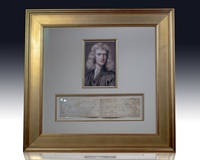
1698149618January 25 1698-1699. Rare vellum manuscript signed by Sir Isaac Newton as Warden of the Royal Mint in which he makes a case against his nemesis coin counterfeiter William Chaloner soon to be hanged for high treason. One page vellum manuscript document signed by Isaac Newton  “Is. Newton†January 25 1698-1699. Recognizance bond issued by Isaac Newton as Warden of the Royal Mint to ensure the future appearance of Nathaniel Peck as a witness against Newton’s nemesis the counterfeiter William Chaloner. The document reads in part "Nathanl Peck de Black Fryars London…Thos Worley de St Sepulchres London Glover…Symon Cross de east Aurifaber…Upon Condition the said Peck do personally appear at the next Genll Sessions of the peace …in St John str for the County aforesaid Then and there to answer…objected agt him touching his packing away Counterfeit money for advantage." Appointed as Warden of the Mint in 1696 upon the recommendation of Charles Montagu Chancellor of the Exchequer Isaac Newton ascended to the role of Master of the Mint the following year—a position he would retain for the remainder of his life. Prioritizing his duties at the Mint over his academic commitments he relinquished his responsibilities at Cambridge in 1701 to devote himself fully to the office. As Master Newton spearheaded significant currency reforms and pursued counterfeiters with unwavering diligence wielding the full force of the law as exemplified by the fate of William Chaloner. On the very day Newton signed this bond he received a formal statement from Nathaniel Peck who attested that seven years prior Chaloner had commissioned him to modify two iron pieces which were subsequently used to produce counterfeit French pistoles. Additionally Peck admitted to purchasing counterfeit pistoles from Chaloner at a rate of eight shillings per coin and reselling them for eleven shillings. Some months later Chaloner provided Peck with forged guineas which he likewise circulated before Chaloner turned to Thomas Holloway as his preferred distributor. By early 1699 Newton had compiled a formidable body of evidence against Chaloner consisting of 44 depositions. Chaloner had been apprehended in November 1698 on charges of forging lottery tickets though those specific allegations were ultimately dismissed. Nevertheless Newton proceeded to indict him on three separate counts securing a conviction for high treason on March 3 1699. Mere weeks later on March 22 Chaloner met his end at the gallows of Tyburn. In good condition fold at center scattered toning. Archivally mounted matted and framed with a portrait of Newton. The document measures 12.25 inches by 3 inches. The entire piece measures 23.5 inches by 23 inches. Signed documents by Newton are exceptionally rare. Isaac Newton 1643–1727 was an English mathematician physicist and astronomer widely regarded as one of the most influential scientists in history. His groundbreaking work Philosophiæ Naturalis Principia Mathematica 1687 laid the foundation for classical mechanics introducing the laws of motion and universal gravitation. However beyond his scientific achievements Newton played a crucial role in England’s financial and legal system. In 1696 he was appointed Warden of the Royal Mint largely due to the recommendation of Charles Montagu Chancellor of the Exchequer. A few years later in 1699 he became Master of the Mint a position he held until his death. Newton took his role seriously overseeing the recoinage of England’s currency implementing measures to stabilize the economy and aggressively pursuing counterfeiters. His meticulous investigations led to the conviction of notorious forgers like William Chaloner demonstrating his unwavering commitment to upholding the integrity of England’s monetary system. hardcover