Newton, IsaacBiblio.com

240 résultats
18481803065Daniel Adee 1848. 1st Edition. Hardcover. Near Fine/No Jacket. Near fine TRUE first American edition 1st issue as stated on the title page. Some water stains on page edges. Previous owner's bookplate on front pastedown. Rubbing on outside spine and corners and at bottom of spine. Tape at endpapers and pastedowns along gutters. Housed in custom-made slip case. Daniel Adee hardcover
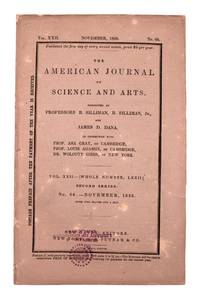
1856323434New York: G.P. Putnam & Co 1856. Three engraved plates folding engraved map woodcut text figures. 8vo. Original printed wrappers untrimmed; some occasional light marginal foxing wrappers chipped at head and foot of spine. Three engraved plates folding engraved map woodcut text figures. 8vo. The first appearance of the discovery of greenhouse gasses as delivered on Foote's behalf before the American Association for the Advancement of Science AAAS on August 23 1856 she was not a member although there were two women members by 1850 three years after its founding. Although in the early 19th Century Joseph Fourier suggested that the Earth's temperature was warmed by more than just the sun and Claude Pouillet suggested that water vapor and carbon dioxide must effect it it was Foote who provided the first experimental proof of the insulating effects of various gasses proving that increasing amounts of carbon dioxide in the air would increase the ground temperature.<br /> <br /> "Foote's paper demonstrated the interactions of the sun's rays on different gases through a series of experiments using an air pump four thermometers and two glass cylinders. First Foote placed two thermometers in each cylinder and using the air pump removed the air from one cylinder and condensed it in the other. Allowing both cylinders to reach the same temperature she then placed the cylinders with their thermometers in the sun to measure temperature variance once heated and under various states of moisture. She repeated this process with hydrogen common air and CO2 all heated after being exposed to the sun." McNeill<br /> <br /> Her work predates that of John Tyndall who presented a paper the relation between thermal radiation and various gasses in 1859 and that of Svante Arrhenius who quantified the effect of airborne carbon dioxide on the ground temperature of the Earth in his paper "On the Influence of Carbonic Acid in the Air upon the Temperature of the Ground" 1896 forty years after Foote.<br /> <br /> Eunice Newton Foote 1819-1888 was a scientist inventor and campaigner for the rights of women. She was a neighbor and friend of Elizabeth Cady Stanton and attended the 1848 Senaca Falls Convention the first women's right's convention where she and her husband signed the declaration of the legal rights of women and helped prepare the proceedings of the convention. Her scientific work was overlooked in preference to that of her male peers until more recently and the American Geophysical Union started a prize in her name in 2022 honoring discoveries in earth and life sciences. L. McNeill "This lady scientist defined the greenhouse effect but didn't get the credit because sexism" SmithsonianMag.com 5 December 2016; E. W. Reed American women in science before the Civil War 1992 2019 pages 64-68; R. P. Sorenson "Eunice Foote's pioneering research on CO2 and climate warming" Search and discovery American Association of Petroleum Geologists Tulsa no. 70092 31 January 2011; J. Perlin "Science knows no gender: Eunice Foote the woman who in 1856 discovered the cause of global warming" symposium UC Santa Barbara 17 May 2018; Baum Sr. Rudy M. 2016. "Future Calculations: The first climate change believer". Distillations. 2 2: 38-39 2018 G.P. Putnam & Co unknown
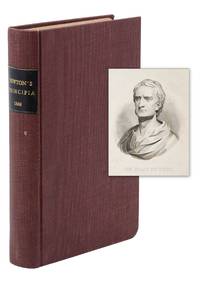
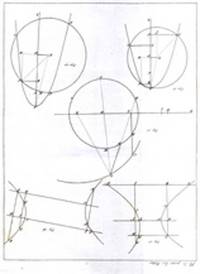
1848140949208New York: Daniel Adee 1848. First American Edition. Very Good. First American edition first printing with date 1848 on title page and publisher's address listed as 107 Fulton-Street. 4 v-viii 9-581 pp. illustrated with engraved frontispiece protected by tissue guard. Recently bound in maroon buckram title label to spine. Very Good with light wear to covers and slight bumping to lower corners; title label beginning to lift at one corner. Band of paper residue to front free endpaper. Light toning and moderate foxing to textblock edges and contents dampstain to outer textblock edge and outer margin throughout. Cohen pp. 347-352.<br /> <br /> <p>The first American edition of the foundational physics text first published in Latin in 1687. Andrew Motte's 1729 translation was reprinted in 1803 and 1819 in Britain but subsequent 19th century editions were printed only in the United States and Germany. The New York-based publisher Daniel Adee deposited a copyright for the Principia in 1846 then printed five issues between 1848 and 1850. A contemporary notice in the Scientific American declared:<br /> <br /> <p>"For a long time the 'Principia' was kept far out of the reach of the mere English Scholar as if Newton had written it exclusively for the classical student and philosopher. It was a scarce book when printed in the Latin language; it is now thanks to the spirit of an American publisher printed in our mother tongue and should find a place in every family library. Daniel Adee unknown
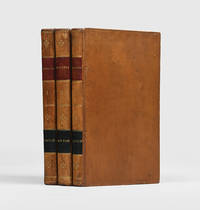
1803327150London: Symonds 1803. hardcover. near fine. 3 volumes. 55 folding copper engravings and small engravings throughout the text frontispiece copperplate portrait of Isaac Newton in volume 1. 8vo handsomely rebound in full dark brown calf with blind-stamped design on covers and spine black leather spine labels. Some scattered age toning and spotting; neat small ownership name at top of title pages and half titles. London: H. D. Symonds 1803. A scarce set in a handsome binding.<br/> <br/> Symonds unknown
18552091202133212831Bell and Daldy 1855. Soft Cover. Fine. Volume: 1 Bell and Daldy paperback
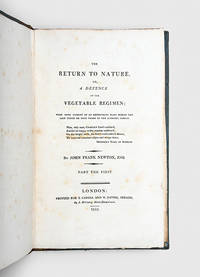
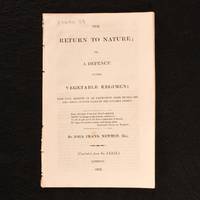
1811164685London: printed for T. Cadell and W. Davies by J. McCreery 1811. The root of the Shelleys' vegetarianism First edition of this pioneering work of vegetarianism in which the author advocates for the medical and intellectual benefits of a meat-free diet. It was a great influence on fellow vegetarian Percy Bysshe Shelley as well as on Mary Shelley's depiction of the Creature as a herbivore in Frankenstein. This is a particularly well-preserved copy in the original boards. Newton 1767-1837 promoted a diet of fruit vegetables raisins bread eggs milk and potatoes and he drank only distilled water because of his belief that the Thames was contaminated with animal fat. Unlike his mentor William Lambe 1765-1847 Newton was not a vegan. He inspired several significant figures to adopt a vegetarian diet including the physician John Snow 1813-1858 and Percy Shelley whose Vindication of Natural Diet 1813 echoed Newton's ideas. "It is from his meeting with John Newton in November 1812 that Shelley's proselytising vegetarianism dates. From Newton's book he drew many of his arguments" Crook and Guiton p. 77. The two men differed in the fact that Newton was mainly concerned with the scientific benefits rather than the moral implications of vegetarianism. "Though not a doctor Newton regarded The Return to Nature principally as a work of medicine; he had himself found relief from chronic asthma through vegetarianism and was anxious to impart to others the knowledge of its benefits in a number of diseases" ibid. However "in one of his most surprising and emphatic passages" Newton ventures into a diatribe against "the monster syphilis with all its gorgon terrors" and explains his hope that vegetarianism could cause it to "be driven from the earth" p. 131. This was expanded upon by Shelley in his own writing through his emphasis on the immorality of consuming flesh in all its guises along with his link between a carnivorous diet and alcoholism. He made use of the allegory of Prometheus; it was only through the unnatural theft of fire that humans gained the ability to transform meat from bloody flesh into something fit for consumption. Newton was also an occasional guest of Mary Shelley's father William Godwin a fellow proponent of the vegetarian diet. Presumably it was because Newton's ideas filtered through Shelley and Godwin that Mary Shelley decided to describe the Creature in Frankenstein as a vegetarian: "My food is not that of man; I do not destroy the lamb and the kid to glut my appetite; acorns and berries afford me sufficient nourishment. The picture I present to you is peaceful and human." The Return to Nature is rare in commerce particularly so in original boards. We can trace just one copy thus at auction which appeared over 50 years ago. Octavo. Uncut in original brown paper-backed blue boards printed paper spine label. Dedication leaf misbound following introduction. Head of spine crumpled corners worn light foxing to boards and contents but otherwise very crisp initial leaves creased at upper margin leaf A3 partially loose at lower cord and consequently standing proud: a very good copy. Nora Crook & Derek Guiton Shelley's Venomed Melody 2010. hardcover
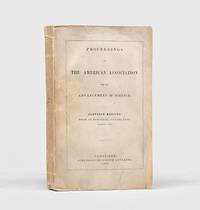
1858155260Cambridge: Joseph Lovering 1858. One of only two known papers by the author Uncommon first edition of the first article by a woman published in the Proceedings of the AAAS: a well-preserved copy in the original wrappers with the ownership signature of American ornithologist George N. Lawrence 1806-1895 listed as a member of the AAAS on p. xxxviii of this volume. The American scientist inventor and women's rights campaigner Eunice Newton Foote 1819-1888 is best remembered for her discovery of the absorption of thermal radiation by carbon dioxide and water vapour: namely the greenhouse effect. Her famous paper on the topic was presented to the AAAS in August 1856 read on her behalf by Joseph Henry first Secretary of the Smithsonian and published shortly after in the American Journal of Science and Arts. This is Foote's second paper which provides an early experimental description of the effect of a pressure-driven change on the static electricity of air with reference to observations by Humboldt Sabine and de Saussure. It was presented to the AAAS on 14 August 1857 again read by Joseph Henry on her behalf. Its first appearance in print was in the Proceedings; abbreviated versions later appeared in the American Journal of Science and Arts and in the Philosophical Magazine. In Mary Creese's landmark study of American and British women scientists from 1800 to 1900 she noted that of the approximately 3400 scientific publications authored by women in the period - less than 1% of the total published - there were "just 16 papers by American women in physics over the whole century. Only two pre-date 1889 and they are the two papers by Eunice Foote" Jackson p. 117. John Perlin author and visiting scholar at the UCSB Physics department which hosted a 2019 exhibition on Foote remarked that she was "the only woman to be published in serious physics journals until Madame Curie" quoted in Jacobs. Octavo. Five folding plates one engraved with astronomical illustrations the rest featuring diagrams and graphs and two engraved plates numerous illustrations in text. Original buff printed wrappers. Faint pencilled signature "Geo. N. Lawrence" along upper edge of front cover pencilled number at centre of spine. Wrappers expertly restored spine ends chipped contents crisp and clean: a very good copy. Roland Jackson "Eunice Foote John Tyndall and a Question of Priority" Notes and Records 74 2019 pp. 105-18; Tom Jacobs "More than a Historical Foote Note" UCSB's The Current 6 November 2019 available online. unknown
1819183664London: Printed for Sherwood Neely and Jones; and Davis and Dickson 1819. The Newtonian ascendancy A handsomely bound edition bringing together Newton's masterpiece with several works refining Newtonian theory and an early draft of the Principia itself. This translation of the Principia together with the Laws of the Moon's Motion by John Machin c. 1686-1751 is drawn from the first edition in English published in 1729. William Davis 1771-1807 originally brought out the three-volume edition in 1803 revising and extending Motte's translation to cover the remaining third of Newton's text. This is thus only the second edition of a complete translation of the Principia into English. No further edition was published until the "modernized" version brought out by the University of California Press in 1934 and no entirely new translation was made until 1999. This edition pairs these works with the Short Comment on and Defence of The Principia 1770 by William Emerson 1701-1782 and Newton's own System of the World written 1685. By the turn of the 19th century the Principia's theory of gravity had become widely accepted in scientific circles and Davis's edition "made this available to a number of generations of nineteenth-century students" ODNB. 3 vols octavo 212 x 127 mm. Engraved portrait frontispiece and 56 plates 8 of which folding. Extensive tables and formulae in the text. Contemporary calf spines lettered decorated and ruled in gilt and with red and black morocco labels covers panelled in blind light brown coated endpapers edges sprinkled brown. Spine ends restored. Light bumping and wear minor browning and offsetting to contents: a very good copy. Babson 22; Grey 25; Wallis 25. unknown
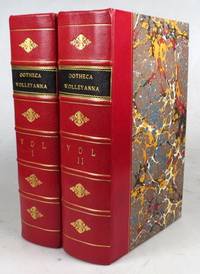
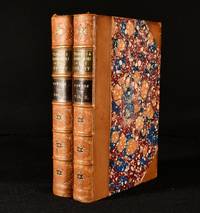
186449256London: Sold by R.H. Porter 1864 1902 1905 1907. Sole editions. Four parts bound in two volumes. Large 8vo. xl 525 3 527-532; vi 665 1 96 4 pp. Expertly bound in recent quarter red morocco over marbled boards spines with raised bands gilt lettered black labels lettered direct to another and with a gilt device repeated to the others the original printed wrappers to all four parts bound in at the rear of volume II adjacent to the first wrapper is a 3 pp. autograph letter signed from Newton addressed to "My dear Edge" on Magdalen College Cambridge headed paper parts II and III feature tipped in handwritten notes presenting them "with the editor's compliments" parts II and IV also come with letters from Newton to the original recipient's son finally the set is complemented with two pieces of interesting egg related printed ephemera. Photogravure portrait frontispiece 21 chromolithograph plates of bird eggs numbered I-XXI 16 lithograph plates tinted chromolithographic or uncoloured depicting birds nests and landscapes lettered A-P and a folding colour map of Lapland. John Wolley 1823-1859 was an ornithologist and egg collector first becoming interested in the subject whilst studying at Cambridge. Over time he became something of an expert on the Dodo and later on the Great Auk. His studies led to travels in Europe and Scandinavia and it was during one of these trips in the 1850s that he interviewed the men that had killed the last of the Great Auk species the previous decade. Wolley fell ill after one of these foreign trips and eventually passed away at the tender age of 36. On his demise his notes and remaining egg collection passed to his close friend Alfred Newton who painstakingly edited and published Wolley's notes over the next half century. Alfred Newton 1829-1907 became one of the pre-eminent ornithologists of the age being one of the founders of the British Ornithologists' Union in 1858 and ascending to the chair of Zoology and Comparative Anatomy at Cambridge in 1866 a post that he held until his death. In these later decades Newton also edited or contributed to many other important ornithological works such as editions of Yarrell's Birds the Encyclopaedia Britannica and his own Dictionary of Birds four volumes 1893-96 but his editorship of Wolley's work was by far his crowning achievement in print. The first letter is dated September 1864 and is evidently written to James Thomas Edge 1827-1894 originally James Thomas Hurt he took his mother's maiden name early in his adult life. Newton explains that he had asked Van Voorst to send Edge a copy of the work but that the publisher had ignored his instruction to inscribe the volume with his wishes. This omission prompted Newton's belated letter which had been delayed due to a summer long bird watching trip to Spitsbergen. The later letters are both addressed to Edge's son Thomas Lewis Kekewich Edge 1856-1931 the first of these references the senior Edge's collection - the importance of certain pieces within it and the need to ticket them. Newton's final letter is dated March 1907 just three months prior to his death. He is glad that Edge has had "the 4th and last part of this book and seems to like it" and commends an extract that Edge had quoted from his father's journal in a previous letter apparently confirming a conclusion John Wolley had also come to. Interestingly Wolley's father Francis also changed surname during his adult life - taking on his wife's maiden name. Prior to becoming a Wolley Francis' surname had been Hurt. Thus it transpires that as well as sharing a keen interest in ornithology and oology John Wolley and James Thomas Edge were second cousins. The ephemera comprises an 1865 printed sale notice from the auctioneer J.C. Stevens offering a "Rare & Remarkable Egg" of a bird "presumed to be quite extinct" which he states was "probably the Dinornis ingens of Owen". Richard Owen had been sent a fragment of an unusual bone that had been excavated in New Zealand in the late 1830s. After studying it for several years he came to the conclusion that it was almost certainly a part of a bone from a giant flightless bird which he named Dinornis novaezealandiae more commonly known by its Maori name of Moa which had long since been extinct. Also inserted is a 24 pp. sale catalogue of eggs dated 1858 offered by the same auctioneer the eggs collected by John Wolley himself in Lapland the previous year. A handsome set of a what is ordinarily an uncommon work this set rendered unique with its the family association letters from the editor and the related ephemera. London: Sold by R.H. Porter unknown
1870110127New York: Robert Carter and Brothers 1870. Rare early edition of this work by Newton. Octavo original cloth illustrated. Presentation copy inscribed by Moody on the front free endpaper "To John Syme D.L. Moody My dear Brother be useful be earnest be fruitful and the blessing of God will rest on you." In good condition. Signatures of the legendary evangelist are rare especially with such a lengthy inscription. Dwight Lyman Moody also known as D. L. Moody was an evangelist and publisher connected with the Holiness Movement who founded the Moody Church Northfield School and Mount Hermon School in Massachusetts Moody Bible Institute and Moody Publishers. One of his most famous quotes was “Faith makes all things possible. Love makes all things easy.“ Moody gave up his lucrative boot and shoe business to devote his life to revivalism working first in the Civil War with union troops through YMCA in the United States Christian commission. In Chicago he built one of the major evangelical centers in the nation which it is still active. Working with singer Ira Sankey he toured the country and Britain Europe drawing large crowds with a dynamic speaking style that preached God's love and friendship kindness and forgiveness rather than hellfire and condemnation. Robert Carter and Brothers hardcover
182219114Glasgow: Andreae et Joannis M. Duncan 1822. FIRST GLASGOW EDITION. Numerous text diagrams and illustrations. Contemporary calf all covers with blind-stamped floral border within gilt floral borders within gilt-lined borders spines in compartments with gilt decoration spine labels; first few leaves of each volume spotted otherwise an excellent set. First Glasgow reprint of the first Jesuit edition printed in Geneva from 1739-1742. This edition of Newton’s Principia was edited by John Martin Frederick Wright of Trinity College who contributed additional commentary. Babson notes that Glasgow’s printing of this edition of the complete text was a great credit to the university whereas Cambridge was “satisfied with reprints of the first three sections of the first book.â€<br /> <br /> Babson 32; Gray 17; Wallis 17. Andreae et Joannis M. Duncan unknown
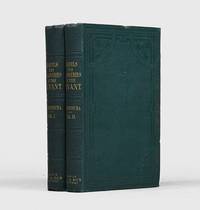
1865152733London: Day & Son Limited 1865. Presentation copy with letter First edition presentation copy inscribed on the front free endpaper of vol. I "Gaisford from the author Feb 1866" and with a 6-page autograph letter signed from the author loosely inserted. The letter headed British Museum 10 January 1852 details Newton leaving his position in the British Museum to take up a role as vice-consul at Mytilene. "My dear Sir you will probably be surprised to hear that I am going to leave the British Museum and also England. I have for some time wishes to exchange my present location for one where I could have more leisure time for literary pursuits & a warmer climate for my health has suffered from residence in London. After a good deal of deliberation I thought that if I could get a small Consulship in the Levant when the official duties were not very heavy I should be enabled to pursue archaeology by the study of remains in situ". Newton goes on to detail the circumstances of his being awarded the position. The recipient of the volumes was a member of the Gaisford family headed by the classical scholar and Dean of Christ Church Cathedral in Oxford Thomas Gaisford 1779-1855 to whom the letter is probably addressed Newton notes his hope to visit Oxford soon. Thomas Gaisford was deceased by the time of the book's presentation and consequently the recipient of the volumes is likely one of his seven children who would have paired them with the letter. The volumes originate from the Gaisford family home of Howth Castle near Dublin. Newton worked as vice-consul at Mytilene from 1852 to early 1853 then as acting consul at Rhodes from April 1853 to January 1854. In both positions he was authorized to undertake considerable archaeological excavations and purchases for the British Museum which he followed by excavations in Kalymnos in 1854 and 1855 financed by Lord Stratford de Redcliffe the British ambassador at Constantinople. The present book gives his account of these travels and excavations. On his return he became the first keeper of Greek and Roman Antiquities at the Museum in 1861. He was closely involved in the foundation of three highly influential archaeological institutions: the Society for the Promotion of Hellenic Studies to which he gave an inaugural address in June 1879; the Egypt Exploration Fund founded in 1882; and the British School at Athens opened in November 1886. 2 vols tall octavo. Folding map frontispiece to each 12 lithographic plates from photographs by Francis Bedford after drawings by Newton and his wife 20 plates one of which folding the majority etched after photographs by Colnaghi and Spackman 2 double- and 2 full-page maps one double- and 2 full-page plans numerous wood-engraved illustrations to the text. Original green pebble-grain cloth spines lettered in gilt blind panelling to covers pale yellow endpapers. Obituary of Newton mounted to front pastedown of vol. I with another for his friend Reginald Stuart Poole loosely inserted. Very light rubbing and peripheral bumping cloth still bright and fresh without wear and with joints and hinges intact light foxing to contents as usual some leaves unopened towards end of vol. I. An excellent copy. Atabey 869; Blackmer 1193; Gernsheim Incunabula of British Photographic Literature 284. hardcover
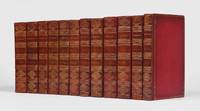
1813143137London: Printed for G. Kearsley J. Walker J. Stockdale R. Lea E. Jeffery & 10 others 1813. A "vastly ambitious survey" First edition of this extensively illustrated Georgian encyclopedia a "vastly ambitious survey of human genius learning and industry" ODNB here presenting particularly nicely in contemporary red morocco. 12 vols octavo 232 x 145 mm. Illustrated throughout with engravings many with contemporary hand colouring. Contemporary red straight-grain morocco spines lettered and tooled in gilt covers with foliate border in gilt and blind gilt turn-ins grey endpapers gilt edges. Contemporary ownership signature to half-titles pencilled doodle to front free endpaper of vol. I. Bumping at head of contents of vol. IV. A very handsome set the bindings without wear and the contents clean. unknown
180211944Paris: Chez Bernard 1802. 2 volumes bound as one. First French edition. Extensively illustrated with folding engraved diagrams of geometric problems. 4to contemporary calf with gilt tooling on covers and spine. Red morocco lettering panel. Gilt stamp of the “Prix du College Royal D’Henry IV†on both covers. xxiv 252; 258 errata1 ad. A fine especially bright copy with a small tear to upper spine. A VERY SCARCE ISSUE OF THESE IMPORTANT MATHEMATICAL LECTURES. These algebraic lectures given by Newton at Cambridge were first published by William Whiston in 1707. Whiston “extracted from Newton a somewhat reluctant permission to print it. Among several new theorems on various points in algebra and the theory of equations Newton here enunciates the following important results. He explains that the equation whose roots are a solution of a given problem will have as many roots as their are different probable cases.He extends Descartes rules of signs to give limits to the number of imaginary roots.The most interesting theorem contained in the work is his attempt to find a rule analogous to that of Descartes for real roots by which the number of imaginary roots of a equation can be determined.†Later with the idea of stimulating annotations to the work Gravedsande published SPECIMIN COMMENTARII IN ARITHMETICAM UNIVERSLAEM; and Maclaurins’s ALGEBRA seems to have been written in response to this. Chez Bernard unknown
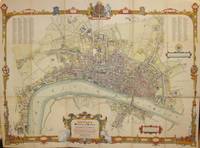
1855M7534London: Bell & Daldy 1855. Very good folding map laid down on contemporary canvas. Notes: This very decorative and large-scale mid-19th century map engraved on copper by Thomas Sherralt represents London at the time of Henry VIII circa 1517 from Westminster Abbey to the Tower. A pink line represents the area destroyed by the Great Fire of 1666. A decorative border encases the map illustrated by the royal coat of arms important English shields the names of important Englishmen and kings and allegorical figures around the title cartouche. Two indexes sit in the upper corners a compass rose and scale sit beneath the upper right index and a dedicatory cartouche sits in the lower right. The map folds and is backed by dark navy cloth.<br><br>The map is accompanied by a historical text by William Newton "London in the Olden Time." It is in matching dark navy cloth a small folio. Paginated x 120 pp. The whole comes in a navy cloth case with the title gilt on the upper board. Unlike the map the cloth case is scuffed and rubbed at the extremities in good condition. Size : 1020x1370 mm 40.16x53.94 Inches Coloring: Hand Colored Category: Maps City Maps; Maps Europe United Kingdom England London;Maps Folding Maps; Bell & Daldy hardcover
1855542536London: Bell and Baldy 1855. A very scarce hard cover within a protective rigid pocket folder both in very good condition for their age. An extensive and decorative historical map of the capital in the time of Henry VIII. Its full title is "London in the Olden Time being a Topographical and Hiftorical Memoir of London Weftminster and Southwark Accompanying a Pictoral map of the City and its Suburbs as they exifted in the Reign of Henry VIII before the Diffolution of the Monafteries." The map laid on linen is presented within the hard cover book. This details the history of London and contains a complete index to the map. According to details penned to title page this copy was presented to the Herne Bay Literary Institute by Miss Newton the daughter of the author William Newton d.10.07.1861 Herne bay in July 1883. Brown cloth pocket folder rigid has bright gilt title and decoration to the front. Light fading rubbing and wear to front edges and corners with bubbling to rear board where a section of cloth has lifted from card. No tears present. Pocket folder 'closing' flap is worn creased and faded with marble backing paper torn and missing in places. Boards show wear to edges and corners bumped light wrinkling and fading to cloth cover creasing to spine head and foot closed tear to spine foot split to spine head and occasional blemish. Front board is decorated as per card case. Map within shows some age-related discolouration at folds but details and colours are bright and true. A pink line represents the area of London destroyed by the Great Fire of London in 1666. Beautifully illustated border comprises of a royal coat of arms various English shields the names of notable Englishmen and Kings and allegorical figures around the title cartouche. Within pages and map are securely bound. Tanning and foxing is present to pages and reverse of map however none is overly significant and content is bright and clear. More pictures are available upon request. CN. Hardcover. Very Good/Very Good. Illus. by Sherratt Thomas Original engraving. Used. Bell and Baldy Hardcover
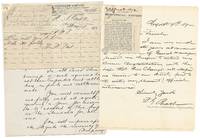
1892457459Cincinnati; Chicago 1892. Near Fine. A small archive of six letters written to C. Jay French general manager of the American Bell Telephone Company including two holograph letters and a telegram written in 1879 by the Theodore Vail who oversaw the building of America's first coast to coast telephone system. The remaining four letters are from four business colleagues in 1892. Each set of letters is neatly pinned together at the upper left corner: the first with an autograph note by French; and the second with a clipping outlining French's career. Both sets are in fine condition overall.<br /> <br /> Contemporary journalists called Theodore Vail the “Cincinnatus of Communications†and modern biographers call him “one of the two or three foremost organizing geniuses in the history of American industry.†In 1878 he was called to run Bell Telephone as its general manager just two years after Alexander Graham Bell patented his invention of the telephone in 1876. He helped establish the country’s first commercial telephone exchange lines in 1878 and organized the Bell empire in the 1880s.<br /> <br /> The two Vail letters retained by French reveal his direct management style: the first was written to the head of a regional Bell company at Cincinnati to introduce French: “… As he will be in your city for a few days I would like if you would give him all the insight possible into the manner of conducting an exchange and also any other information in regard to the Telephone business that may be in your power.â€<br /> <br /> The second letter outlines French’s duties: “You will make it your first duty to visit the different agencies of this Co. and establish a correct uniform and prompt system of reports to this Company … You will consult freely and fully with all agents … You will impress upon the agents the necessity of the Company being fully advised as to the operations of the agency. In all cases we desire reports of the business – In all cases also it is the desire of this Company that the agents’ interest be consulted.â€<br /> <br /> The other set of letters were written by four leading managers to congratulate French for his promotion to general manager of the American Bell Telephone Company in 1892. A scarce cache of letters documenting the beginning of America’s telephone exchange network. A list of both sets of letters is available. unknown
1813117185London: H.M.S.O. 1813. First edition thus of Newton's reports to the Privy Council or the Treasury during his position of Master of His Majesty's Mint the report signed and dated in print 21 September 1717. Newton was first appointed warden of the Mint in May 1696 rising to the position of Master following the death of Thomas Neale in December 1699. "Macaulay avers in his history that Newton - independently I suppose of his public action in reference to the Re-Coinage - has left no exposition of his opinions touching the currency. The eloquent historian thus leaves out of view the well-known report of 1717 upon which was based the reduction of the Guinea from 21 shillings and 6 pence to 21 shillings. It would seem then that the doctrinal importance of this Report had escaped recognition from the English historian though as I have had occasion to ascertain it was the subject of appreciative comment in France and Prussia more than a century ago. Indeed I read it first in a German translation printed at Berlin in 1762." Horton quoted in Gray. Foolscap folio 332 x 202 mm pp. 3. Docket title printed on final blank for folding. Disbound two sewing holes as issued. Two small sewing holes to centre fold; in excellent condition. Gray 350; Wallis 350.6. World Cat and Library Hub Discover record a 4-page version with the title "Return to an order of the House of Commons dated 1 March 1813; - for copies of all reports or memorials; made by Sir Isaac Newton when Master of his Majesty's Mint to the Privy Council or to the Treasury on the state of the coin of these realms: so far as relates to the Treasury." taken from the series of British Parliamentary papers; Accounts and papers Great Britain Parliament. Session 1812-13. House of Commons; 77. We can find no record of the present version. unknown
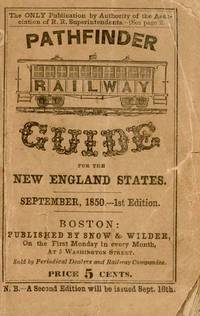
185046378Boston: Snow & Wilder Publishers 1850. 1850. First edition with the words in print "September 1850 - 1st Edition" on the front cover noting that "A Second Edition will be issued Sept. 16th." Publisher's illustrated wrappers showing a railway carriage 110 pp. of schedules plus 18 pp. of advertisements and a two-sided folding map at the front. The booklet measures 2 3/4" x 4 1/4" and the map when unfolded measures 7" x 9 1/4." One side of the map details the railroad lines of New England and the verso shows the city of Boston. Some small tears and small chips to the extremities else a very good copy. Snow & Wilder, Publishers, 1850. unknown
181361937London: Printed for G. Kearsley J. Walker J. Stockdale R. Lea et al. 1813. Large 8vo. In 13 volumes 12 volumes of text with plates bound separately in extra volume. Uniformly bound in contemporary black half calf over dark green cloth. Gilt decoration & blind-stamped panels to spines. Marbled endpapers. Some rubbing & wear to spines & corners. Boards clean. All internally clean. All bindings firm. With 370 plates. Small tear to one plate. Plates plain without any colour in this copy. . Very Good. Half Calf. 1813. Printed for G. Kearsley, J. Walker, J. Stockdale, R. Lea, et al. 1813 unknown
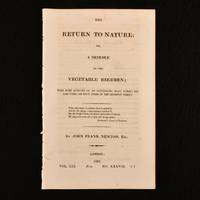
1821907F32London: The Pamphleteer 1821 . First edition. Unbound. Very Good. 9.5" by 5.5". None. A very scarce edition of John Frank Newton's highly influential early nineteenth century argument in favour of vegetarianism. A vanishingly scarce contemporary edition of John Frank Newton's important work.First published in 1811 this edition appeared as No. XXXVIII in Vol. XIX of 'The Pamphleteer' and here appears unbound.A pioneering work on vegetarianism in his work Newton explains his view that the natural food of man is vegetables and that animal flesh is unhealthy. In his work he uses personal anecdotes and explains that many members of his household adopted the diet for between three and four years prior to the publication of the work.The work influenced fellow vegetarian Percy Bysshe Shelley providing the basis of his 'A Vindication of the Natural Diet' and prompting Mary Shelley's depiction of the Creature as a herbivore in 'Frankenstein'.With the stamp of the pamphlet collection of the British Library to the verso of the title page.One of the more unusual claims in the work is that a vegetarian diet may eradicate syphilis. Unbound. Externally exceptionally bright. Stamp to verso of title page. Internally firmly bound. Pages clean and bright. Very Good The Pamphleteer unknown
1865713L6London: Day and Son 1865. First edition. Leather. Very Good Indeed. 9.5" by 6". None. A smartly bound first edition copy of Charles Newton's travelogue regarding his time in the Levant. With sixteen plates to volume I with twenty-three plates to volume II. Frontispiece to both volumes James Hendrick of Font Grove New Scotland. Collated complete.Charles Thomas Newton was a British archaeologist. This work follows the greatest archaeological exploit of Newton's life. He discovered the remains of the mausoleum of Halicarnassus which is one of the seven wonders of the world. He described the results of this in his 'History of Discoveries at Halicarnassus' as well as this work. In addition to Halicarnassus this work depicts other important discoveries at Branchidae excavations at Mitylene Rhodes Kaymnos and various sites on the coast of Asia Minor. A very smart copy of this work. In a half calf binding with paper covered boards. Externally very smart with light rubbing to the joints and extremities. Light marks to the spine. Bookplate to the front pastedowns 'James Hendrick of Font Grove'. Internally both volumes are firmly bound. Pages are very bright. Occasional scattered spots to pages. Very Good Indeed Day and Son hardcover
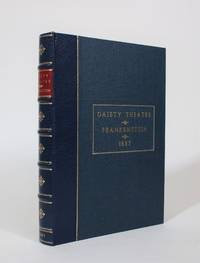
1887007387London: Gaiety Theatre 1887. Soft cover. Fine. 5.5" x 7.5" Slim pamphlet two nestled small bifolio sheets not stapled in protective Brodart sleeve inside custom half-leather and blue cloth clamshell box with gilt tooling. Pamphlet is slightly foxed else a fine scarce programme for a theatrical adaptation of Mary Shelley's Frankenstein at the Gaiety Theatre starring Nellie Farren as Dr. Frankenstein Fred Leslie as The Monster produced by Charles Harris with music by Meyer Lutz. Following Mary Shelley's death in 1851 new theatrical adaptations of her novel abounded. This play opened December 24 1887 and only ran for a week because its feministic leanings were not popular with a Victorian audience. Its reversal of sexual roles would eventually find an audience nearly a hundred years later in films like Jesse James Meets Frankenstein's Daugther 1966 and The Daughter of Frankenstein 1971. Gaiety Theatre unknown
1822968Z35London: The Pamphleteer 1822. Disbound. Good Only. 8" by 5". None. The final part of John Frank Newton's highly influential early nineteenth century argument in favour of vegetarianism published in parts in 'The Pamphleteer'. The final part of a three part series published in 'The Pamphleteer' Vol. XX No. XL.The work was first published in 1911 with all parts combined. The work was then published by 'The Pamphleteer' split into three parts with part one appearing in Vol XIX No. XXXVIII part two appearing in No. XXXIX. This work in all forms is very scarce with this being a very scarce early edition. A pioneering work on vegetarianism in his work Newton explains his view that the natural food of man is vegetables and that animal flesh is unhealthy. In his work he uses personal anecdotes and explains that many members of his household adopted the diet for between three and four years prior to the publication of the work. The work influenced fellow vegetarian Percy Bysshe Shelley providing the basis of his 'A Vindication of the Natural Diet' and prompting Mary Shelley's depiction of the Creature as a herbivore in 'Frankenstein'.Disbound with all pages of this article present. Disbound with all pages of this article present. Most pages disbound all present. Pages bright with the odd spot slightly heavier to the rear pages. Good Only The Pamphleteer unknown
18909182London: Whittaker & Co 1890. Extra illustrated by the Hampstead antiquarian and author Ernest E Newton with around 100 additional maps illustrations letters trade cards and Hampstead ephemera. In very good robust condition bursting with additional material. Handsomely half bound in brown and blue contrasting cloth old library stamp to verso of title page. With numerous additional blank leaves and a back pouch which together contain a further array of laid in and pasted in contemporary ephemera compiled by Ernest E. Newton of Achilles Road West Hampstead who wrote extensively on local history. In addition to the inserted material there are abundant hand written pencil annotations and additions to the margins throughout in Newton's hand. Over 100 additionally laid in items of ephemera include though not comprehensively: Hand written letter and envelope addressed to the publisher of the Birmingham Morning News from German revolutionary and writer Karl Blind dated Feb 20th 1874. A hand written note mentioning poet and dramatist Joanna Baillie's book order for a sermon by Rev Richard Cargill dated 1843. 1902 hand written letter from the author FE Baines to EE Newton in response to the latter's newspaper article titled Leigh Hunt's Cottage in the Vale of Heath. A small programme produced by the Borough of Hampstead in 1911 advertising The planting of an Oak Tree on Fortune Green in Commemoration of the Coronation of King George V. A postcard depicting a b/w photograph of the planting of the Coronation Oak to commemorate King George V. Pamphlet promoting a fund-raising Garden Party for the purchase of an extension to Hampstead Heath or the purchase of Golders Hill dated July 21st 1898. Colour prospectus for the proposed building of the Central Square on the Hampstead Garden Suburb including forms for shares. Pamphlet promoting the Spaniard's Hotel printed circa 1898. Advertisement for the 'Wonder Coach' the prettiest 20-mile drive round London and a ticket advertising a four-horse mail coach ride from Charring Cross to Jack Straw's Castle c1900. Leaflet regarding the 1000th edition of the Hampstead and Highgate Express dated 1881. Advertising leaflet communicating the removal of Mother Huff from Hampstead Heath to North End at the Hoop and Bunch of Grapes. From Mist's Weekly Journal Aug 31st 1728. Stamped and post marked b/w postcard of the Bull and Bush Hampstead. Exhibition notice of the remaining works of the late Charles Green and JF Sullivan dated Oct 29th 1898 to be held at 148 New Bond St. Newspaper cutting dated 15th June 1918 titled Dickens Fellowship Visit to Hampstead. Hand written transcript of a 1748 report of the purchase by Hampstead residents of two fire engines. Pasted in illustrations and engravings include Rifle Practice at Kilburn Gate on Tuesday Last portraits of William Pitt Lady Byron Edward Mc Grath EE Newton William Murray the Earl of Mansfield John Gurney Hoarr Wellington a silhouette of Fanny Brawne Frank Holl RA W Beckford Coleridge and an engraving by WP Sherlock titled Upper Compartment of a Window in the Chicken House Hampstead published by White Cochrane & Co January 1814. Many contemporary photographs and paper cuttings dated between 1804 and 1938. London Underground advertising postcard depicting Dicken's London signed by the artist Weeks. Sotheby's sale notice dated 1917 of Dicken's letters addressed to Clarkson Stansfield RA. 3 integral maps within original volume include: Fold out map on waxed cloth titled A portion of Rocque's survey of London 1745 printed for the records of Hampstead Dec 1889. Produced by London Stanford's Geog Estab. Measures 44 cm x 38 cm. in excellent condition. Fold out map on waxed cloth titled Map of the parish of St John Hampstead NW. Drawn by Sprague & Co London 1890. Hand coloured boundaries marked and numbered in differing colours. In very good condition. Hand written pencil annotation to bottom. Measures 38 cm x 40 cm. Wax backed map of the Parish of St John Hampstead NW dated march 1890 by Spraque and Co. Very good condition Please contact Christian White Rare Books Ltd for more information or images of this item 1890 Whittaker & Co hardcover